Sunday, 18 November 2018

Dutch authorities prosecute doctor for performing involuntary euthanasia on elderly woman

I call heaven and earth to record this day against you, that I have set before you life and death, blessing and cursing: therefore choose life, that both thou and thy seed may live: Deuteronomy 30:19

For whoso findeth me findeth life, and shall obtain favour of the Lord.
But he that sinneth against me wrongeth his own soul: all they that hate me love death.
Proverbs 8:35-36

There is a way which seemeth right unto a man, but the end thereof are the ways of death. Proverbs 14:12 (also Proverbs 16:25)

Righteousness exalteth a nation: but sin is a reproach to any people. Proverbs 14:34

Professing themselves to be wise, they became fools,...
...And even as they did not like to retain God in their knowledge, God gave them over to a reprobate mind, to do those things which are not convenient;
Romans 1:22,28

Physicians in the Netherlands in the 21st century are now doing voluntarily what Dutch physicians in the 1940s refused to do under Nazi occupation and pressure; so why are the Nazis still regarded as villains in countries that are increasingly adopting their policies?

This blogger has long predicted that voluntary euthanasia will eventually lead to involuntary euthanasia, so it comes as no surprise to see a report such as the following, which shows the slippery slope argument against euthanasia to be accurate; I am surprised that someone is actually being prosecuted. As reported by Agence France-Presse and Connor Boyd of the London Daily Mail, November 9, 2018:

Dutch authorities are prosecuting a doctor for euthanising an elderly woman with dementia in the first case of its kind since the practice was legalised in 2002.

The doctor, who was not named, has been charged with secretly drugging the woman's coffee with Dormicum to make her drowsy and asking her family to hold her down as she was lethally injected in a care home in The Hague in 2016.

Whilst the 74-year-old patient was receiving the lethal injection she woke up and began fighting the doctor.

An investigation showed that the only way the doctor could complete the injection was by getting family members to help restrain her.

It also revealed that the patient said several times 'I don't want to die' in the days before she was put to death.

It's the first time prosecutors in the Netherlands have successfully charged a doctor with unlawfully ending a patients life since euthanasia was legalised 16 years ago.

The Netherlands and neighbouring Belgium became the first countries in the world to legalise so-called mercy killing, but it can only be carried out by doctors and under very strict conditions.

According to the Dutch Medical Complaints Board, the dementia-sufferer had earlier expressed a desire for euthanasia when 'the time was right' if she ever ended up in a care home.

The medical board reprimanded the doctor in July after concluding its investigation.

It found that even though the woman was suffering intolerably and there were no further treatment options, two key prerequisites mentioned in Dutch euthanasia law, they deemed that the doctor had acted carelessly by not asking the patient explicitly if she agreed with the euthanasia.

Medical paperwork showed that she often exhibited signs of fear and anger and would wander around the building at night.

The nursing home's senior doctor was of the opinion that the patient was suffering intolerably, but that she was no longer in a position where she could confirm that the time was now right for the euthanasia to go ahead.

However, the euthanasia doctor reportedly believed that the woman's circumstances made it clear that the time was right for euthanasia.

The doctor also did not tell her patient what was in her coffee as it was also likely to cause further disruption to the planned euthanasia process.

Prosecutors said the doctor in the case 'overstepped the mark' with the nursing home patient, who had written a will saying she wanted to die but did not clearly say so at the time of her death.

'A nursing home doctor who performed euthanasia in April 2016 on a 74-year-old demented and incapacitated woman will be prosecuted,' the Netherlands prosecution service said in a statement.

'This is the first time that the Dutch Public Prosecution Service will prosecute a doctor for euthanasia since the introduction of the Act on Termination of Life on Request and Assisted Suicide in 2002.'

The doctor believed she had acted cautiously and 'welcomes further guidance on the question of the wishes of incapacitated patients,' her spokesman was quoted as saying by the NOS public television channel.

'She regrets however that she has been prosecuted for this.'

The medical complaints board found that the advance directive of the OAP was contradictory and it should have never been read as a voluntarily and well-thought out wish to die.

The board added that the doctor made a mistake not discussing the use of a soporific in the patient's coffee.

Prosecutors added that the doctor 'should have checked with the woman whether she still had a death wish by discussing this with her.'

They said the case 'addresses important legal issues regarding the termination of life of dementia patients. To get these questions answered, the prosecution service now presents this specific issue to the court.'

The medical complaints board ruled: 'Given the irreversibility of ending a life and the ethical aspects linked to consciously ending the life of a fellow human being, a written euthanasia declaration should not leave any doubts for interpretation.'

The doctor, who retired a month after the euthanasia incident, has appealed the decision.

According to Dutch law, euthanasia is only legal as long as the doctor abides by the strict standards described in the 'Termination of Life on Request and Assisted Suicide (Review Procedures) Act'.

The Dutch law code reads: 'Any person who deliberately terminates another person's life at that person's express and earnest request shall be liable to a term of imprisonment not exceeding twelve years or a fifth-category fine.

In 2017, some 6,585 people chose euthanasia to end their own lives in the Netherlands, about 4.4 percent of the total number of more than 150,000 registered deaths in the country, according to the Regional Euthanasia Review Committee which strictly monitors all cases.

That year, the number of people in the Netherlands who legally ended their lives with medical assistance rose by eight per cent; the figure for 2016 was 6,091.

Twelve cases were identified as having possible concerns by the committee, of which two are now under investigation by prosecutors.

According to the Euthanasia Review Committee, which checks after the event if each euthanasia process was performed according to the law, 90 per cent of those who underwent euthanasia had been suffering from incurable diseases such as cancer or muscle-wasting diseases such as ALS.

However, three patients in a severe state of dementia also chose to end their life, as did 166 who only had early symptoms of dementia.

Saturday, 17 November 2018

"Secular" Oasis community incorporates practices from various religions

The fool hath said in his heart, There is no God...Psalms 14:1a (also Psalms 53:1a)

Having a form of godliness, but denying the power thereof: from such turn away. II Timothy 3:5

The Oasis community in Toronto, whose board of directors includes the notorious atheist United Church of Canada minister Gretta Vosper (see post below), claims to be "secular" and "not atheist," which leads this blogger to suspect that they just prefer the word "secular" because "atheist" carries more negative connotations. As reported by Megan Dolski of the Toronto Star, December 28, 2016 (links in original):

A new Toronto group is expected to launch on Feb. 12, joining a growing network of communities popping up across the central and southern United States, with meetings based on shared common values instead of a religion.

It’s not a church, but in many ways is sort of like one.

Oasis groups meet weekly in whatever space they find suitable — from dance studios to conference centres — for talks, discussions and music. This movement is founded on five shared values including: people are more important than beliefs, reality has its roots in reason, and humans can fix human problems.

In Toronto, the group is being started by a core team of about 10 people, including West Hill United Church’s atheist minister Gretta Vosper, Humanist Canada’s Martin Frith, Bangladeshi author Raihan Abir and advocate and artist Agah Bahari. It will be the first chapter of the network in Canada.

Vosper, who joined the network’s board of directors this year, made headlines when the United Church ruled that she was “unsuitable” to do her job because she doesn’t believe in God. The church is expected to decide whether it will defrock sometime next year. Although she’s still at West Hill United, Vosper is expanding her work with Oasis, which she says is similar to what she’s doing already — but this time, with absolutely no church affiliation.

“I think there are a number of things that religion does within community and for individuals that are important,” Vosper said. “Church didn’t come up with the idea of gathering, and church didn’t come up with the idea of transmitting values from one person to the next or transmitting things from one generation to the next.”

She thinks Oasis can meet those needs in a non-religious way. Vosper said no membership is needed to attend an Oasis gathering and drop-ins are welcome.

Helen Stringer, who started an Oasis chapter in Kansas City and is the co-founder of the network, said the movement is growing faster than she expected.

“The real thing that we’re offering is really that type of community support that is missing, I think, in a lot of people’s lives,” she said. “We are more individualized and isolated probably than ever, our society has just kind of started to flow that way. So a lot of us are looking for alternative ways to still connect with human beings.”

Stringer said even though the group has made no attempt at promoting itself, the Oasis network has received media attention. She said people have expressed interest in starting their own Oasis communities as far as Africa, South America and Europe. Although the non-profit network hasn’t got around to translating its start-up materials to meet overseas demand, she thinks the concept can work anywhere.

Bahari, one of the Toronto group’s founding members, thinks the network will fit well here, even if it might initially “freak some people out.”

He notes that Oasis is a secular community, not an atheist one, and that it will be open to listening and morphing into what the local public wants it to be.

“I think the fact that there are many different people from many different backgrounds has a lot of significance,” Bahari said. “I think that’s the most Toronto thing about it.”

Closer to its launch date, founding members of the Toronto Oasis will announce details about upcoming, public weekly gatherings, which will be hosted at the University of Toronto’s multi-faith centre.
From a quick glance at the Toronto Oasis website, the movement strikes this blogger not so much as "secular," but rather just anti-Christian. I always find it amusing that secularists atheists can't invent anything of their own, but always seem to counterfeit Christianity; in the case of Oasis, they have their gatherings on Sunday. The blog posts announcing the topics of their gatherings promote several practices that have religious origins and associations. Just two recent examples:

Sun Oct 14th: Mindful Living: The True Path to Wisdom

Sun Nov 18 – Plant-based Eating: Discussion and Questions

Mindfulness comes from Buddhism, while vegetarianism is traditionally associated with pagan nature worship and Eastern religious beliefs, including reincarnation. The one consistent thing about Oasis is its anti-Christian worldview.

Friday, 16 November 2018

Atheist minister with United Church of Canada keeps her job after an agreement in lieu of a heresy trial

The fool hath said in his heart, There is no God...Psalms 14:1a (also Psalms 53:1a)

Having a form of godliness, but denying the power thereof: from such turn away. II Timothy 3:5

It comes as no surprise to this blogger that a hopelessly apostate church that long ago abandoned any objective, biblical standard of orthodoxy has no basis for properly pursuing a charge of heresy. The United Church of Canada is not only not in any biblical sense a Christian church, but is so far gone into apostasy that it's completely beyond the possibility of satire. As reported by Colin Perkel of Canadian Press, November 9, 2018:

A United Church minister who had faced an unprecedented ecclesiastical court hearing over her professed atheism is no longer in danger of a defrocking after the two sides reached an agreement in the long-running case.

In an unexpected development this week, Rev. Gretta Vosper and the church settled ahead of what some had dubbed a “heresy trial,” leaving her free to minister to her east-end Toronto congregation.

“It’s going to be wonderful,” Vosper said in an interview Friday. “We’ll be out from underneath that heavy cloud. Now we’ll be able to really fly.”

The settlement, the terms of which are confidential, came during what was supposed to be a week of routine preliminary motions ahead of the full hearing later in the month.

The church did not immediately respond to a request for comment Friday but said in a statement that the formal hearing had been called off in light of the agreement, while the Right Rev. Richard Bott, who was elected in July to lead the United Church in Canada, said in a public message that he was pleased with the resolution.

At the same time, Bott acknowledged the controversy that has been swirling around Vosper and the church’s initiative to fire her. In a message to adherents, Bott referenced the church’s core values of faith in God and inclusiveness.

“The dance between these core values, how they interact with and inform each other, is one that we continue to explore as followers of Jesus and children of the creator,” he said. “As a Christian church, we continue to expect that ministers in the United Church of Canada will offer their leadership in accordance with our shared and agreed upon statements of faith.”

Vosper, 60, who was ordained in 1993 and had served as minister of West Hill United Church since 1997, has been upfront about her atheism and non-belief in the Bible for years.

Most of her current congregants are supportive of her views but some have been critical, saying her beliefs are at fundamental odds with the doctrine and values of the United Church, Canada’s second-largest religious denomination.

Things came to a head after she wrote an open letter to the church’s spiritual leader following the Charlie Hebdo massacre in Paris in January 2015 in which she pointed out that belief in God can motivate bad things.

Following complaints, the Toronto Conference interview committee conducted a review that found in a split decision in 2016 that Vosper was unsuitable to continue in ordained ministry because “she does not believe in God, Jesus Christ or the Holy Spirit.”

Vosper’s lawyer, Julian Falconer, called it an important day for the United Church that his client no longer was risk of sanction.

“Both parties took a long look at the cost-benefit at running a heresy trial and whether it was good for anyone (and) the results speak for themselves,” Falconer said. “They recognized there’s a place for Gretta, and that there is no reason to separate the minister and the congregation.”

Vosper, who was allowed to keep her position pending outcome of the aborted hearing, is free to continue her ministry without any restrictions. She calls herself an atheist to describe her non-belief in a theistic, interventionist, supernatural being called God.

Critics have called it appalling that the church would allow an atheist to stand in a pulpit and not proclaim the Gospel of Christ. Either way, Vosper said it’s been a long road to clearing her name.

“There have been times of elation when I have felt the incredible support and energy of that support and love and affirmation from my congregation and across the country and around the world,” she said. “And there have been moments of incredible despair.”

The chairman of the West Hill church board, Randy Bowes, expressed delight at the outcome, saying Vosper was a product of the church and that her ordeal had been challenging.

“West Hill’s non-exclusive language provides a church experience that draws participants across a wide spectrum of belief and unbelief,” Bowes said.
Even some secular journalists have noticed the connection between the United Church's increasing liberalism and its increasing irrelevance and declining membership, and in the case of Rosie Dimanno of the Toronto Star, referring to the support for Ms. Vosper as a cult. As reported by Ms. Dimanno on November 11, 2018:

They brought her flowers. They gave her a standing ovation. They repeatedly professed it “a great day.”

This is the cult of Gretta Vosper.

A United Church of Canada minister who doesn’t believe in God.

An atheist — outed herself before the congregation five years ago — rather than the less radical non-theist term, which is a person who doesn’t think of God as a being, thereby avoiding some of the more negative baggage associated with the A-word.

A heretic, frankly, as Vosper herself shorthands it on tweets with the hashtag #heresytrial.

There will be no trial, no formal ecclesiastical hearing, no defrocking. After three-and-a-half years of preparation and internal controversy, the United Church swallowed its theological opposition, last week announcing that Vosper is free to continue her ministry without any sanctions or restrictions, thus aborting a much-anticipated “trial” that had been scheduled to begin next Monday.

Carry on deleting all reference to God or a supernatural being in all sermons and rewritten hymns. Carry on expunging the Lord’s Prayer. Carry on with a fundamentally humanist dogma. Carry on conducting services as a community-centred attestation where everybody gets a shot at the microphone.

But what a cross to bear that gigantic wooden crucifix at the front of the Church of the Master must be, constant reminder of everything this parish rejects. Church of the Master in far-flung Scarborough is only a temporary landlord, of course, providing worshipping space for West Hill United because their building has a leaking roof and other structural issues.

It came as a shock to the wider United Church — Canada’s second-largest religious denomination (and dwindling fast) — when the “inquisition” (the General Council) halted in its tracks on Wednesday, declaring in a joint statement with Vosper and the Toronto Conference that they’d settled all outstanding issues between them.”

Immediately disappearing was the threat hanging over Vosper’s head that she, ordained minister, would be placed on the Discontinued Service List (Disciplinary).

Curiously, illogically, on the United Church of Canada website appeared a further statement, stressing that the decision “doesn’t alter in any way the belief of The United Church of Canada in God, a God most fully revealed to us as Christians in and through Jesus Christ.”

Except, you know, for the exceptional.

The heresy trial would have been the next big step following a 2016 report that found Vosper unsuitable for ministry because she was no longer in “essential agreement” with church doctrine; was “unwilling and unable” to reaffirm the vows she made when she was ordained in 1993.

I don’t know how big the congregation was when this scandal bubbled to the surface in 2015. Vosper, oft inclined to “pseudo-controversial pronouncements,” as described by one critic, had objected to a prayer published on the United Church website by then-moderator Gary Paterson, following the massacre by Islamist militants at the Charlie Hebdo magazine office in Paris. In an open letter, Vosper wrote that she was offended by a prayer that espoused belief in some sort of transcendent entity, pressing Paterson to denounce all religion and eradicate religiosity from the public sphere.

“I urge you to lead our church toward freedom from such idolatrous belief …”

But on Sunday morning, there were fewer than 100 congregants at interim West Hill United. All but a handful white, most of them grey, plus two children, one baby and one mutt. As 60-year-old Vosper noted regretfully in her sermon, the church needs to take risks to make it a more welcoming place to the non-traditional, the minorities and the marginalized. “That’s what the United Church right now is — it’s a great white wall of seniors.”

I would characterize their embrace of Vosper as idolatrous.

They may not believe in God — some still do — but they clearly believe in the virtue of Vosper. Those who don’t have already peeled away, distressed with where Vosper has taken the congregation.

As one introductory speaker reminded: They are “aggressively progressive” and their focus is not on theology.

If I understand correctly, Vosper promotes the rigidly secular, the gospel of get-God-out. Which is stunningly oxymoronic for a church. There are myriad ways to do good work — as this parish, like so many others, is in the process of sponsoring a refugee family. But to strip faith out of doctrine, to go God-less (or godless) is intrinsically, profanely sacrilegious and anti-spiritual. It is what Vosper exalts: Apostasy.

Which is fine. But how can an individual, a minister, wrap herself in the mantle of a formal church while simultaneously repudiating its ethos? Right Rev. Richard Bott, elected this past July to lead the United Church in Canada, hasn’t explained that. And there will likely never be any explanation because the agreement contains a confidentiality clause.

What Bott did say, in a message praising the resolution to church adherents, stressing core values and inclusivity: “The dance between these core values, how they interact with and inform each other, is one that we continue to explore as followers of Jesus and children of the creator. As a Christian church, we continue to expect that ministers in the United Church of Canada will offer their leadership in accordance with our shared and agreed upon statements of faith.”

How can anybody in the United Church take that contradictory statement, in its Vosper hands-off, on faith?

Christian religion, except in charismatic and evangelical interpretations, is losing traction globally, churches shuttered and sold off as attendance plunges. The United Church in Canada, perhaps the quintessential Protestant faith in this country, making a virtue out of easy-peasy belief — the church that stands for nothing which requires rigour or temperance — has tumbled more than most. From its founding in 1925 as a merger of Methodists, Presbyterians and Congregationalists, when it boasted 6.25 per cent of the Canadian population as members — peaking at 1.06 million in 1967 — its adherents have fallen to 1.5 per cent, according to its own published figures. Between 1968 and 2009, it lost more than half its membership.

Relevance is the matter. When you hold nothing sacred, then nothing is relevant.

When you take the God out of religion, as Vosper has done, then you are innately irreligious. Doesn’t make you a bad person but definitely makes you a subversive outlier within the hierarchy of church and theology. Or Vosper could have found a more amenable place in the Unitarian Church, which is post-theist and professes no creed.

“There’s no gloating in this,” Vosper told her congregants. “There’s no waking up in the morning and saying it should have been different, we shouldn’t have had to go through that three-and-a-half years. There’s only gratitude.’’

Swear it on a Bible? Probably not.
Douglas Todd of the Vancouver Sun seems a little more sympathetic to the United Church of Canada than Rosie Dimanno (and this blogger), but even Mr. Todd is critical of the United Church's constant self-abasement. As reported by Mr. Todd on November 15, 2018 (links in original):

“Worm theology” is used to describe people of faith who perceive themselves as fundamentally flawed, guilty and unworthy.

Based on Biblical references to humans having no more status than lowly “worms,” the term is relevant to last week’s long-awaited decision by the United Church of Canada’s large Toronto conference, which ruled that a high-profile atheist could remain as a clergywoman.

Rev. Gretta Vosper, who heads a small Toronto congregation within what has arguably been called Canada’s biggest Protestant denomination, has long accused her oppressive United Church of Canada employer of persecuting her for writing books that declare the superiority of atheism over belief in a God.

Skilled in marketing through social media, Vosper trotted out the Twitter hashtag #heresytrial to denounce the United Church investigation into a completely legitimate question: Should an avowed atheist be clergy in a Christian church? Vosper and her vociferous backers compared the review committee to the torture-mad 15th-century Spanish Inquisition.

With Vosper celebrating her victory, the decision fits a long-standing pattern in the denomination, which places supreme value on being “inclusive”. The downside is that the denomination increasingly lacks an identity and, judging in part from the United Church Observer magazine, has a relentless habit of lamenting what it perceives as its many moral failings.

It is unfortunate that Toronto conference is not stating the reasons for its ruling. Whether it is confidentiality concerns or something else, the silence means the denomination’s lack of clarity about what it stands for will insidiously drag on. Its 400,000 remaining active members, as well as the almost two million Canadians who tell the census they still identity with the church, will continue to be confused. Many will find the denomination’s leadership increasingly hard to fathom, and most likely irrelevant, in the way it so assiduously mirrors this secular age.

There is nothing wrong with being an atheist, as 4.5 million Canadians will attest. There is no doubt atheists can be highly ethical people. But is it wise to give a long-proud atheist a formal role as clergy in a Christian church, which has historically put theism, in its diverse forms, at its core? What’s next: Self-declared Buddhists, Sikhs, Jews and neo-pagans as Christian clergy?

A disturbing thing about the Vosper case is that the denomination’s policy and leadership seem unable to actually spell out what it stands for. That is a sign of an institution without a definition, which lacks confidence, and may even believe, like the Biblical worms: “We’re not worthy.”

It’s good for people and institutions to be self-critical. But just as it’s hard to spend time with human beings who psychologically internalize external criticism and constantly belittle themselves, who wants to be part of a self-defeating organization that doesn’t seem to think much of itself?

To broaden the question for a moment, how much does the United Church, which in its much larger heyday in the 1960s was viewed as the culturally prototypical Canadian church, reflect what is happening to English-speaking Canada in general?

One just has to read The United Church Observer to see how often its editors and others beat up on themselves, or more precisely, the membership.

This year, The Observer has featured key articles about allegedly widespread intolerance, racism, sexism, hetero-normativism, ableism, colonialism and more that the editors seem to believe infects the church body.

Despite the United Church of Canada being arguably the most liberal, tolerant and “progressive” major Christian denomination in the world — it ordained women and homosexuals, for instance, decades before others — the denomination’s magazine continuously tries to expose how its members fall short, especially on identity politics (the key 21st-century source of “worm theology”).

The cover story of the November issue of The Observer maintains anti-black racism is pervasive in the church. June’s #MeToo cover gave prominence to nine cases of alleged sexual harassment within the church. The May cover story chastised United Church church members for supposedly marginalizing pregnant clergy. The magazine has prominently featured a disabled clergyman claiming members treat him as invisible. And the Observer’s readers are frequently taken to task for failing to properly reconcile with Indigenous people. The scolding goes on.

In regards to spiritual topics, readers of the magazine, which is devoted to “faith, justice and ethical living,” usually have to go to the back pages to find more than fleeting references to Jesus or Christian theology. At the same time, The Observer often sympathetically covered Vosper’s atheistic stance, letting her camp overwhelm its letters section. An ongoing series in the magazine supportively highlights the beliefs of non-Christians, especially the fashionable “spiritual but not religious”.

It’s worth noting the last two three-year-term national moderators of the United Church of Canada have been a gay and a lesbian. So, when the new moderator was elected in July, in the midst of repeated conference floor allegations that the church was racist and “exclusive,” The Observer approvingly reported on how the man who received the most ballots, Vancouver Rev. Richard Bott, immediately issued an apology for himself.

“I stand before you tonight as a person who has exactly one set of lenses,” Bott told the national delegates gathered in Oshawa, Ont. “I am a white, middle-class, university-educated, able-bodied, middle-aged, cis-male settler who grew up and lives on unceded territory of the people of this land. I am the epitome of privilege.”

Not to take the parallel too far, but I wonder how the United Church’s contrite approach to its own existence mirrors that of many other Canadians? Justin Trudeau says Canada is the world’s first “post-national country”. An Angus Reid Institute poll found one-quarter of Canadians think the country does not have a “unique culture”. The pollster has also found Canadians roughly splitting on whether our leaders apologize too often.

To be fair to Bott, it should be noted he at least didn’t apologize for being a Christian, that is, one who believes in God in some form. And after thanking the Toronto conference for its decision on Vosper, Bott explained its move comes out of ongoing tension between the church’s stated faith in God and its commitment to be “open and inclusive” and to show “all are welcome”.

While a psychologist might worry that, if the denomination was a person, it has loose boundaries that make it vulnerable to manipulation, and others might see signs of “worm theology” in its self-flagellation, Bott appears to recognize his exceedingly nice church has a possibly fatal weak identity. He has cautioned that he is “not sure that, as a denomination, we could articulate our communal purpose.”

Even though some individual United Church congregations around the country are managing to thrive, Bott, with that admission, seemed to capture the feeble larger reality of his denomination, which was once-inspiring, once-proud, once-healthy.

Will the United Church of Canada again find its reason for being, its soul?
The answer is no, since the United Church of Canada rejected the truth and authority of the Bible decades ago.

August 11, 2023 update: She's a speaker at a convention of atheists and agnostics; as reported by Protestia, August 11, 2023:
The United Church of Canada (UCC) is the spiritual sibling of the wretched PCUSA and ELCA, functioning less like churches and more like temporary pens to house hordes of goats and false converts. Pro-LGBTQ, Pro-choice, and pro-every theological perversion you can think of, they’re populated almost entirely of senior citizens and the occasional blue-haired queer 20-year-old, and their membership reflects this. Between 2011 and 2021, the denomination lost nearly 40% of its members, a trend that reveals no sign of slowing down.

With 2,711 congregations, they’re also the largest Protestant Christian denomination in Canada, showing what sort of sick shape our neighbors to the north are in. (The second biggest, the Anglican Church of Canada, are hardly any different.)

This is why it should surprise no one that West Hill United Church Pastor Gretta Vosper is headlining a conference for atheists and skeptics.
Vosper is notorious within the UCC for being a vocal and outspoken atheist who is still allowed to remain an ordained minister. Six years ago, there was a half-heated attempt to defrock her via an ecclesiastical court. However, Vosper had too much denominational support, and devils and cowards populated the institutional leadership. Instead, she and the UCC settled.

They would allow her to continue preaching and retain her congregation and building, with the then-Moderator saying she could keep her job so long that she continues to offer her leadership “in accordance with our shared and agreed upon statements of faith.”

Upon hearing the news that the UCC was going to let her be, Vosper’s lawyer was ebullient, saying in a statement:

“Both parties took a long look at the cost-benefit of running a heresy trial and whether it was good for anyone (and) the results speak for themselves. They recognized there’s a place for Gretta and that there is no reason to separate the minister and the congregation.”

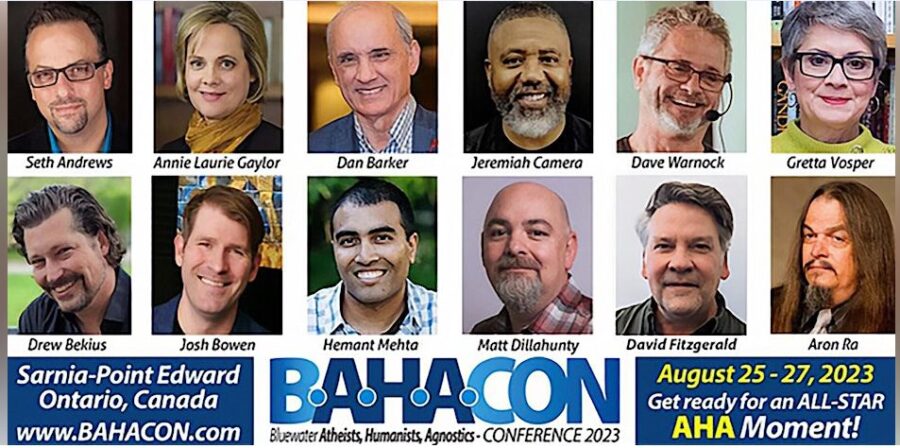
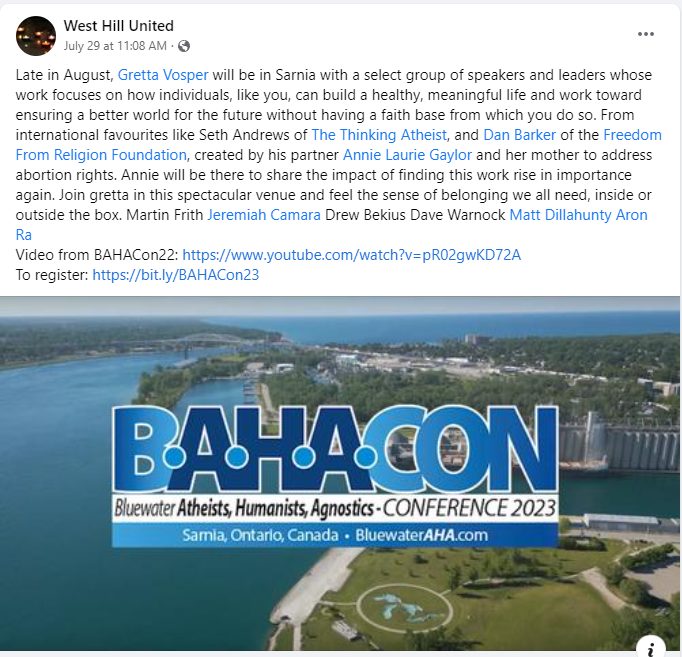
Vosper will be joined at the convention by the who’s who of pagans and atheists, including Dan Barker of the Freedom from Religion Foundation, Seth Andrews of the Thinking Atheist, Hemant Mehta of “The Friendly Atheist” and Matt Dillahunty.
See also my posts:

Calgary Herald blasts United Church of Canada for advocating a boycott of Israel (May 15, 2012)

Canadian Senators warn United Church of Canada over proposed boycott of Israeli goods (July 6, 2012)

A secular columnist accurately assesses Canada's declining liberal churches (July 30, 2012)

United Church of Canada elects its first openly sodomite moderator (August 16, 2012)

50 years ago: United Church of Canada unveils Sunday School curriculum denying the truth of the Bible (August 1, 2014)

80 years ago: United Church of Canada ordains Canada's first female minister (November 7, 2016)

Amalgamation of congregations in Edmonton provides more evidence of the continuing decline of the United Church of Canada (January 31, 2017)

30 years ago: New Ager Matthew Fox delivers keynote lecture at Queen's Theological School (October 11, 2017)

50 years ago: United Church in Calgary experiments with modern music (June 15, 2018)

Mainline church leaders 50 years ago advocated methods used by "evangelical" churches today (November 6, 2018)

Thursday, 15 November 2018

Feminists attempt to invade Hindu temple in India

Feminists are not only attempting to take over nominal and actual Christian churches (see post below), but are attempting the same in non-Christian religions. Submitted for your approval, the following, as reported by Kai Schultz of The New York Times, October 23, 2018 (links in original):

NEW DELHI — Before Hindus can climb the 18 golden steps leading to the Sabarimala Temple, a centuries-old hillside shrine in southern India, there are customs to observe.

Devotees fast for 41 days, avoiding alcohol and tobacco. They prepare bundles of goods to be tied to their heads, filling pouches with jaggery, flattened rice and turmeric powder. And they observe a ban on women of childbearing age from visiting, because the shrine’s deity, Lord Ayyappa, is celibate.

Last month, after India’s Supreme Court struck down that ban, furious protests burst the calm surroundings at the Sabarimala Temple, located in a forested patch of the state of Kerala.

When the temple reopened for six days on Wednesday, for the first time since the court’s decision, the pilgrimage path became a kind of conflict zone, pitting traditionalists against police officers who vowed to enforce the law and protect any woman who wished to visit.

At least 12 women attempted the journey. Each was met with a mob that variously shouted in her face, pummeled the police, set vehicles on fire, hurled rocks and blocked the steep, three-mile trail leading to the temple by lying on its slippery stones. All of the women were forced to turn back. One was so overwhelmed that she fainted.

Now, with the temple closed again for about two weeks before its peak season starts, officials are scrambling to figure out what to do. On Tuesday, India’s Supreme Court announced that it would hear petitions next month challenging its ruling. The court did not elaborate; some lawyers said it was too early to say whether the justices had been swayed by the protests, but that a reversal of the ruling seemed unlikely.

For now, Krishna Kumar, a commanding officer posted near the temple, said the focus was on law and order. He gave a dry laugh when asked if the police were ready for November’s reopening. The annual event is often compared to the rush at Mecca, and a crush of millions of pilgrims can clog the trail for hours.

“This is a huge problem,” Mr. Kumar said, “a very huge challenge for the police.”

It is not unusual for Indian court rulings to go unenforced, particularly in remote rural areas. The Supreme Court put that to the test with its September ruling, which overturned a 1991 decision by the High Court of the state of Kerala that banned menstruating women — defined as girls or women between the ages of 10 and 50 — from visiting the temple.

Advocates of the ban argued that it should be respected because it had been in effect for so long, and that the temple’s celibate deity had constitutional rights. But in a 4 to 1 decision, the court disagreed. “Religion cannot become a cover to exclude and to deny the right of every woman to find fulfillment in worship,” Judge Dhananjaya Y. Chandrachud wrote in his opinion.

Almost immediately, thousands of protesters who disagreed marched in Kerala, threatening violent repercussions for women who tried to visit the temple.

Bhakti Pasrija Sethi, a lawyer who was involved in challenging the ban, said she was baffled by the backlash, saying the dismantling of exclusionary rules in other places of worship, like the Haji Ali, a mosque and tomb in Mumbai, or temples in west central India, were not met with the same level of vitriol.

In any case, she said, there was evidence that women had peacefully visited the Sabarimala Temple decades ago for rice-feeding ceremonies, which mark a baby’s first intake of solid foods. Other temples dedicated to Lord Ayyappa also allow women to enter, she said.

“They are giving superstition the cover of religion,” Ms. Sethi said of the protesters. “What they are doing is not religion. The Hindu religion is not teaching you violence.”

Kerala’s chief minister, Pinarayi Vijayan, attributed much of the chaos to members of fringe Hindu groups disguising themselves as pilgrims and then “spreading terror.” Kerala is run by a coalition of communist parties; opposition politicians in the state have warned the police not to use force against protesters and argued that India’s central government, which is led by a party with Hindu nationalist roots, should take over security at the temple.

Initially, the police encouraged women to visit. When a female journalist for The New York Times tried to climb up the path on Thursday, several officers went before her, insisting that it was safe to continue even as the mob began throwing stones. She was struck on the shoulder but was not injured.

As the security situation grew more intense, the government seemed to waver on enforcing the court’s ruling. On Friday, two women, Rehana Fathima, a social activist, and Kavitha Jakkal, a journalist, began climbing the trail in helmets and shoulder pads, escorted by about 100 police officers in riot gear.

As they crested the hill, becoming the only women yet to make it that far, a police officer said there was news: The Kerala government had called to say it was not particularly pleased with the situation.

Kadakampally Surendran, an official with the state Devaswom, a religious trust that helps manage temples, told reporters in Kerala’s capital, Thiruvananthapuram, that the authorities could not allow the shrine to become a place where “activists can come and showcase their power.”

Ms. Fathima said she was not there for activism, but Sunil Arumanoor, a public relations officer with the temple, called her “publicity hungry.” He said those who visited the temple specifically to make a point would be turned away. “This temple belongs to true devotees,” he said in an interview.

After Ms. Fathima and Ms. Jakkal reached the temple’s entrance, a crowd of protesters blocked their way. The temple’s priest warned that he would lock the doors if the women proceeded. They turned back.

Since then, several more women have tried their luck, but the obstacles seemed to pile up. On Saturday, when an advocate for the rights of Dalit people told the police she wanted to go, they discouraged her from doing so because of the heavy rains, and they subjected her to a background check. Others were so badly harassed by protesters that they did not even make it to the trail.

By Monday evening, when the temple complex shut, the message, at least for the moment, seemed clear: The Supreme Court’s ruling had no bearing there.

“History not made,” read a headline on NDTV, an Indian news channel.
The temple was scheduled to reopen on November 16, 2018; go here for the latest news.

Several things about the article above struck this blogger as interesting. The reader will notice that false gods and religions make extraordinary demands on their followers; such is the way with man-made religion, which always involves salvation or self-improvement by works. The God of the Bible, on the other hand, is a God of love and grace, who has not only done everything necessary and sufficient for salvation Himself, but has given us everything we need for "life and godliness" (II Peter 1:3).

India's Supreme Court is just as activist as the Supreme Courts of Canada and the United States, making a ruling to push their agenda and then inventing the most absurd legal justification for it. The "right of every woman to find fulfillment in worship" is given precedence over the right of the religion itself to determine its own doctrines and practices. This isn't a matter with wider social significance (such as whether Jehovah's Witnesses can deny blood transfusions to children who aren't yet of age), but a matter just within the religion itself as to what constitutes permissible worship. The Indian Supreme Court's invention of this "right" is one to keep in mind, to see if and when North American courts invoke it in future rulings restricting religious freedom.

The male Hindu traditionalists mentioned in the article above may be aware of Vox Day's second law of Social Justice Warriors: SJWs always double down. In striking contrast to the wimpiness so often seen among professing Christians in the West, they aren't meekly submitting to an activist court ruling, but are vigorously asserting their right to preserve and practice their religion, even if it means opposing the courts and police. You seldom see that among professing Christians in Western nations.

Roman Catholic feminists continue to try to force their way into church leadership

Feminist behaviour in churches is a perfect example of Vox Day's second law of Social Justice Warriors: SJWs always double down. As apostate mainline Protestant--and increasingly, "evangelical"--churches have shown, and continue to show, feminists in churches won't be satisfied until they're ruling over men and running the churches, and they'd rather destroy the churches than repudiate or dial back their feminist agenda. The Roman Catholic Church will end up the same way, if feminists and other suspicious people in the church have their way; the reader of the following article will note the Jesuit support for feminism. As reported by Reuters, October 23, 2018:

VATICAN CITY — Catholic women say there’s a clerical stained glass ceiling in the Vatican, and they want to shatter it.

They want to vote in major policy meetings. They want Pope Francis to deliver on his promise to put more women in senior positions in the Holy See’s administration. And some of them say they want to be priests.

“Knock knock! Who’s there? More than half the Church!” several dozen Catholic women chanted outside the Vatican on Oct. 3, the first day of this year’s synod of bishops from around the world.

The role of women in the Church has been a recurring theme at the month-long meeting, which brings together some 300 bishops, priests, nuns and lay participants. Only about 35 are women.

The subject has come up in speeches on the floor, in small group discussions and at news conferences by participants in the gathering, officially titled “Young People, Faith and Discernment of Vocation.”

Only “synod fathers,” including bishops and specially appointed or elected male representatives, are allowed to vote on the final recommendations to be sent to the pope, who will take them into consideration when he writes his own document. Other participants are non-voting observers, auditors or experts.

Some of the attendees have pointed to what they say is a contradiction in the rules of the synod, which takes place every few years on a different theme.

This year, two “brothers”, laymen who are not ordained, are being allowed to vote in their capacity as superiors general of their religious orders.

But Sister Sally Marie Hodgdon, an American nun who also is not ordained, cannot vote even though she is the superior general of the Sisters of St. Joseph of Chambery.

“I am a superior general. I am a sister. So in theory, logically you would think I would have the right to vote,” Hodgdon, who is also vice president of the International Union of Superiors General (UISG), an umbrella group of Catholic nuns, told reporters.

The membership of female religious orders is about three times larger than that of male orders.

A petition demanding that women have the right to vote at synods has collected 9,000 signatures since it opened online at the start of this meeting. It is sponsored by 10 Catholic lay groups seeking change in the Church, including greater rights for women and gays and a bigger role for the laity.

“If male religious superiors who are not ordained can vote, then women religious superiors who are also not ordained should vote. With no ontological/doctrinal barrier, the only barrier is the biological sex of the religious superior,” it reads.

The cause has won some influential clerical male backers.

At a news conference on Oct. 15, superiors general of three major male religious orders – the Jesuits, the Dominicans and one branch of the Franciscans – expressed support for changes in synod rules in order to allow women to vote in the future.

Backing also came from Cardinal Reinhard Marx, archbishop of Munich, president of the German Bishops Conference and one of the most influential Catholic leaders in Europe.

“We must face up to the often uncomfortable and impatient questions of young people about equal rights for women also in the Church,” Marx said in his speech to the synod.

“The impression that the Church, when it comes to power, is ultimately a male Church must be overcome in the universal Church and also here in the Vatican. It is high time.”

The Holy See, as the offices of the central administration of the 1.3 billion-member Church are known, and the State of Vatican City have a combined workforce of about 4,100 people. About 700 are women.

Of the approximately 60 departments in the Holy See, about 10 must be headed by priests because they deal with governance and jurisdiction over other ordained ministers or other sensitive doctrinal matters, the Church says.

Francis has promised to put more women in senior roles in those other 50 departments. But more than five years after he was elected, there are only six women in such roles. Five are lay women and one is a nun. None of them heads a department.

Francis told Reuters in June he had to “fight” internal resistance to appoint 42-year-old Spanish journalist Paloma Garcia-Ovejero as deputy head of the Vatican’s press office.

He declined to name those who had resisted, but said he had to use “persuasion,” an apparent reference to the powerful conservative wing of what has been an institution run exclusively by males for 2,000 years.

The Vatican Museums, which are part of the State of Vatican City, are headed by Barbara Jatta, the first woman to hold the high-profile post which oversees nearly 1,000 employees.

The pope’s critics, including former Irish President Mary McAleese, say he is moving too slowly.

“How long can the hierarchy sustain the credibility of a God who wants things this way, who wants a Church where women are invisible and voiceless in Church leadership?” she said at a conference in Rome in March.

Sister Maria Luisa Berzosa Gonzalez, one of the participants at the current Synod, thinks it is time for change — in the Synod, and in the wider Church.

The Spanish nun, whose energy belies her 75 years, has dedicated her life to educating the poor and underprivileged in Spain, Argentina and Italy and is still going strong.

“With this structure in the synod, with few women, few young people, nothing will change. It should no longer be this way. Its participation should be broadened,” she told Reuters.

Berzosa, who took her vows in 1964, said she supports a female priesthood, a position not very common among nuns her age.

The Church teaches that women cannot become priests because Jesus chose only men as his apostles.

Proponents of a female priesthood, like 32-year-old Kate McElwee, who organized the protest on the synod’s opening day, say Jesus was merely acting according to the norms of his times.

“Some women feel called by God to be priests. They discern a vocation to the priesthood just as men do,” said McElwee, the Rome-based executive director of the Women’s Ordination Conference, a US lobbying group.

McElwee has found kindred spirits in nuns like Berzosa.

The nun said she knows women won’t be priests in her lifetime because change comes slowly and piecemeal in the Church.

Still, between one easy laugh and another, her frustration slipped through.

“I lead spiritual exercises, I develop a deep rapport with people, I teach them how to pray, and then someone else comes along to say the Mass,” Berzosa said. “It’s not fair.”

Wednesday, 14 November 2018

Female human remains found on Vatican property could shed light on 1983 disappearance of girl

As reported by Angela Giuffrida of the English newspaper The Guardian, October 31, 2018:

The family of a teenager who went missing in Italy in 1983 has called on the Vatican to provide more details on the discovery of human remains in one of its properties in Rome.

Fragments of human bone were found during restoration work on the property next to the diplomatic office of the Holy See in Rome in what could be a breakthrough for police investigating one of Italy’s darkest mysteries.

Italian media have speculated that the discovery could shed light on the fate of one or possibly two teenagers who went missing in the 1980s.

“We will ask Rome prosecutors and the Holy See how the bones were found and why their discovery has been linked to the disappearance of Emanuela Orlandi or Mirella Gregori,” the Orlandis’ family lawyer, Laura Sgrò, told the media.

“The statement released by the Holy See provides hardly any information.”

Citing sources close to the investigation, the Italian news agency Ansa reported on Wednesday that the remains found during restoration work on the floor of the property could belong to two people. Initial tests on some of the bones found indicate they belonged to a woman, according to the agency.

Workers are reported to have found an almost complete skeleton in one area and bone fragments in another.

A police investigation was under way to establish the age and gender of the remains and date of death. Media reports said the remains were discovered on Monday.

“Above all we need to established the period [of death] before we jump to conclusions,” Greg Burke, the Vatican’s spokesperson, told the Guardian. “The [outcome of the investigation] isn’t anything that will be known in a few days, it will take some time.”

Detectives will be looking in particular at whether they are a DNA match for Orlandi or Gregori, both of whom were 15 when they went missing in Rome within the space of 40 days in 1983.

Orlandi was the daughter of a member of the Vatican’s police and was last seen on 22 June 1983 when leaving a music class.

Theories have circulated that the then teenager was kidnapped by an organised crime gang to put pressure on Vatican officials to recover a loan. Another claim was that she was taken to force the release from prison of Mehmet Ali AÄŸca, a Turkish man who attempted to assassinate Pope John Paul II in 1981.

Orlandi’s brother, Pietro, has been leading a decades-long campaign to find out what happened to her and has accused the Vatican of silence and even complicity in the case.

The Vatican has said on several occasions that it has cooperated with Italian police over the case.

Pietro Orlandi organised a sit-in demonstration in June, accusing the Vatican of “raising the wall even higher”.

“A few days after Emanuela disappeared, Monsignor Giovanni Battista Morandini told my dad that the state was concerned about the incident and that it was suggested to plug the leak before it was too late. I think the decision to drop the investigation was a consequence of those words,” he said at the time.

Sgrò said the Orlandi family were waiting to understand the details of the discovery and would comment further after a DNA test.

“The family’s hope is that [the remains belong to Emanuela], for so long we have fought a battle to bring her home.”

Gregori disappeared 40 days before Orlandi. Her mother says Gregori answered the intercom at the family apartment before telling her parents it was a school friend and she was going out to speak to him. She never returned. Investigators have not ruled out that the cases could be connected.

“I don’t want to delude myself, I want to keep my feet on the ground but in my heart I hope the bones belong to Mirella so that we can put an end to this story and have a place to weep and take a flower to my sister,” Maria Antonietta Gregori, her sister, told the Italian press.

The four workers who discovered the remains will meet Rome’s chief prosecutor over the coming days. The bones were found as they carried out restoration works on the floor of what used to be the home of the building’s caretaker.

The property where the remains were discovered had been left to the Vatican in 1949 by a Jewish businessman who belonged to the Nazi party before the introduction of racial laws in Italy, and later converted to Catholicism, according to Italian media.
As reported by Tamar Lapin of the New York Post, October 31, 2018:

...Recently, a leading Italian journalist caused a stir when he published a document stolen from a locked Vatican cabinet that suggested the Holy See was involved in Orlandi’s disappearance. The document seemed to be written by a cardinal and listed supposed expenses for Orlandi’s upkeep after she vanished.

The Vatican said the document was a fake but never explained what it was doing in one of their cabinets.

225 years ago: France establishes the Cult of Reason

Blessed is the nation whose God is the LORD; Psalms 33:12a

On November 10, 1793, the Fête de la Raison was proclaimed in France. The celebration of atheism was supervised by revolutionaries Jacques Hébert and Antoine-François Momoro, transforming churches into Temples of Reason, with reported incidents of licentiousness and debauchery. Six days later, the secular humanist regime ordered the mass drowning of 90 Roman Catholic priests at Nantes.

The Cult of Reason, part of the dechristianization of France during the French Revolution's Reign of Terror, proved to be too much even for French revolutionary leader Maximilien de Robespierre, President of the Committee of Public Safety. Mr. Robespierre, a deist, opposed dechristianization, and established the deistic Cult of the Supreme Being early in the spring of 1794. Several leaders of the Cult of Reason were guillotined, effectively ending the cult's brief existence.

Teenage bell-ringer sues English church after being injured in training session

Holy Quasimodo, Batman! Churches without manually operated bells don't have this problem; as reported by Gareth Davies of the London Daily Telegraph, November 7, 2018:

A bell-ringer who thought he was going to die when he was flung into the air during a practice session is suing the church for damages.

Steven Tomsett, 18, broke both ankles in the incident at St Helen's Church, Abingdon, Oxfordshire, in January.

The trainee engineer also damaged his right leg and injured his lower back when he was sent flying into the air after the wooden stay which keeps the bell upright was broken.

Mr Tomsett, who was 17 at the time of the accident, said: "I was pulled quickly up into the air and just remember looking down and seeing everybody's faces looking up at me. It was terrifying and was one of those moments when you think you are going to die. I thought, 'is this really happening to me?'

"At about 20ft up I let go and came crashing down and then heard somebody shouting for me to let go.

"The pain I felt was just indescribable. I was in absolute agony. It's fair to say I was using language that shouldn't probably be used in church."

The teenager was rescued from the church tower by the fire service who winched him to the floor, as a stretcher could not be taken along the spiral staircase to the bell ringing room.

Mr Tomsett is taking a personal injury claim against the church and says the incident has left him in "constant pain".

He said via his solicitors on Tuesday: "I'm taking action against the church as this whole thing was avoidable if the bells had been maintained properly. I'm the only one who has suffered.

"I lost my job, I'm in constant pain and now the church has said what happened is not their fault. It doesn't seem right."

St Helen's in Abingdon have been contacted for comment.

Tuesday, 13 November 2018

Unitarian leaders 50 years ago resembled Emerging Church leaders of recent years

A double minded man is unstable in all his ways. James 1:8

With an emphasis on experience over doctrine, and conversation rather than "thus saith the Lord," the Unitarian minister profiled in the following article would be at home in the Emerging Church, and the methods he used remind this blogger of those used by the Church Growth Movement. As reported by the Calgary Albertan, October 26, 1968 (bold in original):

For the first time in a year, Calgary's 200 Unitarians have a minister to guide them.

He is Rev. Jerome Howell, 38, of Berkeley, Calif., who describes himself as "a liberal right down the line.

His church is the former Crescent Heights United on 17 Ave. N.W., leased on a monthly basis from the United Church presbytery.

Mr. Howell not only is new to Calgary and to Canada, but a newcomer to the ministry as well. He recently completed a three-year postgraduate course in divinity at Starr-King School in Berkeley.

NO DOGMA

Perhaps it's his liberal tendencies that make him a member of the Unitarian Church, which is non-dogmatic and has no creedal requirements for membership.

Members often become Unitarians in dismay with the more traditional churches, he said in an interview. They continue to feel the need for religious community in "something like a church," and thus become Unitarians voluntarily. A Unitarian may be Christian, agnostic or atheist.

Rev. Howell is no radical of the sort that sports beard and sideburns. He's a pretty conventional type of individual, with a trace of conservatism in his manner.

"I didn't come here to reform Calgary, but to learn about this city and its people," he observed.

The Detroit-born father of five frankly admits he's here to respond to his own feelings of bewilderment about the U.S., where he grew up as a social liberal with no church experience. He served with the air force in the Korean war, then obtained a degree in anthropology and spent some years in personnel work. At the Naval Ordnance Test Station at China Lake, Calif., while he was involved in weapons development, he began to realize the cost in human lives of war. After considerable soul-searching, he decided to undertake divinity work.

TWO CAMPS

After just two weeks in Calgary, he has already become interested in the problems of the community. He views his own role as one in which he hopes to have "a foot in both camps" on the issues concerning his congregation.

Cognizant of the current concern over drugs, he said he's talked to kids who use drugs, to get their point of view, but on the other hand, he's ever mindful of four growing boys of his own.

"I'm certainly not one who advocates the use of drugs, but I have to understand those who do in order to translate their thoughts to others."

While he was a student at Berkeley, Rev. Howell said he took a couple of courses from the radical Anglican Bishop James Pike. He described him as "a very bright man...a good example of a man of our time who thinks and talks for the world, but seems rather sad himself."

"I was with him in issues until he became interested in spiritualism."

Worship in the Unitarian Church is less traditional than many churches, and Rev. Howell's ministry will follow the pattern.

POETRY, RECORDS

At his initial service, he discussed a recent controversial book, The New Romans, on Canadian-U.S. relations, and the factors which led him to leave the U.S. Then he went on to play records and read poetry, followed with a coffee break and informal group discussion, in which the congregation shared feelings.

This Sunday, Rev. Howell will discuss "Our Boston Heritage," relating back to the time when the Unitarian Church began and existed very much as the traditional church. He noted that King's Chapel still stands in Boston, and continues to use the Anglican Book of Common Prayer. Sunday, Rev. Howell will depart from his customary pulpit dress of suit and tie, and wear a robe, to fit the theme. He will also follow the liturgical order of service "to come to grips with what our historical antecedents were," he said.

Contending the church is not a place where the minister knows the truth and has a pipeline to the better life, rather, a place where the minister has leadership quality, but so do the lay members. Rev. Howell said he will strive to make the church as relevant as possible to society.

LAY MEMBERS

With this in mind, he will follow a pattern of preaching perhaps three Sundays out of five, and the balance will be left up to the lay members, while he becomes just another member of the congregation.

He believes the institution of the church is not the powerful force it once was, because society has become secular. Thus, it is up to the church, if it cares, to be known in all its facets, he contends.

To do so, means increased community involvement and less salvation. And to illustrate and relate to his new community, Rev. Howell has cancelled services for Sunday, Nov. 3, holding instead a Saturday night service for the marchers in the Miles for Millions Walk.

SING AND PLAY

"We'll sing and play our young people on their way," he said.

Fresh from a unique seminar in Boston for new ministers of the Unitarian faith and their wives, Rev. Howell said it served as an indoctrination for both he and his Canadian born wife into the ministry. The wives received an awareness of how a marriage comes under stress, and had the opportunity to engage in discussion and share experiences.

One of the programs he hopes to initiate in Calgary is encounter groups for lay people. In groups of about 30, they will act out the things which break down their hostilities, with openness and honesty the ultimate goal.

"It's a personal concern of our members to have a community action awareness. After that they are most interested in their existentialist selves," he said.
Neither Mr. Howell's marriage nor his career as a Unitarian minister lasted many years past the publication of this article. His website indicates that he led an interesting life until his death in 2017 at the age of 87. If I'd met him, I probably would have liked him--although I certainly wouldn't have wanted his advice on any spiritual matters.

Tuesday, 6 November 2018

Mainline church leaders 50 years ago advocated methods used by "Evangelical" churches today

and meddle not with them that are given to change: Proverbs 24:21b

As reported by The Edmonton Journal, October 21, 1968, p. 42 (bold in original):

Church must become flexible, mobile, say United ministers

The big change to the modern church must be to make the church both flexible and mobile so that it can get out to the people.

This was the feeling of two United Church ministers who are acquainted with the need for change in the Christian church generally and the change in approach necessary for churches in the central core of the city.

Dr. Rex Dolan, minister of Knox United Church in Saskatoon, and author of The Big Change, a United Church Study book, and Rev. Harry Meadows of McDougall United Church in Edmonton discussed these changes prior to the 97th anniversary service of McDougall Church.

Change was the key to the service and the forum on Sunday evening, Rev. Meadows said, because McDougall Church was on the threshold of a great change.

Plans were discussed to use the highly valued commercial property on which the church is now located for a business complex containing a church.

A sub-committee of McDougall Church has done considerable study as to how the ministry could be best served by using revenue from the sale of this property for projects which would take the church to the people in the central core of the city, Rev. Meadows said.

NEW IMAGE

Dr. Dolan is aware of the particular problems in central core churches from the years he spent as minister at the Young Street Church in Winnipeg, near Portage and Main, and the Knox United Church in Saskatoon, another central core church.

"All wings of the Christian church recognize the need to change and get the church out to the people," Dr. Dolan said.

He noted that the Catholic church was ahead of the Protestant churches in some areas of this change.

"The church must develop a new image today. The new image is that of a servant," he said.

FLEXIBLE

The new image was necessary, he said, because in the past the church was leaving much of the world untouched.

"The church is not opposed to the world," Dr. Dolan said. The church today must listen to bring the gospel to the public domain and to find out how much of the gospel is already there.

Secondly, because of the "amazing development of technological innovation," the church has got to get used to change, he said.

"We will have to live with change for the next 50 or 100 years if not infinitely. For this the church must be both mobile and flexible."

Dr. Dolan said this change would include music closer to the rhythm of our times, prayers which are thoughtful and world-centred, and sermons which are short or instead question and answer periods and forum types.
The emphasis by these United Church of Canada ministers on the importance of change sounds like the same thing that's been promoted by the "Emerging Church" and by the Church Growth Movement in "evangelical" churches over the last 15-20 years. "Change for the next 50" years in the United Church, which was in the early stages of declining membership--which peaked in 1965--has been in the direction of further apostasy and decline.

One thing that hasn't changed in 50 years is that McDougall United Church still occupies the same building downtown; the original building that was next to it, a small structure built in 1873, was long ago moved to Fort Edmonton Park as part of the tourist attraction's heritage theme, which seems appropriate. What's missing in "central core" churches such as McDougall United is a central core of biblical Christian doctrine.

See also my previous posts:

Today's Evangelicals, Tomorrow's Liberals--A Warning from 1983 (January 13, 2010)

More evidence that yesterday's liberalism has become today's evangelicalism (November 8, 2011)

More evidence that today's yesterday's evangelicals are tomorrow's today's liberals (January 24, 2015)

The latest LifeWay survey provides more evidence that many "evangelicals" may not be Christians (October 30, 2018)

Monday, 5 November 2018

Indigenous spirituality takes centre stage at the Parliament of World Religions in Toronto

It's been 30 years now since Dave Hunt and T.A. McMahon published their book America: The Sorcerer's New Apprentice (reissued under the title The New Spirituality), arguing that the New Age Movement is really a revival of ancient pagan nature worship. This paganism is now on display at the Parliament of World Religions in Toronto--a city which, long ago, was nicknamed "Toronto the Good," and was known for its large number of Christian churches.

The reader will note that these nature worshippers have their own end-time prophecies--which this blogger believes will be part of the end-time deception prophesied in biblical passages such as Matthew 24:4-5 and II Thessalonians 2:6-12. The perceptive reader will also note that the pagan Indigenous ceremony was sponsored by St. Michael's College--a school which is ostensibly Roman Catholic.

As reported by Michael Swan of the Catholic Register, November 2, 2018 (link in original):

When Indigenous people from across Canada and beyond took centre stage, conducting the first of two opening ceremonies Nov. 1 at the Parliament of World Religions in Toronto, it was far more than a token appearance.

Though officially just one of 10 themes woven throughout 900 workshops, musical performances, art exhibitions and plenary sessions, the Indigenous people’s program is the secret sauce spread liberally throughout the seven-day event which has drawn delegates from over 70 countries, said Toronto co-chair of the Parliament Rev. John Joseph Mastandrea.

Acknowledging the original inhabitants of the land beneath North America’s fourth largest city isn’t about guilt. “It’s about the grace of truth,” Mastandrea told The Catholic Register just before ceremonies got underway. “It’s about helping people rediscover who they are…. It matters simply to understand who First Nations people are.”

“We live in the great spiritual Indigenous revival,” Anishnawbek elder Kevin Deer told a couple of hundred delegates who braved a constant cold rain to take part in the Indigenous opening ceremonies for the Parliament of World Religions. “When we look at what’s happening, those future generations are in danger because the Indigenous, sacred knowledge — knowledge of this land — has been forgotten.”

Because native spirituality is so connected to the land, it becomes ever more important in an age of climate change as the environment shifts underneath us, Indigenous working group co-chair Bob Goulais told the gathering around a sacred fire that will burn in Olympic Park for the duration of the Parliament of World Religions. The sacred fire and Indigenous opening ceremonies were sponsored by the University of St. Michael's College.

The Anishinaabe people want to see the “Eighth Fire Prophecy” come true at the Parliament of World Religions, Goulais said. The prophecy foresees a time when the Anishinaabe will share their traditional spirituality and knowledge about the environment with the rest of the world, according to Goulais.

Delegates to the Parliament of World Religions who attend some of over 60 Indigenous-developed-and-led workshops, panels, film screenings and other events, plus attend an eight-hour intensive program, can earn a “Certificate in Indigenous Cultural Awareness” from the First Nations Technical Institute while at the week-long conference. The FNTI is based on Tyendinaga Mohawk Territory halfway between Belleville and Kingston, Ont.

Elder Isaac Day took out one of the booths in the trade-show portion of the sprawling Metro Toronto Convention Centre to promote his Giizhigat Maple Products from Serpent River First Nation. But he is also at the Parliament of World Religions because he believes interfaith dialogue is “very important.”

Day argues that climate change requires a spiritual response.

“When you change the environment, you change your mental state — your spiritual state,” he said.

Grade 8 Our Lady of Sorrows Catholic School student Nora McLeod is one of a small band of student volunteers who are watching the Sacred Fire in Olympic Park behind the convention centre full of delegates from around the world.

“Is it important? Yes,” McLeod told The Catholic Register. “Keeping the fire going is important.”

A couple of hours later McLeod was listening as Dene Suline elder Francois Paulette brought greetings from the Athabasca region.

“I come from a place that is suffering right now,” Paulette told the crowd. “It’s the last territory in this part of the world that is vast… The river that flows by me is polluted. You have to think about the tar sands. It produces one third of Canada’s greenhouse gases, but concentrated in one place.”

Scientific knowledge about what’s happening to the environment isn’t complete without spiritual knowledge, Paulette argued.

“These people who do not understand Mother Earth, who do not know fire, who do not know water, we need to teach them. I encourage you (Indigenous) to colonize them,” he said. “I’m here to assimilate a few white people.”
See also my posts: 25 years ago: Representatives of 12 religions join Pope John Paul II at World Day of Prayer for Peace (October 26, 2011)

125 years ago: The World's Parliament of Religions opens in Chicago (September 11, 2018)

Saturday, 3 November 2018

U.S. prosecutors tell Catholic Bishops to preserve personnel records related to sexual abuse

As reported by Jeremy Roebuck of the Philadelphia Inquirer, October 26, 2018 (links in original):

U.S. prosecutors pursuing an unprecedented inquiry into clergy sex abuse and cover-ups within the Catholic Church in Pennsylvania have turned their attention to bishops outside the state, signaling a wider federal probe than initially reported.

In a letter sent this month, Philadelphia-based investigators instructed the U.S. Conference of Catholic Bishops, its staff, and the nearly 200 prelates across the country who comprise its membership to preserve personnel records and documents related to sex abuse that could be of interest to the probe.

A conference spokesperson declined to describe what types of records the prosecutors sought to preserve, but conference general counsel Anthony R. Picarello Jr. said Friday that his organization had complied.

"We have transmitted the U.S. attorney's letter [to our staff] at his request, and in the spirit of cooperation with law enforcement," he said in a statement.

News of the correspondence comes less than three weeks before the U.S. Conference and its members are set to convene in Baltimore after months of developments that have plunged the church into crisis over its handling of sex-abuse claims.

The last three months have seen the toppling of Cardinal Theodore McCarrick of Washington and his successor, Donald Wuerl, over abuse-related complaints as well as a scathing Pennsylvania grand jury report that implicated six of the state's eight Catholic dioceses in decades of concealment, and inspired similar probes in at least a dozen other states.

But until this month, the bishops had largely escaped federal scrutiny.

All eight Pennsylvania dioceses confirmed last week that they had been served on Oct. 9 with grand jury subpoenas from prosecutors under the purview of William M. McSwain, U.S. attorney for the Eastern District of Pennsylvania.

McSwain's letter to the U.S. Conference – first reported by Rocco Palmo, a Philadelphia-based writer of the Vatican insider blog Whispers in the Loggia — was sent on the same date and was distributed by the conference to dioceses across the country earlier this week.

Archdiocesan spokespeople from across the country — including in Louisville, Chicago, Los Angeles, and New Orleans — confirmed Friday that they had received the message but said their offices had not been subpoenaed. The letter did not compel the organization or any particular diocese to hand over any information to federal authorities, although it ordered recipients not to "destroy, discard, dispose of, delete, or alter" any of the identified records.

"The practice in the Archdiocese of New Orleans is to always cooperate with any civil investigation," said Sara McDonald, a spokesperson for the Louisiana archdiocese.

Meanwhile, agents already have begun fanning out across Pennsylvania to begin interviewing potential witnesses.

Michael McIlmail, who recently settled a lawsuit against the church after his late son said he was abused by a priest at a Northeast Philadelphia parish in the '90s, said he met with prosecutors assigned to the probe.

"The feds have the resources," he said Friday. "And what I like about the FBI is, if you lie to the FBI, it's a crime."

A spokesperson for McSwain's office has refused to confirm or deny the existence of an investigation. But sources familiar with the matter, although not authorized to discuss it, have said agents are looking at potential crimes ranging from possession of child pornography to aiding and abetting child exploitation and transporting children across state lines for the purposes of engaging in sex.

The subpoenas served on Pennsylvania's dioceses sought records pertaining to church finances, clergy assignments, insurance coverage, and confidential personnel files that have come to be known as the church's secret archive.

News of similar inquiries by federal prosecutors in Washington and Buffalo, N.Y. also emerged this week.
Click on the link for the feature report Failure at the Top by Jeremy Roebuck, Julia Terruso, and William Bender of the Philadelphia Inquirer, and Jenn Abelson and Thomas Farragher of The Boston Globe, as published in the Inquirer, November 3, 2018.

Wednesday, 31 October 2018

Tired of fake news? How about fake Jews?

Or at least one fake Jew; as reported by Breaking Israel News, October 29, 2018:

Wolfgang Seibert has been leader of the Pinneberg’s 250-strong Jewish community since 2003. Recent German media reports said that Seibert claimed he was born in a displaced person’s camp and that his grandmother survived Auschwitz. Seibert was born a Protestant and baptized and has never converted to Judaism. As a result of the outcry, Seibert has resigned his post.
As reported by Benjamin Weinthal in the Jerusalem Post, October 21, 2018 (link inserted by blogger):

The 71-year-old chairman of the small Jewish community in the city of Pinneberg in the German state of Schleswig-Holstein faces an accusation from the magazine Der Spiegel that he is not Jewish, deceiving Jewish members since 2003.

Spiegel reported in this week’s issue that Wolfgang Seibert fabricated his Jewish origin and is a Protestant whose family members fought for Nazi Germany in World War II against the allied powers.

Seibert said he will consult with his attorney before issuing a public comment, adding that the contention that he plans to resign is false.

The Jewish community in Pinneberg, a city of more than 42,000 residents, numbers 250 members.

According to Spiegel, Seibert was born in 1947 as the son of the Protestant parents, and was baptized three days later. The magazine wrote that his grandparents were also Protestant.

Seibert claims that his grandmother, Anna Katharina Schmidt, whose birth last name was Marx, survived Auschwitz. The magazine wrote Seibert’s claim about his grandmother cannot be true because her grandfather was Protestant.

Jewish ancestors are not likely, added Spiegel, because Seibert’s grandfather on his father’s side was an officer in World War II and his father was an infantryman for Hitler’s army.

Seibert was previously convicted a number of times for fraud and embezzlement.

Seibert, according to the paper Die Welt, garnered media attention in 2014 when the Jewish community provided “asylum” for a Muslim refugee. The Pinneberg Jewish community represents liberal Judaism and Seibert has advocated Jewish-Christian dialogue over the years.

The case of Seibert’s alleged fake Jewish identity is not the first instance of non-Jewish Germans falsely depicting their religious background.

A number of cases of Germans, who pretended to be Jews and attacked the Jewish state, have surfaced over the years.

The Jerusalem Post revealed in 2016 a teacher, Christoph Glanz, in the German state of Lower Saxony, advocated a complete boycott of Israel posed as a Jew to sign a petition calling for all Palestinian refugees to be returned to the Jewish state.

The petition, titled “Jews for Palestinian Right of Return,” was located online and stated that “the Zionist regime officially denies the Nakba, the ethical equivalent of Holocaust denial.”

Michaela Engelmeier, a prominent Social Democratic politician, said at the time that Glanz is a “racist and antisemite.”

In 2012, a non-Jewish German poet and anti-Israel activist acknowledged that she fabricated her supposed service in the IDF during the First Lebanon War.

“I said I was in the IDF,” but “it was a lie,” said Irena Wachendorff, 51. She has called strong pro-Israel activists “the neo-Nazi troop among the Jews,” and expressed support for Hamas in the Gaza Strip.

Jennifer Pyka, a German investigative journalist in Munich, obtained evidence that contradicted Wachendorff’s alleged Jewish identity.

In 2010, Edith Lutz, a non-Jewish German who tried to break Israel’s naval blockade of Gaza aboard the catamaran Irene, said she converted to Judaism. The Irene was dubbed the “Jewish boat,” and garnered widespread media attention because of the presence of a small number of Jews onboard. Prominent German Jewish author and journalist Henryk M. Broder helped expose that Lutz did not convert to Judaism.

Tuesday, 30 October 2018

The latest LifeWay survey provides more evidence that many "Evangelicals" may not be Christians

There is a way which seemeth right unto a man, but the end thereof are the ways of death. Proverbs 14:12 (also Proverbs 16:25)

Jesus saith unto him, I am the way, the truth, and the life: no man cometh unto the Father, but by me. John 14:6

Forasmuch then as we are the offspring of God, we ought not to think that the Godhead is like unto gold, or silver, or stone, graven by art and man's device.
And the times of this ignorance God winked at; but now commandeth all men every where to repent:
Acts 17:29-30

I do not frustrate the grace of God: for if righteousness come by the law, then Christ is dead in vain. Galatians 2:21

To say that God accepts the worship of all religions is to deny the words of the Lord Jesus Christ Himself. If God accepts the worship of all religions, then why did Jesus say He was the only way to the Father, and why did He die? As reported by Adam Eliyahu Berkowitz of Breaking Israel News, October 22, 2018 (links in original):

A recent survey of Evangelical Christians revealed that a majority of them acknowledge that God accepts the prayers of Jews. Although this seems to be a positive development in Jewish-Christian relations, the idea that basic tenets of Christianity can be cast aside is the source of serious concern for the Christian clergy.

The results of the 2018 State of Theology survey conducted by LifeWay Research was recently released. The survey asked 3,000 American Evangelicals about their theological beliefs. Fifty-one percent of respondents agreed with the statement that “God accepts the worship of all religions, including Christianity, Judaism, and Islam,” while 42 percent disagreed.

Chris Larson, president of Ligonier Ministries, told Christian Post that the results indicate “an urgent need for bold teaching of historic Christianity.”

“The State of Theology survey highlights the urgent need for courageous ministry that faithfully teaches the historic Christian faith,” Larson said in the interview. “It’s never been popular to talk about mankind’s sinfulness or the exclusive claims of Jesus Christ… but at a time when a darkened world needs the light of the Gospel, it’s disheartening to see many within the evangelical church confused about what the Bible teaches. We hope this survey provides local churches with a little more insight into what people in our neighborhoods and in our pews actually believe.”

“Indeed, among Christians who believe many religions can lead to eternal life, 80% name at least one non-Christian faith that can do so.

The Lifeway researchers noted that the results indicated that the majority of respondents did not accept one of Christianity’s core beliefs: it is only through accepting Jesus that a person can achieve salvation.

David Nekrutman, the executive director for the Center for Jewish-Christian Understanding and Cooperation (CJCUC), responded to the poll results with a question.

“Why are we blending salvation and worship?” Nekrutman asked rhetorically. “This survey asks if there is room within Christian thought that my prayers as a Jew to the God of Abraham, Isaac, and Jacob will be accepted by God within Christian thought. Of course, there is no question that Jews believe their prayers are accepted. Judaism also holds that anyone who prays to the God of Abraham, Isaac, and Jacob, his prayers are accepted.”

Nekrutman noted that the Lifeway survey raises more questions than it answers.

“One question is ‘When a Christian comes to the Kotel (Western Wall), who does he think we are praying to?” Nekrutman asked. “Does he believe that all our prayers are automatically rejected by God?”

This recent survey seems to be more of a long-term trend among evangelicals toward accepting other religions than a temporary anomaly. A 2008 Pew Survey showed a majority of all American Christians (52 percent) think that at least some non-Christian faiths can lead to eternal life. The survey indicated that this Christian open-mindedness was primarily focused on Jews. The overwhelming majority (69 percent) of non-Jews who said that many religions can lead to salvation believed that Judaism can bring eternal life. Though evangelicals were less likely than other groups to say that non-Christian faiths can lead to eternal life, about two-thirds of evangelicals who did believe that there are multiple paths to salvation felt that Judaism can bring eternal life.

Tommy Waller, the founder of Hayovel, an organization that brings Christian volunteers to harvest grapes in Israel, was cautiously optimistic about the Lifeway survey results.

“This may be a product of progressiveness on Christianity,” Waller told Breaking Israel News. “This may be an attempt to make everybody happy, make everyone feel comfortable in the church. This results in not having a solid stance on anything, embracing some things which simply cannot coexist with faith in God and the Bible. A liberal mindset is very problematic.”

“There is a bit of positive in this,” Waller said. “I think Christianity needs to move toward accepting Judaism in Israel. As a Christian, I see a God connection in Jews returning, in the fulfillment of God’s covenant. Accepting this into my faith is not a rejection of any core faith. It is embracing what is written in the Bible; the Old Testament as well as the New Testament. In this respect, there is a significant difference between Islam and Judaism.”

“You can be too conservative, stuck in the old ways that are not relevant to changes that have taken place. I believe that Christians need to open their minds and their hearts. But for me, opening up does not mean not embracing every religion, but there is hope for every religion.

“Jesus prayed as a Jew, practiced Judaism in Israel, and loved the Temple,” Waller emphasized. “How can we, as Christians, reject that?”
See also my previous posts:

Today's Evangelicals, Tomorrow's Liberals--A Warning from 1983 (January 13, 2010)

More evidence that yesterday's liberalism has become today's evangelicalism (November 8, 2011)

More evidence that today's yesterday's evangelicals are tomorrow's today's liberals (January 24, 2015)