Showing posts with label Roman Catholicism. Show all posts

Friday, 31 October 2025

Vatican opens prayer room for Muslims

Yet another step preparing the way for the religion of the Antichrist, as reported by Adam Eliyahu Berkowitz of Israel365 News, October 19, 2025 (links in original):

The Vatican Apostolic Library, one of the world’s most prestigious repositories of religious scholarship, has confirmed it now provides a dedicated prayer space for Muslim academics visiting its collections. This move has ignited passionate debate about the growing ties between the Vatican and Islam.

The revelation emerged from an interview between Italian newspaper La Repubblica and Father Giacomo Cardinali, the 48-year-old Vice Prefect of the Vatican Library. Speaking casually about the institution’s role as a global research hub, Father Cardinali disclosed: “Some Muslim scholars have asked us for a room with a carpet for praying and we have given it to them.”

The comment, embedded in a broader discussion about the library’s digitization efforts and extraordinary collection, has since reverberated through Catholic and interfaith circles worldwide.

The decision represents a historic departure from Vatican tradition. As the center of the Catholic Church, Vatican City State has never before hosted non-Catholic places of worship within its borders. The world’s smallest sovereign nation—with a population of approximately 800 residents—consists entirely of Catholic citizenry and clergy. The establishment of a prayer space for Islamic worship, even in the context of academic hospitality, marks an unprecedented accommodation in the Vatican’s 95-year history as an independent state.

This makes Father Cardinali’s seemingly casual announcement all the more significant, as it introduces for the first time a designated space for non-Catholic religious practice within the walls of Vatican City.

Orthodox Jewish law forbids Jews from praying inside or even entering a Catholic church.

Catholicism and Islam are not theologically compatible as Islam considers Catholicism to be idolatry. Catholicism affirms the Trinity and Islam strictly rejects any division or plurality in the divine. Its foundational doctrine, Tawḥīd, asserts the absolute oneness of Allah. Associating anyone or anything with God — called shirk — is considered the gravest sin in Islam. In Islam, Jesus (ʿĪsā ibn Maryam) is a prophet and messenger of Allah, not divine. Islam denies the divinity of Jesus, the incarnation (God becoming man), and the atonement through the crucifixion. In Islamic theology, Jesus is subordinate to Allah.

Founded in 1475 by Pope Sixtus IV, the Vatican Library houses approximately 80,000 manuscripts, 1.6 million printed books, 100,000 engravings and prints, and countless artifacts from diverse civilizations. Among its treasures are “incredibly old Qurans” alongside Hebrew, Ethiopian, Arabic, and Chinese texts that span centuries of human knowledge.

Father Cardinali emphasized the institution’s universal character. “We are a universal library, with Arabic, Jewish, Ethiopian collections, and unique Chinese pieces,” he explained, noting that the library even discovered it holds “the oldest medieval Japanese archive outside of Japan.”

The prayer room provision appears to be a pragmatic response to the needs of international researchers rather than a formal policy announcement. The library admits up to 60 scholars daily, requiring applications that include letters of introduction, proof of academic qualifications, and valid identification. While the institution already accommodates various scholarly needs—from ergonomic workstations to archival gloves—this marks the first publicly acknowledged provision for Islamic worship on Vatican grounds.

Father Cardinali framed the decision as routine hospitality within an academic context, describing it as part of the Vatican’s effort to support a diverse international scholarly community rather than a theological statement.

The gesture is a continuation by Pope Leo XIV, who ascended to the papacy in May 2025, of the policies of Pope Francis.

In his inaugural address, the new pontiff invoked the 2019 Document on Human Fraternity signed by Pope Francis and Grand Imam Ahmed el-Tayeb in Abu Dhabi, stressing the importance of “fraternity” between Catholicism and Islam. Under his leadership, the Vatican has hosted several inter-religious events, including a joint Christian-Muslim prayer vigil for peace in the Middle East in July.

In contrast, the Vatican has frequently ignored the validity of Judaism. During a 12-day tour of four Southeast Asia and Oceania nations, Pope Francis gave an address, stating that different religions are all; paths to god. When detailing this, he omitted Judaism. In 2021, Pope Francis hosted an inter-religious prayer service titled “Prayer for the sons and daughters of Abraham” at a ziggurat marking the site in Iraq purported to be the birthplace of Abraham. The event was attended by Christians, Muslims, Mandaean-Sabaean, Yazidi and other religious groups. No Jews were invited.

The prayer room disclosure has drawn sharp criticism from traditionalist Catholic voices who view it as a dangerous compromise of Catholic identity.

LifeSiteNews, a conservative Catholic news outlet, quoted Deacon Nick Donnelly calling the move “a total betrayal of Our Lord Jesus Christ,” arguing that permitting non-Christian worship in a Catholic space undermines the Church’s evangelistic mission. Novus Ordo Watch, a sedevacantist blog representing ultra-traditionalist Catholics, condemned it as “Vatican II theology in action.”

Many critics have highlighted what they perceive as a lack of reciprocity, noting that non-Muslims are strictly forbidden from entering Islam’s holy city of Mecca. Some characterized the decision as “effectively allowing a rival faith to set up shop on its property.”

The unprecedented nature of the accommodation has intensified these concerns, with critics arguing that allowing non-Catholic worship in Vatican City itself—not merely in Catholic institutions abroad—crosses a symbolic threshold that compromises the Holy See’s unique identity.
The friendliness of the Roman Catholic Church toward Islam goes back at least as far as the Second Vatican Council, and the United States Conference of Catholic Bishops has provided a page full of Vatican Council and Papal Statements on Islam from 1964-2013. There are too many quotes to be include in this blog post, so the reader is invited to click on the preceding link. Here are a few early examples, which may come as a surprise to those who think that the attitudes of Popes Francis and Leo XIV are a recent phenomenon.

107. Then we see another circle around us. This too is vast in extent, yet not so far away from us. It comprises first of all those men who worship the one supreme God, whom we also worship. We would mention first the Jewish people, who still retain the religion of the Old Testament, and who are indeed worthy of our respect and love. Then we have those worshipers who adhere to other monotheistic systems of religion, especially the Moslem religion. We do well to admire these people for all that is good and true in their worship of God. (Pope Paul VI, Ecclesiam suam, August 6, 1964)

16...But the plan of salvation also includes those who acknowledge the Creator. In the first place amongst these there are the Muslims, who, professing to hold the faith of Abraham, along with us adore the one and merciful God, who on the last day will judge mankind. (Second Vatican Council, Lumen gentium, November 21, 1964)

3. The Church regards with esteem also the Moslems. They adore the one God, living and subsisting in Himself; merciful and all- powerful, the Creator of heaven and earth,(5) who has spoken to men; they take pains to submit wholeheartedly to even His inscrutable decrees, just as Abraham, with whom the faith of Islam takes pleasure in linking itself, submitted to God. Though they do not acknowledge Jesus as God, they revere Him as a prophet. They also honor Mary, His virgin Mother; at times they even call on her with devotion. In addition, they await the day of judgment when God will render their deserts to all those who have been raised up from the dead. Finally, they value the moral life and worship God especially through prayer, almsgiving and fasting.

Since in the course of centuries not a few quarrels and hostilities have arisen between Christians and Moslems, this sacred synod urges all to forget the past and to work sincerely for mutual understanding and to preserve as well as to promote together for the benefit of all mankind social justice and moral welfare, as well as peace and freedom.
(Second Vatican Council, Nostra aetate, October 28, 1965)

“I deliberately address you as brothers: that is certainly what we are, because we are members of the same human family, whose efforts, whether people realize it or not, tend toward God and the truth that comes from him. But we are especially brothers in God, who created us and whom we are trying to reach, in our own ways, through faith, prayer and worship, through the keeping of his law and through submission to his designs.

“But are you not, above all, brothers of the Christians of this great country, through the bonds of nationality, history, geography, culture, and hope for a better future, a future that you are building together? Is it not right to think that in the Philippines, the Muslims and the Christians are really traveling on the same ship, for better or for worse, and that in the storms that sweep across the world the safety of each individual depends upon the efforts and cooperation of all?...

“I salute all this efforts [of civic and political cooperation] with great satisfaction, and I earnestly encourage their extension. Society cannot bring citizens the happiness that they expect from it unless society itself is built upon dialogue. Dialogue in turn is built upon trust, and trust presupposes not only justice but mercy. Without any doubt, equality and freedom, which are at the foundation of every society, require law and justice. But as I said in a recent letter addressed to the whole Catholic Church, justice by itself is not enough: ‘The equality brought by justice is limited to the realms of objective and extrinsic goods, while love and mercy bring it about that people meet one another in that value which is man himself, with the dignity that is proper to him’ (Dives in misericordia, encyclical letter ‘On the Mercy of God’).

“Dear Muslims, my brothers: I would like to add that we Christians, just like you, seek the basis and model of mercy in God himself, the God to whom your Book gives the very beautiful name of al-Rahman, while the Bible calls him al-Rahum, the Merciful One.”
(Pope John Paul II, address to representatives of Muslims of the Philippines, February 20, 1981)

Saturday, 26 April 2025

50 years ago--a couple of items related to ecumenism

Can two walk together, except they be agreed? Amos 3:3

Having a form of godliness, but denying the power thereof: from such turn away. II Timothy 3:5

Manmade efforts to unite nominal Christian churches have never quite been able to succeed; could that be because God isn't behind these efforts? From back in the days when most newspapers had a religion page and/or section on Saturday, here are a couple of items that appeared on the first page of the religion section of The Edmonton Journal, April 26, 1975 (headlines in original):

Catechism joint effort

LONDON (Reuter)--A new move toward Christian unity--a joint Protestant and Roman Catholic catechism--has been introduced here.

The common catechism, published in Britain on April 21, is the first book on Christian belief to be produced by a mixed team of Protestant and Roman Catholic theologians.

It was first issued two years ago in German, edited by two Swiss theologian scholars.

The English-language translation, published by search press, has the blessing but not the official recognition of both Protestant and Roman Catholic church leaders.

Doctrinal questions such as the existence of God and approaches to faith are tackled in the catechism, which is more than 650 pages long.
The Common Catechism: A Book of Christian Faith, by Johannes Feiner and Lukas Vischer, was the work of Roman Catholic, Lutheran Church, and Reformed Church theologians, and was published in English by Seabury Press on January 1, 1975.

Union losing impetus

ORILLIA, Ont. (CP)--The moderator of the United Church of Canada says the proposed union of the United and Anglican Churches "seems to have slowed down in the past few months."

Speaking at a Muskoka presbytery rally, Dr. Wilbur Howard of Ottawa said the United Church "is waiting anxiously for a circularization in the membership of the Anglican Church to see how mwmbers of the general congregation feel about the union."

He noted that the Anglican House of Bishops recently made public a report affirming a possible union.

But, he said, "they found the plan of union unacceptable."

"In the United Church we did not seem to have a clear understanding of the role of the bishops. Also the United Church believes that women should be ordained.

"Maybe we pushed too hard and maybe we didn't listen enough. But it was a good try. Union can't be imposed, it can only come when we work for it. I think it's part of the future."

Dr. Howard also said that the United Church is including in its "design for the future" husband and wife acting as ordained ministers. He said such ministries are being considered for Saskatchewan, Manitoba, and Ontario.
As reported by Henry Overduin of the Montreal Gazette, June 20, 1975 (bold in original):

The decision this week by the Anglican synod meeting in Quebec City to reject the plan of union with the United Church is not as big a blow to ecumenism as might first be believed.

The plan of union was killed early February, when the bishops rejected it, commenting that it did not even provide a useful basis for continuing talks.

The synod, less brusquely but with the same result, confirmed the bishops' decision although accepting the plan as a study paper. But that's just a euphemism for "putting it on the shelf" where the plan of union will gather dust until some historian or archivist decides to peruse it.

LACK OF INTEREST

Lack of interest in schemes leading to organic union among Protestants is simply a fact of ecclesiastical life today.

This lack of interest, for example, is illustrated by the response to the so-called circularization of the Anglican church membership on union talks with the United Church.

That circularization--a poll--was decided on after the bishops rejected the plan of union, and something had to be done fast to assure the United Church that the Anglicans were still sincere about church union.

It was also made plain at the outset that the poll was not a referendum, that its results would not be binding on the church.

Results of the poll showed that while 72.1 per cent of eligible clergy responded, only 11 per cent of the eligible laity did.

The clergy were roughly divided half-and-half on the desirability of continuing talks--494 said yeas, and 473 said no. The general membership was also divided. A total of 33,396 favored continuation of the talks, and 28,930 were against.

But, based on the small sample and its volunteer nature, this poll hardly constituted a reliable gauge of Anglican sentiment.

As has been said before, it would be wrong to read into the synod's negative decision what is not really there, namely, that the ecumenical movement has suffeed a major setback. The concern of the ecumenical movement , in its general sense, was in fact affirmed. In this general sense, the ecumenical movement seeks to express the unity of the church in ways other than organizational charts.

NOTHING NEW

Also, the Anglican synod did go on record as favoring a continuation of talks based on a step-by-step approach to greater unity, instead of the grand plan originally proposed. But that's hardly new.

What can be expected--based on the leadership of the Church of England--is a greater movement toward unity with the Roman Catholic Church.

And, if one is to go by logic, isn't that the only sort of institutional direction the ecumenical movement can take?
As reported by Canadian Press and reported in the Montreal Gazette, June 20, 1975:

...Two decisions of major import affecting the entire church were made at the week-long meeting with synod stating that women can be priests and deciding toend negotiations for union with two other Protestant churches.

Both steps troubled the delegates and feelings during debate ran high...

In his closing remarks Archbishop [E.W.] Scott expressed his personal regrets to representatives of the United Church of Canada and the Christian Church (Disciples of Christ) as they returned home to face the "difficult task" of officially informing their churches of the church-union decision.

General synod Tuesday found the plan of union that the three churches unacceptable, and though it expressed its willingness to continue to seek unity, its decision was viewed as a final turndown after 32 years of talks.

Among other resolutions pushed through swiftly as the synod sought to clean up its business--much was left unfinished--was one that called upon local committees and other church groups to determine and report if any of their financial investments are in banks or corporations that have trade or have investments in South Africa. The committees were told to sell such holdings as soon as possible.

The church has gone on record as opposing and deploring apartheid--separation of the races--in that country.

All dioceses were asked to study and respond to the concept of a guaranteed annual income for Canadians.

A memorial for the diocese of Edmonton asked that the Anglican Book Centre, a publishing firm, determine if it were financially possible to reprint the 1938 hymn book, now out of print.

It has been superseded by a joint hymn book adopted in 1971 by the Anglican Church and the United Church, which many members do not like. Many churches continue to use the old book
. The Anglican Church of Canada ordained its first six priestesses on November 30, 1976--40 years after the United Church of Canada began doing so--but formal unity of the two churches has never occurred. The two are united, however, in their increasing apostasy. The Anglican Church, according to its own 2019 survey, will be dead by 2040, and it will come as no surprise if the same isn't true for the United Church. The United Church's intention of having husband and wife as ordained ministers seems quaint in 2025; ordaining alphabet perverts wasn't on the radar screen in 1975. To see the United Church of Canada's downward slide as measured by its views on "Gender and Transgender Justice," go here and get the timeline right from the horse's mouth (or should that be the ass's butt?).

Wednesday, 28 August 2024

South Africa's Chief Rabbi blasts Pope Francis and Archbishop of Canterbury Justin Welby for their unbiblical positions on Israel

In striking contrast to Evangellyfish, the Chief Rabbi of South Africa calls a spade a spade; as reported by Etgar Lefkovits of Jewish News Syndicate, August 27, 2024 (photo, bold, links in original, added by blogger):
Archbishop of Canterbury Justin Welby exchanges gifts with Pope Francis at the Vatican on May 2, 2024. Photo by Vatican Media via Vatican Pool/Getty Images.

The head of the Catholic Church and the leader of the Church of England are effectively rejecting the Bible by supporting policies that negate the connection of the Jewish people to the Holy Land, the chief rabbi of South Africa said on Sunday.

The blunt theological critique comes after the archbishop of Canterbury endorsed a ruling by the International Court of Justice last month that Israel’s presence in the “occupied Palestinian territories” is unlawful, and as the pontiff has sought to thread the needle and maintain strict neutrality during Israel’s war against Islamist terrorists in Gaza.

“At a time when Europe’s future hangs in the balance, its two most senior Christian leaders—the head of the Catholic Church, Pope Francis, and the head of the Church of England, Archbishop Justin Welby—have abandoned their most sacred duty to protect and defend the values of the Bible,” South African Chief Rabbi Warren Goldstein wrote in a post on X.

The world is locked in a civilizational battle of values, threatened by terrorism and jihad, the rabbi said.

“Now is the time for religious leaders to come to the defense of society, to speak up for Western values and freedom,” Goldstein said. “Instead, Pope Francis and the Anglican archbishop are silent: indifferent to the murder of Christians in Africa, and to the threat of terrorism throughout Europe, and outright hostile to Israel’s attempts to battle these jihadi forces led by Iran.”

Does the archbishop read the Bible?

The Jewish leader said that the head of the Church of England’s remarks put him in “direct opposition” to the Bible.

“Does the archbishop believe the accounts of the Bible are mere myths?” Goldstein ponders in a 15-minute video address attached to the X post. “How can anyone who believes in the Bible say that Israel is an illegal occupier of the Temple Mount?”

After the U.N. court ruling, Welby said that ending “Israeli occupation of Palestinian territory is a legal and moral necessity.”

Goldstein continued, “If the archbishop reads his Bible, he should know that Jerusalem existed before London and was the capital of Israel before anyone heard of Britain.”

Imploring his fellow religious leaders to “go back to the Bible,” the South African rabbi said that denying Israel’s biblical claims to the Land of Israel was a threat to both the United Kingdom and Europe at a time of rising Islamic extremism.

“Jihadist ideology that seeks to destroy Israel is a clear and present danger to the future of Europe and its value system,” Goldstein said. “If Israel is abandoned to jihadi forces, Europe is next.”

Friday, 21 April 2023

Flashback: 1998, 2001--more examples of sin finding people out

...and be sure your sin will find you out. Numbers 32:23b

How embarrassing...as reported by Sun Media and published in The Edmonton Sun, February 11, 1998:

OTTAWA--A retired priest suffered a heart attack during a private showing in a Quebec strip bar, police said yesterday.

Jean-Paul Snyder died last Wednesday in the Champagne Room in Le Mandarin, a strip club in Mont Laurier, about 125 km northeast of Ottawa.

The 71-year-old priest, who was in his street clothes at the time, collapsed at about 10:30 p.m. The dancer, who performed for him in the private room and other club employees tried to revive him before the ambulance arrived.

"Snyder had a lengthy cardiac history," said said Quebec provincial police Const. Gilles Couture.

The priest was pronounced dead upon arrival at hospital.

Snyder retired from the priesthood in 1992 for "health reasons," said Ottawa Archdiocese spokesman Guy Levac.

Archbishop Marcel Gervais' first thoughts were for Snyder's family when he found out the circumstances surrounding the retired priest's death.

"If on occasion a person makes mistakes or shows a lack of judgment, that does not erase the good done in their life," Gervais said in a statement.
As reported by Associated Press and Canadian Press, and repoted in The Edmonton Sun, April 20, 2001:

Colleagues of a Russian professor, described as a rising star in international law, were shocked yesterday when told he died in Newfoundland after cocaine-filled balloons burst in his stomach.

Gennady Danilenko, who taught at Wayne State University in Detroit, was on his way to Detroit from Amsterdam on Sunday when he became gravely ill aboard a transatlantic flight.

The airliner was diverted to Goose Bay, Nfld., where Danilenko, 45, was taken to hospital. Doctors removed a dozen balloons from his body and he died Wednesday.

An autopsy revealed six of the cocaine-filled balloons had ruptured.

"We were shocked by his death," said Joan Mahoney, dean of the Wayne State law school.

Wednesday, 12 April 2023

100 years ago--Roman Catholic priests in Michigan settle their differences

A direct approach in resolving personal differences is often very effective, as with this example reported in the Edmonton Bulletin, April 13, 1923 (bold in original):

PRIEST KILLED BY ANOTHER AT KALAMAZOO

--------------------

Slayer Says He Was "Driven to Fury" by Alleged Ill-Treatment

--------------------

KALAMAZOO, Mich., April 12.--The Rev. Father Charles Dillon, 56, assistant rector of St. Augustine's Roman Catholic Church, shot and killed Rev. Father Henry O'Neill, rector of the church, as they sat at the dinner table tonight, then calmly went to the telephone and notified the police and coroner.

Dillon fired four shots, all of which took effect. As Father O'Neill fell dead, Dillon turned to the Rev. Father McCollough, the only witness of the tragedy, and handed him a phial containing holy oils with the request that he administer the sacrament of extreme unction at once.

According to a statement, the assistant rector is said to have told the police and county officers he was "driven to fury" by alleged ill-treatment at the hands of the dead priest. Rev. Father O'Neill was a graduate of Assumption college, Sandwich, Ontario.
A gun and holy oils for extreme unction are strange things to bring to the dinner table, which leads this blogger to use his Sherlockian detective powers and deduce that Rev. Dillon's act was premeditated.

Thursday, 18 August 2022

"Pope Michael" dead at 62

On August 2, 2022, David Bawden, who claimed to be the true Roman Catholic Pope, using the name Michael I, died in Kansas City, Missouri at the age of 62, several weeks after slipping into a coma following emergency brain surgery. For those who may not be aware of his papacy, Michael I was elected head of the Roman Catholic Church (at least the segment that recognized his authority) in a conclave in Belvue, Kansas in 1990. Pope Michael continued to live at home with his parents after his consecration, which isn't exactly what you expect from the head of what purports to be the one true church representing the Lord Jesus Christ.

As reported by Phil Johnson of the Topeka Capital-Journal, January 13, 2012 (link, photo in original):
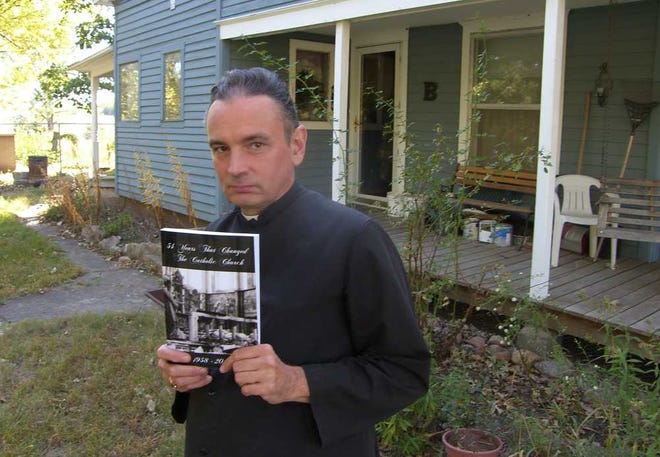
David Bawden, who is also known as Pope Michael, claimed ascendancy to the papacy in 1990. He lives on a farm near Delia where he runs the Annunciation Seminary that has one full-time and one part-time student. Bawden is shown here holding a copy of his latest book, "54 Years that Changed the Catholic Church: 1958-2012." Topeka Capital-Journal

DELIA — Attired in a black cassock that covered all but the bottom of a pair of red pants and Nike flip-flops, David Bawden on a recent Sunday afternoon reclined on a couch in the living room of his Vatican in Exile, a wooden-frame farm home in southwestern Jackson County, and talked about events that led to what he said was his election as pope of the Roman Catholic Church.

Bawden matter-of-factly reflected on the 21 years that have passed since 1990, when he was voted in as pope by six people who gathered at his parents’ second-hand store in nearby Belvue.

His biggest beef with the Roman Catholic Church, which he said led to his papacy, was its move toward modernism, starting with Vatican II, which included doing away with the traditional Latin Mass.

By now, Bawden has heard the whispers and out-loud criticisms that have come his way since he declared himself the head of the Roman Catholic Church and its 1 billion adherents worldwide.

Yet he remains committed to his papacy, saying it was ordained of God, and that nothing will stop him from being pope.

A book he wrote that was released this past May, “54 years that Changed the Catholic Church: 1958-2012,” chronicles Bawden’s claim to the papacy and also sheds light on where he said the Roman Catholic church went astray.

For his new book, he said, “I discovered some very important information that would help present the case more clearly.”

The 196-page self-published book provided details of Catholic Church changes beginning with the election of Pope John XXIII in 1958.

That pope, and all who followed him, weren’t truly Catholic, Bawden asserts, because of the “pseudo council called Vatican II” that resulted in their elections.

A few faithful Catholics realized they could lawfully take the matters into their own hands and began the restoration of the church, Bawden said.

Some were emboldened by Roman Catholic archbishops who were critical of Vatican II — including Marcel Lefebvre and Ngo-Dihn Thuc.

Bawden, a native of Oklahoma City, came to St. Marys in 1980 after he and his family became members of a breakaway Catholic group known as the Society of St. Pius X.

Bawden in the late 1970s had attended St. Pius X schools but was asked to leave. Despite his efforts to return, he was barred from being a student again.

“There was some infighting in the seminary, and I got in the middle of it,” Bawden said. “I was dismissed because of that.”

While continuing to pursue his vocation, Bawden held fast to his belief that Rome no longer had authority for the Catholic Church, that popes it elected were heretics and therefore the papal position was vacant.

It was Bawden’s belief that if the College of Cardinals wasn’t equipped to elect a pope, the duty fell to laypeople in the church.

Before he staked his claim to the papacy, he outlined his problems with the modern Catholic church in a 1990 book titled “Will the Catholic Church Survive the 20th Century?” He said he wrote the book to appeal to other traditionalists like himself.

After his book was published, he sent notices of an upcoming papal vote to traditionalists around the globe. But only six people showed up for the pivotal vote that took place July 16, 1990.

One was Bawden’s late father, Kennett, who died in 1995. One was his mother, Clara “Tickie” Bawden, 83. One was Bawden himself.

Then there were three others, all of whom, Bawden lamented, since have “fallen away” from the Catholic Church that he leads.

Bawden said he had an inkling he might be voted in as the pontiff that day.

“I thought it was a possibility,” he said. “But it was in God’s hands, who showed up to vote. We had to get the job done.”

More than two decades later, his actual followers are few, he acknowledges, with but one full-time and one part-time student in the Annunciation Seminary he runs out of the house that he shares with his mother.

Yet he says many people — perhaps millions — around the globe share his sentiments and mindset.

Bawden has a presence on the World Wide Web at www.vaticaninexile.com and even has a fan club on Facebook, something he said caused him to chuckle when he stumbled upon it.

“Someone in Germany started it,” he said. “Yes, I was surprised.”

His sermons are uploaded on YouTube by a follower in Rockford, Ill. People keeping tabs on him are notified each time a new sermon is posted.

A film class from the University of Notre Dame in South Bend, Ind., made a visit to Delia a few years ago and produced a documentary on Pope Michael, parts of which can be found on the Internet.

“I was impressed by that,” Bawden said of the documentary. “I was quite impressed with the quality of work they did and their questions.”

Despite the few followers in his flock, Bawden said he doesn’t see himself as an outcast in the Delia community, located about 10 miles north of Rossville.

Bawden said he visits with people when he sees them at the grocery store in Rossville or when he passes them on the country roads in his neck of the woods. The conversations are always cordial, he said.

Each day starts with Mass, followed by prayer, seminary classes and work around the farm.

Bawden announced recently that he was ordained a priest and consecrated a bishop in December by a bishop in the National Catholic Apostolic Church, qualifying him to celebrate Mass.

Bawden is cultivating a grape arbor for wine-making for the daily Masses.

He and his several followers also are in the process of taking classic Catholic books — some of which are borrowed from the Benedictine College library in Atchison — and scanning them into computers, so they can be republished in an “on-demand” printing arrangement with a publisher.

Bawden’s mother supports her son and said his rise to the papacy started when he was a boy.

“I was trying to raise him right — to raise him in the Catholic Church,” she said. “When you see it disintegrating in front of you, you feel like something has seriously gone wrong.”

She said her closest family members were convinced that they needed to pursue what they believed to be the correct teachings of the Roman Catholic church, even if it meant taking a road less traveled.

It hasn’t always been an easy road, but she said she has no regrets.

“Everyone in their time and place — grace is coming to them,” she said. “And it works perfectly.”


Saturday, 6 August 2022

Israeli soldiers discover 1,500-year-old convent

As reported by Israel365 News, August 2, 2022:

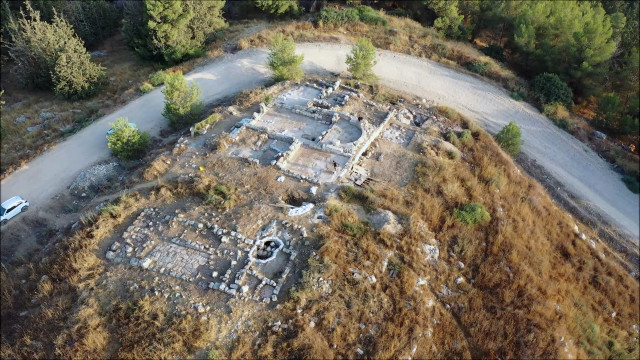
Over the past month, dozens of soldiers re-uncovered a 1500-year-old nuns’ convent complex at Horbat Hani, in the low foothills east of Shoham, after a small area of the site located within a military zone was accidentally damaged by the army.

The activity took place in the framework of the army educational project initiated together with the Israel Antiquities Authority: ”The Nature Defense Forces Project: Officers Take Responsibility for the Environment.”

The Byzantine convent was first excavated twenty years ago by Dr. Uzi Dahari and Dr. Yehiel Zelinger of the Israel Antiquities Authority, and it was subsequently covered up to protect it. It is now visible again, thanks to the project carried out with the soldiers.

According to Issy Kornfeld, Director of the excavation on behalf of the Israel Antiquities Authority, “Recently, a small part of the ancient ecclesiastical site was damaged in the course of army activities in the military zone. In this context, the Israel Antiquities Authority, together with the Nature Defense Forces program, initiated an educational project, whereby this impressive site was re-opened and cleaned up under the guidance of the Israel Antiquities Authority Community Educational Centre.” Kornfeld continues, “In the original excavation, two buildings were uncovered, one of which was a church paved with a colorful mosaic depicting faunal and vegetal scenes, an entrance hall, the nuns’ dormitories, hermit cells, a tower with rooms, and a crypt, an underground burial complex. The other building included a kitchen, a refectory (dining hall), and an inn for pilgrims.”

There was evidence that the convent preserved a tradition related to women. Dr. Eitan Klein, an archaeologist at the Israel Antiquities Authority, proposed that the convent at Horbat Hani, may have commemorated the burial place of the biblical Hannah, the wife of Elkanah, who was childless, and gave birth to a son, the prophet Samuel, after she vowed to dedicate him to the service of God.

According to Kornfeld, “As often in the ancient world, the convent was erected here, commemorating an ancient tradition, possibly of the burial place of Hannah, mother of the prophet Samuel.” The original excavation also uncovered a few female skeletons, possibly of women who sought to be buried in proximity to the sanctified figure of Hannah.

Guy Saly, director of the IDF Nature Defense Forces Project: ”The excavation is an example of officers taking responsibility for the environment and carrying out meaningful activity, exposing and conserving the ancient site—archaeologists together with officers and soldiers who are the citizens of tomorrow—thus enabling us to experience and connect with our country’s heritage. The soldiers and the offices enjoyed the hands-on archaeological work, and we hope that the joint activities protecting the archaeological sites will continue in the future.”

According to Eli Eskosido, Director of the Israel Antiquities Authority, “The joint IAA initiative with the IDF Nature Defense Forces Project, creates an opportunity for every soldier and army officer. The adoption of archaeological sites in army bases and military zones, and the creation of archaeological exhibitions in army bases, further consolidate the strong connection between the defense of the State of Israel, and the protection of the ancient sites and our cultural inheritance.”

The church mosaic is now partially visible, and it can be seen with advance permission from the IDF Central Command: 02-5305042.
Aerial view of the church complex in the military zone. (Photo credit: Idan Yunish/Israel Antiquities Authority)
Decorative elements in the mosaic pavement. (Photo credit: Gilad Stern/Israel Antiquities Authority)
Aerial view of the mosaic. (Photo credit: Idan Yunish/Israel Antiquities Authority)

Saturday, 9 July 2022

Documents of Portuguese Inquisition digitized by National Library of Israel

As reported by Jewish Press Desk, July 8, 2022 (link, photos in original):

Nearly 500 years after the Portuguese Inquisition began, rare documentation of its proceedings and victims has been discovered in the Central Archives for the History of the Jewish People at Jerusalem’s National Library of Israel and digitized for the first time. The 60-page manuscript, penned in the 18th century, documents the first 130 years of the Portuguese Inquisition tribunal’s activities, mainly in Lisbon. It includes detailed information about trials conducted by inquisitors against newly converted Christians accused of continuing to secretly practice Judaism.

The document, written in Portuguese, is known as “Memoria de todos os autos da fé que setem feito em Lisboa” (“An Accounting of All the Autos-da-Fé that Took Place in Lisbon”), and it includes information about autos-da-fé, public spectacles in which the sentences of Inquisition victims were read and executed by the authorities. Most of the information pertains to such ceremonies in Lisbon between the years 1540–1669, with a brief mention of trials in Tomar. The number of victims at each auto-da-fé, the trial dates, and locations, as well as the names of the priests who delivered sermons appear in the document.

The manuscript also contains the number of people burned at the stake. Among those prosecuted were “New Christians” accused of “Judaizing,” yet not all of the defendants mentioned in the document were Jews. “Old Christians”’ (defendants who came from families without any Jewish background) were also convicted of sodomy, bigamy, possession of forbidden books, and sacrilege.

In 1536, the Catholic Church initiated the Inquisition in Portugal following a mass influx into the country of Anusim (Jews who had been forced to convert to Christianity) fleeing the Spanish Inquisition. The Portuguese Inquisition included particularly cruel punishments often carried out before large crowds gathered to watch autos-da-fé. Trials ceased after about 250 years, although Portugal’s Inquisition was not officially abolished until 1821.

Over the centuries, most of the Jews who converted to Christianity in Portugal abandoned any sign of their Jewish roots, yet some continued to keep some form of Jewish observance in private. For example, some would secretly celebrate Yom Kippur and Passover belatedly to confuse the authorities, or light Sabbath candles inside pottery vessels to conceal the flames. Children under the age of 12 were not permitted to attend these clandestine religious ceremonies to keep them from revealing secrets that might betray their families.

According to Dr. Yochai Ben-Ghedalia, Director of the Central Archives for the History of the Jewish People at the National Library of Israel, “These discoveries shed light on the realities of a complex chapter in Jewish history, as well as on the Inquisition’s obsession with revealing any form of deviance, including traces of Jewish tradition. We hope the newly discovered document will help scholars better investigate this fascinating and difficult period of history.”
A page from the manuscript describing auto-da-fé trials in Lisbon. Courtesy of National Library of Israel

Title page of the auto-da-fé sermon of the priest Phillippe Moreira, printed in 1646. Courtesy of National Library of Israel

Saturday, 15 January 2022

Pope Francis caves in to sodomites as part of reorganization of doctrine office

Wherefore God also gave them up to uncleanness through the lusts of their own hearts, to dishonour their own bodies between themselves:
Who changed the truth of God into a lie, and worshipped and served the creature more than the Creator, who is blessed for ever. Amen.
For this cause God gave them up unto vile affections: for even their women did change the natural use into that which is against nature:
And likewise also the men, leaving the natural use of the woman, burned in their lust one toward another; men with men working that which is unseemly, and receiving in themselves that recompence of their error which was meet.
And even as they did not like to retain God in their knowledge, God gave them over to a reprobate mind, to do those things which are not convenient;
Being filled with all unrighteousness, fornication, wickedness, covetousness, maliciousness; full of envy, murder, debate, deceit, malignity; whisperers,
Backbiters, haters of God, despiteful, proud, boasters, inventors of evil things, disobedient to parents,
Without understanding, covenantbreakers, without natural affection, implacable, unmerciful:
Who knowing the judgment of God, that they which commit such things are worthy of death, not only do the same, but have pleasure in them that do them.
Romans 1:24-32

Pope Francis keeps providing ammunition to critics within the Roman Catholic Church who regard him as an antipope; as reported by Heather Bair of Newsweek, January 10, 2022:

Pope Francis on Monday demoted Archbishop Giacomo Morandi, the No. 2 official in the doctrine office, due to the belief that he is responsible for the controversial document that bars blessings for same-sex couples.

Morandi is believed to be behind the March 2021 document that declared the Catholic Church would not bless same-sex unions because God "cannot bless sin." The document stated that Francis had been informed and "gave his assent" to its publication.

The document outraged the gay community, to which Francis has since made several gestures of outreach, including to the gay Catholic community and its advocates.

He also wrote a recent letter to an American nun, Sister Jeannine Gramick, on her 50 years of LGBTQ ministry. He wrote a letter to Michael O'Loughlin, an American magazine national correspondent who is a gay Catholic, and commended him for reporting on the Catholic response to the HIV/AIDS crisis.

Morandi was named bishop of the Italian diocese of Reggio Emilia-Guastalla, which is seen as demotion, since he currently has the title of archbishop and will not be going to an archdiocese, but rather a small diocese. The Vatican said, though, that he would retain the title of archbishop "ad personam," meaning the title was granted to him personally.

Morandi joined the Congregation for the Doctrine of the Faith (CDF) as an under-secretary in 2015. He was promoted to secretary, or No. 2, in 2017. The CDF is considered one of the most important Vatican offices, as it interprets doctrine for the universal Catholic Church, sanctions dissenters and handles cases of clergy sexual abuse of minors.

The CDF is currently headed by the Jesuit Cardinal Luis Ladaria, but he is expected to retire relatively soon since he turns 78 in April, three years beyond the normal retirement age for bishops.

Aside from Morandi, there are two "additional secretaries" in the CDF, including the American Archbishop Joseph Di Noia, who also is due to retire soon since he turns 79 in July. The other is Archbishop Charles Scicluna, but he has a full-time job as archbishop of Malta.

The impending retirements and transfer of Morandi suggest some management changes at the office, though they probably won't be announced until Francis releases the blueprint of his reform of the Vatican's overall bureaucracy, expected sometime this year.

Thursday, 25 February 2021

Jews not mentioned among religious groups invited to Pope Francis' inter-religious prayer service in Iraq

Pope Francis continues his efforts to unite the world's religions; as reported by Mohammed Aty of Reuters, February 22, 2021:

BAGHDAD - Pope Francis is due to hold an inter-religious prayer service at the ancient Mesopotamian site of Ur when he visits Iraq next week - an event local archeologists hope will draw renewed attention to the place revered as the birthplace of Abraham.

Popular with Western visitors in the 1970s and 1980s, Ur is scarcely visited today after decades of war and political instability shattered Iraq’s international tourism industry. The coronavirus crisis now also keeps local tourists away.

Located about 300 km (200 miles) south of the capital Baghdad, the site comprises a pyramid-style Ziggurat and an adjacent residential complex as well as temples and palaces.

It was excavated about 100 years ago by Leonard Woolley, a Briton who recovered treasures rivalling those found in Tutankhamen’s tomb in Egypt. But little work has since been doneon one of the world’s oldest cities, where urban dwelling, writing and central state power began.

According to the State Board for Antiquities and Heritage director for Ur, Ali Kadhim Ghanim, the complex next to the Ziggurat dates back to about 1900 BC...

...According to Ghanim, the housing settlement was restored in 1999, after Pope Francis’ predecessor, Pope John Paul II, announced a trip to Iraq. But his visit was cancelled when negotiations with the government of then-Iraqi leader Saddam Hussein broke down.

This time, Ghanim hopes that Pope Francis’ visit will attract international attention to the site, which he says is badly needed to fund restoration works on its palaces and temples.

“Not only tourism, but we believe that there will be a Christian pilgrimage season,” Ghanim said.

Un Ponte Per, an Italian-based organisation, is working with the United Nations Development Programme on infrastructure works such as paths, rest areas and signposts to help visitors.

Roads around the site are being renovated and powerlines extended ahead of the pope’s visit.

But without adequate funding, Ghanim says his administration has been limited to containing further damage to the site, such as digging trenches to divert rainwater from the ruins.

Basra’s Archbishop Habib al-Naufaly stressed the symbolic importance of the pope’s March 5-8 visit as Iraq is still recovering from the war against Islamic State that destroyed scores of Christian heritage sites.

The inter-religious prayer service will be attended by Christians, Muslims, Mandaean-Sabaean, Yazidi and other religious minorities present in Iraq.

The focus will be on harmony between religious groups in a service the Vatican has named “Prayer for the sons and daughters of Abraham”.
As reported by Adam Eliyahu Berkowitz of Israel365 News, February 24, 2021 (links in original):

...Iraq declared war on the newly established Jewish state in 1948 and since then the two countries have technically been in a state of war. Iraqi forces participated in wars against Israel in 1967 and 1973.

The plight of the Christians in the Muslim country is not much better. Twenty years ago, Pew Research Center reported there were 1.4 million professing Christians in Iraq, but today there are only about 270,000.
Despite the oppression of Christians and suppression of Christianity, Iraq seems to hold a fascination for the Vatican. Pope John Paul II, planned a trip to Iraq in 1999 but his visit was canceled when negotiations with the government of then-Iraqi leader Saddam Hussein broke down...

...The pyramidic ziggurat, located about 200 miles south of the capital Baghdad, is a Neo-Sumerian structure located in what was the city of Ur near Nasiriyah, in present-day Dhi Qar Province. In ancient times, this ziggurat served as a religious center as it was part of a temple complex dedicated to idolatry. The recovery of about 2,000 burials by archaeologists indicates that the site, excavated about 100 years ago by Leonard Woolley, was used for the practice of human sacrifice on a large scale. The bodies were buried in elaborate graves nearby. The sacrificial murders were carried out by a sharp instrument being driven into their heads after which they were buried in elaborate funerals. Their bodies were usually arranged neatly, the women in an elaborate headdress, the men with weapons at their side.

The ziggurat also holds great significance to modern despots. In the 1980s, Saddam Hussein restored the façade of the massive lower foundation of the ziggurat, insisting that his own name be stamped on all of the modern bricks used in the reconstruction. He also built his personal palace to mirror the ziggurat. In 1981, the site was where celebrations took place to commemorate the first anniversary of the Iraqi invasion of Iran, with officials using the slogan, Nebuchadnasar al-ams Saddam Hussein al-yawm (yesterday Nebuchadnezzar, today Saddam Hussein). During the war led by American and coalition forces, Saddam Hussein parked his MiG fighter jets next to the Ziggurat.

The timing of the papal visit is auspicious and perhaps even prophetic. It will come right after the Jewish holiday of Purim commemorating the salvation of the Jews of Iraq from Haman, the descendent of Agag, King of Amalek and whose connection to the future war of Gog is hinted at by the Prophet Ezekiel.

As those who traverse the country make their rounds, any one of them who sees a human bone shall erect a marker beside it, until the buriers have interred them in the Valley of Gog’s Multitude. Ezekiel 39:15

The Hebrew word for ‘multitude’ is הֲמוֹן (Hamon, similar to the name Haman). Haman is known as an Agagite, also connecting him at least etymologically with Gog.

The visit also comes a few weeks before the “twenty-fourth day of the first month (Nisan)”, the day on which Daniel had his vision, described in chapter 10, that took place on the Mesopotamian River Tigris. In his enigmatic vision, Daniel saw, “a man dressed in linen, his loins girt in fine gold,” and the “sound of his speech was like the noise of a multitude.” The man in the vision gave Daniel a message:

“Do you know why I have come to you? Now I must go back to fight the prince of Persia. When I go off, the prince of Greece will come in. Daniel 10:20

Many modern interpretations of prophecy identify Persia as Iran and Greece, a country founded by the offspring of Esav, as Catholicism.

Since ascending to the papacy in 2013, Pope Francis has been working openly to bring Esau and Ishmael together by enhancing Christian-Muslim relations. On the return flight from a recent visit to Morocco, where the official state religion is Islam, the Pope spoke with journalists about his vision for uniting the descendants of Esau and the descendants of Ishmael.

In 2016, Pope Francis hosted Iranian President Hassan Rouhani at the Vatican.

These efforts by Pope Francis culminated in 2019 when he signed the Document on Human Fraternity for World Peace and Living Together Sheikh Ahmed el-Tayeb, Grand Imam of Al-Azha, an agreement that was harshly criticized by Catholics and Muslims alike.

Jewish tradition contains a prophecy that the children of Esau (today’s Western nations) and the children of Ishmael (today’s Arab nations) will unite against the Jewish people at the End of Days.

This alliance was forged at the very beginning of the Bible when Esau married Ishmael’s daughter, Mahalath, whose name means ‘disease’.

So Esau went unto Ishmael, and took unto the wives that he had Mahalath the daughter of Ishmael Abraham’s son, the sister of Nebaioth, to be his wife. (Genesis 28:9)

This is explained by Rabbi Yechiel Weitzman explains in his book The Ishmaelite Exile “During the End of Days, Ishmael and Esau will join forces to seek the destruction of the Jewish people.”

Rabbi Weitzman concluded his introduction to the End of Days alliance with good news. “At the very outset of their history, Ishmael and Esau forged a bond through marriage. And so it shall be at the End of Days. This alliance between them will bring history to its culmination in the redemption.”
While Jewish tradition and eschatology may be interesting, the Bible itself is the only authoritative and reliable source of truth.

Thursday, 24 December 2020

Vatican's 2020 nativity scene displays occult symbols

To quote renowned cultural observer James Stolee out of context: "What utter blasphemy!" As reported by Vigilant Citizen, December 15, 2020 (bold, links in original):

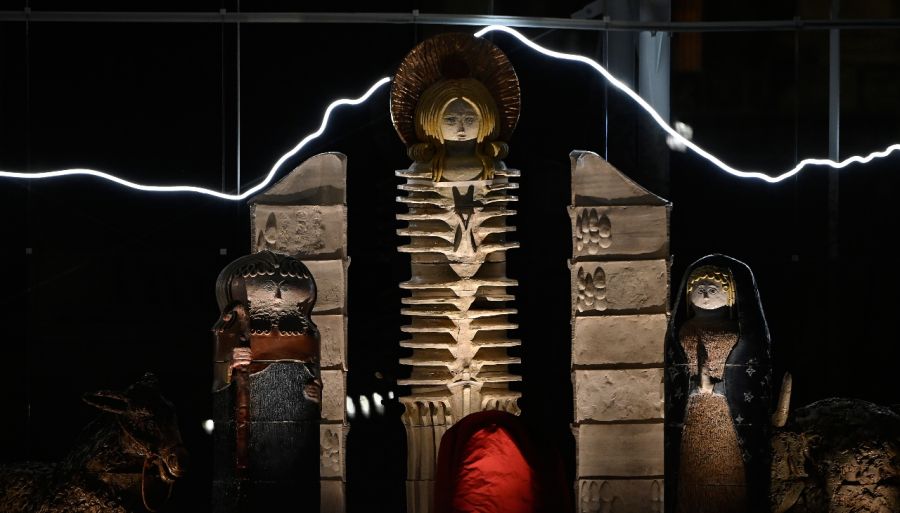
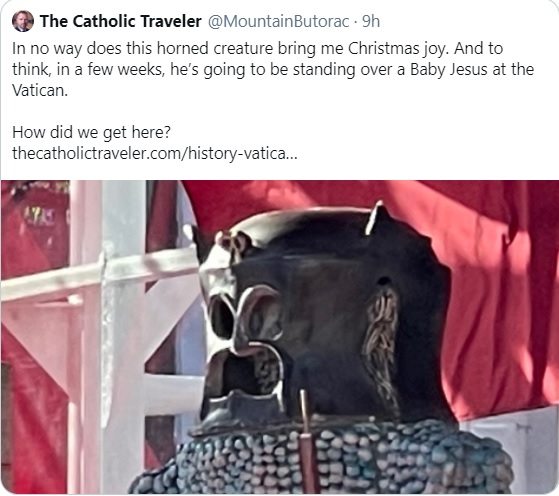
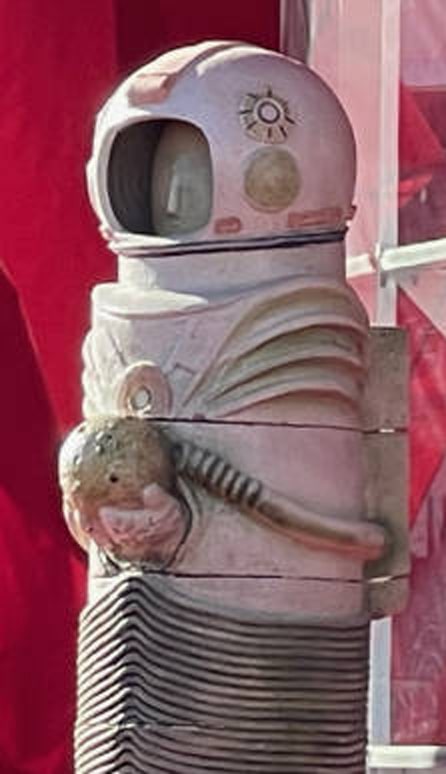
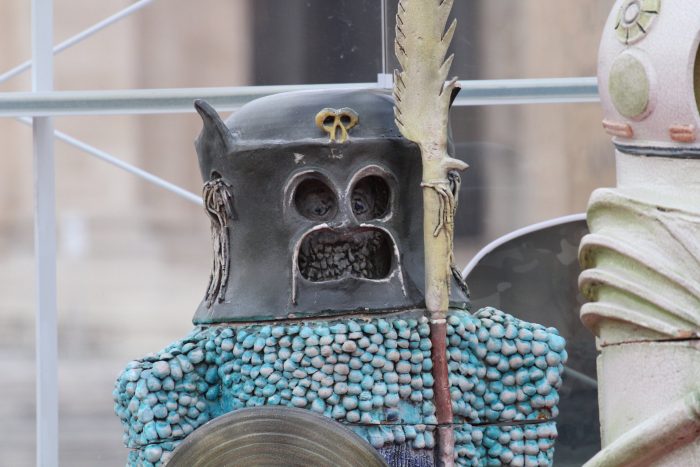
On December 11th, the Vatican unveiled its 2020 Nativity scene in St-Peter’s Square. And, once the red drape covering the scene was removed, the crowd discovered a towering, brutalist, and totem-like Angel Gabriel staring back at them, along with an astronaut and a masked executioner (yes, those guys who kill people who are sentenced to death).

Let’s say that the applause following the unveiling was “polite”. Here are some pictures of the Nativity scene.
An ominous-looking angel looks down at the crowd while Jesus remains covered in red cloth for a while (not sure why). Behind the figures is a neon light that is probably meant to look like mountains on the horizon. However, at first glance, it looks like lightning striking the Nativity scene.
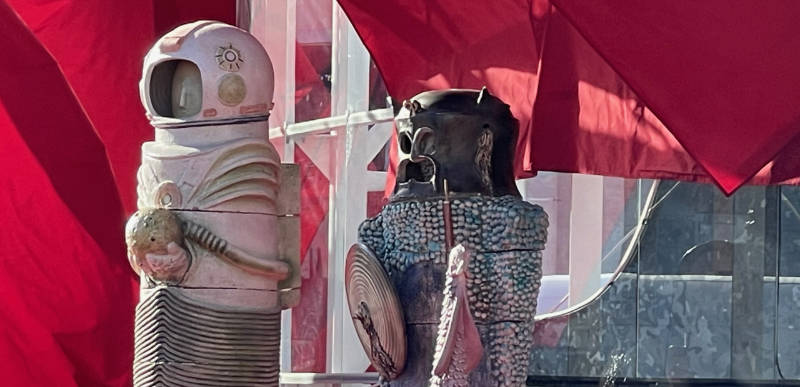
An astronaut and a masked executioner are also included in the Nativity scene.

In a press release, a Vatican City Governorate announced that the manger “aims to be a sign of hope and faith for the whole world especially in this difficult time due to the COVID-19 health emergency.”

But this thing did not bring “hope and faith” at all. In fact, nearly all observers absolutely hated it.
In no way does this horned creature bring me Christmas joy. And to think, in a few weeks, he's going to be standing over a Baby Jesus at the Vatican.

How did we get here?

--The Catholic Traveler

It is almost as if the Vatican created – on purpose – something that is so ugly that it causes devout Christians to hate piece depicting the birth of Jesus. Satanists wouldn’t have done better.

Weaponized Ugliness

Titled “Monumental Nativity”, this Nativity scene was originally created between 1965 and 1975 by students and teachers from the FA Grue Art School in Castelli, Italy. The original work contained over 50 pieces, but only a few were selected for the Vatican’s Nativity scene and they chose an executioner wearing a horned mask.

“Monumental Nativity” is said to be a tribute to the world-renowned ceramic works of the Abruzzo region while giving a post-modern twist to the classic Nativity scene.

Speaking with a local newspaper, Italian art historian Andrea Cionci asked if it was a “nightmare or a masterpiece”.

“Forget the sweet face of the Madonna, the tender, luminous incarnation of the Child Jesus, the paternal sweetness of St. Joseph and the devout wonder of the shepherds. For the first time in the middle of Bernini’s colonnade, the Vatican has erected a brutally postmodern work dating back to the sixties. In the choice of this crib, all the themes of Francis’ pontificate are recognized: Above all, heavy modernism and a drastic break with Tradition.

The figures resemble the masks of the ancient and ferocious Samnites, ancestors of the Abruzzese, who had a pantheistic, animist, fetishist, magical religion, a bit like the Andean fertility goddess Pachamama.

Castelli’s “Nativity scene” is an outdated work and the product of a strongly ideological art school. The work offers an image of Castelli’s ceramics that most certainly does not correspond to reality, given that this admirable art is famous for its formal elegance and exquisite, delicate decorative inspiration that are completely absent here.

The references to the Greek, Egyptian and Sumerian sculptures of the characters suggest the liberal historical-critical method of interpreting Scripture. Liberal biblical scholars have hypothesized various aspects of the Bible as adaptations of pagan cultures rather than the result of divine revelation.”

Although “ugliness” is subjective, this Nativity scene nearly goes out of its way to be as unpleasant to the eye as possible which, in turn, is unpleasant to the soul. The least one can say is that this scene is anti-devotional. I mean, who would actually pray to this thing? You just can’t. And that’s kind of the goal of the twisted minds behind this thing.

Furthermore, beyond its overall ugliness, the Nativity scene also contains many symbols and historical references that convey a rather blatant message: This is actually an anti-Nativity scene.

Anti-Nativity

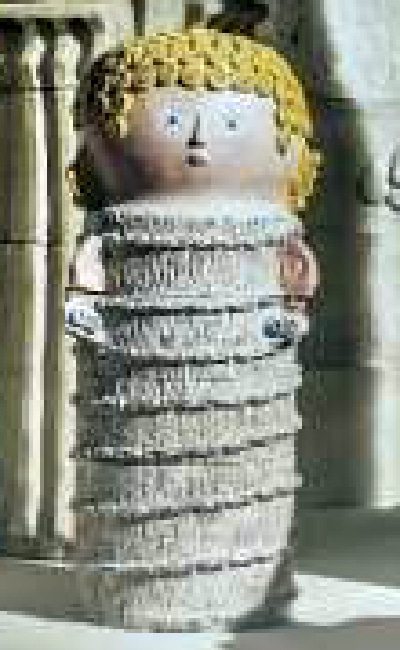
Usually, the center focus of Nativity scenes is baby Jesus. However, in this thing, Baby Jesus is basically a random toddler, just standing there, looking like a giant cork.
WORSHIP ME

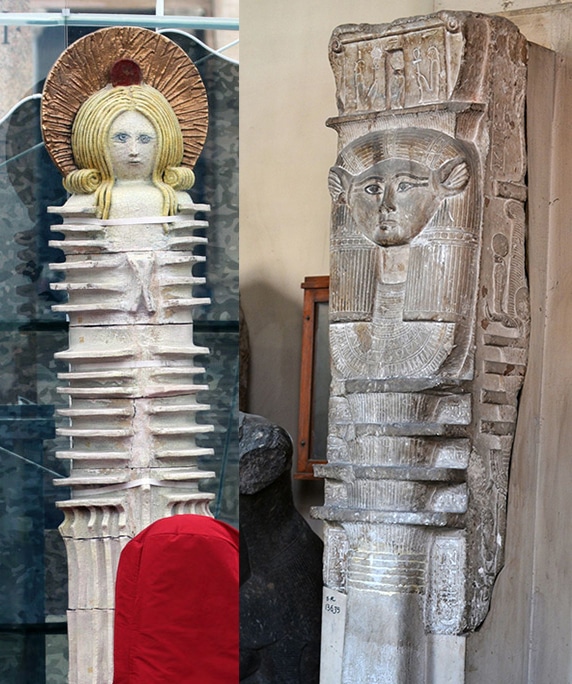
The center focus of this piece is not Jesus but rather the angel Gabriel. He is surrounded by a massive aureola while Jesus is still standing there looking like a giant cork. Furthermore, the angel towers over everything atop a rib ribbed pillar. The overall shape of this pillar is highly reminiscent of an important symbol in Ancient Egypt: The Djed pillar.
On the right: A djed pillar dedicated to the goddess Hathor.

The djed is a common symbol in Ancient Egypt and is believed to represent the god Osiris, more specifically his spine. While this symbol probably bears an esoteric meaning relating to the chakras (which are said to be based on the spine), the djed is also phallic in nature and associated with fertility rites. In fact, the “raising of the djed” was an important ceremony in Ancient Egypt.

Did the Vatican deceptively make its believers witness a “raising of the djed” ceremony? One thing is for sure, the Egyptian influence of this Nativity scene blends well with what’s immediately behind it.
Right behind the Nativity scene is St. Peter’s obelisk (which is originally from Egypt).

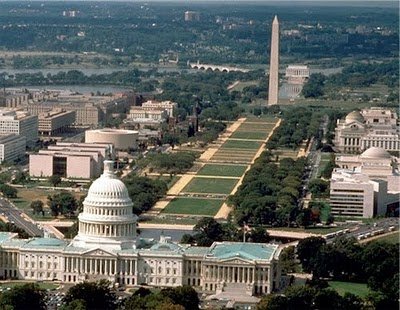
The general layout of the Vatican is Egyptian magic in plain sight. The phallic obelisk (representing Osiris and the male principle) faces the womb-like dome of the St. Peter’s Basilica (representing Isis and the female principle). The same exact layout can be found in various power centers of the world, including Washington DC.
In Washington DC, an obelisk (the Washington monument) faces the dome of the U.S. Capitol.

In Egyptian magic, the union of male and female principles (Osiris and Isis) produces a “star child” (Horus). In esoteric terms, that star child is potent magical energy...

...the Vatican’s Nativity scene also features an astronaut. Why? God knows.
The astronaut appears to be holding/giving birth to something. Also, there’s an eight-pointed star on the helmet.

Considering the fact that this figure was created between 1965 and 1975, it might be a reference to the moon landing of 1969. But why, in 2020, did the Vatican select this thing to stand next to Jesus?

Even more baffling, why is there an executioner wearing a horned mask standing next to Jesus?
Even he’s thinking to himself: “What am I doing here?”.

In ancient times, executioners carried out the death sentences of legally condemned persons by chopping their heads off. In some cases, they wore grotesque masks with macabre and menacing traits to further terrify the prisoners while depersonalizing them as an individual. In short, that’s a bizarre figure to place next to a newborn baby Jesus, especially considering the fact that Jesus himself was ultimately sentenced to death.

According to Religion News Service, the executioner is there to represent the Vatican’s opposition to the death penalty. That’s a pretty weak argument that barely makes any sense. I mean, I’m pretty sure that the Vatican is also against crystal meth. Should they also add a meth dealer to the Nativity scene as well?

In a scene that is literally called “Nativity”, this horned figure represents death. It is the antithesis of a “Nativity”. I don’t think that Satanists would have done a better job desecrating a scene representing the birth of Jesus.

In Conclusion

In a way, this year’s Nativity scene is a sad reflection of the year 2020. It is a collection of expressionless and socially-distanced figures who do not interact with each other while standing under the neon glow of phone and computer screens.

It also reflects how the occult elite reared its ugly head this year, poisoning every aspect of our lives with its toxic agenda. Through a display that is thoroughly anti-Christian, the elite sought to prove that its toxic ideology is also embedded in the Vatican.

While “Monumental Nativity” was created decades ago, it was selected for this year’s 2020 Nativity scene for a specific reason: It contains specific symbols while conveying a specific energy. Like everything else that happened this year, this scene is about showcasing the control of the elite and the demoralization of the masses.

Tuesday, 22 December 2020

Pope Francis approves Covid-19 vaccine despite its links to abortion

If any pope ever deserved the title of "Antichrist," it's Cardinal Bergoglio from Argentina; he gets more brazen in his promotion of ungodliness every time you look around. As reported by Tyler Van Dyke of the Washington Examiner, December 21, 2020 (links in original):

Pope Francis approved a note released by the Congregation for the Doctrine of Faith on Monday, condoning the use of coronavirus vaccines that have an indirect connection to abortion, saying it is "morally acceptable" to receive the vaccine.

"It is morally acceptable to receive Covid-19 vaccines that have used cell lines from aborted fetuses in their research and production process," the CDF wrote. "All vaccinations recognized as clinically safe and effective can be used in good conscience with the certain knowledge that the use of such vaccines does not constitute formal cooperation with the abortion from which the cells used in production of the vaccines derive."

The letter was signed by Cardinal Luis Ladaria Ferrer, the Vatican prefect, and Archbishop Giacomo Morandi, Vatican secretary. Pope Francis approved the text on Dec. 17 and released the note Monday.

The Pfizer-BioNTech and Moderna vaccines were involved in a commonly employed "confirmatory test" that relies on HEK293, a cell line derived from a human embryonic kidney cell from a fetus that was aborted in the 1970s. Because of this, some Catholics have expressed concerns about the ethics of getting the vaccine, with some calling for Catholics to "reject a vaccine which has been produced immorally."

The papal notice follows a similar missive from bishops in the United States who sanctioned getting the vaccine despite concerns from members of the Catholic community. One Texas church leader, Bishop Joseph Strickland, said that he "urge[d] all who believe in the sanctity of life to reject a vaccine which has been produced immorally."

"In view of the gravity of the current pandemic and the lack of availability of alternative vaccines, the reasons to accept the new COVID-19 vaccines from Pfizer and Moderna are sufficiently serious to justify their use, despite their remote connection to morally compromised cell lines," the committees wrote, referring to the use of HEK293-derived tests. "Being vaccinated safely against COVID-19 should be considered an act of love of our neighbor and part of our moral responsibility for the common good."

The CDF's note continues a trend in previous pronouncements, according to Vatican News. As recently as 2017, the Holy See said the value of vaccines and their distance from contemporary abortion practices "lead us to exclude that there is a morally relevant cooperation between those who use these vaccines today and the practice of voluntary abortion."

"The morality of vaccination depends not only on the duty to protect one's own health, but also on the duty to pursue the common good," the CDF said. "In the absence of other means to stop or even prevent the epidemic, the common good may recommend vaccination, especially to protect the weakest and most exposed."

Saturday, 17 October 2020

40 years ago: Queen Elizabeth II visits Pope John Paul II

Now the Spirit speaketh expressly, that in the latter times some shall depart from the faith... I Timothy 4:1a

On October 16, 1555, erstwhile Church of England Bishops Hugh Latimer and Nicholas Ridley became two of the most Protestant martyrs of the Reformation in England when they were burned at the stake in Oxford, England as heretics for refusing to accept Roman Catholic doctrine, particularly transubstantiation. As the flames rose around them, Mr. Latimer reportedly said, "Be of good comfort, Master Ridley, and play the man; we shall this day light such a candle by God’s grace in England as shall never be put out." That candle has been put out, evidence of which was an event that occurred the day after the 425th anniversary of the martyrdom of Messrs. Latimer and Ridley.

On October 17, 1980, another step was taken along the road to uniting all denominations under the banner of a false Christianity, as Queen Elizabeth II became the first British monarch to make a state visit to the Vatican, where she and Prince Philip were received by Pope John Paul II. As reported by BBC News, October 17, 1980:

The Queen has made history after becoming the first British monarch to make a state visit to the Vatican.

Pope welcomed Her Majesty and the Duke of Edinburgh, for what was described as a "warm and relaxed" encounter.

The Queen, dressed in a long black taffeta gown in line with Vatican protocol, arrived with the Duke at the Vatican in the rain at 1100 local time and took the lift up to the second floor.

Trumpets sounded and the royal procession moved slowly along the corridor into the Clementine Hall.

The Queen and the Duke were welcomed by John Paul II at the door of his private library.

The Queen then opened her speech with assurances of sincere friendship and good will.

She invited the Pope to her country in two years' time, but made clear this would not be a state visit but one "to the Roman Catholic community in Great Britain where some four million of my people are members of the Roman Catholic Church.

"We support the growing movement of unity between the Christian Churches throughout the world and we pray that your Holiness's visit to Britain may enable us all to see more clearly those truths which both unite and divide us in a new and constructive light."

In reply the Pope welcomed the opportunity of the forthcoming pastoral visit to the UK.

He said: "I render homage to the Christian history of your people, as well as to their cultural achievements.

"The ideals of freedom and democracy, anchored in your past remain challenges for every generation of upright citizens in your land."

They then held private talks and the Pope presented the Queen with a facsimile of the manuscript of Dante's Divine Comedy with its illustration of the Order of the Garter in the time of Edward IV.

In return she offered a book about Windsor Castle by St John Hope and two signed photographs.

After the talks, the Queen and Prince Philip walked out into the Clementine Hall and they went on to meet the Pope's Secretary of State, Cardinal Casaroli, at the home of the British Minister to the Holy See, Mark Heath.


As reported by BBC News:

The Queen's visit was seen as a big step towards forging relations with the Church Of England and the Roman Catholics.

In 1982 John Paul II was welcomed by Her Majesty two years later at Buckingham Palace during a historic visit to Great Britain.

The Queen visited the Vatican again in 2000 to mark the 20th anniversary of their first meeting.

The Pope reinforced their close ties over the years when he said: "Relations between the United Kingdom and the Holy See have not always been untroubled; long years of common inheritance were followed by the sad years of division.

"But in recent years there has emerged between us a cordiality more in keeping with the harmony of earlier times and more genuinely expressive of our common spiritual roots."

The Pope died at 2137 (1937 GMT) on Saturday 2 April 2005 after he failed to recover from a throat operation.

Saturday, 18 July 2020

150 years ago: First Vatican Council issues decree proclaiming papal infallibility

On July 18, 1870, the First Vatican Council, which had been convened by Pope Pius IX on June 29, 1868, issued Pastor aeternus (First Dogmatic Constitution on the Church of Christ). Pastor aeternus defined four Roman Catholic doctrines regarding the papacy: I. Of the Institution of the Apostolic Primacy in blessed Peter; II. On the Perpetuity of the Primacy of blessed Peter in the Roman Pontiffs; III. On the Power and Nature of the Primacy of the Roman Pontiff; IV. Concerning the Infallible Teaching of the Roman Pontiff. The doctrine that attracted the most controversy was Chapter IV, the text of which reads:

First Dogmatic Constitution on the Church of Christ.

Published in the Fourth Session of the holy Œcumenical Council of the Vatican.

PIUS BISHOP, SERVANT OF THE SERVANTS OF GOD, WITH THE APPROVAL OF THE SACRED COUNCIL, FOR AN EVERLASTING REMEMBRANCE...

...Chapter IV.
Concerning the Infallible Teaching of the Roman Pontiff.

Moreover, that the supreme power of teaching is also included in the Apostolic primacy, which the Roman Pontiff, as the successor of Peter, Prince of the Apostles, possesses over the whole Church, this Holy See has always held, the perpetual practice of the Church confirms, and œcumenical Councils also have declared, especially those in which the East with the West met in the union of faith and charity. For the Fathers of the Fourth Council of Constantinople, following in the footsteps of their predecessors, gave forth this solemn profession: The first condition of salvation is to keep the rule of the true faith. And because the sentence of our Lord Jesus Christ can not be passed by, who said: 'Thou art Peter, and upon this rock I will build my Church,'301 these things which have been said are approved by events, because in the Apostolic See the Catholic religion and her holy and well-known doctrine has always been kept undefiled. Desiring therefore, not to be in the least degree separated from the faith and doctrine of that See, we hope that we may deserve to be in the one communion, which the Apostolic See preaches, in which is the entire and true solidity of the Christian religion.302

And, with the approval of the Second Council of Lyons, the Greeks professed that the holy Roman Church enjoys supreme and full primacy and preeminence over the whole Catholic Church, which it truly and humbly acknowledges that it has received with the plenitude of power from our Lord himself in the person of blessed Peter, Prince or Head of the Apostles, whose successor the Roman Pontiff is; and as the Apostolic See is bound before all others to defend the truth of faith, so also, if any questions regarding faith shall arise, they must be defined by its judgment.303

Finally, the Council of Florence defined:304 That the Roman Pontiff is the true vicar of Christ, and the head of the whole Church, and the father and teacher of all Christians; and that to him in blessed Peter was delivered by our Lord Jesus Christ the full power of feeding, ruling, and governing the whole Church.305

To satisfy this pastoral duty, our predecessors ever made unwearied efforts that the salutary doctrine of Christ might be propagated among all the nations of the earth, and with equal care watched that it might be preserved genuine and pure where it had been received. Therefore the Bishops of the whole world, now singly, now assembled in Synod, following the long-established custom of churches,306 and the form of the ancient rule,307 sent word to this Apostolic See of those dangers especially which sprang up in matters of faith, that there the losses of faith might be most effectually repaired where the faith can not fail.308 And the Roman Pontiffs, according to the exigencies of times and circumstances, sometimes assembling œcumenical Councils, or asking for the mind of the Church scattered throughout the world, sometimes by particular Synods, sometimes using other helps which Divine Providence supplied, defined as to be held those things which with the help of God they had recognized as conformable with the sacred Scriptures and Apostolic traditions. For the Holy Spirit was not promised to the successors of Peter, that by his revelation they might make known new doctrine; but that by his assistance they might inviolably keep and faithfully expound the revelation or deposit of faith delivered through the Apostles. And, indeed, all the venerable Fathers have embraced, and the holy orthodox doctors have venerated and followed, their Apostolic doctrine; knowing most fully that this See of holy Peter remains ever free from all blemish of error according to the divine promise of the Lord our Saviour made to the Prince of his disciples: 'I have prayed for thee that thy faith fail not, and, when thou art converted, confirm thy brethren.'309

This gift, then, of truth and never-failing faith was conferred by heaven upon Peter and his successors in this chair, that they might perform their high office for the salvation of all; that the whole flock of Christ, kept away by them from the poisonous food of error, might be nourished with the pasture of heavenly doctrine; that the occasion of schism being removed, the whole Church might be kept one, and, resting on its foundation, might stand firm against the gates of hell.
But since in this very age, in which the salutary efficacy of the Apostolic office is most of all required, not a few are found who take away from its authority, we judge it altogether necessary solemnly to assert the prerogative which the only-begotten Son of God vouchsafed to join with the supreme pastoral office.

Therefore faithfully adhering to the tradition received from the beginning of the Christian faith, for the glory of God our Saviour, the exaltation of the Catholic religion, and the salvation of Christian people, the sacred Council approving, we teach and define that it is a dogma divinely revealed: that the Roman Pontiff, when he speaks ex cathedra, that is, when in discharge of the office of pastor and doctor of all Christians, by virtue of his supreme Apostolic authority, he defines a doctrine regarding faith or morals to be held by the universal Church, by the divine assistance promised to him in blessed Peter, is possessed of that infallibility with which the divine Redeemer willed that his Church should be endowed for defining doctrine regarding faith or morals; and that therefore such definitions of the Roman Pontiff are irreformable310 of themselves, and not from the consent of the Church.
But if any one—which may God avert—presume to contradict this our definition: let him be anathema.

Given at Rome in public Session solemnly held in the Vatican Basilica in the year of our Lord one thousand eight hundred and seventy, on the eighteenth day of July, in the twenty-fifth year of our Pontificate.

301 Matt. xvi. 18.

302 From the Formula of St. Hormisdas, subscribed by the Fathers of the Eighth General Council (Fourth of Constantinople), A.D. 869 (Labbe's Councils, Vol. V. pp. 583, 622).

303 From the Acts of the Fourteenth General Council (Second of Lyons), A.D. 1274 (Labbe, Vol. XIV. p. 512).

304 From the Acts of the Seventeenth General Council of Florence, A.D. 1438 (Labbe, Vol. XVIII. p. 526).

305 John xxi. 15-17.

306 From a letter of St. Cyril of Alexandria to Pope St. Celestine I., A.D. 422 (Vol. VI. Part II. p. 36, Paris edition of 1638).

307 From a Rescript of St. Innocent I. to the Council of Milevis, A.D. 402 (Labbe, Vol. III. p. 47).

308 From a letter of St. Bernard to Pope Innocent II. A.D. 1130 (Epist. 191, Vol. IV. p. 433, Paris edition of 1742).

309 Luke xxii. 32. See also the Acts of the Sixth General Council, A.D. 680 (Labbe, Vol. VII. p. 659).

310 That is, in the words used by Pope Nicholas I., note 13, and in the Synod of Quedlinburg, A.D. 1085, 'It is allowed to none to revise its judgment, and to sit in judgment upon what it has judged' (Labbe, Vol. XII. p. 679).
The way the doctrine is defined by the Roman Catholic Church, papal infallibility only once (so far): On November 1, 1950, Pope Pius XII exercised his official infallibility in the apostolic constitution Munificentissimus Deus, which includes:

...3. Actually God, who from all eternity regards Mary with a most favorable and unique affection, has "when the fullness of time came"(2) put the plan of his providence into effect in such a way that all the privileges and prerogatives he had granted to her in his sovereign generosity were to shine forth in her in a kind of perfect harmony. And, although the Church has always recognized this supreme generosity and the perfect harmony of graces and has daily studied them more and more throughout the course of the centuries, still it is in our own age that the privilege of the bodily Assumption into heaven of Mary, the Virgin Mother of God, has certainly shone forth more clearly.

4. That privilege has shone forth in new radiance since our predecessor of immortal memory, Pius IX, solemnly proclaimed the dogma of the loving Mother of God's Immaculate Conception. These two privileges are most closely bound to one another. Christ overcame sin and death by his own death, and one who through Baptism has been born again in a supernatural way has conquered sin and death through the same Christ. Yet, according to the general rule, God does not will to grant to the just the full effect of the victory over death until the end of time has come. And so it is that the bodies of even the just are corrupted after death, and only on the last day will they be joined, each to its own glorious soul.

5. Now God has willed that the Blessed Virgin Mary should be exempted from this general rule. She, by an entirely unique privilege, completely overcame sin by her Immaculate Conception, and as a result she was not subject to the law of remaining in the corruption of the grave, and she did not have to wait until the end of time for the redemption of her body.

6. Thus, when it was solemnly proclaimed that Mary, the Virgin Mother of God, was from the very beginning free from the taint of original sin, the minds of the faithful were filled with a stronger hope that the day might soon come when the dogma of the Virgin Mary's bodily Assumption into heaven would also be defined by the Church's supreme teaching authority...
-------------------------------------------------------------------------
2. Gal 4:4.
This reiteration of the Roman Catholic doctrine that Mary was "from the very beginning free from the taint of original sin" is anything but infallible, as it contradicts the plain words of the Bible:

And Mary said, My soul doth magnify the Lord,
And my spirit hath rejoiced in God my Saviour.
Luke 1:46-47

Mary wouldn't have rejoiced in God as her Saviour if she had been "free from the taint of original sin," because she wouldn't have needed a saviour. So much for papal infallibility.