Showing posts with label Death. Show all posts

Thursday, 27 February 2025

75 years ago--Americans divided on euthanasia

I call heaven and earth to record this day against you, that I have set before you life and death, blessing and cursing: therefore choose life, that both thou and thy seed may live: Deuteronomy 30:19

It did come as a surprise to this blogger to come across this item from 1950 and see the large percentage of Americans who supported euthanasia. This was just five years after the end of a war that Americans and their allies fought against the Nazis, under whom euthanasia morphed into mass murder, followed by the Nuremberg trials of the perpetrators for crimes against humanity. I've been dismayed to see belief in the sanctity of human life declining over the last 50-60 years, but I didn't know it was already fairly low even 75 years ago (assuming the results of the survey are accurate, of course). As reported by the Canadian Institute of Public Opinion and published in the Calgary Herald, February 27, 1950 (bold in original):

PRINCETON, N.J.--Public sentiment in a coast-to-coast survey by the American Institute is closely divided on the principle of euthanasia or mercy killing.

The weight of opinion is against the idea, but the margin is very close.

In testing the nation's views on this controversial and much discussed issue the Institute patterned its question after the model bill proposed by the Euthanasia Society of America. This proposal would call for the consent of the patient, and an examination by a board of doctors appointed by a court.

Here are the questions used in the survey and the vote:

A. "When a person has a disease that cannot be cured, do you think doctors should be allowed by law to end the patient's life by some painless means if the patient and his family request it?"

B. If no, or no opinion, ask: "Would you approve of ending a patient's life if a board of doctors appointed by the court agreed that the patient could not be cured?"


Thirty-six per cent indicated approval and another 7 per cent on the second part, making the total as follows:

Favor mercy killing------43%
Oppose mercy killing-----46%
No opinion---------------11%

Opinion on the issue is not greatly different now from what it was when the Institute first tested sentiment with a similar question 13 years ago. There has been a small increase in the vote in favor.

The Sander case in New Hampshire and the Carol Paight case in Connecticut stimulated nationwide discussion of the pros and cons of legalized euthanasia.
When I read this article I had never heard of the Sander and Paight cases, but a quick Google search produced some results. First, the case of Dr. Herman Sander--as reported by Australian Associated Press and reported in the Cairns Post, January 5, 1950 (bold, capitals in original):

EUTHANASIA CASE IN NEW HAMPSHIRE

DOCTOR INDICTED.

DEATH OF CANCER PATIENT.


NEW YORK, Jan. 3 (A.A.P.). A Manchester, New Hampshire, grand jury of 21 middle-aged men, was convened to-day to consider whether Dr. Hermann Sander should be indicted for murder. Sander, who is 40, has been accused of the mercy killing of an incurable woman cancer patient, by the injection of air into her veins, as she lay on her hospital deathbed.

The judge, instructing the jurors, asked if any had signed any of the widely circulated petitions supporting Dr. Sander. There was no response.

Sander, who is on bail, continued calling.on his patients to-day. He told reporters that he still felt his action was not legally or morally wrong, and added: "I believe my position ultimately will be vindicated.

Meanwhile euthanasists have made plans to use the Sander case as a wedge in seeking the adoption of "a mercy death law."

The vice-president of the Euthanasia Society of America (Mrs. Robertson Johns) said in NewYork: "This is absolutely the best case, yet for our cause. It is good, because of Dr. Sander's integrity, and because he did not hide what he did."

A member of the New Hampshire Legislature (Mr. Ray Sawyer) said be felt that something should be done about légalising mercy deaths. He suggested that physicians should draw up such a Bill. Later Dr. Sander was indicted by the grand jury on a charge of first degree murder.
According to Rick Holmes in the Derry News, June 30, 2011:

Probably you heard that earlier this month — June 3, 2011 — Dr. Jack Kevorkian died. He was of course the so called "Doctor Death." Last year, there was even a Hollywood movie about his career. His passing brought back to memory those events of a decade ago when we were all talking about the right — or wrong — of physician-assisted suicide.

While all the country's attention has been on Kevorkian, it is interesting to know that the very first trial for medical euthanasia involved a doctor who had once lived in Derry. In 1950 — exactly 50 years before the Kevorkian trial — there was the trial of Dr. Herman Sander.

Sander (1908-1996) was born in New York, the first child of George and Ada Sander. Ada had been born in New Jersey but George had emigrated from Dresden, Germany, in 1888. He was a 1901 graduate of Stevens Institute of Hoboken, N.J. with a degree in electrical engineering. Shortly after Herman's birth the family moved to Derry. Here, George Sander was employed as superintendent of the Derry Electric Company. They lived in an apartment at 71 East Broadway, directly across from today's McGregor Library Building. After a few years in Derry, the family moved to Manchester where he was employed with the Traction, Light and Power Company — the concern that ran the Manchester and Derry Trolley.

Herman grew up in Manchester and, while attending Central High School, he became the state's first Eagle Scout. He studied at the University of Munich and received his undergraduate degree at Dartmouth College (1930) and his medical degree from New York University. His entire career was spent practicing in the Manchester area.

In 1949, Mrs. Abbie Borroto lay dying of cancer in the Hillsborough County Hospital. The 60-year-old woman was suffering; she was racked with unbearable pain that no amount of medication could ease. During that year, she had wasted from 140 to 80 pounds. It seemed likely to most that she had only a few days to live. All day and night she was screaming for someone, anyone, to help her die.

Herman Sander was her doctor and knew he was powerless to reduce her suffering. He then gave four injections of air directly into her veins. She died painlessly in about 10 minutes. Dr. Sander entered into her medical records exactly what he had done. Sander's supervisor read the entry and reported the death to the police. An arrest warrant was quickly issued for Sander that charged him with wrongful death. A grand jury soon found that there was enough evidence to hold a murder trial.

In 1950, Herman Sander became the first doctor ever put on trial for "mercy killing." The trial was held at the Hillsborough County Courthouse and was attended by reporters from all over the state and nation including novelists Fanny Hurst and John O'Hara. The prosecution was led by future U.S. Sen. Louis Wyman. On the witness stand Dr. Sander told the jury he thought Mrs. Borroto was already dead. But if that were true, why did he gave a dead patient the injections? In answer to that question, all he could say was, "Why I did it I cannot tell. It didn't make any sense."

All across America there was an active debate on Dr. Sander and mercy killing. Evangelist Billy Graham said the court should find him guilty of murder and make "an example" of him. In his hometown of Candia, 605 of the town's 650 registered voters gave Sander a "written testimonial of his integrity and goodwill."

In Derry, the local Baptist and Catholic Church were strictly opposed to euthanasia. They based their arguments on the scriptural command that "Thou shall not kill." It may be supposed that most of the other Derry pastors were also in favor of Sander being found guilty.

The first clergyman in the greater Manchester area to come out in public support of Sander was Rev. Dr. Charles S. Milligan of East Derry's First Parish Church. To make sure everyone knew his views, he announced a week before, the topic of his next sermon. That Sunday, the sanctuary of the church was filled to overflowing.

Pastor Milligan began his sermon with the declaration that "I believe God does not enjoy human suffering. I question that those who don't want it (euthanasia) have the right to deny it to those who do." He went on to say that doctors have been performing mercy killing for millennia but it has always been hidden. If euthanasia was made legal then it can be regulated for only extreme cases of suffering. He concluded by saying that now "only the honest doctor gets punished."

On March 9, 1950, the jury took just 71 minutes to find Herman Sander not guilty on the all charges. Today this verdict is viewed by many as being an example of jury nullification — a guilty man had been set free because the 12 men and women in the jury room didn't believe in the law against mercy killing.

Despite being found not guilty, the state refused to give Sander back his medical license. He could no longer practice medicine in New Hampshire. To support his wife and three daughters, the doctor was forced to work as a farm hand. In time, the New Hampshire Medical Board did give him back his license. He retired in 1974 after 33 years as a physician. He spent his remaining years as a beekeeper in Candia. In 1979, Candia honored him as "the most influential individual in town." Sander died in 1996 at a Manchester nursing home at 87 years of age.
The case of Carol Ann Paight occurred around the same time. As reported by Australian Associated Press and published in the Adelaide News, February 2, 1950 (bold, capitals in original):

U.S. GIRL KILLER "WAS INSANE"

New York, Wednesday.

--A psychiatrist today testified that Carol Paight was insane when she fired the fatal "mercy" bullet at her father.


He said she had not recovered her sanity nearly three weeks later.

Carol, 21, killed her father in hospital after learning he had incurable cancer. She is charged with second-degree murder.

Dr. Clifford Moore, medical director of a mental institution, was called as a witness after the girl's mother had given evidence that there had been in sanity both in her family and her late husband's.

Dr. Moore said Carol was insane when he examined her 19 days after the shooting. He didn't know whether she had recovered yet.
As reported by Mara Bovsun in the New York Daily News, June 19, 2010 (updated April 9, 2018):

If one thing was clear in this sad case, it was that Carol Ann Paight loved her father. She loved him so much that she could not bear to see him suffer. So she killed him.

Her father, Police Sgt. Carl Paight, 52, was a good-natured family man, adored by his wife, Mary, 52 and children, Carol, 21, and Carl, Jr., 22, both college students. They lived in a modest home in Stamford, Conn.

By all accounts, Sgt. Paight was the kind of dad every child deserves – responsible, good to their mother, and fun. The family spent hours swimming and sailing, and even chores were enjoyable when he was around.

It all came to a crashing end in September 1949. Sgt. Paight had not been feeling well, so he checked into a Stamford hospital. The doctors recommended exploratory surgery, scheduled for the 23rd.

During the operation, Carol and her mother, both devote Roman Catholics, went to church to pray.

Their prayers went unanswered. Back at the hospital, Dr. William E. Smith gave them the worst possible news. Sgt. Paight’s body was “riddled” with cancer, and he had, at most, three months to live.

Carol knew what that meant. Two of her aunts, Agnes and Alice, had died of cancer, and she witnessed these vibrant women shrivel away in agony. The experience had instilled in her a deep terror of the disease.

“Don’t tell Daddy!” Carol screamed when Dr. Smith delivered the news. Then she grew glassy-eyed and pale, and started babbling. Carol didn’t appear to hear anything, and seemed to be in a world of her own.

The Paight women returned home, but Carol didn’t stay. She swiped her father’s service revolver, and headed back to the hospital, stopping briefly at a spot in the woods to take one practice shot.

With the gun wrapped in a jacket, she returned to her father. Moments later, nurses heard an odd noise, like a tray dropping, and saw the tall, blond girl in the doorway of Paight’s room. Inside, they found the gun on the bed, and a bullet wound in the patient’s head.

“I shot him,” Carol told them. Then she became hysterical.

Later, as members of her late father’s squad guarded her, she seemed calm and detached. At around 8:30 p.m., she told Capt. William J. Lynch that she didn’t care what people thought or what would happen to her. She couldn’t stand to see her dad suffer.

The girl remembered nothing the next morning. She recalled hearing the doctor’s dreaded words, but after that, everything was a blank.

From the start, sympathy was with the girl. Civic leaders and businesses took up a collection for her defense. “It is my honest belief and firm conviction that the case of Carol Paight deserves extreme sympathy and leniency,” Stamford Mayor George Barrett told reporters.

Nevertheless, the district attorney had no choice but to arrest Paight, charging her with second-degree murder. It carried a life sentence.

The girl’s plight ignited a long-smoldering debate over mercy killing. In the 1930s, two groups were building a movement around the right to die – England’s Euthanasia Legalization society, and the Euthanasia Society of America. Both groups took keen interest in the case.

By the time Paight’s trial opened on Jan. 23, 1950, two more mercy killings were grabbing headlines. A New Hampshire doctor, Hermann Sander, had been arrested for injecting air into the veins of a dying cancer patient. In Ontario, Can., engineer Ralph Kilbon’s mentally ill wife had tried to kill herself with a bullet to the abdomen. When Kilbon found her, she was dying and in pain, so he shot her to finish what she started.

In Paight’s trial, everything hinged on the girl’s state of mind at the time of the killing, a period that Carol could not remember.

Witnesses swore that she certainly looked insane, swinging from shrieks and sobs to periods of calm, glassy-eyed detachment. Psychiatric experts for the defense said the news about her father had caused temporary insanity, and pushed her into a “fugue state” in which her subconscious mind controlled her actions.

The outcome was not hard to predict when the prosecution’s expert witness was booed for voicing the opinion that the defendant had been sane, and knew exactly what she was doing when she pulled the trigger.

Also helpful was the composition of the jury. It was made up entirely of parents – mothers and fathers with children about the same age as the accused.

After about four hours’ deliberation, the jury found her not guilty. Carol went home, and got on with her life. By September, a year after her father’s death, she had some good news, a wedding. “Carol Paight, the schoolgirl who was acquitted of the mercy-slaying of her cop-pop … is blessed eventing,” wrote legendary gossip columnist Walter Winchell a few months later.

The president of the Euthanasia Society said Paight’s acquittal was a “vindication” of his group. Ministers came out in support of mercy killings, and physicians went on record saying that they had, on occasion, made lethal doses of morphine available to the incurably ill.

For a time, it seemed as if Paight’s story might open a floodgate of mercy killings, especially after the two other high-profile cases ended in acquittals.

But the tide turned. In November 1952, another woman, Lois Curtiss, 33, stood in the same courthouse as Paight. Curtiss was accused of murdering her cancer-ridden father by turning on the gas jets in their apartment, an act that left her partially paralyzed. She said she had been motivated by love, and her only goal was to end his suffering. But the judge saw this death as “one of those killings which dramatists and sob sisters call a mercy killing” and sent her to prison.
Carol Ann Paight (center) is comforted by her brother Carl, Jr., and her mother, Mary Nolan Paight, during the Paight trial in Bridgeport, Conn. (Photo by Walter Kelleher/NY Daily News Archive via Getty Images)

In both the cases mentioned above as well as the notorious Canadian case of R v Latimer (1997, 2001), I'm struck by the willingness of so many people to believe that the killing was motivated by love. Who says the killer was motivated by love? The killer. Robert Latimer was a farmer in Saskatchewan whose 12-year-old daughter Tracy had severe cerebral palsy and was in constant pain, which may have been eased by surgery. Mr. Latimer murdered Tracy while the rest of the family was at church, but claimed that she had died in her sleep. Police became suspicious when an autopsy revealed high amounts of carbon monoxide in Tracy's blood, and only then did he admit that he had killed her by connecting a hose from the exhaust pipe to the cab. Mr. Latimer was charged with first-degree murder, was convicted of second-degree murder, and served almost 10 years in prison before being granted full parole in December 2010.

It disturbed me then, as it does now, that an Ipsos-Reid poll conducted in 1999 found that 73% of those responding (it should be kept in mind that Ipsos-Reid admits, but doesn't publicize, that 70% of the people they contact refuse to talk to them) believed that Mr. Latimer acted out of compassion, and 41%--a plurality--believed "mercy killing" shouldn't even be against the law. It doesn't help that the media focus on the instances in which killing has taken place rather than those in which people in positions such as Mr. Latimer don't kill their loved ones. A former pastor of mine and his wife are parents of a son with multiple disabilities that require round-the-clock care. His parents aren't trained caregivers, aren't wealthy, have to work for a living, and have other children to take care of as part of living their lives. They found an institution in which their disabled son could receive the care he requires, and had him placed there. The institution is hundreds of miles and several provinces away from the parents, but they visit him several times a year, and the last I heard, reported that he was receiving excellent care. This is far from an ideal situation, but in a fallen world, this was the best choice they could make. Unfortunately, this example of true Christian compassion seldom gets any press.

Unfortunately, Canadian society has deteriorated so far and so fast since the Latimer case that he wouldn't even be charged today. Under the Orwellian-named MAiD (Medical Assistance in Dying), introduced by the "Liberal" regime of Justin Trudeau in 2016, MAiD deaths have increased from 5,665 in 2019 to 15,343 in 2023, making it the fastest-growing such program in the world. Very few of these people are dying; rather, they're people who have problems in living, and a disproportionately high percentage are poor. This is exactly the way it happened in Germany in the 1920s and '30s, culminating in mass murder and genocide during World War II. My father fought against the regime that did that; I'm glad he's not around to see what became of the country he fought for.

Sunday, 21 January 2024

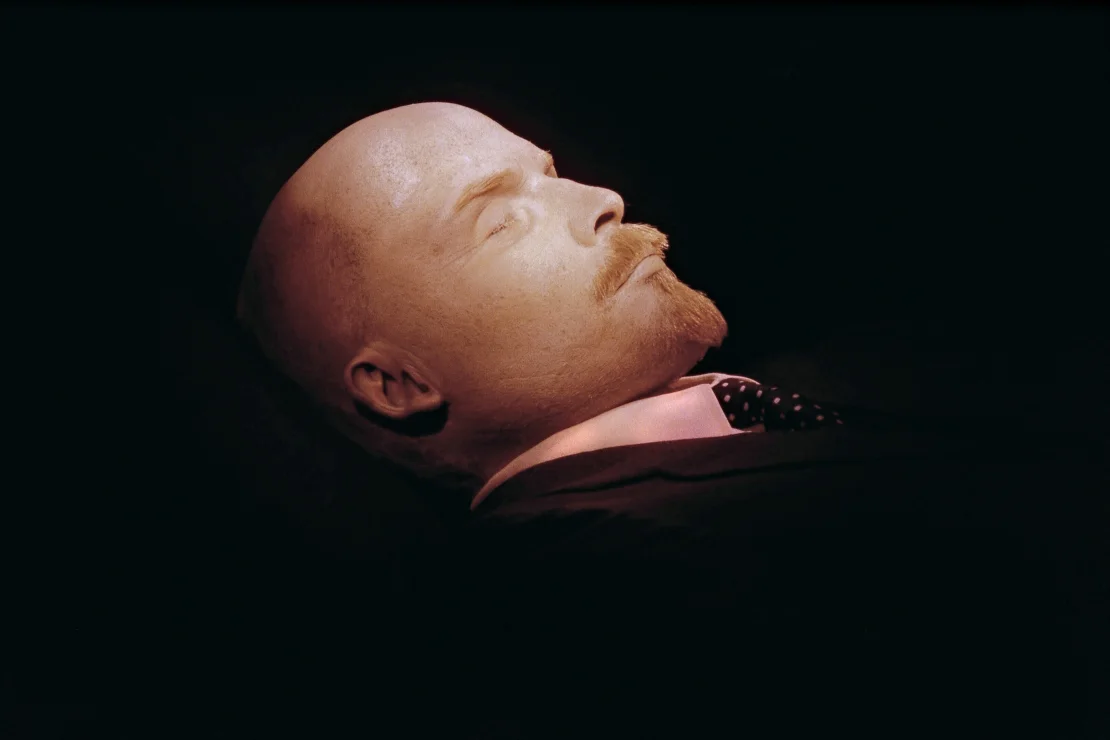
100 years ago--the death of Lenin

Taking photos of Lenin's body isn't permitted. This rare shot shows the revolutionary leader in October 1991. (Agence France-Presse/Getty Images)

On January 21, 1924, Vladimir Lenin, aka Nikolai Lenin, né Vladimir Ilyich Ulyanov, Chairman of the Council of People's Commissars of the Russian Soviet Federative Socialist Republic since 1917 and Chairman of the Council of People's Commissars of the Soviet Union since 1923, died in Gorki, Moscow Governate, at the age of 53, after a series of strokes. Mr. Lenin put the Communist philosophy of Karl Marx into action as the leader of the Bolshevik Revolution that seized power in November 1917, and plunged Russia and much of the world into decades of misery.

Mr. Lenin produced death and darkness, and his body remains in his tomb in Moscow. The Lord Jesus Christ, on the other hand, brings life and light (John 1:4-9, 8:12), and resurrected and left His tomb (Matthew 28, Mark 16, Luke 24, John 20), exactly as He predicted, and right on schedule (John 2:19-22). While many people have put their faith in the dead Mr. Lenin, I put my faith in the living Lord Jesus Christ, from whom we have eternal life (John 10:28).

Sunday, 28 May 2023

On the recent deaths of two Jewish clergymen

Harold Kushner, member of the Rabbinical Assembly of Conservative Judaism and congregational rabbi of Temple Israel of Natick in Natick, Massachusetts for 24 years, died on April 28, 2023, 25 days after his 88th birthday. Rabbi Kushner wrote 16 books, and was best known for When Bad Things Happen to Good People (1981), in which he argued that a benevolent but finite God offers solace to those who suffer, but isn't powerful enough to prevent suffering. The book was very popular, appealing to people with "itching ears" (II Timothy 4:3).

On April 19, 2023, Albert Runge, born into a Jewish family in Brooklyn, New York, died in Abbotsford, British Columbia at the age of 94. He placed his trust in Jesus Christ as his saviour and lord at the age of 14, and spent his career as a pastor with the Christian & Missionary Alliance in the United States and Canada, including almost a decade (1981-1991) at Beulah Alliance Church in Edmonton.

In a sermon at Beulah in 1983, Pastor Runge referred to Rabbi Kushner's most famous book, saying, "Doesn't that Jew know his scriptures? I feel sorry for that rabbi, worshipping such a weak god." Pastor Runge worshipped the true omnipotent God of the Bible and took his God seriously and kept the faith, but never took himself seriously. Pastor Runge told his story in his autobiography A Brooklyn New Meets Jesus (2001).

Friday, 21 April 2023

Flashback: 1998, 2001--more examples of sin finding people out

...and be sure your sin will find you out. Numbers 32:23b

How embarrassing...as reported by Sun Media and published in The Edmonton Sun, February 11, 1998:

OTTAWA--A retired priest suffered a heart attack during a private showing in a Quebec strip bar, police said yesterday.

Jean-Paul Snyder died last Wednesday in the Champagne Room in Le Mandarin, a strip club in Mont Laurier, about 125 km northeast of Ottawa.

The 71-year-old priest, who was in his street clothes at the time, collapsed at about 10:30 p.m. The dancer, who performed for him in the private room and other club employees tried to revive him before the ambulance arrived.

"Snyder had a lengthy cardiac history," said said Quebec provincial police Const. Gilles Couture.

The priest was pronounced dead upon arrival at hospital.

Snyder retired from the priesthood in 1992 for "health reasons," said Ottawa Archdiocese spokesman Guy Levac.

Archbishop Marcel Gervais' first thoughts were for Snyder's family when he found out the circumstances surrounding the retired priest's death.

"If on occasion a person makes mistakes or shows a lack of judgment, that does not erase the good done in their life," Gervais said in a statement.
As reported by Associated Press and Canadian Press, and repoted in The Edmonton Sun, April 20, 2001:

Colleagues of a Russian professor, described as a rising star in international law, were shocked yesterday when told he died in Newfoundland after cocaine-filled balloons burst in his stomach.

Gennady Danilenko, who taught at Wayne State University in Detroit, was on his way to Detroit from Amsterdam on Sunday when he became gravely ill aboard a transatlantic flight.

The airliner was diverted to Goose Bay, Nfld., where Danilenko, 45, was taken to hospital. Doctors removed a dozen balloons from his body and he died Wednesday.

An autopsy revealed six of the cocaine-filled balloons had ruptured.

"We were shocked by his death," said Joan Mahoney, dean of the Wayne State law school.

Wednesday, 22 December 2021

10 years ago--the death of "New Atheist" Christopher Hitchens

The fool hath said in his heart, There is no God. Psalms 14:1a (also Psalms 53:1a)

On December 15, 2011, British-born journalist Christoper Hitchens died of pneumonia at the age of 62. Mr. Hitchens was a Marxist and socialist who wrote for various magazines and newspapers in a career spanning 40 years. He moved to the United States in 1981 as part of an editor exchange program between the New Statesman and The Nation, and eventually became an American citizen in 2007. Mr. Hitchens was critical of American foreign policy in the 1980s, but broke with most leftist opinion in the 2000s when he supported the American war in Iraq. He also broke with the left when he criticized U.S. President Bill Clinton.

Mr. Hitchens was, with Richard Dawkins, Daniel Dennett, and Sam Harris, one of the "Four Horsemen" of the New Atheist movement in the mid-late 2000s, expressing his views in his book God is Not Great (2007). As early as 2008, Vox Day, blogger and author of The Irrational Atheist (2014), was writing that the New Atheist movement had already peaked. In 2010, Mr. Hitchens was diagnosed with esophageal cancer, which likely resulted from decades of heavy smoking and drinking. He wrote essays on cancer, which were published as the book Mortality (2012) after his death.

The best comment on the death of an atheist--if one is to look at it from a purely materialistic point of view--that I've seen is from Mr. Day, on December 16, 2011:

The conglomeration of atoms that were, for a very brief moment in history, collectively known by the name Christopher Hitchens, have begun to disperse. The universe continues as before, uncaring and unaware.

Tuesday, 8 June 2021

50 years ago: The death of J.I. Rodale

Boast not thyself of to morrow; for thou knowest not what a day may bring forth. Proverbs 27:1

I'm going to live to be 100, unless I'm run down by some sugar-crazed taxi driver. J.I. Rodale

Missed it by that much! Maxwell Smart

Jerome Irving Rodale, born Jerome Irving Cohen on August 16, 1898, co-founded the electrical equipment firm Rodale Manufacturing with his brother Joseph in 1923, and founded Rodale Press in 1930. J.I. Rodale was concerned with his health and became a health and food faddist, establishing an organic food farm, and publishing magazines such as Organic Farming and Gardening and Prevention. He was also a playwright, operating a couple of theatres to stage his works.

On June 8, 1971, Mr. Rodale was a guest on The Dick Cavett Show; the show was taped early in the evening for broadcast several hours later. During his interview, Mr. Rodale said, "I'm in such good health that I fell down a long flight of stairs yesterday and I laughed all the way;" "I've decided to live to be a hundred;" and "I never felt better in my life!" After the interview, Mr. Cavett was interviewing journalist Pete Hamill, and Mr. Rodale, who was sitting further down the couch, slumped over dead; efforts to revive him were unsuccessful. The program was never broadcast.

Wednesday, 12 August 2020

Ancient cremated remains found in Israel

As reported by Judy Siegel-Itzkovich of Breaking Israel News, August 12, 2020:

Burying the dead was the conventional way of disposing of the bodies of the departed in ancient times. Now, archaeologists and anthropologists have uncovered the oldest-known case of intentional cremation of human bodies in the Near East – dating back 9,000 years to the Neolithic Period.

Excavations at the Neolithic site of Beisamoun in the Hula Valley in northern Israel have uncovered an ancient cremation pit containing the remains of a corpse that appears to have been intentionally incinerated as part of a funerary practice.
Picture of bones in situ: A. Segment of axial skeleton: ribs and vertebrae exposed in the middle of the structure. B. Right coxal in situ; preserved almost complete by a piece of collapsed mud wall (see Fig 2D). C. Four right pedal proximal phalanges found directly under the right coxal. (Photo credit: Bocquentin et al, 2020)

The findings have just been published in the open-access journal PLoS (Public Library of Science) from a team led by Dr. Fanny Bocquentin, a leading bioanthropologist at the the French National Center for Scientific Research and colleagues at the Israel Antiquities Authority, the Zinman Institute of Archaeology at the University of Haifa, the Hebrew University of Jerusalem’s National Natural History Collections and others in the US, Canada and France.

The remains comprise most of one skeleton of a young adult whose bones show evidence of having been heated to temperatures of over 500°C shortly after death. They were found inside a pit that appears to have been constructed with an open top and strong insulating walls. Microscopic plant remains found inside the pyre-pit are likely leftover from the fuel for the fire. This evidence led the authors to identify this as an intentional cremation of a fresh corpse, as opposed to the burning of dry remains or a tragic fire accident.

These remains were directly dated to between 7013 to 6700 BCE, making them the oldest known example of cremation in the Near East.

In the autumn of 2007, a major salvage excavation took place on the western margins of Beisamoun in the Hula Valley as part of the development of the Rosh Pina-Kiryat Shmona highway. Excavation in the western part of the greater area of the Beisamoun site, formerly known for its Pre-Pottery Neolithic finds, revealed a wealth of a archaeological objects attributed to an early phase of the Pottery Neolithic period.

This early cremation comes at an important period of transition in funerary practices in this region of the world, the researchers noted. “Old traditions such as the removal of the cranium of the dead and the burial of the dead within the settlement, were on the way out, while practices like cremation were new. This change in funeral procedure might also signify a transition in rituals surrounding death and the significance of the deceased within society. Further examination of other possible cremation sites in the region will help elucidate this important cultural shift.”

Bocquentin wrote in the 44-page article that the funerary treatment involved on site cremation within a pyre-pit of a young adult individual who previously survived from a flint projectile injury. The inventory of bones and their relative position strongly supports the deposit of an articulated corpse and not dislocated bones.” She added that “this is a redefinition of the place of the dead in the village and in society.”

The researchers used a multidisciplinary approach that integrated archaeothanatology, spatial analysis, bioanthropology, zooarchaeology, soil micromorphological analysis to reconstruct the different stages and techniques involved in this ritual. The origins and development of cremation practices in the region are explored as well as their significance in terms of Northern-Southern Levantine connections during the transition between the 8th and 7th millennia BCE, she continued.

“The treatment of the dead during the Neolithization process in the Near East was a complex process, embedded in a cognitive and symbolic world that underpinned the economic and dietary shift from hunting and gathering to agro-pastoralism,” wrote the researchers.

“Burial location and funerary gestures varied from one community to another as well as between one individual and another within the same site. Thus, several operational sequences in burial practice coexisted resulting in primary, secondary, plural, single, staging, manipulations and/or skeletal element removal that were carried out, sometimes side by side. Occasional defleshing and/or dismemberment, and temporary mummification are also suspected to have been practiced.”

The bones were distributed throughout the bottom of the pit, partly superimposed one on the other to a thickness of 40 centimeters. “However, the density of remains was not very marked except at the center of the pit. If there was an apparent anatomical disorder at first glance, by looking at the details some interesting patterning could be observed. Cranial and mandibular fragments were found only in the southern half of the structure,” the authors continued.

“Next to the south wall on the upper level, we found the base of the skull; the rest of the cranial vault and face were found slightly lower down at the center of the pit. Conversely, the cervical vertebrae were dispersed out from the center to the northern half of the pit. The thoracic column and some of the ribs were concentrated in the center, roughly following a west-east direction. The lumbar vertebrae were found in the middle and against the southwestern wall.”
Beisamoun pyre fields (Photo courtesy Beisamoun project)

Click on the link to see the original article Emergence of corpse cremation during the Pre-Pottery Neolithic of the Southern Levant: A multidisciplinary study of a pyre-pit burial by Fanny Bocquentin, Marie Anton,Francesco Berna, Arlene Rosen, Hamoudi Khalaily, Harris Greenberg, Thomas C. Hart, Omri Lernau, and Liora Kolska Horwitz in PLoS One, August 12, 2020.

Friday, 31 July 2020

Physician-assisted suicide in Canada doubled from 2017-2019

I call heaven and earth to record this day against you, that I have set before you life and death, blessing and cursing: therefore choose life, that both thou and thy seed may live: Deuteronomy 30:19

For whoso findeth me findeth life, and shall obtain favour of the Lord.
But he that sinneth against me wrongeth his own soul: all they that hate me love death.
Proverbs 8:35-36

There is a way which seemeth right unto a man, but the end thereof are the ways of death. Proverbs 14:12 (also Proverbs 16:25)

Righteousness exalteth a nation: but sin is a reproach to any people. Proverbs 14:34

Professing themselves to be wise, they became fools,...
...And even as they did not like to retain God in their knowledge, God gave them over to a reprobate mind, to do those things which are not convenient;
Romans 1:22,28

I find it difficult to understand why today's residents of what were the Allied nations in World War II still regard the Nazis as villains when those nations are increasingly adopting the Nazis' policies. To regurgitate what I said in a previous post: It comes as no surprise to this blogger to see the rabidly antichrist Trudeaupian Canadian government of the Manchurian Pothead, Prime Minister Justin Trudeau fulfilling my prediction that the slippery slope argument will prove correct in Trudeaupia Canada as it did in Germany from the 1920s through the 1940s, with the legalization of euthanasia eventually leading to widespread killing. Doctor-assisted death is rapidly morphing into doctor-initiated death.

As reported by Christine Rousselle of Catholic News Agency, July 30, 2020 (link in original):

Washington, D.C. Newsroom - The number of Canadians killed by physician-assisted suicide nearly doubled between 2017 and 2019, according to a report released by the Canadian government. More than a third of those who opted for “medical assistance in dying” cited concerns of being a burden to family or carers.

The “First Annual Report on Medical Assistance in Dying in Canada 2019” was published in July. It follows a series of interim reports that were published over the last year.

In 2019, a total of 5,631 Canadians ended their lives through the country’s “Medical Assistance in Dying,” or “MAID” protocols. This amounts for 2% of the total deaths in Canada, an increase from 2018’s percentage. In 2018, the number of MAID deaths accounted for 1.12% of the total number of deaths in Canada.

The report found that cancer was the most common condition among those who ended their lives with MAID, followed by respiratory conditions and neurological ailments. Slightly over two thirds of those who used MAID had cancer as an underlying condition.

Along with having a “reasonably foreseeable” natural death, a person who wished to receive MAID also had to show that their condition was causing them “enduring physical or psychological suffering that is intolerable to them and cannot be relieved in a manner that they find acceptable.”

In just over a third of 2019’s MAID deaths, a “perceived burden on family, friends or caregivers” was one of the reasons cited, and in 13.7% of cases, “isolation or loneliness” was a factor.

“When asked to describe the nature of the suffering prompting their request, patients most often reported ‘a loss of ability to engage in meaningful life activities’ followed by ‘loss of ability to perform activities of daily living’ reported in 82.1% and 78.1% of cases, respectively,” says the report.

“Inadequate control of pain” was cited in 53.9% of cases, followed by “loss of dignity” in 53.3% of cases.

In U.S. states with legal physician-assisted suicide, less than one half of one percent of deaths are due to euthanasia, the lowest rate in the world. If Canada’s numbers were extrapolated to the United States, approximately 50,000 people each year would end their lives with MAID. This would put euthanasia in the top 10 causes of death for the United States, just above “intentional self-harm (suicide)” and just below kidney disease.

Countries that permit physicians to administer euthanasia and do not mandate self-administration have higher percentages of deaths from euthanasia. Similar to countries such as Belgium and the Netherlands, Canadian law permits doctors to administer the lethal dose of medication to the patients. In the United States, the drugs must be self-administered.

While Canadians have the option to self-administer the drugs, the number of people who chose to do so last year was “fewer than seven.”

In 2019, the average age of a person who received MAID in Canada was 75.2 years, but 103 people between the ages of 18 and 45 received MAID.

Last year, 92.2% of requests for MAID were approved, out of a total of 7,336 applications.

Only 3.6% of people who were deemed eligible for MAID withdrew their request.

Of those who were deemed ineligible for MAID in 2019, about a quarter were denied because death was “reasonably foreseeable,” and an additional quarter were denied due to not being “in an advanced state of irreversible decline in capability.” Those requirements are likely to change for future years.

In September 2019, the Superior Court of Quebec found that the requirement that a person who receives MAID have a “reasonably foreseeable natural death” was unconstitutional. The Canadian government later announced that they do not intend on appealing this decision, and a piece of legislation titled Bill C-7 was introduced in February 2020 to further expand MAID criteria.

In addition to removing the requirement of a reasonably foreseeable death, Bill C-7 would also allow for advanced directives.

Cardinal Thomas Collins, the Archbishop of Toronto, released a statement in February criticizing Bill C-7 for expanding the criteria for MAID without expanding the availability of palliative care.

“Where is the political will to push forward on palliative care for all Canadians? Only 30% of Canadians have access to quality palliative care even though we know that pain and loneliness are among the biggest fears of those who are suffering. Palliative care can address these issues,” said Collins.

“If all Canadians had access to quality palliative care, fewer would seek lethal injection. But instead of developing an overall culture of care, we are rushing towards death on demand,” adding that doctors will be forced to comply with requests for euthanasia as Canada does not have conscience rights protections for medical professionals.

“We should take time to be truly present to those who may feel that they are on the margins in our community,” said Collins.

“Those who feel that their life no longer has value must be assured by all of us that this is absolutely not the case — there is dignity within each human life, not just when we are young, healthy and able, but even more so, when we are fragile and vulnerable.”
See also my previous posts:

Supreme Court of Canada strikes down ban on assisted suicide (February 6, 2015)

Canada's largest children's hospital drafts policy that could allow for the euthanasia of children (October 11, 2018)

Canada's antichrist Liberal government plans to study reports on expanding euthanasia (December 23, 2018)

Wednesday, 25 December 2019

Good riddance to Richard Alpert, aka Baba Ram Dass

And as it is appointed unto men once to die, but after this the judgment: Hebrews 9:27

Neither repented they of their murders, nor of their sorceries, Revelation 9:21a

On December 22, 2019, New Age guru Baba Ram Dass, born Richard Alpert, died at the age of 88 after years of declining health. Dr. Alpert was born into a Jewish family and was bar mitzvahed, but considered himself an atheist in his younger years.

He earned a doctorate in psychology and became an assistant professor of clinical psychology at Harvard University in 1958. Dr. Alpert soon became associated with fellow Harvard psychology professor Dr. Timothy Leary, and the two began experimenting with hallucinogenic drugs, which Dr. Alpert regarded as his first "whiff of God." Drs. Leary and Alpert were both dismissed from Harvard University in 1963, and set up a commune with other advocates of mind-altering drugs. The word rendered "sorceries" in Revelation 9:21 is from the Greek pharmakeia--from which we get the English word "pharmacy"--referring to the use of drugs, "generally accompanied by incantations and appeals to occult powers...".

Dr. Alpert went to India in 1967, and was indoctrinated into Hinduism, becoming a devotee of Neem Karoli Baba, aka Maharaj-ji, who gave him the name "Ram Dass." Dr. Alpert's conversion to Hinduism was a predictable development; the supernatural experiences people reported while using hallucinogenic drugs were similar, if not identical, to those reported by Hindu gurus, thus indicating a common source for the experiences.

Baba Ram Dass went on to found educational and service foundations, such as the Hanuman Foundation and the Seva Foundation. He denounced Dr. Leary in 1974, but the two reconciled in 1983. Ram Dass co-founded the Living/Dying Project in 1986, based in Marin County, California (surprise!), in which people were instructed in "conscious dying." Dr. Elisabeth Kübler-Ross, the pioneering scholar of near-death studies and authoress of On Death and Dying (1969), was one of Ram Dass' students. It's worth noting here that Hinduism teaches reincarnation rather than resurrection, and believes the lie "Ye shall not surely die" (Genesis 3:4), while denying the biblical truth that death is an enemy (I Corinthians 15:26).

At the age of 60, Baba Ram Dass began exploring Judaism, and established a long-standing friendship with Rabbi Zalman Schachter-Shalomi of the Jewish Renewal movement, who tried, without apparent success, to draw him back into the Jewish fold. In the 1990s, Baba Ram Dass began publicly discussing his bisexuality, thereby providing more evidence that deviant spirituality is often manifested in deviant sexuality.

Friday, 8 November 2019

Court denies American murderer's claim that he had served his life sentence when he "died" in hospital

And as it is appointed unto men once to die, but after this the judgment: Hebrews 9:27

Maybe there's a reason why the ancient Israelites didn't regard anyone as really being dead until they'd been dead for three days. The reasoning behind that would seem to apply to the case described below. As reported by Anna Spoerre of the Des Moines Register, November 7, 2019:

A man convicted of murder was rushed from the Iowa State Penitentiary to the hospital in 2015, where his heart was restarted five times.

Now he claims his life sentence was fulfilled in his short-lived death, and that he has over-stayed his prison time by four years.

Benjamin Schreiber, found guilty of first-degree murder in 1997 and sentenced to life behind bars without the possibility of parole, was hospitalized in March 2015 after large kidney stones caused him to develop septic poisoning, according to court records.

By the time he arrived at the hospital, he was unconscious, records show.

Schreiber had signed a "do not resuscitate" agreement years earlier. But medical staff called his brother in Texas who told them, "if he is in pain, you may give him something to ease the pain, but otherwise you are to let him pass," according to court records.

Doctors proceeded to save his life by administering resuscitation fluids through an IV. Then he underwent surgery to fix the damage done by the kidney stones.

Schreiber filed for post-conviction relief in April 2018, claiming that because he momentarily died at the hospital, he fulfilled his life sentence and therefore should be freed immediately.

He was sentenced to life without parole, “but not to life plus one day," Schreiber argued in court records.

The district court denied Schreiber's request, writing that it found his claim "unpersuasive and without merit."

The Iowa Court of Appeals on Wednesday affirmed the district court's decision, agreeing that Schreiber's sentence isn't up until a medical examiner declares he is deceased.

"Schreiber is either still alive, in which case he must remain in prison, or he is actually dead, in which case this appeal is moot," Judge Amanda Potterfield wrote in the court of appeals opinion.

The district court did not address Schreiber's additional claim that his due process rights were violated when the doctors failed to follow his "do not resuscitate" request, court records show. Because of this, the court of appeals in its ruling said it could not address it either, because the lower court had not made any judgment on it.

Schreiber's attorney could not immediately be reached for comment Thursday.

Monday, 30 September 2019

Italy's constitutional court rules in favour of assisted death in cases of irreversible condition and "intolerable" pain

I call heaven and earth to record this day against you, that I have set before you life and death, blessing and cursing: therefore choose life, that both thou and thy seed may live: Deuteronomy 30:19

The pro-death attitude of the world--especially that of the post-Christian and anti-Christian West--continues apace, as reported by Nick Squires of the London Daily Telegraph, September 26, 2019:

Euthanasia is justified in cases where a person is suffering from an irreversible condition and “intolerable” pain, Italy’s constitutional court has ruled in a landmark decision.

The court said that, in certain circumstances, anyone who "facilitates the suicidal intention... of a patient kept alive by life-support treatments and suffering from an irreversible pathology" should not be punished.

The ruling was strongly criticised by the Catholic Church but applauded by right-to-die activists and some politicians.

In its judgment, the court said that assisted dying should be allowed if a patient had an irreversible condition which caused him or her severe physical and psychological suffering.

The court made the decision after considering the case of Marco Cappato, a right-to-die activist who was accused of assisting the suicide of a 40-year-old DJ who was left a tetraplegic after a horrific car accident in 2014.

Fabiano Antoniani, better known as DJ Fabo, took his own life at a Swiss euthanasia clinic in 2017.

He had been left profoundly disabled by the crash, as well as blind and in need of assistance to eat and breath.

Mr Cappato welcomed the ruling, saying that “as of today, all of us in Italy are freer.”

In a trial in Milan, he was facing up to 12 years in jail for "instigating or assisting suicide" but is now likely to be acquitted.

The DJ’s former girlfriend also hailed the court’s judgment, saying that it meant his suffering had not been for nothing.

"Fabo's body had become a cage and he lived in that prison for two years and nine months. If a person in these conditions dreams of dying at home, I find it profoundly unfair that someone else should say no,” said Valeria Imbrogno.

But the Italian Bishops’ Conference called the judgment a “grave decision” which violated the sanctity of life.

“I don’t understand how you can talk of freedom. This is creating the preconditions for a culture of death,” said Monsignor Stefano Russo, the secretary general of the Catholic body.

The court’s decision divided politics. It was supported by members of the centre-Left Democratic Party, who together with the populist Five Star Movement formed a new coalition last month.

Andrea Marcucci, a Democrat senator, said the “ping pong” debate that had gone on for years between society and the Catholic Church should now be laid to rest, and called on parliament to pass a new law.

But Matteo Salvini, the leader of the hard-Right League who was interior minister and deputy prime minister until his coalition with Five Star imploded last month, said he would never agree to "suicide by law".

Simone Pillon, a senator from the League, was highly critical of the judgment, saying that patients should be given all possible palliative care but should not be allowed to end their own lives. “Human life is sacred and inviolable,” he said. The decision of the court’s judges would “weigh on their consciences for life,” he said.

An association of Catholic doctors said they would not abide by the court’s decision and would fight "a slide towards euthanasia and a violation of our professional code".

Thursday, 29 August 2019

Britain's largest funeral provider reports 80% decline in religious funerals since 2011

There is no fear of God before their eyes. Romans 3:18

The figures quoted in the following article don't surprise me, but this blogger is surprised by the fact that the decline has occurred in such a short time; eight years is not a long time. The collapse of societies once nominally regarded as Christian is accelerating; as reported by Gabriella Swerling of the London Daily Telegraph, August 29, 2019 (link in original):

An all-black dress code, pallbearers marching in unison, and a steady stream of tears are not often associated with golf courses, zoos and Chinese takeaways.

Yet according to the most extensive ever report on UK funeral trends which, the religious funeral is dying a death.

Instead of services in crematoriums, churches and cemeteries, Britons are instead opting for increasingly quirky ways to mourn their loved ones.

The Co-op, the UK’s largest national funeral provider which conducts more than 100,000 every year, has today published a report revealing that since 2011 there has been a 80 per cent decline in religious funerals.

Eight-years-ago 67 per cent of people requested traditional religious services and just 12 per cent were non-religious. However by 2018, just 13 per cent wanted a religious funeral.

Undertakers have reported a “staggering shift” towards unique, secular ceremonies. Among the more niche requests, there have been milk floats, canal boats, converted steam trains and quad bikes being turned into hearses.

The location of funerals has also provided opportunities for the more imaginative mourners. Zoos, buses, a cattle auction house, next to the 18th hole on a golf course - and even a McDonald’s Drive Thru - have hosted processions for the deceased. A total of 77 per cent of Co-op’s employees have had requests for funerals to be held outside of traditional religious settings.

Among the 4,000 people surveyed for the report, researchers have found that tributes to loved ones have even extended to creative ways of immortalising or memorialising their ashes; some mourners opt to place them inside the furnace of a steam train, create a tattoo or scatter them during a skydive, while others choose to keep them inside a rucksack so they can take them everywhere they go.

Funeral directors also reported that 22 per cent of people have already decided what they want inside their coffins. Among the more unusual requests are Chinese takeaways, a false leg, a moble phone, a Wizard of Oz costume, a broomstick and an Argos catalogue.

The report, entitled Burying Traditions: The Changing Face of UK Funerals, revealed that experts noted that this “shift” towards more unique funerals was because “people feel more able to act on their loved ones’ personal wishes than they would have previously” as the nation becomes increasingly secular.

In July The Telegraph reported that atheism was on the rise in the UK as Christianity is suffering a “dramatic decline”.

According to the National Centre for Social Research, the number of people who define themselves as "confident atheists", rose from 10 per cent in 1998 to 18 per cent in 2008 and hit its record high of 26 per cent in 2018.

Teddy Prout, director of community services at the charity, Humanists UK, said that the trend for bespoke, personalised funerals “is reflective of the huge societal shift of more people identifying as non-religious than ever before and with that, perhaps, comes more open attitudes towards death”.

In the last five years, the report found that requests for traditional pallbearers to carry coffins has dropped from 91 per cent in 2014 to 20 per cent in 2019. Furthermore, requests to arrange obituaries have declined by over a third (37%) and asks for traditional limousines have declined by a sixth (16%).

Samantha Tyrer, managing director of Co-op Funeralcare, said: "The funeral sector is rapidly changing. Whilst 16.5 million of us still feel uncomfortable talking about death, we're clear on what we want and, in the majority of cases, it's no longer a traditional funeral service.

"Our funerals represent the unique life an individual has lived. More so now than ever before, we're seeing requests for wonderfully personalised ceremonies, whether that be on the 18th hole of a golf club, or having a pet dog present on the day. The choices are endless."

Wednesday, 24 July 2019

50 years ago: Organ transplant doctors redefine death

While the world--including this blogger--was thrilled by the Apollo 11 lunar landing in July 1969, an event of arguably greater significance--literally a matter of life and death--took place in Madrid. As reported by the British newspaper The Guardian, July 19, 1969:

Madrid, July 18--Organ transplant specialists from around the world have reached agreement here on a new definition of death.

Delegates to the first international transplant symposium in Madrid agreed to define death as the moment when the brain ceases to perform its vital functions and fails to react to medical stimuli.

The conclusion, announced today after last night's closing session, was far from unanimous, but it is expected to form the basis for new legislation in many countries.

The doctors rejected the proposal of defining death as the moment when the heart stops beating, because they felt a heart should be in good working order for a successful transplant.

The medical panel's recommendation that death be defined in neurological terms was approved in a heated debate in the final session. Other conditions imposed by the doctors were that the doctor signing the death certificate should not form a part of the team involved in a transplant operation and that the dead or moribund patient should not be capable of breathing without the help of medical devices.

The consensus of the symposium was that the failure of the brain to react and the cessation of vital brain activity should be irreparable, with the absence of any clinical reaction to customary medical tests.

The panel advised, however, that a final decision on death should be made only on the recommendation of qualified experts after they had conducted a series of internationally approved medical tests, including the electro-encephalograph.

They further warned that such tests should be carried out on a potential donor over a minimum of 24 hours.

The surgeons warned that the criteria should be applied only with considerable reservation in the case of children and that they were not applicable in cases involving drugs.
This conference took place less than 20 months after the first successful human heart transplant. Physicians had previously been hesitant to perform heart transplants, because under the definition of death which had long been in place--cessation of the heartbeat--performing a heart transplant necessarily meant involved removing the heart from a living person, thus killing the donor. In order for surgeons to perform heart transplants without killing people--and to have a heart that was in good working order--it was necessary to define death as being something other than cessation of the heartbeat, thus redefining the donor as dead.

It's worth noting that the adoption of the definition of death as cessation of brain function and reaction was "far from unanimous," and was "approved in a heated debate." This indicates that the definition of death as "brain death" was not obvious, and was more political than scientific, created to salve the consciences of doctors.

Sunday, 23 December 2018

Canada's antichrist Liberal government plans to study reports on expanding euthanasia

I call heaven and earth to record this day against you, that I have set before you life and death, blessing and cursing: therefore choose life, that both thou and thy seed may live: Deuteronomy 30:19

For whoso findeth me findeth life, and shall obtain favour of the Lord.
But he that sinneth against me wrongeth his own soul: all they that hate me love death.
Proverbs 8:35-36

There is a way which seemeth right unto a man, but the end thereof are the ways of death. Proverbs 14:12 (also Proverbs 16:25)

Righteousness exalteth a nation: but sin is a reproach to any people. Proverbs 14:34

Professing themselves to be wise, they became fools,...
...And even as they did not like to retain God in their knowledge, God gave them over to a reprobate mind, to do those things which are not convenient;
Romans 1:22,28

Woe unto him that buildeth his house by unrighteousness, and his chambers by wrong; Jeremiah 22:13a

It comes as no surprise to this blogger to see the rabidly antichrist Trudeaupian Canadian government of the Manchurian Pothead, Prime Minister Justin Trudeau fulfilling my prediction that the slippery slope argument will prove correct in Trudeaupia Canada as it did in Germany from the 1920s through the 1940s, with the legalization of euthanasia eventually leading to widespread killing. Doctor-assisted death is rapidly morphing into doctor-initiated death. As reported by Deborah Gyapong of Catholic News Service, December 18, 2018 (links in original):

OTTAWA – The Liberal government has promised to study three new reports on the possible expansion of the euthanasia law to include minors and those who suffer from mental disorders, but advocacy groups warn the government will likely expand the law after the 2019 election.

“My position is the Liberals do plan to expand the euthanasia law and Dying with Dignity is pressuring hard on the issue of advanced requests,” said Alex Schadenberg, executive director of the Euthanasia Prevention Coalition. “I also see them expanding it to children.”

The Council of Canadian Academies (CCA) submitted three separate reports in mid-December that studied whether to expand access to assisted suicide for “mature minors,” for those who had made advance requests for euthanasia should they become incompetent, and for those who suffer from mental disorders with no underlying physical condition that would make their death reasonably foreseeable.

“The results of these three independent reviews will help to inform dialogue on the issue of medical assistance in dying among Canadians and decision-makers,” said Justice Minister Jody Wilson-Raybould, who tabled the CCA reports in the House of Commons Dec. 12, in a joint statement with Health Minister Ginette Pettipas Taylor. “Given the complexity and sensitivity of these topics, it will be important to take the time necessary to consider the evidence presented in the CCA’s reports.”

“It seems like they are trying to walk the line, just sort of put out the information and not really take the position,” said Amy Hasbrouck, a disability rights expert who heads Toujours Vivant/Not Dead Yet, an advocacy group for the disabled community.

Hasbrouck noted Quebec’s new government has indicated it will expand the province’s law to include advanced directives. As well, there is ongoing litigation at the federal and provincial level that would “dispense with the idea you have to be at end of life for death to be reasonably foreseeable,” she said.

There is also pressure for euthanasia of children, “oddly enough coming from the parents of children with disabilities,” she said, referring to a study done by the Canadian Pediatrics Society that showed most requests for the euthanasia of children under 17 came from the parents not from the children themselves.

Hasbrouck expressed disappointment there was not more representation on the CCA panel from the disabled community. Toujours Vivant was the only one to come from the disabled community. First Nations perspectives were also missing.

Schadenberg said he is glad the CCA reports were not consensus reports, but reflected the wide divergence of opinion on the various questions.

The CCA report offered pro and con arguments for child euthanasia, with no clear direction, says Schadenberg.

The CCA report on euthanasia for those with mental disorders alone also featured pro and con arguments, acknowledging the contentious nature of the issue, but warned if Canada were to allow it, based on the current “subjective assessment” of intolerable suffering, “it could become the most permissive jurisdiction in the world with respect to how relief of suffering is evaluated.”

“On the issue of mental illness, I can see them hesitating on that one,” Schadenberg said, noting that in order to allow it, the law would have to remove the section of the law that says death must be “reasonably foreseeable.”

But like Hasbrouck, Schadenberg is concerned expansion of the law could come through the courts.

The safeguard of “reasonably foreseeable” is already under challenge in the courts, he said, though the Supreme Court of Canada recently declined to speed up the case of Julia Lamb, a B.C. woman with spinal muscular atrophy who is not terminally ill, yet wants the ability access assisted suicide.
It also comes as no surprise to this blogger that Trudeaupia's Canada's most secular province, which was less than enthusiastic about fighting the Nazis during World War II, is already doing its best to implement Nazi policies, as reported by LifeSite News, December 12, 2018 (links in original):

Sick patients in Quebec are sometimes “abruptly” killed by doctors through the province’s euthanasia program with little or no effort to mitigate or relieve the patient’s suffering through non-lethal medical means, a study in an international medical journal is claiming.

“Requests for and provision of MAiD [Medical Aid in Dying] as documented in the chart can occur abruptly and without a documented evolution of the goals of care which may imply that requests for MAiD are not treated as having particular moral considerations but merely administrative or legal ones,” the study titled “Situating requests for medical aid in dying within the broader context of end-of-life care: ethical considerations” states.

“If MAiD is not ethically distinct from other end-of-life practices, then the timing would not appear to add any additional ethical concerns to those already expressed in relation to late discussion of end-of-life care options in general. If, however, MAiD is ethically distinct and should be treated with special consideration, the tendency to avoid, delay or have inadequate conversations about end-of-life care may be especially troubling in the context of their unknown impact on requests for assisted death,” the study added.

The study was published last month in the Journal of Medical Ethics

A leading bioethicist says the study shows the speciousness of claims by euthanasia advocates that ending a sick person’s life would only be done when nothing else can relieve the suffering.

“Euthanasia advocates are so full of it, promising that snuff medicine will only be a last resort when nothing else can be done to alleviate suffering. It’s never been true,” Wesley J. Smith wrote in a Dec. 10 article in National Review.

Smith said that once euthanasia is “normalized,” the next logical step is for it to simply become a “banal bureaucratic” process.

“And what else should we expect?” he asked. “Harnessing the authority of doctors in support of homicide transforms the act into a perceived beneficence, which quickly erodes the perceived intrinsic value of human life.”

“Over time,” Smith added, “euthanasia practice becomes a banal bureaucratic matter of checking the right boxes or finding ways to maneuver around the ‘protective guidelines’ — now perceived as ‘obstacles,’” he added.

“Humans are a logical species. Once we adopt a principle — here, that killing is an acceptable way to defeat suffering — we take the road wherever it leads,” he concluded.

Canada legalized euthanasia in 2016, with a reported 2,000 deaths by assisted suicide in the first year, more than were expected. The numbers since have soared with an at least 30-percent increase.

The government has also since pushed euthanasia through advertisements in hospital waiting rooms.

Two Canadian doctors and a bioethicist argued in the September edition of the New England Journal of Medicine for taking of organs from people who have chosen to end their lives through euthanasia while they are still alive.

This past fall it was reported that the Canadian government is now considering euthanasia for citizens suffering with mental illness, those who wish to produce an advanced directive and euthanasia for children.
It doesn't take much imagination to envision belief in the deity of the Lord Jesus Christ being classified as a "mental disorder" requiring pre-emptive euthanasia. Many years ago, I thought that the Antichrist would have to do a fair amount to get people to follow him and do his will, but I was wrong; by the time his identity is revealed, he won't have much to do to achieve his goals, since so much work is being done in advance to prepare the world for him.

Monday, 19 November 2018

100 years ago: The death of Mormon Church President Joseph Fielding Smith, Sr.

But as touching the resurrection of the dead, have ye not read that which was spoken unto you by God, saying,
I am the God of Abraham, and the God of Isaac, and the God of Jacob? God is not the God of the dead, but of the living.
Matthew 22:31-32

And as it is appointed unto men once to die, but after this the judgment; Hebrews 9:27

For Christ also hath once suffered for sins, the just for the unjust, that he might bring us to God, being put to death in the flesh, but quickened by the Spirit:
By which also he went and preached unto the spirits in prison;
Which sometime were disobedient, when once the longsuffering of God waited in the days of Noah, while the ark was a preparing, wherein few, that is, eight souls were saved by water...
...For for this cause was the gospel preached also to them that are dead, that they might be judged according to men in the flesh, but live according to God in the spirit.
I Peter 3:18-20, 4:6

On November 19, 1918, Joseph Fielding Smith, Sr., President of the Church of Jesus Christ of Latter-day Saints since 1901, died of pneumonia resulting from pleurisy, six days after his 80th birthday. Mr. Smith, a nephew of Mormon Church founder Joseph Smith, had five wives and fathered 45 children, although he officially opposed polygamy because he believed it was more important for Utah to achieve statehood within the U.S.A.

On October 3, 1918, six weeks before his death, Mr. Smith, the Latter-day Saints' "Prophet, Seer and Revelator" received the "Vision of the Redemption of the Dead," which he submitted to the counselors of the First Presidency, the Council of the Twelve, and the Patriarch on October 31, and it was unanimously accepted by them. The revelation is now part of the Mormon scripture Doctrine and Covenants as section 138.

Some excerpts:

27 But his ministry among those who were dead was limited to the brief time intervening between the crucifixion and his resurrection;

28 And I wondered at the words of Peter—wherein he said that the Son of God preached unto the spirits in prison, who sometime were disobedient, when once the long-suffering of God waited in the days of Noah—and how it was possible for him to preach to those spirits and perform the necessary labor among them in so short a time.

29 And as I wondered, my eyes were opened, and my understanding quickened, and I perceived that the Lord went not in person among the wicked and the disobedient who had rejected the truth, to teach them;

30 But behold, from among the righteous, he organized his forces and appointed messengers, clothed with power and authority, and commissioned them to go forth and carry the light of the gospel to them that were in darkness, even to all the spirits of men; and thus was the gospel preached to the dead.

31 And the chosen messengers went forth to declare the acceptable day of the Lord and proclaim liberty to the captives who were bound, even unto all who would repent of their sins and receive the gospel.

32 Thus was the gospel preached to those who had died in their sins, without a knowledge of the truth, or in transgression, having rejected the prophets.

33 These were taught faith in God, repentance from sin, vicarious baptism for the remission of sins, the gift of the Holy Ghost by the laying on of hands,

34 And all other principles of the gospel that were necessary for them to know in order to qualify themselves that they might be judged according to men in the flesh, but live according to God in the spirit.

35 And so it was made known among the dead, both small and great, the unrighteous as well as the faithful, that redemption had been wrought through the sacrifice of the Son of God upon the cross.

36 Thus was it made known that our Redeemer spent his time during his sojourn in the world of spirits, instructing and preparing the faithful spirits of the prophets who had testified of him in the flesh;

37 That they might carry the message of redemption unto all the dead, unto whom he could not go personally, because of their rebellion and transgression, that they through the ministration of his servants might also hear his words...

...50 For the dead had looked upon the long absence of their spirits from their bodies as a bondage.

51 These the Lord taught, and gave them power to come forth, after his resurrection from the dead, to enter into his Father’s kingdom, there to be crowned with immortality and eternal life,

52 And continue thenceforth their labor as had been promised by the Lord, and be partakers of all blessings which were held in reserve for them that love him...

...57 I beheld that the faithful elders of this dispensation, when they depart from mortal life, continue their labors in the preaching of the gospel of repentance and redemption, through the sacrifice of the Only Begotten Son of God, among those who are in darkness and under the bondage of sin in the great world of the spirits of the dead.

58 The dead who repent will be redeemed, through obedience to the ordinances of the house of God,

59 And after they have paid the penalty of their transgressions, and are washed clean, shall receive a reward according to their works, for they are heirs of salvation.

60 Thus was the vision of the redemption of the dead revealed to me, and I bear record, and I know that this record is true, through the blessing of our Lord and Savior, Jesus Christ, even so. Amen.
Although the passages cited my Mr. Smith in I Peter don't tell us the exact words spoken by the Lord Jesus Christ to the spirits in prison, a reasonable inference is that He proclaimed that He had fulfilled the prophecies and completed His work of salvation. There's nothing in these passages to indicate that He was offering the possibility of salvation after death. Indeed, the vision received by Joseph Fielding Smith contradicts the statement of the Lord in Matthew 22:31-32 and Hebrews 9:27. The God of the Bible is the God of the living, but Mormonism is obsessed with the dead.

The perceptive reader will notice in paragraphs 58-59 of the vision clear proclamations that salvation is by works and not by the grace of God. Mormonism then and now believes that the blood of Jesus Christ is not sufficient to pay for all sins, but there are sins for which the sinner must shed his own blood, contrary to the biblical teaching that the blood of Jesus Christ cleanses us from all sin (I John 1:7). The Mormon "gospel" is not the true gospel of Jesus Christ at all, but a false gospel, which, according to Galatians 1:6-7, is not a gospel at all.

Since the Vision of the Redemption of the Dead received by Mormon "Prophet, Seer and Revelator" Joseph Fielding Smith, Sr. flatly contradicts the clear statements of the Bible, I conclude that Mr. Smith's vision didn't come from God; it's a false revelation, and Mr. Smith was a false prophet.

Joseph Fielding Smith, Sr. was succeeded as Latter-day Saints President by Heber J. Grant. Mr. Smith's son Joseph Fielding Smith, Jr. served as President of the Church of Jesus Christ of Latter-day Saints from 1970-1972.

See also my post Researcher claims that Mormons are still baptizing Holocaust victims and other dead Jews (December 29, 2017).

Friday, 12 October 2018

90 years ago: A Christian Science leader's prophecy is proven false

And the serpent said unto the woman, Ye shall not surely die. Genesis 3:4

And as it is appointed unto men once to die, but after this the judgment: Hebrews 9:27

On October 12, 1928, Augusta Stetson, a disciple and co-worker of Christian Science founder Mary Baker Eddy, died of heart trouble in Rochester, New York at the age of 86, with a physician in attendance. Mrs. Stetson had proclaimed that she would never die; she was mistaken.

Sunday, 17 June 2018

Beware of lawnmowers at church

Charismaniacs would probably accuse the lawnmower in this incident of being demon-possessed. As reported by The Canadian Press, June 16, 2018:

HALIFAX - Police say a 61-year-old man is dead after a lawn mower rolled on top of him in the Halifax area Saturday morning.

Halifax Regional Police say the man was operating a ride-on mower on the grounds of a church on Rocky Lake Drive.

They say it appears that he rolled over a steep hill leading to the nearby Bedford Highway.

Emergency personnel responded just after 10 a.m. but the man was pronounced dead at the scene.

Police say their thoughts are with the victim's family.

HT: WHM


Friday, 29 December 2017

Researcher claims that Mormons are still baptizing Holocaust victims and other dead Jews

But as touching the resurrection of the dead, have ye not read that which was spoken unto you by God, saying,
I am the God of Abraham, and the God of Isaac, and the God of Jacob? God is not the God of the dead, but of the living.
Matthew 22:31-32

And as it is appointed unto men once to die, but after this the judgment; Hebrews 9:27

The main emphasis of I Corinthians 15 is on the reality and necessity of the bodily resurrection, especially the bodily resurrection of Jesus Christ.

But if there be no resurrection of the dead, then is Christ not risen:
And if Christ be not risen, then is our preaching vain, and your faith is also vain.
I Corinthians 15:13-14

Else what shall they do which are baptized for the dead, if the dead rise not at all? why are they then baptized for the dead? I Corinthians 15:29

According to Gleason Archer in his Encyclopedia of Bible Difficulties (1982), pp. 401-402, the term "for the dead" really means "for the sake of the dead" rather than "on behalf of the dead," and refers to the 1st century practice of older Christians who were on their deathbeds and would summon loved ones to their bedsides and exhort them to believe the gospel and trust in the Lord Jesus Christ as Saviour. Enough people did come to saving faith in this way that their public confession of faith and baptism could be referred to as being "for the sake" of the dead person whose godly example and exhortation had led them to Christ.

The Mormon practice of having current Latter-day Saints being baptized on behalf of dead people is an erroneous practice based on a faulty understanding of I Corinthians 15:29. As reported by Josefin Dolsten of Jewish Telegraphic Agency, December 22, 2017 (links in original):

A researcher says Mormons have posthumously baptized the late Lubavitcher rebbe, the grandparents of Carrie Fisher and Steven Spielberg, and hundreds of Holocaust victims, violating an agreement to halt the practice.

Helen Radkey, a Salt Lake City-based independent researcher who has been looking into the Mormon practice of posthumous baptisms for two decades, said there are hundreds of examples of Jewish Holocaust victims being baptized in Mormon churches around the world since 2012. In a report released this week, she shared names of 20 such people who had been baptized.

“There are at least hundreds, probably more,” Radkey, a former Mormon who was excommunicated from the church in 1978, told JTA on Thursday.

The names cited by Radkey refer to Holocaust victims baptized from April 2012 and onward. In March 2012, the Mormon church, formally known as the Church of Jesus Christ of Latter-day Saints, sent a letter to its congregations reiterating a 1995 policy that members should only do posthumous baptisms on their own ancestors and forbidding baptisms of Jewish Holocaust victims and celebrities.

In addition to hundreds of Holocaust victims, Radkey claims to have found other examples of famous Jews being baptized. For example, she says the late Chabad-Lubavitch leader Rabbi Menachem Mendel Schneerson and his father, Rabbi Levi Yitzchak Schneerson, were baptized in 2015. So were philosopher Martin Buber in 2016, and the grandparents of Spielberg and Fisher in 2015 and 2017.

Radkey found the names in FamilySearch, a website used by Mormons to trace family lineages and submit requests for proxy baptisms. Her study was first reported by The Associated Press.

The practice of proxy baptisms is a controversial one. Mormons are instructed to perform baptisms on dead relatives who did not have the opportunity to convert to the church. However, in the 1990s it was discovered that Mormons had performed such rites on hundreds of thousands of Jews who died in the Holocaust. This angered Jewish groups, which said the practice disrespected the victims’ religious beliefs.

In 1995, the Mormon church reached an agreement with Jewish leaders to cease the practice, and it was emphasized in the 2012 letter.

Radkey also says she found examples of family members of famous politicians, including Presidents Donald Trump, Barack Obama and Bill Clinton, as well as relatives of celebrities such as Kim Kardashian, being posthumously baptized.

Eric Hawkins, a spokesman for the Church of Jesus Christ of Latter-day Saints, said the church was doing its part to ensure there were no posthumous baptisms.

“The Church cares deeply about ensuring these standards are maintained,” he said in a statement. “Each month, we receive a list of names of Holocaust victims from the [Simon] Wiesenthal Center in Los Angeles. These are added to our database of names that require a direct family connection before temple work can be requested or performed.”

Four full-time employees at FamilySearch monitor the site for names of Holocaust victims and others that should not be added, Hawkins added.

The Anti-Defamation League, which has worked with the Mormon church on the issue, said the church was doing its part to prevent Holocaust baptisms.

“My sense is that they are making every good faith effort to first of all block these before they happen, [and] if in the case that something slips through and they become aware of it, they then remove it and reverse it,” ADL’s director of interfaith affairs, Rabbi David Sandmel, told JTA on Friday. “I’m satisfied that they take this seriously and that they are doing the best they can to fulfill the commitment they made on this.”

However, Gary Mokotoff, a Jewish genealogist who has been involved in the issue, begged to differ.

“If the problem still exists, whatever the church is doing to prevent it is not working” Mokotoff told JTA on Friday.

“A single person called Helen Radkey can find hundreds, if not thousands, of examples of Holocaust victims being submitted for posthumous baptism, then why can’t the church, which claims they actually have people working on it, find the very thing that Helen is finding?” he asked.

Mokotoff, who has relatives that died in the Holocaust, said the baptisms of Nazi victims were particularly jarring.

“These people died because they were Jews,” he said, “and here you are bringing them into a second religion even though these people are not related to you.”

The Simon Wiesenthal Center said the idea that Jews needed to be baptized was offensive. The parents of the center’s namesake, famed Nazi hunter Simon Wiesenthal, have previously been baptized by Mormons.

“We were sure that these baptisms were removed but we’re seeing that they’re not,” Rabbi Marvin Hier, the center’s founder and dean, said in a statement emailed to JTA. “We reiterated yet again the reasons we protested that it’s insulting that the People of the Book whom G-d made a Covenant would need the assistance of a group of Mormons to gain entrance to Heaven.”
That the Church of Jesus Christ of Latter-day Saints would agree not to baptize Jews is typical of Mormonism, which has a history of officially doing away with practices that prove unpopular with outsiders. However, if you believe, as Mormons do, that baptism into the Mormon church is necessary for salvation and is possible even after death, are you going to stop doing it because a particular hypersensitive group finds it offensive?

While disagreeing with the Mormon practice of baptism for the dead, I also take issue with the statement of Rabbi Marvin Hier at the end of this article. Rabbi Hier sounds exactly like the Pharisees in John 8 who thought they had a relationship with God on the basis of their genealogy; the Lord Jesus Christ had nothing good to say to or about them:

They answered him, We be Abraham's seed, and were never in bondage to any man: how sayest thou, Ye shall be made free?
Jesus answered them, Verily, verily, I say unto you, Whosoever committeth sin is the servant of sin.
And the servant abideth not in the house for ever: but the Son abideth ever.
If the Son therefore shall make you free, ye shall be free indeed.
I know that ye are Abraham's seed; but ye seek to kill me, because my word hath no place in you.
I speak that which I have seen with my Father: and ye do that which ye have seen with your father.
They answered and said unto him, Abraham is our father. Jesus saith unto them, If ye were Abraham's children, ye would do the works of Abraham.
But now ye seek to kill me, a man that hath told you the truth, which I have heard of God: this did not Abraham.
Ye do the deeds of your father. Then said they to him, We be not born of fornication; we have one Father, even God.
Jesus said unto them, If God were your Father, ye would love me: for I proceeded forth and came from God; neither came I of myself, but he sent me.
Why do ye not understand my speech? even because ye cannot hear my word.
Ye are of your father the devil, and the lusts of your father ye will do. He was a murderer from the beginning, and abode not in the truth, because there is no truth in him. When he speaketh a lie, he speaketh of his own: for he is a liar, and the father of it.
And because I tell you the truth, ye believe me not.
Which of you convinceth me of sin? And if I say the truth, why do ye not believe me?
He that is of God heareth God's words: ye therefore hear them not, because ye are not of God.
Then answered the Jews, and said unto him, Say we not well that thou art a Samaritan, and hast a devil?
Jesus answered, I have not a devil; but I honour my Father, and ye do dishonour me.
And I seek not mine own glory: there is one that seeketh and judgeth.
Verily, verily, I say unto you, If a man keep my saying, he shall never see death.
Then said the Jews unto him, Now we know that thou hast a devil. Abraham is dead, and the prophets; and thou sayest, If a man keep my saying, he shall never taste of death.
Art thou greater than our father Abraham, which is dead? and the prophets are dead: whom makest thou thyself?
Jesus answered, If I honour myself, my honour is nothing: it is my Father that honoureth me; of whom ye say, that he is your God:
Yet ye have not known him; but I know him: and if I should say, I know him not, I shall be a liar like unto you: but I know him, and keep his saying.
Your father Abraham rejoiced to see my day: and he saw it, and was glad.
Then said the Jews unto him, Thou art not yet fifty years old, and hast thou seen Abraham?
Jesus said unto them, Verily, verily, I say unto you, Before Abraham was, I am.
John 8:33-58

Tuesday, 31 October 2017

20 years ago: Good riddance to Anton LaVey

On October 29, 1997, Anton Szandor LaVey, who founded the Church of Satan in 1966 and published The Satanic Bible in 1969, died at the age of 67. Mr. LaVey, born Howard Stanton Levey, was mainly a con man and a showman, and often seemed to do things in order to generate publicity; many aspects of his biography that he claimed for himself have apparently been proven untrue. Anton LaVey was already largely forgotten by the time of his death, and with the further passage of time, I suspect he will increasingly be regarded as a footnote character in the culture of the 1960s.

The book Selling Satan: The Tragic History of Mike Warnke (1993) by Mike Hertenstein and Jon Trott contains an appendix titled Reality is a Sometime Thing: A Strange Evening with Anton LaVey. As part of the research for their book, Messrs. Hertenstein and Trott were dinner guests circa 1991-1992 at the home of Mr. LaVey and his longtime companion Blanche Barton, and provided the following commentary on Mr. LaVey:

If our quest had been to discover the "real" Anton LaVey, here at last he was: a human being on the edge of eternity, grasping after immortality and significance. he seemed very much alone and quite deluded...

...the interplay between Anton LaVey's barricaded Kingdom of Evil and the rest of the world was full of contradictions. The Satanic Bible, which purported to be a celebration of will, was actually a celebration of LaVey's will, full of "oughts" and "shoulds" that any real nonconformist would have thrown out the window. The Black Pope, hater of humanity--who has praised such isolated "joys" as masturbation--worries about being forgotten, his own icon smashed by time. One had to wonder if perhaps LaVey's entire masquerade was just one long whistle past the graveyard, an attempt to tame evil and take the sting out of death by reducing them to mere objects of "kitsch." But the last laugh was coming.

Jon shook the iron gate--Blanche had insisted we make sure it was locked behind us. We waved to her on the porch and she pulled the front door shut, securing the black house from the violent world of homicidal nuts that LaVey, with his bubble gum nihilism, had helped to create. As we headed down California Street toward our car, my partner and I felt a great sadness for Anton LaVey. It was clear that his chain-link fence against the darkness wasn't going to hold out for much longer.