Showing posts with label Anglicanism. Show all posts

Saturday, 6 December 2025

100 years ago--Canadian Anglican minister warns against lack of interest in Bible study

It might seem incredible to modern readers, but well into the 20th century, not only did newspapers weekly publish the text of sermons at major churches, but there were Anglican ministers who actually believed the Bible. As reported in the Winnipeg Evening Tribune, December 7, 1925 (bold in original):

Present Generation Too Unconcerned About Bible Study, Pastor Declares

-----------------

Rev. H.D. Martin Deplores Absence of Teaching in Schools

--------------

Following its long established custom of giving its readers each week a sermon from a Winnipeg pulpit, A Tribune reporter, yesterday visited St. George's Church, Crescentwood, and reported the sermon of Rev. H.D. Martin, the pastor.

-----------

Rev. Henry D. Martin, in a sermon [at St. George's] Church, Crescentwood, deplored the fact that the Bible was not taught in the schools. Mr. Martin told his congregation that they had a smaller appreciation of the Bible than its enemies.

Thee was far too little study of the Bible in this generation. If he asked some of them how often they read it he knew what their answer would be. And yet the Bible was the one book they needed at all times, he said.

Outlining briefly the contents of the Bible, he explained that in the Old Testament there was found the literature of an ancient people occupying a distinctive position in their age and in the history of the world. In the New Testament literature they found the story of a movement which centred in a person.

The object of the movement was to promote faith in that person, and through that faith to work a revolution in the world.

Law and Prophecy

In the Old Testament they had the law which comprised religious, moral and social sanctions which had built up the ancient Jewish people. They had also the prophets, which included the history of the captivity and restoration of the Jewish people. The prophetic utterances, said Mr. Martin, were unique, directing the mind of the people and shaping their destiny.

Then there were the writings, in which were included the Psalms, the greatest book of devotion in the world.

In the New Testament, there was a close connection with the Old. There was also a difference. Saint Augustine had expressed it by saying that the New Testament was latent in the Old, and that the Old Testament was patent in the New.

The prophets had forecast the Person of which the New Testament bore witness. He was the Mediator of the new covenant, a unique character, a personality who arrested their attention and won their affection. His words and works, and life was sketched briefly, but His death was described in detail.

Man's Thought Is Changed

His coming brought the possibility of an enlargement of the people of God. It was to be all-inclusive, embracing the whole of mankind. The result of His presence was a decided change in the thought of men. "We realize that faith in this Man, who calls Himself the Son of God and the Son of Man, brings about a regenerative influence in the lives of men who give themeselves to Him, and that this influence spreads to the uttermost parts of the earth," he said.

This faith was a new fact, a new power by which men became sons of God, children of the family of the almighty Father.

The prophetic book with which the Bible closed pictured the time when all the kingdmos of the world would be the kingdoms of God and His Christ, said Mr. Martin.

The study of the Bible would give them the secret of life. It would place in their hands the key of all history. It would provide them with a revelation of God to His children.

Helps Daily Life

"Perhaps the most wonderful thing about the Bible is that it helps us live our common life. Apart from its revelation of God, and its human interest, and practical teaching, it is a curiously 'homey' book. It enters intimately into the ways of life. It always helps us when we go to it for help.

"It has taken the intelligence of the greatest men of the centuries to understand it. Yet the simplest and most unintelligent can take up the Bible and read therein words that bring life to them.

Mr. Martin paid tribute to the character building value of the book, stating that great men testified to the influence on the minds and lives. In the great crises of life there flashed across the memory some words of scripture, he said.

The Bible had been the mother of good literature. It had made English literature. It had provided some nations with the only literature they possessed.

All this was not a mere accident. The Bible was not a collection of myths, stories and legends. It "was the word of God."

"It is a rock that can never be moved. It is a book that enables men to be at one with God; to hold communion and fellowship with God; to enter into the life of God. It teaches them the brotherhood of mankind, and prepares them foer the life that is to come."
To get an idea of how much the Anglican Church of Canada has changed over the last century, see also my posts:

Baptists, Anglicans and Pentecostals team up to host Emergent speaker and writer Peter Rollins (February 26, 2009)

Calgary parish votes to leave the Anglican Church of Canada and join the Roman Catholic Church (December 6, 2010)

Anglican Church of Canada mulls open communion (March 9, 2011)

Dissident Anglican congregations lose their properties when the Supreme Court of Canada declines to hear their case (June 18, 2011)

Another dissident congregation leaves the Anglican Church of Canada (July 5, 2011)

Lutheran pastor assumes important Anglican post in Canada (February 5, 2012)

Canadian Anglican priest returns to the pulpit after serving time in prison for indecent assault--and then resigns in the wake of negative publicity (February 3, 2012)

More Canadian Anglicans break away to join the Roman Catholic Church (May 16, 2012)

50 years ago: Anglican Church of Canada adopts new Book of Common Prayer (August 22, 2012)

Aboriginal bishops in Anglican Church of Canada invoke "colonial occupation" in opposition to same-sex marriage (March 10, 2016)

Anglican Church of Canada votes in favour of sodomite and lesbian marriage--after changing the vote count (July 13, 2016)

40 years ago: Anglican Church of Canada ordains its first female priests (November 30, 2016)

90 years ago: Guy Fawkes Day in Toronto (November 5, 2017)

50 years ago: Anglican Church of Canada abandons its opposition to abortion (December 18, 2017)

An Anglican Church of Canada priest who's an example of a pagan disguised as a Christian (February 28, 2018)

50 years ago: Canadian Anglican traditionalists oppose union with United Church of Canada (June 21, 2019)

Statement from Anglican Church of Canada Primate-elect shows the church to be beyond the possibility of satire (July 27, 2019)

Anglican Church of Canada General Synod votes overwhelmingly to remove prayer for the conversion of the Jews from the Book of Common Prayer (August 7, 2019)

Anglican Church of Canada will review its governance structure in order to remove those who stand in the way of the alphabet pervert agenda (August 22, 2019)

Anglican Church of Canada General Synod votes to endorse Chrislamic A Common Word Between Us and You (December 22, 2019)

Anglican Church of Canada will be dead by 2040, according to its own report (December 22, 2019)

100 years ago--Canadian Anglicans envision new social order (September 30, 2023)

An Anglican "church" in Winnipeg hosts an alphabet pervert "reimagination" of Handel's Messiah (December 22, 2023)

50 years ago--the Anglican Church of Canada votes to ordain women to the priesthood (June 18, 2025)

The Anglican Church of Canada is repurposing its buildings because it can no longer fill them (June 22, 2025)

Tuesday, 30 September 2025

Trinity Episcopal Church in Toledo provides more evidence that the Episcopal Church is thoroughly apostate

Having a form of godliness, but denying the power thereof: from such turn away. II Timothy 3:5

Wherefore God also gave them up to uncleanness through the lusts of their own hearts, to dishonour their own bodies between themselves:
Who changed the truth of God into a lie, and worshipped and served the creature more than the Creator, who is blessed for ever. Amen.
For this cause God gave them up unto vile affections: for even their women did change the natural use into that which is against nature:
And likewise also the men, leaving the natural use of the woman, burned in their lust one toward another; men with men working that which is unseemly, and receiving in themselves that recompence of their error which was meet.
And even as they did not like to retain God in their knowledge, God gave them over to a reprobate mind, to do those things which are not convenient;
Being filled with all unrighteousness, fornication, wickedness, covetousness, maliciousness; full of envy, murder, debate, deceit, malignity; whisperers,
Backbiters, haters of God, despiteful, proud, boasters, inventors of evil things, disobedient to parents,
Without understanding, covenantbreakers, without natural affection, implacable, unmerciful:
Who knowing the judgment of God, that they which commit such things are worthy of death, not only do the same, but have pleasure in them that do them.
Romans 1:24-32

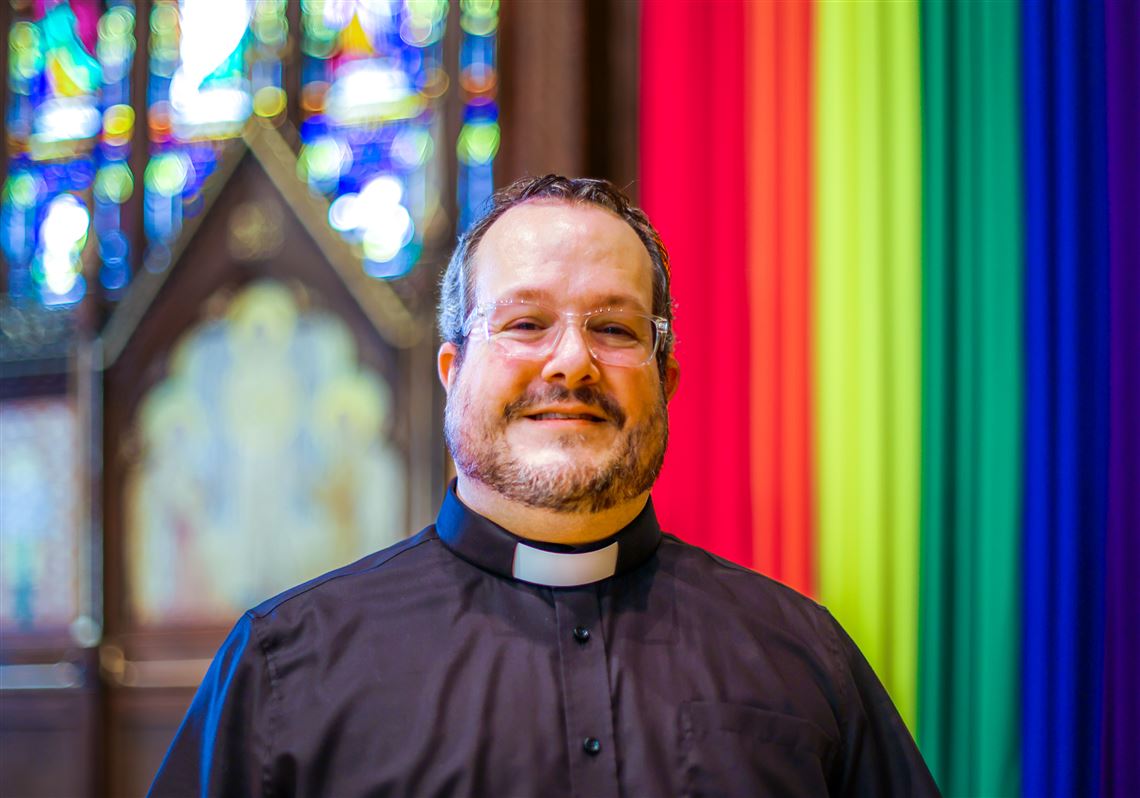
Trinity Episcopal Church in Toledo is part of the Episcopal Diocese of Ohio in the Episcopal Church, what passes for mainline Anglicanism in the United States. Click on these three links, and it won't take long to find evidence that all three organizations are thoroughly apostate. Trinity Episcopal Church has a new rector (or should that be rectum?); as reported by Sarah Readdean of the Toledo Blade, August 14, 2025 (bold, photo in original):
(Photo credit: Philip Kaplan/The Blade)

The Rev. Jon Richardson says he has “crippling stage fright.”

He still does theater — alongside his husband, director Michael Kidney — but prefers to stick to behind-the-scenes work.

And meanwhile, the Episcopal priest of 16 years has gotten comfortable with preaching every week.

“I was terrified for years, but now I’ve kind of come into my own,” Reverend Richardson said. “On one hand, it doesn’t activate my stage fright because it’s kind of like it’s not me because I am embodying priest in that moment. But on the other hand, the most naked and vulnerable you can be is talking about your experience of faith. It's a complicated thing. I’ve just figured out how to do it.”

His sermons have changed in the last few months since he moved from the East Coast to northwest Ohio as the new rector at Trinity Episcopal Church in downtown Toledo.

“I’m growing as a preacher here because of the kind of community it is. I’m finding my voice changing a lot because of the kind of community this is,” the 46-year-old said. “I feel like I’m becoming more of myself, like I feel the freedom here to really let loose, just to let myself go.”

Trinity advertises itself as “a progressive, inclusive, and creative community of faith” — making it a perfect fit for the priest who said he had always known a church like this existed.

After seeing the Toledo church was looking for a new priest, Reverend Richardson said, he was “immediately enchanted by the place,” and knew the members of this growing congregation were his people.

“These people are doing something different; they’re being the church in a way that almost nobody else is,” he recalls thinking when he first found Trinity. “I have to remind myself that we’ve only been here four months, because it’s been such a natural, easy fit. I kind of feel like I’ve been here forever.”

Time of transition

Over the course of the last three years, Trinity has had three different priests. Its former rector, the Rev. Lisa Tucker-Gray, left in 2023, and the Rev. Stephen Applegate served as interim rector for 14 months.

“Staff has had a lot of transition, and he has come in [saying], ‘Let’s start really envisioning where we’re at a year from now,’” Heather Meyer, director of operations for the church, said of the new rector. “He’s been really great at that.”

The congregation has been warm and welcoming to their new priest, his husband, and their dog, Tino, since they settled into Ottawa Hills in March. “I’m here for the long haul,” Reverend Richardson said, noting that his priorities right now are building relationships with the parish and city and seeing where God is calling the parish.

Trinity’s 33rd rector was raised in Louisiana and spent the last 20 years in the Northeast, primarily in New Jersey. His father is a United Methodist pastor and the young Richardson said he first felt called to ministry at age 16. He came out as gay two years later at a time when the United Methodist Church was not accepting of queer clergy. (It wasn’t until last year that the denomination voted to lift its ban on that.) He spent some time away from the church but got a taste of the Episcopal Church while working as a paid singer in a church choir during college. There he felt comfortable and drawn to its liturgy. He eventually decided to study church history instead of vocal music performance, and ended up pursuing ordination in the church.

The Episcopal Church has been “theoretically inclusive” since 2003 when Bishop Gene Robinson was ordained as the first openly gay bishop in the church, and it’s been “increasingly inclusive” since then, Reverend Richardson said.

His early years in ministry were spent working on the institutional level to foster relationships and conversations around sexuality between Anglicans worldwide. He also contributed to legislation that would include transgender people in the church's nondiscrimination canons.

Celebrating Pride

Having long been involved in various social service and justice initiatives in Toledo, Trinity is recognizable at 316 Adams St. by its Pride flag and Homeless Jesus sculpture. It also makes its space available to community groups.

The new rector said he’s moved by the action, service, and vision that take place there and that it helps him feel like he's part of something bigger than himself.

The 188-year-old parish has a number of activities lined up for the 16th annual Toledo Pride.

The weekend kicks off Friday with a Pride Family Picnic, including drag performers and a gender-affirming clothing swap, from 5 to 8 p.m. on the church plaza.

Hospitality for the Toledo Pride Parade begins at 10 a.m. at the church, which will open its bathrooms and a cooling station to the public and offer water and snacks. About 20 members will march with the Better Together: Faith Communities United for Pride movement, and Bishop Anne Jolly of the Episcopal Diocese of Ohio may be joining from Cleveland, the priest said.

A Big Queer Pride Service will be a 10 a.m. affirming liturgy Sunday in the sanctuary, which has been adorned with 15-foot rainbow banners hanging from the buttresses. “We’re always a little bit queer,” the priest said, but this service will be especially rainbow focused.

“Each year, we try to figure out a way which we can engage just a little bit stronger, more creatively,” Meyer said of Trinity’s involvement in the annual event. The queer-affirming parish is the only church along the downtown parade route, she noted.

The Revs. Megan Allen-Miller and Melanie Forrey organized the Better Together initiative last year, bringing together about 300 people from more than 30 area faith communities across nine denominations. This year, they’re welcoming six groups that hadn’t participated last year, which Pastor Forrey of Zoar Lutheran Church in Perrysburg said brings in new excitement and energy.

“Pride is such an amazing, wonderful opportunity to come together in celebrating joy,” said Reverend Allen-Miller, priest at St. Andrew’s and All Saints Episcopal churches in Toledo.

“From the beginning, our intention was to be an embodied message of inclusion that demonstrates in a big way how we have a lot more in common than we don’t,” Pastor Forrey said. “Part of that is wearing the same shirt. Part of that is walking behind the shared banner. And we speak together for our shared values of inclusion, for not just the LGBTQIA+ community, but humanity in general.”

Sunday, 22 June 2025

The Anglican Church of Canada is repurposing its buildings because it can no longer fill them

Having a form of godliness, but denying the power thereof: from such turn away. II Timothy 3:5

More evidence of the accelerating suicide of the Anglican Church of Canada, as reported by Nicole Thompson, The Canadian Press, June 22, 2025 (photo in original):

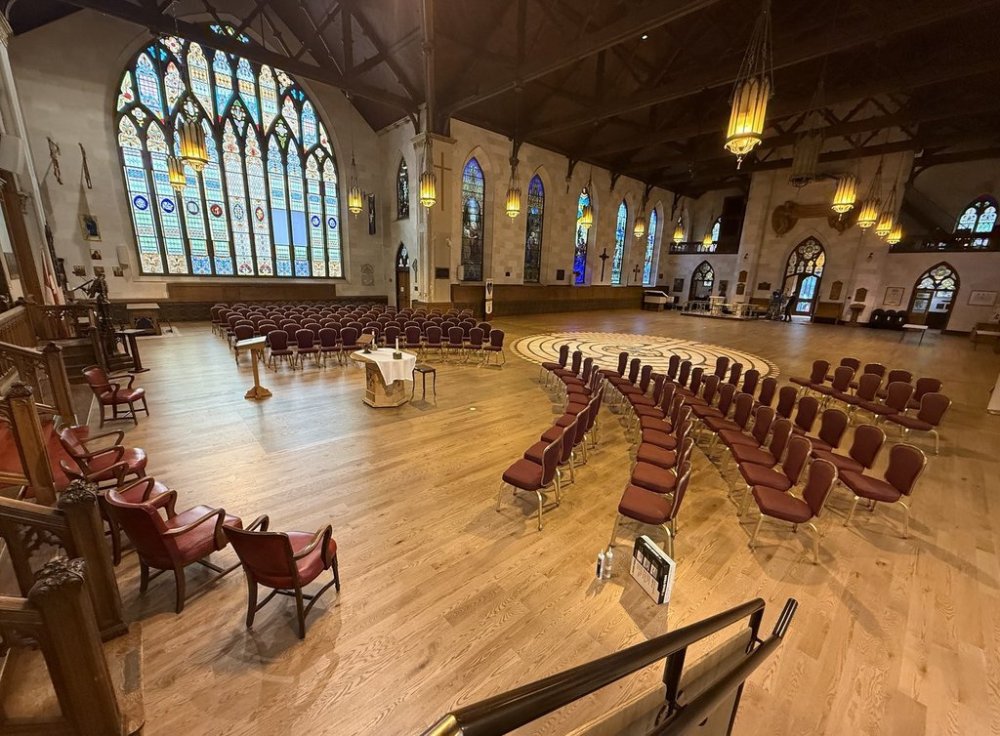
The newly renovated St. Paul's Cathedral in London, Ont., is pictured in this undated handout photo. THE CANADIAN PRESS/Handout - St. Paul's Cathedral, Rev. Kevin George (Mandatory Credit)
When Rev. Kevin George first arrived at St. Paul’s Cathedral, congregants accused him of coming to rip out the pews.

“I was like, ‘OK, everybody take a breath. I don’t have my chainsaw with me,'” he said Friday, a day after welcoming the public into the newly renovated building in downtown London, Ont.

It’s been 18 months since he started working at the church, and the pews are indeed gone.

After much prayer and consideration, the change came with the blessing of the congregation.

George is leading the adaptive redevelopment of St. Paul’s in an effort to keep the Anglican church building alive in a model not unlike the one endorsed by a new report from the Canadian Urban Institute.

It argues churches must change their approach to managing their buildings because declining attendance is putting their longevity at risk. The institute fears the loss of physical buildings could spell the end for the churches’ civic function.

The non-profit’s report says that in addition to their spiritual role, church buildings have long been places where people go for social services, from food pantries to foot clinics and charity bingo to child care.

It was that same argument that got members of St. Paul’s onside, George said.

They asked themselves, “What are we doing with the space and what does that space do for us to allow us to be the church that we need to be today, tomorrow and for generations to come?” George recalled.

“And when we did that work, the barriers began to fall.”

Without the pews, which seated 700, the space can be used in any manner of ways — as a concert venue, a conference hall, and, of course, a space for worship.

The renovations, which also included making the space wheelchair accessible and installing much-needed air conditioning, have cost $1.9 million.

The congregation and Anglican Diocese of Huron have together raised $1.1 million, and they’re now looking to external sources to cover the balance. They’re hoping some funds could come from the City of London, which has endorsed the space as a new creative hub.

The church will also expand its civic role, George said.

“When I moved downtown in January of 2024, one of the overwhelming narratives about St. Paul’s was, ‘I can never get in there. The doors are locked,'” he said. “Well, that’s changed dramatically and will continue to change because our attitude now is ‘doors open.'”

If churches don’t adapt, CUI President Mary Rowe said, they face two major threats: development and decay.

“As urban environments intensify…those kinds of civic spaces that provide this kind of opportunity for informal, casual social interaction, they get encroached upon because the market pressure is such that that building starts to become more desirable for high-end housing,” Rowe said.

“And in small communities where there may not be the same kind of pressure for real estate development, there’s no money or resources to shore up the civic functions of these places.”

The report contends church spaces, which for decades have benefited from tax exemptions, have a duty to continue offering civic services. But a 2019 study by the National Trust for Canada predicted that one-third of Canada’s 27,000 faith buildings, most of which are Christian, would likely close permanently in the next 10 years.

“What we need are new models that get new resources into these places so that you can actually evolve in a way that serves the community around it,” Rowe said.

The report attempts to “unravel the Gordian knot” of how at-risk, faith-built assets like churches should be managed going forward.

That’s a question Rev. Graham Singh has spent more than a decade working to answer.

He’s the senior pastor at St. Jax Church in Montreal and CEO of the charity Releven, which works to preserve and repurpose underused churches.

St. Jax, formerly called St. James the Apostle Anglican Church, is a sort of prototype for the Releven model.

The grand cathedral on Rue Sainte-Catherine ceased operations in 2015. It was in disrepair and maintenance was extremely expensive because of its heritage designation. It reopened the following year under the new name.

“A challenge is the building itself,” Singh said. “Raising money to repair the roof, which is this heritage-listed slate roof that has to be repaired with like-for-like materials. And then the same thing with the masonry, which is a very expensive 150-year-old stone construction.”

But now, the building is home to four separate congregations and a non-religious non-profit, which will soon handle management of the building. Secular tenants of St. Jax include organizations that work in refugee resettlement, food security and youth employment.

Meanwhile, the City of Montreal is in the final stages of a process to acquire the green space outside St. Jax with the goal of turning it into a park.

Singh also knows about the complexity of working with the municipal government.

In order to make all the changes to how the St. Jax building operates, his organization had to prove they had the historic right to change the site’s purpose and use.

That heritage impact assessment has become part of the Ville-Marie Pilot Project, which opens the door for other churches in the city to share their space with non-religious groups, he said.

“The city has indeed been updating their zoning and urban planning framework to allow more of that to be happening in other locations in the future,” Singh said.

Through Releven, he’s taking that experience and helping other churches leverage it.

The CUI report found one of the barriers for churches looking to change their business model is a lack of knowledge on the part of local leadership.

“There’s very few examples of a congregation or a diocese or an owner of a faith building that have been able to do it by themselves because of the complexity of these buildings and the regulatory environment,” said Jennifer Barrett, managing director of programs, planning and policy at CUI.

Some churches have partnered with real estate developers.

Among them is All Saints’ Anglican Church in Winnipeg, whose lands are now home to West Broadway Commons, a 110-unit housing project. Fifty-six of those units are affordable.

But in many cases, Barrett said, churches are resistant to that sort of change and fearful of giving up control.

“It is challenging for faith communities to let go of their buildings,” she said.

George said that was true for the congregation at St. Paul’s. Ultimately, they decided that they should retain ownership of the property.

“We would have become sort of a tenant in our own space, and the Diocesan structure of the Anglican Church doesn’t work well for that,” George said.

“We’re working on what we believe will be a public-private partnership to administer this going forward because we know we’re going to get very busy. I mean, we’ve only just moved in yesterday, and we’re already receiving calls. There’s a demand here for a space like this.”
According to its own 2019 report, the Anglican Church of Canada will be dead by 2040. A similar report from 2006 warned that the church would be dead by 2061, so the pace of decline has accelerated.

See also my posts:

An example of a dead church morphing into a community centre (January 26, 2014)

An example from Edmonton of a community service centre masquerading as an evangelical church (January 22, 2015)

More examples from Edmonton of community service centres masquerading as churches (December 31, 2015)

Anglican Church of Canada will be dead by 2040, according to its own report (December 22, 2019)

An example from Saskatoon of a community service centre masquerading as a Christian church (March 28, 2016)

100 years ago--Canadian Anglicans envision new social order (September 30, 2023)

Wednesday, 18 June 2025

50 years ago--the Anglican Church of Canada votes to ordain women to the priesthood

As reported by Canadian Press and published in the Montreal Gazette, June 19, 1975:

QUEBEC--Ordination of women to the priesthood was approved last night by 88 of 106 lay delegates to the 27th general synod of the Anglican Church of Canada.

Seventy-five of the 105 clergy voted yes while 26 of the 34 in the House of Bishops voted their approval.

It was the second time the synod had approved the ordination of women. Approval in principle was given at a 1973 synod but it is necessary for a second synod to approve the action for it to become fact.

Also approved was a resolution that women be ordained at the discretion of diocesan bishops after consultation with the House of Bishops.

This allows a bishop to refuse ordination if he opposes the principle.

On this motion, 95 of the lay delegates voted yes and nine no. The clergy voted 86 in favor and 19 against while bishops voted 27 for and seven against.

There are deep feelings in the church on the question. It has been before Anglican communions since 1862 when a bishop of the Church of England ordained a deaconness. The Canadian church has deaconnesses.

The Lambeth conference of 1968 accepted the principle that deaconnesses are within the diaconate but it does not ordain them as priests.

The general synod of 1973 approved ordination in principle but specified that it not be implemented until the House of Bishops developed a pattern that included an education process.
As reported by Canadian Press and published in the Montreal Gazette, June 20, 1975:

...The final act of synod was to state that no person should be penalized as a result of synod's accepting the principle that women be admitted to the priesthood.

Two decisions of major import affecting the entire church were made at the week-long meeting with synod stting that women can be priests and deciding to end negotiations for union with two other Protestant churches.

Both steps troubled the delegates and feelings during debate ran high, even nearing the end as the "conscience clause" was adopted.

This came out of Wednesday's synod acceptance of women priests. Many in the house said it was "sad" that a church law was necessary to enforce an idea that should be accepted by a Christian church.

Archbishop [E.W.] Scott said the action was necessary for canonical and legal reasons.

The adopted resolution said:

"No bishop, priest, deacon or lay person, including postulants for ordination of the Anglican Church of Canada, should be penalized in any manner, nor suffer any canonical disabilities nor be forced into positions which violate or coerce his or her conscience as a result of general synod's action in affriming the principle of the ordination of women to the priesthood..."

Some bishops oppose ordination of women on theological grounds and have said they will refuse to ordain them. They were given discretion in this but it was feared by many clerical and lay members that penalties would be imposed if they refused...
Putting women in positions of leadership in a church is not only a sign of further apostasy to come but also of how much apostasy has already progressed. How has the Anglican Church of Canada's 1975 decision worked out? In 1975 there were 1,015,016 people listed on parish rolls. It peaked in 1964 at 1,365,313. By 2022 it was down to 294,931, a 70% decline since 1975 and more than 78% since 1964. According to its own 2019 report, the Anglican Church of Canada will be dead by 2040. The ordination of women as priests was a major step in the church's process of suicide.

Saturday, 26 April 2025

50 years ago--a couple of items related to ecumenism

Can two walk together, except they be agreed? Amos 3:3

Having a form of godliness, but denying the power thereof: from such turn away. II Timothy 3:5

Manmade efforts to unite nominal Christian churches have never quite been able to succeed; could that be because God isn't behind these efforts? From back in the days when most newspapers had a religion page and/or section on Saturday, here are a couple of items that appeared on the first page of the religion section of The Edmonton Journal, April 26, 1975 (headlines in original):

Catechism joint effort

LONDON (Reuter)--A new move toward Christian unity--a joint Protestant and Roman Catholic catechism--has been introduced here.

The common catechism, published in Britain on April 21, is the first book on Christian belief to be produced by a mixed team of Protestant and Roman Catholic theologians.

It was first issued two years ago in German, edited by two Swiss theologian scholars.

The English-language translation, published by search press, has the blessing but not the official recognition of both Protestant and Roman Catholic church leaders.

Doctrinal questions such as the existence of God and approaches to faith are tackled in the catechism, which is more than 650 pages long.
The Common Catechism: A Book of Christian Faith, by Johannes Feiner and Lukas Vischer, was the work of Roman Catholic, Lutheran Church, and Reformed Church theologians, and was published in English by Seabury Press on January 1, 1975.

Union losing impetus

ORILLIA, Ont. (CP)--The moderator of the United Church of Canada says the proposed union of the United and Anglican Churches "seems to have slowed down in the past few months."

Speaking at a Muskoka presbytery rally, Dr. Wilbur Howard of Ottawa said the United Church "is waiting anxiously for a circularization in the membership of the Anglican Church to see how mwmbers of the general congregation feel about the union."

He noted that the Anglican House of Bishops recently made public a report affirming a possible union.

But, he said, "they found the plan of union unacceptable."

"In the United Church we did not seem to have a clear understanding of the role of the bishops. Also the United Church believes that women should be ordained.

"Maybe we pushed too hard and maybe we didn't listen enough. But it was a good try. Union can't be imposed, it can only come when we work for it. I think it's part of the future."

Dr. Howard also said that the United Church is including in its "design for the future" husband and wife acting as ordained ministers. He said such ministries are being considered for Saskatchewan, Manitoba, and Ontario.
As reported by Henry Overduin of the Montreal Gazette, June 20, 1975 (bold in original):

The decision this week by the Anglican synod meeting in Quebec City to reject the plan of union with the United Church is not as big a blow to ecumenism as might first be believed.

The plan of union was killed early February, when the bishops rejected it, commenting that it did not even provide a useful basis for continuing talks.

The synod, less brusquely but with the same result, confirmed the bishops' decision although accepting the plan as a study paper. But that's just a euphemism for "putting it on the shelf" where the plan of union will gather dust until some historian or archivist decides to peruse it.

LACK OF INTEREST

Lack of interest in schemes leading to organic union among Protestants is simply a fact of ecclesiastical life today.

This lack of interest, for example, is illustrated by the response to the so-called circularization of the Anglican church membership on union talks with the United Church.

That circularization--a poll--was decided on after the bishops rejected the plan of union, and something had to be done fast to assure the United Church that the Anglicans were still sincere about church union.

It was also made plain at the outset that the poll was not a referendum, that its results would not be binding on the church.

Results of the poll showed that while 72.1 per cent of eligible clergy responded, only 11 per cent of the eligible laity did.

The clergy were roughly divided half-and-half on the desirability of continuing talks--494 said yeas, and 473 said no. The general membership was also divided. A total of 33,396 favored continuation of the talks, and 28,930 were against.

But, based on the small sample and its volunteer nature, this poll hardly constituted a reliable gauge of Anglican sentiment.

As has been said before, it would be wrong to read into the synod's negative decision what is not really there, namely, that the ecumenical movement has suffeed a major setback. The concern of the ecumenical movement , in its general sense, was in fact affirmed. In this general sense, the ecumenical movement seeks to express the unity of the church in ways other than organizational charts.

NOTHING NEW

Also, the Anglican synod did go on record as favoring a continuation of talks based on a step-by-step approach to greater unity, instead of the grand plan originally proposed. But that's hardly new.

What can be expected--based on the leadership of the Church of England--is a greater movement toward unity with the Roman Catholic Church.

And, if one is to go by logic, isn't that the only sort of institutional direction the ecumenical movement can take?
As reported by Canadian Press and reported in the Montreal Gazette, June 20, 1975:

...Two decisions of major import affecting the entire church were made at the week-long meeting with synod stating that women can be priests and deciding toend negotiations for union with two other Protestant churches.

Both steps troubled the delegates and feelings during debate ran high...

In his closing remarks Archbishop [E.W.] Scott expressed his personal regrets to representatives of the United Church of Canada and the Christian Church (Disciples of Christ) as they returned home to face the "difficult task" of officially informing their churches of the church-union decision.

General synod Tuesday found the plan of union that the three churches unacceptable, and though it expressed its willingness to continue to seek unity, its decision was viewed as a final turndown after 32 years of talks.

Among other resolutions pushed through swiftly as the synod sought to clean up its business--much was left unfinished--was one that called upon local committees and other church groups to determine and report if any of their financial investments are in banks or corporations that have trade or have investments in South Africa. The committees were told to sell such holdings as soon as possible.

The church has gone on record as opposing and deploring apartheid--separation of the races--in that country.

All dioceses were asked to study and respond to the concept of a guaranteed annual income for Canadians.

A memorial for the diocese of Edmonton asked that the Anglican Book Centre, a publishing firm, determine if it were financially possible to reprint the 1938 hymn book, now out of print.

It has been superseded by a joint hymn book adopted in 1971 by the Anglican Church and the United Church, which many members do not like. Many churches continue to use the old book
. The Anglican Church of Canada ordained its first six priestesses on November 30, 1976--40 years after the United Church of Canada began doing so--but formal unity of the two churches has never occurred. The two are united, however, in their increasing apostasy. The Anglican Church, according to its own 2019 survey, will be dead by 2040, and it will come as no surprise if the same isn't true for the United Church. The United Church's intention of having husband and wife as ordained ministers seems quaint in 2025; ordaining alphabet perverts wasn't on the radar screen in 1975. To see the United Church of Canada's downward slide as measured by its views on "Gender and Transgender Justice," go here and get the timeline right from the horse's mouth (or should that be the ass's butt?).

Monday, 30 December 2024

70 years ago--Archbishop of Canterbury pessimistic about immediate ecumenical unity

Ecumenical speculation from the leading cleric of the Church of England is nothing new, as exemplified in the following item reported by Canadian Press and published in the Calgary Herald, October 12, 1954:

WINNIPEG - The Archbishop of Canterbury said Sunday night the world's churches are getting nearer to one another but he does not anticipate any general reunion of the separated churches into one articulated body, governed by one constitution.

Most Rev. Dr. Geoffrey Fisher, who recently attended the World Council of Churches in Evanston, Ill., and toured Canada, spoke on "Prospects for unity." His address was recorded during a visit to Winnipeg for broadcast in the C.B.C. program, "Our Special Speaker." Dr. Fisher arrived back in England Oct. 4.

"We are all sinful men with our share of wilfulness and wrongheadedness," he said. "This truly shows that every church in Christendom has erred in matters of faith; and that liability to err remains, will remain.

"If there were but one church, its errors would bring final disaster to all. We need our various traditions to continue within the whole church catholic, so that as occasion needs, the insight of one may correct the error of another; and one may hear what the Holy Spirit speaks to the church when others are temporarily deaf to it."
Then, as now, the World Council of Churches was apostate, but the Archbishop of Canterbury spoke as though liberal churches were actually Christian. His skepticism regarding churches uniting into one body has so far been correct; if they do unite, it will likely be under the umbrella of the Roman Catholic Church.

Wednesday, 28 August 2024

South Africa's Chief Rabbi blasts Pope Francis and Archbishop of Canterbury Justin Welby for their unbiblical positions on Israel

In striking contrast to Evangellyfish, the Chief Rabbi of South Africa calls a spade a spade; as reported by Etgar Lefkovits of Jewish News Syndicate, August 27, 2024 (photo, bold, links in original, added by blogger):
Archbishop of Canterbury Justin Welby exchanges gifts with Pope Francis at the Vatican on May 2, 2024. Photo by Vatican Media via Vatican Pool/Getty Images.

The head of the Catholic Church and the leader of the Church of England are effectively rejecting the Bible by supporting policies that negate the connection of the Jewish people to the Holy Land, the chief rabbi of South Africa said on Sunday.

The blunt theological critique comes after the archbishop of Canterbury endorsed a ruling by the International Court of Justice last month that Israel’s presence in the “occupied Palestinian territories” is unlawful, and as the pontiff has sought to thread the needle and maintain strict neutrality during Israel’s war against Islamist terrorists in Gaza.

“At a time when Europe’s future hangs in the balance, its two most senior Christian leaders—the head of the Catholic Church, Pope Francis, and the head of the Church of England, Archbishop Justin Welby—have abandoned their most sacred duty to protect and defend the values of the Bible,” South African Chief Rabbi Warren Goldstein wrote in a post on X.

The world is locked in a civilizational battle of values, threatened by terrorism and jihad, the rabbi said.

“Now is the time for religious leaders to come to the defense of society, to speak up for Western values and freedom,” Goldstein said. “Instead, Pope Francis and the Anglican archbishop are silent: indifferent to the murder of Christians in Africa, and to the threat of terrorism throughout Europe, and outright hostile to Israel’s attempts to battle these jihadi forces led by Iran.”

Does the archbishop read the Bible?

The Jewish leader said that the head of the Church of England’s remarks put him in “direct opposition” to the Bible.

“Does the archbishop believe the accounts of the Bible are mere myths?” Goldstein ponders in a 15-minute video address attached to the X post. “How can anyone who believes in the Bible say that Israel is an illegal occupier of the Temple Mount?”

After the U.N. court ruling, Welby said that ending “Israeli occupation of Palestinian territory is a legal and moral necessity.”

Goldstein continued, “If the archbishop reads his Bible, he should know that Jerusalem existed before London and was the capital of Israel before anyone heard of Britain.”

Imploring his fellow religious leaders to “go back to the Bible,” the South African rabbi said that denying Israel’s biblical claims to the Land of Israel was a threat to both the United Kingdom and Europe at a time of rising Islamic extremism.

“Jihadist ideology that seeks to destroy Israel is a clear and present danger to the future of Europe and its value system,” Goldstein said. “If Israel is abandoned to jihadi forces, Europe is next.”

Friday, 31 May 2024

Survey indicates that many Canadian "Evangelicals" aren't Christians

Now the Spirit speaketh expressly, that in the latter times some shall depart from the faith, giving heed to seducing spirits, and doctrines of devils; I Timothy 4:1

Having a form of godliness, but denying the power thereof: from such turn away. II Timothy 3:5

I don't share the liberal views of the Winnipeg Free Press's religion writer, but at least he reports on issues that almost all other mainstream media outlest in Canada ignore. As reported by John Longhurst in the Winnipeg Free Press, May 18, 2024:

God as a three-in-one, Jesus as divine, the resurrection of Jesus from the dead — these are traditional church teachings that all Christians are assumed to believe. But a recent study by Cardus and the Canadian Bible Society has found that assumption to be unfounded.

Titled “Still Christian(?): What Canadian Christians Actually Believe,” the study’s author, Andrew Bennett, found the beliefs of many Canadian Christians don’t match up with what their churches teach on these and other doctrines.

For example, when asked to agree or disagree with the statement “there is one true God in three persons: Father, Son, and Holy Spirit,” 89 per cent evangelicals agreed, as did 51 per cent of Catholics and 57 per cent of mainline Protestants.

When asked if the resurrection of Jesus Christ was a historical event, 81 per cent of evangelicals said yes, as did 48 per cent of Catholics and 55 per cent of mainline Protestants.

As for whether Jesus was God, 74 per cent of evangelicals said yes, as did 46 per cent of Catholics and 42 per cent of mainline Protestants.

Are all religions equally true? The study found that 20 per cent of evangelicals agreed, as did 54 per cent of Catholics and 57 per cent of mainline Protestants.

When it comes to whether Christian moral teachings should evolve with changes in society, 45 per cent of evangelicals said yes, as did 72 per cent of Catholics and 61 per cent of mainline Protestants.

The study of 2,026 randomly selected Canadian adults was conducted by the Angus Reid Institute in February. Along with questions about doctrines, it also asks respondents for their views on things like abortion, same-sex marriage, heaven and hell and church attendance.

For Bennett, who is program director for Faith Communities at Cardus, the results are startling. “You could say there’s a real problem in the pews,” he said.

While evangelicals are more likely to hold to their denominational doctrines, there is “still some level of incoherence there,” he said, adding that especially for Catholics and mainline Protestants there are hints of “deep fractures” within those groups.

Although many diverged from traditional teachings, Bennett noted they still viewed themselves as Christians. “This fact is significant in itself,” he said.

One surprising finding from the study is that younger Canadian Christians display stronger commitments to traditional teachings compared to older generations. One reason for this, suggested Bennett, is that at a time when Christianity is no longer a cultural norm in Canada, some younger people “may be making deliberate, counter-cultural choices to adhere to the beliefs and devotional life of historical Christianity.”

For Sam Reimer, who teaches sociology at Crandall University in Moncton, the Cardus study mirrors his own research into the disparity between what Canadian evangelical clergy believe and what their denominations teach.

“Even active evangelicals will disagree knowingly with their church’s or denomination’s position on a moral or doctrinal belief,” said Reimer. He thinks this is because what used to be an accepted external locus of authority — church teaching — has been replaced by an internal locus where Christians think each person can decide what they want to believe “based on what works for them.”

Kevin Flatt studies religion at Redeemer University in Ancaster, Ont., For him, the results “are not surprising since they are consistent with longstanding patterns and trends in Christianity in Canada.”

What stands out for him is how evangelicals seem to have resisted an erosion of traditional doctrines, compared to Catholics and mainline Protestants — even if that group shows some significant differences of opinion.

“Overall, I would have expected to see secularization having more of an impact on evangelicals as well,” he said, suggesting evangelicals are more resistant to secularization than other groups.

For Andrew Rampton, rector at St. John the Evangelist, an Anglican church in Hamilton, the problem is that denominations like his haven’t done a good job of teaching their members the foundational Christian beliefs.

“We were so very drunk on Christendom for such a very long time,” said Rampton of the Anglican Church of Canada, noting that for a very long time the values of the surrounding culture supported Christian belief and practice — teaching about it wasn’t as necessary.

That led Anglicans to rely on something he called “liturgical osmosis,” or just assuming everyone would figure it out just by being in Canada.

But now that Canada is less Christian — “not a bad thing for the church in my estimation,” he offered — “we have to remember how to be a group who are not the dominant cultural mindset.”

Rampton also has seen evidence of how young people are more likely to hold traditional beliefs. “Most of the young people I know in the Anglican Church are there by choice,” he said, noting they were very deliberate about choosing that option.

As for the study itself, one question it doesn’t ask is whether the beliefs it highlights are still the ones Christians most need to be faithful in the 21st century; is the problem really as big as the study’s author suggests?

Or maybe something is happening in Canadian churches today as people find new ways of expressing and practising faithfulness — ways that go beyond the need to believe certain things in order to be a Christian. For that, we might need a different study.

The full Cardus study can be found at https://www.cardus.ca/research/faith-communities/reports/still-christian/?utm_source=Still+Christian+NR&utm_medium=Cision&utm_campaign=Still+Christian(%3f)
It comes as no surprise to this blogger to see the apostasy of Roman Catholics and mainline Protestants, although Evangelical useful idiots such as Brian Stiller, former president of the Evangelical Fellowship of Canada and currently the Global Ambassador to the World Evangelical Alliance, believe that these apostate churches are part of the body of Christ (yes, he stated that belief in a speaking tour of Canadian churches in 2014 after accompanying other "Evangelical" leaders such as Kenneth Copeland (!) in a visit to Pope Francis at the Vatican).

The increasing apostasy of so-called Evangelicals also comes as no surprise to this blogger; Singaporean Chrsitian leader Samuel Tow presciently warned of this development in 1983 in his address Today's Evangelicals, Tomorrow's Liberals. As for the results of this survey, if all those who identified as "Evangelicals" were actually Christians, 100% would say that there is one God in three persons; that the resurrection of Jesus Christ was a historical event, and that Jesus is God, while 0% would say that all religions are equally true and that Christian moral teachings should evolve with changes in society (those churches that do believe that Christian moral teachings should evolve with changes in society are the churches that are dying).

It's laughable that Andrew Rampton, rectum rector of the Church of St. John the Evangelist in Hamilton, is cited as an expert on "foundational Christian beliefs." He's the sodomite who, shortly before he assumed his post in Hamilton, occupied the same position at Holy Trinity Anglican Church in Winnipeg, which staged an alphabet pervert "reimagination" of Handel's Messiah in 2023 (see link below).

As Paul's warnings to Timothy indicate, the increasing apostasy of professing Christians is more evidence that we are in the latter times preceding the return of the Lord Jesus Christ, and real Christians should be looking for His coming.

See also my posts: The latest LifeWay survey provides more evidence that many "Evangelicals" may not be Christians (October 30, 2018)

An Anglican "church" in Winnipeg hosts an alphabet pervert "reimagination" of Handel's Messiah (December 22, 2023)

Friday, 22 December 2023

An Anglican "church" in Winnipeg hosts an alphabet pervert "reimagination" of Handel's Messiah

Pride goeth before destruction, and an haughty spirit before a fall. Proverbs 16:18

Thou shalt not lie with mankind, as with womankind: it is abomination. Leviticus 18:22

Wherefore God also gave them up to uncleanness through the lusts of their own hearts, to dishonour their own bodies between themselves:
Who changed the truth of God into a lie, and worshipped and served the creature more than the Creator, who is blessed for ever. Amen.
For this cause God gave them up unto vile affections: for even their women did change the natural use into that which is against nature:
And likewise also the men, leaving the natural use of the woman, burned in their lust one toward another; men with men working that which is unseemly, and receiving in themselves that recompence of their error which was meet.
And even as they did not like to retain God in their knowledge, God gave them over to a reprobate mind, to do those things which are not convenient;
Being filled with all unrighteousness, fornication, wickedness, covetousness, maliciousness; full of envy, murder, debate, deceit, malignity; whisperers,
Backbiters, haters of God, despiteful, proud, boasters, inventors of evil things, disobedient to parents,
Without understanding, covenantbreakers, without natural affection, implacable, unmerciful:
Who knowing the judgment of God, that they which commit such things are worthy of death, not only do the same, but have pleasure in them that do them.
Romans 1:24-32

Having a form of godliness, but denying the power thereof: from such turn away. II Timothy 3:1-5

According to the Anglican Church of Canada's own report from 2019, the church will be dead by 2040. The death will be self-inflicted and well-deserved, evidence of which includes the following, as reported by John Longhurst in the Winnipeg Free Press, December 20, 2023 (updated December 21, 2023) (photos in original):

Messiah Queered — that’s the title of a reimagining of Handel’s classic oratorio performed through an LGBTTQ+ lens.

The oratorio, a staple at Christmas time for many people, will be performed by the Rainbow Harmony Project choir, together with soloists and a 16-piece orchestra made up of professional and amateur players at Holy Trinity Anglican Church Friday at 7:30 p.m.

The idea for the performance came up during a conversation between Nathan Poole, a local violin and piano teacher, and Sandra Bender, music director at Holy Trinity Church.

Bender, who is bisexual and the soprano soloist in the performance, thought it would be a great oratorio for LGBTTQ+ people.

“It’s the story of a transient who hung out with marginalized people, who offered love and self-sacrifice and who experienced rejection and betrayal — something LGBTTQ+ people understand in all too real a way,” she said.

Kathleen Murphy, a student and choir director for Rainbow Harmony Project and the mezzo-soprano in the performance, said doing the Messiah through an LGBTTQ+ lens is “a way to push back expectations.”

That includes who does the solos. In a traditional performance of Messiah, a bass sings the aria, “Why do the nations so furiously rage,” but Murphy is singing the part this time.

“It’s fun to sing such a powerful aria,” Murphy, who is non-binary and a soloist at Young United Church, said.

Bender, meanwhile, will sing The Trumpet Shall Sound, which is also usually a bass part, while tenor Kyle Briscoe will sing Rejoice Greatly, O Daughter of Zion, traditionally sung by a soprano.

“Nothing musically is altered, but we’re swapping gender roles, subverting them,” said Poole, who is gay and conducting the concert.

For Bender, The Messiah can be seen as “a trans anthem, with its lyrics about people “being changed at the sound of the last trumpet when we will be revealed in our best and truest form. I’m happy to be the one who conveys that message in the concert.”

While singing it, “We can be our full authentic selves, be unapologetic about our queerness,” she said.

The three noted the church at 256 Smith St., which is donating use of the sanctuary for the performance, is a welcoming, safe space for members of the LGBTTQ+ community. That’s important for those who might be cautious about going into a church because of the way they have been treated in the past.

Along with listening to the concert, audience members are invited to bring a score and sing along, said Poole.

“It’s not every day people get to sing with an orchestra,” he said, noting audience members are encouraged to dress in drag if they want.

Tickets for the concert, which is sponsored by the Manitoba Arts Council, can be purchased at the Rainbow Harmony Project site at wfp.to/j44 or with cash at the door. The cost is $25 per person, with all proceeds being donated to Sunshine House, a community drop-in and resource centre focusing on harm reduction and social inclusion.
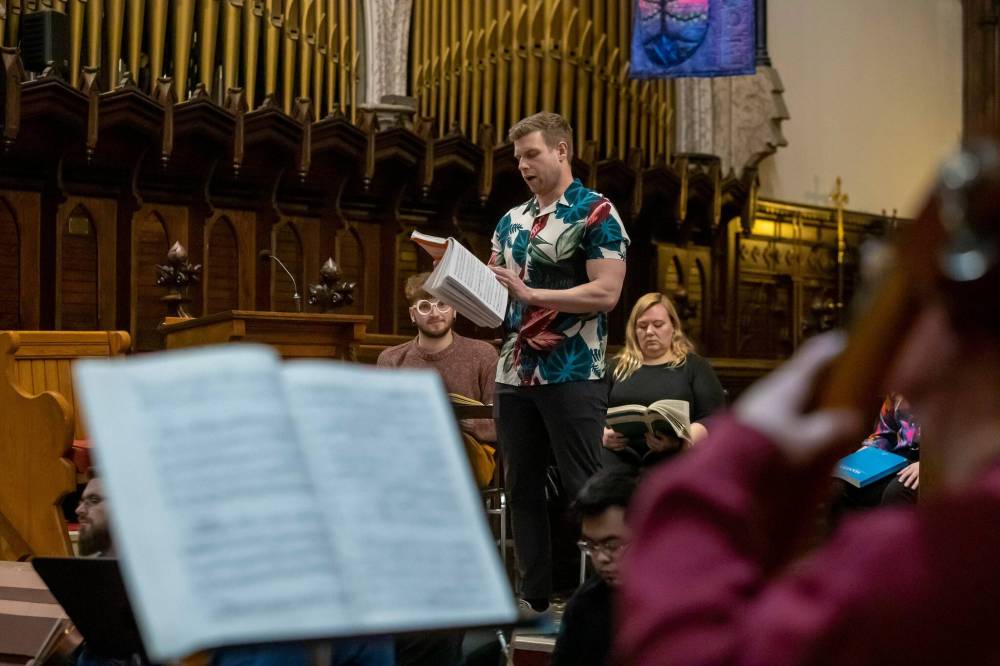
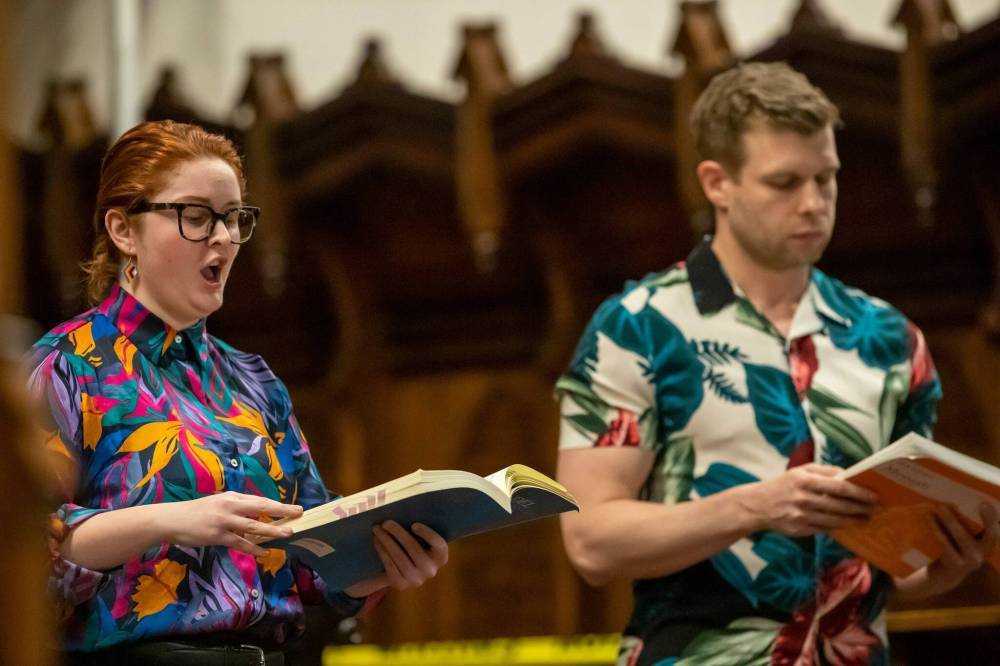
Bass-baritone Stephen Haiko-Pena takes part in a dress rehearsal Wednesday of Messiah Queered at Holy Trinity Anglican Church. (Brook Jones/Winnipeg Free Press)
Kathleen Murphy, who is a student and choir manager for Rainbow Harmony Project, sings during a dress rehearsal for the upcoming production of Messiah Queered at Holy Trinity Anglican Church in Winnipeg, Wednesday. (Brook Jones/Winnipeg Free Press)
Nathan Poole conducts the dress rehearsal of Messiah Queered. The production is a re-imagining of Handel's classic oratorio performed through a LGBTTQ+ lens. (Brook Jones/Winnipeg Free Press)

The reader will note that these agents of Satan can't write their own oratorio, but have to resort to mangling a traditional masterpiece. Some of the perverts of the past were at least capable of producing good music and art, but with present-day perverts, their whole lives seem to revolve around celebrating and promoting their abominations.

Here's an example of a proper performance of Handel's Messiah that you can wash your ears out with:


December 28, 2023 update: If you're wondering why Holy Trinity Anglican Church was hosting this abomination, the following may explain, as reported by Mr. Longhurst in the Winnipeg Free Press, December 27, 2023 (photo in original):
Andrew Rampton, rector at Holy Trinity Anglican Church, is leaving the congregation for another opportunity in Ontario early next year. (John Longhurst/Winnipeg Free Press)

It was a bittersweet Christmas Day for Andrew Rampton, rector at Holy Trinity Anglican Church.

On the one hand, he was looking forward to preaching on that special day in the downtown church’s calendar. But since it was his last sermon as rector at the historic 139-year-old church, it was a sad occasion.

Rampton, 41, and his husband, Adam Dobson, an architectural technologist, will head to Hamilton, where Dobson has new work opportunities, on Jan. 2. Rampton will be taking up a new job as rector at St. John the Evangelist Anglican Church.

Rampton, who was born and raised in Morden, arrived at Holy Trinity in 2020 via a circuitous route.

Although he grew up in a family that notionally claimed to belong to the United Church of Canada, “We went to church very seldom,” he said, adding “I grew up largely neutral or negative when it came to religion.”

While religion wasn’t his thing, he realized in his early teens that he was gay.

Being a gay person in a small town was a challenge, but so was moving to Winnipeg to study at the University of Manitoba in the early 2000s.

“There wasn’t the same kind of LGBTTQ+ community back then like there is now,” he said. “There were gay clubs, but they were private. There was a sense of danger, an underground feeling about it. And most churches weren’t accepting of gay people.”

Going to church wasn’t on his mind until a music teacher told him about an opening in the choir at Holy Trinity Church. Rampton, who had been taking piano and singing lessons, took it — not because he was religious, but because it was a chance to sing and earn a small honorarium.

“It paid half my rent,” he said.

At first, nobody at the church made an issue of his sexuality, but when a new rector arrived things changed.

Rampton admits he was full of opinions about how the church was being run and not afraid to share them — something that didn’t endear him to the new rector. When the rector fired him, “there was no gentle correction or discussion,” he remembered.

“The speculation is it was less about my critique and more about me being gay” he said. “It was a proxy for the real issue.”

His involvement with church didn’t end, though. Almost immediately, St. Luke’s Anglican Church asked him to join them as a singer and organist. Later, he went to St. Paul’s Anglican and then to St. Michael’s and All Angels. where he served as organist and choir master. That is also where he joined the church and fell in love with liturgy.

“The way they did liturgy there really worked for me,” Rampton said. “It was a good place to be. It was a fertile soil for my spiritual soul to grow in.”

Feeling a call to ministry, he left for seminary in Ontario in 2014 where he developed a deep appreciation for the rituals, ceremonies and traditions of the church.

“I’m happy to wear miles of lace, swing incense and sing Gregorian chants” he said.

After graduation, he landed at Holy Trinity, not expecting it would be such a short stay.

One thing he’s loved about being at the church is its ministries, such as the Lunchroom, which serves 250 meals once a week to downtown residents.

“It’s one of the very few food programs downtown where unhoused or precariously housed people can get a meal right away,” he said.

He said he hopes the church, which has between 50 and 60 people in the pews on a Sunday morning, can stay viable and be an active presence downtown.

“The church needs to be here,” he said. “It needs a safe place where people can just be. There aren’t many other places where people can go for free, where nobody wants anything from you.”

As for being a gay priest, his sexuality has “never been an impediment,” to his ministry, Rampton said, but acknowledges not all are comfortable with him being in that role; he’s been called a false teacher and “living in sin.”

He has appreciated the support of Geoff Woodcroft, the Bishop of Rupert’s Land, who has permitted individual Anglican churches to decide for themselves how welcoming and affirming of LGBTTQ+ people they will be.

“Some have never met a gay priest,” he said, of the message his role sends to LGBTTQ+ people who have been hurt by Christianity. Some tell him “If the church accepts you, then I must be OK in God’s eyes, too.”

Rampton’s departure makes Woodcroft sad. But he is grateful for his service.

“His contributions have been outstanding,” Woodcroft said. “He has a rich theology of how to be a priest in the world today.”

He praised Rampton’s work on behalf of downtown residents.

“He knows many of them on a first-name basis,” he said, adding his work as a liturgist has resulted in “solid and alive worship.”

“He is intelligent and gifted, and we are going to miss him,” he said.
I don't know if there are any normal male clergymen left in the Anglican Church of Canada, but there won't be any clergy of any kind in that "church" anymore, the way it's going.

Saturday, 30 September 2023

100 years ago--Canadian Anglicans envision new social order

The social gospel which replaced the true gospel in the mainline churches was already at work in the Church of England in Canada (now the Anglican Church of Canada) a century ago, with man bringing in the kingdom of God. Even with that liberalism, you'll notice that their views on immigration would bring instant condemnation today. There were no women clergy then, of course, and alphabet perverts were in the closet instead of the pulpit. As reported in the Calgary Daily Herald, September 17, 1923, p. 10 (bold, headlines in original):

ANGLICANS GIVEN VISION OF NEW SOCIAL REGIME

-------------

Canon Vernon Presents His Report As Secretary To Big Congress

-------------

NOT REVOLUTION, BUT AN ORDERLY PROCESS

-------------

Immigration Issue to Be Fully Discussed by Church Heads

-------------

The vision of a new social order was outlined at the opening session of the boards of the general Synod of the Church of England in Canada, which for the next ten days will be held in the Paget Hall. Practically the whole of the morning, after routine had been transacted, was taken up with the consideration of the report of the general secretary of the council of social service, the Rev. Canon C.W. Vernon.

He stated that in the new vision the value of personality would be applied at all costs in the realms of business, industry, politics and the social order generally, in which the sacrificial service for others would become the normal characteristic of the professing Christian, and the distinguishing mark of the true Christian.

Not Violence of Revolution

That social order, he said, was not to be developed by the violence of revolution, but by the orderly progress of an evolution ever tending upward and onward. There was no short cut to the realization of that ideal. Love alone, not force, could build the city of God. The new social order, he said, would never be consummated by the establishment of a reign of law enforced by penalties whether legalized or of the Ku Klux Klan variety. The new order would be a kingdom of love, expressing itself in service, a commonwealth of God, in which every laborer, whether with brain or hand, would have the artist's joy of achievement, in which each would seek the good of all, and all would spend themselves in service for otehrs.

The Immigration Issue

The question of immigration was also dealt with at considerable length in the report, and this will be fully discussed at a later period. In connection with that phase the report pointed out that the council had no more important work than in looking after the newcomer. They were witnessing the building of a nation and a church by the process of immigration. They were naturally anxious that the best of their British traditions, and the ideals of the Church of England, should shape and fashion the life of the Canadian nation within the British commonwealth. There was much to encourage them. The census figures of 1921 published in the spring showed that in the last decade the percentage of people of British racial origin in Canada increased from 54.08 in 1911 to 55.40 in 1921. The percentage of Anglicans in Canada, which was 12.6 in 1901, and 14.47 in 1911, had risen to 16.02 in 1921.

Emigration to States

While immigration to Canada was a bright and interesting side of the picture, unfortunately there was another factor to be considered, and that was the large emigration from Canada to the United States of native-born Canadians and of comparatively recent newcomers from the mother land. They must build up their own economic and social life so efficiently that all would be convinced that there was no country with greater prospects, more opportunities for service and more attraction as a place to spend one's life than Canada.

Helping British Harvesters

Incidentally Canon Vernon stated that much good work had been accomplished in connection with the large number of British harvesters that had arrived in the Dominion. Each of these had been presented with a card on landing at Quebec or Halifax, that if any of them found themselves "up against it" they should write to the headquarters of the Social Service Council.

In commencing his report Canon Vernon stated that were two widely prevalent but mistaken ideas met with in connection with social service. One was that it was for the poor alone; the other that the church's social ministry was badly needed in the overcrowded centres of population, but had no place in their rural districts. "It cannot be too emphatically asserted," he said, "that the church's social ministry is for the rich, among whom very often the under-privileged and maladjusted are to be found, as well as for those poor in the world's goods, and that our rural districts have to the full as many social problems as our cities and towns. It is because of this universal need of social service that the value of the church in coping with the need should be recognized more than is often the case."

There was a very full attendance of high Anglican church dignitaries present when the initial session opened on Monday morning. The Very Rev. C.P. Matheson, Primate of all Canada, presided.

Altogether there are more than 120 archbishops, bishops, clergy and laity in attendance. It is the first time that this important gathering has been held in the west. At all Anglican churches in the city on Sunday, special sermons were delivered, the primate preaching at the Pro-Cathedral in the morning, and the Bishop of Huron in the evening.

The boards meeting here represent the Missionary Society, Religious Education, and Social Service. The last mentioned was the subject which engaged attention at the opening of proceedings on Monday. One of the chief features of this was the question of immigration.

A public meeting will be held in the Paget Hall at 8 o'clock on Monday, under the auspices of the council of Social Service. The speakers will be the Rt. Rev. the Bishop of Ottawa, whose subject will be "Christianity and the Public Conscience," and the Rt. Rev. the Bishop of Saskatchewan, who will talk on "Immigration."

Thursday, 31 August 2023

Archbishop of York whines about "oppressively patriarchal" Lord's Prayer

This provides more evidence that you can't be a satirist anymore--assuming that this item wasn't meant as satire. As reported by Harriet Sherwood in The Guardian, July 7, 2023 (links in original):

The archbishop of York has suggested that opening words of the Lord’s Prayer, recited by Christians all over the world for 2,000 years, may be “problematic” because of their patriarchal association.

In his opening address to a meeting of the Church of England’s ruling body, the General Synod, Stephen Cottrell dwelt on the words “Our Father”, the start of the prayer based on Matthew 6:9–13 and Luke 11:2–4 in the New Testament.

“I know the word ‘father’ is problematic for those whose experience of earthly fathers has been destructive and abusive, and for all of us who have laboured rather too much from an oppressively patriarchal grip on life,” he said.

His comment – a brief aside in a speech that focused on the need for unity – will divide members of the C of E, a body whose differences on issues of sexuality, identity and equality have been highly visible for years.

After Cottrell’s speech, Canon Dr Chris Sugden, chair of the conservative Anglican Mainstream group, pointed out that in the Bible Jesus urged people to pray to “our father”.

He said: “Is the archbishop of York saying Jesus was wrong, or that Jesus was not pastorally aware? It seems to be emblematic of the approach of some church leaders to take their cues from culture rather than scripture.”

Rev Christina Rees, who campaigned for female bishops, said Cottrell had “put his finger on an issue that’s a really live issue for Christians and has been for many years”.

She added: “The big question is, do we really believe that God believes that male human beings bear his image more fully and accurately than women? The answer is absolutely not.”

In February, the C of E said it would consider whether to stop referring to God as “he”, after priests asked to be allowed to use gender-neutral terms instead.

It agreed to launch a commission on gendered language, saying “Christians have recognised since ancient times that God is neither male nor female, yet the variety of ways of addressing and describing God found in scripture has not always been reflected in our worship”.
As reported in the Irish Times, February 8, 2023:

The Church of England is considering alternatives to referring to God as “he” after priests asked to be allowed to use gender-neutral terms instead.

The church said it would start a project in the spring to decide whether to propose changes or not.

Any potential alterations, which would mark a departure from traditional Jewish and Christian teachings dating back millennia, would have to be approved by synod, the church’s decision-making body.

Rev Dr Michael Ipgrave, Bishop of Lichfield and vice-chair of the liturgical commission responsible for the matter, said the church had been “exploring the use of gendered language in relation to God for several years”.

Sunday, 3 January 2021

100 years ago: The beginning of religious broadcasting

As reported by Paul Guggenheimer of the Pittsburgh Tribune-Review, January 2, 2021 (bold, links in original):

Before Jerry Falwell, Jim and Tammy Faye Bakker, Joel Osteen, Archbishop Fulton Sheen and famous radio evangelists such as Father Charles Coughlin and Aimee Semple McPherson, there was Edwin Van Etten.

It was the Rev. Edwin Van Etten, far from a household name, who helped popularize the live radio sermon. It began Jan. 2, 1921, at Pittsburgh’s Calvary Episcopal Church on fledgling KDKA radio and continued Sunday nights for decades. And as it happens, Van Etten, rector of the East Liberty church, initially shied away from the idea.

It was exactly two months after KDKA’s historic first broadcast of the 1920 Harding-Cox presidential election results that the station put together the first live remote broadcast from Calvary.

Broadcast pioneer Harry P. Davis — a vice president of Westinghouse Electric, which owned KDKA — was looking to sell “radio sets,” as they were called back then. In order to do that, he needed programming of all types to give people a reason to buy them.

“Davis wants to be successful. He wants this to be a major commercial enterprise for Westinghouse,” said Anne Madarasz, chief historian at the Senator John Heinz History Center. “And the more quality programming and the more variety they can offer, the better opportunity he has to sell radio sets.”

Plans were made to do all sorts of live, remote broadcasts, but the one from Calvary proved to be KDKA’s test case, according to Madarasz.

“Two weeks later, Herbert Hoover does an address at the Duquesne Club, and they do a remote (broadcast) from there,” Madarasz said. “By April, they’re doing boxing, by August they’re doing the Davis Cup and Pirates games, college football in October. So, they literally go right from the Calvary broadcast to this.”

How Calvary Episcopal was chosen

Calvary was chosen for that first church broadcast by an ancient tradition: Somebody knew somebody.

Davis wanted to do some type of religious broadcast on Sundays. A Westinghouse employee named Fletcher Hallock — a choir member at Calvary — suggested his own church.

Van Etten was open to the idea but expressed concern about how much of a distraction the broadcast would create. He and others also worried that people might be less inclined to attend church in person if they could just listen to it on the radio. However, he never suggested it shouldn’t be tried.

“Calvary has always been easygoing and welcoming when it comes to embracing new things,” said the Rev. Jonathon Jensen, the rector of Calvary since 2014.

Nevertheless, Van Etten decided radio was a passing fad and would just be “a fizzle.” So he sat that first broadcast out and delegated the duty of giving radio’s first sermon to his assistant, the Rev. Lewis Whittemore.

But a lot of planning and rehearsing had to be done at the church before Whittemore stepped up to that live microphone.

“The (engineers) practiced for two weeks moving the transmitters and microphones around to see how to get the best reception,” Madarasz said. “They used three microphones — one with the organ, one with the choir and one with the pastor — and it takes two engineers.

“They had a Jewish engineer and a Catholic engineer, and they wore choir robes the first week so they blended in and didn’t distract the congregants.”

The sound was transmitted over telephone lines back to the KDKA studios and broadcast from there.

You would think all of this would have been a cause for great excitement among the Calvary faithful. Not so, according to Jensen.

A ‘nonevent’ …

“The service 100 years ago was almost a nonevent,” Jensen said. “There’s two little paragraphs in the bulletin about it. The first radio broadcast received slightly less attention than the basketball league scores.” In the church calendar, Van Etten announced that “interesting arrangements have been made for tonight’s service. The International Radio Company (Westinghouse) has installed wireless telephone receiving apparatus in the chancel, and tonight’s music, sermon and service will be flashed for a radius of 1,000 miles through space.”

But at 7:45 that Sunday evening of Jan. 2, 1921, something magical happened. The sermon preached by Whittemore was titled “The Wood and the Sword.”

“My friends, one would not lose an opportunity to speak and be heard by the radio congregation,” Whittemore said. “He would want to say something that could be of use and of strength and of meaning to every one who might hear his word.

“He would want to point out with all earnestness that the real perils and dangers of life are never the outside ones. It is never the difficult tasks that prove fatal to life. The real dangers to life are always the inside uncertainty, the inside entanglements and the inside inability.”

Jensen noted that Whittemore’s address was long by today’s standards.

… becomes a sensation

But, more importantly, it was a huge hit with the radio audience.

“Apparently, that radio broadcast was reaching people a thousand miles away,” Jensen said. “People started sending in letters thanking them. They were excited about it. They started sending in dimes and nickels, and that’s eventually how we paid for the plaque on the front of the church” that commemorates the broadcast.

Van Etten was reported to have said radio should not be used to raise money for churches.

However, after seeing how well the broadcast was received, he decided to take on the lead role when the broadcasts became a weekly event on Sunday nights, thus becoming the first regularly heard radio evangelist. He gained a formidable following in the process.

Any concerns about radio keeping people away from church proved unfounded. To the contrary, people approached Van Etten to say they were coming to church because they had heard him on the radio.

Other churches wanted to be on the radio as well.

“Shortly after KDKA’s broadcast, other radio stations around the country start doing it,” Madarasz said. “They recognized there’s a market for this.”

‘The KDKA Chapel’

“By March, they’ve got the KDKA Chapel, as they called it, up and running. They’re bringing a revolving series of churches in, and they’re also doing other remote broadcasts.

“They’re dedicating three broadcasts on Sundays to church services.”

The following year, KDKA broadcast a guest sermon by William Jennings Bryan, the politician and popular orator, from Point Breeze Presbyterian Church. (The church building at Fifth and Penn avenues is now home to St. Paul Baptist.) It was Bryan’s first-ever radio broadcast.

The weekly KDKA broadcasts from Calvary would continue until 1962.

On Sunday, Calvary will commemorate the 100th anniversary of the first broadcast. Some of the music from the 1921 service — “The Angels and the Shepherds,” “Carol of the Russian Children” and “Jesu Bambino” — will be performed, along with one of the hymns.

A reproduction of the 1921 service bulletin appears at the end of Calvary’s newsletter online.
HT: Puget Sound Radio

Monday, 30 November 2020

Church of Ireland marks 30 years of women priests

As for my people, children are their oppressors, and women rule over them. O my people, they which lead thee cause thee to err, and destroy the way of thy paths. Isaiah 3:12

Let your women keep silence in the churches: for it is not permitted unto them to speak; but they are commanded to be under obedience And if they will learn any thing, let them ask their husbands at home: for it is a shame for women to speak in the church. I Corinthians 14:34-35

But I suffer not a woman to teach, nor to usurp authority over the man, but to be in silence. I Timothy 2:12

As reported by Patsy McGarry of the Irish Times, November 30, 2020:

The 30th anniversary of the ordination of women to the priesthood in the Church of Ireland will be marked at its General Synod this week.

The General Synod was originally to have taken place at Croke Park last May but was postponed due to the pandemic. It will now happen online, on December 1st and 2nd.

The ordination of women priests and bishops was approved by General Synod in May 1990 and in the following month two deacons – Rev Irene Templeton and Rev Kathleen Young – became the first female priests in Ireland following their ordination at St Anne’s Cathedral in Belfast by then Bishop of Connor Samuel Poyntz.

Though attended by several hundred people, television cameras were excluded from the actual ceremony on June 24th, 1990. However, Bishop Poyntz’s words of ordination were relayed outside on loudspeakers.

The Church of Ireland’s first woman deacon, Rev Katharine Poulton, was ordained to that role three years previously in June 1987. In 2010 she was the first woman Dean of Ossory and installed that Easter at St Canice’s Cathedral, Kilkenny.

The Church of Ireland’s first woman bishop, Most Rev Pat Storey, was consecrated as Bishop of Meath and Kildare on November 30th, 2013.

Currently about one in five of the Church of Ireland’s 500 serving clergy are women.

This week’s General Synod will be the first presided over by new Primate of All Ireland and Archbishop of Armagh John McDowell, who assumed office last April. His predecessor Archbishop Richard Clarke retired last February.

Dr McDowell will deliver his first General Synod Presidential address on Wednesday morning.

All relevant reports have already been made available online to General Synod attendees. The Representative Church Body, the central trustee body of the church, has reported that its total funds in 2019 increased by 13 per cent, from €179.3 million to € 203 million.
Women in places of leadership in a church is not only a reliable indicator of the extent to which apostasy has already taken place, but of future apostasy and decline. According to Revd Dr William M. Marshall in The Oxford Companion to British History:

Today with two archbishoprics and twelve dioceses, it has a total membership (1990) of 437,000 (340,000 in the North and 97,000 in the Republic).

As reported by the Church of Ireland itself (current as of the time of this post):

The Church of Ireland has around 375,400 members – 249,000 in Northern Ireland and 126,400 in the Republic of Ireland.

The Church of Ireland has lost almost 62,000 members in the 30 years since it began ordaining women to the priesthood. I have no explanation for the increase in the Republic of Ireland; maybe C of I members have been migrating from north to south.

Saturday, 17 October 2020

40 years ago: Queen Elizabeth II visits Pope John Paul II

Now the Spirit speaketh expressly, that in the latter times some shall depart from the faith... I Timothy 4:1a

On October 16, 1555, erstwhile Church of England Bishops Hugh Latimer and Nicholas Ridley became two of the most Protestant martyrs of the Reformation in England when they were burned at the stake in Oxford, England as heretics for refusing to accept Roman Catholic doctrine, particularly transubstantiation. As the flames rose around them, Mr. Latimer reportedly said, "Be of good comfort, Master Ridley, and play the man; we shall this day light such a candle by God’s grace in England as shall never be put out." That candle has been put out, evidence of which was an event that occurred the day after the 425th anniversary of the martyrdom of Messrs. Latimer and Ridley.

On October 17, 1980, another step was taken along the road to uniting all denominations under the banner of a false Christianity, as Queen Elizabeth II became the first British monarch to make a state visit to the Vatican, where she and Prince Philip were received by Pope John Paul II. As reported by BBC News, October 17, 1980:

The Queen has made history after becoming the first British monarch to make a state visit to the Vatican.

Pope welcomed Her Majesty and the Duke of Edinburgh, for what was described as a "warm and relaxed" encounter.

The Queen, dressed in a long black taffeta gown in line with Vatican protocol, arrived with the Duke at the Vatican in the rain at 1100 local time and took the lift up to the second floor.

Trumpets sounded and the royal procession moved slowly along the corridor into the Clementine Hall.

The Queen and the Duke were welcomed by John Paul II at the door of his private library.

The Queen then opened her speech with assurances of sincere friendship and good will.

She invited the Pope to her country in two years' time, but made clear this would not be a state visit but one "to the Roman Catholic community in Great Britain where some four million of my people are members of the Roman Catholic Church.

"We support the growing movement of unity between the Christian Churches throughout the world and we pray that your Holiness's visit to Britain may enable us all to see more clearly those truths which both unite and divide us in a new and constructive light."

In reply the Pope welcomed the opportunity of the forthcoming pastoral visit to the UK.

He said: "I render homage to the Christian history of your people, as well as to their cultural achievements.

"The ideals of freedom and democracy, anchored in your past remain challenges for every generation of upright citizens in your land."

They then held private talks and the Pope presented the Queen with a facsimile of the manuscript of Dante's Divine Comedy with its illustration of the Order of the Garter in the time of Edward IV.

In return she offered a book about Windsor Castle by St John Hope and two signed photographs.

After the talks, the Queen and Prince Philip walked out into the Clementine Hall and they went on to meet the Pope's Secretary of State, Cardinal Casaroli, at the home of the British Minister to the Holy See, Mark Heath.


As reported by BBC News:

The Queen's visit was seen as a big step towards forging relations with the Church Of England and the Roman Catholics.

In 1982 John Paul II was welcomed by Her Majesty two years later at Buckingham Palace during a historic visit to Great Britain.

The Queen visited the Vatican again in 2000 to mark the 20th anniversary of their first meeting.

The Pope reinforced their close ties over the years when he said: "Relations between the United Kingdom and the Holy See have not always been untroubled; long years of common inheritance were followed by the sad years of division.

"But in recent years there has emerged between us a cordiality more in keeping with the harmony of earlier times and more genuinely expressive of our common spiritual roots."

The Pope died at 2137 (1937 GMT) on Saturday 2 April 2005 after he failed to recover from a throat operation.