Showing posts with label Politics and government. Show all posts

Monday, 7 September 2026

125 years ago--not much peace at this Methodist peace conference

At the time of the event reported in the following article, the British Empire was involved in the Second Boer War in South Africa. U.S. President William McKinley was at the Pan-American Exposition in Buffalo, where on September 5, 1901, he spoke from the Esplanade, delivering a speech in support of reciprocity. The next day, he was greeting people at the Temple of Music on the exposition grounds when he was shot twice in the stomach by Leon Czolgosz, an anarchist. President McKinley died on September 14, and was succeeded as President by Vice President Theodore Roosevelt. The events in Buffalo were yet to occur or were unnown to those in attendance at the Methodist peace conference in London.

The following article appeared in several newspapers, including the Washington Post, September 7, 1901:

London, Sept. 6--A stormy meeting of the ecumenical Methodist conference resulted to-day from reading by the Rev. C.W. Smith of Pittsburg, Pa., of a paper on "The Influence of Methodism in the Promotion of International Peace." The five-minute rule was adopted, and the pastors made firery speeches for and against the war in South Africa. The campaign came in for a lot of criticism, and finally the chairman ruled reference to it out of order. Many Americans took part in the discussion, but none of the more prominent bishops spoke. The speeches were punctuate by frequent, noisy interruptions, and cheers and counter cheers. There was a scene of considerable disorder, and the discussion terminated without any conclusion being reached.

The Rev. George Elliott, of Detroit, saying he had often been called a little American, bitterly denounced the war.

The Rev. R.J. Cooke, of Chattanooga, defended the necessity of hostilities to vindicate a principle.

The Rev. J.M. King, of Philadelphia, said the best solution of the question was in President McKinley's sentences, uttered at Buffalo, as follows: "'The period of exclusiveness is past. The expansion of our trade and commerce is the pressing problem. Commercial wars are unprofitable. A policy of good will and friendly trade relations will prevent reprisals. Reciprocity treaties are in harmony with the spirit of the times; measures of retaliation are not.'"

The reading of President McKinley's remarks brought forth loud applause.

The Rev. E.E. Hoss, of Nashville, Tenn., said it would be impertinence for the conference to tell Great Britain what to do in South Africa.

Thursday, 30 July 2026

100 years ago--U.S. President Calvin Coolidge addresses the Sesquicentennial Exposition in Philadelphia

On July 5, 1926, the day after his 54th birthday, U.S. President Calvin Coolidge attended the Sesquicentennial Exposition in Philadelphia. Before a rain-soaked audience of 35,000 at Sesquicentennial Stadium, he delivered an address on the subject of the 150th anniversary of the Declaration of Independence, which had occurred on Mr. Coolidge's birthday. Submitted for your approval, Mr. Coolidge's speech, consisting of words which are seldom spoken by politicians today:

Fellow Countrymen:

We meet to celebrate the birthday of America. The coming of a new life always excites our interest. Although we know in the case of the individual that it has been an infinite repetition reaching back beyond our vision, that only makes it more wonderful. But how our interest and wonder increase when we behold the miracle of the birth of a new nation. It is to pay our tribute of reverence and respect to those who participated in such a mighty event that we annually observe the 4th day of July. Whatever may have been the impression created by the news which went out from this city on that summer day in 1776, there can be no doubt as to the estimate which is now placed upon it. At the end of 150 years the four corners of the earth unite in coming to Philadelphia as to a holy shrine in grateful acknowledgment of a service so great, which a few inspired men here rendered to humanity, that it is still the preeminent support of free government throughout the world.

Although a century and a half measured in comparison with the length of human experience is but a short time, yet measured in the life of governments and nations it ranks as a very respectable period. Certainly enough time has elapsed to demonstrate with a great deal of thoroughness the value of our institutions and their dependability as rules for the regulation of human conduct and the advancement of civilization. They have been in existence long enough to become very well seasoned. They have met, and met successfully, the test of experience.

It is not so much, then, for the purpose of undertaking to proclaim new theories and principles that this annual celebration is maintained, but rather to reaffirm and reestablish those old theories and principles which time and the unerring logic of events have demonstrated to be sound. Amid all the clash of conflicting interests, amid all the welter of partisan politics, every American can turn for solace and consolation to the Declaration of Independence and the Constitution of the United States with the assurance and confidence that those two great charters of freedom and justice remain firm and unshaken. Whatever perils appear, whatever dangers threaten, the Nation remains secure in the knowledge that the ultimate application of the law of the land will provide an adequate defense and protection.

It is little wonder that people at home and abroad consider Independence Hall as hallowed ground and revere the Liberty Bell as a sacred relic. That pile of bricks and mortar, that mass of metal, might appear to the uninstructed as only the outgrown meeting place and the shattered bell of a former time, useless now because of more modern conveniences, but to those who know they have become consecrated by the use which men have made of them. They have long been identified with a great cause. They are the framework of a spiritual event. The world looks upon them, because of their associations of one hundred and fifty years ago, as it looks upon the Holy Land because of what took place there nineteen hundred years ago. Through use for a righteous purpose they have become sanctified.

It is not here necessary to examine in detail the causes which led to the American Revolution. In their immediate occasion they were largely economic. The colonists objected to the navigation laws which interfered with their trade, they denied the power of Parliament to impose taxes which they were obliged to pay, and they therefore resisted the royal governors and the royal forces which were sent to secure obedience to these laws. But the conviction is inescapable that a new civilization had come, a new spirit had arisen on this side of the Atlantic more advanced and more developed in its regard for the rights of the individual than that which characterized the Old World. Life in a new and open country had aspirations which could not be realized in any subordinate position. A separate establishment was ultimately inevitable. It had been decreed by the very laws of human nature. Man everywhere has an unconquerable desire to be the master of his own destiny.

We are obliged to conclude that the Declaration of Independence represented the movement of a people. It was not, of course, a movement from the top. Revolutions do not come from that direction. It was not without the support of many of the most respectable people in the Colonies, who were entitled to all the consideration that is given to breeding, education, and possessions. It had the support of another element of great significance and importance to which I shall later refer. But the preponderance of all those who occupied a position which took on the aspect of aristocracy did not approve of the Revolution and held toward it an attitude either of neutrality or open hostility. It was in no sense a rising of the oppressed and downtrodden. It brought no scum to the surface, for the reason that colonial society had developed no scum. The great body of the people were accustomed to privations, but they were free from depravity. If they had poverty, it was not of the hopeless kind that afflicts great cities, but the inspiring kind that marks the spirit of the pioneer. The American Revolution represented the informed and mature convictions of a great mass of independent, liberty loving, God-fearing people who knew their rights, and possessed the courage to dare to maintain them.

The Continental Congress was not only composed of great men, but it represented a great people. While its Members did not fail to exercise a remarkable leadership, they were equally observant of their representative capacity. They were industrious in encouraging their constituents to instruct them to support independence. But until such instructions were given they were inclined to withhold action.

While North Carolina has the honor of first authorizing its delegates to concur with other Colonies in declaring independence, it was quickly followed by South Carolina and Georgia, which also gave general instructions broad enough to include such action. But the first instructions which unconditionally directed its delegates to declare for independence came from the great Commonwealth of Virginia. These were immediately followed by Rhode Island and Massachusetts, while the other Colonies, with the exception of New York, soon adopted a like course.

This obedience of the delegates to the wishes of their constituents, which in some cases caused them to modify their previous positions, is a matter of great significance. It reveals an orderly process of government in the first place; but more than that, it demonstrates that the Declaration of Independence was the result of the seasoned and deliberate thought of the dominant portion of the people of the Colonies. Adopted after long discussion and as the result of the duly authorized expression of the preponderance of public opinion, it did not partake of dark intrigue or hidden conspiracy. It was well advised. It had about it nothing of the lawless and disordered nature of a riotous insurrection. It was maintained on a plane which rises above the ordinary conception of rebellion. It was in no sense a radical movement but took on the dignity of a resistance to illegal usurpations. It was conservative and represented the action of the colonists to maintain their constitutional rights which from time immemorial had been guaranteed to them under the law of the land.

When we come to examine the action of the Continental Congress in adopting the Declaration of Independence in the light of what was set out in that great document and in the light of succeeding events, we can not escape the conclusion that it had a much broader and deeper significance than a mere secession of territory and the establishment of a new nation. Events of that nature have been taking place since the dawn of history. One empire after another has arisen, only to crumble away as its constituent parts separated from each other and set up independent governments of their own. Such actions long ago became commonplace. They have occurred too often to hold the attention of the world and command the administration and reverence of humanity. There is something beyond the establishment of a new nation, great as that event would be, in the Declaration of Independence which has ever since caused it to be regarded as one of the great charters that not only was to liberate America but was everywhere to ennoble humanity.

It was not because it was proposed to establish a new nation, but because it was proposed to establish a nation on new principles, that July 4, 1776, has come to be regarded as one of the greatest days in history. Great ideas do not burst upon the world unannounced. They are reached by a gradual development over a length of time usually proportionate to their importance. This is especially true of the principles laid down in the Declaration of Independence. Three very definite propositions were set out in its preamble regarding the nature of mankind and therefore of government. These were the doctrine that all men are created equal, that they are endowed with certain inalienable rights, and that therefore the source of the just powers of government must be derived from the consent of the governed.

If no one is to be accounted as born into a superior station, if there is to be no ruling class, and if all possess rights which can neither be bartered away nor taken from them by any earthly power, it follows as a matter of course that the practical authority of the Government has to rest on the consent of the governed. While these principles were not altogether new in political action, and were very far from new in political speculation, they had never been assembled before and declared in such a combination. But remarkable as this may be, it is not the chief distinction of the Declaration of Independence. The importance of political speculation is not to be underestimated, as I shall presently disclose. Until the idea is developed and the plan made there can be no action.

It was the fact that our Declaration of Independence containing these immortal truths was the political action of a duly authorized and constituted representative public body in its sovereign capacity, supported by the force of general opinion and by the armies of Washington already in the field, which makes it the most important civil document in the world. It was not only the principles declared, but the fact that therewith a new nation was born which was to be founded upon those principles and which from that time forth in its development has actually maintained those principles, that makes this pronouncement an incomparable event in the history of government. It was an assertion that a people had arisen determined to make every necessary sacrifice for the support of these truths and by their practical application bring the War of Independence to a successful conclusion and adopt the Constitution of the United States with all that it has meant to civilization.

The idea that the people have a right to choose their own rulers was not new in political history. It was the foundation of every popular attempt to depose an undesirable king. This right was set out with a good deal of detail by the Dutch when as early as July 26, 1581, they declared their independence of Philip of Spain. In their long struggle with the Stuarts the British people asserted the same principles, which finally culminated in the Bill of Rights deposing the last of that house and placing William and Mary on the throne. In each of these cases sovereignty through divine right was displaced by sovereignty through the consent of the people. Running through the same documents, though expressed in different terms, is the clear inference of inalienable rights. But we should search these charters in vain for an assertion of the doctrine of equality. This principle had not before appeared as an official political declaration of any nation. It was profoundly revolutionary. It is one of the corner stones of American institutions.

But if these truths to which the Declaration refers have not before been adopted in their combined entirely by national authority, it is a fact that they had been long pondered and often expressed in political speculation. It is generally assumed that French thought had some effect upon our public mind during Revolutionary days. This may have been true. But the principles of our Declaration had been under discussion in the Colonies for nearly two generations before the advent of the French political philosophy that characterized the middle of the eighteenth century. In fact, they come from an earlier date. A very positive echo of what the Dutch had done in 1581, and what the English were preparing to do, appears in the assertion of the Rev. Thomas Hooker, of Connecticut, as early as 1638, when he said in a sermon before the General Court that-- The foundation of authority is laid in the free consent of the people.

The choice of public magistrates belongs to the people by God's own allowance.

This doctrine found wide acceptance among the nonconformist clergy who later made up the Congregational Church. The great apostle of this movement was the Rev. John Wise, of Massachusetts. He was one of the leaders of the revolt against the royal governor Andros in 1687, for which he suffered imprisonment. He was a liberal in ecclesiastical controversies. He appears to have been familiar with the writings of the political scientist, Samuel Pufendorf, who was born in Saxony in 1632. Wise published a treatise entitled "The Church's Quarrel Espoused" in 1710, which was amplified in another publication in 1717. In it he dealt with the principles of civil government. His works were reprinted in 1772 and have been declared to have been nothing less than a textbook of liberty for our Revolutionary fathers.

While the written word was the foundation, it is apparent that the spoken word was the vehicle for convincing the people. This came with great force and wide range from the successors of Hooker and Wise. It was carried on with a missionary spirit which did not fail to reach the Scotch-Irish of North Carolina, showing its influence by significantly making that Colony the first to give instructions to its delegates looking to independence. This preaching reached the neighborhood of Thomas Jefferson, who acknowledged that his "best ideas of democracy" had been secured at church meetings.

That these ideas were prevalent in Virginia is further revealed by the Declaration of Rights, which was prepared by George Mason and presented to the general assembly on May 27, 1776. This document asserted popular sovereignty and inherent natural rights, but confined the doctrine of equality to the assertion that "All men are created equally free and independent." It can scarcely be imagined that Jefferson was unacquainted with what had been done in his own Commonwealth of Virginia when he took up the task of drafting the Declaration of Independence. But these thoughts can very largely be traced back to what John Wise was writing in 1710. He said, "Every man must be acknowledged equal to every man." Again, "The end of all good government is to cultivate humanity and promote the happiness of all and the good of every man in all his rights, his life, liberty, estate, honor, and so forth * * *."

And again, "For as they have a power every man in his natural state, so upon combination they can and do bequeath this power to others and settle it according as their united discretion shall determine." And still again, "Democracy is Christ's government in church and state." Here was the doctrine of equality, popular sovereignty, and the substance of the theory of inalienable rights clearly asserted by Wise at the opening of the eighteenth century, just as we have the principle of the consent of the governed state by Hooker as early as 1638.

When we take all these circumstances into consideration, it is but natural that the first paragraph of the Declaration of Independence should open with a reference to Nature's God and should close in the final paragraphs with an appeal to the Supreme Judge of the world and an assertion of a firm reliance on Divine Providence. Coming from these sources, having as it did this background, it is no wonder that Samuel Adams could say "The people seem to recognize this resolution as though it were a decree promulgated from heaven."

No one can examine this record and escape the conclusion that in the great outline of its principles the Declaration was the result of the religious teachings of the preceding period. The profound philosophy which Jonathan Edwards applied to theology, the popular preaching of George Whitefield, had aroused the thought and stirred the people of the Colonies in preparation for this great event. No doubt the speculations which had been going on in England, and especially on the Continent, lent their influence to the general sentiment of the times. Of course, the world is always influenced by all the experience and all the thought of the past. But when we come to a contemplation of the immediate conception of the principles of human relationship which went into the Declaration of Independence we are not required to extend our search beyond our own shores. They are found in the texts, the sermons, and the writings of the early colonial clergy who were earnestly undertaking to instruct their congregations in the great mystery of how to live. They preached equality because they believed in the fatherhood of God and the brotherhood of man. They justified freedom by the text that we are all created in the divine image, all partakers of the divine spirit.

Placing every man on a plane where he acknowledged no superiors, where no one possessed any right to rule over him, he must inevitably choose his own rulers through a system of self-government. This was their theory of democracy. In those days such doctrines would scarcely have been permitted to flourish and spread in any other country. This was the purpose which the fathers cherished. In order that they might have freedom to express these thoughts and opportunity to put them into action, whole congregations with their pastors had migrated to the Colonies. These great truths were in the air that our people breathed. Whatever else we may say of it, the Declaration of Independence was profoundly American.

If this apprehension of the facts be correct, and the documentary evidence would appear to verify it, then certain conclusions are bound to follow. A spring will cease to flow if its source be dried up; a tree will wither if it roots be destroyed. In its main features the Declaration of Independence is a great spiritual document. It is a declaration not of material but of spiritual conceptions. Equality, liberty, popular sovereignty, the rights of man - these are not elements which we can see and touch. They are ideals. They have their source and their roots in the religious convictions. They belong to the unseen world. Unless the faith of the American people in these religious convictions is to endure, the principles of our Declaration will perish. We can not continue to enjoy the result if we neglect and abandon the cause.

We are too prone to overlook another conclusion. Governments do not make ideals, but ideals make governments. This is both historically and logically true. Of course the government can help to sustain ideals and can create institutions through which they can be the better observed, but their source by their very nature is in the people. The people have to bear their own responsibilities. There is no method by which that burden can be shifted to the government. It is not the enactment, but the observance of laws, that creates the character of a nation.

About the Declaration there is a finality that is exceedingly restful. It is often asserted that the world has made a great deal of progress since 1776, that we have had new thoughts and new experiences which have given us a great advance over the people of that day, and that we may therefore very well discard their conclusions for something more modern. But that reasoning can not be applied to this great charter. If all men are created equal, that is final. If they are endowed with inalienable rights, that is final. If governments derive their just powers from the consent of the governed, that is final. No advance, no progress can be made beyond these propositions. If anyone wishes to deny their truth or their soundness, the only direction in which he can proceed historically is not forward, but backward toward the time when there was no equality, no rights of the individual, no rule of the people. Those who wish to proceed in that direction can not lay claim to progress. They are reactionary. Their ideas are not more modern, but more ancient, than those of the Revolutionary fathers.

In the development of its institutions America can fairly claim that it has remained true to the principles which were declared 150 years ago. In all the essentials we have achieved an equality which was never possessed by any other people. Even in the less important matter of material possessions we have secured a wider and wider distribution of wealth. The rights of the individual are held sacred and protected by constitutional guaranties which even the Government itself is bound not to violate. If there is any one thing among us that is established beyond question, it is self-government - the right of the people to rule. If there is any failure in respect to any of these principles, it is because there is a failure on the part of individuals to observe them. We hold that the duly authorized expression of the will of the people has a divine sanction. But even in that we come back to the theory of John Wise that "Democracy is Christ's government * * *."

The ultimate sanction of law rests on the righteous authority of the Almighty.

On an occasion like this great temptation exists to present evidence of the practical success of our form of democratic republic at home and the ever-broadening acceptance it is securing abroad. Although these things are well known, their frequent consideration is an encouragement and an inspiration. But it is not results and effects so much as sources and causes that I believe it is even more necessary constantly to contemplate. Ours is a government of the people. It represents their will. Its officers may sometimes go astray, but that is not a reason for criticizing the principles of our institutions. The real heart of the American Government depends upon the heart of the people. It is from that source that we must look for all genuine reform. It is to that cause that we must ascribe all our results.

It was in the contemplation of these truths that the fathers made their declaration and adopted their Constitution. It was to establish a free government, which must not be permitted to degenerate into the unrestrained authority of a mere majority or the unbridled weight of a mere influential few. They undertook to balance these interests against each other and provide the three separate independent branches, the executive, the legislative, and the judicial departments of the Government, with checks against each other in order that neither one might encroach upon the other. These are our guarantees of liberty. As a result of these methods enterprise has been duly protected from confiscation, the people have been free from oppression, and there has been an ever-broadening and deepening of the humanities of life.

Under a system of popular government there will always be those who will seek for political preferment by clamoring for reform. While there is very little of this which is not sincere, there is a large portion that is not well informed. In my opinion very little of just criticism can attach to the theories and principles of our institutions. There is far more danger of harm than there is hope of good in any radical changes. We do need a better understanding and comprehension of them and a better knowledge of the foundations of government in general. Our forefathers came to certain conclusions and decided upon certain courses of action which have been a great blessing to the world. Before we can understand their conclusions we must go back and review the course which they followed. We must think the thoughts which they thought. Their intellectual life centered around the meetinghouse. They were intent upon religious worship. While there were always among them men of deep learning, and later those who had comparatively large possessions, the mind of the people was not so much engrossed in how much they knew, or how much they had, as in how they were going to live. While scantily provided with other literature, there was a wide acquaintance with the Scriptures. Over a period as great as that which measures the existence of our independence they were subject to this discipline not only in their religious life and educational training, but also in their political thought. They were a people who came under the influence of a great spiritual development and acquired a great moral power.

No other theory is adequate to explain or comprehend the Declaration of Independence. It is the product of the spiritual insight of the people. We live in an age of science and of abounding accumulation of material things. These did not create our Declaration. Our Declaration created them. The things of the spirit come first. Unless we cling to that, all our material prosperity, overwhelming though it may appear, will turn to a barren scepter in our grasp. If we are to maintain the great heritage which has been bequeathed to us, we must be like-minded as the fathers who created it. We must not sink into a pagan materialism. We must cultivate the reverence which they had for the things that are holy. We must follow the spiritual and moral leadership which they showed. We must keep replenished, that they may glow with a more compelling flame, the altar fires before which they worshiped.
Mister, we could use a man like Calvin Coolidge again.

See also the previous two posts: 100 years ago--Opening ceremonies for the Sesquicentennial International Exposition in Philadelphia include speeches addressing the U.S.A.'s material and spiritual condition (May 31, 2026)

150 years ago--Opening ceremonies for the Centennial International Exhibition in Philadelphia include a long opening prayer (June 30, 2026)

Sunday, 31 May 2026

100 years ago--Opening ceremonies for the Sesquicentennial International Exposition in Philadelphia include speeches addressing the U.S.A.'s material and spiritual condition

On May 31, 1926, opening ceremonies for the Sesquicentennial International Exposition took place at the newly-constructed Sesquicentennial Stadium in Philadelphia. Rain kept the attendance to 80,000, but 100,000 people went through the gates of the world's fair on opening day. The speakers at the opening ceremonies included Philadelphia Mayor W. Freeland Kendrick, U.S. Secretary of State Frank B. Kellogg, and U.S. Secretary of Commerce Herbert Hoover.

The representatives of the cabinet of President Calvin Coolidge noted the changes that had taken place in the 150 years since the Declaration of Independence and the 50 years since the Centennial Exposition in Philadelphia in 1876, but also addressed the nation's moral and spiritual condition. The mention of improved ease and comfort might ring warning bells in the minds of those who regard such improvements as often being accompanied by moral and spiritual decline; of course, if people alive in 2026 were to travel in time back to 1926, they might take issue with that era's ideas of ease and comfort. The speeches of Messrs. Kellogg and Hoover showed how American leaders viewed the country's past, present, and future. It should be remembered that the Great War was less than a decade in the past, and the Civil War and Centennial were within living memory of many of those in attendance (the Civil War was about as far removed in time from 1926 as the Vietnam War is from 2026).

As reported in The New York Times, June 1, 1926 (bold in original):

...Mayor Kendrick then declared the exposition open and introduced Secretary Kellogg, who said in part:

"We have assembled in celebration of the formal opening of the Sesquicentennial Exposition of the City of Philadelphia, on the occasion of the one hundred and fiftieth anniversary of the birth of our nation. I like to think of the ceremony as the inauguration of the edifice which this exposition typifies. It is an edifice which this exposition typifies. It is an edifice which has its foundations in the pride and history of one hundred and fifty years and which will represent in its completion the achievement of a virile and versatile people, dedicated to the peaceful pursuits of art, commerce and industry.

"Citizens of Philadelphia, I congratulate you on this mighty conception. I congratulate you on the energy and patriotism which have made it possible. I congratulate you on marking by your civic effort the great milestones of the nation's history, the one hundred and fiftieth anniversary of the Declaration of Independence. But, beyond all, I congratulate you on being citizens of the city that can truthfully be called the birthplace of the United States.

"President McKinley once said: 'Expositions are the timekeepers of progress. They record th world's advancement.' This is a pertinent saying, full of wisdom and observation. Expositions enable each generation to view itself and offer a very salutary opportunity for each generation to compare itself with the past. They are cross-sections of the life we lead and should be viewed with the keenest scrutiny.

"But the greatest value to the people of the United States of celebrations such as this, commemorating great moments in our history, lies in the fact that they keep alive the spirit which animated our ancestors in their struggle for independence and that thay constantly bring to the mind of the present generation the benefits of of the representative democracy under which for nearly a century and a half we have enjoyed that blessing of liberty and the stability and security of law.

"I have been reading recently what was said by the speakers at the opening of your other exposition just fifty years ago. They were amazed at the mighty progress of the nation in its first hundred years. We are no less amazed at the extraordinary development of our scientific and industrial life, in the development of our resources, in the exploitation of our potentialities, above all in the increased ease and comfort which has come to our common citizens during our own lifetime. Facts and figures of staggering dimensions could be cited to instance this progress. My time does not permit it, nor is it needful to any of us since we have ourselves lived through these bewildering and kaleidoscopic changes.

Hold Ideals of Fathers.

"What is more difficult to assess is the spiritual quality of our people. Are those rugged virtues still in us, that unshaken belief in the efficacy of law which is the heritage of civilization, that love of country and devotion to duty which animated that quiet group of men on July 4, 150 years ago?

"We recently took our part in a great war, a great soul-stirring event. Millions of our people went abroad, millions more gave up their normal occupations and undertook strange tasks. All of us were thrown with violence from the routine of our daily thought by the rush of great emotion. For some the pendulum swung back, life was flat and had lost its savor and in that dullness and disillusion agitators arose and are still active who questioned those institutions and that civilization which is ours and which had been accepted previously without question.

"Demands were made for changes in the fundamental law of our Government whoch would sweep away the guarantees of personal liberty, security of property and stability of Government. Even through these days, however, the great mass of our people held fast to their faith. The rugged virtues persisted and even in the complexities of our modern life Americans looked with direct gaze through sophistry and distortion and held with simple faith to the ideals of our fathers.

"Throughout the life of our country there have been the greatest changes in the economic and social conditions of the world ever recorded in history in a similar period. There have been revolutions and upheavals in society which have imperilled the very existence of stable governments but our people have held fast to those declarations of liberty and human rights and those principles of government enunciated in the Declaration of Independence and promulgated in the Constitution of the United States.

"Nations stand out in history as being animated by one straight and inflexible purpose, but this is seldom the case. We often forget that in other periods than our own, men have doubted, internal struggle has been rife. Some of man's greatest works have been the result of the bitterest struggle. The Constitution of the United States itself was fought with intense bitterness, and it was only the overwhelming personality of Washington which obtained its acceptance in the legislatures in certain of the Colonies.

"This questioning of our institutions was then but a normal thing. So we may stand secure in the belief that at heart this nation has not changed, that the things which the founders of our Republic longed for, we still long for, in so far as they have not been attained, that we are willing, when necessary, to fight to maintain these things which they fought for.

Exposition a Rededication.

"That no nation, however, is more reluctant than our own to enter war has been shown forcibly by our stimulation of and participation in all forms of international gatherings for the maintenance of peace and for the finding of methods for putting an end to war.

"However, in the last analysis, this meeting in Philadelphia is the sort of international gathering that we really prefer. When nations come together to show their products and wares in friendly rivalry, endeavor to stimulate their mutual trade and try to make themselves understood by their neighbors through their exhibits and friendly intercourse, that indeed is the happiest form of international gathering.

"While I am speaking of the international side of this exposition, may I mention an interesting coincidence between your exhibition fifty years ago and today? In 1876 a courtesy visit was made by the Swedish Fleet during the exposition and one of the young navy officers was his Royal Highness Prince Oscar, now known as Prince Bernadotte, who was enthusiastically received by Philadelphia. The nephew of this Prince Oscar, his Royal Highness the Crown Prince of Sweden, has done us the honor of visiting the United States and will come to Philadelphia as did his distinguished uncle. I know that his visit will be an equal success.

"Secure then in the permanence of the faith of early America,. grateful for the material progress of this nation, let us consider this exposition, the tangible evidence of our one hundred and fiftieth anniversary, as a rededication of the nation to American ideals, a fresh acceptance of America's burdens and a renewed gratitude for the bounty of America's blessings."

Secretary Hoover's Speech.

Secretary Hoover, the next speaker, drew a contrast between the condition of the United States now and at the time of the centennial of its independence.

"We have in this half century more than doubled our population. We have multiplied ten times in natural wealth. We have progressed vastly in science, in invention, in art and industry and in our social and national life.

"In the field of science the discoveries of fifty years ago were comparatively only upon the borderland of the great unknown continent of nature. The explorations of that day were set out here in a richness of exhibits. But since that time the men of science have pushed deeper and deeper into the unknown lands of nature and have brought new discoveries and inventions. A multitude of blessings to humanity have flowed from their labors.

"In the field of industry I would recall to you that the greatest tool then known to man was shown at the exposition of fifty years ago--the 1,400 H.P. Corliss steam engine. Here, too, was the first public appearance of Bell's telephone. They were wonders of the time. Today we build a single steam engine of 70,000 H.P.--fifty times as large. The transmission of power and electrical devices for relief of human labor were just in their infancy; the gasoline engine, the automobile, the aeroplane and the radio were unknown.

"Since then also science and industry have given us the steam turbine, radium, X-rays, moving pictures, talking machines, refrigeration, the linotype, typewriter, the harvester and tractor and a hundred other tools and comforts. Vast progress marks our chemical industries. We have advanced in the construction of buildings and homes, in the manufacture of textiles and a thousand other things. And today we are on the threshold of other great discoveries, the bare beginnings of which will again form a part of these exhibits.

Educational and Social Progress.

"From the inventions of this half century and the control of the powerful forces of nature men have been able to produce vastly more; to diffuse the benefits more widely; to decrease the sweat of men; to lift the standards of living; to increase the comforts of all our people to a higher level than ever before in the history of the world. With it all poverty and fear have become less, happiness has increased.

"We may be proud of the educational progress of our people in the fifty years' span between these expositions. During this time we have extended free education throughout the land. Free entrance to the doors of free opportunity, through education, is now open to all of our youth from the lowest grade to the university. We have seen the number of children in the public schools treble while our population but doubled. The youth in our high schools are ten times as many as fifty years ago. Those who attend our institutions of higher learning have increased in number over seven times.

"Progress in art is not to be measured by spans of fifty years but we may recount the important advance in commercial architecture as an outstanding accomplishment. Moreover, we have wider diffusion of the finer arts of decoration, music and literature through our people.

"In our social life we are steadily finding a better adjustment between our industrial and social systems. The rights of the public in the development and use of the great tools of power, transportation and industry are better controlled; the relations of employe and employer are upon a juster basis; we have gained greatly in spirit of cooperation and mutual helpfulness in such community. Our frictions are growing less. All of which shows fundamental social progress.

"Politically we have gained greatly in national unity. This great experiment in democracy is demonstrating the hopes, the prayers and the wisdom of its founders. Our national institutions have grown stronger and the resolute spirit for a democracy dedicated to an equality of opportunity among men that has not diminished but has gained in strength. We have risen in power and influence among nations until no foreign danger threatens our shores.

No Economic or Foreign Dangers.

"Morally we have made gains toward a higher plane in the conduct of our commercial relations. In many particulars we show improvement in the conduct of our national and local Government, though we suffer a national misfortune in the growing disrespect for law.

"Our dangers today are not economic or foreign; they lie in the possible submergence of the morel and spiritual by our great material success, and if this exposition, and the many conferences and congresses to be held here, serve to stimulate the moral and spiritual sense of our people it will have served a great and lasting purpose.

"The American people may well be proud of the accomplishment which will be shown here. It is the demonstration of the progress of peace, and it should contribute to the advancement of peace--for we invite all people to our shors to participate in our celebration of the arts of peace.

"This exposition of the arts, sciences and industry should not only point the way to further progress and the information, learning and good taste, but should strengthen the spirit of our people in reolution to further effort.

"This stock-taking of progress should contribute to mark the road to further advancement. We have yet much to do if we would make America that land of contentment and happiness, of service to the world and God."
Mr. Kellogg went on to co-author the Kellogg-Briand Pact in 1928, which outlawed war as a way of solving disputes between nations, and for which Mr. Kellogg was awarded the Nobel Peace Prize in 1929. He died on December 21, 1937, the day before his 81st birthday. Mr. Hoover succeeded Mr. Coolidge as President of the United States on March 4, 1929, and was in office through the early years of the Great Depression, losing his bid for re-election to Democratic Party nominee Franklin D. Roosevelt in 1932. Mr. Hoover died on October 20, 1964 at the age of 90. Neither Mr. Kellogg nor Mr. Hoover would likely recognize the country that now still goes by the name of United States of America.

Wednesday, 4 March 2026

125 years ago--Pennsylvania Presbyterians criticize Sunday session of Congress

On Monday, March 4, 1901, William McKinley was inaugurated into his second term as President of the United States, with a new Vice President, Theodore Roosevelt, also taking office. To end his first term as President, Mr. McKinley signed a number of bills passed by Congress, including bills for Naval Appropriation and establishment of a National Bureau of Standards; the St. Louis Fair Bill; a bill amending the act authorizing the receipt of United States gold coin in exchange for gold bars; and a bill amending the act making further provision for the civil government of Alaska.

To get the bills passed for Mr. McKinley's signature, the United States Congress was in session on Sunday, March 3, to the displeasure of many, including Presbyterian Church leaders in Pennsylvania. Observance of the Lord's Day was taken more seriously in 1901 than it is today. As reported in the Washington Post, March 4, 1901 (bold, capitals in original):

PRESBYTERIANS THUNDER AT CONGRESS.

----------------

Making Laws on Sunday an "Evil Example to Law-Breakers."


Danville, Pa., March 4.--At a meeting of ministers and elders of Northumberland Presbytery, held here to-day, the following resolution was adopted by a unanimous vote:

"The Presbytery of Northumberland has learned with distress and alarm of the session of the National Congress for the transaction of ordinary business held on the Sabbath day, March 3. This needless disregard of the Lord's day is at once a violation of the civil law, an affront to the Christian conscience of the country, an evil example to lawbreakers in general, a wicked departure from the reverent custom of the fathers of the republic, and an offense to Almighty God, the gracious giver of the day of rest. It is against the general welfare, deserves general reprobation, and we earnestly hope may not prove a precedent for future meetings of our national legislature."

Norristown, Pa., March 4.--The East Pennsylvania Evangelical Conference, in session here to-day, adopted a resolution deprecating the action of the National House of Representatives in holding sessions on Sunday. The preamble states that the Christian feelings of the people have been shocked. The resolution was:

"Resolved, we, the East Pennsylvania Conference, desire hereby to express our emphatic disapproval of this open desecration of the Lord's day, thereby violating the laws of God and our country."

An interesting feature of to-day's session was in the patriotic service held at the noon hour in honor of the inauguration of President McKinley. Bishop Dubbs prayed earnestly for the President, the Vice President, their advisers, Congress, the army and navy, and all in authority, closing with an appeal to God to stop the "bloody war in the Philippines."

Tuesday, 30 December 2025

100 years ago--an anti-Christian spirit in China

The following article was published three months after the death of Sun Yat-sen, founder of the Republic of China and Premier of its governing party, the Kuomintang (KMT). China was ruled by the collective leadership of the Central Executive Committee of the Kuomintang from March 1925-May 1926, before Chiang Kai-shek won a power struggle for party and national leadership in 1927. The arguments used against Christianity in China in the 1920s sound like those used by the Communists in later years. As reported in an anonymous article pubished in the Border Cities Star, June 26, 1925 (bold in original):

Strong Anti-Christian Spirit is Big Factor in Chinese Situation

------------------------------

China's dislikes of foreigners is a stream gathered from many sources, but perhaps the most important of them is the strong anti-Christian spirit in China today. Naturally the Chinese have identified the foreign religion with the foreigners who first brought it to them and continued to preach it, and they believe it has been used as a cloak to conceal imperialist designs. But the sentiment is even wider than that. It is more than anti-Christian. it is anti-religious in the same sense as is the spirit among the leading Bolshevists. Probably the challenge of Christianity was responsible for the growth of anti-religious feeling. The Chinese were forced to think seriously upon religious matters because the question was pressed upon them by missionaries, and as a result, many of them came to the conclusion that all religious ideas were mistaken and immoral. The anit-religious movement is being carried on by the anti-Christian Federation among other similar agencies. They spring up like mushrooms and are manned largely by young and educated Chinese, many of them having been first trained in Christian missions.

AROUSED THE STUDENTS

Writing in The Nation, Stanley High, who is connected with the American Methodist Board of Foreign Missions, says that it is doubtful if even in Soviet Russia the literature of anti-religion has grown more rapidly in the past two years than it has in China. It was given impetus in 1922 by the eleventh conference of the World's Student Christian Federation in Pekin. Many distinguished representatives of organized Christianity addressed the student delegates from some 40 nations on the significance of the Christian world program. The publicity given the proceedings and some of the remarks of the speakers aroused hostility of the anti-religionists in Pekin, and shortly after the conference concluded there came into being the Student Anti-Religious movement, sponsored by several professors of national reputation. The anti-imperialist movement which began among students last year aided the drive against Christianity, and was followed by the Anti-Christian Federation organized by a prominent student leader who had been discharged from Shanghai College. He founded the paper, The Awakened, which is having a tremendous sale.

RELIGION IS OPPOSED

At the inauguration of the Federation a manifesto was issued declaring the purpose of the movement to "actively oppose Christianity and its various expressions with a nationalistic consciousness and a scientific spirit." In regard to religion in general opposition is declared because:

It is conservative and traditional and it does not make for intellectual progress.

It encourages denominational prejudice and hatred. It does not make for the unity and harmony of the human race.

It develops superstition (sic) in superhuman beings.

It does not make for scientific enlightenment.

It cultivates the attitude of dependence as over against the development of self-realization.

It suppresses individuality. It does not develop the human instincts.

CHRISTIANITY AND THE CHURCH

In regard to Christianity in particular, this opposition is especially pronounced because:

It is one form of religion.

It contains dogmatisms and monopolizes good teachings of the past.

It is the forerunner of imperialism and foreign exploitation.

Further, in regard to the Christian Church, hostility is expressed because:

It always allies itself with the influential class.

It draws people into its membership by material temptations.

It is alrady composed of eaters on religion (sic) as well as hypocrites.

It interferes with the civil and military affairs of China and other nations.

It sometimes meddles with personal affairs.

It substitutes God for gods and develops a servile attitude toward foreigners.

NOT OPPOSED TO CHRIST

Mr. High says that the movement is not fundamentally a result of Bolshevist propaganda though that has not been lacking. While foreign prestige in China has declined as a result of the war, the spirit of nationalism has constantly grown. It is believed that Western influence is the chief obstacle to a rediscovery of the basis of China's ancient civilization which is the aim of the young nationalists. It is particularly felt, says Mr. High, that Christian missionaries are too conservative to aid in China's progress. The books which are most reverenced in missionary circles are said to be of no interest whatever to many of the outstanding students. Ibsen, Kropotkin and Marx are mores esteemed even than Confucius, and they are at the centre of the intellectual ferment among the leading young Chinese. At the annual meeting of the National Federation of Provincial Educational Associations further anti-foreign sentiment was shown because education is being maintained in China by foreigners. This is held to kill the nationalistic spirit, and is an interference with the educational rights of a free people. Mr. High concludes by observing that though there is widespread hostility toward many Christian organizations there is very little hostility toward the person or teachings of Jesus Christ. He thinks it is possible that when the history of this period of western ascendancy is written, it may be recorded that its greatest achievement was not the advance of the organizations of Christianity, but the restoration of the person of Christ to the Orient.

Monday, 1 December 2025

100 years ago--Winston Churchill blasts socialism and Communism

Mister, we could use a man like Winston Churchill again. As reported on the front page of the Montreal Gazette, November 30, 1925:

CHURCHILL LASHES BRITISH SOCIALISM

-----------------------------------------------

Summed Up Results of Marx' Teaching in Tunbridge Wells Speech

-------------------------------------------------

(Special Cable to the New York Times and Montreal Gazette.)

London. Nov. 29--Socialists and Communists received a merciless tongue-lashing Saturday from Chancellor of the Exchequer Winston Churchill--who, by the way, is 51 today.

Speaking at Tunbridge Wells, he said:

"The Socialist in his folly and the Communist in his malice would undermine and fatally wreck the pillars of our society. They wish to go as fast as possible along the same road, but the Communist thinks he can smash his way by violence and the Socialist believes he can do it by humbug. The theories of that remarkable German, Karl Marx, if put into practice, would finally and fatally destroy the liberty and prosperity of these islands and, whether our ruin is achieved by a violent blow or by administration in subtle doses of slow poison, is only a secondary matter. Britain would be laid low and the only question at the post-mortem would be: 'Did she fall or was she pushed?'

"The Socialist tries to lead us to disaster by foolish words and the Communist by violent deeds. We must show ourselves equally capable of meeting and beating them, whether it is a matter of words or deeds.

Churchill derided the Socialist claims of seeking to place life on a nobler plane, and commented on the foreign nature of Socialist minds. "Even their dreary gospel," he said, "comes from Germany and Russia. British Socialists are well known to be the dullest in the world. They have merely gulped down what Karl Marx and Lenin handed over to them." Churchill warned against the "dark power of Moscow" and said: "There we have what was never known before--a band of cosmopolitan conspirators gathered from the underworld of the great cities of Europe and America, in despotic possession of what was once the mighty and famous Empire of Russia. These men are ceaseless in their endeavors to spread revolution throughout every land. There is no country more the object of malignity than this island home of ours, which has so long preserved democratic freedom with order and responsibility in all classes."

Saturday, 31 May 2025

Recent political events in Canada expose another false prophet

When a prophet speaketh in the name of the Lord, if the thing follow not, nor come to pass, that is the thing which the Lord hath not spoken, but the prophet hath spoken it presumptuously: thou shalt not be afraid of him. Deuteronomy 18:22

For a dream cometh through the multitude of business; and a fool's voice is known by multitude of words. Ecclesiastes 5:3

The wisest prophets make sure of the event first. Horace Walpole

On January 6, 2025, Justin Trudeau announced his intention to resign after more than nine years as Prime Minister of Canada. His resignation took effect on March 14 when he was succeeded as Prime Minister by Mark Carney, who had succeeded Mr. Trudeau as leader of the Liberal Party of Canada on March 19. Mr. Carney obtained a dissolution of Parliament several days later, and a federal election was called for April 28. The election resulted in the Liberals winning their fourth straight minority government, their total of 169 seats falling three short of the total required for a majority of the 343 seats in the House of Commons.

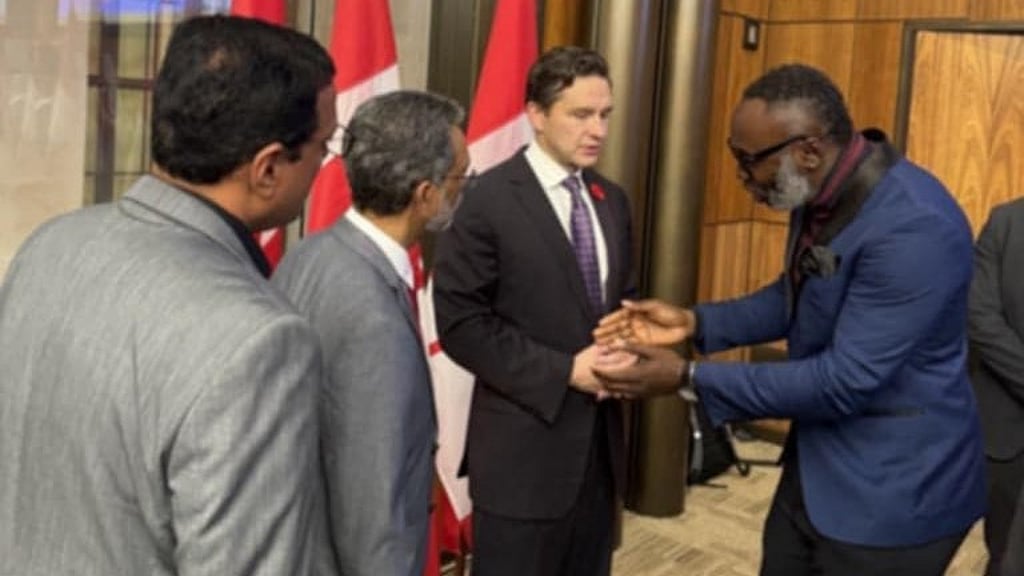
The result must have come as a shock to Solomon Davies Ikhuiwu, founder and leader of God Heal Our Land, a charismatic ministry that typically misuses II Chronicles 7:14, applying it to Canada instead of Israel. As reported by Lee Harding of the Western Standard, April 12, 2025 (link, photo in original):
Solomon Davies (right) and Pierre Poilievre in Hamilton in Ottawa 2024 (Photo credit: Solomon Davies)

Two prominent Canadian Christian leaders are turning to prayer as the federal election draws near, fervent in their belief that the result is at stake.

Hamilton evangelist Solomon Davies launched the Canada Prayer Challenge at the end of January. The online prayer meeting was only meant to last 40 evenings, but still continues due to the importance of the election campaign.

In an interview with Western Standard, Davies said he attended an event on Parliament Hill with seven pastors from his area last October. recalled asking Conservative leader Pierre Poilievre for permission to pray for him in person, which he received.

"The Lord wanted me to tell him that he will be the next prime minister of Canada. This was what I told him October of last year. And I was so sure of what I said to him, because whenever God speaks to me, I run with the word."

The minister said he saw Poilievre again at a well-attended rally in Hamilton two weeks ago and encouraged him again.

"I was like, 'Hey, we're praying for you.' He was like, 'Yeah, we need your prayers.'"

Davies said being a prophetic voice is outside his typical ministry. Nevertheless, he believes a dream he had on April 6 carried divine significance.

"In my dream, Pierre was about to give his victory speech from the campaign the election, I'm close to the front and I'm excited. I'm in anticipation."

However, Poilievre did not emerge as expected.

"To my surprise, the person that came out of the door was not Pierre. It was actually a pastor who was an intercessor [person of prayer] for the nation. I saw my dream, he is praying over the crowd, not on the microphone."

Davies declined to name the man, given he did not have his permission to do so, but believes that he symbolically represents the Church.

"It's almost like the Lord has left it to the church not only to go vote or to campaign for for righteous leaders, to go door knocking for them, to volunteer for them, but the most important thing besides...is praying for this election," Davies said.

"If the church gets lazy, we don't pray, we don't fast, anything can happen, because there's such a thing as election fraud, right?"

From New Brunswick, My Canada founder Faytene Grasseschi sent an email blast on Tuesday to urge Christians to pray for the election.

"Over the last few days, I have felt an increasingly strong impression that I need to fast for our nation. The urgency was growing," Grasseschi wrote.

"This morning, one of my dear friends, Shirley Hildebrandt, messaged me to let me know that TODAY is the 21st day to the federal election and she was feeling to call a fast.

"As soon as I read Shirley's message, I knew that this was what the Lord had been trying to speak to me: a 21-Day Fast."

Hildebrandt is hosting daily prayer calls over Zoom at Noon Eastern through April 29. Grasseschi is organizing an online national day of prayer for Holy Thursday, April 17, which will run from 11 am to 5 pm Eastern.

"We know what is at stake: (possibly) charity status for churches and Christian ministries, increasing debt, a federal unity crisis, parental rights, expanding assisted suicide even more...just to start," Grasseschi said.

"I feel weepy. It is time to cry out for mercy for our land. We don't deserve it, but perhaps He will give it if we humble ourselves and pray."
The website of God Heal Our Land doesn't seem to have been updated recently; it would be interesting to hear Mr. Ikhuiwu's explanation of how God had given him a prophecy that proved to be false. This is the kind of self-deception that happens when you believe that God speaks to you directly through dreams instead of just relying on the Bible, which is the only completely trustworthy source of prophecy.

As for the election, this blogger regars the result as more evidence that Canada is already under God's judgement, and that's likely to continue until He returns.

Saturday, 15 March 2025

Nigerian primate and "prophet" warns Peoples Democratic Party of satanic forces

The Peoples Democratic Party is one of the two major political parties in Nigeria, and is regarded as being on the center-right of the political spectrum. Its candidates won every presidential election from 1999-2011, but the PDP's share of the popular vote has been declining in recent years, not only in presidential but in congressional elections. INRI Evangelical Spiritual Church is led by Primate Elijah Ayodele, who is described as "God's Mouthpiece, Global Prophet, Father of Nations, Great Leader, A Teacher." Readers are advised to remember the following warning when the Nigerian elections occur in 2027. As reported by Seun Opejobi of the Lagos Daily Post, March 14, 2025:

The Leader of INRI Evangelical Spiritual Church, Primate Elijah Ayodele, on Friday revealed that the Peoples Democratic Party, PDP, may not have a presidential candidate in 2027 if the party doesn’t wake up from its slumber.

Primate Ayodele stated that the party needs to retrace its steps, as there are satanic forces in place aiming to ruin it completely.

In a statement by his spokesman, Oluwatosin Osho, Primate Ayodele said that even if the PDP eventually has a legally recognized candidate, the party will lose disgracefully.

He said: ‘‘If care isn’t taken, PDP will lose in 2027 unless they retrace their steps and undergo a total cleansing. PDP will not even come second, let alone third, in the election. There are satanic forces that will ruin PDP until the party dies unless they wake up.”

The prophet stated that the party must turn to God in order to survive because it is rapidly declining, and those who have the power to save it are neither listening nor willing to implement the necessary reforms.

“They need to run to God, or else the party won’t survive 2027. PDP is dying rapidly, and those who can save it won’t listen. In some states, like Lagos, the party’s candidate will not stand a chance. If care isn’t taken, PDP may not even be able to produce a candidate in 2027 because there is a satanic spell on them. Important personalities will continue to decamp,” he said.

However, he stated that the party still has 91 days to begin the process of getting back on track, or else it will only take God’s mercy for a resurrection.

“The party has 91 days to start the process of getting back on track because the spirit of hatred and irritation has been invoked against PDP, and it will only take the mercy of God for them to rise again,” he added.

Tuesday, 31 December 2024

90 years ago--Association of National German Jews urges support for Hitler

I should have posted this a few months ago on the actual anniversary, but better late than never...On August 19, 1934, 17 days after the death of President Paul von Hindenburg, a referendum was held in Germany on whether to merge the posts of Chancellor and President. 95.65% of registered voters went to the polls, with 89.93% voting "Yes" to the following:

The office of the national president is united with that of the national chancellor. In consequence, the former powers of the national president pass to the leader and national chancellor, Adolf Hitler. He appoints his deputy. Do you, German man, and you, German woman, approve of the arrangement made in this law?
The 10.07% "No" vote was reported in Western newspapers as a triumph for the opposition to Adolf Hitler, who had been Chancellor for less than 19 months. However, that view proved to be inaccurate, as combining the offices of head of government and head of state had the effect of allowing Mr. Hitler to take the title Führer und Reichskanzler (Führer and Reich Chancellor), consolidating his dictatorial power as leader of the Nazi regime.

While looking for contemporary newspaper accounts of the referendum, I came upon the following article, published as "Special Cable to the New York Times and Montreal Gazette," published in the Montreal Gazette, August 18, 1934 (bold, capitals in original):

GERMAN JEWS TOLD TO VOTE FOR HITLER

-----

Berlin League Says Suffering Necessary to Mend Harm Done

-----

Berlin, August 17--The League of National German Jews, a small Jewish organization in Berlin, issued today a summons to all German Jews to vote for Chancellor Hitler in the plebiscite Sunday. The league declared the Jews' suffering in Germany had been necessary in order to clear away the damage done by "un-German elements." The statement reads:

"We members of the League of National German Jews, founded in 1921, have always, in war or peace, placed the good of the German people and the German Fatherland above our own good. Accordingly, we greeted the national uprising of January, 1933, although it brought rigors for us, for we saw it as the only means to clear away the damage done in fourteen unhappy years by un-German elements.

"We agree fully with the political testament of Reich President and Field Marshal von Hindenburg, who called the accomplishment of Reich Chancellor Hitler and his movement a decisive step of major historical importance and stated that reconciliation which will include the whole German Fatherland must follow the national awakening and unification of the German people.

"To the German Fatherland belongs body and soul that portion of the Jews who, like ourselves, know no other fatherland than Germany. In the spirit of the dead Reich President's testament, we support the unification of the offices of Reich leader and Reich Chancellor.

"We urge all Jews who feel themselves Germans to vote "yes" on August 19."
Until coming across this article, I had never heaerd of the Verband nationaldeutscher Juden (Association of National German Jews aka League of National German Jews). It was founded by Max Naumann in 1921 and was anti-Zionist, while favouring assimilation of German Jews into the German Volksgemeinschaft (folk community). The Association regarded the anti-Semitism of the early months of the Nazi regime as merely an attempt to stir up the masses. As to the likely future for Jews in Germany as a result of their support for the "Yes" vote in the referendum, it might have become apparent immediately if the following was any indication, as reported by Associated Press, and published in The New York Times, August 20, 1934 (bold in original):

Mueller Hails Hitler's Victory Over Jews: Says Anti-Semitism Is Christian Campaign

Berlin, Aug. 19--Five thousand members of the German Christian Society celebrating Chancellor Hitler's victory tonight heard Reichbishop Ludwig Mueller call anti-Semitism a Christian campaign.

His words left no doubt in the minds of his hearers that the German Protestant church under his leadership will be a racial institution.

"Hitler's fight is a fight for Christendom against Jews, the most savage enemies of Christianity," the Bishop asserted. "The German people, united today, may go through bitterness and distress but will win this campaign for Christianity even if the Jews get together and determine to destroy the nation."

Drawing a parallel between Christ and Chancellor Hitler, the Reich Bishop said:

"As in the days of the old Christians, faith is equal to confidence. Jesus, preaching the gospel, pleaded for confidence. So did our leader when he put the plebiscite as a question of confidence to the nation. We as true Christians had to give him our 'ja,' as only our consent gives him the right to defend our religion."

Bishop Mueller said the election result was "the beginning of the whole nation's Christianity, since it had the courage to vote for and stand behind the leader in his fight against the Jews."

Walter Kinder, Nazi radical church leader, closed the meeting, held in the Friedrichshain Convention Hall, with the German Christian society slogan:

"With God, under the leadership of Hitler, we will march on."
Richard Steigmann-Gall, in his book The Holy Reich: Nazi Conceptions of Christianity, 1919-1945 (2003), refers to Reich Bishop Mueller as "a theological moderate among the German Christians" (p. 159).

How did the Association of National German Jews' policy of appeasement and assimilation work out for them? Not too well: the Association was declared illegal and was dissolved on November 18, 1935, and Mr. Naumann was arrested by the Gestapo the same day, and interned at Columbia concentration camp. He was released after a few weeks, and died of cancer on May 18, 1939 at the age of 64. Most other members of the Association were exterminated by the Nazis during the Holocaust in World War II.

The Verband nationaldeutscher Juden wasn't the only Jewish organization in Germany that supported the Nazis; Der deutsche Vortrupp. Gefolgschaft deutscher Juden (The German Vanguard: German Jewish Followers) was founded in February 1933--almost immediately after Mr. Hitler took office as Chancellor--by Hans-Joachim Schoeps, a professor of religions and religious history at the University of Erlangen. The German Vanguard was basically a youth movement of intellectuals, with a membership of 150 students, and regarded itself as a Jewish political movement within a resurgent German nationalism, while disdaining Eastern European Jews, Zionism, Marxism, and liberalism.

The German Vanguard was dissolved in December 1935, the month after the dissolution of the Association of National German Jews. Professor Schoeps, a monarchist, fled to exile in Sweden late in 1938, and spent World War II in that country, while his parents were deported to Theresienstadt concentration camp in June 1942, and his father died there six months later. Professor Schoeps returned to western Germany in the autumn of 1946, resuming his position at the University of Erlangen in 1950. He died on July 8, 1980 at the age of 71.

Saturday, 30 November 2024

Religious divisions show up in 2024 U.S. presidential election

As reported by John Longhurst in the Winnipeg Free Press, November 16, 2024:

The U.S. election is over. How did religious people vote?

Exit polls from news outlets found a majority of those who identify as Christians voted for Donald Trump, including 63 per cent of Protestants and 58 per cent of Catholics. For white Protestants, that figure was 72 per cent, while for white Catholics it was 61 per cent.

For Catholics, that was a jump of eight per cent over 2020, when 50 per cent favoured Trump while 49 per cent supported Biden. Some of that increase may be because of the increase in support for Trump among Hispanic voters, with 53 per cent voting for him in 2024 compared to 28 per cent in 2020. (Trump also saw a surge among Latino Protestants, from 48 per cent in 2020 to 64 per cent this year.)

Unsurprisingly, 81 per cent of evangelicals overall also voted for him, similar to the figures for 2016 and 2020.

Jews went the other way, with 78 per cent voting for Kamala Harris. So did those who claim no religious affiliation — 71 per cent of the “nones” voted for her. A majority of Muslims voted for her as well (63 per cent), with 32 per cent voting for Trump. Four per cent of Muslims voted for a third-party candidate such as Jill Stein.

About six in 10 members of the Church of Jesus Christ of Latter-day Saints supported Trump, while about eight in 10 Black Protestants supported Harris.

It may be too early to tell exactly why people voted the way they did. But Robert Jones of the Public Religion Research Institute suggested that it might come down to economics for Hispanics, while Trump’s message about being tough on immigration and crime may have appealed to some white Christians. Harris’s support for reproductive rights may have caused Conservative Christian voters to vote for her opponent.

For Jones, the 2024 election once again showed the close allegiance between white Christians and the Republican Party. “They have not moved a centimetre,” said Jones. “And they get out and vote.”

Not all religious people supported Trump. Some lamented his victory, worried that he will implement a Christian nationalist agenda by giving Christians a privileged position in the government and the country and that he will flout the separation of church and state.

They base that fear on comments from Trump himself, who told a Christian group in October “the more powerful you become, the better the country is going to be.” In February he told evangelical Christian broadcasters they would experience “power at a level that you’ve never used before” if he was elected.

According to prominent evangelical supporter Lance Wallnau, Trump’s win would give Christians in America an opportunity to tear down the “gates of Hell” in the Department of Justice and the Internal Revenue Service. “We have to see these strongholds come down,” he said. “God’s giving us a chance to see it happen.”

For Christian nationalist leader Joel Webbon, Trump’s victory paves the way for the church “to instruct civil authorities regarding their identity and duties,” he said.

Trump did nothing to tamp down that kind of speculation. On the campaign trail, he pledged to “protect Christians in our schools and in our military and our government” and in “our public square.” Meantime, while the Republican platform pledged to protect the right to “pray and read the Bible in school” — no other holy scriptures or forms of prayer were mentioned.

Comments like that prompted Andrew Whitehead, author of Taking America Back for God: Christian Nationalism in the United States, to wonder if those who do not embrace that expression of Christianity will “feel marked as not truly American.”

Whitehead, who is also an associate professor of sociology at Indiana University Indianapolis, went on to ask if that Christian nationalist view might result in a pro-Christian stance that includes restrictive immigration policies against non-Christian immigrants in the name of protecting traditional American culture — something along the lines of the first Trump administration’s ban on travel from several Muslim-majority countries.

But Robert Jeffress, pastor of First Baptist Church of Dallas and one of Trump’s most prominent evangelical supporters since 2016, tried to squelch those worries. “People who are not Christians are unduly worried he’s going to institute some kind of oppressive theocracy,” said Jeffress. “He has no interest in doing that.”

As for Donald Trump himself, in his victory speech he stated that “God spared my life for a reason,” referring to the two assassination attempts he survived on the campaign trail. “And that reason was to save our country and restore America to greatness. And now we’re going to fulfil that mission together.”

Over the next few years, we will see how that turns out for everyone in that country — religious and non-religious alike.
It's worth noting that while the majority of those who identified themselves as Christians voted for Donald Trump, the majority of Jews voted for Kamala Harris, in larger numbers than even those who profess no religion, providing yet more evidence that there is no such thing as "Judeo-Christian" values; Judeo values are not Christian values. Since Mr. Trump is much more pro-Israel in his views than Ms. Harris and incumbent Preisdent Joe Biden, whom she succeeded as the Democratic Party candidate, one might wonder why Jews insist on voting the way they do.

As for the 80% of black Protestants who voted for Ms. Harris, it's quite apparent that they were voting for reasons of race rather than principle. As flawed a candidate as Donald Trump is, I don't understand how any true Christian could possibly vote for Kamala Harris, who has made it quite clear that the Lord Jesus Christ and His people are not welcome where she is.

Sunday, 24 July 2022

100 years ago: League of Nations Council confirms British Mandate for Palestine

And it shall come to pass, when all these things are come upon thee, the blessing and the curse, which I have set before thee, and thou shalt call them to mind among all the nations, whither the LORD thy God hath driven thee,
And shalt return unto the LORD thy God, and shalt obey his voice according to all that I command thee this day, thou and thy children, with all thine heart, and with all thy soul;
That then the LORD thy God will turn thy captivity, and have compassion upon thee, and will return and gather thee from all the nations, whither the LORD thy God hath scattered thee.
If any of thine be driven out unto the outmost parts of heaven, from thence will the LORD thy God gather thee, and from thence will he fetch thee:
And the LORD thy God will bring thee into the land which thy fathers possessed, and thou shalt possess it; and he will do thee good, and multiply thee above thy fathers.
Deuteronomy 30:1-5

This is a slightly different version of my post 90 years ago: League of Nations supports Zionism (July 21, 2012).

On July 24, 1922, the League of Nations Council confirmed the text of the draft of the British Mandate of Palestine; Britain formally assumed control of Palestine on September 29, 1923. As reported by the Israel Bible, July 24, 2022 (links in original):

...On April 24,1920, 51 nations, so recently divided by World War I, sent representatives to the League of Nations in Sanremo, Italy. At the San Remo Conference, they agreed to divide up the Ottoman territories, putting Israel in the hands of the British. The decision incorporated the Balfour Declaration, written during the war in 1917, which established the basis for a Jewish state in Israel. The text of this agreement was confirmed by the Council of the League of Nations on July 24, 1922.

How did this all come to be?

In 1917, while the outcome of World War One was very much in the balance, the United Kingdom’s Foreign Secretary Arthur Balfour sat down to write a letter to Lord Rothschild, a leader of the British Jewish community, for transmission to the Zionist Federation of Great Britain and Ireland. The letter was the first public expression of support for Zionism by a major political power, and was the result of rising sympathy among British evangelical Christians towards the “restoration of the Jews” to Palestine that had begun 80 years earlier.

In some ways the Balfour Declaration was the beginning of the process. It certainly was the seed from which the State of Israel grew, but it nearly became a meaningless piece of paper. When Lord Balfour put pen to paper, the British armies were stuck in Egypt and the British government had no political ability to carry out this vision.

On October 31, 1917, the remarkable charge of the Australian 4th Light Horse Brigade captured Beersheba from the German and Ottoman forces. This opened the way for the British forces to advance and capture Jerusalem six weeks later, making the Balfour Declaration relevant, and having practical implications for the Jewish people.

After the war, in 1920, the Paris Peace Conference founded the League of Nations, the first worldwide intergovernmental organization whose principal mission was to maintain world peace. That same year, the seven-day San Remo Conference was held. The full text of the Balfour Declaration became an integral part of the San Remo resolution and the British Mandate for Palestine, turning the letter of intent into a legally-binding foundational document under international law.

51 nations signed the resolution. No objections were raised from the Arab world. In fact, a signed agreement between Emir Faisal, the third son of Hussein ibn Ali al-Hashimi, King of the short-lived Kingdom of Hejaz, and Chaim Weizmann, a Zionist leader, was one of two documents used by the Zionist delegation at the Paris Peace Conference to argue that the Zionist plans for Palestine had prior approval of Arabs.

Faisal, who acquiesced to a Jewish state in order to gain support for his claim on Syria, Jordan, Saudi Arabia, Iraq, Lebanon, and Egypt, was the sole recognized representative of the entire Arab people in 1918. No other Arab states existed at the time. Ironically, the same San Remo Conference that paved the way for Israel also paved the way for the Arab nations that sprung into existence in the region, allocating 99% of the land to form new Arab states.

It took another 27 years and a new organization named the United Nations to formally establish the Jewish state, but the foundations were laid and confirmed by the League of Nations in San Remo in 1922.
See also my posts:

100 years ago: The Balfour Declaration paves the way for fulfillment of biblical prophecy (November 2, 2017)

100 years ago: British forces capture Jerusalem (December 11, 2017)

100 years ago: The Faisal-Weizmann Agreement (January 3, 2019)

Thursday, 31 March 2022

Evangelical churches in Canada use Covid-19 as an opportunity to team up with unbelievers in promoting an antichrist agenda

Be ye not unequally yoked together with unbelievers: for what fellowship hath righteousness with unrighteousness? and what communion hath light with darkness? II Corinthians 6:14

As annoying as the Covid-19 "plandemic" has been, it has served the useful purpose of revealing the advanced state of the apostasy of professing Evangelical Christianity. The material in this post provides an explanation for why Evanjellyfish have been so silent in the face of governmental abuses of power (such as the imprisonment of Christian pastors such as James Coates and Artur Pawlowski). The organization responsible for this project of alleged Christian compassion has been kind enough to publish the names of its partners and supporters, providing ample evidence that they comprise a cage of unclean birds (Revelation 18:2). Submitted for your approval, the following item, as posted by Kristen Parker on the website of the Christian & Missionary Alliance in Canada, June 10, 2021 (bold, links in original):

Love My Neighbour

A member of an Alliance church has developed a project to enable Canadians to express their appreciation for their COVID-19 vaccine by paying it forward to people in vulnerable populations around the world.

Sara Hildebrand, a member and worship leader at Toronto Alliance Church, is the project coordinator for the Love My Neighbour project “a national movement for global vaccine equity inspired by Millennium Kids and Canadian faith communities.” The project was inspired by Matthew 15, where Jesus feeds 4000 people with only a few loaves of bread and some fish. Hildebrand believes that if we all play a small role, we can make a big difference!

Many Canadians have had the privilege of receiving their first vaccine—and some have even received their second. Over 2 billion vaccines have been administered globally, yet still less than 1% of low-income countries have received their first dose.

Through the Love My Neighbour campaign, Canadians have an incredible opportunity to express their gratitude for the vaccines that we will receive by gifting vaccines to vulnerable populations around the world through UNICEF. Through a $25 donation, you can gift a 2-dose vaccine to a global neighbour. This includes: the vaccine, transport, cold-chain protection, health worker training, and safe disposal of needles and waste.

Love My Neighbour wants to see every Canadian gift a $25 donation to vaccinate another individual. With approximately 38 million Canadians, we would be able to work together to help end the pandemic.

There are ways for cities, businesses, churches, families, teams, friend groups, individuals, and more to get involved with the Love My Neighbour Campaign. People are getting creative, and we encourage you to do the same!

At Toronto Alliance Church the quiz team raised donations for vaccines by running a fundraiser where they quoted all of the verses they’ve memorized in Matthew this year. Eight students and their coaches quoted over 1400 verses on a Sunday afternoon. They raised over $2500, providing over 100 vaccines to individuals in low-income countries.

Mayors are choosing to make their cities a Love My Neighbour city. They are encouraging their residents to get involved. Businesses are making donations on behalf of each of their employees. Churches are creating donation pages and encouraging and inspiring their members to increase their giving. There are classrooms that are learning about social justice who are raising donations and learning about their impact. An engaged couple has asked their guests to donate vaccines instead of give gifts! People across Canada are coming together to ensure that our global neighbours have the opportunity to be vaccinated!

June 11-13 the leaders of the G7 countries will be meeting for the UK G7 Summit. Their conversations will be focused on vaccines, and how we can work together to end the pandemic. Hildebrand is hopeful that Canada will make a commitment to return 10% of our vaccine doses to the global distributor of vaccines, COVAX, beginning now, so they can give them to low-income countries.

Ways to Get Involved:

Make a donation! $25 can change someone’s life.

Send a letter to your MP.

Share about the project with your church, employer, mayor, friends, family, team, or anyone you can think of!
At the time the above item was posted, there was abundant evidence that the "vaccines" were actually harming and killing people rather than helping them, and the evidence for that is greater now than it was then; readers are invited to research this for themselves. Professing Christians are promoting a procedure that is not only not helpful, but is weakening and killing the very neighbours whom they profess to love. Even if the vax weren't harmful, the Love My Neighbour project isn't at all about loving my neighbour in any sense of Christian compassion, but is actually about supporting the United Nations, as one can see after clicking on the links at Love My Neighbour's website. Submitted for your approval (bold, capitals, links in original):

Love My Neighbour

The Project

Join Love My Neighbour, and help UNICEF provide COVID-19 vaccines to the world’s most vulnerable people.

Love My Neighbour is a national movement for global vaccine equity, inspired by Millennium Kids and Canadian faith communities, to raise funds to help increase equitable access and delivery of COVID-19 vaccines to vulnerable populations around the world.

Gift a 2-dose vaccine to a global neighbour with your donation of $25 CD, or split the cost with a friend.

This includes vaccines, per-person cost for transport, cold chain protection, health worker training, and safe disposal of needles and waste.

Global vaccination against COVID-19 is the biggest health project in our lifetime - and you can help! Our goal is to supply 38 million vaccines to our neighbours living in lower-income countries – that’s one for each grateful Canadian.

By donating or setting up a fundraiser, you’ll help write the ending of our global pandemic story. Thank you for joining us.
Media Kit

Background Information

Love My Neighbour is the national movement for global vaccine equity, inspired by Millennium Kids and Canadian faith communities. We are collaborating to tackle the biggest health project in our lifetime -- global vaccination against COVID-19 -- by increasing the equitable access and delivery of vaccines to vulnerable populations around the world. Our goal is to supply 38 million additional vaccines to our neighbours living in lower-income countries – that’s one for each grateful Canadian.

WHY

In Canada, we can wait in confidence with gratitude knowing our government has already procured enough vaccines for our entire population. Canadians will be vaccinated in 2021. But we know delayed vaccinations around the world could put everyone at risk of additional COVID variants for years to come. COVAX AMC was designed to supply COVID-19 vaccines to the poorest 92 low and low-middle income countries—more than half the world’s population. But the 1.3 billion COVAX doses planned for 2021 will protect less than 20% of our four billion global neighbours. COVAX AMC’s massive and ambitious vaccination plan will not sufficiently protect four billion living in the developing world, nor end the pandemic in 2021 – they need our help. Every Love My Neighbour donation will increase the number of vaccines delivered to our global family.

HOW

Love My Neighbour is partnering with UNICEF, faith communities, corporations, NGOs, community groups and individuals across the country to reach our goal. We are inviting Canadians to help supply additional vaccines for the world’s most vulnerable people. Every $25 donation helps fund everything needed for UNICEF to deliver a vaccine to people in the world’s hardest-to-reach places. This includes vaccines, per-person cost for transport, cold chain protection, health worker training, and safe disposal of needles and waste. Donations can be made through UNICEF at www.LoveMyNeighbourProject.org

Love My Neighbour is also inviting Canadian businesses to take up our corporate challenge to give one vaccine forward for each employee, and encourage employees to join the movement too.

KEY PLAYERS

COVAX, the vaccines pillar of the Access to COVID-19 Tools (ACT) Accelerator, is co-led by CEPI, Gavi and WHO – working in partnership with developed and developing country vaccine manufacturers, UNICEF, the World Bank, and others. It is the only global initiative that is working with governments and manufacturers to ensure COVID-19 vaccines are available worldwide to both higher-income and lower-income countries. The Gavi COVAX Advance Market Commitment (COVAX AMC) was created to procure COVID-19 vaccines for the poorest 92 low- and middle-income countries, as identified by COVAX, throughout 2021.

UNICEF is tasked with the global distribution and administration of the COVID19 vaccines procured by COVAX AMC. UNICEF’s global presence and expertise make UNICEF the only organization capable of delivering the vaccines equitably and on a global scale. Love My Neighbour funds will be used by UNICEF to procure and deliver up to 100 million additional vaccine doses above and beyond those supplied by COVAX.

Love My Neighbour is a Canadian national movement for global vaccine equity inspired by Millennium Kids and diverse faith communities across the nation to increase the number of COVID-19 vaccines distributed quickly and equitably in in low- and middle-income countries around the world. Love My Neighbour’s fundraising and advocacy gives our whole global family access to life-saving prevention measures.

MORE INFORMATION

Visit www.LoveMyNeighbourProject.org to learn more and join the movement for global vaccine equity.
Love My Neighbour Partners with UNICEF to Invite Every Canadian to Gift A Vaccine Forward

92 countries must settle for 20% vaccination coverage by the end of 2021

TORONTO, ON, May 5, 2021 – Love My Neighbour, a national movement for global vaccine equity, announced today in partnership with UNICEF Canada the launch of a project aimed at gifting forward 38-million COVID-19 vaccines to hardest-to-reach vulnerable neighbours living in 92 low- and middle-income countries – that’s one for each grateful Canadian. Inspired by Millennium Kids and Canadian faith communities, the Love My Neighbour project hopes to increase the equitable distribution of vaccines throughout the developing world to help end the COVID-19 pandemic.

As the world surpasses one billion administered vaccine doses with only 20-million delivered to African countries, UNICEF has called on high-income countries to consider donating at least 5% of their doses without delay.

One $25 donation funds everything needed for UNICEF to procure and deliver a two-dose vaccine – from the manufacturer to the arms of people in some of the world’s hardest-to-reach places. This includes the per-person cost to transport the vaccines, protect the cold chain, train health workers and safely dispose of waste. The project seeks to fund doses over and above the two billion doses expected from COVAX—the global mechanism for equitable access to COVID19 vaccines— in 2021.

“We hope every Canadian will agree that we can all play a role in ensuring that COVID-19 vaccines are affordable and accessible to all countries. We must be better neighbours,” said Sara Hildebrand, Executive Director of Millennium Kids and Project Coordinator of the Love My Neighbour project. “We want to cross the COVID-19 immunity line side-by-side and write this pandemic ending together.”

“Love My Neighbour has built an amazing multi-faith coalition who share a passion and commitment to vaccine equity, and to doing everything they can to bring the world to the other side of COVID-19,” said David Morley, President and CEO of UNICEF Canada. “UNICEF is so pleased to partner with Love My Neighbour and shares the hope that through this national movement we can help put an end to a pandemic that creates serious threats to children and families around the globe.”

About Love My Neighbour

Love My Neighbour is the national movement for global vaccine equity inspired by Millennium Kids and diverse faith communities to increase the number of COVID-19 vaccines distributed quickly and equitably in low- and middle-income countries, through fundraising and advocacy. Visit lovemyneighbourproject.org to learn more.

About Millennium Kids

MILLENNIUM KIDS creates opportunities for and with Canadian children and youth to help Canada keep its United Nations' Sustainable Development Goals promise to reduce global poverty, inequalities and care for the planet by 2030. Millennium Kids provides tools and amplifies the voices of children and youth to become lifelong active, engaged citizens for the common good—shaping the Canada they will inherit. Visit millenniumkids.ca to learn more.

About UNICEF

UNICEF is the world’s leading humanitarian organization focused on children. We work in the most challenging areas to provide protection, healthcare and immunizations, education, safe water and sanitation and nutrition. As part of the United Nations, our unrivaled reach spans more than 190 countries and territories, ensuring we are on the ground to help the most disadvantaged children. While part of the UN system, UNICEF relies entirely on voluntary donations to finance our life-saving work. Please visit unicef.ca to learn more.

# # #

Contact:
Melody Lynch
melody@symmetry-pr.com
306.250.7235


Our Team

Project Coordinator

Sara Hildebrand | Founder/Executive Director, Millennium Kids

Executive Advisors

Rabbi Arthur Bielfeld | Rabbi Emeritus, Temple Emanu-El, Toronto

Michael Cooke | VP Students (Interim) at St Lawrence College; VP Academic Emeritus at George Brown College, Toronto

Patrick Flanagan | Bandleader; Singer/Songwriter; Social Development Advocate, NB

The Rev. Dr. Karen Hamilton | Former General Secretary, Canadian Council of Churches

Zul Kassamali | President, National Alliance for the Advancement of Pluralistic Societies; Vice Chair, Canadian Interfaith Conversation; President, Toronto Area Interfaith Council

Commissioner Christine MacMillan | Director, World Evangelical Alliance Global Human Trafficking Network; Chair, Micah Global; Member, United Nations Multi-Faith Council

Communications Team

Tina Kraulis | Strategic Communications & Events

Cynthia Innes | Management Communications Consultant

Emily Williams | Web Design

Alicia Wheatley | Graphic Design

Krystle Moilliet | Graphic Design

Anne Sophie Roy | French Translation

Irene Soquier | French Translation

Melody Lynch | Symmetry PR

Lisa Rusinek | Social Media

Karen Schenk | Iconium Media

Regan Neudorf | Graphic Design

Our Participants

The following faith communities and organizations are participating in LMN in a range of ways--from advocacy efforts, to writing about LMN in digital publications and/or spreading the word to their membership.

Anglican Church of Canada

Canadian Baptist Ministries

Canadian Council of Imams

Canadian Multifaith Federation

Canadian Rohingya Development Initiative

The Christian and Missionary Alliance in Canada

ERDO (Emergency Relief & Development Overseas)

Faith of Life Network

G20 Interfaith Forum

H4Community

Hamilton Interfaith Peace Group

Human Concern International

International Development and Relief Foundation (IDRF)

Intriciti

Islamic Relief Canada

KAIROS: Canadian Ecumenical Justice Initiatives | KAIROS: Initiatives oecuméniques Canadiennes pour la justice

La fondation Anne Sophie Musique | Anne Sophie Music Foundation

Mennonite Central Committee Canada

Mennonite World Conference

Millennium Kids | Enfants du millénaire

National Alliance for the Advancement of Pluralistic Societies

National Muslim Christian Liaison Committee

Ontario Zoroastrian Community Foundation

Penny Appeal Canada

The Pentecostal Assemblies of Canada

Presbyterian Church in Canada

Reform Jewish Community of Canada

The Salvation Army Canada

Sayeda Khadija Mosque

SymmetryPR

Toronto Board of Rabbis

Union of Medical Care and Relief Organizations-Canada (UOSSM-Canada)

The United Church of Canada

WayBase

World Evangelical Alliance

Our Corporate Donors

Jason Hildebrand Creative Arts

Progressive Contractors Association of Canada

Signpost Music/Steve Bell

In looking at Love My Neighbour's home page, the reader will notice Millennium Kids listed with UNICEF as a partner. This blogger had never heard of Millennium Kids before seeing this, but following the links leaves no doubt that the organization has nothing to do with the Lord Jesus Christ and His kingdom, but is a project to brainwash children into supporting the agenda of the godless United Nations. If a movement is endorsed by Canadian environmentalist, former geneticist, and professing atheist David Suzuki, it's highly unlikely to be compatible with Christianity.

Millennium Kids

Proudly endorsed by David Suzuki

"Today's children and all future generations will bear the brunt of the consequences of our ecologically destructive actions going on today. Millennium Kids are taking action to press our leaders to think about the kind of legacy we are bequeathing to coming generations. Thank you for your efforts to wake up those who are deciding on your futures." - David Suzuki

About Millennium Kids

Millennium Kids are urging everyone to join them in bold strategic action to meet the Sustainable Development Goals (SDGs) by 2030.

Backstory

I first learned about the precursor to the SDGs, the Millennium Development Goals (MDGs 2000-2015) in November 2009. I remember my surprise that I had missed nine years of these historic and global anti-poverty goals (though I birthed our four kids since the adoption of the goals in September 2000). I was convinced that if Canadians knew Canada made this incredible promise in 2000 to “spare no effort” to fulfill the MDGs, in collaboration with 188 other nations, we would find a way to keep our promise. I also knew from my own children that school social justice clubs were spreading across our nation as social justice-mindedness increased in our youngest generation.

Justice and advocacy initiatives

Here are some of the creative ways Millennium Kids have increased awareness and advocated for the MDGs / SDGs across Canada:

Broadcast Millennium Kids public service announcements on national television networks

Recorded an MK anthem for our Download and Be Counted! campaign on the iTunes platform

Marked #1000DaysToGo on the MDGs with a student event at the Glenn Gould Studio, CBC Building, Toronto and a twitter campaign in collaboration with organizations in UK and Germany 2013

Delivered Millennium Kids MDG Petition to Parliament 2014 asking the House of Commons to keep Canada’s MDG promise and allocate the promised 0.7% of our Gross National Income to do so

14-yr-old Millennium Kid spoke at the Micah Summit on the MDGs at the UN Headquarters in NYC 2014

Nine MKs were invited to speak to MPs at an Alternative Committee Meeting on Parliament Hill about the urgency of keeping our MDG and 0.7% Official Development Assistance promises in 2015

Hosted a Live Below The Line $1.75 supper at Toronto restaurant The Depaneur to raise awareness of global extreme poverty

Canada-wide #ChalkYourSidewalk “.7%AID” campaign during the international Conference on Financing for Development in Ethiopia July 2015

Millennium Kids’ Lawn Signs calling 42nd Parliament to take action on poverty and climate

Encouraged children and youth to make handmade Welcome Cards for Syrian newcomer youth coming to Canada 2015-16 (40 MKs from 14 schools delivered 1600+ cards to Minister McCallum at Parliament Dec 9, 2015)

Millennium Kids participated in the United Nations Economic and Social Council Youth Forum 2015 & 2016

Vision & Mission

Vision

Millennium Kids are urging everyone to join them in bold strategic action to meet the Sustainable Development Goals (also known as the Global Goals).

Mission

Engaging the next generation to pursue the SDGs with passion.

Empowering youth to be SDG global partners.

Celebrating together our SDG successes.

Objectives

Increase awareness of the SDGs across generations

Catalyze innovative youth participation in fulfilling the SDGs

Mobilize tremendous public support for the SDGs

Celebrate citizen, organizational and government SDG efforts and accomplishments

Values

Hope, celebration, cooperation, generosity, courage, accountability, tenacity, integrity, diversity, equality, acceptance, kindness, and creativity.

Meet Our Director

Sara Hildebrand is the founder and director of Millennium Kids, a youth movement creating opportunities for youth to propel Canada forward to meet the Sustainable Development Goals by 2030. She is passionate about encouraging youth to use their voice for justice and the common good in the public sphere. Sara received her JD from the University of Toronto Law School and was called to the Ontario bar in 2000.

She was the national coordinator for the Interfaith Millennium Development Goals Events initiative leading up to the 2010 G8 Summit. This initiative encouraged diverse faith communities to gather together with their Members of Parliament in ridings across Canada to express the urgency of meeting the MDGs by 2015. Sara has also worked as Crown Counsel in the Criminal Law Policy Branch for the Ontario Ministry of the Attorney General. Sara was recently honoured as one of 100 Fantastic Canadian Christian Women Leaders for 2014. Sara lives in Toronto with her husband and four children.

The Sustainable Development Goals

The sustainable development goals as outlined on the United Nations website.

1. End poverty in all its forms everywhere

2. End hunger, achieve food security and improved nutrition and promote sustainable agriculture

3. Ensure healthy lives and promote well-being for all at all ages

4. Ensure inclusive and equitable quality education and promote lifelong learning opportunities for all

5. Achieve gender equality and empower all women and girls

6. Ensure availability and sustainable management of water and sanitation for all

7. Ensure access to affordable, reliable, sustainable and modern energy for all

8. Promote sustained, inclusive and sustainable economic growth, full and productive employment and decent work for all

9. Build resilient infrastructure, promote inclusive and sustainable industrialization and foster innovation

10. Reduce inequality within and among countries

11. Make cities and human settlements inclusive, safe, resilient and sustainable

12. Ensure sustainable consumption and production patterns

13. Take urgent action to combat climate change and its impacts*

14. Conserve and sustainably use the oceans, seas and marine resources for sustainable development

15. Protect, restore and promote sustainable use of terrestrial ecosystems, sustainably manage forests, combat desertification, and halt and reverse land degradation and halt biodiversity loss

16. Promote peaceful and inclusive societies for sustainable development, provide access to justice for all and build effective, accountable and inclusive institutions at all levels

17. Strengthen the means of implementation and revitalize the

Global Partnership for Sustainable Development

Learn more about the Sustainable Development Goals at the United Nations SDG website.
In February 2022, a convoy of Canadian truckers travelled across the country to Ottawa to protest "vaccine" mandates. The federal regime of Prime Minister Justin Trudeau responded by invoking the Emergencies Act, basically declaring war on the Canadian people for daring to exercise their God-given and constitutionally-protected rights and freedoms. The move was rescinded a few days later, but the stain remains, and it's increasingly obvious to the country and the rest of the world that Mr. Trudeau's regime is a dictatorship. Despite this, the following letters from Love My Neighbour to the Prime Minister remain on the organization's website as of this posting; they haven't aged well. The perceptive reader will notice that Loving My Neighbour's idea of loving their neighbours involves funding their project with money forcibly taken from their neighbours (i.e., taxpayers); and what's loving about that? I'm not going to mention that the Trudeau regime's idea of supporting global health systems is to support abortion throughout the world.

Letter to Prime Minister Justin Trudeau

May 7,2021

SENT VIA EMAIL

The Right Honourable Justin Trudeau, Prime Minister of Canada

Office of the Prime Minister

Dear Prime Minister Trudeau,

Love My Neighbour (LMN) is a Canadian grassroots project founded by Millennium Kids and diverse faith communities to increase the number of COVID-19 vaccines distributed quickly and equitably in lower income countries. LMN has brought together Canadians of diverse faiths from across the country, united in our desire to see all people regardless of nationality, enjoy equitable access to life-saving COVID-19 vaccines. We encourage the Canadian government to join us in care for our neighbours through working for increased access to vaccines globally.

We recognize the efforts of the government to ensure fair and equitable access to vaccines for priority populations in Canada, as well as international financial support for COVAX. We also believe that Canada can play a greater leadership role to ensure vaccine equity, especially when it comes to prioritizing vaccine access for essential workers and the most vulnerable,around the world and here in Canada.

Canada has currently purchased enough vaccines to vaccinate Canada’s population many times over. Vaccine inequality will only prolong the global pandemic.

We urge the creation and rapid implementation of a re-distribution and donation plan of Canada’s purchased and committed vaccine doses, including doses purchased from COVAX,to COVAX.Following the example of countries like Norway, we urge an immediate minimum 5% donation of Canada’s vaccines to COVAX. The global response to the COVID-19 pandemic must betimely and equitable if it is to be successful.

We also encourage Canadian support for the temporary Trade-Related Aspects of Intellectual Property Rights (TRIPS) waiver, presented to the World Trade Organization. This waiver will ensure that trade regulations and licensing do not impede the timely manufacture, distribution, and affordability of vaccines. Canada has maintained that it has not rejected this proposal, and it is studying the impacts of intellectual property regulations on vaccine manufacturing. While we affirm the importance of careful deliberation, we also urge a rapid response. Without the TRIPS waiver, many low-and middle-income countries may not have access to anywhere near sufficient vaccines before 2023, to say nothing of testing or medications for supportive care.

We also encourage Canada to continue to support global health systems strengthening through an increased Official Development Assistance budget, with funding specially designated for community-based health organizations, including those run by women.

Canada can lead the way in ensuring fair access, distribution and administration of the vaccine around the world. We would like to request a meetingwith you or your designate to discuss how we can work together towards achieving the goals outlined in this letter, including the development of a matching fund for any donations made towards the purchase of global vaccines, global vaccine delivery and health support systems.

Signed:

Anglican Church of Canada

Anglican Council of Indigenous Peoples

Canadian Baptist Ministries

Canadian Council of Imams

Canadian Multi-faith Federation

Canadian Rohingya Development Initiative

Christian and Missionary Alliance in Canada

Congrégation de Notre-Dame

Human Concern International

International Development and Relief Foundation (IDRF)

Intriciti

Islamic Relief Canada

KAIROS: Canadian Ecumenical Justice Initiatives

La fondation Anne Sophie Musique

Mennonite Central Committee

Millennium Kids

National Muslim Christian Liaison Committee

Ontario Zoroastrian Community Foundation

The Pentecostal Assemblies of Canada/ Emergency Relief and Development Overseas

The Presbyterian Church in Canada Primates Fund for World Relief and Development Reform

Jewish Community of Canada

Union of Medical Care and Relief Organizations-Canada

The United Church of Canada

Cc:

Hon. Chrystia Freeland, Deputy Prime Minister and Minister of Finance

Hon. Marc Garneau, Minister of Foreign Affairs

Hon. Karina Gould, Minister of International Cooperation

Hon. Mary Ng, Minister of International Trade

Hon. Patty Hadju, Minister of Health

Hon. Hon. Marco E. L. Mendicino, Immigration, Refugees and Citizenship

Hon. Anita Anand, Minister of Public Services and Procurement

Hon. Erin O’Toole, Leader of the Official Opposition

Mr. Jagmeet Singh, Leader of the New Democratic Party

M. Yves-François Blanchet, Chef du Bloc Québécois

Ms. Annamie Paul, Leader, Green Party of Canada

Michael Chong, Official Opposition Critic for Foreign Affairs Conservative Party of Canada

Heather McPherson, New Democratic Party Critic for International Development

Jack Harris, Critic for Foreign Affairs New Democratic Party

Stephane Bergeron, Critic for Foreign Affairs Bloc Quebecois

Hon. Raquel Dancho, Official Opposition Critic for Immigration, Refugees and Citizenship, Conservative Party of Canada

Christine Normandin, Bloc Critic for Immigration, Refugees, and Citizenship

Jenny Kwan, NPD Critic for Immigration, Refugees, and Citizenship

Tracy Gray, Official Opposition Critic, Export Promotion and Trade, Conservative Party of Canada

Garnett Genuis, Official Opposition Critic, International Development and Human Rights, Conservative Party of Canada

Stéphane Bergeron, Bloc Critic for Foreign Affairs

Simon-Pierre Savard-Tremblay, Bloc Critic for International Trade

Alexis Brunelle-Duceppe, Bloc Critic for Francophonie and International Cooperation

Daniel Blaikie, NDP Critic for Export Promotion and International Trade
----------------------------------------------------------------------------

Thank You Letter to the PM

December 21, 2021

SENT VIA EMAIL

The Right Honourable Justin Trudeau, Prime Minister of Canada

Office of the Prime Minister

Hon. Minister Karina Gould

Hon. Minister Harjit Sajjan

Dear Prime Minister Trudeau, Minister Gould and Minister Sajjan,

Thank you for the creation and support of the generous matching grant for global vaccine access through UNICEF Canada. We are grateful for the chance to demonstrate the compassion and concern Canadians of faith share for our global neighboursand the desire to ensure everyone is able to access life-saving vaccines. Across the country, Canadians held fundraisers, wrote songs, took part in bake sales, decorated pumpkins and sidewalks, buzz cut their hair, swam 7 km across LacSt-Pierre, requested vaccine donations in lieu of wedding and birthday gifts, and collaborated with their Scouts’ group, Girl Guides’ Unit, school, youth group, neighbourhood or faith community, in support of global vaccination efforts. Together with UNICEF Canada, we raised over $9.6 million to help fully vaccinate nearly 4 million people in low-income countries against COVID-19!

We recently learned that our unique partnership between 35 diverse faith organizations, Millennium Kids and UNICEF Canada has garnered the Association of Fundraising Professional’s 2021 Outstanding Foundation or Philanthropic Group Award. Thank you for being part of this award-winning collaborative effort! As we celebrate, we also remember the billions of people who still do not have access to vaccines. With the good news of vaccine approvals for Canadian children, we recognize the growing gap in vaccine access and supply between Canada and our global south neighbours, including kids around the world. And, with Canada’s privileged position comes an increased responsibility to ensure that everyone-adults, youth and children all over the world, have access to their right to a healthy and safe life. The new variant, Omicron, also reveals the need to close the global vaccine gap to keep everyone safe, in Canada and globally.

We would welcome the chance to meet and discuss how we, as faith organizations, can continue to work with the Canadian government to end the pandemic everywhere through a globalplan for equitable global vaccine access. Based on supplies, we could have comprehensive vaccine coverage of the world in 2022, but to do so we need a clear and financed plan that prioritizes the most vulnerable around the world. Canada is uniquely positioned to play a leading role, in multilateral spaces in which we sit, in the creation and implementation of a plan that includes support of the WTO TRIPs waiver on patents, vaccine dose sharing, and global health systems support.

As we have demonstrated through Love My Neighbour, Canadians of faith are eager to support you in your efforts. We look forward to meeting together to discuss how we can continue to work to end the pandemic everywhere, for everyone,in 2022.

Signed

Anglican Church of Canada

Anglican Council of Indigenous Peoples

Canadian Baptists Ministries

Canadian Council of Imams

Canadian Multi-faith Federation

Canadian Rohingya Development Initiative

Christian and Missionary Alliance in Canada

International Development and Relief Foundation (IDRF)

Intriciti

Islamic Relief Canada

KAIROS: Canadian Ecumenical Justice Initiatives

La foundation Anne Sophie Musique

Mennonite Central Committee

Mennonite World Conference

Millennium Kids

National Association for the Advancement of Pluralistic Societies

National Muslim Christian Liaison Committee

Ontario Zoroastrian Community Foundation

Primates World Relief and Development Fund

Reform Jewish Community of Canada

Salvation Army Canada

World Evangelical Alliance

cc: David Morley, President, UNICEF Canada
If the reader requires more proof of the unholy fellowships among professing Christians, apostate Christian bodies, non-Christian religions, and government, and that participation in Love My Neighbour by professing Christians is an act of disobedience and evidence of apostasy, the project's Interfaith Resources link provides it. Look carefully at the wide variety of religions involved; the reader may recognize, and may even be shocked, at the names on the list.

Interfaith Resources

Hope, Gratitude and Solidarity

A Message to Canadians from Religious Leaders in Canada in Response to the COVID-19 Pandemic

In spite of present sufferings, which can seem overwhelming at times, the flames of hope cannot be extinguished.

Let us witness hope to each other and so become beacons of light during these uncertain times.

Canadians are experiencing the devastating impact of COVID-19 in what has become a rapidly evolving crisis. Understandably, this crisis has brought about feelings of anxiety, apprehension and fear. Critical elements of our daily lives are being thrown into uncertainty: health, employment, financial security, recreational activities, as well as our ability to gatheras worshiping communities. In view of these difficulties, we as religious leaders wish to bring forward a message of hope, gratitude and solidarity to all people who call Canada home.

A Message of Hope

We draw hope from a variety of sources: from our religious beliefs, the love of our families, the relationships with friends and the work we do. Each of these, and others as well, provides rays of hope to our daily lives. Likewise, hope provides courage to face the burdens we bear and the ability to look onwards toward the dawning of a new day. In spite of present sufferings, which can seem overwhelming at times, the flames of hope cannot be extinguished. Love, which gives life its fullest meaning, continues to seek out the common good in spite of individual difficulties. Acts of kindness can bring us closer in spirit, despite the requirements of physical distancing. Let us witness hope to each other and so become beacons of light during these uncertain times.

Canada has gone through several difficult and painful experiences in its history. When current and former generations have responded to these challenges, many were empowered by unwavering hope as well as human and spiritual resilience. For religious believers, this hope takes on a special and unique dimension. It assures us of the caring embrace of the Creator, a sacred relationship sustained by prayer, and which flows into our human relationships whereby we care for one another and bear each other’s burden. Yet, hope brings for everyone a promise of renewal, even in the midst of human suffering. Hope assures us that this affliction too shall pass.

We draw hope from a variety of sources: from our religious beliefs, the love of our families, the relationships with friends and the work we do. Each of these, and others as well, provides rays of hope to our daily lives.

A Message of Gratitude

During this time of crisis, we as religious leaders wish to offer words of appreciation and gratitude. Health care professionals are providing unfailing and dedicated service under stressful and difficult circumstances. They provide for us a powerful witness of care, expertise and service in the midst of the COVID-19 pandemic.

There is also the increased risk of exposure to infection along with other hardships being experienced by so many others. For instance, while the rest of society rightly heeds the precautions of physical distancing, many remain at work in grocery stores, pharmacies and factories. Students, the middle-aged, and those close to retirement are fulfilling a variety of essential front-line jobs in the supply chain, ensuring that stores remain open, shelves remain stocked, and goods are delivered so that others can have food, medicines and other essentials for their families and communities. We express a deep appreciation and gratitude for these workers.

Governments across Canada as well as religious leaders are bearing particularly heavy burdens in steering our communities through this calamity. It is comforting to see that in such demanding times, political differences are being set aside to serve the common good. This too is a witness of hope for Canadians. For all these acts of generosity and dedication, let us add our expressions of gratitude for the important work of the diverse leaders of our country.

A Message of Solidarity

We urge all people in Canada to listen and follow attentively the directions of our public health officials and government leaders. We, as religious leaders, pledge to lead by example. We all must act together in confronting this virus. While everyone is vulnerable during this crisis, let us not forget those in our society who, prior to COVID-19, were already vulnerable to health and social ailments. As religious leaders, we raise our collective voices to highlight the necessity for greater attention to the needs of the homeless, the incarcerated, the elderly and those already suffering from social isolation. We remember too those people, especially women and children who face abuse and violence, who are not safe at home and may suffer additional abuse and violence as stress increases. We must never overlook or exclude these groups from our planning, preparedness and response to this pandemic. We are particularly mindful of First Nations, Métis and Inuit communities, including isolated Northern communities, who were already facing pre-existing challenges and for whom the COVID19 outbreak could prove singularly devastating. Likewise, we need to remember the needs and vulnerabilities of the many refugees and migrant workers who have come to Canada seeking safety and security.

Charitable organizations in Canada will face greater challenges during this time of crisis and will need greater assistance from governments so as to continue their vital work. This is a time for human solidarity. We all need to pull together. It is essential to carry out the practical requirements to limit the spread of this virus. It is also important to maintain a posture of attentive caring towards our neighbour. This includes care and solidarity for the global community who face this crisis with far fewer resources than those accessible to Canada. This is a time for us to draw closer to God.

Religion and spirituality can indeed contribute to building people up, to providing a sense of meaning, inner strength, new horizons and openness of hearts. As religious leaders, we wish to emphasize, especially in times like these, the power and importance of prayer. We earnestly pray for healing, for the continued efforts to relieve human suffering, and for perseverance throughout these challenging times. As history records these moments for our country’s future, let us pray that, in the face of COVID-19, we respond with an abundance of hope, gratitude and solidarity, trusting in the loving and ever merciful God, the source of all hope.

Rev. Kenesha Blake-Newell
Itinerant Elder (Grant AME)
African Methodist Episcopal Church

Farhan Iqbal
Missionary
Ahmadiyya Muslim Jama’at Canada

Rev. Shane B. Janzen
Archbishop
The Anglican Catholic Church of Canada

The Most Rev. Linda Nicholls
Archbishop and Primate
The Anglican Church of Canada

Rev. Fr. John Benjamin Vic Paradero, OMHS
Rev. Fr. Jose Mark John Jamili, OMHS
Apostolic Catholic Church of Canada

Rev. Wesley E. Mills
President
Apostolic Church of Pentecost of Canada, Inc.

His Grace Bishop Abgar Hovakimyan
Primate
Armenian Holy Apostolic Church Diocese of Canada

Mobeen Khaja, O Ont.
President
Association of Progressive Muslims of Canada

Kevin Schular
Executive Director
Baptist General Conference of Canada

Charles Mashinter
Executive Director
Be In Christ Church – Canada

Lee Nicholas-Pattillo
President
Canadian Association for Baptist Freedoms

MGen Guy J.J. Chapdelaine, OMM, CD, QHC
Chaplain General
Canadian Armed Forces

Rev. Dr. Terry G. Smith
Executive Director
Canadian Baptist Ministries

Dr. Peter Reid
Executive Minister
Canadian Baptists of Atlantic Canada

Rev. Tim McCoy
Executive Minister
Canadian Baptists of Ontario and Quebec

Rev. Rob Ogilvie
Executive Minister
Canadian Baptists of Western Canada

Dr. Adriana Bara
Executive Director
Canadian Centre for Ecumenism

+Richard Gagnon
Archbishop of Winnipeg, President
Canadian Conference of Catholic Bishops

Elton Da Silva
National Director
Canadian Conference of Mennonite Brethren Churches

Rev. Stephen Kendall, President
Pastor Peter Noteboom, General Secretary
The Canadian Council of Churches

Imam Mohamed Refaat Abo Onar
President
Canadian Council of Imams

Nina Karachi-Khaled
President of the National Board
Canadian Council of Muslim Women

Rev. David McGrew
National Director
Canadian Fellowship of Churches and Ministers

Pandit Roopnauth Sharma
President
Canadian Multifaith Federation

Zul Kassamali, Co-chair
Aileen Van Ginkel, Co-chair
Canadian Interfaith Conversation

Rabbi Reuven Poupko
Rabbi Baruch Friedman-Kohl
Rabbi Debra Landsberg
Rabbi Jonathan Infeld
Co-chairs
Canadian Rabbinic Caucus, an affiliate of the Centre for Israel and Jewish Affairs

Beverly Shepard
Presiding Clerk
Canadian Yearly Meeting of the Religious Society of Friends (Quakers)

Rev. Dr. David Hearn
President
The Christian and Missionary Alliance in Canada

Rev. Ann Stainton
Moderator
Christian Church (Disciples of Christ) in Canada

The Rev Dr. Darren Roorda
Canadian Ministries Director
Christian Reformed Church in North America

Elder Michel J. Carter
Elder John N. Craig
Elder James E. Evanson
Elder Michael R. Murray
Area Seventies
The Church of Jesus Christ of Latter-day Saints

Rev. Dr. Ian Fitzpatrick
National Director
Church of the Nazarene Canada

Kerry Richards
President, Canada East
Community of Christ

Rabbi Reuven P. Bulka, CM, Ph.D
Rabbi Emeritus and spiritual leader
Congregation Machzikei Hadas, Ottawa

Rev. Dr. David Schrader
National Pastor
Congregational Christian Churches in Canada

Netta Phillet
Coordinator
Edmonton Interfaith Centre for Education & Action

H.G. Anba Mina
Bishop Mississauga, Vancouver and Western Canada
H.G. Anba Makar
Bishop of Goshen, Egypt;
Papal Vicar in the Archdiocese of Toronto
H.G Abba Boulos
Bishop of Ottawa, Montreal, and Eastern Canada
The Coptic Orthodox Church in Canada

L.K. (Rev. Fr.) Messale Engeda
Head priest and Administrator
Ethiopian Orthodox Tewahedo Church of Canada

Dr. David P. Lavigne
Bishop
The Evangelical Christian Church in Canada

Bruce J. Clemenger
President
The Evangelical Fellowship of Canada

Dr. William Taylor
Executive Director
Evangelical Free Church of Canada

The Rev. Susan C. Johnson
National Bishop
Evangelical Lutheran Church in Canada

Tim Dyck
Executive Director
Evangelical Mennonite Conference

Rev. Steven F. Jones
National President
The Fellowship of Evangelical
Baptist Churches in Canada

Steve Falkiner
President
Foursquare Gospel Church of Canada

Bill Hall
President
Grace Communion International Canada

Philip Bryant
Executive Director
Grace Fellowship Canada

His Eminence Archbishop Sotirios
Greek Orthodox Archdiocese of Canada

Pandit Roopnauth Sharma
President
Hindu Federation of Canada

Rev. Paul McPhail
General Secretary
Independent Assemblies of God International Canada

Dr. Ronald A. Kuipers
President
Institute for Christian Studies

Halil Yurtsever
Intercultural Dialogue Institute

Brian A. Hawes
President
Interfaith Committee on Chaplaincy in the Correctional Service of Canada

Imam Ilyas Sidyot
Grand Mosque of Saskatoon
Islamic Association of Saskatchewan (Saskatoon) Inc.

Jennifer Henry
Executive Director
KAIROS: Canadian Ecumenical Justice Initiatives

Naj Mankal
President
Islamic Centre of Southwest Ontario

Imam Zubair Sidyot
Lethbridge Muslim Association (Alberta)

Belle Jarniewski
President
Manitoba Multifaith Council

Rev. Dr. Isaac Mar Philoxenos Episcopa
Bishop, Diocese of North America And Europe
Mar Thoma Syrian Church

Doug Klassen
Executive Minister
Mennonite Church Canada

Zul Kassamali
President
National Alliance for the Advancement of Pluralistic Society

Muneeb Nasir
Co-Chair
National Muslim Christian Liaison Committee

His Eminence, Archbishop Irénée
Archbishop of Ottawa and Canada and the Archdiocese of Canada
Orthodox Church in America

Rev. Dr. David R. Wells
General Superintendent
The Pentecostal Assemblies of Canada

Rev. Terry W. Snow General Superintendent Pentecostal Assemblies of Newfoundland & Labrador The Rev. Amanda Currie
Moderator
The Presbyterian Church in Canada

Imam Irshad Unia
Prince Albert Muslim Association (Saskatchewan)

The Rev. Marijke Strong
Executive Secretary
Regional Synod of Canada
Reformed Church in America

Pascale Frémond
President
Religions for Peace Canada

Commissioner Floyd J. Tidd
Territorial Commander
The Salvation Army Canada and Bermuda Territory

The Most Rev. Zenji Nio
Abbot, Samurai Buddhist Temple & Museum
Tokyo, Japan & Bay Street Corridor, Toronto

Rabbi David Seed
President
Toronto Board of Rabbis

The Most Reverend Lawrence Huculak, O.S.B.M.
Metropolitan Archbishop of Winnipeg for Ukrainian Catholics in Canada

His Eminence, The Most Rev. Metropolitan Yurij (Kalistchuk)
Archbishop of Winnipeg and the Central Eparchy
Primate of the Ukrainian Orthodox Church of Canada

Rev. David Rowley
General Secretary
The Union of French Baptist Churches in Canada

Rev. Brian K. Magnus
Bishop
The United Brethren Church in Canada

The Right Rev. Richard Bott, Moderator
Nora Sanders, General Secretary
The United Church of Canada

David Ruis
National Director
Vineyard Canada

Pastor Mike Stone
Executive Director
Vision Ministries Canada

Rev. Dr. Eric R. Hallett
District Superintendent, Central Canada District
The Wesleyan Church

Venerable Dr. Bhante Saranapala
West End Buddhist Temple and Meditation Centre

Jaskaran Singh Sandhu
Executive Director
World Sikh Organization of Canada
See also my posts:
American Christians--Is your pastor a hireling of the United States government? (May 3, 2010)

Trudeaupia's Canada's public health officer wants "faith leaders" to promote Covid-19 vaccine acceptance (January 27, 2021)

July 5, 2022 update: Love My Neighbor is exemplifying Vox Day's second law of SJWs: They always double down. Despite increasingly overwhelming evidence that the Covid-19 "vaccine" is killing some people and making others seriously ill, LMN is pushing ahead with its pseudo-righteous efforts. The reader of the latter of the two following articles will notice that it makes no mention of the actual purpose of Love My Neighbour.

As reported by Matthew Neugebauer of Faith Today, June 24, 2022 (links in original):

While Canada’s COVID-19 vaccination rate is currently at 86 per cent, the rate of those in poorer countries who have received at least one dose is only 17.8 per cent, according to OurWorldInData.org.

Christine MacMillan, a senior advisor with the World Evangelical Alliance, says this low rate is primarily about the socioeconomic conditions that prevent people from getting vaccinated, even more than the physical availability of the vaccines.

She offers the example of wage labourers considering if they can take time off to get vaccinated. “It’s their daily work for daily food. They couldn’t afford to take a few hours off work.”

Enter activist Sara Hildebrand, who started a Canadian interfaith campaign to support vaccine access in low-income countries. The Love My Neighbour campaign highlights the need for vaccine equity, encourages churches and other community groups in awareness-raising efforts and provides a donation portal directly to UNICEF’s GiveAVax program.

Hildebrand, known for founding the youth movement Millennium Kids in support of the United Nations Sustainable Development Goals, says the new vaccine campaign has employed everything from special Sunday collections to inspiring sermons to youth arts and crafts projects and even a Bible Quiz-a-thon to raise funds and awareness. She encourages donors to “pay forward” the vaccine doses that Canadians receive for free through public healthcare, asking for symbolic contributions of $25.

At time of writing, Love My Neighbour has raised over $750,000.

The campaign formally includes several familiar Christian groups including The Alliance Canada (formerly Christian & Missionary Alliance), Salvation Army Canada and The Pentecostal Assemblies of Canada/Emergency Relief and Development Overseas.

David Adcock, head of ERDO, serves on Love My Neighbour’s advocacy committee, which recently made a submission to a federal parliamentary committee urging the Canadian government to increase vaccine access and support the World Trade Organization waiver on patents for COVID-19 vaccines.

Other participants in the campaign include musician Steve Bell’s record label Signpost Music and the World Evangelical Alliance, with MacMillan contributing as an executive advisor connecting Love My Neighbour to the United Nations and UNICEF. She says her membership on both the World Evangelical Alliance’s UN Mission and the UN’s Multi-Faith Advisory Council are key assets to the campaign.

MacMillan, who previously led The Salvation Army in Canada and Bermuda (and did a stint in Papua New Guinea), says evangelical involvement in the movement for global vaccine equity is inspired by the way “Jesus acknowledged, while He was here on earth, the vulnerable, those who were considered in some ways castaways by society.”

Hildebrand, a lifelong member of The Alliance Canada, similarly looked to the gospel accounts for motivation to start Love My Neighbour, especially the story of the five loaves and two fish.

“What great plans might the Creator have to bless where all we see is vaccine shortage?” she asks on the “Our Story” section on the organization’s site. “To love our neighbours as ourselves, shouldn’t we pass on [“pay forward”] every second vaccine available to us?”
As reported by Sharon Chisvin of the Winnipeg Free Press, July 2, 2022:

Winnipeggers may have recently noticed more than the usual number of lemonade stands set up in neighbourhoods across the city. That’s because those lemonade stands are among the micro-fundraising, youth-oriented initiatives being encouraged by Love My Neighbour (LMN), a national, multi-faith movement devoted to global COVID vaccine equity.

Sara Hildebrand, a Toronto lawyer and social activist, was inspired to create LMN early last winter after reading in scripture about Jesus miraculously feeding 5,000 people with only five loaves of bread and two fish. That parable led her to question vaccine availability and accessibility in Canada, in comparison to poorer countries, and to begin researching what the United Nations was planning for its vaccine rollout in the developing world.

“I learned about the international partnership, COVAX, and its ambitious plan to provide one billion COVID vaccines doses for 500 million of the world’s poor,” Hildebrand says, “(but) I couldn’t shake the simple math calculation that only 12 per cent of the poorest half of the globe would have access to this lifesaving vaccine in 2021 according to COVAX’s plan.”

Finding that fact unacceptable, Hildebrand — who is also the founder of the social justice and advocacy organization Millennium Kids — reached out to multi-faith advisers and acquaintances across the country with the idea of organizing Canadians to pay forward their receipt of free vaccines with vaccines to lower-income nations. Upon receiving an overwhelmingly positive response from those she contacted, Hildebrand organized an inaugural Zoom meeting with more than two dozen faith and NGO leaders in order to put her plan into action.

“We shared our deep discomfort with finding our country at the front of the vaccine queue while so many global neighbours might wait years to receive their vaccine,” Hildebrand says. “As faith communities, this was a social inequity we were not prepared to live with.”

LMN, which launched publicly in May, currently enjoys the support of 37 Canadian religious communities and organizations. These include churches, synagogues, mosques and parochial schools, all of which are raising awareness about or funds for the organization and its cause.

In Winnipeg, the Manitoba Islamic Association has already raised thousands of dollars in partnership with Islamic Relief Canada to purchase vaccines for Yemen and India, while the Home Street Mennonite Church fundraised for vaccines under the auspices of the Mennonite World Conference’s LMN campaign. The local church also decorated its walls with people-shaped cut-outs as a means of keeping track of the number of individuals overseas who received vaccines as a result of the congregation’s generosity.

Congregation Etz Chayim, a conservative synagogue in Winnipeg’s North End, is also becoming increasingly involved with LMN.

“I plan to encourage members of CEC to get involved with LMN’s newest fundraising campaign,” says Rabbi Kliel Rose, the synagogue’s spiritual leader.

“In addition, I intend to encourage our members to utilize the LMN Jewish resources online.”

Those online resources, developed by a group of rabbis from across Canada, feature sermon materials, a conversation guide, classroom resources, a video, a petition and a call to action, and can be used by any faith community.

Rose also continues to meet virtually with other local and national LMN representatives and religious leaders to discuss additional ways in which Canadians can help alleviate vaccine inequity.

“The world needs people of faith, people of justice and compassion to arise, to say not on our watch, and then, with feet on the ground, to act together,” Hildebrand emphasizes.

“Collective advocacy for global vaccine equity has been a defining feature of LMN right from the beginning,” she adds.

Whether that advocacy takes shape as a sermon, a petition or a lemonade stand, it sends a message and makes a difference. The purchase of a glass of lemonade for a couple dollars on a sunny summer day in Winnipeg means someone somewhere in the developing world will receive two doses of a COVID vaccine that could save their life. And that’s rewarding and refreshing news for everyone.