





As reported by Israfan, February 20, 2025:
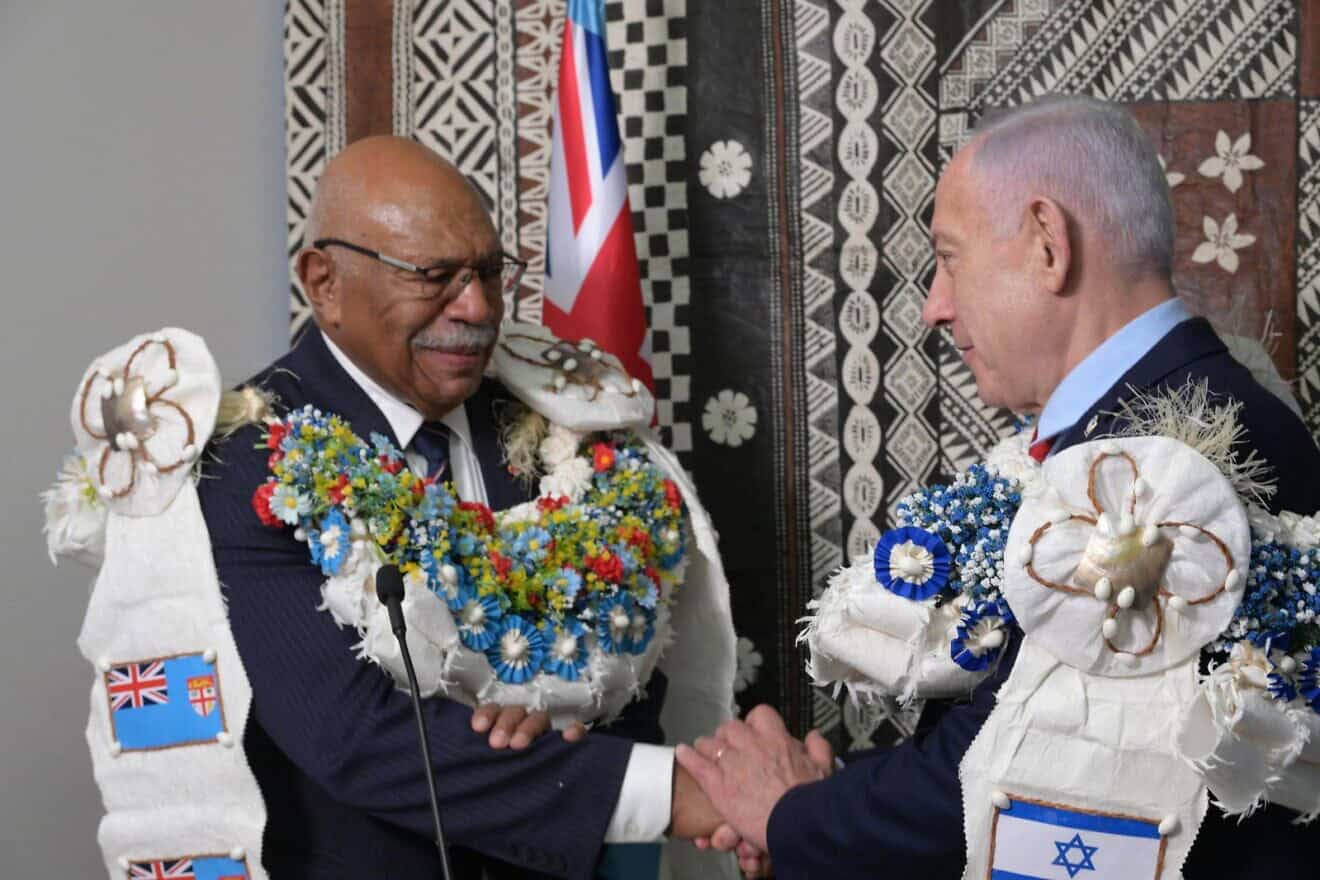
The South Pacific nation of Fiji is set to open an embassy in Jerusalem later this year, Deputy Prime Minister Viliame Gavoka announced on Wednesday. The decision, approved by Fiji’s Cabinet on Tuesday, marks a significant step in strengthening bilateral ties with Israel.As reported by Etgar Lefkovits of Jewish News Syndicate, September 17. 2025:
“We are absolutely excited about coming to Jerusalem, and we most definitely will be there this year,” Gavoka told JNS in a phone interview. The embassy inauguration, originally planned for last year, was delayed due to the war against Hamas in Gaza.
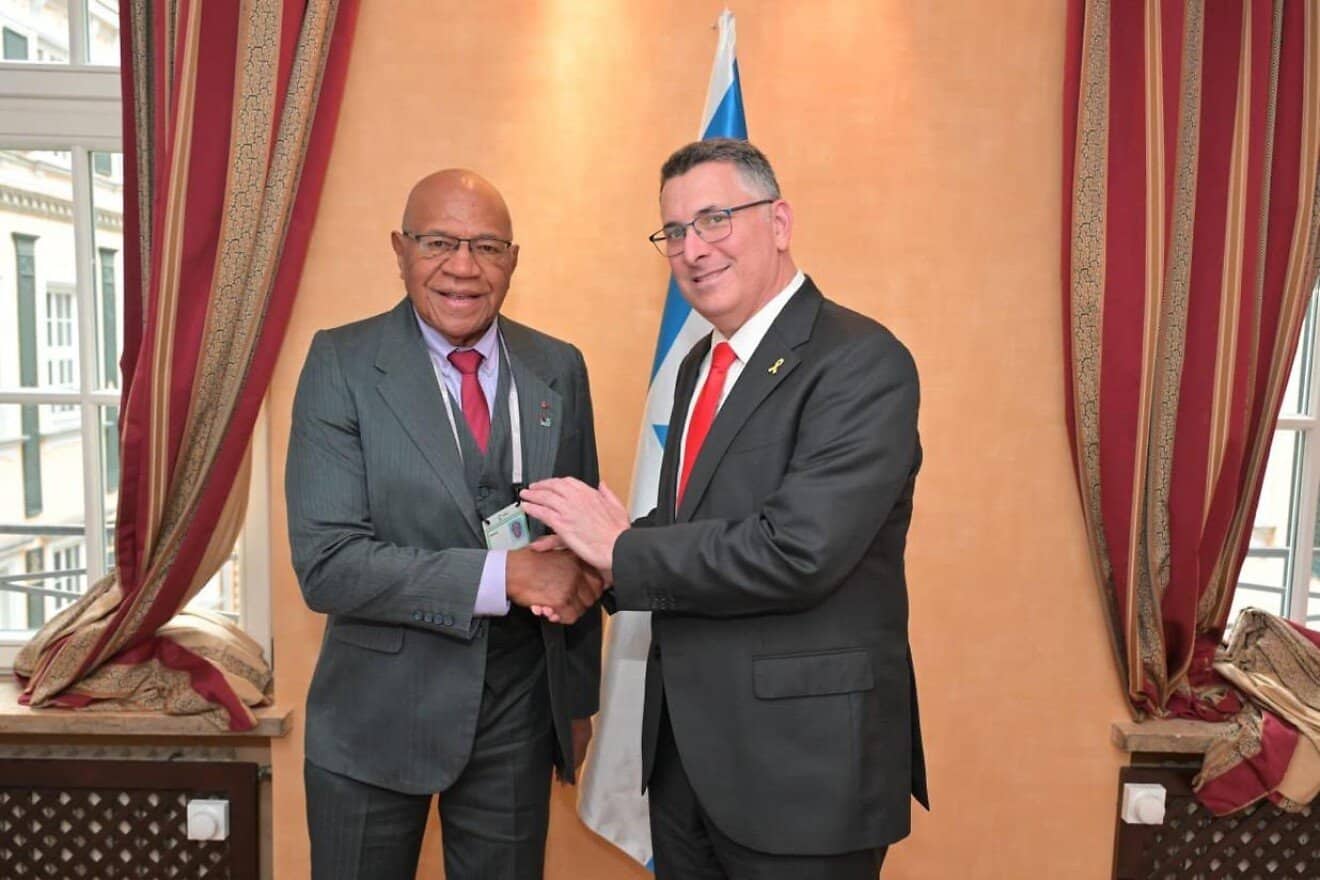
Fiji’s Prime Minister Sitiveni Rabuka reaffirmed the decision during a meeting with Israeli Foreign Minister Gideon Sa’ar on the sidelines of the Munich Security Conference. Sa’ar welcomed the move, tweeting: “I commend the Republic of Fiji’s government for its historic decision to open an embassy in Jerusalem, the eternal capital of the Jewish people.”
With Fiji’s decision, the list of countries with embassies in Jerusalem will grow to seven, joining the United States, Guatemala, Honduras, Kosovo, Paraguay, and Papua New Guinea. Most other countries with diplomatic ties to Israel maintain their embassies in Tel Aviv or its surrounding areas.
The momentum to recognize Jerusalem as Israel’s capital received a major boost in 2018 when then-U.S. President Donald Trump moved the American embassy to the city. Since then, several nations have followed suit, with more expected to announce similar decisions soon.
Fiji’s move not only underscores its support for Israel but also contributes to the growing international acknowledgment of Jerusalem as the heart of the Jewish state.
The South Pacific country of Fiji inaugurated its embassy in Jerusalem on Wednesday, becoming the seventh nation to have its diplomatic mission in the capital of Israel.
”The fact that you have come here and you have put your embassy in Jerusalem, you recognize a truth that everybody should recognize but few governments have done so far: that this has been our capital for 3,000 years since the days of King David,” Israeli Prime Minister Benjamin Netanyahu said at the inauguration ceremony.
“The special bond with your great nation is deeply revered by the people of Fiji,” said its prime minister, Sitiveni Rabuka, who traveled to the Jewish state from halfway around the world with a delegation of his senior government ministers for the inauguration. “The opening of our embassy is a great testament to the enduring connection between our two peoples.”
Rabuka, who took office three years ago, first announced the move in February. He heads a three-party government that includes the right-wing Christian Sodelpa Party, one of whose leaders’ demands was that Fiji open an embassy in Jerusalem.
“You are paving the path of truth,” Israeli Foreign Minister Gideon Sa’ar told the Fijian leader at a reception at the Ministry of Foreign Affairs, expressing disbelief at how other nations around the world still try to deny the Jewish people’s biblical roots to the historic city. “You are a true friend of Israel.”
He added that “Jerusalem is the eternal capital and beating heart of the Jewish people. Today, Fiji lays a stone in its ancient walls.”
Rabuka, who also serves as foreign minister, in turn invited Netanyahu to visit the archipelago in the South Pacific Ocean, northeast of New Zealand and two-thirds of the way from Hawaii to New Zealand.
The move also follows a decades-long campaign by an evangelical organization—the International Christian Embassy in Jerusalem—through its network of churches across the Southern Pacific.
Six countries have their embassies in Israel’s capital: the United States, Guatemala, Honduras, Kosovo, Paraguay and Papua New Guinea.
All other nations that maintain ties with Israel have their embassies in Tel Aviv or its suburbs, due to the political sensitivities of Jerusalem.
U.S. President Donald Trump’s decision to move the American embassy to Jerusalem in May 2018 set the stage for other countries to follow suit. The Hamas-led terrorist attacks in southern Israel on Oct. 7, 2023, and Israel’s ensuing war against the terrorist group based in the Gaza Strip, have temporarily derailed such moves.
As reported by Jewish News Syndicate, December 19, 2025 (links in original):
As reported by Akiva Van Koningsveld of Jewish News Syndicate, August 27, 2025 (links in original):Fiji’s Prime Minister Sitiveni Rabuka (left) and Israeli Foreign Minister Gideon Sa’ar meet in Munich, Germany, on Feb. 15, 2025. Photo by Shlomo Amsalem/GPO.
Israel will open an embassy in the South Pacific island nation of Fiji next year, Foreign Minister Gideon Sa’ar announced on Thursday, saying he informed Fiji’s Prime Minister and Foreign Minister Sitiveni Rabuka of the move during a phone call.
“Fiji is one of Israel’s most consistent supporters, also in the UN arena. In our call today, the PM again said: ‘We will always be with you,’” Sa’ar wrote on X following the call.
Sa’ar said that opening the embassy will deepen relations between the countries, help cultivate their longstanding friendship, and strengthen cooperation in the fields of development, economics, security and more.
“At the same time, Israel’s embassy in Fiji will strengthen Israel’s presence in the entire Pacific region, which is friendly to Israel, and will deepen our ties with other Pacific island nations,” added Sa’ar.
Just spoke with the PM and FM of Fiji @slrabuka, that I met in September during his visit to open Fiji's embassy in Jerusalem.
I informed the PM of my decision to open an Israeli embassy in Fiji in 2026.
Fiji is one of Israel's most consistent supporters, also in the UN arena. In… pic.twitter.com/DJl3LLiRnW
— Gideon Sa'ar | גדעון סער (@gidonsaar) December 18, 2025
Fiji inaugurated its embassy in Jerusalem on Sept. 17, becoming the seventh nation to establish a diplomatic mission in Israel’s capital. Rabuka traveled to the Jewish state with a delegation of senior government ministers for the inauguration ceremony, meeting Sa’ar, Prime Minister Benjamin Netanyahu and other Israeli officials.
In October, Deputy Foreign Minister Sharren Haskel became the first Israeli government official to make a state visit to Fiji and Papua New Guinea.
Israeli Prime Minister Benjamin Netanyahu on Tuesday for the first time publicly recognized the genocide carried out against the Armenians, Assyrians and Greeks by Ottoman Turkey in the early 20th century.As reported by David Isaac of Jewish News Syndicate, November 24, 2025 (bold, links in original):
Asked by conservative podcaster Patrick Bet David why Jerusalem has yet to recognize the Armenian genocide, Netanyahu said, “In fact, I think we have. I think the Knesset passed a resolution to that effect.”
On Aug. 1, 2016, lawmakers of the Knesset Education, Culture and Sports Committee issued a resolution that recognized the Armenian genocide, urging the government to acknowledge it as such formally.
Pressed on why no prime minister has publicly characterized the World War I-era events as genocide, Netanyahu said, “I just did. Here you go.”
A spokesperson for Israel’s Prime Minister’s Office told JNS on Wednesday that it would not be adding to the comments made by Netanyahu.
BREAKING!
Prime Minister @Netanyahu OFFICIALLY recognizes the Armenian, Assyrian & Greek genocide committed by the Ottoman Empire. pic.twitter.com/fLtsr41YRy
— Patrick Bet-David (@patrickbetdavid) August 26, 2025
In 2018, then-Public Security Minister Gilad Erdan urged Netanyahu to recognize the mass murders of 1.5 million Armenians by the Ottoman government as genocide. While Turkey denies the genocide, over 30 countries have officially recognized the 1915-1917 killings as such.
In the past, Jerusalem’s Foreign Ministry assessed that recognition by the Israeli government would likely to lead to the expulsion of embassy staff in Ankara and the recalling of Turkey’s ambassador from Israel.
However, Turkish President Recep Tayyip Erdoğan has become more hostile toward Israel and closer to Hamas since the Palestinian terror organization’s cross-border attack on southern Israel on Oct. 7, 2023.
In March, Erdoğan prayed for the Jewish state’s destruction as he led a prayer service marking the end of Ramadan at a mosque in Istanbul.
“May Allah, for the sake of his name ‘Al-Qahhar,’ destroy and devastate Zionist Israel,” the Islamist Turkish president told attendees. “May we all, witnessing what is happening there [in the Gaza Strip], stay united, strong and resilient as brothers; may Allah keep our unity everlasting.”
Al-Qahhar is one of the names of God in Islam and is often translated from Arabic as “The Conqueror,” “The Vanquisher,” or “The Subduer.”
Last year, the Turkish leader called Netanyahu a “vampire who feeds on blood,” while urging Muslims worldwide to take up arms against Israel.
Erdoğan also told Newsweek that Palestinian terrorists from Gaza were “simply defending their homes, streets and homeland” when they murdered some 1,200 people, primarily civilians, on Oct. 7.
In July 2024, Erdoğan openly threatened to invade the Jewish state. “We must be very strong so that Israel can’t do these things to Palestine. Just as we entered Karabakh, just as we entered Libya, we might do the same to them. There is nothing we cannot do,” he said in a televised address.
Foreign Minister Gideon Sa'ar meets with Paraguay Foreign Minister Rubén Darío Ramírez Lezcano in Asunción, Paraguay, Nov. 24, 2025. Credit: MfA.
Israeli Minister of Foreign Affairs Gideon Sa’ar visited Paraguay on Monday, where he signed a Memorandum of Understanding on security cooperation.
“Paraguay is developing major defense capabilities. Israel’s defense industry has experience and capabilities that we want to share with you,” said Sa’ar during a press conference with Paraguay’s Foreign Minister Rubén Ramírez Lezcano.
In honor of the visit, the South American nation held a special session of both houses of Congress.
Sa’ar also met with Paraguay’s President Santiago Peña, whom he described as “one of the most impressive leaders on the international stage today.”
He thanked Peña for moving his country’s embassy to Jerusalem—a promise made by his predecessor in 2018—and for designating Iran’s Islamic Revolutionary Guards Corps (IRGC) a terrorist organization as well as the so-called “political” wings of Hamas and Hezbollah.
Sa’ar, with an Israeli economic delegation in tow, noted that Paraguay boasts a “strong and growing” economy with projected economic growth for 2025 at 5.3%.
“In 2023, bilateral trade between Israel and Paraguay stood at $133 million. In 2024, it grew to over 212 million. 2025 is not yet over. It has already surpassed last year’s numbers,” he said.
“Israelis love Paraguayan meat,” he said. A huge proportion of Paraguay’s exports to Israel is meat.
“My visit today is an expression of our belief in Paraguay’s bright future,” he said. “We already trade in technological and agricultural equipment. We want to deepen our cooperation in water technologies, advanced agriculture, cyber, renewable energy and more.”
Honored to meet the President of Paraguay @SantiPenap in Asunción.
We discussed ways to strengthen bilateral and economic ties as well as the situation in the Middle East and Latin America.
I detailed our economic delegation that accompanied me and we discussed the MOU on… pic.twitter.com/6i4g86zq7d
— Gideon Sa'ar | גדעון סער (@gidonsaar) November 24, 2025
‘One of Israel’s greatest friends’
Sa’ar spoke of Israel’s targeted killing on Sunday of Hezbollah’s chief of staff, saying: “The world is a better place today without Ali Tabatabai.”
The United States had a $5 million bounty on Tabatabai’s head. The Hamas commander led terror attacks against Israel and had recently directed efforts to rebuild Hezbollah’s terror army, Sa’ar said.
“Over the past year, since the ceasefire, Hezbollah has been working to rearm after the heavy blows it suffered from Israel in 2024,” he said.
Sunday’s IDF operation and its previous ones against Hezbollah didn’t violate Lebanon’s sovereignty because “the very existence of Hezbollah” as the most powerful armed force in Lebanon is a violation of Lebanese sovereignty.
“As long as Hezbollah is not disarmed, Lebanon will remain de facto under Iranian occupation,” the foreign minister added.
Sa’ar called on the Lebanese government to implement its decision to dismantle Hezbollah’s arsenal. So far, it has only made minor inroads, he said. “In fact, Hezbollah is rearming more than it is disarming.”
Sa’ar thanked his hosts for their warm welcome in Paraguay’s capital of Asunción, describing Paraguay as “one of Israel’s greatest friends.”
He stated that the ties between the two countries are based on shared values: “Paraguay’s foreign policy has a clear moral dimension: You voted for the establishment of the State of Israel at the United Nations in 1947. You were among the very first countries to recognize Israel.”
As reported by Pesach Benson of Tazpit Press Service, November 26, 2025:
Argentine President Javier Milei (left) greets Israeli Foreign Minister Gideon Sa'ar in Buenos Aires on Nov. 25, 2025. (Photo by Argentine President's Office/TPS-IL)
Israel and Argentina deepened economic cooperation as Foreign Minister Gideon Sa’ar led a high-level business delegation to Buenos Aires, announcing new trade initiatives and signing agreements aimed at expanding bilateral commerce.
Saar and Argentine Foreign Minister Pablo Quirno opened a business forum on Monday with representatives from Israel’s security, cyber, renewable energy, technology, and science sectors.
The event followed a similar forum held a day earlier in Paraguay as part of Saar’s regional tour.
During the Argentina visit, the Manufacturers Association of Israel signed a memorandum of understanding with the Argentine Industrial Union (UIA), laying what both sides described as the groundwork for expanded industrial collaboration.
The agreement aims to promote joint ventures, facilitate market access, and strengthen diplomatic ties.
Saar highlighted Argentina’s shifting economic direction under President Javier Milei, saying the changes create new space for partnership.
“President Milei is re-paving Argentina’s path to greatness,” he said.
“Over the years, failed leaderships have repeatedly damaged the Argentine economy. But today Argentina is on the right track. I believe that when you combine this with Israeli talent and technology and mutual investment opportunities, something significant can happen.”
The foreign minister also announced that Israel will open new economic attaché offices in Buenos Aires in 2026 to support expanding trade activity.
“We want to dramatically increase our investments in Argentina,” Sa’ar explained.
The Israeli trade delegation includes government officials, business leaders, and representatives from the Export Institute and Chamber of Commerce.
The delegation included individuals from the fields of security, cyber, renewable energy, technology, and science and met with their Argentine counterparts to identify areas of cooperation.
“The signing of the memorandum of understanding today is an important step in establishing a long-term business relationship between Israel and Argentina, which is doubly important for strengthening trade with countries that support Israel and have stood by us for the past two years. The innovation and capabilities of Israeli industry will contribute significantly to the development of Argentine industry, while at the same time opening a gateway to a developing market with enormous potential for Israeli companies,” said President of the Israeli Manufacturers Association Dr. Ron Tomer.
On Tuesday, Milei told Sa’ar he intends to open Argentina’s new embassy in Jerusalem in the spring.
The move would make Argentina the eighth country to move its embassy from Tel Aviv to Jerusalem, joining Fiji, the United States, Guatemala, Honduras, Kosovo, Papua New Guinea, and Paraguay.
Milei has been promoting what he calls the “Isaac Accords,” a partnership between Israel and Latin American democracies—particularly Costa Rica, Panama, and Uruguay.
The initiative is modeled after the 2020 Abraham Accords that normalized relations between Israel, the United Arab Emirates, Bahrain, Morocco, and subsequently Sudan, brokered by Donald Trump’s first presidential administration. As reported by Joshua Marks of Jewish News Syndicate, November 26, 2025 (links in original):
Israel is expecting Argentine President Javier Milei to visit in April or May to open his country’s embassy in Jerusalem, Israeli Foreign Minister Gideon Sa’ar said on Tuesday.
“We hope to have the president in April or May to open Argentina’s embassy in Jerusalem, D.C.—David’s Capital,” said Sa’ar in an address to the Israel-Argentina Business Forum alongside Argentina’s Foreign Minister Pablo Quirno, who he noted will be visiting the Jewish state in February.
Milei announced during his visit to Israel in June that Argentina will open its embassy in Jerusalem in 2026.
Israel’s top diplomat also announced that Israel will be opening an Economic Attaché Office in Buenos Aires next year, stressing that Israel wants to “dramatically increase” investments in Argentina.
Sa’ar brought a business and economic delegation from Israel to accompany him on his diplomatic and trade trip to Paraguay and Argentina, which aimed at expanding economic cooperation between the countries, according to the Israeli Foreign Ministry.
The group included senior government officials, company representatives and key economic leaders.
In the address, Sa’ar also said that Jerusalem is keen to boost imports from Argentina, and updated the announcement on establishing direct flights between the two countries made during Milei’s visit in June.
“A government decision was approved. And we are now moving to the operational stage. I hope and I believe it won’t be long and this will boost our economic relations,” said Sa’ar.
Calling it an honor to meet “one of the world’s boldest and most impressive leaders” in Buenos Aires Tuesday during his diplomatic visit to the ally, Sa’ar said in a post on X that the two had discussed their “extraordinary bilateral relations.”
The President of Argentina @JMilei is one of the world's boldest and most impressive leaders.
It was a true honor to meet him in Buenos Aires and discuss our extraordinary bilateral relations.
The economic delegation accompanying me today is an expression of our belief in the… pic.twitter.com/qHWJsB6Rf0
— Gideon Sa'ar | גדעון סער (@gidonsaar) November 25, 2025
”The economic delegation accompanying me today is an expression of our belief in the president’s bold economic reforms and Argentina’s economy under his leadership,” said the Israeli foreign minister.
He concluded his comments by thanking Milei for “standing consistently by Israel on the international stage. Argentina, under President Milei’s leadership, is one of Israel’s best friends in the world. We’ll continue strengthening these extraordinary relations!”
Sa’ar also met on Tuesday with Quirno, thanking him for his “warm hospitality” in the Argentine capital and saying that they “had great discussions on our extraordinary bilateral relations,” including working on the direct flights between Tel Aviv and Buenos Aires.
I thank Argentina's FM @pabloquirno for his warm hospitality in Buenos Aires.
We had great discussions on our extraordinary bilateral relations.
Our economic delegation here today is an expression of our belief in President Milei's economic reforms. We're working to bring… pic.twitter.com/2KEwTZeaty
— Gideon Sa'ar | גדעון סער (@gidonsaar) November 25, 2025
Sa’ar also met with Martin Menem, president of Argentina’s Chamber of Deputies, and members of the chamber.
“I told them that we want to be partners in Argentina’s success story, under President Milei’s leadership. We discussed parliamentary exchanges and deepening our economic cooperation,” he said.
Sa’ar laid a wreath at a monument honoring Argentine national hero General Jose de San Martin in Buenos Aires on Tuesday.
He was scheduled to attend memorial events for victims of the 1992 Israeli Embassy bombing and 1994 AMIA Jewish center attack, both attributed to Hezbollah and which killed 29 and 85 people, respectively.
Sa’ar will also speak at the 90th anniversary celebration of DAIA, Argentina’s umbrella organization for Jewish institutions.
Israel’s top diplomat visited Paraguay on Monday, where he signed a memorandum of understanding on security cooperation.
“Paraguay is developing major defense capabilities. Israel’s defense industry has experience and capabilities that we want to share with you,” said Sa’ar during a press conference with Paraguay’s Foreign Minister Rubén Ramírez Lezcano.
In honor of the visit, the South American nation held a special session of both houses of Congress in the capital Asunción, playing Israel’s national anthem, “Hatikva,” in Sa’ar’s presence.
Sa’ar also met with Paraguay’s President Santiago Peña, whom he described as “one of the most impressive leaders on the international stage today.”
He thanked Peña for moving his country’s embassy to Jerusalem—a promise first made by his predecessor in 2018—and for designating Iran’s Islamic Revolutionary Guards Corps (IRGC) as a terrorist organization, as well as the so‑called “political” wings of Hamas and Hezbollah.
As reported by Shula Rosen of United With Israel, December 8, 2025:
A Hungarian flag flies next to the country's new embassy branch in Jerusalem on December 1, 2025. (Lazar Berman/The Times of Israel)
A sign denoting Hungary’s new embassy branch in Jerusalem, December 1, 2025.(Lazar Berman/The Times of Israel)
Hungary is expanding its diplomatic footprint in Jerusalem, raising its flag over a new embassy branch that will begin operating early next year, according to information provided to The Times of Israel.
The site, known as the Hungarian Academy, will function as both a cultural center and an official extension of Hungary’s mission in Israel.
The new branch is located in the Talbiyeh neighborhood, next to the YMCA, and will open once its director arrives in January.
It will join two other European representations already clustered in the same area: the Czech Republic’s embassy branch, which faces the new Hungarian site, and Slovakia’s branch a short distance away.
Hungary’s primary embassy will remain in Tel Aviv, though Budapest has maintained a separate trade office in Jerusalem since 2019.
Only seven countries currently host full embassies in Jerusalem — the US, Guatemala, Honduras, Kosovo, Papua New Guinea, Paraguay and Fiji — making Hungary the first European Union member to open a diplomatic branch in the capital following the US decision in 2017 under President Donald Trump.
The step had been on the table for years but was slowed by the Hamas-led terrorist attacks of October 7, 2023. The move comes as ties between Budapest and Jerusalem remain warm. During Prime Minister Benjamin Netanyahu’s wartime trip to Hungary last year — his first visit to Europe since the ICC issued arrest warrants for him and then-defense minister Yoav Gallant — Hungarian Prime Minister Viktor Orbán reiterated that his government would not enforce the order.
Hungary’s Honorary Consul in Israel described the current state of relations as exceptionally close.
“The relations between Hungary and Israel are excellent, and develop every day to an additional level,” David Wiernik told JNS at the time of Netanyahu’s visit, adding that “The recognition of Jerusalem as Israel’s capital, and the move to Jerusalem, is very important to the State of Israel and is much more than a symbolic move.”
Hungary has signaled repeatedly that it views itself as one of Israel’s strongest partners within the EU, a position reflected in its latest diplomatic expansion.
As reported by Jewish News Syndicate, December 9, 2025:
Israeli Economic Minister Nir Barkat and Costa Rica's minister of foreign trade, Manuel Tovar Rivera, at the signing ceremony for a free trade agreement in Jerusalem, Dec. 8, 2025. Credit: Israeli Ministry of Foreign Affairs.
Israel and Costa Rica have taken a “leap forward” in bilateral relations with the signing of a free trade agreement encompassing goods, services and investments, Jerusalem’s Foreign Ministry announced on Monday.
The announcement came just days after Costa Rica’s minister of foreign trade, Manuel Tovar Rivera, announced that San José would be opening an office for innovation in trade and investment in Jerusalem in 2026.
Monday’s ceremony was also attended by Israeli Foreign Minister Gideon Sa’ar and Minister of Economy and Industry Nir Barkat, the MFA stated.
The agreement will immediately eliminate over 90% of tariffs, granting broad access for Israeli industrial and agricultural products to the Costa Rican market. The Jewish state will also reduce import costs on a wide range of goods, from food and medical equipment to industrial tools.
“This agreement opens significant new avenues for both Costa Rica and Israel,” Tovar Rivera said, adding: “It enhances access to high-quality Costa Rican goods and services while creating a mutually beneficial platform for collaboration in high-technology industries, premium agribusiness and specialized services.
Barkat hailed Costa Rica as “a natural trade partner for Israel—an advanced OECD country with a deep commitment to free and open trade.”
He added, “The free trade agreement is expected to strengthen the growth trend in Israeli exports, deepen business cooperation, and help reduce the cost of living in Israel by lowering the costs of imports.”
The announcement that Costa Rica would be opening a trade office was made on Saturday night, in the wake of a meeting in Jerusalem between Sa’ar and Tovar Rivera, and followed similar moves by other countries that do not maintain their embassy in the Jewish state’s capital.
Costa Rica formerly maintained its embassy in Jerusalem but relocated it to Tel Aviv in 2006 due to international pressure and efforts to further its relations with the Arab world.
As reported by Nathan Guttman of All Israel News, December 10, 2025:
FM Sa'ar and Bolivian FM Fernando Armayo at the signing ceremony event in Washington DC, signing a Joint Communiqué to renew diplomatic relations between the two countries. December 10, 2025 Photo: Ministry of Foreign Affairs by Shmulik Almani
Israel and Bolivia have renewed full diplomatic relations. Israeli Foreign Minister Gideon Sa’ar and his Bolivian counterpart, Fernando Aramayo, signed an agreement to re-establish relations at a ceremony in Washington, D.C., on Tuesday.
Bolivian Minister of Finance and Economy José Gabriel Espinoza also attended the event.
“The countries look forward to the renewal of ties between their peoples, including a rediscovery of the spiritual and cultural heritage of the Holy Land by Bolivians, and Israelis returning to explore the breathtaking natural beauty, rich cultural traditions, and warm hospitality of Bolivia,” the agreement stated.
“Aware of the historic opportunity to join in a shared effort to promote a more stable, secure, and prosperous future for the benefit of both peoples, they aspire to renew full diplomatic relations, friendship, and cooperation.”
Sa’ar said in his speech, “Today, we are ending a long and unnecessary chapter of disconnect between our two nations. We agreed to restore full diplomatic relations and to appoint ambassadors in the near future. We exchanged mutual invitations for government and private-sector representatives. We will visit each other’s countries to explore new opportunities for cooperation. The two foreign ministries will maintain an ongoing dialogue on bilateral, regional, and multilateral issues."
"Our goal is to strengthen and deepen relations in many areas. Following the cancellation of the visa requirement for Israeli tourists, I know that thousands of Israelis will once again visit this beautiful country every year. This will help strengthen the human bridge between our peoples.”
“Strengthening relations with Latin American countries is a central objective of my foreign policy for 2026,” Sa’ar declared. “I have just visited Argentina and Paraguay. Renewing and rebuilding relations with Bolivia is a cornerstone of this policy. Today, Israel and Bolivia are opening a new chapter in their relations.”
Earlier this week, Sa’ar announced the renewal of relations, stating that Bolivia has undergone a “political change” in the recent elections that made the move possible.
“I spoke with the new president the day after he was elected. Before him, there was a very left-wing government, connected to Iran and other problematic actors, which, among other things, severed relations with the State of Israel. Tomorrow I will meet their foreign minister and we will sign the renewal of relations,” he said.
In the October elections, Rodrigo Paz Pereira, a center-right candidate, won the election after receiving about 54.5% of the vote in the second round against Jorge Quiroga. For the first time in 20 years, a candidate from the left, part of former president Evo Morales’ Movement for Socialism party, did not make it to the decisive round.
Diplomatic relations between Israel and Bolivia were established in the 1950s, but have been severed several times due to Bolivia’s opposition to Israeli military operations. The most recent break occurred at the start of the Gaza War in October 2023, after relations had previously been restored in 2019.
“I see the beginning of change in Latin America. There is a trend of change, and it is very important for the United States, but also for Israel, because those who are friends of the United States are usually friends of Israel as well,” Sa’ar added.
“We will invest major efforts in establishing and deepening our relations in South America. I will also add that the Minister of Foreign Trade of Costa Rica is currently in Jerusalem to sign a free trade agreement. They will open an innovation office with diplomatic status in Jerusalem. Ecuador has done the same. Argentina will open an embassy in Israel this coming spring. Paraguay did so a year ago. There is much progress in many fields, and we will continue this.”
As reported by Jewish News Syndicate, December 17, 2025:
Hebrew University President Tamir Sheafer (left), Ecuador’s Ambassador to Israel María Cristina Cevallos Calero and Israeli Foreign Minister Gideon Sa’ar. Photo by David Salem/Israel’s Ministry of Foreign Affairs.
Ecuador on Tuesday inaugurated its Center for Innovation and Entrepreneurship in Israel, located within the Hebrew University of Jerusalem Entrepreneurship and Innovation Center in Givat Ram.
The ceremony was attended by Israel’s Foreign Minister Gideon Sa’ar, Ecuadorian Ambassador to Israel María Cristina Cevallos Calero, Hebrew University President Professor Tamir Sheafer and Professor Amnon Dekel, executive director of ASPER-HUJI Innovate.
The new center is slated to spearhead collaborations in entrepreneurship and innovation across government, industry and academia, with student training workshops, the Hebrew University said in a statement.
Ecuador’s President Daniel Noboa visited Israel in May to cement the establishment of the Ecuadorian Center.
Cevallos Calero issued a statement, thanking the university and saying: “Innovation is a catalyst. It opens doors that did not exist before, transforms challenges into opportunities, and empowers societies to reimagine the boundaries of what is possible. When supported by a strong entrepreneurial spirit, innovation becomes a powerful engine of economic growth, social development and long-term resilience.”
Sheafer praised the collaboration, saying, “The establishment of the [Ecuadorian Center] sends a clear message: Innovation is a shared language between our societies. … [This initiative] strengthens our role as a global university and demonstrates how close cooperation between academia, industry and government in Ecuador and Israel can translate into real impact on the ground.”
Dekel was quoted as saying that the Ecuadorian Center “is not envisioned as a one-way relationship. We look forward to deep collaboration between researchers, students and innovators from both Ecuador and Israel.”
On Dec. 1, Sa’ar expressed hope that the new center for Innovation and Entrepreneurship would in time lead to the transfer of the Ecuadoran embassy to Israel’s capital.
Speaking at the opening of the center, Sa’ar noted that Guatemala, Paraguay and Honduras had moved their embassies to Jerusalem, and that Argentinean President Javier Milei had announced he would do so in the spring. The opening of Ecuador’s innovation center was “another milestone” in the right direction, Sa’ar added.
Ecuador opened an embassy in Jerusalem in the 1950s, but moved it to Tel Aviv in 1980. As reported by Etgar Lefkovits of Jewish News Syndicate, December 16, 2025 (links in original):
Czech Foreign Minister Petr Macinka voices support for moving the embassy to Jerusalem at a Sunday night Chanukah candle lighting ceremony in central Prague, Dec. 14, 2025. Credit: Courtesy of Chabad-Lubavitch.
The Czech Republic is expected to move its embassy in Israel to Jerusalem next year, an official said Tuesday, further strengthening close bilateral ties dating back to the founding of the Jewish state.
The show of support from one of Israel’s closest European allies comes as Argentina plans to open its embassy in Jerusalem in the spring, and as Hungary is also weighing a similar move.
The Czech Republic’s new foreign minister publicly voiced support on Sunday for relocating the country’s embassy from Tel Aviv to the Israeli capital.
“I personally am very much looking forward… to be present when one of the symbols of solidarity becomes the fact that the Czech Republic finally moves its embassy to Jerusalem,” Czech Foreign Minister Petr Macinka said at a Chanukah event in central Prague organized by the Chabad movement. “It should have been there a long time ago.”
JNS has learned that Czech Prime Minister Andrej Babiš is expected to visit Israel early next year and could announce the embassy move during the trip.
Three days after the Hamas-led Oct. 7, 2023, massacre, the Czech Parliament unanimously adopted a resolution urging the government to move the country’s embassy to Jerusalem in a bipartisan show of support. The previous government, however, never implemented the move, even as it backed Israel in international legal forums and on the diplomatic stage during the war against Hamas in Gaza.
“We see the Czech Republic as one of our greatest friends in Europe and in the world, and as a natural partner,” Israeli Foreign Minister Gideon Sa’ar wrote on X Tuesday evening after a congratulatory phone call with his Czech counterpart upon assuming office. “We appreciate the Czech Republic’s close friendship and consistent support, especially throughout the war.”
The historic connection between the two small countries dates back to Israel’s 1948 War of Independence, when Czechoslovakia alone supplied vital arms to the fledgling Jewish state.
Seven countries currently maintain embassies in Israel’s capital: the United States, Guatemala, Honduras, Kosovo, Paraguay, Papua New Guinea and Fiji.
U.S. President Donald Trump’s decision to move the American embassy to Jerusalem during his first term set the stage for other countries to follow suit.
As reported by The Algemeiner and World Israel News Staff, December 27, 2025:
Israel on Friday became the first country to officially recognize the Republic of Somaliland as an independent and sovereign state, in a move expected to reshape regional power dynamics as the two governments expand political, security, and economic cooperation.
Israeli Prime Minister Benjamin Netanyahu, alongside Foreign Minister Gideon Saar and Somaliland President Muse Bihi Abdi, signed a joint declaration of mutual recognition, formally establishing full diplomatic relations between the two sides.
Somaliland is an unrecognized state in the Horn of Africa, situated on the southern coast of the Gulf of Aden and bordered by Djibouti to the northwest, Ethiopia to the south and west, and Somalia to the east.
In a statement on the newly signed agreement, Netanyahu praised Abdi for “his leadership and commitment to promoting stability and peace” in the region, while also inviting him to make an official visit to Israel.
“The State of Israel plans to immediately expand its relations with the Republic of Somaliland through extensive cooperation in the fields of agriculture, health, technology, and economy,” the Israeli leader wrote in a post on X.
With the newly signed agreement, Saar said plans would also move forward for the appointment of ambassadors and the opening of embassies.
“We will work together to promote the relations between our countries and nations, regional stability, and economic prosperity,” the top Israeli diplomat said.
Despite Netanyahu’s announcement, Trump made clear that the United States would not immediately follow Israel’s move to recognize the African nation, remarking, “Does anyone know what Somaliland is, really?”
The foreign ministers of Somalia, Egypt, Turkey, and Djibouti also denounced Israel’s decision to recognize Somaliland, Somalia’s breakaway region, Egypt announced on Friday.
According to a statement from Egypt’s Foreign Ministry issued after a phone call among the four foreign ministers, “The ministers affirmed their total rejection and condemnation of Israel’s recognition of the Somaliland region, stressing their full support for the unity, sovereignty and territorial integrity of Somalia.”
The U.N. Security Council will convene an emergency session on Monday afternoon following Israel’s controversial recognition of Somaliland.
For his part, Abdi announced that Somaliland would also join the Abraham Accords, calling it a “step toward regional and global peace” and affirming his government’s commitment to building partnerships, boosting mutual prosperity, and promoting stability across the Middle East and Africa.
Although no other country has formally recognized Somaliland, several — including the United Kingdom, Ethiopia, Turkey, the United Arab Emirates, Denmark, Kenya, and Taiwan — have maintained liaison offices, allowing them to engage diplomatically and conduct trade and consular activities without full formal recognition.
Israel’s move has provoked outrage among several regional powers, with the foreign ministers of Somalia, Egypt, Turkey, and Djibouti condemning its recognition of Somaliland as undermining Somalia’s sovereignty and territorial integrity.
According to experts, the growing Israel-Somaliland partnership could be a “game changer” for Israel, boosting the Jewish state’s ability to counter the Yemen-based Houthi terrorist group while offering strategic and geographic advantages amid shifting regional power dynamics.
Unlike most other states in the region, Somaliland has relative security, regular elections, and a degree of political stability — qualities that make it a valuable partner for international allies and a key player in regional cooperation.
Last month, the Institute for National Security Studies (INSS), a prominent Israeli think tank, released a new report arguing that Somaliland’s strategic position along the Red Sea, its closeness to Houthi-controlled areas in Yemen, and its willingness to work with pro-Western states make it a key ally for Israel, benefiting both sides amid rising regional volatility.
“Somaliland’s significance lies in its geostrategic location and in its willingness — as a stable, moderate, and reliable state in a volatile region — to work closely with Western countries,” the INSS report said.
“Somaliland’s territory could serve as a forward base for multiple missions: intelligence monitoring of the Houthis and their armament efforts; logistical support for Yemen’s legitimate government in its war against them; and a platform for direct operations against the Houthis,” it continued.
This strategic partnership comes at a critical moment, as Israeli and US officials have warned of rising Islamist terrorist threats across Sub-Saharan Africa, placing the region at the forefront of global concern over jihadist activity.
As reported by Matthew Shea and Lahav Harkov of Jewish Insider, December 29, 2025 (links in original):
Israel’s recognition of Somaliland has stirred unease across parts of the Arab and Muslim world, challenging regional power dynamics as Jerusalem moves first in a strategically sensitive corner of the Horn of Africa.
Israel became the first country to recognize Somaliland on Friday, 34 years after the democratic, pro-Western state declared its independence from Somalia. The move puts Israel at odds with a number of Arab and Muslim nations including Qatar, a major power broker in Somalia and a key mediator in regional conflicts, at a time when Washington is seeking to expand the Abraham Accords and manage competing Arab interests in the Horn of Africa.
Israeli Prime Minister Benjamin Netanyahu and Foreign Minister Gideon Sa’ar signed a document establishing full diplomatic relations between the countries which affirms that they have “shared values, strategic interests and the spirit of mutual respect that binds our peoples,” and that “this relationship will contribute to advancing peace, stability, and prosperity in the Horn of Africa, the Middle East and beyond.”
The Prime Minister’s Office described the recognition as being “in the spirit of the Abraham Accords, signed at the initiative of President [Donald] Trump,” and Netanyahu told Somaliland President Abdirahman Mohamed Abdullahi that he would “communicate to President Trump your willingness and desire to join the Abraham Accords.”
However, Trump has largely dismissed the idea that the U.S. would follow suit at this juncture, saying it is “under study.”
“Does anyone know what Somaliland is, really?” Trump told The New York Post.
Somalia is a member of the Arab League, joining in 1974 as the first non-Arab nation due to strong cultural, religious and historical ties. Somalia also holds a crucial geopolitical location for global trade.
Somalia has served as a proxy battleground for broader regional power struggles, with influential Middle Eastern states supporting different factions and projects.
Qatar has sought to establish itself as a dominant influence and key mediator in Somalia, supporting the central government and pouring resources into the country for over a decade.
On Saturday, the Qatari government released a statement rejecting “the announcement of mutual recognition between the Israeli occupation authorities and the Somaliland region,” and “any attempts aimed at establishing or imposing parallel entities that would undermine the unity of Somalia.” Doha also said in the statement that it would be “more appropriate” for the Jewish state to “recognize the State of Palestine.”
Qatar also released a statement with 21 Arab and Muslim countries — including Jordan, Egypt, Iran, Pakistan and “the State of Palestine” — “stressing their unequivocal rejection of Israel’s recognition of the Somaliland region.”
Recognizing Somaliland is also a way of positioning Israel against Qatar, as Foundation for Defense of Democracies CEO Mark Dubowitz pointed out: “Want another reason to back Somaliland? Qatar — the Muslim Brotherhood’s biggest bankroller — backs the other side.”
An official Somaliland X account posted that “Doha has no business meddling in Somaliland’s affairs while bankrolling Muslim Brotherhood proxies to prop up Mogadishu’s failed regime. … Foreign powers parroting Mogadishu’s line can shove their hypocrisy. Our future is ours—not dictated by Qatar’s Islamist agenda.”
Egypt and Turkey, both close allies of Somalia, have also condemned Israel’s recognition of Somaliland. Saudi Arabia, a country that holds a more moderate posture toward the Jewish state but has expressed reticence to establish relations with it, is reportedly less likely to normalize ties with Israel due to the recognition of Somaliland, according to Israel’s Channel 12.
The UAE, in contrast, has nurtured a close relationship with Somaliland, a factor that may have encouraged Jerusalem in its move to recognize the African state, though Abu Dhabi has not yet recognized Somaliland, Asher Lubotzky, a researcher at the Israel-Africa Relations Institute, wrote.
Sa’ar said in a statement that relations between the two countries grew over the course of the last year, and that they will exchange ambassadors and open embassies. Israel and Somaliland also plan to cooperate in the fields of agriculture, health and technology, the Prime Minister’s Office stated.
Israeli and Somaliland officials have reportedly held secret meetings over the course of the past several months. The president of Somaliland has met with Netanyahu and Sa’ar, as well as Israeli Defense Minister Israel Katz, and Netanyahu invited him for another visit.
In a paper published by Tel Aviv University’s Institute for National Security Studies a month before Israel recognized Somaliland, Lubotzky wrote that the African state’s “security importance for Israel has become even more pronounced over the past two years.”
Somaliland is strategically located for Israel, across the Gulf of Aden from parts of Yemen controlled by the Houthis, who have frequently attacked Israel over the past two years.
“Somaliland could serve as a forward base for a range of missions,” Lubotzky wrote, “intelligence collection and monitoring of the Houthis and their military buildup; logistical support for Yemen’s internationally recognized government in its war against the Houthis; and direct operations, from offensive actions to intercepting Houthi attacks at sea or by UAVs.”
The growing number of countries recognizing a Palestinian state also may have curbed Israel’s former reluctance to recognize secessionist states out of a concern that it could set a precedent for supporting Palestinian statehood, Lubotzky noted.
Earlier this year, reports indicated that Somaliland could be open to accepting Palestinian refugees from Gaza, as President Donald Trump expressed support for relocation from the enclave to enable reconstruction efforts. Recent reports suggest this idea has resurfaced and may factor into any emerging arrangement between Israel and Somaliland.
The European Union released a statement that it “reaffirms the importance of respecting the unity, the sovereignty and the territorial integrity of the Federal Republic of Somalia … This is key for the peace and stability of the entire Horn of Africa region.”
The African Union has declined to formally recognize Somaliland in the past, citing concerns that doing so could set a precedent for secession across the continent and trigger wider instability.
As reported by All Israel News, December 31, 2025 (links in original):
Turkish President Recep Tayyip Erdoğan said Israel’s decision to formally recognize the Republic of Somaliland is illegitimate and unacceptable, adding that Israel risks destabilizing the Horn of Africa with the move.
“Preserving the unity and integrity of Somalia in all circumstances holds special importance in our view. Israel’s decision to recognize Somaliland is illegitimate and utterly unacceptable to us,” Erdoğan said on Tuesday during a press conference alongside Somali President Hassan Sheikh Mohamud.
NOW - Turkey's Erdogan condemns Israel's recognition of Somaliland as an illegal act aimed at destabilizing "the entire Horn of Africa." pic.twitter.com/3TCW085JZQ
— Disclose.tv (@disclosetv) December 30, 2025
Mohamud arrived in Istanbul on Tuesday for talks expected to focus on bilateral ties, military cooperation, economic development, and political unity following Israel’s recognition of Somaliland.
Erdoğan also took the opportunity to lash out at Israeli Prime Minister Benjamin Netanyahu, which he has done repeatedly over the past few years, but especially since the start of the Oct. 7 Gaza War.
Turkish President Recep Tayyip Erdoğan accused Israel of seeking to destabilize the Horn of Africa, saying: “The Netanyahu government, which bears the blood of 71,000 of our Palestinian brothers and sisters on its hands, following its relentless and aggressive assaults on Gaza, Lebanon, Yemen, Iran, Qatar, and Syria, is now actively attempting to destabilize the entire Horn of Africa region.”
The Israeli announcement of recognition sparked condemnation, mostly from the Muslim and Arab states in the region, led by the Arab League, along with Turkey, Djibouti and several European countries.
Turkey appears largely concerned that Israel’s move could undermine the regional military superiority it has gradually built under Erdoğan.
At the same time, the Turkish leader announced that his country will send an energy drilling ship to the waters off the coast of Somalia in 2026 as part of the strategic cooperation between the countries, which some analysts have called a form of colonialism.
The new Othman coloniser led by Sultan Erdogan has transformed Somalia into the only modern day colony in Africa. From seizing their resources, airports, ports, and blue economy to enslaving Somalians in their own country, Ankara wanted to swallow Somaliland alongside Somalia.… https://t.co/egKi4PnZ0t pic.twitter.com/6u30whSBUB
— HE. AMB. HAGGOOGANE (@HAGGOOGANE) December 30, 2025
The Israeli think tank, the Institute for National Security Studies (INSS), compared Somalia to a “client state” of Turkey, writing, “For Turkey, Somalia is a central ally in the Red Sea region, approaching the status of a client state.”
Under Erdoğan, Turkey has invested significantly in Somalia, providing military training, infrastructure support – often carried out by Turkish companies – along with economic and humanitarian aid. Ankara has also established its largest embassy in the world in the capital, Mogadishu.
In 2017, Turkey established "Camp TURKSOM," aimed at training the Somali army to be a national defense force. The base operates within a framework of military cooperation established in 2010.
The Turkey-Somali military cooperation expanded significantly in 2024, with the signing of a 10-year defense and economic cooperation agreement that included the construction of a joint naval base, which will include training by Turkish forces.
While the Israeli government said recognition of Somaliland is intended to strengthen regional stability, deepen the fight against terrorism, and expand political, security, and civilian cooperation with like-minded regional partners, analysts say the move is also aimed at countering efforts by Turkey – along with Qatar – to isolate Israel from countries in the region.
Israel's recognition of Somaliland came shortly after Jerusalem hosted Greece and Cyprus for a joint summit last week. Following the summit, Erdoğan warned the three countries against any actions that would violate Turkey’s “rights” in the region.
In recent years, Israel, Greece and Cyprus have gradually increased cooperation and discussed the possibility of forming a joint military force to combat Turkish aggression.
Sunday, 31 October 2021
Hippos are now legally recognized as persons in the United States, but unborn humans aren't
More evidence that you can't be a satirist anymore, as reported by Amy Cheng of The Washington Post, October 26, 2021 (links in original):
Some 100 hippos, descended from a herd smuggled into Colombia by the notorious drug kingpin Pablo Escobar, are now recognized by a U.S. court as “interested persons” following a decision this month that is believed to be the first of its kind in the United States.Of course, it's horribly bigoted to refer to the hippos as an "invasive species," rather than as "undocumented immigrants" bringing "diversity" to the swamps of Colombia.
The Animal Legal Defense Fund, which sought the interested persons designation for the “cocaine hippos,” called the ruling by a judge in the U.S. District Court for the Southern District of Ohio a “critical milestone” in its larger effort to have the American legal system recognize “enforceable rights” for animals.
Legal analysts say the U.S. court order has no direct effect in Colombia. It remains to be seen what influence the ruling might have on a lawsuit there seeking to safeguard the hippos’ well-being.
Escobar smuggled several hippos onto his estate in the 1980s. Their wild descendants now roam the wetlands north of Bogotá, where they are the largest invasive species on the planet. Colombia had considered culling them, but Luis Domingo Gómez Maldonado, an animal rights lawyer, filed the lawsuit to prevent their being killed.
Colombian authorities have since said they will instead sterilize the herd with a chemical contraceptive called GonaCon, which was developed by the U.S. Department of Agriculture. The United States has donated dozens of doses of the chemical, used to sterilize animals such as horses and deer, to Colombia.
Now Gómez is seeking to have the hippos treated with a contraceptive that has already been used on the species. GonaCon has not been tested for hippo sterilization.
Ariel Flint, a staff attorney for the Animal Legal Defense Fund, said the federal court’s order is “narrow,” in that its purpose is to allow two U.S. wildlife experts to be deposed in support of the legal proceedings in Colombia. But their testimony is “critical in ensuring that the hippos are sterilized in a humane way, and in proving that sterilization is an effective option for any hippos that may yet be euthanized,” he wrote in an email to The Washington Post.
Escobar brought four hippos to his Colombia estate, Hacienda Nápoles, to add to his private collection of exotic animals, which also included ostriches, giraffes and elephants. After his death in 1993, the hippos were left to their own devices. They lived along the Magdalena River and ballooned to the current population of as many as 120.
The biggest community of hippos outside their native Africa, the semiaquatic mammals prospered in the absence of natural predators in South America. Favorable weather in the region may have induced them to reproduce at a younger age, researchers say.
Gómez, the Colombian lawyer, has praised his country’s jurisprudential attitude toward animals. Colombian courts characterize them as “sentient beings” entitled to some rights, the legal academic Macarena Montes Franceschini wrote in the Journal of Animal Ethics.
In 2018, a Colombian court granted legal personhood status to part of the Amazon rainforest in a landmark decision that urged the government to put an end to the region’s deforestation crisis.Monday, 30 March 2020
Superstition and idolatry are alive and well in Argentina
As reported by Chris Jewers of the London Daily Mail, March 27, 2020 (links in original):
(photograph)
Netizens in Argentina have thanked the Virgin Mary for protecting them after claiming this image of her appeared in the sky amid the Coronavirus outbreak.
The 'figure' was taken at around 5pm on Wednesday in the city of San Carlos, in the northeastern Argentine province of Corrientes and was later spread on social media and messaging services.
An unnamed resident whose daughter took the picture said 'in the sky, a rainbow started to be seen, and then some drops started to create the figure (of the Virgin) in the sky surrounding the sun'.
Local media reported that some residents compared the figure seen in the sky with the Virgin of Itati, the patron saint of the province of Corrientes.
While netizen Susy Jimenez seemingly saw the figure as the Virgin Mary, writing: 'Thanks Mother for protecting us, for interceding for God, and for your mercy for the people.'
Reports state the figure was also seen from the nearby town of Candelaria. San Carlos is said to be one of the oldest Jesuit towns in the province.
Nancy Cervantes Saez commented 'and there are a lot of stories… I do know we are very sensitive, aren't we asking for a bit of hope?', connecting the incident with coronavirus pandemic and the beginning of the quarantine in Argentina.
But 'Ricardo Busto' added: 'My cousin says she sees a penis'.
Argentina has had 589 confirmed cases of Covid-19, with 12 deaths, according to the Johns Hopkins coronavirus tracker.
Friday, 17 January 2020
Guyana's first place of "worship" for alphabet perverts opens
Wherefore God also gave them up to uncleanness through the lusts of their own hearts, to dishonour their own bodies between themselves:
Who changed the truth of God into a lie, and worshipped and served the creature more than the Creator, who is blessed for ever. Amen.
For this cause God gave them up unto vile affections: for even their women did change the natural use into that which is against nature:
And likewise also the men, leaving the natural use of the woman, burned in their lust one toward another; men with men working that which is unseemly, and receiving in themselves that recompence of their error which was meet.
And even as they did not like to retain God in their knowledge, God gave them over to a reprobate mind, to do those things which are not convenient;
Being filled with all unrighteousness, fornication, wickedness, covetousness, maliciousness; full of envy, murder, debate, deceit, malignity; whisperers,
Backbiters, haters of God, despiteful, proud, boasters, inventors of evil things, disobedient to parents,
Without understanding, covenantbreakers, without natural affection, implacable, unmerciful:
Who knowing the judgment of God, that they which commit such things are worthy of death, not only do the same, but have pleasure in them that do them. Romans 1:24-32
There doesn't seem to be any place on Earth that's free from apostasy and degeneracy; as reported by iNews Guyana, January 15, 2020:
A place of worship, specifically opened for persons of the lesbian, gay, bisexual, transgender, queer+ (LGBTQ+) community, has opened its doors in Guyana.
The LGBTQ+ community has not traditionally been welcomed into churches with open arms and has continued to experience discrimination at its highest that negatively impacts all aspects of their lives.
But the Hope of Christ Anglican Church has become the first church in Guyana to include LGBTQ+ persons in its congregation.
The all-inclusive church, which holds services at Society Against Sexual Orientation Discrimination (SASOD) on Duncan Street, Georgetown is aiming to provide a place of worship for people of all races, genders, and sexualities, along with getting the message of love, inclusiveness, and affirmation to the people.
Services are held every first and third Sunday of each month at 10:00h.
Founder and Pastor of the church, Marvin Livan, explained that he decided to launch the church owing to the neglect and rejection of the LGBTQ+ community from traditional churches based on their sexual orientation.
“We started the all-inclusive church for those like myself who have been kicked out of their local church based on their sexual orientation or gender identity and they don’t serve in the church or have any purpose in the church anymore. It is for those LGBTQ persons who are Christians that have been home, away from church and away from everything and away from the calling on their life,” Livan added.
Livan also added that as a result of rejections persons in the LGBTQ+ community faced, it has stifled their ministry, hence the church is all about reviving that ministry.
“Last week, in our service, we had somebody from the LGBTQ community that their talent was exposed within our circle and I tell you even me was amazed when I humble myself when someone is praying for me. The gift of that person was buried down there due to discrimination and rejection from the church that he used to attend and that gift was unveiled at the service,” Livan explained.
Tuesday, 17 December 2019
Brazil to move its embassy in Israel to Jerusalem in 2020
As reported by Ariel Kahana of Israel Hayom, December 15, 2019:
Son of Brazilian President Jair Bolsonaro, Eduardo Bolsonaro, told Prime Minister Benjamin Netanyahu on Sunday that Brazil was committed to moving its embassy in Israel to Jerusalem in 2020.
Bolsonaro Jr. spoke during a meeting inaugurating an office of Brazil's APEX-Brasil trade organization in Jerusalem.
Bolsonaro Jr. said that he had spoken with his father, the president, prior to arriving in Israel, and that "he intends to move the embassy to Jerusalem and … he will do it."
During the meeting, Netanyahu spoke with President Bolsonaro by telephone.
A few months ago, reports said that Brazil had decided not to relocate its embassy in Israel due to opposition to the move in the Brazilian government.
Netanyahu said that the opening of the Brazilian trade office in Jerusalem was part of the "strengthening ties between Israel and Brazil."
"I would like to express my appreciation for President Bolsonaro's stances supporting Israel in international forums. President Bolsonaro changed [Brazilian] policy immediately and said, 'We stand with Israel, we stand by the truth.' We here in Israel stand with Brazil because we stand by the truth, and we support Brazil in any way we can," Netanyahu said.
Bolsonaro Jr. said, "Mr. Benjamin Netanyahu, we will fight terrorism together. If we want to prevent terrorist attacks, we must demonstrate strength. So sooner or later, we [Brazil] will declare Hezbollah a terrorist organization."
Earlier Sunday, Netanyahu warned that if Hezbollah leader Hassan Nasrallah attacked Israel, both Hezbollah and the state of Lebanon would pay a very "heavy price."
Speaking at the weekly cabinet meeting, Netanyahu said, "In recent days we have heard a senior Iranian Revolutionary Guard commander again threaten that Iran will destroy Tel Aviv from Lebanon. He thus reveals a simple truth: Hezbollah is simply Iran's arm in Lebanon against Israel.
"Even though Nasrallah immediately denied the senior Iranian commander's remarks, I would like to make it clear that if Nasrallah dares to attack Israel, the organization and the Lebanese state that enable aggression from its territory against us will pay a very heavy price," Netanyahu continued.
See also my posts:
Israeli Prime Minister Benjamin Netanyahu stands by his choice as Ambassador to Brazil despite Brazilian objections (January 16, 2016)
The first Palestinian embassy in the Western Hemisphere is inaugurated in Brazil (February 11, 2016)
Friday, 29 November 2019
Bolivia to renew diplomatic relations with Israel
And I will bless them that bless thee, and curse him that curseth thee: Genesis 12:3a
As reported by Marcy Oster of Jewish Telegraphic Agency, November 28, 2019:
JERUSALEM — Bolivia will renew diplomatic ties with Israel, a decade after it broke off relations with Israel over its 2008 Operation Cast Lead against Gaza.See also my posts:
Bolivian Foreign Minister Karen Longaric made the announcement on Thursday.
She told reporters that the decision to renew relations was made “out of respect for the sovereignty of the state, cordiality and that relations could lead to positive aspects for both sides and contribute to Bolivian tourism.”
In 2010, then-President Evo Morales formally recognized Palestine as an independent and sovereign state within the 1967 borders.
Morales resigned earlier this month and sought asylum in Mexico following a disputed national election.
South Africa downgrades its embassy in Israel to a liaison office (January 2, 2018)
Israel pursues [diplomatic] relations with U.S. Virgin [Islands] (August 8, 2018)
Israel to resume diplomatic relations with Chad, while seeking relations with Bahrain and Oman (December 2, 2018)
Israel renews diplomatic relations with Chad; Mali may be next (January 23, 2019)
Tuesday, 12 November 2019
Conservative Catholics accuse Pope Francis of "idolatrous worship" during Amazon synod
The lesson, as always, is: Never trust a Jesuit. As reported by Nick Squires of the London Daily Telegraph, November 12, 2019 (links in original):
One of the statuettes of an Amazon fertility symbol that went on display at the Vatican during the Amazon synod (AFP)
Pope Francis has been accused of being “sacrilegious” and idolatrous for embracing indigenous symbols in the Vatican’s recent summit on the Amazon by a group of 100 Catholic traditionalists.
In one of the strongest attacks yet on the Pope, conservative Catholic clergy, historians and intellectuals from around the world lambasted Francis for supposedly allowing the “idolatrous worship” of statuettes of an Amazon fertility symbol.
Several statues of the goddess Pachamama featured in ceremonies during last month’s synod, or bishops’ meeting, on the future of Catholicism in the Amazon.
A pair of ultra-conservatives was so incensed that they stole the statuettes from a church near the Vatican and tossed them into the Tiber River.
In a strongly-worded open letter, the traditionalists accused the Pope of indulging in “sacrilegious and superstitious acts” during the synod, in which bishops from the Amazon gathered in Rome.
The most contentious issue the bishops discussed was whether to allow already married men to become priests, in an attempt to address the chronic lack of Catholic clergy in the vast region.
Conservatives see that as the beginning of the end for the centuries-old tradition of celibacy.
During the synod, Pope Francis adopted an inclusive attitude towards indigenous people, welcoming them to the Vatican and embracing the traditional objects they use in their worship of God.
But the conservatives, from Britain, the US, France, the Netherlands, Australia, Germany and several other countries, branded the statuettes of Pachamama as “pagan idols” which represented “a false goddess of mother earth.”
They were further angered when the Pope asked forgiveness from Amazonian bishops and tribal leaders after the statues were stolen and dumped in the Tiber.
He insisted that the statuettes of naked pregnant women were brought to the Vatican “without any intention of idolatry.”
But in their letter, the Pope’s critics said: “Absolutely all participation in any form of the veneration of idols is … an objectively grave sin that only God can judge.”
Francis should “repent publicly and unambiguously … of all the public offences that he has committed against God and the true religion.”
Their letter is the latest salvo in the battle being waged against Francis’s papacy by conservative Catholics who are appalled at his inclusive stance on homosexuality and the prospect of giving communion to divorced Catholics who have remarried in civil ceremonies.
Leading figures in the resistance movement against the Argentinian pope include Cardinal Gerhard Müller of Germany and Cardinal Raymond Burke of the US.
“These traditionalists take every opportunity to criticise Francis,” Austen Ivereigh, a Vatican expert, told The Telegraph.
“They have a deliberate strategy to weaken Francis’s position in advance of the next conclave (the election of a new pope).”
The conservatives remain vehemently opposed to the reforms of the Second Vatican Council in the 1960s, said Mr Ivereigh, the author of The Great Reformer: Francis and the Making of a Radical Pope.
“For them it’s all about the war against modernity - the Church should be a fortress that protects traditions from contamination. But they are not representative of the majority of the world’s one billion Catholics. They speak for the rump of the Church, which is very small but very vociferous.”Monday, 31 December 2018
Israel punishes Paraguay for moving its Israeli embassy to Jerusalem, and then back to Tel Aviv
Behold, I will make Jerusalem a cup of trembling unto all the people round about, when they shall be in the siege both against Judah and against Jerusalem.
And in that day will I make Jerusalem a burdensome stone for all people: all that burden themselves with it shall be cut in pieces, though all the people of the earth be gathered together against it...
...In that day will I make the governors of Judah like an hearth of fire among the wood, and like a torch of fire in a sheaf; and they shall devour all the people round about, on the right hand and on the left: and Jerusalem shall be inhabited again in her own place, even in Jerusalem...
... In that day shall the Lord defend the inhabitants of Jerusalem; and he that is feeble among them at that day shall be as David; and the house of David shall be as God, as the angel of the Lord before them.
And it shall come to pass in that day, that I will seek to destroy all the nations that come against Jerusalem. Zechariah 12:2-3, 6, 8-9
In 1979, when Canadian Prime Minister Joe Clark was hedging on his promise to move Canada's embassy in Israel to Jerusalem, someone jokingly suggested putting the embassy on wheels so that it could be moved if there was a change of mind. The following item, which I missed when it occurred earlier this year, shows that the location of a country's Israeli embassy is very much tied to whoever happens to be in power at the moment. First, as reported by David Rosenberg of Israel National News, May 21, 2018 (links in original):
Paraguay’s President Horacio Cartes officially inaugurated his country’s new embassy in Jerusalem Monday, making Paraguay the third nation to relocate its embassy in Israel from Tel Aviv to the Israeli capital city.As reported by Tal Polon of Israel National News, September 5, 2018:
The move comes a week after the US unveiled its new embassy in the Arnona neighborhood of Jerusalem. Two days later, Guatemala transferred its embassy to a temporary facility in an office building in the Malha neighborhood of southern Jerusalem.
“It is an honor for me to be here today,” President Cartes said at the opening ceremony Monday.
"This occasion is of special significance because it expresses the sincere friendship and brave solidarity between Paraguay and Israel." continued Cartes.
"From the depth of my heart, I appreciate this country that courageously defends its right to live in peace and it is building a praiseworthy economically prosperous state that ensures its future and that of its children."
Prime Minister Netanyahu also spoke at the opening ceremony, praising the move and expressing optimism regarding the relationship between Israel and Paraguay, saying there would be “greater” cooperation between the two countries in the years ahead.
"A great day for Israel, a great day for Paraguay, a great day for our friendship. You’ve done much for your country, much for your country, and now you you’re doing something for both our countries. And this follows the example and I would say the practice of Paraguay for many, many years."
"We have great cooperation and it’s going to get greater. We have delegations; I reviewed all the visitors, the parliamentarians, the experts, the ministers, the delegations that go back and forth. It’s time. It’s time to do a lot more. It’s time to let our cooperation, how should I say this, flow like water."
"We’re discussing water, we’re discussing agriculture, we’re discussing technology, we’re discussing security, but we’re doing and we want to do more, and we will do more. And because of this, you have not only the support of our government but the profound gratitude of the people of Israel. We remember our friends. We have no better friends than you. Thank you, Horacio. Thank you, Paraguay."
President Cartes arrived in Israel late Sunday evening ahead of the embassy unveiling, and met with Internal Security Minister Gilad Erdan (Likud).
“I thanked the president [Cartes] for his decision [to move the embassy], which highlights the deep ties between our two countries, and his brave leadership,” tweeted Erdan. “Another leader of a state which chose the truth and to strengthen our sovereignty over our capital. Thanks!”
Earlier this month, Paraguay formally announced its plans to relocate its embassy from Tel Aviv to Jerusalem.
In April, President Cartes vowed to move his nation’s embassy to the Israeli capital before leaving office this August.
Three-and-a-half months after transferring its embassy to Jerusalem, the government of Paraguay has announced that it is moving the embassy back to Tel Aviv.Israel didn't take Paraguay's flip-flop lying down; as reported by Israel National News, September 12, 2018:
Speaking to reporters, Paraguayan Minister of Foreign Affairs Luis Castiglioni said that "Paraguay wants to contribute to an intensification of regional diplomatic efforts to achieve a broad, fair and lasting peace in the Middle East."
It is unclear what the timetable will be for the return move.
In response to the announcement, Prime Minister Netanyahu instructed the foreign ministry to return the Israeli ambassador to Paraguay back to Israel for consultations, and to close the Israeli embassy in Paraguay.
“Israel views with great severity the unusual decision of Paraguay which will cloud relations between the countries,” the foreign ministry said.
Israel’s Economics Ministry cancelled a planned visit to Paraguay by a delegation of Israeli economists, as part of the ongoing diplomatic dustup following Asunción’s decision to relocate Paraguay’s embassy in Israel from Jerusalem to Tel Aviv.See also my posts:
In May, Paraguayan President Horacio Cartes inaugurated his country’s new embassy in Jerusalem, following similar moves by the US and Guatemala.
Last week, however, Paraguayan Minister of Foreign Affairs Luis Castiglioni announced that the embassy would be moving back to Tel Aviv, something he hoped would “contribute to an intensification of regional diplomatic efforts” towards a lasting peace agreement.
The decision to move the embassy back was reached by Paraguay’s new president, Mario Abdo Benitez, following pressure from Arab leaders and Turkey, who argued that the move would help spur peace talks in the region.
In response to the announcement, Prime Minister Binyamin Netanyahu instructed the Foreign Ministry to return the Israeli ambassador to Paraguay back to Israel for consultations, and to close the Israeli embassy in Paraguay.
On Wednesday, it was announced that Economics Minister Eli Cohen (Kulanu), had cancelled a trip by a ministry delegation to Paraguay planned for this coming December.
The delegation was intended to work towards strengthening economic ties between the two countries, and aiding Paraguay’s economic development.
“The decision by the new president, President Benitez, has a heavy economic price – not just a political one,” Cohen said. “His attempt to strengthen economic ties with Israel and enjoy Israeli technology while at the same time violating an agreement made between the two countries is hypocrisy, which has a price.”
El Salvador denies that it's moving its embassy in Israel from Tel Aviv to Ramallah (January 28, 2016)
U.S. President Donald Trump declares Jerusalem to be Israel's capital (December 7, 2017)
Guatemala follows U.S.A.'s lead in announcing that it will move its embassy in Israel to Jerusalem (December 25, 2017)
South Africa downgrades its embassy in Israel to a liaison office (January 2, 2018)
Czech Republic recognizes Jerusalem as Israel's capital (January 2, 2018)
Romania reportedly intends to move its Israeli embassy to Jerusalem (January 2, 2018)
Philippines denies reports that it intends to move its Israeli embassy to Jerusalem (January 2, 2018)
Conservative Party of Canada promises to recognize Jerusalem as Israel's capital--if they ever get back into power (March 1, 2018)
Paraguay and Honduras are reported to be ready "in principle" to move their Israeli embassies to Jerusalem (March 16, 2018)
Honduran Congress votes to move the country's Israeli embassy to Jerusalem (April 18, 2018)
Australia recognizes West Jerusalem as Israel's capital (December 17, 2018)Saturday, 29 December 2018
Genetic study reveals much evidence of Sephardic Jewish ancestry in Latin America
And the Lord shall scatter thee among all people, from the one end of the earth even unto the other; and there thou shalt serve other gods, which neither thou nor thy fathers have known, even wood and stone. Deuteronomy 28:64
As reported by Cnaan Liphschiz of Jewish Telegraphic Agency, December 27, 2018 (links in original):
In a genetic study of 6,589 people from five Latin American countries, about a quarter displayed traces of what may be Sephardic Jewish ancestry.
Geneticist Juan-Camilo Chacón-Duque and his colleagues published their findings last week in Nature Communications magazine, in an article titled “Latin Americans show wide-spread Converso ancestry and imprint of local Native ancestry on physical appearance.”
Converso is the Spanish-language word for people who converted from Judaism to Christianity during the Inquisition in Spain and Portugal. Many conversos, or anusim in Hebrew, fled to Latin America.
Overall, converso genes account for only a small part of the ancestries of the study populations from each country, ranging from 1 percent in Brazil to 4 percent in Chile. The researchers used a set of DNA variations, or haplotypes, observed to be common among Jews with roots in the Iberian Peninsula.
But converso genes “are widespread,” Chacón-Duque told JTA.
Some 23 percent of the 6,589 people sampled showed some genes — or more than 5 percent of their ancestry — associated with Sephardic, East Mediterranean or South Mediterranean ancestry, “probably stemming mostly from the clandestine colonial migration” of conversos, the researchers wrote.
“For every individual we characterized more than 600,000 genetic variants,” they added, “creating a dense genome-wide profile of genetic variation for each individual.”
The study is the most comprehensive of its kind in Latin America, but “it doesn’t represent the whole population” of the genetically diverse region and “has biases,” Chacón-Duque said.
While the study indicates that converso genes have spread far and wide in Latin America, he added, the research sample of fewer than 7,000 people “doesn’t necessarily mean that a quarter of Latin Americans have Sephardic genes.”
Earlier this month, U.S. Rep.-elect Alexandria Ocasio-Cortez (D-N.Y.) announced at a Hanukkah candle-lighting ceremony that she is descended from Sephardic Jews who fled to Puerto Rico during the Spanish Inquisition. During the ensuing debate, genealogists noted that any individual can count some 1 million ancestors between the present and the year 1500.
Subscribe to: Posts (Atom)


