There is a way which seemeth right unto a man, but the end thereof are the ways of death. Proverbs 14:12 (also Proverbs 16:25)
Ye shall know them by their fruits. Do men gather grapes of thorns, or figs of thistles?
Even so every good tree bringeth forth good fruit; but a corrupt tree bringeth forth evil fruit.
A good tree cannot bring forth evil fruit, neither can a corrupt tree bring forth good fruit.
Every tree that bringeth not forth good fruit is hewn down, and cast into the fire.
Wherefore by their fruits ye shall know them. Matthew 7:16-20
I am the vine, ye are the branches: He that abideth in me, and I in him, the same bringeth forth much fruit: for without me ye can do nothing. John 15:5
Warning: Lengthy post ahead
My church conducted a survey in 2017 of the spiritual condition of the church. I refused to fill it out for two reasons: I didn't trust the confidentiality (I'm a suspicious person); and when I went to the website of the firm conducting the survey, I didn't like what I saw. The survey was conducted by
Gloo, which describes itself as Software for developing people--
Designed for Growth, Powered by Relationships (bold in original). Gloo offers solutions for: Churches; Dental Organizations; Addiction Recovery Centers; Para-Churches; Mindfulness; Healthcare; Life Coaching; Corporate Mentorship; Behavioral Health; Financial Services; Education.
The mention of the New Age practice of mindfulness should raise the eyebrows of any discerning Christian. As Ray Yungen
stated,
mindfulness involves focusing on the breath to stop the normal flow of thought. In effect, it acts the same way as a mantra; and as with Yoga, it is presented as something to cure society’s ills.
Go to
Lighthouse Trails Research Project and search under "mindfulness" for more information.
Gloo advocates and uses the familiar methods of the Church Growth Movement, which uses techniques derived from business and applies them to the church. The pastor is no longer a shepherd, but a Chief Executive Officer, leading by "vision casting," and the main duty of elders is to support the pastor's vision--a leadership model which is not found in the New Testament. Instead of emphasis on the gospel of Jesus Christ as "the power of God unto salvation" (
Romans 1:16), Christianity is treated as a consumer good to be marketed, and the people in the pews are regarded as customers whose felt needs are to be satisfied. Of course, "felt needs" are not necessarily the same as real needs, and what we all really need is a Saviour.
I take great offense at church members being described as customers. I'm not a customer; I'm a member of the body of Christ, with my membership purchased by His blood on the cross. A customer has no obligation to the company; if dissatisfied, a customer can get a similar product elsewhere, or forgo the product entirely.
Jesus said "Without me you can do nothing," but the Church Growth Movement says, "Yes, you can, just follow the methods we recommend, and these methods will work not just for churches, but for other organizations." If the methods of the Church Growth Movement can be used by secular organizations--even those which are anti-Christian--then the Church Growth Movement is not in fact Christian, because Jesus said, "Without me you can do nothing."
The Lord said that he would build his church, and that the gates of hell would not prevail against it (
Matthew 16:18). The church in the 1st century that was under the leadership of the apostles--men directly commissioned by Jesus Christ--didn't use the methods of the Church Growth Movement, but the church grew anyway.
See my post
Orthodox Jewish synagogues in the United States are using the methods of the Church Growth Movement (December 27, 2017).
An example of Gloo's promotion of the Church Growth Movement is provided by Matt Engel,
November 1, 2017 (bold, links in original):
It’s estimated that only 35% of Americans attend church weekly and 84% of churches are declining or plateauing.
In the article Christian America is in Decline, the author explains,
“One reason so many are opting out of religion, or never opting in to begin with, is that churches are addressing the wrong questions.”
In short, members leave because they feel their church doesn’t provide enough spiritual engagement. Some want more opportunities to serve. While other are looking for ways to solve frustrations or doubts. Many even feel like church is irrelevant, and list that as the primary reason they leave, or never get involved in church.
Keep reading to see more about how you can rethink the decline in church attendance. Then learn about big data and how you can use it to reach your communities and retain congregants.
Churches that adopt new ways to connect with their cities and congregations are thriving
Not all churches are declining. Some are thriving as they discover new ways to meet spiritual and communal needs. One of the newest ways churches can determine these needs is with big data.
“The typical church is not good at tracking data. We keep track of how big the offering is. We keep good track of attendance. But we honestly don’t use data well,” explains Carl Kuhl of Outreach Magazine.
The article, 7 Keys to Church Growth, states “Church members are one of the key customer groups in a church. Understanding their unique needs and ensuring their needs are met – within the scope of the vision – is critical to church growth.”
Before we jump into the ways you can use big data in your church, let’s take a minute to discuss what big data is.
You’ve heard about it, but what exactly is big data?
Google defines big data as “extremely large data sets that may be analyzed to reveal patterns, trends, and associations, especially relating to human behavior and interactions.”
Though the term is relatively new, the use of data to guide decisions is not. Tribespeople tracked data by carving notches in bones or sticks to calculate trading activities or determine how long their supplies would last.
In the 1660s John Graunt collected mortality data and analyzed it to determine the frequency of various causes of death. He used that same data to refute the idea that the bubonic plague spreads by contagion. He even theorized an early warning system for the plague. Though mortality information had been collected for years, Graunt was the first to use the information to make connections to disease and population.
Today analysts use big data to predict heart disease, predict the spread of malaria and, of course, to track buying habits and encourage new purchases. But, just as John Graunt used data to draw conclusions to certain illnesses and disease, the data collected today does little good if it’s not acted upon.
Big data only offers solutions when it’s acted upon
We consciously, or subconsciously, match our reactions to the information we have available, in other words Know & Match. The more we know, the better we’re able to match our responses. For example, when you connect to your weather app you know the forecast and can match your clothing or activities accordingly. You act on the information provided.
Doctors predict disease based on genetics and family history, which allow them to act by providing preventative care. As a pastor, when you see data indicating your members are at risk of divorce, you can act on that data by planning sermons that focus on building stronger relationships or promoting marriage support groups.
You can access and use big data for your church today
There are many ways to collect data to understand the needs of your congregation and community. Here’s a few tools you can use today.
Use analytics from social media to know more about your following
There are many ways to collect and analyze data from social media. Facebook has Insights and Twitter has Analytics. More tools are available through Linkedin, Instagram and other social media channels.
Surveys and assessments give you first party information about your people
Many churches use surveys to assess the needs of their members. These can be done through software like SurveyMonkey or SurveyGizmo to assess the spiritual and temporal needs of your congregants.
Some churches find it helpful to collect data through formal assessments. Data can be collected in meetings, private interviews or detailed reports from church leaders.
Demographic reports tell you information about ages, income and more
Demographics can provide a lot of insight into your community. Through these reports, you can often access religious affiliation, marital status, household income and the ages of residents.
Third party data vendors create models that predict people's likelihood to get divorced (and much more!)
While some data can be collected from individual sources, there are services that gather, sort and provide data for their clients on a much larger scale, searching millions in their databases and producing thousands of data points per person for analysis. This information can be used to create predictive models of behavior. That means, you'll be able to know things like:
. A specific person's likelihood to get divorced
. If your congregation needs support when it comes to money
If you decide to use a data analytics platform, make sure you select one that corresponds with the data you need to reach your local community and congregants, and one that also provides a high degree of privacy. More about that in a minute.
What about privacy?
When you use big data and analytics you need to keep those details private.
When you work with a data analytics platform, all identifying information is kept private. The data is processed, scrubbed of any personal details, and then returned to you with only relevant information.
Churches that take advantage of modern tools to know their people and match their approach based on those insights give themselves the best opportunity to grow
It’s important to remember that big data is predictive, not prescriptive. It should organize known ideas, habits, demographics and activities then allow you to organize the information to represent the whole and act on it. Churches that use the power of big data in this way are able to predict struggles, pain points and in general, know more about their congregants and community. When they use that information to tailor their message, they’ll see long-term engagement that leads to growth.
As Carey Nieuwhof explains,
“I’m trying to read the minds of the people in the audience, in the congregation every week and I’m trying to think through the minds of a church person, of a non-church person, someone on the verge of divorce, someone who’s single … You run your message through a lot of filters, but with big data, you can actually know.”
Using big data in your church is about understanding your congregation’s needs and then matching those needs with relevant solutions. As you learn more, you can match more accurately and take a proactive approach to ministry.
Get the Guide to Big Data and Church
Download the E-Book and learn how to activate the power of big data to grow your church.
Get the E-Book
A particularly egregious example of the unbiblical drivel promoted by Gloo is the following, by Josh Hansen, from
March 19, 2017 (originally dated February 17, 2017) (bold, links in original):
What Can Your Church Learn from Uber?
The World is Changing...
Our world is changing. Rapidly. Constantly. Exponentially. Technology is changing the very way we interact as businesses and organizations, as communities and individuals.
Consider some of the fastest growing companies of today.
(Uber, airbnb, alibaba)
The largest ride share company in the world is a mobile-based platform called Uber, a company which possesses no cars. Likewise, the largest hospitality company in the world owns no real estate, and it runs on a platform by the name of Airbnb. The largest retail company in the world, one that has revolutionized ecommerce, has no true inventory as a result of the platform it runs on—Alibaba.
While each of these companies are branded organizations with budgets and staff, they all function on platforms upon which the entire mission and work of their businesses—their core interactions—are provided by non-staff people.
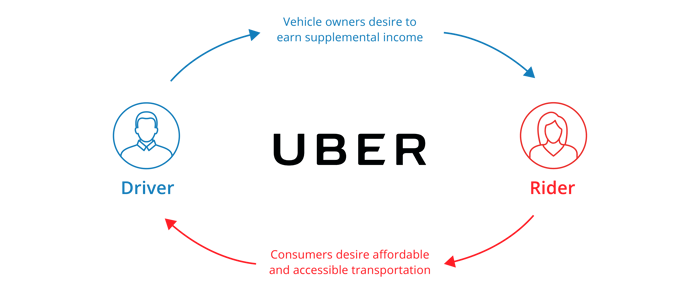
In Uber’s case, their core interaction as a business is to connect ordinary people with rides to people who need them. Uber identified an incredibly untapped energy source on both sides of their equation. On one side, people desired to earn additional income and owned a vehicle from which they could do so. On the other side of the equation, people who didn’t have access to a vehicle wanted a seamless, simple and cheap way to catch a ride.
(Uber platform)
Their platform is what enables this core interaction to happen.
How do platforms do it?
To simplify the corporate structure of each of these companies, they are all just platforms. High functioning and complex, yes, but still platforms.
Platforms are organizations based on enabling value-creating interactions between external producers and consumers.
The most successful platforms today are leveraging digital technology to match the right producers to the right consumers. Platforms provide additional tools to reduce the friction that is commonly present in these interactions.
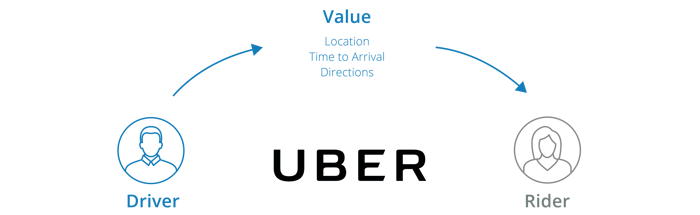
(value)
Ratings & Reviews → decrease the likelihood that you’ll get an unprofessional drive
Location → GPS makes it easier for your driver to find you, and you find them
Time to Arrival → no more wondering when your driver will pick you up
Directions → no more pointing over the shoulder, his phone tells him where to go
Payment → you know the price before your ride, and tips are included
(feedback)
Uber uses technology to remove friction at every point in the process, making the ride more efficient and enjoyable.
Platforms are changing the way we connect with each other, changing the way we exchange value and helping us do things better, smarter and at scale.
They create a space for anyone and everyone to be equipped to contribute to a primary, unifying mission—a core interaction.
Your church is a platform
There’s a common phrase spoken within Christian circles that you’ve likely heard before: “The Church is God’s plan A to carry out His mission, and He has no plan B.” Jesus laid out a clear mission for His Church at the end of His time on earth; a mission most call the Great Commission:
“All authority on heaven and earth has been given to Me. Go therefore, and make disciples of all nations.” —Matthew 28:18
Your church is an organization with a building, budget and staff, similar to Uber. And, like Uber, your church is made up of a number of ordinary people committed to a unified community. The mission for your church members—your core interaction—is to make disciples of Jesus, and your church is the platform through which this mission is carried out.
So what can your church learn from Uber? Uber founded its success on the ability of its platform to activate ordinary people to contribute to the core interaction of its business, i.e. providing a ride.
This core interaction is not primarily provided by the people Uber employs. Its employees primarily provide support for the platform to continue functioning so that every day people can be further equipped to carry out the core interaction of the company.
Your church functions in the exact same way. Your staff are set in place primarily to equip the congregation to carry out the mission—the core interaction—of your church.
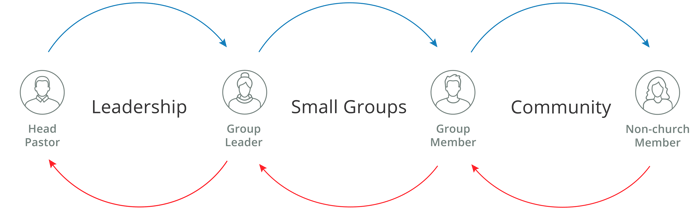
(Leadership, Small Groups, Community)
“And He gave the apostles, the prophets, the evangelists, the shepherds and teachers to equip the saints for the work of the ministry, for building up the body of Christ.” —Ephesians 4:11-12
God designed and intended for the structure of the church, in its organized, local context, to function as a platform where you, the full-time ministers, equip the lay members to make disciples.
The Barrier to Your Platform
We realize that this is likely one of the biggest obstacles you wrestle with. I’d assume that the majority of your congregation either explicitly or implicitly believes that making disciples should primarily be your job since you work in full-time ministry.
Our American church culture has made this idea so embedded into our perception of what church is that even full-time ministers fall into a line of thought that the core interaction of your church is to have people show up on Sunday mornings and fill seats in your small groups.
But find encouragement that you do not carry the weight of this mission alone. You provide the platform to equip these lay men and women in your local church to be the ones making disciples of Jesus in their everyday interactions with people.
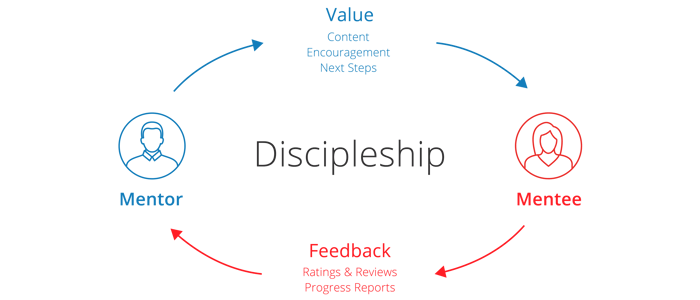
(discipleship)
Just as Uber found their success, we want to help your church scale the platform you have to activate anyone and everyone in your congregation to carry out your mission and make disciples.
Leveraging Your Platform
We believe with the right technology in place, your church can scalably leverage your resources and staff to better equip your people in carrying out the mission. We dream of a church environment where ordinary members are activated to be the church and make disciples.
So what would this kind of technology platform look like? What could it provide for your church? What core interaction could it help you scale?
We've created the Discipleship Planner to help you plan where you can strategically leverage your church's platform for your core interaction. Click below to access this free resource for your church today.
Start Planning Your Platform Strategy
Let's just see how sound Uber's practices and results are. As reported by Emel Akan in
The Epoch Times,
April 27, 2017 (updated April 28, 2017) (bold, links in original):
Uber is losing money faster than any other Silicon Valley startup. The ride-hailing company does not own cars or other fixed assets, but it is valued higher than both General Motors and Ford.
So what makes this cash-burning machine the most valuable private company in the world?
According to transportation industry expert Hubert Horan, Uber’s whopping valuation reflects the anticipation that it would one day drive all incumbent taxi and limo companies out of business.
“It is well on the way to achieving that objective in many markets,” Horan said, in a report.
But Uber lacks the competitive advantage and economies of scale that are required to achieve profitability, hence its business model is entirely different from other giant tech companies, like Amazon.
Horan said Uber’s rapid growth and industry dominance have been “entirely artificial, powered by its predatory investor subsidies.”
The ride-hailing company, which operates in nearly 75 markets, more than doubled its gross bookings and recorded $6.5 billion in revenue last year, according to a Bloomberg report.
However, it announced a massive $3.8 billion loss in 2016, including $1 billion from China where Uber sold its business to rival Didi Chuxing.
Uber has churned through at least $8 billion since its launch in 2009, according to Bloomberg.
The company lost nearly $1 billion in the last quarter of 2016—a massive amount for one quarter and unprecedented for a startup, according to experts.
Despite record losses, the company has managed to raise $13 billion from investors and reached a valuation of $69 billion.
Uber’s model is simple and replicable, but experts say its success is dependent on its ability to convince the world that it is a highly efficient operator that will rapidly grow into profitability.
But the company is far from breaking even, according to Horan.
“If you look at their economics, you can’t find any basis for expecting financial results to dramatically improve, much less close the $3 billion gap to break even,” Horan wrote in an email. “They’ve already cut driver pay quite a lot and can’t find much more savings there.”
Uber drivers used to receive 80 percent of each ride’s fare, but recent financial data shows a significant drop in that share.
Uber has announced that it still has $7 billion cash on hand and an untapped $2.3 billion credit facility. The company does not seem to need new capital in the short term.
The Pursuit of Power
Many users consider Uber better than traditional taxis when it comes to service quality, including driver courtesy and professionalism, car cleanliness, and availability at peak times.
But these service advantages are achieved through investor funds subsidizing the drivers.
Uber’s below-cost pricing is used as a tool to beat its competitors. The ride-hailing giant sharply cuts its prices when a competitor enters the market, incurring substantial losses until it drives out the rival from the market, experts say. Recently, taxi drivers and companies Yellow Cab and American Cab filed lawsuits in California against Uber for predatory pricing.
When raising funds from investors, Uber insists on special terms and restrictions, according to media reports. For example, the company does not allow investors to put money into competitors, like Lyft.
Uber’s investors include big Silicon Valley venture capital firm Kleiner Perkins Caufield & Byers, Goldman Sachs, Jeff Bezos of Amazon, and Blackrock. The company also raised $3.5 billion from Saudi Arabia’s Public Investment Fund last year.
Uber’s pursuit of industry dominance is the only way to deliver decent returns to investors, according to Horan.
The Silicon Valley venture capital community may not earn returns on their $13 billion investment without the “ability to exploit anti-competitive market power,” Horan said in his report.
“Uber’s objective is not merely a dominant market position, but a full control of the laws and regulations governing the urban car service industry,” he noted.
He believes Uber’s predatory tactics are a big concern for the transportation industry. However, nothing can be done “until there is a greater awareness that Uber’s business model is based on subsidizing prices and service levels to drive more efficient companies out of business so they could achieve quasi-monopoly market power,” he said.
Uber has run into many crises recently, including claims of sexual harassment, competitor sabotage, journalist intimidation, and a toxic corporate culture, which has resulted in at least nine top executive departures in recent months.
The company also came under fire in March for using a tool called Greyball, which allows Uber to avoid authorities in markets where its service is illegal or faces resistance from law enforcement.
“Most people assume Uber is a highly efficient, strong, and viable company—they incorrectly think these ‘cultural issues’ are anomalies that can be fixed. They can’t be fixed,” wrote Horan in the email.
As reported by Mike Isaac in
The New York Times,
February 22, 2017:
SAN FRANCISCO — When new employees join Uber, they are asked to subscribe to 14 core company values, including making bold bets, being “obsessed” with the customer, and “always be hustlin’.” The ride-hailing service particularly emphasizes “meritocracy,” the idea that the best and brightest will rise to the top based on their efforts, even if it means stepping on toes to get there.
Those values have helped propel Uber to one of Silicon Valley’s biggest success stories. The company is valued at close to $70 billion by private investors and now operates in more than 70 countries.
Yet the focus on pushing for the best result has also fueled what current and former Uber employees describe as a Hobbesian environment at the company, in which workers are sometimes pitted against one another and where a blind eye is turned to infractions from top performers.
Interviews with more than 30 current and former Uber employees, as well as reviews of internal emails, chat logs and tape-recorded meetings, paint a picture of an often unrestrained workplace culture. Among the most egregious accusations from employees, who either witnessed or were subject to incidents and who asked to remain anonymous because of confidentiality agreements and fear of retaliation: One Uber manager groped female co-workers’ breasts at a company retreat in Las Vegas. A director shouted a homophobic slur at a subordinate during a heated confrontation in a meeting. Another manager threatened to beat an underperforming employee’s head in with a baseball bat.
Until this week, this culture was only whispered about in Silicon Valley. Then on Sunday, Susan Fowler, an engineer who left Uber in December, published a blog post about her time at the company. She detailed a history of discrimination and sexual harassment by her managers, which she said was shrugged off by Uber’s human resources department. Ms. Fowler said the culture was stoked — and even fostered — by those at the top of the company.
“It seemed like every manager was fighting their peers and attempting to undermine their direct supervisor so that they could have their direct supervisor’s job,” Ms. Fowler wrote. “No attempts were made by these managers to hide what they were doing: They boasted about it in meetings, told their direct reports about it, and the like.”
Travis Kalanick, Uber’s chief executive, has taken several steps since a former employee’s accusations of discrimination and sexual harassment by managers.
Her revelations have spurred hand-wringing over how unfriendly Silicon Valley workplaces can be to women and provoked an internal crisis at Uber. The company’s chief executive, Travis Kalanick, has opened an internal investigation into the accusations and has brought in the board member Arianna Huffington and the former attorney general Eric H. Holder Jr. to look into harassment issues and the human resources department.
To contain the fallout, Mr. Kalanick also began more disclosure. On Monday, he said that 15.1 percent of Uber’s engineering, product management and scientist roles were filled by women, and that those numbers had not changed substantively over the past year.
Mr. Kalanick also held a 90-minute all-hands meeting on Tuesday, during which he and other executives were besieged with dozens of questions and pleas from employees who were aghast at — or strongly identified with — Ms. Fowler’s story and demanded change.
In what was described by five attendees as an emotional moment, and according to a video of the meeting reviewed by The New York Times, Mr. Kalanick apologized to employees for leading the company and the culture to this point. “What I can promise you is that I will get better every day,” he said. “I can tell you that I am authentically and fully dedicated to getting to the bottom of this.”
Some Uber employees said Mr. Kalanick’s speedy efforts were positive. “I am pleased with how quickly Travis has responded to this,” Aimee Lucido, an Uber software engineer, wrote in a blog post. “We are better situated to handle this sort of problem than we have ever been in the past.”
As chief executive, Mr. Kalanick has long set the tone for Uber. Under him, Uber has taken a pugnacious approach to business, flouting local laws and criticizing competitors in a race to expand as quickly as possible. Mr. Kalanick, 40, has made pointed displays of ego: In a GQ article in 2014, he referred to Uber as “Boob-er” because of how the company helped him attract women.
That tone has been echoed in Uber’s workplace. At least two former Uber workers said they had notified Thuan Pham, the company’s chief technical officer, of workplace harassment at the hands of managers and colleagues in 2016. One also emailed Mr. Kalanick.
Uber also faces at least three lawsuits in at least two countries from former employees alleging sexual harassment or verbal abuse at the hands of managers, according to legal documents reviewed by The Times. Other current and former employees said they were considering legal action against the company.
Liane Hornsey, Uber’s chief human resources officer, said in a statement, “We are totally committed to healing wounds of the past and building a better workplace culture for everyone.”
Uber’s aggressive culture began with its 2009 founding, when Mr. Kalanick and another founder, Garrett Camp, created a start-up that would let customers hail a cab with little more than a few taps of their smartphone — bypassing many of the headaches people had with the taxi industry. Mr. Kalanick also started putting into place what eventually became Uber’s 14 core values, inspired by the leadership principles at one of the biggest public tech companies, Amazon.
To grow quickly, Uber kept its structure decentralized, emphasizing autonomy among regional offices. General managers are encouraged to “be themselves,” another of Uber’s core values, and are empowered to make decisions without intense supervision from the company’s San Francisco headquarters. The top priority: Achieve growth and revenue targets.
While Uber is now the dominant ride-hailing company in the United States, and is rapidly growing in South America, India and other countries, its explosive growth has come at a cost internally. As Uber hired more employees, its internal politics became more convoluted. Getting ahead, employees said, often involved undermining departmental leaders or colleagues.
Arianna Huffington, an Uber board member, was brought in to look into harassment issues and the human resources department. Workers like Ms. Fowler who went to human resources with their problems said they were often left stranded. She and a half-dozen others said human resources often made excuses for top performers because of their ability to improve the health of the business. Occasionally, problematic managers who were the subject of numerous complaints were shuffled around different regions; firings were less common.
One group appeared immune to internal scrutiny, the current and former employees said. Members of the group, called the A-Team and composed of executives who were personally close to Mr. Kalanick, were shielded from much accountability over their actions.
One member of the A-Team was Emil Michael, senior vice president for business, who was caught up in a public scandal over comments he made in 2014 about digging into the private lives of journalists who opposed the company. Mr. Kalanick defended Mr. Michael, saying he believed Mr. Michael could learn from his mistakes.
Uber’s aggressive workplace culture spilled out at a global all-hands meeting in late 2015 in Las Vegas, where the company hired Beyoncé to perform at the rooftop bar of the Palms Hotel. Between bouts of drinking and gambling, Uber employees used cocaine in the bathrooms at private parties, said three attendees, and a manager groped several female employees. (The manager was terminated within 12 hours.) One employee hijacked a private shuttle bus, filled it with friends and took it for a joy ride, the attendees said.
At the Las Vegas outing, Mr. Kalanick also held a companywide lecture reviewing Uber’s 14 core values, the attendees said. During the lecture, Mr. Kalanick pulled onstage employees who he believed exemplified each of the values. One of those was Mr. Michael.
Since Ms. Fowler’s blog post, several Uber employees have said they are considering leaving the company. Some are waiting until their equity compensation from Uber, which is restricted stock units, is vested. Others said they had started sending résumés to competitors.
Still other employees said they were hopeful that Uber could change. Mr. Kalanick has promised to deliver a diversity report to better detail the number of women and minorities who work at Uber, and the company is holding listening sessions with employees.
At the Tuesday all-hands meeting, Ms. Huffington, the Uber board member, also vowed that the company would make another change. According to attendees and video of the meeting, Ms. Huffington said there would no longer be hiring of “brilliant jerks.”
As reported by Mr. Isaac in
The New York Times,
March 1, 2017:
SAN FRANCISCO — Travis Kalanick, the chief executive of Uber, apologized on Tuesday after a video showing him in a verbal altercation with a driver for the ride-hailing company became public.
In the video, recorded this month and reported on earlier by Bloomberg, Mr. Kalanick is seen in the back seat of an Uber car with two women. When they reach their destination, he begins talking with the driver, Fawzi Kamel.
During the exchange, Mr. Kamel complains about what he says is Uber’s history of lowering earnings for drivers, and Mr. Kalanick says Mr. Kamel should “take responsibility” for his own problems.
The conversation quickly becomes heated, with Mr. Kalanick using obscenities and generally being dismissive of Mr. Kamel’s complaints.
Hours after the video became public, Mr. Kalanick delivered an apology in the form of an email to employees addressing Mr. Kamel, “as well as the driver and rider community, and to the Uber team.”
“To say that I am ashamed is an extreme understatement,” Mr. Kalanick wrote in the email, which the company later posted to its public blog. “My job as your leader is to lead, and that starts with behaving in a way that makes us all proud. That is not what I did, and it cannot be explained away.”
The company said it had reached out to Mr. Kamel and hoped to arrange a conversation between him and Mr. Kalanick...
...The apology issued by Mr. Kalanick on Tuesday is the first instance in which he has admitted significant problems with his hard-charging leadership style.
“It’s clear this video is a reflection of me — and the criticism we’ve received is a stark reminder that I must fundamentally change as a leader and grow up,” Mr. Kalanick wrote in his email. “This is the first time I’ve been willing to admit that I need leadership help and I intend to get it.”
Mr. Kalanick did not specify in the email what sort of help he would seek.
As reported by Mr. Isaac in
The New York Times,
March 3, 2017:
SAN FRANCISCO — Uber has for years engaged in a worldwide program to deceive the authorities in markets where its low-cost ride-hailing service was resisted by law enforcement or, in some instances, had been banned.
The program, involving a tool called Greyball, uses data collected from the Uber app and other techniques to identify and circumvent officials who were trying to clamp down on the ride-hailing service. Uber used these methods to evade the authorities in cities like Boston, Paris and Las Vegas, and in countries like Australia, China and South Korea.
Greyball was part of a program called VTOS, short for “violation of terms of service,” which Uber created to root out people it thought were using or targeting its service improperly. The program, including Greyball, began as early as 2014 and remains in use, predominantly outside the United States. Greyball was approved by Uber’s legal team.
Greyball and the VTOS program were described to The New York Times by four current and former Uber employees, who also provided documents. The four spoke on the condition of anonymity because the tools and their use are confidential and because of fear of retaliation by Uber.
Uber’s use of Greyball was recorded on video in late 2014, when Erich England, a code enforcement inspector in Portland, Ore., tried to hail an Uber car downtown in a sting operation against the company.
At the time, Uber had just started its ride-hailing service in Portland without seeking permission from the city, which later declared the service illegal. To build a case against the company, officers like Mr. England posed as riders, opening the Uber app to hail a car and watching as miniature vehicles on the screen made their way toward the potential fares.
But unknown to Mr. England and other authorities, some of the digital cars they saw in the app did not represent actual vehicles. And the Uber drivers they were able to hail also quickly canceled. That was because Uber had tagged Mr. England and his colleagues — essentially Greyballing them as city officials — based on data collected from the app and in other ways. The company then served up a fake version of the app, populated with ghost cars, to evade capture...
...In a statement, Uber said, “This program denies ride requests to users who are violating our terms of service — whether that’s people aiming to physically harm drivers, competitors looking to disrupt our operations, or opponents who collude with officials on secret ‘stings’ meant to entrap drivers.”...
...Uber, which lets people hail rides using a smartphone app, operates multiple types of services, including a luxury Black Car offering in which drivers are commercially licensed. But an Uber service that many regulators have had problems with is the lower-cost version, known in the United States as UberX.
UberX essentially lets people who have passed a background check and vehicle inspection become Uber drivers quickly. In the past, many cities have banned the service and declared it illegal.
That is because the ability to summon a noncommercial driver — which is how UberX drivers using private vehicles are typically categorized — was often unregulated. In barreling into new markets, Uber capitalized on this lack of regulation to quickly enlist UberX drivers and put them to work before local regulators could stop them.
After the authorities caught on to what was happening, Uber and local officials often clashed. Uber has encountered legal problems over UberX in cities including Austin, Tex., Philadelphia and Tampa, Fla., as well as internationally. Eventually, agreements were reached under which regulators developed a legal framework for the low-cost service.
That approach has been costly. Law enforcement officials in some cities have impounded vehicles or issued tickets to UberX drivers, with Uber generally picking up those costs on the drivers’ behalf. The company has estimated thousands of dollars in lost revenue for every vehicle impounded and ticket received.
Uber’s Greyball tool was developed to weed out riders thought to be using its service improperly. This is where the VTOS program and the use of the Greyball tool came in. When Uber moved into a new city, it appointed a general manager to lead the charge. This person, using various technologies and techniques, would try to spot enforcement officers.
One technique involved drawing a digital perimeter, or “geofence,” around the government offices on a digital map of a city that Uber was monitoring. The company watched which people were frequently opening and closing the app — a process known internally as eyeballing — near such locations as evidence that the users might be associated with city agencies.
Other techniques included looking at a user’s credit card information and determining whether the card was tied directly to an institution like a police credit union.
Enforcement officials involved in large-scale sting operations meant to catch Uber drivers would sometimes buy dozens of cellphones to create different accounts. To circumvent that tactic, Uber employees would go to local electronics stores to look up device numbers of the cheapest mobile phones for sale, which were often the ones bought by city officials working with budgets that were not large.
In all, there were at least a dozen or so signifiers in the VTOS program that Uber employees could use to assess whether users were regular new riders or probably city officials.
If such clues did not confirm a user’s identity, Uber employees would search social media profiles and other information available online. If users were identified as being linked to law enforcement, Uber Greyballed them by tagging them with a small piece of code that read “Greyball” followed by a string of numbers.
When someone tagged this way called a car, Uber could scramble a set of ghost cars in a fake version of the app for that person to see, or show that no cars were available. Occasionally, if a driver accidentally picked up someone tagged as an officer, Uber called the driver with instructions to end the ride.
Uber employees said the practices and tools were born in part out of safety measures meant to protect drivers in some countries. In France, India and Kenya, for instance, taxi companies and workers targeted and attacked new Uber drivers.
“They’re beating the cars with metal bats,” the singer Courtney Love posted on Twitter from an Uber car in Paris at a time of clashes between the company and taxi drivers in 2015. Ms. Love said that protesters had ambushed her Uber ride and had held her driver hostage. “This is France? I’m safer in Baghdad.”
Uber has said it was also at risk from tactics used by taxi and limousine companies in some markets. In Tampa, for instance, Uber cited collusion between the local transportation authority and taxi companies in fighting ride-hailing services.
In those areas, Greyballing started as a way to scramble the locations of UberX drivers to prevent competitors from finding them. Uber said that was still the tool’s primary use.
But as Uber moved into new markets, its engineers saw that the same methods could be used to evade law enforcement. Once the Greyball tool was put in place and tested, Uber engineers created a playbook with a list of tactics and distributed it to general managers in more than a dozen countries on five continents.
At least 50 people inside Uber knew about Greyball, and some had qualms about whether it was ethical or legal. Greyball was approved by Uber’s legal team, led by Salle Yoo, the company’s general counsel. Ryan Graves, an early hire who became senior vice president of global operations and a board member, was also aware of the program.
Ms. Yoo and Mr. Graves did not respond to requests for comment.
Outside legal specialists said they were uncertain about the legality of the program. Greyball could be considered a violation of the federal Computer Fraud and Abuse Act, or possibly intentional obstruction of justice, depending on local laws and jurisdictions, said Peter Henning, a law professor at Wayne State University who also writes for The New York Times...
...On Friday, Marietje Schaake, a member of the European Parliament for the Dutch Democratic Party in the Netherlands, wrote that she had written to the European Commission asking, among other things, if it planned to investigate the legality of Greyball.
To date, Greyballing has been effective. In Portland on that day in late 2014, Mr. England, the enforcement officer, did not catch an Uber, according to local reports.
And two weeks after Uber began dispatching drivers in Portland, the company reached an agreement with local officials that said that after a three-month suspension, UberX would eventually be legally available in the city.
As reported by Solomon Israel of
CBC News,
March 7, 2017 (updated March 8, 2017):
Uber has used a clandestine software tool to dupe authorities in different cities around the world and prevent them from hailing Uber rides, according to a New York Times report.
It's called Greyball: a secret method used by Uber to track and evade unfriendly authorities in cities around the world.
The ride-hailing service won't confirm whether it used that clandestine tool to deceive regulatory and law enforcement authorities in Canadian cities...
...Uber's Canadian office offered no comment in response to requests from CBC News.
"The City of Toronto was successful in undertaking enforcement prior to Uber being licensed," said Tracey Cook, executive director of municipal licensing and standards for the City of Toronto, who added that the city's July 2016 bylaw regulating Uber and other private transportation companies would prohibit Uber "from obstructing information with regard to the accounts."
Montreal authorities have no proof that Greyball was ever used by Uber in that city, said Renaud Beauchemin, a spokesperson for the Bureau du taxi de Montreal.
"Using this software or a similar technology could be considered as obstruction to the authorities," he said.
Through a spokesperson, the city of Edmonton said it has "no knowledge of the use of this technology by Uber from an enforcement perspective."...
As reported by Mr. Isaac in
The New York Times,
May 4, 2017:
SAN FRANCISCO — Uber is the subject of a United States Department of Justice inquiry over a program that it used to deceive regulators who were trying to shut down its ride-hailing service.
The inquiry concerns Uber’s use of a software tool called Greyball, which the company developed in part to aid entrance into new markets where its service was not permitted. The tool allowed Uber to deploy what was essentially a fake version of its app to evade law enforcement agencies that were cracking down on its service...
...The federal inquiry was disclosed in a transportation audit conducted by the City of Portland, Ore., published last week. In the audit, Portland officials said they had been notified by the United States attorney’s office for the Northern District of California about the existence of the inquiry. The City of Portland said it was cooperating with the inquiry.
Reuters reported on Thursday that the inquiry was a criminal investigation. The United States attorney’s office for the Northern District of California generally conducts criminal investigations, and some of the laws that Uber may have broken carry criminal penalties. A federal inquiry often does not result in any charges being filed...
As reported by Greg Bensinger of
The Wall Street Journal,
May 30, 2017:
Uber Technologies Inc. expects to conclude a report soon on claims of sexual harassment and sexism that it hopes will close a damaging chapter in its history. But it also could bring even greater scrutiny for the troubled ride-hailing company.
The report—expected next week—will be the culmination of an investigation triggered in February when former software engineer Susan Fowler Rigetti claimed in a nearly 3,000-word blog post that Uber management had ignored multiple complaints from her and other female workers of sexual harassment and sexism by their managers.
The outcome carries significant stakes for the world’s most valuable startup. Some employees say the allegations and the three-month investigation, along with other recent controversies, have been painful distractions and threaten Uber’s ability to attract talent. Employees will be looking for information about how Uber’s leaders handled workplace issues and what changes the report might trigger. Others who will be contemplating the results: candidates in Uber’s search for its first-ever chief operating officer to assist CEO Travis Kalanick.
As reported by Subrat Patnaik of
Reuters,
June 1, 2017:
Uber Technologies Inc said its head of finance is leaving, and the privately held ride-hailing company also said that its first-quarter loss narrowed substantially from the prior quarter, putting it on a path toward profitability.
Head of finance Gautam Gupta is leaving in July to join another startup in San Francisco, the company said, making Gupta the latest high-profile executive to leave Uber.
Uber, which has been rocked by several high-level executive departures in the past few months as it grapples with a series of controversies, has been looking for a chief operating officer to help change its now-notorious "bro" culture.
Gupta's exit sets the stage for a second major executive search, now for a chief financial officer who has public company experience.
About a dozen top executives have left Uber since February.
The company on Tuesday fired the technology whiz it had hired to lead its self-driving unit, Anthony Levandowski, after he failed to comply with a court order to hand over documents at the center of a legal dispute between Uber and Alphabet Inc's (GOOGL.O) Waymo unit.
Uber on Wednesday said its net loss in the first quarter, excluding employee stock compensation and other items, narrowed to $708 million, from $991 million in the fourth quarter.
As a private company, Uber does not report its financial results publicly, but at times it has confirmed figures reported in the media.
Uber said its first-quarter revenue rose 18 percent to $3.4 billion from the fourth quarter.
"The narrowing of our losses in the first quarter puts us on a good trajectory towards profitability," an Uber spokesperson said in an email...
As reported by Ryan Grenoble of the
Huffington Post,
June 21, 2017:
The wheels finally fell off.
Travis Kalanick is stepping down from his post as CEO of Uber, effective immediately.
Kalanick’s exit came after a shareholder revolt reportedly made it untenable for him to stay at the company he founded in 2009. Investors called for the change in leadership in a letter that was delivered to Kalanick in Chicago and obtained by Times reporter Mike Isaac...
...Uber suffered several turbulent months in early 2017. The rise of #DeleteUber in response to the company appearing to break a taxi picket line in early February drove more than 200,000 people to delete the Uber App from their phone in protest, and was only quelled once Kalanick announced he’d resign from President Donald Trump’s economic advisory council.
That movement regained steam, however, as lurid claims of a toxic work culture surfaced, courtesy of a tell-all blog by a former employee.
Former Uber engineer Susan Fowler penned the blog in late February, recalling her experiences with rampant sexual harassment at the company, including being solicited for sex by male superiors and stonewalled by HR for reporting their conduct.
Two of Uber’s earliest investors, Mitch and Freada Kapor, spoke out at the time and urged the company to switch gears.
“Uber’s outsize success in terms of growth of market share, revenues and valuation are impressive, but can never excuse a culture plagued by disrespect, exclusionary cliques, lack of diversity, and tolerance for bullying and harassment of every form,” the two wrote.
“Uber has had countless opportunities to do the right thing,” they added. “We feel we have hit a dead end.”
Kalanick pledged to clean up the company culture in response. He asked former U.S. Attorney General Eric Holder to lead an inquiry, and got former Huffington Post editor-in-chief (and Uber board member) Arianna Huffington to pitch in.
Yet another crisis developed soon after: Waymo, a Google-founded competitor, sued Uber, claiming the company had stolen technology essential to the development of its self-driving cars.
Uber competitor Lyft continued to pick up steam all the while...
As reported by
Reuters,
September 20, 2017:
Alphabet Waymo unit is seeking about $2.6 billion from Uber for the alleged theft of one of several trade secrets in a lawsuit over self-driving cars, a lawyer for Uber said on Wednesday.
Uber Technologies Inc attorney Bill Carmody disclosed the figure in a hearing in federal court in San Francisco, where both companies are discussing whether a trial in the case will begin next month.
Waymo has asserted claims that Uber stole several of its trade secrets.
The total amount of Waymo's damages request was not publicly disclosed at the hearing on Wednesday.
Waymo claimed in a lawsuit earlier this year that former engineer Anthony Levandowski downloaded more than 14,000 confidential files before leaving to set up a self-driving truck company, which Uber acquired soon after.
Uber has denied using any of Waymo's trade secrets.
Waymo's allegations have already led Uber to fire Levandowski, who had directed Uber's efforts in the nascent yet pivotal field of self-driving cars...
As reported by Nick Statt of
The Verge,
September 22, 2017 (links in original):
Uber CEO Dara Khosrowshahi sent a sobering, self-reflective email to employees today following the London transport authority’s decision not to renew the company’s license. In what is an uncharacteristic move for a company plagued by rampant sexism and regulatory abuse, much of which was a product of the leadership style of former chief exec and founder Travis Kalanick, Khosrowshahi told Uber employees that “there is a high cost to a bad reputation.”...
...“Irrespective of whether we did everything that is being said about us in London today (to be clear, I don’t think we did), it really matters what people think of us,” Khosrowshahi wrote, “especially in a global business like ours, where actions in one part of the world can have serious consequences in another.” It’s clear now that Uber is taking these controversies as teachable moments, and that a ban in a city as large and instrumental to its business as London could push it to improve its systemic issues...
...Those issues include Uber’s use of Greyball, custom software which allowed the company to dodge law enforcement and regulatory officials from using the full app for potential sting operations. Transport for London (TfL), the city’s transportation authority, cited Greyball, among other offenses, when it declined to renew Uber’s license, saying the company’s “approach and conduct demonstrate a lack of corporate responsibility in relation to a number of issues which have potential public safety and security implications.”
“Going forward, it’s critical that we act with integrity in everything we do, and learn how to be a better partner to every city we operate in,” Khosrowshahi concludes. “That doesn’t mean abandoning our principles — we will vigorously appeal TfL’s decision — but rather building trust through our actions and our behavior. In doing so, we will show that Uber is not just a really great product, but a really great company that is meaningful contributing to society, beyond its business and its bottom line.”
As reported by James Titcomb of the London
Daily Telegraph,
November 24, 2017 (links in original):
Uber's new chief executive, who is trying to repair the company's battered reputation, has known about the hack that lost 57 million passengers' and drivers' details for over two months.
Dara Khosrowshahi was told about the breach shortly after taking charge of the company in September, according to reports. It also informed SoftBank, the the Japanese tech giant that is close to an investment of up to $10bn (£7.5bn), three weeks ago.
Uber revealed on Tuesday night that hackers accessed the accounts of 50 million passengers and 7 million drivers in October 2016. It learned about the incident a year ago and paid the hackers $100,000 to delete the data and keep quiet.
The Information Commissioner has since confirmed that the personal data of British users was accessed, and has warned that the company could be fined over the matter.
The company has sought to draw a line under the news, sacking its chief security officer Joe Sullivan and coming clean about the breach, which happened under the watch of its former chief executive Travis Kalanick. But the revelation that its top brass has known for two months, reported in the Wall Street Journal, is likely to raise questions about whether customers should have been notified earlier...
As reported by Zeeshan Aleem of
vox.com,
December 20, 2017 (links in original):
The European Union’s top court has ruled that Uber should be regulated like a taxi company, a move that could have major implications for how the popular ride-hailing app does business in Europe — and raises questions about its future in the US.
The European Court of Justice issued the ruling in a case brought by Barcelona cab drivers, who argued that Uber had an unfair advantage over them because it wasn’t regulated as heavily.
The court rejected Uber’s argument that it is a tech business whose main function is matching passengers with drivers. Instead, it ruled that the company should be classified as a transportation service — and that it needs to be regulated like one.
That ruling, which can’t be appealed, means that the company could face new licensing fees and also raises questions over whether the company could be obligated to provide employee benefits to drivers...
...With a valuation of $70 billion, Uber is currently the most highly valued startup in the world. But its long-term reputation is in peril as it stumbles from controversy to controversy and struggles to shake public perception that it is a company that prefers to buck rules wherever it goes rather than follow them.
In September, London regulators banned Uber from operating in the city, arguing that the company demonstrated a “lack of corporate responsibility” tied to a number of its behaviors, such as failing to report sexual assault by its drivers and using lax background checks.
Uber is currently appealing that case in London courts and has the right to continue operating in the city until the appeals process is exhausted.
But should the company lose in court, it will suffer a massive blow: London is Uber’s largest European market and hosts some 40,000 licensed Uber drivers who serve more than 3 million customers...
...Denmark pushed Uber out of the country this spring after introducing new taxi laws
Uber also has a long history of controversy in the US. After it left Austin, Texas, in 2016 because of the city’s requirements for background checks on drivers, it teamed up with Lyft to spend millions lobbying state lawmakers and eventually convinced the Texas legislature to overrule the city. Uber returned to the city this year, but its return was met with anger from local officials.
Currently at least five states are planning to investigate Uber after it revealed this fall that it had paid hackers $100,000 to cover up a cyberattack that stole nearly 60 million people’s personal data from the company in 2016.
The Department of Justice is also currently looking into whether Uber has broken a US law against bribing foreign officials with payments that it made to officials in China, India, Indonesia, and elsewhere.
Given what has been revealed about Uber in 2017, one wonders why the Church Growth Movement promotes Uber as a model for churches to follow; it's hard to think of a company that has less in common with the church of the Lord Jesus Christ. Uber has been around for only eight years, and it would come as no surprise to this blogger if it won't be around eight years from now. The true church of the Lord Jesus Christ, created by the Lord Himself, has been around for 2,000 years and will be around for eternity.