Showing posts with label Medicine. Show all posts

Thursday, 27 February 2025

75 years ago--Americans divided on euthanasia

I call heaven and earth to record this day against you, that I have set before you life and death, blessing and cursing: therefore choose life, that both thou and thy seed may live: Deuteronomy 30:19

It did come as a surprise to this blogger to come across this item from 1950 and see the large percentage of Americans who supported euthanasia. This was just five years after the end of a war that Americans and their allies fought against the Nazis, under whom euthanasia morphed into mass murder, followed by the Nuremberg trials of the perpetrators for crimes against humanity. I've been dismayed to see belief in the sanctity of human life declining over the last 50-60 years, but I didn't know it was already fairly low even 75 years ago (assuming the results of the survey are accurate, of course). As reported by the Canadian Institute of Public Opinion and published in the Calgary Herald, February 27, 1950 (bold in original):

PRINCETON, N.J.--Public sentiment in a coast-to-coast survey by the American Institute is closely divided on the principle of euthanasia or mercy killing.

The weight of opinion is against the idea, but the margin is very close.

In testing the nation's views on this controversial and much discussed issue the Institute patterned its question after the model bill proposed by the Euthanasia Society of America. This proposal would call for the consent of the patient, and an examination by a board of doctors appointed by a court.

Here are the questions used in the survey and the vote:

A. "When a person has a disease that cannot be cured, do you think doctors should be allowed by law to end the patient's life by some painless means if the patient and his family request it?"

B. If no, or no opinion, ask: "Would you approve of ending a patient's life if a board of doctors appointed by the court agreed that the patient could not be cured?"


Thirty-six per cent indicated approval and another 7 per cent on the second part, making the total as follows:

Favor mercy killing------43%
Oppose mercy killing-----46%
No opinion---------------11%

Opinion on the issue is not greatly different now from what it was when the Institute first tested sentiment with a similar question 13 years ago. There has been a small increase in the vote in favor.

The Sander case in New Hampshire and the Carol Paight case in Connecticut stimulated nationwide discussion of the pros and cons of legalized euthanasia.
When I read this article I had never heard of the Sander and Paight cases, but a quick Google search produced some results. First, the case of Dr. Herman Sander--as reported by Australian Associated Press and reported in the Cairns Post, January 5, 1950 (bold, capitals in original):

EUTHANASIA CASE IN NEW HAMPSHIRE

DOCTOR INDICTED.

DEATH OF CANCER PATIENT.


NEW YORK, Jan. 3 (A.A.P.). A Manchester, New Hampshire, grand jury of 21 middle-aged men, was convened to-day to consider whether Dr. Hermann Sander should be indicted for murder. Sander, who is 40, has been accused of the mercy killing of an incurable woman cancer patient, by the injection of air into her veins, as she lay on her hospital deathbed.

The judge, instructing the jurors, asked if any had signed any of the widely circulated petitions supporting Dr. Sander. There was no response.

Sander, who is on bail, continued calling.on his patients to-day. He told reporters that he still felt his action was not legally or morally wrong, and added: "I believe my position ultimately will be vindicated.

Meanwhile euthanasists have made plans to use the Sander case as a wedge in seeking the adoption of "a mercy death law."

The vice-president of the Euthanasia Society of America (Mrs. Robertson Johns) said in NewYork: "This is absolutely the best case, yet for our cause. It is good, because of Dr. Sander's integrity, and because he did not hide what he did."

A member of the New Hampshire Legislature (Mr. Ray Sawyer) said be felt that something should be done about légalising mercy deaths. He suggested that physicians should draw up such a Bill. Later Dr. Sander was indicted by the grand jury on a charge of first degree murder.
According to Rick Holmes in the Derry News, June 30, 2011:

Probably you heard that earlier this month — June 3, 2011 — Dr. Jack Kevorkian died. He was of course the so called "Doctor Death." Last year, there was even a Hollywood movie about his career. His passing brought back to memory those events of a decade ago when we were all talking about the right — or wrong — of physician-assisted suicide.

While all the country's attention has been on Kevorkian, it is interesting to know that the very first trial for medical euthanasia involved a doctor who had once lived in Derry. In 1950 — exactly 50 years before the Kevorkian trial — there was the trial of Dr. Herman Sander.

Sander (1908-1996) was born in New York, the first child of George and Ada Sander. Ada had been born in New Jersey but George had emigrated from Dresden, Germany, in 1888. He was a 1901 graduate of Stevens Institute of Hoboken, N.J. with a degree in electrical engineering. Shortly after Herman's birth the family moved to Derry. Here, George Sander was employed as superintendent of the Derry Electric Company. They lived in an apartment at 71 East Broadway, directly across from today's McGregor Library Building. After a few years in Derry, the family moved to Manchester where he was employed with the Traction, Light and Power Company — the concern that ran the Manchester and Derry Trolley.

Herman grew up in Manchester and, while attending Central High School, he became the state's first Eagle Scout. He studied at the University of Munich and received his undergraduate degree at Dartmouth College (1930) and his medical degree from New York University. His entire career was spent practicing in the Manchester area.

In 1949, Mrs. Abbie Borroto lay dying of cancer in the Hillsborough County Hospital. The 60-year-old woman was suffering; she was racked with unbearable pain that no amount of medication could ease. During that year, she had wasted from 140 to 80 pounds. It seemed likely to most that she had only a few days to live. All day and night she was screaming for someone, anyone, to help her die.

Herman Sander was her doctor and knew he was powerless to reduce her suffering. He then gave four injections of air directly into her veins. She died painlessly in about 10 minutes. Dr. Sander entered into her medical records exactly what he had done. Sander's supervisor read the entry and reported the death to the police. An arrest warrant was quickly issued for Sander that charged him with wrongful death. A grand jury soon found that there was enough evidence to hold a murder trial.

In 1950, Herman Sander became the first doctor ever put on trial for "mercy killing." The trial was held at the Hillsborough County Courthouse and was attended by reporters from all over the state and nation including novelists Fanny Hurst and John O'Hara. The prosecution was led by future U.S. Sen. Louis Wyman. On the witness stand Dr. Sander told the jury he thought Mrs. Borroto was already dead. But if that were true, why did he gave a dead patient the injections? In answer to that question, all he could say was, "Why I did it I cannot tell. It didn't make any sense."

All across America there was an active debate on Dr. Sander and mercy killing. Evangelist Billy Graham said the court should find him guilty of murder and make "an example" of him. In his hometown of Candia, 605 of the town's 650 registered voters gave Sander a "written testimonial of his integrity and goodwill."

In Derry, the local Baptist and Catholic Church were strictly opposed to euthanasia. They based their arguments on the scriptural command that "Thou shall not kill." It may be supposed that most of the other Derry pastors were also in favor of Sander being found guilty.

The first clergyman in the greater Manchester area to come out in public support of Sander was Rev. Dr. Charles S. Milligan of East Derry's First Parish Church. To make sure everyone knew his views, he announced a week before, the topic of his next sermon. That Sunday, the sanctuary of the church was filled to overflowing.

Pastor Milligan began his sermon with the declaration that "I believe God does not enjoy human suffering. I question that those who don't want it (euthanasia) have the right to deny it to those who do." He went on to say that doctors have been performing mercy killing for millennia but it has always been hidden. If euthanasia was made legal then it can be regulated for only extreme cases of suffering. He concluded by saying that now "only the honest doctor gets punished."

On March 9, 1950, the jury took just 71 minutes to find Herman Sander not guilty on the all charges. Today this verdict is viewed by many as being an example of jury nullification — a guilty man had been set free because the 12 men and women in the jury room didn't believe in the law against mercy killing.

Despite being found not guilty, the state refused to give Sander back his medical license. He could no longer practice medicine in New Hampshire. To support his wife and three daughters, the doctor was forced to work as a farm hand. In time, the New Hampshire Medical Board did give him back his license. He retired in 1974 after 33 years as a physician. He spent his remaining years as a beekeeper in Candia. In 1979, Candia honored him as "the most influential individual in town." Sander died in 1996 at a Manchester nursing home at 87 years of age.
The case of Carol Ann Paight occurred around the same time. As reported by Australian Associated Press and published in the Adelaide News, February 2, 1950 (bold, capitals in original):

U.S. GIRL KILLER "WAS INSANE"

New York, Wednesday.

--A psychiatrist today testified that Carol Paight was insane when she fired the fatal "mercy" bullet at her father.


He said she had not recovered her sanity nearly three weeks later.

Carol, 21, killed her father in hospital after learning he had incurable cancer. She is charged with second-degree murder.

Dr. Clifford Moore, medical director of a mental institution, was called as a witness after the girl's mother had given evidence that there had been in sanity both in her family and her late husband's.

Dr. Moore said Carol was insane when he examined her 19 days after the shooting. He didn't know whether she had recovered yet.
As reported by Mara Bovsun in the New York Daily News, June 19, 2010 (updated April 9, 2018):

If one thing was clear in this sad case, it was that Carol Ann Paight loved her father. She loved him so much that she could not bear to see him suffer. So she killed him.

Her father, Police Sgt. Carl Paight, 52, was a good-natured family man, adored by his wife, Mary, 52 and children, Carol, 21, and Carl, Jr., 22, both college students. They lived in a modest home in Stamford, Conn.

By all accounts, Sgt. Paight was the kind of dad every child deserves – responsible, good to their mother, and fun. The family spent hours swimming and sailing, and even chores were enjoyable when he was around.

It all came to a crashing end in September 1949. Sgt. Paight had not been feeling well, so he checked into a Stamford hospital. The doctors recommended exploratory surgery, scheduled for the 23rd.

During the operation, Carol and her mother, both devote Roman Catholics, went to church to pray.

Their prayers went unanswered. Back at the hospital, Dr. William E. Smith gave them the worst possible news. Sgt. Paight’s body was “riddled” with cancer, and he had, at most, three months to live.

Carol knew what that meant. Two of her aunts, Agnes and Alice, had died of cancer, and she witnessed these vibrant women shrivel away in agony. The experience had instilled in her a deep terror of the disease.

“Don’t tell Daddy!” Carol screamed when Dr. Smith delivered the news. Then she grew glassy-eyed and pale, and started babbling. Carol didn’t appear to hear anything, and seemed to be in a world of her own.

The Paight women returned home, but Carol didn’t stay. She swiped her father’s service revolver, and headed back to the hospital, stopping briefly at a spot in the woods to take one practice shot.

With the gun wrapped in a jacket, she returned to her father. Moments later, nurses heard an odd noise, like a tray dropping, and saw the tall, blond girl in the doorway of Paight’s room. Inside, they found the gun on the bed, and a bullet wound in the patient’s head.

“I shot him,” Carol told them. Then she became hysterical.

Later, as members of her late father’s squad guarded her, she seemed calm and detached. At around 8:30 p.m., she told Capt. William J. Lynch that she didn’t care what people thought or what would happen to her. She couldn’t stand to see her dad suffer.

The girl remembered nothing the next morning. She recalled hearing the doctor’s dreaded words, but after that, everything was a blank.

From the start, sympathy was with the girl. Civic leaders and businesses took up a collection for her defense. “It is my honest belief and firm conviction that the case of Carol Paight deserves extreme sympathy and leniency,” Stamford Mayor George Barrett told reporters.

Nevertheless, the district attorney had no choice but to arrest Paight, charging her with second-degree murder. It carried a life sentence.

The girl’s plight ignited a long-smoldering debate over mercy killing. In the 1930s, two groups were building a movement around the right to die – England’s Euthanasia Legalization society, and the Euthanasia Society of America. Both groups took keen interest in the case.

By the time Paight’s trial opened on Jan. 23, 1950, two more mercy killings were grabbing headlines. A New Hampshire doctor, Hermann Sander, had been arrested for injecting air into the veins of a dying cancer patient. In Ontario, Can., engineer Ralph Kilbon’s mentally ill wife had tried to kill herself with a bullet to the abdomen. When Kilbon found her, she was dying and in pain, so he shot her to finish what she started.

In Paight’s trial, everything hinged on the girl’s state of mind at the time of the killing, a period that Carol could not remember.

Witnesses swore that she certainly looked insane, swinging from shrieks and sobs to periods of calm, glassy-eyed detachment. Psychiatric experts for the defense said the news about her father had caused temporary insanity, and pushed her into a “fugue state” in which her subconscious mind controlled her actions.

The outcome was not hard to predict when the prosecution’s expert witness was booed for voicing the opinion that the defendant had been sane, and knew exactly what she was doing when she pulled the trigger.

Also helpful was the composition of the jury. It was made up entirely of parents – mothers and fathers with children about the same age as the accused.

After about four hours’ deliberation, the jury found her not guilty. Carol went home, and got on with her life. By September, a year after her father’s death, she had some good news, a wedding. “Carol Paight, the schoolgirl who was acquitted of the mercy-slaying of her cop-pop … is blessed eventing,” wrote legendary gossip columnist Walter Winchell a few months later.

The president of the Euthanasia Society said Paight’s acquittal was a “vindication” of his group. Ministers came out in support of mercy killings, and physicians went on record saying that they had, on occasion, made lethal doses of morphine available to the incurably ill.

For a time, it seemed as if Paight’s story might open a floodgate of mercy killings, especially after the two other high-profile cases ended in acquittals.

But the tide turned. In November 1952, another woman, Lois Curtiss, 33, stood in the same courthouse as Paight. Curtiss was accused of murdering her cancer-ridden father by turning on the gas jets in their apartment, an act that left her partially paralyzed. She said she had been motivated by love, and her only goal was to end his suffering. But the judge saw this death as “one of those killings which dramatists and sob sisters call a mercy killing” and sent her to prison.
Carol Ann Paight (center) is comforted by her brother Carl, Jr., and her mother, Mary Nolan Paight, during the Paight trial in Bridgeport, Conn. (Photo by Walter Kelleher/NY Daily News Archive via Getty Images)

In both the cases mentioned above as well as the notorious Canadian case of R v Latimer (1997, 2001), I'm struck by the willingness of so many people to believe that the killing was motivated by love. Who says the killer was motivated by love? The killer. Robert Latimer was a farmer in Saskatchewan whose 12-year-old daughter Tracy had severe cerebral palsy and was in constant pain, which may have been eased by surgery. Mr. Latimer murdered Tracy while the rest of the family was at church, but claimed that she had died in her sleep. Police became suspicious when an autopsy revealed high amounts of carbon monoxide in Tracy's blood, and only then did he admit that he had killed her by connecting a hose from the exhaust pipe to the cab. Mr. Latimer was charged with first-degree murder, was convicted of second-degree murder, and served almost 10 years in prison before being granted full parole in December 2010.

It disturbed me then, as it does now, that an Ipsos-Reid poll conducted in 1999 found that 73% of those responding (it should be kept in mind that Ipsos-Reid admits, but doesn't publicize, that 70% of the people they contact refuse to talk to them) believed that Mr. Latimer acted out of compassion, and 41%--a plurality--believed "mercy killing" shouldn't even be against the law. It doesn't help that the media focus on the instances in which killing has taken place rather than those in which people in positions such as Mr. Latimer don't kill their loved ones. A former pastor of mine and his wife are parents of a son with multiple disabilities that require round-the-clock care. His parents aren't trained caregivers, aren't wealthy, have to work for a living, and have other children to take care of as part of living their lives. They found an institution in which their disabled son could receive the care he requires, and had him placed there. The institution is hundreds of miles and several provinces away from the parents, but they visit him several times a year, and the last I heard, reported that he was receiving excellent care. This is far from an ideal situation, but in a fallen world, this was the best choice they could make. Unfortunately, this example of true Christian compassion seldom gets any press.

Unfortunately, Canadian society has deteriorated so far and so fast since the Latimer case that he wouldn't even be charged today. Under the Orwellian-named MAiD (Medical Assistance in Dying), introduced by the "Liberal" regime of Justin Trudeau in 2016, MAiD deaths have increased from 5,665 in 2019 to 15,343 in 2023, making it the fastest-growing such program in the world. Very few of these people are dying; rather, they're people who have problems in living, and a disproportionately high percentage are poor. This is exactly the way it happened in Germany in the 1920s and '30s, culminating in mass murder and genocide during World War II. My father fought against the regime that did that; I'm glad he's not around to see what became of the country he fought for.

Wednesday, 27 January 2021

Trudeaupia's Canada's public health officer wants "faith leaders" to promote Covid-19 vaccine acceptance

"Dr." Theresa Tam, who has consistently represented the interests of the Chinese Communist regime during the Covid-19 "pandemic" rather than the interests of the Canadian people whom she's supposed to be serving, isn't content with offering Canadians ridiculous advice on their sex lives (see here and here); now she wants "faith leaders" to promote acceptance of the Covid-19 vaccine among their congregations. As reported by John Longhurst of the Winnipeg Free Press, January 22, 2021:

Canadian faith leaders have an important role to play in promoting COVID-19 vaccines, including helping their members overcome vaccine hesitancy.

That was the message Dr. Theresa Tam, Canada’s chief public health officer, delivered to more than 1,300 participants of an online information event Wednesday.

The event was arranged by the Canadian Council of Churches, Canadian Interfaith Conversation and Canadian Multifaith Federation, at the request of the Privy Council and Public Health Agency of Canada.

In her remarks, Tam said combatting the novel coronavirus is a "whole of government, whole of society effort."

As "trusted voices" in their communities, faith leaders are "instrumental" in that effort, since they "know the hearts and minds of their members" and are often "called on for guidance."

Faith groups can help battle the virus by sharing credible information about vaccines with their members, she said, including dispelling fears about their safety.

They can also help by staying "vigilant" and encouraging congregations to maintain safe practices (social distancing, hand hygiene and mask wearing).

By doing this, it will not only help prevent the spread of virus, it will also give vaccines a "bit of a runway" to get going, she added.

Tam said faith groups also have an important role to play by supporting members who are struggling due to the pandemic, especially those who are elderly, vulnerable or dealing with mental health issues.

"Maintaining social, and emotional and spiritual closeness is more important than ever," she said. "Your leadership is vital for supporting and building resilience in your communities as we move through this pandemic and beyond."

Noting some communication materials about vaccines might need to be translated or adapted for different faith and cultural groups, Tam said the federal government is open to providing financial support in such efforts.

She also said Ottawa is open to working with faith groups to use their facilities as vaccination sites.

However, she added, it’s not practical now, since the "first two vaccines are tricky to handle... maybe in the future as more vaccines become available."

As to whether clergy might be put on a priority list for getting the vaccine, Tam said it might be possible, if they are involved in supporting people in long-term care homes, homeless shelters or other services to marginal and vulnerable people.

She also assured faith leaders no animal products or fetal cells were used in the production of the two current vaccines.

When asked when religious groups might see a return to in-person worship services, Tam noted the decision is up to provincial public health authorities.

Her own view is "right now is definitely not the time," with the pandemic surging in some parts of the country.

"It’s really important to follow local public health advice," Tam said, adding: "The best thing to do is to reduce the number of contacts."

All pandemics come to an end, she said, "and this one will as well."

In remarks at the conclusion of the event, Ian Shugart, Clerk of the Privy Council, noted faith groups can contribute to dealing with the pandemic by "inspiring people to action on behalf of others" while showing "none of us is self-sufficient."
The reader will note the liberalism of the "faith groups" named above. Those in "faith groups" that are ostensibly more conservative would still do well to notice if their own "faith leaders" promote acceptance of the vaccine, providing evidence of whether they're shepherds or hirelings.

This blogger would like to see the vaccine administered to politicians, police, and other beings in positions of authority who have shown so little human feeling and done so much to make people's lives miserable over the last year. With reports of people dying from the vaccine (RIP, Hank Aaron), the disappearance from the scene of these authority figures would be what baseball legend Branch Rickey referred to as "addition by subtraction."

May 17, 2022 update: This is also happening in the United States; as reported by Beth Brelje in The Epoch Times, April 6, 2022:

Many who have chosen not to get the COVID-19 shots have cited religious objections. Now Pennsylvania Governor Tom Wolf’s administration wants church leaders to bring vaccination events into churches.

Pennsylvania’s public health leaders want to “harness the power of community trust in statewide faith-based organizations” to convince folks to get a COVID-19 shot. That is according to the mission statement of the Faith-based Organization Coalition, which is being formed under the state’s Department of Health and is expected to launch April 11.

The state aims to reduce vaccine hesitancy through the “Local Innovations in Vaccine Equity in Pennsylvania” project (LIVE PA), which is a grant program that pays churches and nonprofits to speak with their people and persuade them to get vaccinated.

That is, $10 for each person-to-person outreach including direct phone calls, direct text messages, direct social media messages, door-knocking campaigns, and anything that involves one on one dialogue promoting the COVID-19 shot. The church or other nonprofit gets another $10 for each person who gets the shot.

“LIVE PA is a collaboration between the Wolf Administration’s Office of Advocacy and Reform and the departments of Health and Human Services, working closely with United Way of Pennsylvania to fund hyper-local, grassroots nonprofit and faith-based organizations to partner with certified vaccine providers to help the populations they serve overcome barriers to vaccination,” Amanda McNaughton, member services manager and Resilient PA Staff Liaison for United Way of Pennsylvania, told The Epoch Times.

The funding comes federally from the Center for Disease Control with $4 million dollars allocated to nonprofit organizations and $630,000 for faith-based organizations, McNaughton said. Grant applications were open in July 2021 and will continue through the end of 2023. So far, 104 applications have been approved, combining faith-based and nonprofit organizations, and 93 clinics have been hosted.

The LIVE PA program was promoted in a March 24, 2022 training meeting for chaplain assistants at UPMC Health Care System. Usually connected to churches, chaplains visit the sick and offer spiritual services. The Epoch Times obtained a video of the meeting, during which Aubrey Juris, partnership opportunity initiative coordinator for the Pennsylvania Department of Health Office of Health Equity explained its faith-based initiatives and encouraged chaplains to bring LIVE PA to their churches.

She suggested churches and nonprofits get creative in hosting vaccination events. Churches could set aside two hours after the worship service and the state vaccination partner could give entire families shots. A program like Meals on Wheels could have a vaccination nurse ride along on deliveries and offer the shot immediately, right in people’s homes. Or a community block party with food and prizes could be held where vaccines are being offered.

In another program, the state is seeking partners, including churches, to help distribute COVID tests in high-need communities. Participating sites must manage test kit distribution and publicize availability.

Ultimately, Juris said, the state wants to “establish COVID-19 Resource Centers in nonprofit outreach centers and houses of worship that will serve as long term, trusted resources to local communities, paving the way for COVID-19 mitigation as a social norm.”

Of the $630,000 available for faith-based organizations to participate in LIVE PA, only about $16,000 has been spent, Juris said.

McNaughton says working with faith-based organizations has been helpful.

“We have been thrilled to partner with local faith-based organizations because they are often trusted representatives with long, established histories in their communities,” McNaughton said. “The remaining population of people who are not fully vaccinated are experiencing barriers such as lack of trust or lack of access. Faith-based organizations are uniquely placed to have long histories with the populations they serve and have earned mutual trust with them. Their efforts to promote the vaccine to their congregations and the communities they serve through their charity work have been successful at reaching vaccine-hesitant populations.”
As reported by Leo Hohmann, April 7, 2022 (bold, links in original):

...Is your church or favorite ministry one of these organizations sucking up tax dollars to poison and sterilize their congregants and followers? It’s not just local churches, but big ministries that are involved in this evil.

I reported previously that the Vatican was encouraging Catholic churches to partner with governments worldwide to promote the vaccine, and some of the big-name evangelical ministries such as Samaritan’s Purse are doing the same.


I received hateful emails for weeks because folks didn’t want to believe that such a trusted name in evangelical circles as Samaritan’s Purse could be involved in this plan to vaccinate every man, woman and child with an unproven, untested, and now proven deadly serum. If you still don’t believe it, don’t trust me: Read here, here and here.

Many other churches and ministries are involved in this deadly propaganda campaign. My advice would be to check with your pastor and/or the financial records keeping department of your favorite ministries and ask if they have or ever will accept any of these funds.

I did a quick online search and found several examples of churches participating in this.

An ad from Montgomery County, Pennsylvania, states: “Bethel AME Church of Ardmore, Love Your Neighbor, Alpha Kappa Alpha Inc. Phi Beta Omega Chapter, VNA, Walmart Pharmacy and ACME Pharmacy will partner with the Montgomery County Immunization Coalition to hold a community vaccination clinic.”

St. Paul’s Catholic Church partnered with Penn Medicine Princeton Health in Princeton, New Jersey, to convert its church into a vaccine clinic last May.

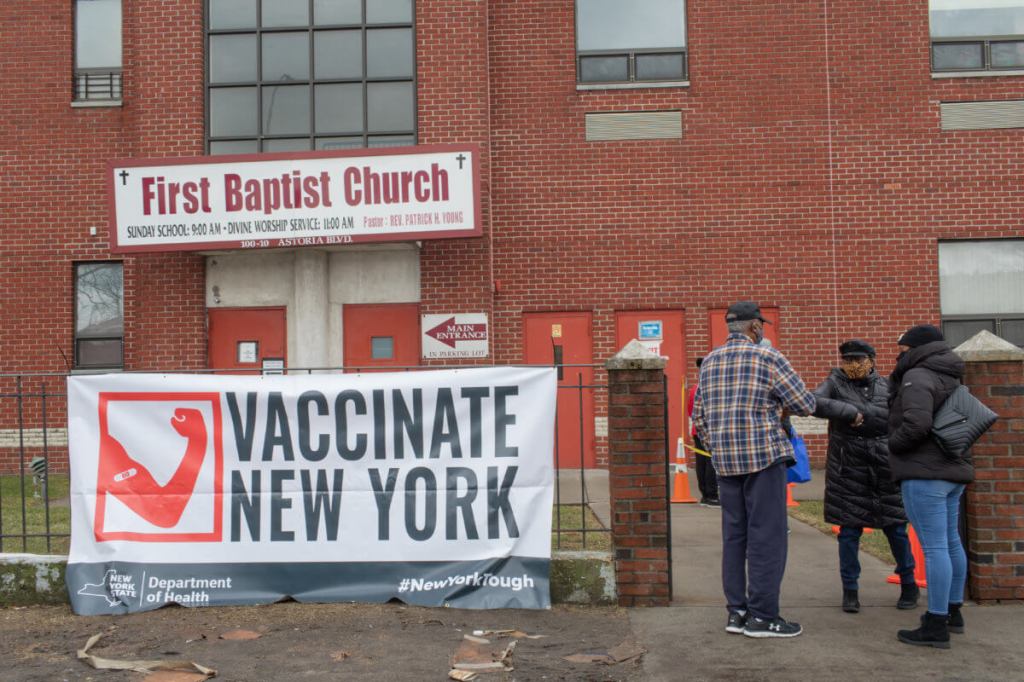
Democrat Congresswoman Alexandria Ocasio-Cortez helped convert First Baptist Church of Corona in New York City into a temporary vaccination center.
You can find hundreds of such examples online of collusion between corrupt churches and the corrupt medical/pharma complex, all feeding off of taxpayer dollars.

I am sure not every one of these churches is being paid to promote this death shot. Some are no doubt doing it for free, thinking they are doing the Lord’s work. There are no more excuses for that kind of stupidity. At this point the data is clear. You just have to look for it, because you won’t find any reporting from the mainstream media on the issue of vaccine safety. They are all bought off.

When the lid finally blows on this story, and the perpetrators of the greatest crime in human history are exposed, every one of these church leaders will be held accountable for their roles in what is quickly becoming a genocide...

...Number one, those churches didn’t become trusted by working with corrupt governments that force experimental medical treatments on their citizens.

Number two, how can this promotional work be considered “charity” if the churches are being paid to do it?

This is not earning trust. This is abusing trust, which is exactly what the globalist elites said they would do when they sat down at the Event 201 conference in October 2019 to run a simulation of the coming global coronavirus pandemic. If you listened to those seminars, they made it very clear that they would tap into “trusted sources” in the community to promote their narrative and destroy competing narratives about the pandemic.

Watch the video below from Event 201 and fast forward to the 19:25 mark. That’s CIA operative Avril Haines speaking in October 2019 about “flooding the zone” with “trusted sources” during an upcoming pandemic. Haines would later become Biden’s director of national intelligence. Another speaker, LaToya Abbott, starts talking at the 23:56 mark about the importance of combatting “anti-vaccine sentiment,” which tells you they already knew (in October 2019 two months before the pandemic was discovered in China) they were going to roll out a first-ever coronavirus vaccine that would be controversial.


Recruiting pastors to entice their flocks to accept a medical treatment they know nothing about is fraud and abuse against the people of God. Only an extremely naive and stupid pastor, or one who is an evil globalist, would agree to work with the government on such an devious plan.

With more data coming out every day on not only the failed efficacy of these injections but the dangers to health and safety, there are simply no more excuses left for pastors to be naive.

God have mercy on any pastor or ministry leader who is participating in this program.

Tuesday, 22 December 2020

Pope Francis approves Covid-19 vaccine despite its links to abortion

If any pope ever deserved the title of "Antichrist," it's Cardinal Bergoglio from Argentina; he gets more brazen in his promotion of ungodliness every time you look around. As reported by Tyler Van Dyke of the Washington Examiner, December 21, 2020 (links in original):

Pope Francis approved a note released by the Congregation for the Doctrine of Faith on Monday, condoning the use of coronavirus vaccines that have an indirect connection to abortion, saying it is "morally acceptable" to receive the vaccine.

"It is morally acceptable to receive Covid-19 vaccines that have used cell lines from aborted fetuses in their research and production process," the CDF wrote. "All vaccinations recognized as clinically safe and effective can be used in good conscience with the certain knowledge that the use of such vaccines does not constitute formal cooperation with the abortion from which the cells used in production of the vaccines derive."

The letter was signed by Cardinal Luis Ladaria Ferrer, the Vatican prefect, and Archbishop Giacomo Morandi, Vatican secretary. Pope Francis approved the text on Dec. 17 and released the note Monday.

The Pfizer-BioNTech and Moderna vaccines were involved in a commonly employed "confirmatory test" that relies on HEK293, a cell line derived from a human embryonic kidney cell from a fetus that was aborted in the 1970s. Because of this, some Catholics have expressed concerns about the ethics of getting the vaccine, with some calling for Catholics to "reject a vaccine which has been produced immorally."

The papal notice follows a similar missive from bishops in the United States who sanctioned getting the vaccine despite concerns from members of the Catholic community. One Texas church leader, Bishop Joseph Strickland, said that he "urge[d] all who believe in the sanctity of life to reject a vaccine which has been produced immorally."

"In view of the gravity of the current pandemic and the lack of availability of alternative vaccines, the reasons to accept the new COVID-19 vaccines from Pfizer and Moderna are sufficiently serious to justify their use, despite their remote connection to morally compromised cell lines," the committees wrote, referring to the use of HEK293-derived tests. "Being vaccinated safely against COVID-19 should be considered an act of love of our neighbor and part of our moral responsibility for the common good."

The CDF's note continues a trend in previous pronouncements, according to Vatican News. As recently as 2017, the Holy See said the value of vaccines and their distance from contemporary abortion practices "lead us to exclude that there is a morally relevant cooperation between those who use these vaccines today and the practice of voluntary abortion."

"The morality of vaccination depends not only on the duty to protect one's own health, but also on the duty to pursue the common good," the CDF said. "In the absence of other means to stop or even prevent the epidemic, the common good may recommend vaccination, especially to protect the weakest and most exposed."

Friday, 31 July 2020

Physician-assisted suicide in Canada doubled from 2017-2019

I call heaven and earth to record this day against you, that I have set before you life and death, blessing and cursing: therefore choose life, that both thou and thy seed may live: Deuteronomy 30:19

For whoso findeth me findeth life, and shall obtain favour of the Lord.
But he that sinneth against me wrongeth his own soul: all they that hate me love death.
Proverbs 8:35-36

There is a way which seemeth right unto a man, but the end thereof are the ways of death. Proverbs 14:12 (also Proverbs 16:25)

Righteousness exalteth a nation: but sin is a reproach to any people. Proverbs 14:34

Professing themselves to be wise, they became fools,...
...And even as they did not like to retain God in their knowledge, God gave them over to a reprobate mind, to do those things which are not convenient;
Romans 1:22,28

I find it difficult to understand why today's residents of what were the Allied nations in World War II still regard the Nazis as villains when those nations are increasingly adopting the Nazis' policies. To regurgitate what I said in a previous post: It comes as no surprise to this blogger to see the rabidly antichrist Trudeaupian Canadian government of the Manchurian Pothead, Prime Minister Justin Trudeau fulfilling my prediction that the slippery slope argument will prove correct in Trudeaupia Canada as it did in Germany from the 1920s through the 1940s, with the legalization of euthanasia eventually leading to widespread killing. Doctor-assisted death is rapidly morphing into doctor-initiated death.

As reported by Christine Rousselle of Catholic News Agency, July 30, 2020 (link in original):

Washington, D.C. Newsroom - The number of Canadians killed by physician-assisted suicide nearly doubled between 2017 and 2019, according to a report released by the Canadian government. More than a third of those who opted for “medical assistance in dying” cited concerns of being a burden to family or carers.

The “First Annual Report on Medical Assistance in Dying in Canada 2019” was published in July. It follows a series of interim reports that were published over the last year.

In 2019, a total of 5,631 Canadians ended their lives through the country’s “Medical Assistance in Dying,” or “MAID” protocols. This amounts for 2% of the total deaths in Canada, an increase from 2018’s percentage. In 2018, the number of MAID deaths accounted for 1.12% of the total number of deaths in Canada.

The report found that cancer was the most common condition among those who ended their lives with MAID, followed by respiratory conditions and neurological ailments. Slightly over two thirds of those who used MAID had cancer as an underlying condition.

Along with having a “reasonably foreseeable” natural death, a person who wished to receive MAID also had to show that their condition was causing them “enduring physical or psychological suffering that is intolerable to them and cannot be relieved in a manner that they find acceptable.”

In just over a third of 2019’s MAID deaths, a “perceived burden on family, friends or caregivers” was one of the reasons cited, and in 13.7% of cases, “isolation or loneliness” was a factor.

“When asked to describe the nature of the suffering prompting their request, patients most often reported ‘a loss of ability to engage in meaningful life activities’ followed by ‘loss of ability to perform activities of daily living’ reported in 82.1% and 78.1% of cases, respectively,” says the report.

“Inadequate control of pain” was cited in 53.9% of cases, followed by “loss of dignity” in 53.3% of cases.

In U.S. states with legal physician-assisted suicide, less than one half of one percent of deaths are due to euthanasia, the lowest rate in the world. If Canada’s numbers were extrapolated to the United States, approximately 50,000 people each year would end their lives with MAID. This would put euthanasia in the top 10 causes of death for the United States, just above “intentional self-harm (suicide)” and just below kidney disease.

Countries that permit physicians to administer euthanasia and do not mandate self-administration have higher percentages of deaths from euthanasia. Similar to countries such as Belgium and the Netherlands, Canadian law permits doctors to administer the lethal dose of medication to the patients. In the United States, the drugs must be self-administered.

While Canadians have the option to self-administer the drugs, the number of people who chose to do so last year was “fewer than seven.”

In 2019, the average age of a person who received MAID in Canada was 75.2 years, but 103 people between the ages of 18 and 45 received MAID.

Last year, 92.2% of requests for MAID were approved, out of a total of 7,336 applications.

Only 3.6% of people who were deemed eligible for MAID withdrew their request.

Of those who were deemed ineligible for MAID in 2019, about a quarter were denied because death was “reasonably foreseeable,” and an additional quarter were denied due to not being “in an advanced state of irreversible decline in capability.” Those requirements are likely to change for future years.

In September 2019, the Superior Court of Quebec found that the requirement that a person who receives MAID have a “reasonably foreseeable natural death” was unconstitutional. The Canadian government later announced that they do not intend on appealing this decision, and a piece of legislation titled Bill C-7 was introduced in February 2020 to further expand MAID criteria.

In addition to removing the requirement of a reasonably foreseeable death, Bill C-7 would also allow for advanced directives.

Cardinal Thomas Collins, the Archbishop of Toronto, released a statement in February criticizing Bill C-7 for expanding the criteria for MAID without expanding the availability of palliative care.

“Where is the political will to push forward on palliative care for all Canadians? Only 30% of Canadians have access to quality palliative care even though we know that pain and loneliness are among the biggest fears of those who are suffering. Palliative care can address these issues,” said Collins.

“If all Canadians had access to quality palliative care, fewer would seek lethal injection. But instead of developing an overall culture of care, we are rushing towards death on demand,” adding that doctors will be forced to comply with requests for euthanasia as Canada does not have conscience rights protections for medical professionals.

“We should take time to be truly present to those who may feel that they are on the margins in our community,” said Collins.

“Those who feel that their life no longer has value must be assured by all of us that this is absolutely not the case — there is dignity within each human life, not just when we are young, healthy and able, but even more so, when we are fragile and vulnerable.”
See also my previous posts:

Supreme Court of Canada strikes down ban on assisted suicide (February 6, 2015)

Canada's largest children's hospital drafts policy that could allow for the euthanasia of children (October 11, 2018)

Canada's antichrist Liberal government plans to study reports on expanding euthanasia (December 23, 2018)

Sunday, 26 April 2020

Dutch Supreme Court permits euthanasia of dementia patients

It comes as no surprise to this blogger that the slippery slope is getting slipperier; as reported by Christine Rousselle of Catholic News Agency, April 22, 2020:

The Supreme Court of the Netherlands ruled on Tuesday, April 21, that it is lawful for doctors to euthanize patients with severe dementia, provided that the patient had expressed a desire to be euthanized while still legally capable of doing so.

Lower courts had previously ruled that a doctor had not acted improperly when he euthanized a 74-year-old woman with advanced dementia, even though the woman had to be repeatedly sedated and physically restrained during the procedure. The case was sent to the Supreme Court for further clarification of the country’s euthanasia law, which permits doctors to kill patients considered to be in “unbearable suffering.”

Per Dutch law, euthanasia is only legal for those with dementia if they had written or discussed an advanced directive with their doctor.

“For some people, the prospect of ever suffering from dementia may be sufficient reason to make an advance directive (living will). This can either be drawn up independently or discussed first with the family doctor. A physician can perform euthanasia on a patient with dementia only if such a directive exists, if statutory care is taken and if, in his opinion, the patient is experiencing unbearable suffering with no prospect of improvement,” says the Dutch government’s website.

The woman who resisted her euthanization had written an advanced directive four years prior, requesting the procedure in lieu of being put in a nursing home. In the directive, she had said she wished to “be able to decide while still in my senses and when I think the time is right.”

Prosecutors argued that her attempt to fight off the doctor indicated that she could have changed her mind, but was unable to verbally communicate.

Dr. Charles Camosy, a professor at Fordham University and bioethicist, told CNA that the supreme court decision is part of a legal “slippery slope” in the Netherlands on euthanasia. Camosy said that patients with conditions including mental deterioration will be at the heart of future debate.

“I believe the next great fight over fundamental human equality will be over the value of human beings with advanced dementia,” he said. “It is impossible, in my view, to separate what is happening in the Netherlands from the broad rejection in the post-Christian West of fundamental human equality.”

A person with advanced dementia or a severe brain injury, Camosy said, is unable to communicate consent to be euthanized, meaning that the doctor performing the euthanasia will be likely the one to decide if the patient is in severe enough suffering to merit death.

“Doctors are notoriously bad at judging these things,” said Camosy. “Study after study finds that they rate the quality of life of their patients worse than the patients do themselves. They assume people want more quality of life than length of life, when in fact the numbers show exactly the opposite.”

Camosy told CNA that given how the Netherlands has euthanized newborn infants, who are also unable to communicate a degree of suffering, for about two decades, “it follows logically that they could say it about someone with late-stage dementia.”

“Like prenatal human beings, and human beings with massive brain injuries, human beings with late-stage dementia simply don’t ‘count,’ morally speaking, the same as human beings that have been determined to have the traits that make someone a person,” he said.

Instead of further expanding euthanasia, Camosy suggested that the Netherlands instead ramp up the number of caregivers for dementia patients, and work to empower families of dementia patients to provide care for them.
See also my posts:

The latest from the Netherlands: Euthanasia house calls (December 17, 2011)

Dutch authorities prosecute doctor for performing involuntary euthanasia on elderly woman (November 18, 2018)

Monday, 13 January 2020

Tel Aviv Chief Rabbinate urges voluntary conversion of people born from donated eggs

Judaism attempts to adjust to the brave new world of 2020, as reported by Kobi Nachshoni of Ynet News, January 2, 2020:

The Tel Aviv Chief Rabbinate will participate in an operation to locate children born from egg donations, as these children's religious status may come under question if the donors were not recognized as Jewish.

Ynet has learned that a private religious fertility clinic is collecting personal information about babies born through in vitro fertilization (IVF), that will be handed to rabbis so that these people could be tapped to go through a conversion process.

Religious leaders have been debating whether a child takes on the religion of their egg donor or that of the mother who carried them to term.

Since Israel does not hold proper records of these pregnancies, many of which are conceived abroad, and since egg donors may often be of other faiths, the Rabbinate had been "lenient in its interpretation and had accepted these children as Jewish."

But now, ultra-Orthodox officials and private fertility clinics are trying to harden the existing practice and treat such children as non-Jews unless proven otherwise.

Due to the lack of proper documentation, the Rabbinate is unable to prevent all those, whose Judaism is questioned, from marrying. The Rabbinate will try to locate that part of the population and urge people to voluntarily undergo a "proper conversion."

Ynet has learned that the deputy head of the Tel Aviv Rabbinate is already participating in this initiative and is prepared to conduct conversions in his rabbinical court. This means he has already adopted the more stringent interpretation of religious law that will have a long-lasting effect on many Israelis.

Among those promoting this initiative is Rabbi Butbul, a Sephardi Rabbi who claims to be following the edicts of the late Rabbi Ovadia Yosef, the spiritual leader of the Shas Party.

"We have 7,000 to 8,000 children each year that are considered Jewish. We don't know them, and they walk among us," Butbul said. "At this rate, one in three secular Israelis could be born from a mixed union and without anyone knowing."

When asked how he intends to locate in vitro children, Butbul said the Rabbinate receives medical information from medical staff at hospitals.

"Major hospitals are cooperating with us and their doctors are in daily contact with the religious fertility clinics, so we have information."

"We can launch a grandiose operation and save the people of Israel from intermixing," Butbul said. "With god's help, we will set out to do the work."

Wednesday, 24 July 2019

50 years ago: Organ transplant doctors redefine death

While the world--including this blogger--was thrilled by the Apollo 11 lunar landing in July 1969, an event of arguably greater significance--literally a matter of life and death--took place in Madrid. As reported by the British newspaper The Guardian, July 19, 1969:

Madrid, July 18--Organ transplant specialists from around the world have reached agreement here on a new definition of death.

Delegates to the first international transplant symposium in Madrid agreed to define death as the moment when the brain ceases to perform its vital functions and fails to react to medical stimuli.

The conclusion, announced today after last night's closing session, was far from unanimous, but it is expected to form the basis for new legislation in many countries.

The doctors rejected the proposal of defining death as the moment when the heart stops beating, because they felt a heart should be in good working order for a successful transplant.

The medical panel's recommendation that death be defined in neurological terms was approved in a heated debate in the final session. Other conditions imposed by the doctors were that the doctor signing the death certificate should not form a part of the team involved in a transplant operation and that the dead or moribund patient should not be capable of breathing without the help of medical devices.

The consensus of the symposium was that the failure of the brain to react and the cessation of vital brain activity should be irreparable, with the absence of any clinical reaction to customary medical tests.

The panel advised, however, that a final decision on death should be made only on the recommendation of qualified experts after they had conducted a series of internationally approved medical tests, including the electro-encephalograph.

They further warned that such tests should be carried out on a potential donor over a minimum of 24 hours.

The surgeons warned that the criteria should be applied only with considerable reservation in the case of children and that they were not applicable in cases involving drugs.
This conference took place less than 20 months after the first successful human heart transplant. Physicians had previously been hesitant to perform heart transplants, because under the definition of death which had long been in place--cessation of the heartbeat--performing a heart transplant necessarily meant involved removing the heart from a living person, thus killing the donor. In order for surgeons to perform heart transplants without killing people--and to have a heart that was in good working order--it was necessary to define death as being something other than cessation of the heartbeat, thus redefining the donor as dead.

It's worth noting that the adoption of the definition of death as cessation of brain function and reaction was "far from unanimous," and was "approved in a heated debate." This indicates that the definition of death as "brain death" was not obvious, and was more political than scientific, created to salve the consciences of doctors.

Thursday, 31 January 2019

New York hospital withdraws man's life support after woman misidentifies him as her brother

Another exciting episode in 21st century medical ethics; as reported by Priscilla DeGregory and Georgett Roberts of the New York Post, January 27, 2019:

They were switched at death.

A horrific hospital mix-up left a Brooklyn woman grieving for nine days at the bedside of a brain-damaged man who doctors insisted was her brother — but who was actually a stranger with the same name, a new lawsuit charges.

But only after she gave consent to have her “brother” taken off life support at St. Barnabas Hospital did Shirell Powell learn the shocking truth: Her real sibling was in jail — and she had just sent a stranger to his death, her Bronx Supreme Court lawsuit says.

“I nearly fainted because I killed somebody that I didn’t even know. I gave consent,” said Powell, 48, of Crown Heights.

“I was like, ‘Where is my brother? What is going on?’ I was devastated.”

The saga began July 15, when Freddy Clarence Williams, 40, was admitted to the Bronx hospital, unconscious from an apparent drug overdose, according to Powell’s lawsuit.

Williams had his Social Security card on him, and it identified him by that name, the court papers say.

But the hospital phoned Powell anyway, telling her that her brother, Frederick Williams, who also is 40 but has no middle name, had been admitted and was near death.

She rushed to the man’s bedside.

“He had tubes in his mouth, a neck brace,’’ Powell told The Post. “He was a little swollen . . . [But] he resembled my brother so much.

“He couldn’t speak from the time they brought him in the hospital. They just assumed it was my brother.”

After two days of tests, St. Barnabas doctors told her that her “brother” was brain-dead, she said.

“That is my baby brother, so it was really hurtful,” she said. “I was worried, hurt, crying, screaming, calling everybody. It was a horrible feeling.”

With no cause to hope for his recovery, she contacted relatives down South, telling them to come and say their goodbyes.

Powell acknowledged that the first time her sister saw the ailing man in the hospital, she questioned whether he was their sibling.

“She walked up into the room and said, ‘That is not my brother,’ ” Powell recalled. “I said, ‘What do you mean?’ ”

“The guy was much bigger,’’ Powell explained.

But he appeared swollen, and “the eyebrows, the nose, the structure — it looked like [our] brother,” Powell said. “My sister, she walked up closer, and you could see the resemblance, and she was like, ‘Oh, OK.’ ”

So on July 29, with her uncle and sister at her side, Powell “authorized [the hospital] to withdraw life support from Frederick Williams,” the lawsuit says.

“It was very devastating,” she recalled. “I was crying.”

Frederick Williams’ “death” was even harder on his two daughters — Brooklyn, 17, and Star, 18, their aunt said.

The teens live in Virginia, and Brooklyn came to the city to say goodbye to her father before he was taken off life support, Powell said.

“She was hysterical,” Powell recalled. “She was holding his hand, kissing him, crying.”

Only after an autopsy did the city Medical Examiner’s Office reveal the truth: The dead man was Freddy Clarence Williams.

Powell said they got a call from a worker at the agency as they were making funeral arrangements.

“She called us just in time,” Powell said. “We would have been burying someone else.”

Meanwhile, it turned out Powell’s actual brother was in jail on a July 1 assault arrest in lower Manhattan.

Powell went to Manhattan Supreme Court for her sibling’s next hearing a few weeks later — just to lay eyes on him.

“I saw my brother,” she said. “I couldn’t believe it. I was very relieved.”

She also called him on the phone at Rikers Island. They had quite a conversation about her decision to pull his plug.

“He was saying, ‘You were going to kill me?’ I explained to him, once you’re brain-dead, there is nothing to do.”

Interviewed at Rikers, Powell’s brother said he had forgiven his sister for pulling the plug on the man she thought was him.

“The doctors told her they couldn’t do anything,” he said. “I’m not mad at her.”

Still, he raged, “How could the hospital do something like that? Look what they put my family through.”

Powell’s lawyer, Alexander M. Dudelson, told The Post that he tried to get information about Freddy Clarence Williams, the stranger who died surrounded by Powell’s sobbing family.

“The representatives [at St. Barnabas] basically spit in my face,” he said. “This is beyond reckless conduct. I requested an investigation. Nothing more. An apology would have been nice.”

Asked about the lawsuit, which seeks unspecified damages, hospital spokesman Steven Clark responded, “We don’t feel there is any merit to this claim.”

Powell also asked the ME’s Office for the dead man’s family information so she could send condolences, but it denied the request, citing privacy concerns.

Now, Powell says, she remains haunted by questions: The man she had grieved for at the hospital — who was he? Does he have family?

“I barely sleep thinking about this all the time,’’ she said.

“To actually stand over him and watch this man take his last breath — sometimes I can’t even talk about it because I get upset and start crying.

“On the one hand, I’m thankful that it wasn’t [my brother]. On the other hand, I killed somebody that was a dad or a brother.”

Wednesday, 30 January 2019

Belgian doctors face prosecution for euthanizing autistic woman

I call heaven and earth to record this day against you, that I have set before you life and death, blessing and cursing: therefore choose life, that both thou and thy seed may live: Deuteronomy 30:19

For whoso findeth me findeth life, and shall obtain favour of the Lord.
But he that sinneth against me wrongeth his own soul: all they that hate me love death.
Proverbs 8:35-36

There is a way which seemeth right unto a man, but the end thereof are the ways of death. Proverbs 14:12 (also Proverbs 16:25)

Righteousness exalteth a nation: but sin is a reproach to any people. Proverbs 14:34

Professing themselves to be wise, they became fools,...
...And even as they did not like to retain God in their knowledge, God gave them over to a reprobate mind, to do those things which are not convenient;
Romans 1:22,28

It comes as no surprise to this blogger that the categories of people deemed eligible for euthanasia are becoming broader, and that countries which fought the Nazis during World War II are increasingly adopting the Nazis' policies. Even if the doctors in this case are convicted, it will just be a matter of time until killing of such people becomes legal. As reported by Lia Eustachewich of the New York Post, November 27, 2018:

A woman with autism may have been improperly euthanized by doctors in Belgium who had her parents hold the needle in place while the deadly injection was administered, according to prosecutors.

The trio of doctors will face trial in the 2010 death of Tine Nys, a 38-year-old woman who was diagnosed with Asperger’s syndrome two months before her death at the hands of a doctor.

The East Flanders physicians are accused of poisoning Nys before she died, as well as botching parts of the procedure.

In Belgium and the Netherlands, it is legal for doctors to euthanize patients who have psychiatric problems that cause “unbearable and untreatable” suffering. Among Belgians put to death for mental health reasons, the most common conditions are depression, personality disorder and Asperger’s, a mild form of autism.

The legitimacy of the controversial practice, however, is hotly debated.

Nys’ family filed a criminal complaint last year alleging numerous “irregularities” in her death, as her doctors tried to thwart the investigation, the Associated Press reported.

“We must try to stop these people,” wrote Dr. Lieve Thienpont, the psychiatrist who approved Nys’ request to die and one of three doctors now facing charges. “It is a seriously dysfunctional, wounded, traumatized family with very little empathy and respect for others.”

One of the doctors asked Nys’ parents to hold the needle in place as he administered the fatal injection — and then asked the family to use a stethoscope to confirm her heart had stopped, one of the victim’s sisters, Sophie Nys, told the AP.

Concerns have been previously raised that Thienpont may have too readily approved euthanasia requests for mentally ill patients.

Thienpont and Dr. Wim Distelmans, head of Belgium’s euthanasia review commission, have come to blows before. Distelmans has said the doctor and colleagues may have failed to meet certain legal requirements before performing euthanasia. He also wrote that he’d no longer accept patients referred from Thienpont.

Since euthanasia was approved in Belgium in 2002, more than 10,000 people have been killed. Only one case has been referred to prosecutors but was later dropped.

The three doctors in Nys’ case have been referred to the Court of Assize in Ghent and will face trial “due to poisoning,” said prosecutor Francis Clarysse.
See also my posts:

Pope Francis orders Roman Catholic charity in Belgium to stop performing euthanasia in its psychiatric hospitals (August 13, 2017)

Belgium now euthanizes children as young as 7 (August 11, 2018)

Friday, 14 December 2018

Ontario Court of Appeal hears case on whether woman on life support is alive or dead

I call heaven and earth to record this day against you, that I have set before you life and death, blessing and cursing: therefore choose life, that both thou and thy seed may live: Deuteronomy 30:19

For whoso findeth me findeth life, and shall obtain favour of the Lord.
But he that sinneth against me wrongeth his own soul: all they that hate me love death.
Proverbs 8:35-36

There is a way which seemeth right unto a man, but the end thereof are the ways of death. Proverbs 14:12 (also Proverbs 16:25)

Righteousness exalteth a nation: but sin is a reproach to any people. Proverbs 14:34

Professing themselves to be wise, they became fools,...
...And even as they did not like to retain God in their knowledge, God gave them over to a reprobate mind, to do those things which are not convenient;
Romans 1:22,28

Woe unto him that buildeth his house by unrighteousness, and his chambers by wrong; Jeremiah 22:13a

As reported by Lorenda Reddekopp of CBC News, December 12, 2018 (link inserted by blogger):

The family of Taquisha McKitty will argue in the Ontario Court of Appeal Wednesday that she's still breathing and alive, even though a lower court has declared her dead.

"We're not convinced that she's dead," said Bishop Wendell Brereton from his church, the Breakthrough Temple in Brampton.

He has visited McKitty in hospital and witnessed her movements.

"Legs, arms. From head to toe she's moving," he said.

"So, it's not a corpse lying there. It's a person."

McKitty was declared dead by doctors more than a year ago after she went into cardiac arrest following a drug overdose and was put on life support.

McKitty's lawyer will argue in appeal court in Toronto that an Ontario Superior Court judge erred in not recognizing McKitty's charter rights, and not taking into account her religious beliefs in a case that could prove precedent-setting.

"Taquisha is alive according to her own religious beliefs," lawyer Hugh Scher writes in a court factum.

He adds that some jurisdictions do take religious beliefs into account before declaring someone dead.

"Taquisha remains alive in Nova Scotia, New York, New Jersey and elsewhere, but according to [Ontario Superior Court] is dead in Ontario."

Erica Baron, the lawyer representing Dr. Omar Hayani, who first declared McKitty dead at Brampton Civic Hospital, argues Scher is misinterpreting Nova Scotia law, and that McKitty would be considered dead everywhere in Canada.

In her legal arguments, Baron writes that because of the family's doubts regarding McKitty's movements, further neurological tests were done.

"These movements are not brain based," she wrote.

"If mechanical ventilation was discontinued, her heart would cease beating very quickly."

Bio-ethicist Kerry Bowman from the University of Toronto raised a number of questions about the issue.

"Who decides whether you're dead or not?" he asked in a phone interview, adding that as a whole, western societies are more focused on brain activity as an indicator of life than eastern societies.

"Can a doctor say, 'You're dead,' irrespective of what your family and your religion believes to be dead?"

He believes the courts need to clearly rule on what constitutes death.

In another Ontario case, the family of an Orthodox Jewish man declared brain dead also disputed the finding and went to the courts.

In that case, though, 25-year-old Shalom Ouanounou's heart later stopped beating and a Jewish doctor declared him dead.

The judge in that case then declared the case moot.

Bowman says one uncomfortable part of this issue that can't be ignored is money and the cost of keeping people on life support indefinitely who show no brain activity.

"I'm not saying we should make resource allocation decisions at the bedside, to say, 'This loved one of yours is not worth money.'"

But Bowman does say the courts may need to decide the line between life and death.

In the McKitty case, the Ontario Court of Appeal may not be the end.

Brereton says the church is determined to have the issue heard by the Supreme Court of Canada if the appeal decision is not in their favour.
The fact that someone in Ms. McKitty's condition can be considered alive in some places and not in others shows how imprecise the definition of death actually is. The definition of death as "brain death" goes back only 50 years; it was devised in order to salve the consciences of doctors who were starting to perform heart transplants, who were removing hearts from donors who were still alive according to the definition then in place. December 4 marked the 50th anniversary of the American Medical Association's adoption of heart transplant guidelines (one year and one day after the world's first heart transplant was performed in South Africa), which stipulated that a person's death had to be declared "irreversible" by at least two doctors not connected with the surgical team before his heart could be transplanted, with the best definition of death being based on "irreversible brain death." I intend to do a more detailed post on this subject next year, God willing.

I appreciate Mr. Bowman's frankness in mentioning the economic aspect of the issue of euthanasia. With an aging population and a health care system that's becoming increasingly expensive to maintain, economic concerns are becoming increasingly important, and will continue to do so, masquerading as compassion.

Every case is different and should be judged on its own merits, including that of Ms. McKitty. I, of course, know virtually nothing about her case, but I suspect that the kind of church mentioned in the article may have something to do with her case coming before the courts. Breakthrough Temple in Brampton, Ontario is a charismaniac Dominionist church, which seems to lean in the direction of the New Apostolic Reformation. They claim "Kingdom authority" in the here and now, which makes me wonder if they're having trouble accepting that a miraculous healing may not be occurring. Their statement of faith is weak when it comes to the Holy Spirit, which leads me to suspect that Breakthrough Temple is a Oneness Pentecostal church (their statement is so vague that it's hard to tell, which makes me suspicious that they're trying to conceal their true beliefs).

January 10, 2019 update: Unfortunately, Ms. McKitty died, as reported by Michelle McQuigge of The Canadian Press, December 31, 2018:

TORONTO - A family that went to court to keep their daughter on life support after she was declared brain dead says the Toronto-area woman's heart stopped beating on Monday, rendering her dead in their view.

Taquisha McKitty was 27 when doctors declared her "dead by neurological criteria" in September 2017 following a drug overdose that left her unconscious on a Brampton, Ont., sidewalk.

McKitty's family turned to the courts to prevent doctors from taking her off life support, saying the fact that her heart was still beating meant she was still alive according to the terms of her religious faith.

An Ontario court ruled against her family over the summer, a decision her relatives were in the process of appealing.

A lawyer representing her family issued a statement on Monday afternoon saying McKitty's heart had stopped beating earlier in the day.

In the statement, McKitty's father thanked the public for their support of the family during their court battle.

Monday, 3 December 2018

Meeting of Irish general practitioners reveals divisions over the issue of conscientious objection to providing abortion services

I call heaven and earth to record this day against you, that I have set before you life and death, blessing and cursing: therefore choose life, that both thou and thy seed may live: Deuteronomy 30:19

For whoso findeth me findeth life, and shall obtain favour of the Lord.
But he that sinneth against me wrongeth his own soul: all they that hate me love death.
Proverbs 8:35-36

There is a way which seemeth right unto a man, but the end thereof are the ways of death. Proverbs 14:12 (also Proverbs 16:25)

Righteousness exalteth a nation: but sin is a reproach to any people. Proverbs 14:34

Woe unto them that call evil good, and good evil; that put darkness for light, and light for darkness; that put bitter for sweet, and sweet for bitter! Isaiah 5:20

Let us pray that the pro-life physicians in Ireland will stand firm. As reported by Paul Cullen of the Irish Times, December 4, 2018 (bold in original):

Bitter, chaotic, uncivil and vitriolic are just some of the words used by doctors to describe the stormy extraordinary general meeting of the Irish College of General Practitioners (ICGP) that took place behind closed doors on Sunday.

The meeting highlighted deep divisions within the medical profession on abortion (no less than in the rest of society) and on the specific issue of conscientious objection.

Dozens of mostly anti-abortion GPs walked out of the meeting – and into the lenses of waiting cameras – claiming a “serious crisis” exists about the rollout of abortion services by the Government’s planned start date of January 1st.

But what happened at the meeting also pointed to a wider disaffection among many family doctors with their treatment by the Government and by the ICGP, their professional and training body.

Difficult debate

And even among those who remained for three hours of often difficult debate after the walkout, it is clear few believe the January deadline is a realistic one.

The 300 or so doctors who attended the meeting roughly broke down into one-third pro-choice, one-third anti-abortion and one-third who “could have been either but were mostly just fed up with everything”, one doctor who attended the meeting summed it up for The Irish Times.

“It was an umbrella meeting for a lot of discontent,” said another doctor. “Many of those who spoke felt disrespected and manipulated by the Government.”

Although it was an egm, no motions were on the agenda. From the start of the meeting, however, a number of speakers sought to have the agenda suspended so that five motions could be tabled.

One asserted that general practice was not the appropriate setting in which to deliver an abortion service – the Government’s plan is for a GP-led service for terminations up to nine weeks. Another motion said there should be no obligation on GPs to refer patients for a termination.

Amid chaotic scenes, attempts by ICGP chief executive Fintan Foy to speak were repeatedly interrupted and some members hurled abuse at other speakers, according to doctors who were present. The walkout occurred after the board informed the meeting that on legal advice the motions could not be taken.

“There was an air of menace in the room. A group of 40-50 pro-life doctors were clearly squaring up for a fight,” a doctor with pro-choice views told The Irish Times.

“It was a disappointing day and a bad one for general practice, but people conducted themselves in a dignified way,” said one anti-abortion doctor who was part of the walkout. “There was no abuse while I was there.”

Even after the walkout, the atmosphere at the meeting remained tense.

“The debate was very difficult. It was respectful overall but some of the comments made were ugly,” said one doctor.

Speakers complained that doctors had never asked for a GP-led abortion service – the proposal came from Oireachtas hearings – that the issue had been badly handled by the Government and that the ICGP was acting as the Government’s “patsy”.

Doctors’ pay

Frustration at the Government’s failure to unwind cuts introduced to doctors’ pay during the recession as part of financial emergency legislation (Fempi) and the marathon talks on a new GP contract also surfaced.

It was pointed out that the €450 which GPs will receive for treating women seeking a termination is twice the amount the State pays for antenatal care over the nine months of a woman’s pregnancy.

“Doctors were annoyed at the attitude ‘just give them a few sweeties and they’ll do it’,” according to one GP who was present.

One issue that united many speakers was a belief that there was “no way” abortion could be introduced by January 1st.

Worries were expressed about legal issues arising from a lack of ultrasound or in the cases where the medication failed to work fully.

Issues relating to indemnity, referral pathways, insurance and education remain to be resolved, the meeting heard.

The group of doctors who walked out of the meeting had already begun collecting signatures for a new egm while it was still going on. They will need about 350 signatures – 10 per cent of the ICGP’s members – to force a second meeting but this is unlikely to take place until well into the new year.

Friday, 19 October 2018

Use of abortion pill slowly increases in Canada

I call heaven and earth to record this day against you, that I have set before you life and death, blessing and cursing: therefore choose life, that both thou and thy seed may live: Deuteronomy 30:19

For whoso findeth me findeth life, and shall obtain favour of the Lord.
But he that sinneth against me wrongeth his own soul: all they that hate me love death.
Proverbs 8:35-36

There is a way which seemeth right unto a man, but the end thereof are the ways of death. Proverbs 14:12 (also Proverbs 16:25)

Righteousness exalteth a nation: but sin is a reproach to any people. Proverbs 14:34

Woe unto them that call evil good, and good evil; that put darkness for light, and light for darkness; that put bitter for sweet, and sweet for bitter! Isaiah 5:20

The following article illustrates abortion advocates' idea of "choice": you can choose to have your child killed by surgery or by a pill. It's easy to forget that the abortion pill was legalized in Canada not by the rabidly anti-Christian Liberal government of Justin Trudeau, but by the "Conservative" government of alleged Christian Stephen Harper; and it wasn't legalized by passage of a law, but by a bureaucratic decision. As reported by Tyler Dawson in the National Post, October 15, 2018:

EDMONTON — It was Calgary’s Kensington clinic that prescribed the first dose of Mifegymiso, the two-pill abortion drug, after it became available in Canada in January 2017.

“When it arrived on our doorstep, we had a patient that day and we offered it to her; we were ready to go,” said clinic executive director Celia Posyniak.

Since Alberta began covering the cost of Mifegymiso last July, at least 2,792 doses have been prescribed — the overwhelming majority of them in Calgary — while 7,197 surgical abortions were performed in the same period. Since the drug became available in January 2017, at least 13,000 prescriptions have been written or filled across Canada, according to numbers provided to the National Post by provincial health ministries.

While the data is incomplete — Yukon wouldn’t release its numbers for privacy reasons and Nova Scotia and Prince Edward Island didn’t respond to the Post’s inquiries — it gives some insight into the rollout of the abortion pill in Canada. Long available in other countries, its arrival here was heralded as major progress for women’s health and a step towards addressing abortion shortages outside of urban centres.

But, as with the delivery of surgical abortion services, there are discrepancies between provinces, in terms of public funding for the drug. Newfoundland and Labrador just started offering Mifegymiso last month. Yukon is in the “final stages” of developing its coverage. Other provinces have complex setups, including Manitoba, where Mifegymiso is covered if dispensed by an abortion clinic, but goes through the provincial pharmacare plan if received elsewhere.

What the numbers suggest is that Mifegymiso hasn’t solved issues of access to abortion in rural and remote areas — at least not yet. In Alberta, for example, just 39 claims were made outside of Edmonton and Calgary between July 21, 2017 and June 28, 2018. This could be because rural doctors don’t want to be involved in abortion services, Posyniak said. It’s also possible that women living in rural areas would rather get an abortion in a large city.

“Some women may prefer to travel to larger centres to maintain confidentiality or to receive specialized care,” Rob Gereghty, assistant director of communications for Alberta Health, said in an email.

But, experts say, substantial progress has been made despite some unavoidable hiccups during the rollout of the drug. “Were still on the very early parts of the curve,” said Dr. Wendy Norman, a University of British Columbia professor who researches reproductive services.

The numbers give insight not only into the prevalence of the prescription as a method of abortion in Canada, but also the challenges that have faced clinics, doctors and patients since Health Canada approved it in 2015. The first doses didn’t arrive in Canada until 2017 — and there were supply issues throughout the year, Posyniak said. Even after the drug became available, it took awhile for provinces to start offering public coverage, and it’s still uneven across Canada. The pills can cost between $300 and $450, so, experts said, public coverage was essential to its appeal.

After Mifegymiso became legal, dispensing policies, educational programs, such as online courses, for physicians and pharmacists all took time, explaining the lag between approval, availability and access. Some clinics, such as the Kensington Clinic, were able to get up and running faster because they were already major providers of surgical abortions, with the experience necessary to quickly develop medical abortion practises.

“The change you see in different provinces’ uptake is very much reflective of the fact that it typically takes … between six months and nine months, even for a purpose-specific abortion facility, to agree on protocols and get the infrastructure in place,” Norman said.

In Quebec, that process led to major delays. For example, the college of physicians in Quebec initially wanted doctors prescribing the pill to also know how to perform surgical abortions, limiting the pool of potential prescribers.

By this May, that was abandoned, said Université Laval faculty of medicine professor Édith Guilbert in an email. Instead, there’s a three-day, in-person course at an abortion clinic for “all physicians who wanted to prescribe the abortion pill and had not been trained in family planning or whose training has not been put into practice for the past three years,” Guilbert wrote. “Quebec is the only province in Canada requiring such a training which may be difficult to take for most primary care physicians, obstetrician-gynecologists or nurse practitioners.”

Since the province began covering the cost last December, only 104 prescriptions were filled as of Aug. 6. The province had about 17,000 surgical abortions in that same time period.

Elsewhere in Canada, though, Mifegymiso is making significant inroads, especially after Health Canada relaxed rules around prescribing last fall.

“We are seeing in Canada a strong preference among those presenting for abortion, to choose a medical abortion if it is available,” Norman said. “Reports from centres offering both choices estimate that between half and three quarters of those eligible, will choose medical over surgical abortion.”

The available numbers offer evidence in support of this: New Brunswick, the first province to cover the cost of Mifegymiso, paid for 407 Mifegymiso prescriptions between June 28, 2017 and June 28, 2018, and, in that same time period, there were 654 surgical abortions. Manitoba didn’t have precise data, but estimated that about 15 per cent of its abortions will be done medically.

Frédérique Chabot, director of health promotion for Action Canada for Sexual Health and Rights, said British Columbia has been particularly supportive of medical abortion services. In the province, about one-third of all abortions are now medical. In Calgary, Posyniak said she expects around 40 per cent of the Kensington Clinic’s clients will eventually choose the pill, now that they’re offered the option, but that the number of annual abortions — surgical or medical — “hasn’t changed at all.”

The available data may be incomplete, but it is a “very interesting pieces of this puzzle,” Chabot said.

“We’re just at the beginning and (the numbers are) demonstrating that there is actually, there was a demand, there was a need,” Chabot said. “It’s actually changing the landscape in terms of what access to a complete package of reproductive health services can look like.”
See also my post Canada's "Conservative" government legalizes RU-486 abortion pill (July 31, 2015)

Thursday, 11 October 2018

Canada's largest children's hospital drafts policy that could allow for the euthanasia of children

I call heaven and earth to record this day against you, that I have set before you life and death, blessing and cursing: therefore choose life, that both thou and thy seed may live: Deuteronomy 30:19

For whoso findeth me findeth life, and shall obtain favour of the Lord.
But he that sinneth against me wrongeth his own soul: all they that hate me love death.
Proverbs 8:35-36

There is a way which seemeth right unto a man, but the end thereof are the ways of death. Proverbs 14:12 (also Proverbs 16:25)

Righteousness exalteth a nation: but sin is a reproach to any people. Proverbs 14:34

Professing themselves to be wise, they became fools,...
...And even as they did not like to retain God in their knowledge, God gave them over to a reprobate mind, to do those things which are not convenient;
Romans 1:22,28

Surely some future historian, surveying our times, will note sardonically that it took no more than three decades to transform a war crime into an act of compassion, thereby enabling the victors in the war against Nazism to mount their own humane holocaust, which in its range and in the number of its victims, may soon far surpass the Nazi one. It is significant that, whereas the Nazi holocaust has received lavish TV and film coverage, the humane one goes rolling along largely unnoticed by the media. Malcolm Muggeridge, Sanctity of Life, Chatelaine, December 1979, p. 138

As reported by Sharon Kirkey of the National Post, October 9, 2018 (updated October 10, 2018) (links in original):

Canada’s largest children’s hospital is drafting a policy in preparation for the day when children could decide for themselves to be euthanized.

A team at Toronto’s Hospital for Sick Children has developed a draft policy on doctor-assisted dying that applies to youth aged 18 and older — the legal age restriction for “medical-aid in dying,” or MAID, in Canada. However, the policy was also developed “with an eye to a future when MAID may well become accessible to capable minors,” the team of bioethicists, palliative care doctors and others report in the Journal of Medical Ethics.

In the introduction to the article, they state, “Thus, this paper is intended as a road map through the still-emerging legal and ethical landscape of paediatric MAID.”

The Sick Kids’ working group says the hospital has willing doctors who could “safely and effectively” perform euthanasia for terminally ill youth 18 and older who meet the criteria as set out in federal law, and that it would be “antithetical” to its philosophy of care to have to transfer these patients to a strange and unfamiliar adult hospital. But it is a suggestion that euthanasia might one day take place without the involvement of parents that has provoked fresh controversy in the assisted-death debate.

The working group said it wasn’t convinced that there is a meaningful difference for the patient “between being consensually assisted in dying (in the case of MAID) and being consensually allowed to die (in the case of refusing life-sustaining interventions).”

In Ontario, “young people can be and are found capable of making their own medical decisions, even when those decisions may result in their death,” they added.

The paper explored a hypothetical scenario: “How should health-care providers respond if a capable patient requests MAID but their parents clearly oppose this request? Are there situations in which MAID requests and administration would be kept secret from parents and other family members, for example, if a capable patient were to indicate that they do not want family members involved?”

The law in most provinces already allows mature minors to make decisions about their own care, including withdrawing or withholding life support. In Ontario, a minor is considered “capable” of providing consent if he or she has the maturity and intelligence to make a decision about the treatment and can appreciate the “reasonably foreseeable consequences” of their decision.

The Sick Kids’ group says families are usually involved in such decisions and that every effort is spent to encourage youth to involve their families but that “ultimately the wishes of capable patients with respect to confidentiality must be respected.”

The draft policy argues the same rules should apply to MAID since there is no meaningful ethical or practical distinction from the patient’s perspective between assisted dying and other procedures that result in the end of a life, such as palliative sedation (where people sleep until they die) or withdrawing or withholding life-sustaining treatments.

The paper comes as a report by an expert panel struck by the Liberals to explore extending euthanasia to mature minors is to be presented to Parliament in December.

The Canadian Council of Academies was also asked to look at cases where mental illness is the sole underling medical condition, as well as “advance requests” to end one’s life in the future.

Sick Kids’ draft policy has riled groups opposed to euthanasia, with the National Review publishing a story with the headline, “Child euthanasia without parent approval pushed for (in) Canada” and The Catholic Register warning, “Assisted suicide plans for children unveiled at Toronto’s Sick Kids hospital.”

But the authors say the government could stipulate the need for parental consent.

“A young person experiencing grievous and irremediable suffering is unimaginably tragic,” said Randi Zlotnik Shaul, director of bioethics at the Hospital for Sick Children and a member of the expert panel studying assisted dying for mature minors.

But assisted dying requests from minors would likely involve “very, very small numbers” and any changes to the law “would, of course, require corresponding changes to hospital policy,” she said.

The draft policy states that, in order to protect staff from “potential violence and social harassment,” it will not make public the names of doctors who have volunteered to provide MAID, nor will it make public a full list of people on the working group.

For some doctors who care for terminally ill children, there is a particular horror at the idea of euthanasia for children. They have argued that when all hope for a cure is gone, virtually all pain and other symptoms can be managed to minimize suffering. In the rare cases where suffering becomes unbearable, they say, a child can be sedated.

Assisted dying involves an injection of barbiturates that abruptly ends life.

Legalization of euthanasia for children under 18 would be “enormously controversial,” said renowned New York University bioethicist Arthur Caplan.

In the U.S., states that have made assisted dying available have done so with very narrow restraints, Caplan said. “I have no doubt that a child might ask for it, but whether they could really fulfill that competency test for such a major, life shattering decision, the U.S. says no,” Caplan said.

“I’m worried about how far people may be pushing this,” said Trudo Lemmens, a professor in health law and policy at the University of Toronto.

When it struck down the Criminal Code prohibitions against euthanasia in 2015, the Supreme Court of Canada “clearly did not equate medical assistance in dying with just any other form of medical care,” he said.

“We do put limits on individual choices of mature minors that expose them to harm,” such as surrogacy and egg donation, Lemmens added.

“I think we have to carefully reflect on what it would mean to allow this particular practice without involvement of the parents.”

The Netherlands and Belgium are the only two jurisdictions in the world where assisted suicide for minors is permitted. The law in Belgium allows terminally ill children of any age to request euthanasia, with their parents’ consent.

In the Netherlands, the law requires parental consent for 12- to 15-year-olds, but permits 16- and 17-year-olds to request a doctor-assisted death.

A survey published last year by the Canadian Paediatric Society found that 45 pediatricians reported receiving requests for MAID by parents. More than half involved newborns or infants under a year old.
It will come as no surprise to this blogger when--not if--this institution that's supposed to be dedicated to healing children prefers killing them instead; such is the way Western society--especially in Trudeaupia--is regressing progressing (see the second post in the list below for information on the relatively benign origins of the German euthanasia policies that ended in genocide).

See also my posts:

One British baby snaps out of a coma after a cuddle from his mother--while another British baby in a coma is ordered by a judge to be left to die (July 31, 2012)

Supreme Court of Canada strikes down ban on assisted suicide (February 6, 2015)

U.K. High Court rejects parents' wishes, orders toddler's life support ended (February 23, 2018)

Belgium now euthanizes children as young as 7 (August 11, 2018)