Showing posts with label Liberalism. Show all posts

Wednesday, 11 February 2026

70 years ago--Mainline churches look to worldly music in an attempt to attract young people

The use of worldly methods and appeasement of engagement with popular culture in an effort to attract people--especially young people--to church was adopted by mainline churches long before it became fashionable in Evangelicalism. It may seem hard to believe today, but in the mid-1950s, religious broadcasting was dominated by mainline denominations; Thomas Reeves wrote about this is his book The Empty Church: The Suicide of Liberal Christianity (1996). The surveys cited in the following article provide an interesting glimpse into the popular musical tastes of young people in the United States just a few months before Elvis Presley became a national rock and roll celebrity (he was already becoming known in the field of what was then known as country and western music; a poll of disc jockeys published in the November 12 issue of The Billboard named him as the most promising C&W artist, with both sides of his single I Forgot to Remember to Forget/Mystery Train in the top 10 of all three C&W charts).

As reported by June Bundy in The Billboard, December 24, 1955 (bold in original, several errors corrected by blogger):

Churches May Woo Kids by Rockin' 'Em

Council Polls Teen-Ager Taste as Video Program Guide; Age Preferences Vary

NEW YORK, Dec. 17--Altho religious interests have long frowned on the teen-agers' preference for rock and roll music, the rhythm and blues medium may yet be utilized as a means of bringing youngsters into the church.

National Council of Churches of Christ introduced the idea of presenting jazz in a religious TV context on the "Theology of Jazz" portions of its CBS-TV series "Look Up and Live." A recent survey by the Council reveals the show is attracting older teen-agers with such jazz greats as Dave Brubeck, but kids in the 13-year-old age group don't dig modern jazz yet.

Instead, younger teen-agers polled for music preferences on the show almost unanimously vote for r.&b.-type record artists; thus confronting Frank Nichols, producer for the Council's broadcasting and film commission, with something of a dilemma.

Lyric Problem

The lyrics of many r.&b. tunes make it difficult--if not impossible--to work them into the context of a religious show. Nevertheless, Nichols is wrestling with the problem and hopes to work out some kind of solution.

The NCCC has been conducting extensive surveys on several different teen-age levels for some time now, in an effort to determine the most effective ways of reaching youngsters. At the same time, the teen-age market in general has become more and more a focal point of merchandising and marketing surveys made by the radio-TV industry, record companies and manufacturers of teen-age products.

Teen-Age Survey

Teen-age Surveys, Inc., this week, for instance, reported on its fourth continuing survey of teen-agers' views on deejays' radio-TV programs, music records and advertising effectiveness, with results again pointing up the differences in tastes between high school and college students.

Cognizant of the growing awareness of the teen-age market by manufacturers, Cleveland's independent radio station WERE is readying a merchandising service, whereby products aimed at the teen-age market will be tested by the station with special groups of teen-agers assembled for deejays' shows.

The survey efforts of the NCCC have been concentrated on three different channels, with a major advertising agency conducting regular tests on a mixed-age audience utilizing electronic program analysis equipment. Another survey is conducted at Columbia University to tap the college group. Still a third is made in the field and generally aimed at the pre-college group.

Qualifications

To qualify as a testee, the teen-agers polled must be "unchurched," since the primary aim of the show is to make converts.

Past surveys have shown that "Look Up and Live" has registered most effectively with the 17 to 23 age group. Consequently, Nichols now feels that somehow they must apply what they have learned about 13 to 17-year-old tastes (notably the rock and roll craze) to future programming.

Interestingly enough, Nichols notes, the 13-year-olds prefer Frank Sinatra (who is liked by all age groups incidentally) to Eddie Fisher, with the latter's name seldom showing up in their request-answers. Bill Haley, the Crew-Cuts, and the Four Freshmen are others showing up strong on their preference sheet, along with Al Hibbler, Count Basie and Joe Williams.

The 13-year-olds have little or no interest in modern jazz. Several students in this group thought Dave Brubeck was a classical musician, and a couple referred to him as blind, evidently confusing him with George Shearing. Also the 17 to 23-year-old group has little interest in r.&b. They responded much more to Brubeck (who has made two appearances on series including one wherein he commented on segregation and how jazz has broken thru the color lines), Eddie Sauter, Stan Kenton, Wilbur de Paris and other jazz greats.

However, surveys indicate that both the 13 to 17 and 17 to 23 age groups have little interest in straight commercial pop singers, and Nichols has programmed the series accordingly during the last year. At first he planned to include country and western artists from time to time, but, according to the surveys, there is virtually no demand among teen-agers generally for c.&w.

Electronic Count

Most scientific of the NCCC's surveys are those conducted by the electronic program analysis equipment, with each person in the audience reporting his responses thruout the show by pressing one of three levers ("not at all interested," "fairly interested," and "very interested").

When these individual reports are out together in chart form, they form a graph, indicating which segs of the show held the most audience interest. Nichols uses them to determine programming schedules on future shows.

The graphs are so detailed that they accurately chart the decline and rise of audience interest on each musical number, thereby enabling a performer to gauge exactly where the lyric or his larynx faltered.

In line with this, Nichols opines that record companies might well utilize such electronic survey equipment to determine which take on a record session is most effective.

Marian and Jimmy McPartland are scheduled to appear on Part 5 of "Theology of Jazz" on "Look Up and Live" January 1. Nichols is also talking of airing a live remote from a Mitch Miller record session early next year. Singer Merv Griffin is the permanent emcee on the "Look Up and Live" which spotlights various members of the clergy (Reverend Alvin "$64,000 Question" Kershaw, etc.) appearing on a rotating basis.

Other music figures who have appeared on the show during the past year include Jerry Jerome's orchestra, Ellis Larkin, Sonny Greer, Lawrence Brown, Jo Jones and Mahalia Jackson.
See also my posts: Today's Evangelicals, Tomorrow's Liberals--A Warning from 1983 (January 13, 2010)

Ambrose University College's "Jazz Day" provides evidence of increasing worldliness in evangelical schools (March 5, 2014)

50 years ago: United Church in Calgary experiments with modern music (June 15, 2018)

Synagogue in U.S. Virgin Islands rewrites Beatles songs for Purim (March 14, 2020)

Saturday, 29 November 2025

Reform Judaism, like liberal "Christianity," is a movement in decline

Numerous items on the decline into irrelevancy and eventual extinction of liberal churches can be found on this blog under the tags of "Liberalism" and "Apostasy." The same appears to be true for Reform Judaism, which, like liberal "Christianity," seems to be social and political liberalism covered with a thin veneer of religion. As reported by Ayala Or-El of Ynet News, November 22, 2025:

Reform Judaism in the United States is confronting years of declining membership, shrinking attendance and mounting financial pressures, prompting many synagogues to repurpose space and rethink how they engage congregants.

Across the country, Reform congregations report dwindling dues income as sanctuaries sit half empty. Unused rooms are increasingly being leased for activities ranging from knitting circles and art workshops to lectures, polling centers and musical or theater performances. Leaders say the rentals help keep buildings open but also symbolize a shift in how synagogues function as community centers.

The trend reflects broader changes in American Jewish life. While the Orthodox community continues to grow and attract young families, both Reform and Conservative congregations report steady drops in membership and lower turnout at religious services. Demographic shifts, evolving expectations among younger Jews and new approaches to community life are reshaping institutions that once operated on longstanding models.

Reform synagogues have long grappled with a pattern in which families depart after a child’s bar or bat mitzvah. By contrast, Conservative congregations have largely maintained stable membership numbers, creating a divergence that has led to closures, mergers and significant financial strain for Reform institutions.

One such case occurred two years ago in Woodland Hills, where the long-standing Temple Aliyah merged with nearby Shomrei Torah Synagogue. The combined congregation, now called HaMakom, was created to serve as an inclusive community open to Jews of all backgrounds, levels of observance and gender identities.

Rabbi Jonathan Aaron, who has led Temple Emanuel in Beverly Hills since 1996, said conversations about declining Reform membership are not new. “I grew up in the Reform movement and this is something people talked about 30 years ago and even earlier,” he said. “There is a decline worldwide in the younger generation’s understanding of the importance of belonging to a synagogue and being part of the Jewish community. I think it has less importance today than it once did. At the same time, I also see young people wanting spirituality and seeking depth and meaning.”

Aaron said economic pressures and the COVID-19 pandemic have contributed to the drop in membership. “We didn’t gather for two years and people got used to participating on Zoom,” he said. “There is less focus on Jewish institutions right now. When I was growing up, people belonged to a synagogue to be part of the community. I don’t think people see it the same way today.”

He noted stark differences between Orthodox and Reform synagogue life. “Orthodox Jews depend heavily on their synagogue,” he said. “They pray there three times a day and come every Friday night and Shabbat. In many ways it is the center of their lives, and that is a fundamental difference from how Reform Jews relate to their synagogue.”

Aaron said the perception of obligation is at the heart of the challenge. “Some Reform Jews feel that once their children have had a bar mitzvah, they are done,” he said. “In my view, a 13-year-old is only beginning to understand the beauty of Judaism. That requires ongoing learning and guidance.”

The divide is also visible in attitudes toward worship. Temple of the Arts in Los Angeles holds High Holy Day services in the Saban Theatre, combining traditional prayers with lectures, musical performances and opera. Supporters say the format makes synagogue life more inviting and relevant for young families. Many Orthodox Jews, however, view the approach as a departure from tradition and a dilution of the sanctity of the day. At Temple Emanuel, an early childhood program and a school through 12th grade help sustain long-term involvement. Reform congregations without schools often struggle to retain families and face sharper membership declines.

The long-term drop in participation reflects a broader transformation within American Judaism. As Orthodox communities expand, Reform and Conservative institutions face demographic change, shifting spiritual preferences and younger generations who seek meaning outside traditional frameworks. Many synagogues are adapting through rentals, cultural programming or expanded educational offerings to keep their doors open.

Whether Reform Judaism can stabilize remains uncertain. The movement offers spiritual flexibility and a path for those seeking personal connection to Jewish life outside strict traditional practice. But the lack of long-term commitment and the focus on temporary experiences continue to challenge its institutions. Some Reform Jews may migrate toward Conservative or Orthodox communities if they seek more structure or deeper communal obligations.

For now, Reform Judaism remains a vital force in American Jewish diversity and spiritual innovation. Its future, leaders say, depends on its ability to retain members and offer meaningful experiences that resonate with the next generation.
See also my posts:

An example of a dead church morphing into a community centre (January 26, 2014)

An example from Edmonton of a community service centre masquerading as an evangelical church (January 22, 2015)

More examples from Edmonton of community service centres masquerading as churches (December 31, 2015)

Anglican Church of Canada will be dead by 2040, according to its own report (December 22, 2019)

An example from Saskatoon of a community service centre masquerading as a Christian church (March 28, 2016)

100 years ago--Canadian Anglicans envision new social order (September 30, 2023)

The Anglican Church of Canada is repurposing its buildings because it can no longer fill them (June 22, 2025)

Tuesday, 30 September 2025

Trinity Episcopal Church in Toledo provides more evidence that the Episcopal Church is thoroughly apostate

Having a form of godliness, but denying the power thereof: from such turn away. II Timothy 3:5

Wherefore God also gave them up to uncleanness through the lusts of their own hearts, to dishonour their own bodies between themselves:
Who changed the truth of God into a lie, and worshipped and served the creature more than the Creator, who is blessed for ever. Amen.
For this cause God gave them up unto vile affections: for even their women did change the natural use into that which is against nature:
And likewise also the men, leaving the natural use of the woman, burned in their lust one toward another; men with men working that which is unseemly, and receiving in themselves that recompence of their error which was meet.
And even as they did not like to retain God in their knowledge, God gave them over to a reprobate mind, to do those things which are not convenient;
Being filled with all unrighteousness, fornication, wickedness, covetousness, maliciousness; full of envy, murder, debate, deceit, malignity; whisperers,
Backbiters, haters of God, despiteful, proud, boasters, inventors of evil things, disobedient to parents,
Without understanding, covenantbreakers, without natural affection, implacable, unmerciful:
Who knowing the judgment of God, that they which commit such things are worthy of death, not only do the same, but have pleasure in them that do them.
Romans 1:24-32

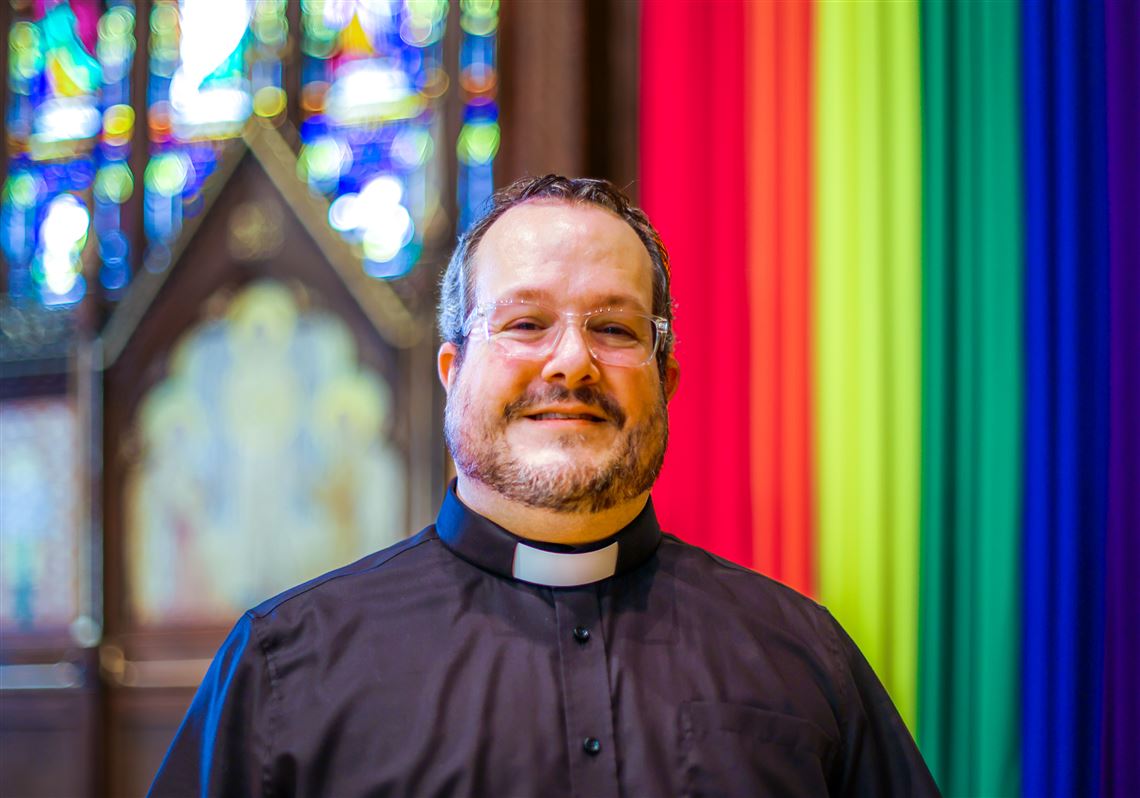
Trinity Episcopal Church in Toledo is part of the Episcopal Diocese of Ohio in the Episcopal Church, what passes for mainline Anglicanism in the United States. Click on these three links, and it won't take long to find evidence that all three organizations are thoroughly apostate. Trinity Episcopal Church has a new rector (or should that be rectum?); as reported by Sarah Readdean of the Toledo Blade, August 14, 2025 (bold, photo in original):
(Photo credit: Philip Kaplan/The Blade)

The Rev. Jon Richardson says he has “crippling stage fright.”

He still does theater — alongside his husband, director Michael Kidney — but prefers to stick to behind-the-scenes work.

And meanwhile, the Episcopal priest of 16 years has gotten comfortable with preaching every week.

“I was terrified for years, but now I’ve kind of come into my own,” Reverend Richardson said. “On one hand, it doesn’t activate my stage fright because it’s kind of like it’s not me because I am embodying priest in that moment. But on the other hand, the most naked and vulnerable you can be is talking about your experience of faith. It's a complicated thing. I’ve just figured out how to do it.”

His sermons have changed in the last few months since he moved from the East Coast to northwest Ohio as the new rector at Trinity Episcopal Church in downtown Toledo.

“I’m growing as a preacher here because of the kind of community it is. I’m finding my voice changing a lot because of the kind of community this is,” the 46-year-old said. “I feel like I’m becoming more of myself, like I feel the freedom here to really let loose, just to let myself go.”

Trinity advertises itself as “a progressive, inclusive, and creative community of faith” — making it a perfect fit for the priest who said he had always known a church like this existed.

After seeing the Toledo church was looking for a new priest, Reverend Richardson said, he was “immediately enchanted by the place,” and knew the members of this growing congregation were his people.

“These people are doing something different; they’re being the church in a way that almost nobody else is,” he recalls thinking when he first found Trinity. “I have to remind myself that we’ve only been here four months, because it’s been such a natural, easy fit. I kind of feel like I’ve been here forever.”

Time of transition

Over the course of the last three years, Trinity has had three different priests. Its former rector, the Rev. Lisa Tucker-Gray, left in 2023, and the Rev. Stephen Applegate served as interim rector for 14 months.

“Staff has had a lot of transition, and he has come in [saying], ‘Let’s start really envisioning where we’re at a year from now,’” Heather Meyer, director of operations for the church, said of the new rector. “He’s been really great at that.”

The congregation has been warm and welcoming to their new priest, his husband, and their dog, Tino, since they settled into Ottawa Hills in March. “I’m here for the long haul,” Reverend Richardson said, noting that his priorities right now are building relationships with the parish and city and seeing where God is calling the parish.

Trinity’s 33rd rector was raised in Louisiana and spent the last 20 years in the Northeast, primarily in New Jersey. His father is a United Methodist pastor and the young Richardson said he first felt called to ministry at age 16. He came out as gay two years later at a time when the United Methodist Church was not accepting of queer clergy. (It wasn’t until last year that the denomination voted to lift its ban on that.) He spent some time away from the church but got a taste of the Episcopal Church while working as a paid singer in a church choir during college. There he felt comfortable and drawn to its liturgy. He eventually decided to study church history instead of vocal music performance, and ended up pursuing ordination in the church.

The Episcopal Church has been “theoretically inclusive” since 2003 when Bishop Gene Robinson was ordained as the first openly gay bishop in the church, and it’s been “increasingly inclusive” since then, Reverend Richardson said.

His early years in ministry were spent working on the institutional level to foster relationships and conversations around sexuality between Anglicans worldwide. He also contributed to legislation that would include transgender people in the church's nondiscrimination canons.

Celebrating Pride

Having long been involved in various social service and justice initiatives in Toledo, Trinity is recognizable at 316 Adams St. by its Pride flag and Homeless Jesus sculpture. It also makes its space available to community groups.

The new rector said he’s moved by the action, service, and vision that take place there and that it helps him feel like he's part of something bigger than himself.

The 188-year-old parish has a number of activities lined up for the 16th annual Toledo Pride.

The weekend kicks off Friday with a Pride Family Picnic, including drag performers and a gender-affirming clothing swap, from 5 to 8 p.m. on the church plaza.

Hospitality for the Toledo Pride Parade begins at 10 a.m. at the church, which will open its bathrooms and a cooling station to the public and offer water and snacks. About 20 members will march with the Better Together: Faith Communities United for Pride movement, and Bishop Anne Jolly of the Episcopal Diocese of Ohio may be joining from Cleveland, the priest said.

A Big Queer Pride Service will be a 10 a.m. affirming liturgy Sunday in the sanctuary, which has been adorned with 15-foot rainbow banners hanging from the buttresses. “We’re always a little bit queer,” the priest said, but this service will be especially rainbow focused.

“Each year, we try to figure out a way which we can engage just a little bit stronger, more creatively,” Meyer said of Trinity’s involvement in the annual event. The queer-affirming parish is the only church along the downtown parade route, she noted.

The Revs. Megan Allen-Miller and Melanie Forrey organized the Better Together initiative last year, bringing together about 300 people from more than 30 area faith communities across nine denominations. This year, they’re welcoming six groups that hadn’t participated last year, which Pastor Forrey of Zoar Lutheran Church in Perrysburg said brings in new excitement and energy.

“Pride is such an amazing, wonderful opportunity to come together in celebrating joy,” said Reverend Allen-Miller, priest at St. Andrew’s and All Saints Episcopal churches in Toledo.

“From the beginning, our intention was to be an embodied message of inclusion that demonstrates in a big way how we have a lot more in common than we don’t,” Pastor Forrey said. “Part of that is wearing the same shirt. Part of that is walking behind the shared banner. And we speak together for our shared values of inclusion, for not just the LGBTQIA+ community, but humanity in general.”

Wednesday, 27 August 2025

"Edmonton's Christian University" schedules a celebration of a Hindu festival

According to the Indian site Book My Pooja (bold in original):

Diwali, also known as Deepavali, is India’s grand festival of lights, symbolizing the victory of light over darkness, knowledge over ignorance, and good over evil. Families come together for prayers, feasting, charity, home decoration, and festive joy. It holds immense spiritual and cultural significance across Hindu, Jain, Sikh, and Buddhist communities.

In 2025, Diwali falls on Monday, 20th October, with Lakshmi Puja as the main highlight of the festival.

Diwali 2025 – Main Date and Tithi Details

Main Diwali Date (Lakshmi Puja): Monday, 20th October 2025
Amavasya Tithi Begins: 20th October at 12:11 AM
Amavasya Tithi Ends: 21st October at 10:43 PM
Lakshmi Puja Muhurat: 6:59 PM to 8:32 PM IST

The 5 Days of Diwali Festival 2025

1. Dhanteras (Dhantrayodashi) – Saturday, 18th October 2025
Worship of Lord Dhanvantari and Goddess Lakshmi
Buying gold, silver, brass, or utensils is considered auspicious
Homes are cleaned and illuminated to welcome prosperity

2. Narak Chaturdashi / Kali Chaudas – Sunday, 19th October 2025

Also known as Choti Diwali
Ritual Abhyang Snan (holy oil bath) is performed before sunrise
In South India, this is the main Deepavali day, marking Lord Krishna’s victory over Narakasura

3. Lakshmi Puja (Main Diwali Night) – Monday, 20th October 2025

Goddess Lakshmi, Lord Ganesha, and Kuber are worshipped
Diyas are lit to drive away darkness and invite divine blessings
Families perform Lakshmi-Ganesha Puja in homes and businesses

4. Govardhan Puja / Annakut – Tuesday, 21st October 2025

Worship of Lord Krishna who lifted Govardhan Hill to protect devotees
Celebrated with grand food offerings (Annakut) and Govardhan rituals in temples

5. Bhai Dooj / Yama Dwitiya – Wednesday, 22nd October 2025

Celebration of the bond between brothers and sisters
Sisters apply tilak on brothers’ foreheads and pray for their longevity
Gifts and sweets are exchanged in a joyful atmosphere

Why Diwali is Celebrated – Cultural Significance

North India: Commemorates Lord Rama’s return to Ayodhya and the lighting of diyas across the kingdom
Gujarat: Marks the end of the financial year, with Chopda Pujan (sanctification of account books)
South India: Celebrates Lord Krishna’s victory over Narakasura
Bengal & Odisha: Diwali coincides with Kali Puja, invoking the fierce form of Goddess Durga
Jainism: Observes Mahavira’s Nirvana (liberation) on this night
Sikhism: Celebrated as Bandi Chhor Divas, marking Guru Hargobind Ji’s release from prison

How Diwali is Celebrated Across India

Lakshmi-Ganesha Puja: Prayers for prosperity, wisdom, and new beginnings
Lighting Diyas: Symbol of light, purity, and spiritual awakening
Decorating Homes: With rangoli, flowers, torans, and lights
Firecrackers: Traditional celebration of joy and the victory of dharma
Feasting and Sweets: Preparation and sharing of homemade mithai like laddus, barfi, kheer
Charity (Daan): Donating food, clothes, or money as part of Diwali dharma
New Clothes: A symbol of renewal and abundance

Modern Tips for a Sustainable Diwali

Use eco-friendly diyas and natural rangoli colors
Prefer green or silent firecrackers to reduce pollution
Gift handmade or local artisan products
Focus on spiritual practices, bonding, and seva (service) rather than materialism

Book Pandit for Lakshmi Puja or 5-Day Diwali Rituals

BookMyPooja offers:

Full 5-day Diwali Puja services, including Lakshmi-Ganesha Archana, Chopda Pujan, Govardhan Puja, and Bhai Dooj rituals
Experienced priests fluent in Hindi, Gujarati, Kannada, Tamil, Telugu, Marathi traditions
Online and in-person pujas with complete puja samagri kits included
Customized pujas for homes, businesses, and gated societies
One need not understand the meaning of all the terms mentioned in the paragraphs above to see that Diwali is a festival of Hinduism and its derivatives, worshipping Hindu deities. One might therefore wonder why The King's University, which bills itself as "Edmonton's Christian University," has the following in its calendar of events for 2025-26 (bold in original):

Diwali Celebration
Current Students
October 21, 2025
All Day
The King's University
This comes as no surprise to this blogger, who has long warned that anyone who thinks that The King's University and similar institutions are actually Christian isn't paying attention to what's going on.

See also my posts:

"Christian" play The Big Picture reduces the Bible to a two-hour production (February 15, 2012)

20 years ago: Activist Supreme Court of Canada invents sodomite rights in provincial legislation (April 2, 2018)

"Edmonton's Christian University" holds a silent online auction (September 23, 2021)

"Edmonton's Christian University" supports United Nations sustainable development goals (January 31, 2023)

"Edmonton's Christian University" celebrates "Pride Week" (March 8, 2023)

Sunday, 22 June 2025

The Anglican Church of Canada is repurposing its buildings because it can no longer fill them

Having a form of godliness, but denying the power thereof: from such turn away. II Timothy 3:5

More evidence of the accelerating suicide of the Anglican Church of Canada, as reported by Nicole Thompson, The Canadian Press, June 22, 2025 (photo in original):

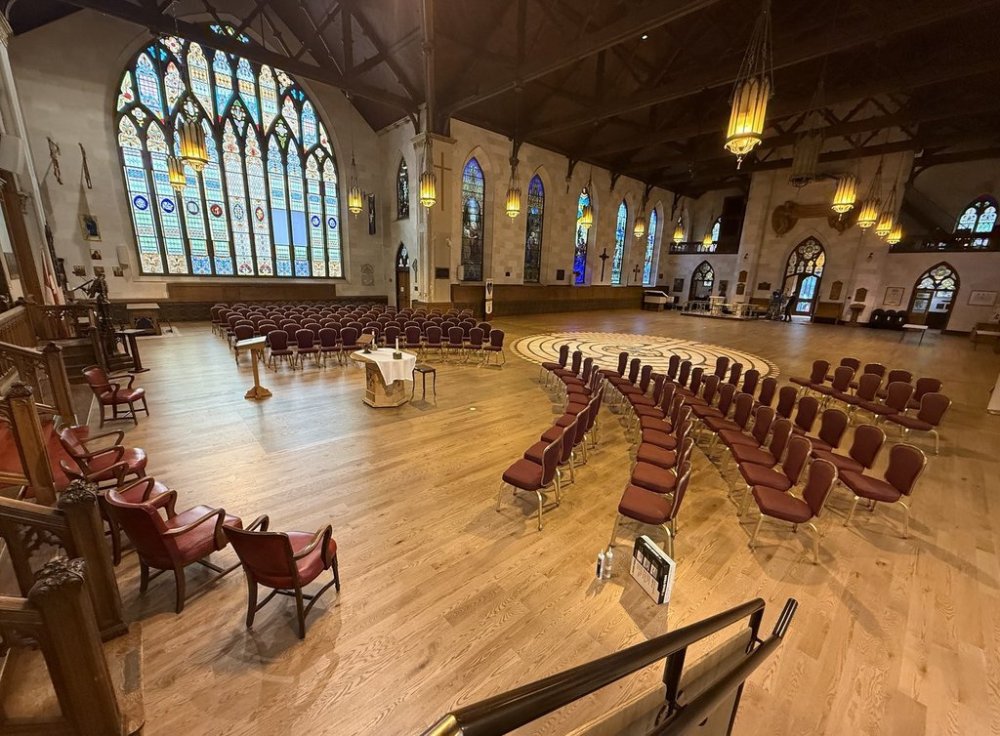
The newly renovated St. Paul's Cathedral in London, Ont., is pictured in this undated handout photo. THE CANADIAN PRESS/Handout - St. Paul's Cathedral, Rev. Kevin George (Mandatory Credit)
When Rev. Kevin George first arrived at St. Paul’s Cathedral, congregants accused him of coming to rip out the pews.

“I was like, ‘OK, everybody take a breath. I don’t have my chainsaw with me,'” he said Friday, a day after welcoming the public into the newly renovated building in downtown London, Ont.

It’s been 18 months since he started working at the church, and the pews are indeed gone.

After much prayer and consideration, the change came with the blessing of the congregation.

George is leading the adaptive redevelopment of St. Paul’s in an effort to keep the Anglican church building alive in a model not unlike the one endorsed by a new report from the Canadian Urban Institute.

It argues churches must change their approach to managing their buildings because declining attendance is putting their longevity at risk. The institute fears the loss of physical buildings could spell the end for the churches’ civic function.

The non-profit’s report says that in addition to their spiritual role, church buildings have long been places where people go for social services, from food pantries to foot clinics and charity bingo to child care.

It was that same argument that got members of St. Paul’s onside, George said.

They asked themselves, “What are we doing with the space and what does that space do for us to allow us to be the church that we need to be today, tomorrow and for generations to come?” George recalled.

“And when we did that work, the barriers began to fall.”

Without the pews, which seated 700, the space can be used in any manner of ways — as a concert venue, a conference hall, and, of course, a space for worship.

The renovations, which also included making the space wheelchair accessible and installing much-needed air conditioning, have cost $1.9 million.

The congregation and Anglican Diocese of Huron have together raised $1.1 million, and they’re now looking to external sources to cover the balance. They’re hoping some funds could come from the City of London, which has endorsed the space as a new creative hub.

The church will also expand its civic role, George said.

“When I moved downtown in January of 2024, one of the overwhelming narratives about St. Paul’s was, ‘I can never get in there. The doors are locked,'” he said. “Well, that’s changed dramatically and will continue to change because our attitude now is ‘doors open.'”

If churches don’t adapt, CUI President Mary Rowe said, they face two major threats: development and decay.

“As urban environments intensify…those kinds of civic spaces that provide this kind of opportunity for informal, casual social interaction, they get encroached upon because the market pressure is such that that building starts to become more desirable for high-end housing,” Rowe said.

“And in small communities where there may not be the same kind of pressure for real estate development, there’s no money or resources to shore up the civic functions of these places.”

The report contends church spaces, which for decades have benefited from tax exemptions, have a duty to continue offering civic services. But a 2019 study by the National Trust for Canada predicted that one-third of Canada’s 27,000 faith buildings, most of which are Christian, would likely close permanently in the next 10 years.

“What we need are new models that get new resources into these places so that you can actually evolve in a way that serves the community around it,” Rowe said.

The report attempts to “unravel the Gordian knot” of how at-risk, faith-built assets like churches should be managed going forward.

That’s a question Rev. Graham Singh has spent more than a decade working to answer.

He’s the senior pastor at St. Jax Church in Montreal and CEO of the charity Releven, which works to preserve and repurpose underused churches.

St. Jax, formerly called St. James the Apostle Anglican Church, is a sort of prototype for the Releven model.

The grand cathedral on Rue Sainte-Catherine ceased operations in 2015. It was in disrepair and maintenance was extremely expensive because of its heritage designation. It reopened the following year under the new name.

“A challenge is the building itself,” Singh said. “Raising money to repair the roof, which is this heritage-listed slate roof that has to be repaired with like-for-like materials. And then the same thing with the masonry, which is a very expensive 150-year-old stone construction.”

But now, the building is home to four separate congregations and a non-religious non-profit, which will soon handle management of the building. Secular tenants of St. Jax include organizations that work in refugee resettlement, food security and youth employment.

Meanwhile, the City of Montreal is in the final stages of a process to acquire the green space outside St. Jax with the goal of turning it into a park.

Singh also knows about the complexity of working with the municipal government.

In order to make all the changes to how the St. Jax building operates, his organization had to prove they had the historic right to change the site’s purpose and use.

That heritage impact assessment has become part of the Ville-Marie Pilot Project, which opens the door for other churches in the city to share their space with non-religious groups, he said.

“The city has indeed been updating their zoning and urban planning framework to allow more of that to be happening in other locations in the future,” Singh said.

Through Releven, he’s taking that experience and helping other churches leverage it.

The CUI report found one of the barriers for churches looking to change their business model is a lack of knowledge on the part of local leadership.

“There’s very few examples of a congregation or a diocese or an owner of a faith building that have been able to do it by themselves because of the complexity of these buildings and the regulatory environment,” said Jennifer Barrett, managing director of programs, planning and policy at CUI.

Some churches have partnered with real estate developers.

Among them is All Saints’ Anglican Church in Winnipeg, whose lands are now home to West Broadway Commons, a 110-unit housing project. Fifty-six of those units are affordable.

But in many cases, Barrett said, churches are resistant to that sort of change and fearful of giving up control.

“It is challenging for faith communities to let go of their buildings,” she said.

George said that was true for the congregation at St. Paul’s. Ultimately, they decided that they should retain ownership of the property.

“We would have become sort of a tenant in our own space, and the Diocesan structure of the Anglican Church doesn’t work well for that,” George said.

“We’re working on what we believe will be a public-private partnership to administer this going forward because we know we’re going to get very busy. I mean, we’ve only just moved in yesterday, and we’re already receiving calls. There’s a demand here for a space like this.”
According to its own 2019 report, the Anglican Church of Canada will be dead by 2040. A similar report from 2006 warned that the church would be dead by 2061, so the pace of decline has accelerated.

See also my posts:

An example of a dead church morphing into a community centre (January 26, 2014)

An example from Edmonton of a community service centre masquerading as an evangelical church (January 22, 2015)

More examples from Edmonton of community service centres masquerading as churches (December 31, 2015)

Anglican Church of Canada will be dead by 2040, according to its own report (December 22, 2019)

An example from Saskatoon of a community service centre masquerading as a Christian church (March 28, 2016)

100 years ago--Canadian Anglicans envision new social order (September 30, 2023)

Wednesday, 18 June 2025

50 years ago--the Anglican Church of Canada votes to ordain women to the priesthood

As reported by Canadian Press and published in the Montreal Gazette, June 19, 1975:

QUEBEC--Ordination of women to the priesthood was approved last night by 88 of 106 lay delegates to the 27th general synod of the Anglican Church of Canada.

Seventy-five of the 105 clergy voted yes while 26 of the 34 in the House of Bishops voted their approval.

It was the second time the synod had approved the ordination of women. Approval in principle was given at a 1973 synod but it is necessary for a second synod to approve the action for it to become fact.

Also approved was a resolution that women be ordained at the discretion of diocesan bishops after consultation with the House of Bishops.

This allows a bishop to refuse ordination if he opposes the principle.

On this motion, 95 of the lay delegates voted yes and nine no. The clergy voted 86 in favor and 19 against while bishops voted 27 for and seven against.

There are deep feelings in the church on the question. It has been before Anglican communions since 1862 when a bishop of the Church of England ordained a deaconness. The Canadian church has deaconnesses.

The Lambeth conference of 1968 accepted the principle that deaconnesses are within the diaconate but it does not ordain them as priests.

The general synod of 1973 approved ordination in principle but specified that it not be implemented until the House of Bishops developed a pattern that included an education process.
As reported by Canadian Press and published in the Montreal Gazette, June 20, 1975:

...The final act of synod was to state that no person should be penalized as a result of synod's accepting the principle that women be admitted to the priesthood.

Two decisions of major import affecting the entire church were made at the week-long meeting with synod stting that women can be priests and deciding to end negotiations for union with two other Protestant churches.

Both steps troubled the delegates and feelings during debate ran high, even nearing the end as the "conscience clause" was adopted.

This came out of Wednesday's synod acceptance of women priests. Many in the house said it was "sad" that a church law was necessary to enforce an idea that should be accepted by a Christian church.

Archbishop [E.W.] Scott said the action was necessary for canonical and legal reasons.

The adopted resolution said:

"No bishop, priest, deacon or lay person, including postulants for ordination of the Anglican Church of Canada, should be penalized in any manner, nor suffer any canonical disabilities nor be forced into positions which violate or coerce his or her conscience as a result of general synod's action in affriming the principle of the ordination of women to the priesthood..."

Some bishops oppose ordination of women on theological grounds and have said they will refuse to ordain them. They were given discretion in this but it was feared by many clerical and lay members that penalties would be imposed if they refused...
Putting women in positions of leadership in a church is not only a sign of further apostasy to come but also of how much apostasy has already progressed. How has the Anglican Church of Canada's 1975 decision worked out? In 1975 there were 1,015,016 people listed on parish rolls. It peaked in 1964 at 1,365,313. By 2022 it was down to 294,931, a 70% decline since 1975 and more than 78% since 1964. According to its own 2019 report, the Anglican Church of Canada will be dead by 2040. The ordination of women as priests was a major step in the church's process of suicide.

Tuesday, 10 June 2025

100 years ago--The United Church of Canada is founded

For I know this, that after my departing shall grievous wolves enter in among you, not sparing the flock.
Also of your own selves shall men arise, speaking perverse things, to draw away disciples after them.
Acts 20:29-30

And have no fellowship with the unfruitful works of darkness, but rather reprove them. Ephesians 5:11

Little children, it is the last time: and as ye have heard that antichrist shall come, even now are there many antichrists; whereby we know that it is the last time.
They went out from us, but they were not of us; for if they had been of us, they would no doubt have continued with us: but they went out, that they might be made manifest that they were not all of us.
I John 2:18-19

Beloved, when I gave all diligence to write unto you of the common salvation, it was needful for me to write unto you, and exhort you that ye should earnestly contend for the faith which was once delivered unto the saints.
For there are certain men crept in unawares, who were before of old ordained to this condemnation, ungodly men, turning the grace of our God into lasciviousness, and denying the only Lord God, and our Lord Jesus Christ.
Jude 3-4

The modern ecumenical movement, which began with the World Missionary Conference in Edinburgh in June 1910, had already been underway for 15 years when, on June 10, 1925, the United Church of Canada was founded as a merger of the Methodist Church, Congregational Union of Ontario and Quebec, two-thirds of the congregations of the Presbyterian Church in Canada, and the Association of Local Union Churches (a movement predominantly of the three provinces of the prairie provinces). 7,000-8,000 representatives attended the founding assembly at Mutual Street Arena in Toronto. In contrast to today, the assembly received so much newspaper coverage that it occupied the front page of the Toronto Daily Star on June 10, with articles appearing on the first seven pages of that day's edition.

M.G. Hammond reported in the June 11, 1910 edition of the Toronto Globe that the United Church had about 800,000 members in 9,000 congregations. Membership in the United Church of Canada peaked in 1964 at 1,064,000. By the end of 2023 the number of United Church congregations had dwindled to 2,451, with a total of 325,215 members--a decline in membership of approximately 70% since its peak. I don't have time to go into detail on the decline of the United Church of Canada, but it can be summed up in one word: apostasy. If you want to know about the current state of the United Church, just look at its website--especially during the month of June, when the UCC takes pride in what God calls an abomination (Leviticus 18:22).

I also recommend my previous posts on the United Church of Canada, especially the one on the 1964 Sunday School curriculum:

Calgary Herald blasts United Church of Canada for advocating a boycott of Israel (May 15, 2012)

Canadian Senators warn United Church of Canada over proposed boycott of Israeli goods (July 6, 2012)

A secular columnist accurately assesses Canada's declining liberal churches (July 30, 2012)

United Church of Canada elects its first openly sodomite moderator (August 16, 2012)

50 years ago: United Church of Canada unveils Sunday School curriculum denying the truth of the Bible (August 1, 2014)

80 years ago: United Church of Canada ordains Canada's first female minister (November 7, 2016)

Amalgamation of congregations in Edmonton provides more evidence of the continuing decline of the United Church of Canada (January 31, 2017)

30 years ago: New Ager Matthew Fox delivers keynote lecture at Queen's Theological School (October 11, 2017)

50 years ago: United Church in Calgary experiments with modern music (June 15, 2018)

Mainline church leaders 50 years ago advocated methods used by "evangelical" churches today (November 6, 2018)

Atheist minister with United Church of Canada keeps her job after an agreement in lieu of a heresy trial (November 16, 2018)

50 years ago: Canadian Anglican traditionalists oppose union with United Church of Canada (June 21, 2019)

United Church of Canada holds racially segregated mandatory workshops--for "racial justice" (May 31, 2021)

"Interfaith" service is appropriate for the retirement of United Church of Canada pastrix (July 30, 2023)

50 years ago--a couple of items related to ecumenism (April 26, 2025)

Saturday, 26 April 2025

50 years ago--a couple of items related to ecumenism

Can two walk together, except they be agreed? Amos 3:3

Having a form of godliness, but denying the power thereof: from such turn away. II Timothy 3:5

Manmade efforts to unite nominal Christian churches have never quite been able to succeed; could that be because God isn't behind these efforts? From back in the days when most newspapers had a religion page and/or section on Saturday, here are a couple of items that appeared on the first page of the religion section of The Edmonton Journal, April 26, 1975 (headlines in original):

Catechism joint effort

LONDON (Reuter)--A new move toward Christian unity--a joint Protestant and Roman Catholic catechism--has been introduced here.

The common catechism, published in Britain on April 21, is the first book on Christian belief to be produced by a mixed team of Protestant and Roman Catholic theologians.

It was first issued two years ago in German, edited by two Swiss theologian scholars.

The English-language translation, published by search press, has the blessing but not the official recognition of both Protestant and Roman Catholic church leaders.

Doctrinal questions such as the existence of God and approaches to faith are tackled in the catechism, which is more than 650 pages long.
The Common Catechism: A Book of Christian Faith, by Johannes Feiner and Lukas Vischer, was the work of Roman Catholic, Lutheran Church, and Reformed Church theologians, and was published in English by Seabury Press on January 1, 1975.

Union losing impetus

ORILLIA, Ont. (CP)--The moderator of the United Church of Canada says the proposed union of the United and Anglican Churches "seems to have slowed down in the past few months."

Speaking at a Muskoka presbytery rally, Dr. Wilbur Howard of Ottawa said the United Church "is waiting anxiously for a circularization in the membership of the Anglican Church to see how mwmbers of the general congregation feel about the union."

He noted that the Anglican House of Bishops recently made public a report affirming a possible union.

But, he said, "they found the plan of union unacceptable."

"In the United Church we did not seem to have a clear understanding of the role of the bishops. Also the United Church believes that women should be ordained.

"Maybe we pushed too hard and maybe we didn't listen enough. But it was a good try. Union can't be imposed, it can only come when we work for it. I think it's part of the future."

Dr. Howard also said that the United Church is including in its "design for the future" husband and wife acting as ordained ministers. He said such ministries are being considered for Saskatchewan, Manitoba, and Ontario.
As reported by Henry Overduin of the Montreal Gazette, June 20, 1975 (bold in original):

The decision this week by the Anglican synod meeting in Quebec City to reject the plan of union with the United Church is not as big a blow to ecumenism as might first be believed.

The plan of union was killed early February, when the bishops rejected it, commenting that it did not even provide a useful basis for continuing talks.

The synod, less brusquely but with the same result, confirmed the bishops' decision although accepting the plan as a study paper. But that's just a euphemism for "putting it on the shelf" where the plan of union will gather dust until some historian or archivist decides to peruse it.

LACK OF INTEREST

Lack of interest in schemes leading to organic union among Protestants is simply a fact of ecclesiastical life today.

This lack of interest, for example, is illustrated by the response to the so-called circularization of the Anglican church membership on union talks with the United Church.

That circularization--a poll--was decided on after the bishops rejected the plan of union, and something had to be done fast to assure the United Church that the Anglicans were still sincere about church union.

It was also made plain at the outset that the poll was not a referendum, that its results would not be binding on the church.

Results of the poll showed that while 72.1 per cent of eligible clergy responded, only 11 per cent of the eligible laity did.

The clergy were roughly divided half-and-half on the desirability of continuing talks--494 said yeas, and 473 said no. The general membership was also divided. A total of 33,396 favored continuation of the talks, and 28,930 were against.

But, based on the small sample and its volunteer nature, this poll hardly constituted a reliable gauge of Anglican sentiment.

As has been said before, it would be wrong to read into the synod's negative decision what is not really there, namely, that the ecumenical movement has suffeed a major setback. The concern of the ecumenical movement , in its general sense, was in fact affirmed. In this general sense, the ecumenical movement seeks to express the unity of the church in ways other than organizational charts.

NOTHING NEW

Also, the Anglican synod did go on record as favoring a continuation of talks based on a step-by-step approach to greater unity, instead of the grand plan originally proposed. But that's hardly new.

What can be expected--based on the leadership of the Church of England--is a greater movement toward unity with the Roman Catholic Church.

And, if one is to go by logic, isn't that the only sort of institutional direction the ecumenical movement can take?
As reported by Canadian Press and reported in the Montreal Gazette, June 20, 1975:

...Two decisions of major import affecting the entire church were made at the week-long meeting with synod stating that women can be priests and deciding toend negotiations for union with two other Protestant churches.

Both steps troubled the delegates and feelings during debate ran high...

In his closing remarks Archbishop [E.W.] Scott expressed his personal regrets to representatives of the United Church of Canada and the Christian Church (Disciples of Christ) as they returned home to face the "difficult task" of officially informing their churches of the church-union decision.

General synod Tuesday found the plan of union that the three churches unacceptable, and though it expressed its willingness to continue to seek unity, its decision was viewed as a final turndown after 32 years of talks.

Among other resolutions pushed through swiftly as the synod sought to clean up its business--much was left unfinished--was one that called upon local committees and other church groups to determine and report if any of their financial investments are in banks or corporations that have trade or have investments in South Africa. The committees were told to sell such holdings as soon as possible.

The church has gone on record as opposing and deploring apartheid--separation of the races--in that country.

All dioceses were asked to study and respond to the concept of a guaranteed annual income for Canadians.

A memorial for the diocese of Edmonton asked that the Anglican Book Centre, a publishing firm, determine if it were financially possible to reprint the 1938 hymn book, now out of print.

It has been superseded by a joint hymn book adopted in 1971 by the Anglican Church and the United Church, which many members do not like. Many churches continue to use the old book
. The Anglican Church of Canada ordained its first six priestesses on November 30, 1976--40 years after the United Church of Canada began doing so--but formal unity of the two churches has never occurred. The two are united, however, in their increasing apostasy. The Anglican Church, according to its own 2019 survey, will be dead by 2040, and it will come as no surprise if the same isn't true for the United Church. The United Church's intention of having husband and wife as ordained ministers seems quaint in 2025; ordaining alphabet perverts wasn't on the radar screen in 1975. To see the United Church of Canada's downward slide as measured by its views on "Gender and Transgender Justice," go here and get the timeline right from the horse's mouth (or should that be the ass's butt?).

Monday, 30 December 2024

70 years ago--Archbishop of Canterbury pessimistic about immediate ecumenical unity

Ecumenical speculation from the leading cleric of the Church of England is nothing new, as exemplified in the following item reported by Canadian Press and published in the Calgary Herald, October 12, 1954:

WINNIPEG - The Archbishop of Canterbury said Sunday night the world's churches are getting nearer to one another but he does not anticipate any general reunion of the separated churches into one articulated body, governed by one constitution.

Most Rev. Dr. Geoffrey Fisher, who recently attended the World Council of Churches in Evanston, Ill., and toured Canada, spoke on "Prospects for unity." His address was recorded during a visit to Winnipeg for broadcast in the C.B.C. program, "Our Special Speaker." Dr. Fisher arrived back in England Oct. 4.

"We are all sinful men with our share of wilfulness and wrongheadedness," he said. "This truly shows that every church in Christendom has erred in matters of faith; and that liability to err remains, will remain.

"If there were but one church, its errors would bring final disaster to all. We need our various traditions to continue within the whole church catholic, so that as occasion needs, the insight of one may correct the error of another; and one may hear what the Holy Spirit speaks to the church when others are temporarily deaf to it."
Then, as now, the World Council of Churches was apostate, but the Archbishop of Canterbury spoke as though liberal churches were actually Christian. His skepticism regarding churches uniting into one body has so far been correct; if they do unite, it will likely be under the umbrella of the Roman Catholic Church.

Saturday, 31 August 2024

Progressive Jews use holiday for animals to promote vegetarianism

As reported by Sharon Chisvin in the Winnipeg Free Press, August 31, 2024:

Exactly one month before Jews worldwide gather in synagogues to commemorate the major holiday of Rosh Hashana and the start of a new Jewish calendar year, a smaller contingent of mostly progressive members of the faith are gathering online to celebrate a lesser-known Jewish holiday.

That holiday is Rosh Hashana L’Behemot, the New Year for Domesticated Animals. Rosh Hashana L’Behemot occurs each year on the first day of the Hebrew month of Elul, and, as a result, is also referred to as Ehad b’Elul. This fall, that date corresponds to Sept. 4.

Rosh Hashana L’Behemot dates back to the days of the ancient holy Temple in Jerusalem when it was customary to tithe every tenth animal in a flock and offer it up as a sacrifice to God. Tithing, and animal sacrifices, like many of the ancient rites and customs associated with the Second Temple, came to an end with the Roman destruction of the Temple in 70 C.E. and the subsequent dispersion of the Jewish people into exile. Commemoration of Rosh Hashana L’Behemot, naturally, fell into decline as well.

The day itself, however, according to Aharon Varady, director of the Open Siddur Project—a grassroots initiative that digitizes diverse Jewish liturgy and texts—remained “documented but dormant, just waiting for the right moment to be revived.”

That moment has been taking its time to arrive, but Rosh Hashana L’Behemot has gradually begun to gain traction again. In recent years, the holiday has primarily evolved into a day on which Jewish community members are encouraged to pause and consider both their relationship with and their responsibility towards domestic animals.

“As Rosh Hashana L’Behemot is still evolving there is no usual way (to celebrate),” explains Rabbi Jonathan Bernhard, Executive Director of the Jewish Initiative for Animals (JIFA), “but common elements include some type of reading, prayer, teaching, or the blowing of the shofar.”

“Most congregations,” he adds, “do not do anything. We are trying to change that!”

JIFA’s determination to make that change is the reason it is partnering for the first time ever with the organization, Jewish Veg, in presenting the on-line, Alep B’Elul, Rosh Hashana L’Behemot celebration on Wednesday morning.

Similar to JIFA, Jewish Veg encourages compassion for animals and the adoption of plant-based diets — which, significantly, also will help alleviate the climate crisis — through the lens of Jewish teachings and values. The organizations’ shared hope is that their Zoom event will increase awareness about and actions aligned with their shared goals.

The 90-minute event will be hosted by Bernard and features a keynote address by Dr. Beth Berkowitz on the topic of “Making Animals a Part of the Jewish Family.” Berkowitz is a Jewish and religious studies scholar at Barnard College and the author of the book What Animals Teach Us about Families: Kinship and Species in the Bible and Rabbinic Literature.

The online event also will honour Dr. Richard Schwartz, a life-long animal rights activist, the founder of Jewish Veg, and a co -founder of the Society of Ethical and Religious Vegetarians.

The author of significant writing on the topic of animal advocacy and the Jewish plant-based movement, Schwartz has repeatedly argued that veganism and vegetarianism is the highest manifestation of the Jewish dietary laws of kashrut.
This is yet more evidence that Judeo values are not Christian values. In contrast to JIFA and Jewish Veg, the Bible does not promote vegetarianism. Although God gave man "every herb bearing seed...and every tree, in the which is the fruit of a tree yielding seed" for food (Genesis 1:29), by the time of Noah and his sons, God says to them, "Every moving thing that liveth shall be meat for you; even as the green herb have I given you all things." (Genesis 9:3). By the time of Moses, God commands the people of Israel to eat the Passover lamb (Exodus 12:8-11); vegetarianism was not an option. Addressing the Jews of his time, the Lord Jesus Christ said,

“Are you so dull?” he asked. “Don’t you see that nothing that enters a person from the outside can defile them?
For it doesn’t go into their heart but into their stomach, and then out of the body.” (In saying this, Jesus declared all foods clean.)
Mark 7:18-19 (NIV)

One of the signs of the end times is the command to abstain from certain foods (I Timothy 4:3), although "every creature of God is good, and nothing to be refused, if it be received with thanksgiving" (I Timothy 4:4). The only dietary restrictions given to Christians are those in Acts 15:20: ...that they abstain from pollutions of idols, and from fornication, and from things strangled, and from blood.

Friday, 31 May 2024

Survey indicates that many Canadian "Evangelicals" aren't Christians

Now the Spirit speaketh expressly, that in the latter times some shall depart from the faith, giving heed to seducing spirits, and doctrines of devils; I Timothy 4:1

Having a form of godliness, but denying the power thereof: from such turn away. II Timothy 3:5

I don't share the liberal views of the Winnipeg Free Press's religion writer, but at least he reports on issues that almost all other mainstream media outlest in Canada ignore. As reported by John Longhurst in the Winnipeg Free Press, May 18, 2024:

God as a three-in-one, Jesus as divine, the resurrection of Jesus from the dead — these are traditional church teachings that all Christians are assumed to believe. But a recent study by Cardus and the Canadian Bible Society has found that assumption to be unfounded.

Titled “Still Christian(?): What Canadian Christians Actually Believe,” the study’s author, Andrew Bennett, found the beliefs of many Canadian Christians don’t match up with what their churches teach on these and other doctrines.

For example, when asked to agree or disagree with the statement “there is one true God in three persons: Father, Son, and Holy Spirit,” 89 per cent evangelicals agreed, as did 51 per cent of Catholics and 57 per cent of mainline Protestants.

When asked if the resurrection of Jesus Christ was a historical event, 81 per cent of evangelicals said yes, as did 48 per cent of Catholics and 55 per cent of mainline Protestants.

As for whether Jesus was God, 74 per cent of evangelicals said yes, as did 46 per cent of Catholics and 42 per cent of mainline Protestants.

Are all religions equally true? The study found that 20 per cent of evangelicals agreed, as did 54 per cent of Catholics and 57 per cent of mainline Protestants.

When it comes to whether Christian moral teachings should evolve with changes in society, 45 per cent of evangelicals said yes, as did 72 per cent of Catholics and 61 per cent of mainline Protestants.

The study of 2,026 randomly selected Canadian adults was conducted by the Angus Reid Institute in February. Along with questions about doctrines, it also asks respondents for their views on things like abortion, same-sex marriage, heaven and hell and church attendance.

For Bennett, who is program director for Faith Communities at Cardus, the results are startling. “You could say there’s a real problem in the pews,” he said.

While evangelicals are more likely to hold to their denominational doctrines, there is “still some level of incoherence there,” he said, adding that especially for Catholics and mainline Protestants there are hints of “deep fractures” within those groups.

Although many diverged from traditional teachings, Bennett noted they still viewed themselves as Christians. “This fact is significant in itself,” he said.

One surprising finding from the study is that younger Canadian Christians display stronger commitments to traditional teachings compared to older generations. One reason for this, suggested Bennett, is that at a time when Christianity is no longer a cultural norm in Canada, some younger people “may be making deliberate, counter-cultural choices to adhere to the beliefs and devotional life of historical Christianity.”

For Sam Reimer, who teaches sociology at Crandall University in Moncton, the Cardus study mirrors his own research into the disparity between what Canadian evangelical clergy believe and what their denominations teach.

“Even active evangelicals will disagree knowingly with their church’s or denomination’s position on a moral or doctrinal belief,” said Reimer. He thinks this is because what used to be an accepted external locus of authority — church teaching — has been replaced by an internal locus where Christians think each person can decide what they want to believe “based on what works for them.”

Kevin Flatt studies religion at Redeemer University in Ancaster, Ont., For him, the results “are not surprising since they are consistent with longstanding patterns and trends in Christianity in Canada.”

What stands out for him is how evangelicals seem to have resisted an erosion of traditional doctrines, compared to Catholics and mainline Protestants — even if that group shows some significant differences of opinion.

“Overall, I would have expected to see secularization having more of an impact on evangelicals as well,” he said, suggesting evangelicals are more resistant to secularization than other groups.

For Andrew Rampton, rector at St. John the Evangelist, an Anglican church in Hamilton, the problem is that denominations like his haven’t done a good job of teaching their members the foundational Christian beliefs.

“We were so very drunk on Christendom for such a very long time,” said Rampton of the Anglican Church of Canada, noting that for a very long time the values of the surrounding culture supported Christian belief and practice — teaching about it wasn’t as necessary.

That led Anglicans to rely on something he called “liturgical osmosis,” or just assuming everyone would figure it out just by being in Canada.

But now that Canada is less Christian — “not a bad thing for the church in my estimation,” he offered — “we have to remember how to be a group who are not the dominant cultural mindset.”

Rampton also has seen evidence of how young people are more likely to hold traditional beliefs. “Most of the young people I know in the Anglican Church are there by choice,” he said, noting they were very deliberate about choosing that option.

As for the study itself, one question it doesn’t ask is whether the beliefs it highlights are still the ones Christians most need to be faithful in the 21st century; is the problem really as big as the study’s author suggests?

Or maybe something is happening in Canadian churches today as people find new ways of expressing and practising faithfulness — ways that go beyond the need to believe certain things in order to be a Christian. For that, we might need a different study.

The full Cardus study can be found at https://www.cardus.ca/research/faith-communities/reports/still-christian/?utm_source=Still+Christian+NR&utm_medium=Cision&utm_campaign=Still+Christian(%3f)
It comes as no surprise to this blogger to see the apostasy of Roman Catholics and mainline Protestants, although Evangelical useful idiots such as Brian Stiller, former president of the Evangelical Fellowship of Canada and currently the Global Ambassador to the World Evangelical Alliance, believe that these apostate churches are part of the body of Christ (yes, he stated that belief in a speaking tour of Canadian churches in 2014 after accompanying other "Evangelical" leaders such as Kenneth Copeland (!) in a visit to Pope Francis at the Vatican).

The increasing apostasy of so-called Evangelicals also comes as no surprise to this blogger; Singaporean Chrsitian leader Samuel Tow presciently warned of this development in 1983 in his address Today's Evangelicals, Tomorrow's Liberals. As for the results of this survey, if all those who identified as "Evangelicals" were actually Christians, 100% would say that there is one God in three persons; that the resurrection of Jesus Christ was a historical event, and that Jesus is God, while 0% would say that all religions are equally true and that Christian moral teachings should evolve with changes in society (those churches that do believe that Christian moral teachings should evolve with changes in society are the churches that are dying).

It's laughable that Andrew Rampton, rectum rector of the Church of St. John the Evangelist in Hamilton, is cited as an expert on "foundational Christian beliefs." He's the sodomite who, shortly before he assumed his post in Hamilton, occupied the same position at Holy Trinity Anglican Church in Winnipeg, which staged an alphabet pervert "reimagination" of Handel's Messiah in 2023 (see link below).

As Paul's warnings to Timothy indicate, the increasing apostasy of professing Christians is more evidence that we are in the latter times preceding the return of the Lord Jesus Christ, and real Christians should be looking for His coming.

See also my posts: The latest LifeWay survey provides more evidence that many "Evangelicals" may not be Christians (October 30, 2018)

An Anglican "church" in Winnipeg hosts an alphabet pervert "reimagination" of Handel's Messiah (December 22, 2023)

Tuesday, 30 April 2024

YMCA-YWCA of Winnipeg drops "Christian" from its name

The Young Men's Christian Association (YMCA) was founded by a draper named George Williams, and was a product of the 19th century movement known as Muscular Christianity, which promoted patriotism, masculinity, duty, discipline, and athleticism. The reader of the following article will notice that while the YMCA-YWCA's distinctive Christian characteristics have faded away, those running and using the Y's are content to sponge off the cultural heritage of Christianity, while scorning the source, resulting in an acronym with no meaning. That's what you're left with when Jesus Christ is removed: a meaningless jumble. As always, the wokesters are incapable of building any such equivalent organizations of their own.

As reported by John Longhurst in the Winnipeg Free Press, February 29, 2024:

The Young Men’s and Young Women’s Christian Association of Winnipeg has changed its full legal name to YMCA-YWCA of Winnipeg.

The reason for dropping references to Christianity and gender is to both reflect the reality of the organization and remove any barriers or concerns some might feel because of those words, said president and chief executive officer Cordella Friesen.

“We are open to all faiths,” Friesen said Thursday, noting while the organization was founded on Christian principles and values in the 19th century, it hasn’t been overtly Christian in Canada since the 1970s.

“That has not been our emphasis for a long time.”

However, she was often asked about the role Christianity played in the organization, including when hiring new staff or when signing partnership agreements.

This is especially true when entering into agreements with Indigenous groups, Friesen said, noting references to Christianity in the former full legal name could be triggering and concerning for some.

Changing it to the acronym YMCA-YWCA “just reflects the reality of who we have been for decades and who we are,” Friesen said, noting the organization serves a lot of people from the local Muslim community.

This includes wanting to make sure the YMCA-YWCA is seen as being open and welcoming to members of the LGBTTQ+ community, she added. The organization is providing a universal washroom and locker room at its downtown Winnipeg location, although it will still have gendered change rooms and bathrooms.

“Having separate rooms for men and women is important for some faith groups,” Friesen said.

The end goal of the name change is to send the message the YMCA-YWCA is “welcoming to all,” Friesen said. “The Y will always be a safe place that promotes and celebrates diversity.”

The name change is part of the organization’s recently released 2024-27 strategic plan, developed by YMCA-YWCA of Winnipeg’s board of directors over the past year.

The YMCA was founded in 1844 in London, as a response to the terrible working conditions facing young men in cities at that time. The first YMCA in North America opened in Montreal in 1851; the Manitoba branch opened in 1879.

The YWCA was founded in 1858 in New York City.
Ms. Friesen provides more evidence that you can't be a satirist anymore, promoting the Y as a "safe place" while providing a universal washroom, thereby making it "safer" for alphabet perverts to indulge their perversions. And yes, "having separate [change] rooms for men and women" is not only important for some faith groups (read "Muslims," since the views of Christians obviously don't matter to her), but to anyone with any grasp of reality.

Sunday, 31 March 2024

Presbyterian Church (U.S.A.) celebrates Transgender Day of Visibility

Wherefore God also gave them up to uncleanness through the lusts of their own hearts, to dishonour their own bodies between themselves:
Who changed the truth of God into a lie, and worshipped and served the creature more than the Creator, who is blessed for ever. Amen.
For this cause God gave them up unto vile affections: for even their women did change the natural use into that which is against nature:
And likewise also the men, leaving the natural use of the woman, burned in their lust one toward another; men with men working that which is unseemly, and receiving in themselves that recompence of their error which was meet.
And even as they did not like to retain God in their knowledge, God gave them over to a reprobate mind, to do those things which are not convenient;
Being filled with all unrighteousness, fornication, wickedness, covetousness, maliciousness; full of envy, murder, debate, deceit, malignity; whisperers,
Backbiters, haters of God, despiteful, proud, boasters, inventors of evil things, disobedient to parents,
Without understanding, covenantbreakers, without natural affection, implacable, unmerciful:
Who knowing the judgment of God, that they which commit such things are worthy of death, not only do the same, but have pleasure in them that do them.
Romans 1:24-32

This know also, that in the last days perilous times shall come... ...Having a form of godliness, but denying the power thereof: from such turn away. II Timothy 3:1,5

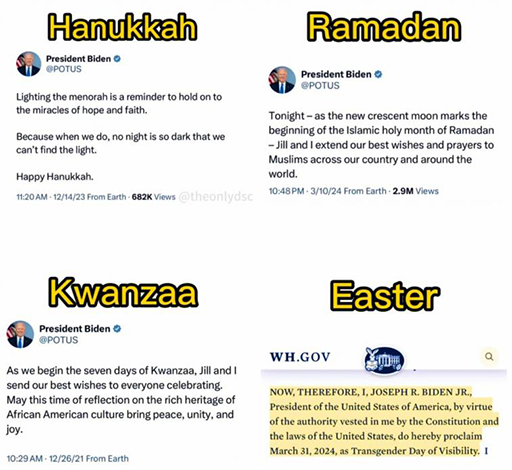
If you're not already aware that the United States (not to mention Canada and other Western nations) are increasingly under the judgement of God, the declaration by the administration of alleged U.S. President Joe Biden of March 31, 2024 as "Transgender Day of Visibility" should help to make it clear. The fact that this celebration of perversion is scheduled for Easter Sunday is not a coincidence. Blogger Vox Day addresses this:
Evangelist Justin Peters offers an excellent biblical perspective--much better than I can--on transgenderism:


For more than half a century, the Presbyterian Church (U.S.A.) has been a hopelessly apostate denomination (see Carl McIntire's 1967 book The Death of a Church for evidence). For current evidence of the PCUSA's apostasy, look no further than the following. As stated by Shea Watts in the Presbyterian Outlook, March 24, 2024 :

In Luke 24, we join two companions traveling the dusty seven-mile road from Jerusalem to Emmaus. As they walk, they grieve the loss of Jesus. Sensing their pain, a stranger approaches and explains how Jesus’ death fulfills God’s promises in Scripture. Amazed, the traveling companions invite the man to dine with them. As the stranger blesses, breaks, and gives the bread, the travelers’ eyes open, and they see Jesus.

In Greek, we’re told here that the disciples recognize (ἐπιγινώσκω) Jesus; they “acknowledge” him. One way of interpreting the story suggests that the men only recognize Jesus when they welcome his presence at the table. In other words, it is not their piety but their hospitality that makes their seeing possible.

This year, Easter falls on the national Trans Day of Visibility (TDOV), allowing us to practice such eye-opening hospitality. We see Jesus whenever we welcome others to the table and acknowledge their presence among us. We see Jesus when we embrace our trans siblings.

According to the PC(USA) Advocacy Committee for LGBTQIA+ Equity, “TDOV is a day that our local churches can embrace and celebrate the diverse identities of transgender and non-binary individuals, affirming their intrinsic worth as creations of God.” This is necessary because transgender persons are the victims of violent legislation and hate crimes. The violence is such that the Human Rights Campaign even declared a National State of Emergency.

Judith Butler (they/them) demonstrates the rise of violence against trans people in Who’s Afraid of Gender? by exploring the anti-gender movement, an umbrella term referring to social movements opposing what they call “gender ideology,” “gender theory” or “genderism.” Examples of the anti-gender movement include efforts to stop talking about gender and sexuality in the classroom and promoting policies to limit trans rights.

Butler writes: “In taking aim at gender, some proponents of the anti-gender movement claim to be defending not just family values but values themselves, not just a way of life but life itself.” Trans people stand at the frontlines of the war on gendered bodies that do not fit the cis-gender, heterosexual standard, says Butler, and they are suffering from the spread of misinformation and rise of hostility. This is why TDOV is important. The fact that it coincides with Easter this year is a coincidence rich for theological reflection.

The paradox of Jesus’ resurrection invites us to look again, think again, and hopefully, live again. Therefore, Easter is an appropriate time to explore our theology of incarnation, embodiment and materiality. One way to understand Christ’s transfiguration is to see Jesus as “a template for other transfigured, transfiguring bodies,” including transgender persons. Cary Howie, a professor at Cornell who writes extensively on gender and sexuality, broaches this idea in his essay “On Transfiguration.” In this line of thinking, recognizing transgender persons allows us to better understand Christ’s resurrection because both Jesus and transgender persons are changed, trans-figured, metamorphosized.

Another way to understand the transfiguration is to think about the impact of being transformed. Howie writes: “To be transfigured is to implicate others in your transfiguration; it is to suggest that ‘luminous glory’ may erupt from, and within, any flesh whatsoever. This implication is part of what makes transfiguration terrifying: no one is untransfigurable, and no one is transfigured alone.” When we see others and acknowledge their transfiguring bodies, we, too, are transfigured and transformed. And the boundaries between “you” and “me” are dissolved until there is only “us."

We see this in the aftermath of Christ’s resurrection in Scripture. After Christ’s revelation to the travelers in Luke 24, he appears to the eleven disciples and friends, opening their minds to the Scripture (Luke 24:45). They become witnesses to Christ’s resurrection and God’s plan for humanity. In Acts, the second book of Luke’s Gospel, we see how they are then charged to tell the story of Jesus to the ends of the earth (Acts 1:8) and how the Holy Spirit aids in this task (Acts 2). When we witness a transformation, we, too, are transformed.

This year with TDOV and Easter falling on the same day, we are asked: are we willing to be transfigured and transformed by acknowledging our trans siblings as images of God? Are we willing to acknowledge their wounds? When we do so, Jesus is revealed and the mystery of Easter bursts into our lives again.

To our trans siblings:

Forgive us

for the times we didn’t see you,

the times we failed to love you.

With your permission and God’s help,

we will love you more faithfully.

We see you, and our hearts burn.
As reported by Shani E. McIlwain of Presbyterian News Service, March 28, 2024 (links, photos in original):
Photo by Alexander Grey via Unsplash

In response to a recent General Assembly mandate, the Advocacy Committee for LGBTQIA+ Equity is at work assisting the Presbyterian Church (U.S.A.) in providing full expression to the rich diversity of its membership as described in the Book of Order.

The committee is made up of teaching elders Ashley DeTar Birt, Daniel Hammer, and Omar Gonzalez; ruling elder Tim Haworth; and deacon Salina Brett.

Committee members say they’re proud to announce the commencement of the committee’s mission dedicated to amplifying the voices of LGBTQIA+ Presbyterians within the PC(USA). With its unwavering commitment to fostering inclusivity and equality, the committee aims to build upon the groundwork laid by pioneers like the Rev. David Sindt, whose courageous act 50 years ago marked a pivotal moment in LGBTQIA+ history.

In a bold demonstration of solidarity and visibility during the 1974 General Assembly of the United Presbyterian Church in the U.S.A., Sindt stood on the Assembly floor holding a hand-written sign that read, “Is anyone else out there gay?”

Today Presbyterians can offer an emphatic “Yes! We are here.” This watershed moment reverberated through the decades, inspiring many individuals to embrace their identities and assert their presence within the Presbyterian community.
The Rev. Ashley DeTar Birt

When asked the question, “Why are you here?” DeTar Birt responded, “It’s about feeling so moved and passionate about something — the work, the people, the theology — that you cannot help but be around it.”

As the committee embarks on this transformative journey, committee members seek to honor Sindt’s legacy and those of a host of allies who have championed LGBTQIA+ rights over the years. Their tireless advocacy and unwavering dedication have paved the way for progress.

The committee also recognizes and honors the contributions of LGBTQIA+ people of color, both past and present. There’s no LGBTQIA+ liberation, after all, without people of color, especially trans people of color. Committee members say they honor the intersections of race, gender identity, and sexual orientation, and commit to amplifying the voices of LGBTQIA+ people of color, especially trans people of color, as much as possible.

The committee’s mandate encompasses a broad spectrum of initiatives, including advocacy for inclusive General Assembly overtures, heightened transgender visibility, and structural reforms to ensure equal access to benefits and opportunities for all members of the LGBTQIA+ community. By leveraging the collective power of all voices, the group hopes to create a more inclusive and equitable PC(USA) that embraces the diversity of its members. The committee invites all members of the PC(USA) to join in this historic endeavor to build a future where every individual is valued, respected, and celebrated for who they are.

The Transgender Day of Visibility is being observed on Sunday. The committee has issued this statement:

“Picture a life shrouded in secrecy, where your true essence remains concealed from the world. Your official documents do not reflect who you truly are. Every public appearance demands that you wear a mask, hiding behind a facade that doesn’t align with your inner truth. Imagine facing legal barriers that limit your access to essential health care, participation in sports, and even the use of public restrooms. Amid this oppressive environment, consider the profound significance of discovering a small community of allies who not only accept but celebrate your authentic self, allowing it to shine brilliantly amidst the darkness. This is the significance of the Transgender Day of Visibility (TDOV).”

“TDOV is a day that our local churches can embrace and celebrate the diverse identities of transgender and non-binary individuals, affirming their intrinsic worth as creations of God. By providing a welcoming space for positive and genuine representation, a local church can help these individuals feel acknowledged and valued for who they truly are. Furthermore, TDOV serves as a valuable opportunity to dispel misconceptions and promote understanding of the transgender and non-binary experience. Using educational resources and social connections, a local church can foster empathy and solidarity within the broader LGBTQIA+ and PC(USA) communities, thereby creating a more inclusive and supportive environment for everyone.

“The Advocacy Committee for LGBTQIA+ Equity (ACQ+E) encourages both local churches and presbyteries to continuing our ongoing denominational efforts of diversity, inclusion, and Christian unity by recognizing March 31 as Transgender Day of Visibility.”

Paul puts it this way in his first letter to the church at Corinth: “For just as the body is one and has many members, and all the members of the body, though many, are one body, so it is with Christ. If one member suffers, all suffer together; if one member is honored, all rejoice together. (I Cor. 12:12, 26)

Haworth, who chairs the committee, sums it up like this: “It has taken us 50 years to come to this place where LGBTQIA+ folks are officially given a voice within our denomination. I recognize that milestone with sadness that it has taken so long and with gratitude for those who have tirelessly and successfully advocated for this recognition and validation of LGBTQIA+ Presbyterians.

“I’m a little awestruck by what they accomplished, and I look forward to working with my fellow committee members, our dedicated advocates and staff to make our church fully open and affirming for all.”
As reported by Beth Waltemath of Presbyterian News Service, March 28, 2024 (links, photos in original):
iStock photo

As the International Day of Transgender Visibility falls on Easter this year, Christians wrestle again with the ways that religion wounds those on the margins of society and in what ways the resurrection calls Christians into new ways of seeing, believing and loving.

In a new post for Presbyterians Today titled, “Healing the Wounds of Transphobia,” Dr. Wendy Farley, professor of spirituality at San Francisco Theological Seminary and author of six books published by Westminster John Knox Press, diagnoses our ailment, “in the religious and legal attacks on our trans siblings, we are experiencing a communal wounding — an indulgence in hatred and contempt whose multiple forms no one can evade.”
Dr. Wendy Farley

She appeals to the belief that we are one body and “what wounds one wounds all.” Christians called to the resurrecting power of love must do more than tolerate our human siblings with a trans identity, whom she calls, “tender bearers of the divine image … mutilated in spirit” by our past beliefs and actions.

When it comes to understanding the evolving nature of gender and the current movement of queer theology, Dr. David Jensen, a professor of Reformed Theology at Austin Presbyterian Theological Seminary, says that “we find surprising helpful resources when we dig deeply into our traditions.”

Such was the topic of his talk on March 21 titled “Queering Theology: Gender Trouble and Christian Faith.” The talk was presented as part of the spring series of faculty talks called “Cultivating Ideas,” hosted by the seminary online at noon Central Time on Thursdays.

In his presentation, Jensen covered texts that challenge gender dichotomies, including Genesis 1, Galatians 2, Gregory of Nyssa’s “On the Creation of Humanity” and early rabbinical commentary on the full representation of genders in each human within Genesis Creation accounts.

“Paul says some striking and sometimes rather conflicting things about gender,” said Jensen, who specifically referenced verses 28–29 in Galatians 3, but at the heart of what Paul is saying is this: “that all of our identities — cultural, religious, socioeconomic, whatever our identities are — they are relativized and renewed in the new life that we have in Jesus Christ.”
Dr. David Jensen

The focus on renewal in Christ applies to gender, according to Jensen, as much as it does to any other characteristic that a person might want to claim is fixed and untouchable. Jensen’s teaching and research explore the interconnections between Christian theology and daily living. Jensen, the author of over nine books, has tackled theologies of human sexuality, parenting, childhood and work. For Jensen, God’s grace transforms and is always transforming in all aspects of people’s lives. There is no part of humanity that God’s grace cannot touch and change, including gender. “Gender essentialism blocks God’s grace,” said Jensen.

Jensen looked to the early church theologian Gregory of Nyssa, who cemented the basics of Trinitarian theology and orthodox understandings of the “both/and” nature of Christ as divine and human.

“Gregory says that humanity’s original creation is genderless,” posited Jensen, and “to be human is beyond gender.” Male and female come later and are a concession to reproduction and, in a certain sense, to sin, according to Jensen’s interpretations of Gregory of Nyssa. “For him, the most key insight,” said Jensen, is that “we are to be genderless in the new life in Christ. That is our true nature and our true destiny.”

Jensen also drew on literary scholar Judith Butler’s seminal work, “Gender Trouble,” from 1990, and a more recent theological work, Susannah Cornwall’s “Constructive Theology and Gender Variance,” to further explore the dangers of gender essentialism and the more faithful approach to gender through queer theology and transgender activism. By putting these contemporary scholars in conversation with early Christian thinkers, Jensen argues that Christians go beyond tolerance of transgender people and consider how “trans people help us better live into our basic Christian beliefs about Christ, Creation and eschatology.”
Susannah Cornwall’s book on queer theology imagines the consummation of the Christian life as genderless.

Ending his talk with a discussion of 2 Corinthians 5:17, Jensen invited listeners to see how Christ, who holds his own human/divine nature together, also heals humanity’s competitive categories: “Everything that seemed to be in opposition to one another, whether one gender over another, one culture over another,” Jensen said, summarizing Cornwall, “all of that is healed, transformed, helped together and changed.” Everything old has passed away, and new things have come into being, as the verse in Paul’s second letter to the church at Corinth imagines.

“Gender is for humanity, not humanity for gender,” Jensen said as he invited listeners to consider Cornwall’s eschatological claim that “we live in a between time, and in this between time, gender identity is slipping away.” The Christian life is an invitation to connect — parts of ourselves, with each other, with God. “Through gender nonconformity and transgender Christians,” according to Jensen’s summation of Cornwall, “we see an expansion of the ways in which we are called to connect with one another.”
Faculty members of Austin Theological Seminary are offering online talks this spring as part of the “Cultivating Ideas” faculty webinar series.

“At the end of the day, that is a deeply Christian thing — to connect, to be changed, to be transformed by grace — so that we might flourish together with one another, drawing life from the living God, the giver of all gifts,” Jensen concluded.

Austin Presbyterian Theological Seminary’s “Cultivating Ideas” series was created to offer “some of the most compelling, fresh ideas from Austin Seminary’s faculty,” according to the seminary’s website. Past lectures including Jensen’s are available in the archives on the seminary’s website.
Anyone with any serious comprehension of Christian doctrine can see that these "scholars" are twisting scripture, and that they and the people whose alleged gender they're celebrating are not Christians; even the liberals whom Carl McIntire was criticizing didn't go so far as to embrace this nonsense.

See also my previous posts:

Presbyterian Church (U.S.A.) narrowly rejects West Bank divestment (July 6, 2012)

60 years ago: Two liberal denominations combine to form the United Presbyterian Church in the United States of America (May 28, 2018)