Monday, 26 September 2022

Tree is granted membership in Manitoba Buddhist Temple

Spiritual buffoonery isn't restricted to New Agers, charismaniacs, or liberal "Christians." As reported by John Longhurst of the Winnipeg Free Press, September 26, 2022 (photo in original):

There’s a new member of the Manitoba Buddhist Temple: a tree.

The large tree, which stands in front of the Winnipeg temple, was made a member of the sangha, or congregation, at a ceremony Saturday.

“It’s a way to make a point about what’s happening to the environment today,” said Tanis Moore, sensei of the temple.

“Trees are vital for our survival, and they provide beauty and shade.”

Moore was inspired to hold the ceremony by what Buddhists in Thailand are doing to preserve their forests.

In the Southeast Asian country, monks have been ordaining trees in order to protect them from being cut down for environmentally destructive cash crops.

The Winnipeg ceremony, which was led by Moore and Fredrich Ulrich, former sensei at the temple, began with the ringing of a bell. It was followed by a chant beside the tree, which had an orange saffron coloured cloth wrapped around its trunk.

The tree was then given the name as Dharma Phala, or “Fruit of the Dharma,” along with the title “honoured one” and thanked for joining the congregation.

The ceremony included the playing of a shakuhachi bamboo flute by Eric Napier Strong, who attends the temple.

It concluded with a prayer: “We gently caress you, our planet and home… make us aware of the harm we have done to the life network upon which we ourselves depend.”

“It’s like baptizing someone into a Christian community,” said Ulrich, explaining the meaning behind the ceremony.

“It’s representative of all trees,” added Moore. “It’s a symbol of our desire to care for the planet.”
Fredrich Ulrich, former sensei at the temple, says the ceremony inviting the tree into the congregation is akin to baptizing someone into a Christian community.
Fred Ulrich has been around for a long time; he was a priest in Edmonton in the 1980s. On March 5, 1987, during Christian Awareness Week at the University of Alberta, he debated Jeff Amano (author of The Reincarnation Sensation) of Probe Ministries on the subject of reincarnation vs. resurrection.

Thursday, 8 September 2022

1,200-year-old rural estate discovered in Israel's Negev Desert

As reported by Israel365 News, August 23, 2022 (photos in original, link inserted by blogger):

A 1,200-year-old luxurious rural estate, the first of its kind in the Negev, was exposed in the archaeological excavations carried out by the Israel Antiquities Authority and funded by the government through the Authority for the Development and Settlement of the Bedouin, prior to the expansion of the town of Rahat. A surprise awaited the archaeologists in the building courtyard: a unique vaulted complex overlying a three-meter-deep rock-hewn water cistern.
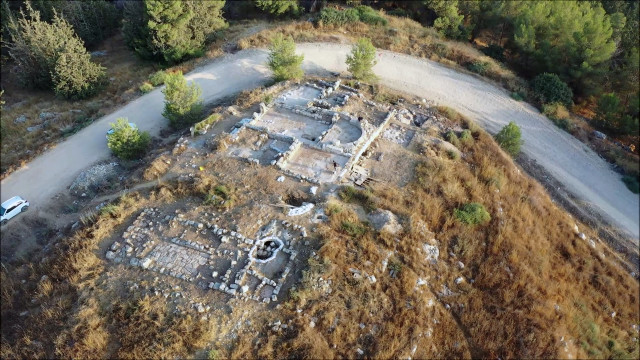
Aerial view of the rural estate uncovered in Rahat, with the vaulted complex in the centre. The estate is the first of its kind discovered in the Negev. Aerial photographs: Emil Aladjem Israel Antiquities Authority

The building, dated to the Early Islamic period (8th-9th centuries CE), was constructed around a central courtyard, and it comprised four wings with rooms to serve the needs of the residents. In one wing, there was a hall paved with a marble and stone floor and walls decorated with frescoes (wall paintings on damp plaster). The extant small fresco fragments were finely colored in red, yellow, blue and black. Other rooms in the building had plaster floors, and in other rooms, very large ovens—probably for cooking—were uncovered. Amongst the small finds were fragments of delicate decorated glass serving dishes.
The hall paved with marble and stone floor. Photograph: Emil Aladjem, Israel Antiquities Authority

According to Oren Shmueli, Dr. Elena Kogan-Zehavi and Dr. Noé D. Michael, the directors of the Israel Antiquities Authority excavations: “This is a unique discovery unknown until today. We were surprised to discover a complex of stone-built vaults at a depth of 5.5 m below the courtyard, standing to a height of 2.5 m. The vaults were carefully constructed, and they probably led into additional underground complexes that have not yet been uncovered. Our biggest surprise was the discovery of an opening below the vaulted rooms, that led into a deep rock-hewn cistern. It seems that the stone-built underground vaults were built as storerooms to store foodstuffs at fairly cool temperatures, and the supporting vaulted structures enabled the residents to move around underground safely and comfortably, to protect themselves from the scorching summer heat, and to drink cool water from the adjacent cistern. The clay oil lamp sherds retrieved on the vault floors were used for lighting the dark rooms, providing evidence for the residents’ activity here.
The underground vaults. Photograph: Oren Shmueli, Israel Antiquities Authority
The water cistern. Photograph: Emil Aladjem, Israel Antiquities Authority
Fragments of luxurious decorated delicate glass vessels are evidence for the wealth of the estate owners. Photograph: Yoli Schwartz, Israel Antiquities Authority

“The luxurious estate and the unique impressive underground vaults are evidence of the owners’ means. Their high status and wealth allowed them to build a luxurious mansion that served as a residence and for entertaining; we can study the construction methods and architectural styles, as well as learn about daily life in the Negev at the beginning of Islamic rule”, say the excavation directors.

According to Eli Eskosido, Director of the Israel Antiquities Authority, “ The excavation in Rahat is the result of close cooperation between the Israel Antiquities Authority and the Authority for the Development and Settlement of the Bedouin. In the excavation, the luxurious estate was uncovered in an area located between two ancient mosques, perhaps among the earliest ever discovered. By good chance, and much to the local population’s interest and excitement, the Islamic building remains have been discovered in the area planned for expanding the town of Rahat. The Israel Antiquities Authority and the Authority for the Development and Settlement of the Bedouin are planning together to conserve and exhibit the finds to the general public.”

On Thursday, 25/8/2022 the Israel Antiquities Authority and the Authority for the Development and Settlement of the Bedouin are opening the site to the public for free tours of the site, and for family digging and sieving activities. For details and registration, see the Israel Antiquities Authority Facebook Page.

Second Temple-era fortified village discovered in southern Samaria

As reported by All Israel News, August 20, 2022 (bold, photo, in original, link inserted by blogger):
Ruins of the Khirbet el-Qutt village (Photo: Screenshot)

The Land of Israel Studies and Archaeology department at Bar-Ilan University has turned its focus to uncovering a fortified village believed to have existed at the time of the Bar Kokhba Revolt in 132-135 A.D.

Ruins of the Khirbet el-Qutt village can be seen near the “Lebonah Ascent” in southern Samaria, overlooking the route to Jerusalem from Samaria and Shechem (where the modern Arab town of Nablus sits). The Lebonah Ascent is surrounded by steep slopes, except where it connected to hilltops toward the south.

The village has been called “Kfar Lakitia,” named after one of the three Roman garrisons Emperor Hadrian stationed at the end of the revolt. Khirbet el-Qutt features a subterranean wine cellar that was converted into a hiding place, according to BibleWalks.com.

Dr. Dvir Raviv is leading the current excavation of Khirbet el-Qutt, whose area extends across about five acres. The late Professor Zecharia Kallai of the Hebrew University of Jerusalem’s Institute of Archaeology first surveyed the site at the end of the 1960s. Kallai reported finding remains of walls, cisterns, caves and pottery from the Early Bronze Age, as well as Iron Age II, and the Roman and Byzantine periods.

A late-1990s survey by the archaeology department of the Civil Administration in Judea and Samaria unearthed a miqveh, or Jewish ritual bath, 500 meters south-southeast of the ruins.

Another survey in late 2014 recorded a second miqveh, along with the remains of buildings, cisterns, caves, quarries, agricultural installations and burial caves.

The Ritual Miqveh

Raviv’s latest survey uncovered the remains of three ritual baths, though one miqveh was exposed recently during illegal looting of the area. The miqveh features an entrance-way with six steps leading to the small, oval-shaped immersion chamber. The walls are lined with gray plaster, typical for the Early Roman period.

The Hiding Complex

A small double-chamber subterranean complex, strewn with sherds of storage and cooking vessels – dating back to the period between the Great Revolt against the Romans and the Bar-Kokhba Revolt – indicate the former wine cellar had been used for hiding.

It is difficult to identify this complex as a hiding place due to the absence of tunnels, except for the presence of the ceramic remains. It is possible that the hardness of the surrounding stone prevented tunnels and additional rooms from being formed.

Dozens of hiding complexes found in recent years in the northern Judean Hills indicate the nature of the stone in the area often forced masons to maximally exploit pre-existing subterranean spaces, and to create short tunnels or a small, simple passage system.

Water Cisterns

Excavators uncovered six water cisterns whose walls were covered with numerous layers of plaster – a nod toward the Early Roman period, inlaid with sherds that might date to the Byzantine period. They are quite similar to the water cisterns of the Royal Hasmonean and Herodian fortresses, built throughout the Hasmonean kingdom.

Fortress or Monastery

The remains of a monumental 900-square-meter building, built of large dressed stones, was uncovered on the eastern slopes. The building style and limited pottery found at the site suggest the remains of a monastery or fort from the Late Roman or Byzantine periods.

The Necropolis

A cemetery extends to the south, consisting of at least 18 tombs. One contains ossuary fragments and a few Early Roman sherds. The number and types of tombs suggest that the site reached its maximum size during the Second Temple period.

Site History

Close to the main road and to the fertile Lebonah valley, Khirbet el-Qutt would have drawn inhabitants throughout history. Findings show evidence of occupation almost continuously from the Iron Age I until the early Muslim period, including during the Hellenistic and Roman periods.

The present survey showed that Khirbet el-Qutt’s settlement peaked during the Early Roman period, at the end of the Second Temple period. During the Byzantine period, the village’s occupants seem to have concentrated at the top of the hill and along its eastern slope, suggesting that a monastery might have stood there.

The development of settlement at the site, and its transition into a large fortified Jewish village, appear to have occurred during the late Hellenistic period, accompanied by the invasion and conquest of the area by the Hasmoneans – also known as the Maccabees. Other excavations in the area offer proof that the Hasmonean dynasty was marked by intensive settlement activity, from about 140 B.C. to 37 A.D.

Sunday, 4 September 2022

Oldest extant printed pages are Hebrew liturgical poems from the mid-15th century

As reported by Adam Eliyahu Berkowitz of Israel365 News, August 17, 2022 (link, photos in original):

Hebrew piyutim printed in 1444 (Photo courtesy of Moshe Rosenfeld)

In March 2015, a Jerusalem book merchant took apart the cover of an old book and found inside it two old printed sheets in excellent condition. According to the merchant’s testimony, while he was drying the pages, an expert in ancient books entered his house and offered a large sum of money for the pages. The merchant did not agree and decided to pass the pages to the experts of the National Library of Israel for examination. He gave the pages to Yitzhak Yudlov, Institute for Hebrew Bibliography, located at the Jewish and National University Library in Jerusalem and a recognized expert.

The Jewish and National University Library kept possession of the pages for about a month and a half for the purposes of carrying out a thorough inspection. At the end of that period of time, Yudlov called the owner, who was abroad at the time. Yudlov told him that the pages were authentic and an especially rare find. The merchant arrived at the Jewish and National University Library, and Yitzhak Yudlov informed him that he thought these were sheets printed in Avignon, France in 1444-6, when an attempt was made to print a Hebrew book there. According to Yudlov, there are two documents located in the district archives in Avignon that relate details of this attempt at printing a Hebrew book.

On one of the sheets, a watermark depicting three hills inside two circles can be found. It is a very rare watermark, identified by Yudlov and Ephraim West as a being created in the first half of the 15th century.

In April 2015, Yitzhak Yudlov wrote his scholarly attestation regarding the sheets on a letterhead of the Institute for Hebrew Bibliography. In the attestation, he referred to the endeavor of printing a Hebrew book in 1444 that predated the printing of the Gutenberg Bible in 1455.

“In our opinion, these pages are remnants of that printing,” Yudlov wrote.

The merchant thought it would be good if Dr. Benjamin Richler, the Emeritus Director of the Institute of Microfilmed Hebrew Manuscripts (IMHM) in the Jewish and National University Library, would also write his opinion and translated the words of Yitzhak Yudlov. Yudlov had shown him the pages and even consulted with him on the matter. Dr. Benjamin Richler agreed to attach his description in English. Below is Dr. Richler’s letter:
(Photo courtesy Moshe Rosenfeld)

It is worth noting that Prof. Malachi Beit Aryeh was also one of the people with whom Yudlov consulted. Prof. Malachi, who was a former director of the Jewish and National University Library, recommended performing a beta-radiography of the watermark which allows getting a picture of the watermark unobscured by the printed text. He put the merchant in touch with Mr. Hominer, the operator of the machine. The merchant paid for the service, and after the merchant took two copies of the beta-radiography of the watermarks, Prof. Malachi Beit Aryeh was given an additional copy.

Prof. Beit Aryeh also asked the merchant to leave the sheets for him for several days, and he agreed, though the professor did not return the sheets for several weeks.

Later research discovered other examples of the watermark described as “three hills in two circles” in two manuscripts in the National Library in Vienna. The Three Hills watermark was used by a family of paper makers in Fabriano Italy. The other examples of the watermark were dated to 1418 and 1439. It is important to note that no examples of this watermark have been found to have been used anywhere after 1439. Other examples were found in Perpignan in the south of France from 1418, recorded by Briquet, as well as in Palermo in Sicily. Another example of the watermark was found at the Ambrosiana Library in Milan on a manuscript dating from 1431.

On August 6, 2018, the antique book dealer, Moshe Rossenfeld published an article signed by the late Yeshayahu Vinograd, concluding that according to all of the experts, the pages were from the oldest known mechanical printing press, produced in 1444-6.

The pages were subsequently sold and the buyer, who is the current owner, tried to sell it in the United States. He encountered difficulties as some people made anonymous claims that the pages were not authentic.

The pages were taken to the Forensic Institute in Jerusalem, under the management of Avner Rosengarten, a world-renowned expert in the field of forgery, and a former senior official in the Police Forensic Identification Laboratory. Rosengarten inspected the pages and determined that they were not forged.

Further research from archives dating to 1444 revealed that one Procopius Waldvogel, a silversmith by trade, arrived in Avignon at that period and borrowed money based on his invention of a mechanical printing press. His claim predates that of Johannes Gutenberg from Mainz, Germany who began printing on a mechanical press using movable type in 1450. It is widely recognized by historians that Gutenberg was not the first to do so and did not invent the process but he was, until now, believed to be the first European to do so.

According to the notarial archives in Avignon, Waldvogel and his partners produced “27 Hebrew letters from iron and steel” and also letters in Latin for the purposes of printing a Hebrew book. It is believed that the effort was unsuccessful for reasons that remain unclear but that some samples were produced. The book was to have been a collection of “piyutim”; Jewish liturgical poems sung during selichot, penitential prayers.

A document from the central archive in Avignon recorded the agreement between the partners leading to the preparation of metal moving Hebrew letters.

“This is neither a small affair nor a personal one,” Moshe Rosenfeld told Israel365. “Before us is a discovery that establishes a connection between Hebrew and the invention of the printing press.”
Agreement to print Hebrew piyutim 1444 (Photo courtesy Moshe Rosenfeld)

Thursday, 1 September 2022

"Divination bones" discovered in southern Israel

As reported by Sarah Katz of Israel365 News, August 16, 2022 (link, photos in original):

Let no one be found among you who consigns his son or daughter to the fire, or who is an augur, a soothsayer, a diviner, a sorcerer,one who casts spells, or one who consults ghosts or familiar spirits, or one who inquires of the dead. Deuteronomy 18:9 (The Israel BibleTM)
The dice assemblage. Photo credit: Yoli Schwartz, Israel Antiquities Authority

A rare assemblage of “astragali”—animal knuckle bones used for gaming and divination—dating from the Hellenistic period (2300 years ago), was uncovered by Dr. Ian Stern in the Maresha-Bet Guvrin National Park in the Judean Shefelah in southern Israel. This exceptionally large assemblage, were published recently for the first time in the British archaeological journal LEVANT, was studied by Dr. Lee Perry-Gal of the Israel Antiquities Authority, Prof. Adi Erlich of the Zinman Institute of Archaeology, University of Haifa, Dr. Avner Ecker of the Department of Land of Israel Studies in University of Bar Ilan, and Dr. Ian Stern of the Nelson Glueck School of Archaeology, Hebrew Union College, Jerusalem. The assemblage was discovered several years ago, in the huge underground cave complex below the ancient city of Maresha.

The “astragali”—knuckle bones of goats, sheep and cattle—were used similarly to dice for gaming and for ritual divination, mainly by women and children. Some of the knuckle bones were shaved down, or perforated, or filled with lead, to be thrown more effectively, as dice.
The dice bear god names and game instructions. Photo credit: Roi Shafir, University of Haifa

Tens of the dice bore Greek inscriptions: some were engraved with the names of gods associated in ancient times with human wishes and desires. Aphrodite, the goddess of fertility, love and beauty, Eros, the god of love, the god Hermes, the goddess Hera, and Nike, the goddess of victory, appear amongst other gods. On other knuckle bones, game instructions and various game-roles are engraved, such as “Robber”, “Stop!”, “You are burnt”, etc.
The dice bear god names and game instructions. Photo credit: Roi Shafir, University of Haifa

According to Dr. Lee Perry-Gal, Israel Antiquities Authority zooarchaeologist and research fellow in the University of Haifa, “The assemblage of astragali from Maresha is very unique, specifically the large quantity and good quality, and the many inscriptions. The assemblage shows that in ancient times of distress, as today, people sought help from external factors, in magic and spells and in the world of the unknown. In the past, men, and especially women, struggled with an environment of uncertainty, death, childbirth, and health issues, and tried to protect themselves with the help of magic. In addition, we know that astragali were used for games. It is noteworthy that we have examples of children buried with similar gaming dice. The cubes, which were a popular gaming activity, had a role in accompanying children to the next world, to be used there”. Perry-Gal adds, “ Since the astragali symbolize good luck, it was customary to inter them under the house threshold, in the hope that they will bring good luck and prosperity.
Dr. Lee Perry-Gal holding the gaming dice. Photo credit: Yoli Schwartz, Israel Antiquities Authority.

“It is of interest that these knuckle bones are often found next to ostraca (pottery sherds with writing inscribed or written in ink), which bore Aramaic texts, such as, ‘Magical incantation’, or ‘If you do so, this will happen to you., which demonstrates their cultic role.

According to Dr. Perry-Gal, “The Hellenistic city of Maresha was one of the period’s melting-pots in the southern Levant. “Different populations and cultures lived side-by side here as neighbors, all subordinate to the Hellenistic rule. There lived here Edomites, Phoenicians, Nabateans and Jews, and the different peoples and cultures influenced each other.”

According to Eli Eskosido, Director of the Israel Antiquities Authority, “This fascinating research sheds light on the life and customs in the ancient world and reminds us that people are regular people all over the world. They dream and hope, and notwithstanding the harshness of daily life, they find time for playing and leisure.”
See video.

Giant prehistoric elephant tusk discovered in southern Israel

As reported by Michael Horovitz of The Times of Israel, August 31, 2022 (photo in original):
Archaeologists, paleontologists and conservators surround the tusk of a straight-tusked elephant, discovered at Kibbutz Revadim, southern Israel, in August 2022. (Photo credit: Yoli Schwartz/Israel Antiquities Authority)

A complete tusk from a large prehistoric elephant was uncovered near Kibbutz Revadim in southern Israel, archaeologists revealed on Wednesday.

The find was made earlier in August during a two-week excavation by Tel Aviv University and the Ben-Gurion University of the Negev called Operation Elephant.

The 2.5-meter-long remnant of the huge straight-tusked elephant — which is now extinct — was discovered by Dr. Eitan Mor, a biologist from Jerusalem, who organized a trip to the area out of curiosity about the elephants, according to an Israel Antiquities Authority statement.

“To my surprise, I spotted something that looked like a large animal bone peeping out of the ground. When I looked closer, I realized that it was ‘the real thing,’ so I rushed to report it to the Israel Antiquities Authority,” he said.

Scientists believe the elephant species, which would tower over their present-day descendants, arrived on Israel’s coastal plain about 800,000 years ago and died out approximately half a million years ago. According to the IAA, findings from elephants are rare and the fossil is “of great scientific interest.”

The IAA explained that past archaeological work at Revadim, where stone and flint tools and other fossilized remains have been discovered, revealed that humans had settled the area and hunted the elephants that roamed the region.

The IAA’s director, Eli Eskozido, noted that the find was of “primary importance for the academic community, but also of great public interest.”

He added that the authority plans to publicly display the tusk after conservation efforts at the IAA’s permanent exhibition hall in Jerusalem.

Prof. Israel Hershkovitz from the Dan David Center for Human Evolution and Biohistory at Tel Aviv University said that the fossil, which was said to be in very good condition, is also “extremely fragile” and efforts were made to protect it after the initial find.

“Now we are excavating it within its archaeological context, before transferring it to the Israel Antiquities Authority Conservation Laboratory, where it will be studied and conserved,” Hershkovitz said.

The discovery of the tusk leads to questions over its presence at Revadim, according to Prof. Ofer Marder of Ben-Gurion University and Dr. Ianir Milevski of the IAA’s Prehistoric Branch.

“Is the tusk the remains of a hunted elephant, or was it collected by the local prehistoric inhabitants? Did the tusk have social or spiritual significance?” the academics asked.

The IAA said the joint study aims to resolve the debates surrounding the prehistoric elephant hunters and their culture.

Thursday, 25 August 2022

Israeli researchers discover evidence of Roman Army's power at the time of the destruction of the Second Temple

As reported by Israel365 News, August 8, 2022 (photos in original):

On the Fast of 9th Av, the Israel Antiquities Authority presented the results of a new research project that sheds light on the power of the Roman army, and the spots of their attack on Jerusalem in the battle that led to the destruction of the Second Temple.

“The Fast of the 9th Av commemorates the day of the destruction of the Second Temple,” says Israel Antiquities Authority researcher Kfir Arbiv. “The Temple was destroyed in 70 CE, after a four-month siege and an intensive battle led by the Roman general Titus in order to conquer the city and suppress the revolt initiated by the Jews four years earlier. The Romans had a well-trained massive army, equipped with the best military innovations of their day. It was a ruthless war machine.”

Arbiv systematically recorded Roman military equipment retrieved in excavations in Jerusalem, many of which were found in the excavations that he directed, together with Dr. Rina Avner, in the Russian Compound, adjacent to the Jerusalem Municipality building. The Roman Arsenal exposed to date includes hundreds of different-sized ballista stones that were launched from sophisticated bolt-throwing machines to a distance of 100–400 m, small slingstones used by trained infantry, and catapult machines that launched spearheads for a distance of 150–200 m. Spears, swords and arrowheads, including heavy arrowheads that could penetrate armor.
Spearhead from the battle against the Roman army. Photograph: Clara Amit, Israel Antiquities Authority

“We know from the historical sources that the Roman army employed massive siege rams to batter the fortification walls, and siege towers that reached the height of the walls, but these have not yet been found in Jerusalem,” says Amit Reem, director of Israel Antiquities Authority Jerusalem Region.

Arbiv’s research focused on the hundreds of ballista stones, and his analysis defined different sizes and weights. Some, directed against people, were launched against the walls to prevent the Jewish rebels from emerging above the walls, and other heavier ones were launched fiercely against the walls to penetrate them.
The ballista stones, the physical evidence of the battle that took place 2000 years ago, are visible on the floor. Photograph: Yoli Schwartz, Israel Antiquities Authority
Ballista stone balls of different dimensions. Photograph: Kfir Arbiv, Israel Antiquities Authority

According to Arbiv, “With the help of the computer, I located all the ballista exactly where they were found. I took into account the local topography and the location of the Second Temple-period city fortification walls, and I made ballistic calculations, including the launching angle, and the throwing distance of the stones. All the data was compared to the renown Jewish historian Josephus’ contemporary detailed descriptions of the battle, and the conquest and destruction of Jerusalem, in his book, ‘The History of the Jewish War against the Romans’.”

According to the research, some of the Roman army artillery machines were located in the center of the modern city of Jerusalem, in the Nahalat Hashiva area, nicknamed ‘Cats’ Square’.

The research also shows for the first time, the probable pots where the Roman army penetrated the city. The Russian Compound excavations exposed part of the Third Wall, the third line of defense that surrounded the city. An exceptionally large concentration of ballista stones was found at one point, some broken after use. It was evident that the Roman army concentrated their efforts here, and hundreds, if not thousands of ballista stones, were directed to this spot. “This is not surprising,” says Arbiv, “as whoever controls this spot, dominates the whole area and the fate of the city. This aligns with Josephus’ account that Titus commanded to penetrate the city from the northwestern side of the city wall.”

According to Eli Eskosido, Director of the Israel Antiquities Authority: “The physical evidence of the huge resources employed by the Roman army in Jerusalem, reflect the extremely harsh battles that eventually led to the destruction of the Second Temple. Notwithstanding the internal factions and the impossible odds, a small group of Jewish defenders withheld the Romans for a few moths until the tragic destruction of the city. The use of up-to-date research methods reveal more and more on the fascinating history of Jerusalem.”

Thursday, 18 August 2022

"Pope Michael" dead at 62

On August 2, 2022, David Bawden, who claimed to be the true Roman Catholic Pope, using the name Michael I, died in Kansas City, Missouri at the age of 62, several weeks after slipping into a coma following emergency brain surgery. For those who may not be aware of his papacy, Michael I was elected head of the Roman Catholic Church (at least the segment that recognized his authority) in a conclave in Belvue, Kansas in 1990. Pope Michael continued to live at home with his parents after his consecration, which isn't exactly what you expect from the head of what purports to be the one true church representing the Lord Jesus Christ.

As reported by Phil Johnson of the Topeka Capital-Journal, January 13, 2012 (link, photo in original):
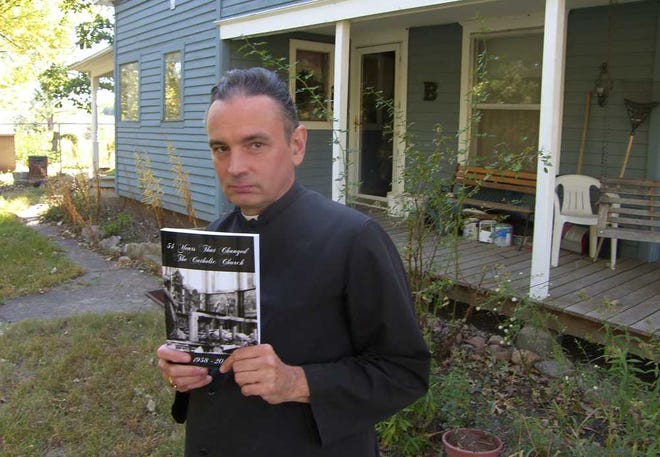
David Bawden, who is also known as Pope Michael, claimed ascendancy to the papacy in 1990. He lives on a farm near Delia where he runs the Annunciation Seminary that has one full-time and one part-time student. Bawden is shown here holding a copy of his latest book, "54 Years that Changed the Catholic Church: 1958-2012." Topeka Capital-Journal

DELIA — Attired in a black cassock that covered all but the bottom of a pair of red pants and Nike flip-flops, David Bawden on a recent Sunday afternoon reclined on a couch in the living room of his Vatican in Exile, a wooden-frame farm home in southwestern Jackson County, and talked about events that led to what he said was his election as pope of the Roman Catholic Church.

Bawden matter-of-factly reflected on the 21 years that have passed since 1990, when he was voted in as pope by six people who gathered at his parents’ second-hand store in nearby Belvue.

His biggest beef with the Roman Catholic Church, which he said led to his papacy, was its move toward modernism, starting with Vatican II, which included doing away with the traditional Latin Mass.

By now, Bawden has heard the whispers and out-loud criticisms that have come his way since he declared himself the head of the Roman Catholic Church and its 1 billion adherents worldwide.

Yet he remains committed to his papacy, saying it was ordained of God, and that nothing will stop him from being pope.

A book he wrote that was released this past May, “54 years that Changed the Catholic Church: 1958-2012,” chronicles Bawden’s claim to the papacy and also sheds light on where he said the Roman Catholic church went astray.

For his new book, he said, “I discovered some very important information that would help present the case more clearly.”

The 196-page self-published book provided details of Catholic Church changes beginning with the election of Pope John XXIII in 1958.

That pope, and all who followed him, weren’t truly Catholic, Bawden asserts, because of the “pseudo council called Vatican II” that resulted in their elections.

A few faithful Catholics realized they could lawfully take the matters into their own hands and began the restoration of the church, Bawden said.

Some were emboldened by Roman Catholic archbishops who were critical of Vatican II — including Marcel Lefebvre and Ngo-Dihn Thuc.

Bawden, a native of Oklahoma City, came to St. Marys in 1980 after he and his family became members of a breakaway Catholic group known as the Society of St. Pius X.

Bawden in the late 1970s had attended St. Pius X schools but was asked to leave. Despite his efforts to return, he was barred from being a student again.

“There was some infighting in the seminary, and I got in the middle of it,” Bawden said. “I was dismissed because of that.”

While continuing to pursue his vocation, Bawden held fast to his belief that Rome no longer had authority for the Catholic Church, that popes it elected were heretics and therefore the papal position was vacant.

It was Bawden’s belief that if the College of Cardinals wasn’t equipped to elect a pope, the duty fell to laypeople in the church.

Before he staked his claim to the papacy, he outlined his problems with the modern Catholic church in a 1990 book titled “Will the Catholic Church Survive the 20th Century?” He said he wrote the book to appeal to other traditionalists like himself.

After his book was published, he sent notices of an upcoming papal vote to traditionalists around the globe. But only six people showed up for the pivotal vote that took place July 16, 1990.

One was Bawden’s late father, Kennett, who died in 1995. One was his mother, Clara “Tickie” Bawden, 83. One was Bawden himself.

Then there were three others, all of whom, Bawden lamented, since have “fallen away” from the Catholic Church that he leads.

Bawden said he had an inkling he might be voted in as the pontiff that day.

“I thought it was a possibility,” he said. “But it was in God’s hands, who showed up to vote. We had to get the job done.”

More than two decades later, his actual followers are few, he acknowledges, with but one full-time and one part-time student in the Annunciation Seminary he runs out of the house that he shares with his mother.

Yet he says many people — perhaps millions — around the globe share his sentiments and mindset.

Bawden has a presence on the World Wide Web at www.vaticaninexile.com and even has a fan club on Facebook, something he said caused him to chuckle when he stumbled upon it.

“Someone in Germany started it,” he said. “Yes, I was surprised.”

His sermons are uploaded on YouTube by a follower in Rockford, Ill. People keeping tabs on him are notified each time a new sermon is posted.

A film class from the University of Notre Dame in South Bend, Ind., made a visit to Delia a few years ago and produced a documentary on Pope Michael, parts of which can be found on the Internet.

“I was impressed by that,” Bawden said of the documentary. “I was quite impressed with the quality of work they did and their questions.”

Despite the few followers in his flock, Bawden said he doesn’t see himself as an outcast in the Delia community, located about 10 miles north of Rossville.

Bawden said he visits with people when he sees them at the grocery store in Rossville or when he passes them on the country roads in his neck of the woods. The conversations are always cordial, he said.

Each day starts with Mass, followed by prayer, seminary classes and work around the farm.

Bawden announced recently that he was ordained a priest and consecrated a bishop in December by a bishop in the National Catholic Apostolic Church, qualifying him to celebrate Mass.

Bawden is cultivating a grape arbor for wine-making for the daily Masses.

He and his several followers also are in the process of taking classic Catholic books — some of which are borrowed from the Benedictine College library in Atchison — and scanning them into computers, so they can be republished in an “on-demand” printing arrangement with a publisher.

Bawden’s mother supports her son and said his rise to the papacy started when he was a boy.

“I was trying to raise him right — to raise him in the Catholic Church,” she said. “When you see it disintegrating in front of you, you feel like something has seriously gone wrong.”

She said her closest family members were convinced that they needed to pursue what they believed to be the correct teachings of the Roman Catholic church, even if it meant taking a road less traveled.

It hasn’t always been an easy road, but she said she has no regrets.

“Everyone in their time and place — grace is coming to them,” she said. “And it works perfectly.”


The success of this item from Olivia Newton-John's discography reveals something about modern evangelicalism

British-born Australian singer and actress Olivia Newton-John, one of the most successful performing artists of the last 50 years, died on August 8, 2022 at the age of 73, after several battles with breast cancer. I was sorry to hear of her death, and I hope she came to faith in Jesus Christ before her passing. She supported various causes, including women's health, the environment, and animal welfare.

In 1994, following her first bout with breast cancer, Miss Newton-John released the album Gaia: One Woman's Journey. Gaia, in Greek mythology, is the personification of the Earth, and is regarded as the ancestral mother of all life. According to the Infogalactic entry on Miss Newton-John:

The following year, Newton-John released a healing CD, Grace and Gratitude. The album was sold exclusively by Walgreens also benefitting various charities including Y-ME National Breast Cancer Organization. The CD was the "heart" of their Body – Heart – Spirit Wellness Collection which also featured a re-branded Liv-Kit and breast-health dietary supplements. Newton-John re-recorded some tracks from Grace and Gratitude in 2010 and re-released the album as Grace and Gratitude Renewed on the Green Hill music label. The Renewed CD includes a new track, "Help Me to Heal," not featured on the original album. The Renewed CD yielded Newton-John's first appearances on the Billboard Christian Albums (No. 36), Christian & Gospel Albums (No. 54) and New Age Albums (No. 2) charts.
The songs on Grace and Gratitude Renewed include Learn to Love Yourself; Grace and Gratitude; Let Go Let God; Help Me to Heal; and The Power of Now. I've listened to these five songs, and I've noticed a few things. Learn to Love Yourself contains the words "Trust the light that shines within," which is far more in keeping with New Age belief than Christian doctrine. Grace and Gratitude contains the words "A thousand names a thousand roads all lead to one simple truth," although the simple truth isn't clearly stated. The thanks expressed are apparently directed toward God, but it's not clear. Let Go Let God is a phrase common among Christians, but the instrumental arrangement sounds increasingly Indian as the song goes on. At about the 2:27 mark of the video for Help Me to Heal, Miss Newton-John is happily pointing to a chart of "The Chakra System," depicting the Hindu teaching that the human body contains nodes of psychic energy known as chakras. The Power of Now is also the title of the first book of New Age author Eckhardt Tolle. The full title of the book is The Power of Now: A Guide to Spiritual Enlightenment (1997); he also wrote the sequel, Practicing the Power of Now: Essential Teachings, Meditations, and Exercises from The Power of Now (2001).

The fact that Grace and Gratitude Renewed appeared on both Christian and New Age charts is an indication of the lack of discernment in modern evangelicalism. See and hear for yourself.


Sunday, 7 August 2022

Five intact clay jugs from Talmudic period found in Shiloh

As reported by Adam Eliyahu Berkowitz of Israel365 News, August 4, 2022:
5 rare, intact jugs uncovered in Shiloh. August 2, 2022 (Photo courtesy Binyamin Region Spokesperson)

Five large clay jars were found intact in the archaeological dig in Shiloh. The jugs were found lined up approximately 20 inches underground in a large room under the floor, most likely to keep them cool during storage. This kept them intact as well. The condition of the jugs implies that the area was vacated abruptly, with residents not having enough time to collect their belongings. The jugs are believed to be from the period of the Talmud (200-400 CE).

The excavation was led by Dr. Reut Ben Aryeh, a resident of Shiloh. The goal of the work is to locate the southern wall of ancient Shiloh and the entrance to the city.

The excavation also discovered a number of coins, a key beleived to have been used to unlock a chest, and wooden dice identical in shape to dice used today.

The discoveries were presented at the 12th Shiloh Conference to mark a century since the site was first excavated, along with other research.

The site was active, from the Bronze Age to the Ottoman Empire and archaeologists have disccovered findings from the Hellenistic, Roman, Byzantine, and Early Muslim periods.

Head of the Mateh Binyamin Regional Council Yisrael Gantz said, “We are privileged to expose finds that are proof of our ties to the Judea and Samaria region and this entire land. The discoveries here give meaning to our daily work to develop this part of the country. There is nothing more exciting than the palpable understanding of how we are continuing our forefathers’ lives here. This is the eternal story of the Jewish people, and that story gives us strength.

“Thank you to the staff at the ancient Shiloh site, the archaeological officer in the IDF Civil Administration, and Dr. Scott Stripling for his work to help the site succeed,” Gantz said.

In 2017, archaeologists found a similar cache of ten jugs. Among the jugs, the also found a goblet known as a kobaat, a type of ritual chalice indicating a connection with the Tabernacle.
As reported by Maayan Hoffman of All Israel News, August 13, 2022 (bold, photo in original):

Archaeologists working at Tel Shiloh earlier this summer discovered piers that they believe formed a door into a gate complex at the northern edge of the biblical city.

The finding, said Scott Stripling, director of the Tel Shiloh excavations for the Associates for Biblical Research, was surprising but also made sense because the wall was only located about a kilometer from the Shiloh spring. It would be logical for residents to have entered and exited from that side of the city to access water.

“This was either the main gate or another gate,” he told ALL ISRAEL NEWS.

Stripling added that they also discovered a “glacis” – an earthen embankment that surrounds the fortification wall – which terminated at the proposed gate entrance. At that location, there was a symmetrical breach in the wall, which suggests there may have been a gate chamber – a complex through which people had to enter before coming into the city itself.

“This is important because the High Priest, Eli, died in the gate of Shiloh,” Stripling said. “We discovered what we think is the gate mentioned in 1 Samuel 4.”

“When he mentioned the ark of God, Eli fell backward off his chair by the side of the gate. His neck was broken and he died, for he was an old man, and he was heavy. He had led Israel 40 years” (1 Samuel 4:18).

43 YEARS OF BIBLICAL DISCOVERY

Stripling carried out his excavations at Tel Shiloh under the auspices of the Civil Administration of Judea and Samaria during May and June, alongside 135 volunteers from 11 nations and 12 different universities. The Associates for Biblical Research has been working in the highlands of Israel for 43 years.

Stripling and his team have been working at Tel Shiloh since 2017, with a two-year hiatus during the COVID-19 pandemic, making this summer their fourth season of excavations.

Before Tel Shiloh, they dug at Khirbet el-Maqatir. Tel Shiloh is the fourth site they have excavated.

Stripling made headlines this year when he announced that a lead tablet measuring 2 square centimeters – taken from a site on Mount Ebal excavated by Prof. Adam Zertal more than 30 years ago – was believed to be a “curse tablet” dating back to at least the 13th century B.C.

Stripling’s team discovered the tablet in December 2019, but it took two years and new CT technology to be able to decipher the text inside because the amulet was folded in half and the metal was too brittle to unfold.

CT scans performed in Prague revealed an ancient proto-alphabetic Hebrew inscription consisting of 48 letters, including what is believed to be God’s name.

Stripling told ALL ISRAEL NEWS that he submitted an article on the discovery to the Archaeological and Anthropological Sciences peer-reviewed journal earlier this month and he hopes the paper will be published soon.

TEL SHILOH IN THE BIBLE

Tel Shiloh is one of the most biblically significant sites where Stripling has worked, he said. The site is first mentioned in the Bible when Joshua erects the tabernacle there in the Late Bronze Age. It is believed that the Ark of the Covenant was kept inside the tabernacle.

Findings date the site back to the Middle Bronze II period. It served as the capital of Israel for over 300 years before Jerusalem.

During their four seasons of excavations, Stripling and his team discovered a number of objects that they believe bring the Bible to life and help validate its narrative – although there are those who disagree.

These items include storage rooms that line the northern perimeter of the fortification walls, strategically positioned next to a monumental building which may have served as a platform for the tabernacle.

Stripling said the rooms are “unique in their construction” and inside them were found a number of collared-rim jars dating to the Iron Age I. Such jars could have been used by people who wanted to store tithes they were bringing.

The platform’s dimensions align with those given in the Bible for the tabernacle. Moreover, a demolished four-horned altar was found nearby, as well as two ceramic pomegranates, typical of the ornaments described in the Bible as hanging from the priest’s robe.

Finally, about a 30-seconds walk from the platform is a deposit of pottery and bones dated around 1400 to 1300 B.C. The majority of the bones are from the right side of the animals, which were all kosher. Leviticus 7 says that the priest’s portion was the right side of the animal.

“All of this together inductively suggests to us that we are seeing what is found in the Bible,” Stripling said. “There are many lines of evidence and from it an overarching picture emerges.”

He said the team excavated thousands of more bones this summer. They will now undergo carbon dating and zooarchaeological analysis in hopes of gaining further clarity.

Stripling said if some colleagues do not believe him, that the biblical narrative is accurate and if they have another explanation, “I would love to hear it.”

He added that the team found evidence the site continued to be occupied for many more generations, including during the Second Temple Period (when Jesus lived), and later during the Byzantine, Islamic, Late Roman and Persian periods, too.

However, he said his team is focusing primarily on the transition period between the Bronze and Iron ages.
Area D where from which the bone deposit derived (Photo courtesy Scott Stripling)

Saturday, 6 August 2022

Israeli soldiers discover 1,500-year-old convent

As reported by Israel365 News, August 2, 2022:

Over the past month, dozens of soldiers re-uncovered a 1500-year-old nuns’ convent complex at Horbat Hani, in the low foothills east of Shoham, after a small area of the site located within a military zone was accidentally damaged by the army.

The activity took place in the framework of the army educational project initiated together with the Israel Antiquities Authority: ”The Nature Defense Forces Project: Officers Take Responsibility for the Environment.”

The Byzantine convent was first excavated twenty years ago by Dr. Uzi Dahari and Dr. Yehiel Zelinger of the Israel Antiquities Authority, and it was subsequently covered up to protect it. It is now visible again, thanks to the project carried out with the soldiers.

According to Issy Kornfeld, Director of the excavation on behalf of the Israel Antiquities Authority, “Recently, a small part of the ancient ecclesiastical site was damaged in the course of army activities in the military zone. In this context, the Israel Antiquities Authority, together with the Nature Defense Forces program, initiated an educational project, whereby this impressive site was re-opened and cleaned up under the guidance of the Israel Antiquities Authority Community Educational Centre.” Kornfeld continues, “In the original excavation, two buildings were uncovered, one of which was a church paved with a colorful mosaic depicting faunal and vegetal scenes, an entrance hall, the nuns’ dormitories, hermit cells, a tower with rooms, and a crypt, an underground burial complex. The other building included a kitchen, a refectory (dining hall), and an inn for pilgrims.”

There was evidence that the convent preserved a tradition related to women. Dr. Eitan Klein, an archaeologist at the Israel Antiquities Authority, proposed that the convent at Horbat Hani, may have commemorated the burial place of the biblical Hannah, the wife of Elkanah, who was childless, and gave birth to a son, the prophet Samuel, after she vowed to dedicate him to the service of God.

According to Kornfeld, “As often in the ancient world, the convent was erected here, commemorating an ancient tradition, possibly of the burial place of Hannah, mother of the prophet Samuel.” The original excavation also uncovered a few female skeletons, possibly of women who sought to be buried in proximity to the sanctified figure of Hannah.

Guy Saly, director of the IDF Nature Defense Forces Project: ”The excavation is an example of officers taking responsibility for the environment and carrying out meaningful activity, exposing and conserving the ancient site—archaeologists together with officers and soldiers who are the citizens of tomorrow—thus enabling us to experience and connect with our country’s heritage. The soldiers and the offices enjoyed the hands-on archaeological work, and we hope that the joint activities protecting the archaeological sites will continue in the future.”

According to Eli Eskosido, Director of the Israel Antiquities Authority, “The joint IAA initiative with the IDF Nature Defense Forces Project, creates an opportunity for every soldier and army officer. The adoption of archaeological sites in army bases and military zones, and the creation of archaeological exhibitions in army bases, further consolidate the strong connection between the defense of the State of Israel, and the protection of the ancient sites and our cultural inheritance.”

The church mosaic is now partially visible, and it can be seen with advance permission from the IDF Central Command: 02-5305042.
Aerial view of the church complex in the military zone. (Photo credit: Idan Yunish/Israel Antiquities Authority)
Decorative elements in the mosaic pavement. (Photo credit: Gilad Stern/Israel Antiquities Authority)
Aerial view of the mosaic. (Photo credit: Idan Yunish/Israel Antiquities Authority)

Sunday, 31 July 2022

Addition by subtraction: The deaths of James Lovelock and Ron Sider

British environmentalist James Lovelock died on July 26, 2022, his 103rd birthday. Dr. Lovelock, a physician by training, was also a climate scientist and futurist. He was best known for proposing the Gaia hypothesis, the idea that Earth itself is a living organism, with life forms interacting with inorganic surroundings to form a synergistic, self-regulating system. The hypothesis, named after the Greek goddess who personified the Earth, has been criticized by secular evolutionists, but has greatly influenced the increase in pagan nature worship that has become so popular in recent decades. I doubt that Dr. Lovelock is enjoying his present climate and environment.

On July 27, 2022, Ron Sider died at the age of 83. Dr. Sider, a native of Stevensville, Ontario, was involved with InterVarsity Christian Fellowship while an undergraduate at the University of Waterloo, and worked in apologetics with IVCF after earning a doctorate in history and master's in divinity from Yale University. He founded Evangelicals for Social Action in 1973, which might more accurately be called "Evangelicals for Socialism."

Dr. Sider was perhaps best known for his books Rich Christians in an Age of Hunger (1977) and Nuclear Holocaust and Christian Hope (1983). Christian writer Lloyd Billingsley described the former as:

A textbook of zero-sum thinking and statist solutions presented in religious vocabulary. A compendium of economic fallacies. (Billingsley, Lloyd. The Absence of Tyranny: Recovering Freedom in Our Time, 1986, p. 196).

Mr. Billingsley said of the latter:

Nuclear Holocaust and Christian Hope, co-authored with Richard Taylor, is a kind of religious version of Jonathan Schell's Fate of the Earth. Like Schell, Sider and Taylor rely heavily on shock tactics--describing blasts, destructions, bombs, blood, vomit, burns, screams. The front, fictionalized section of the book where this occurs is a combination snuff film and nuclear pornographic novel.

Merchandising comes later, the radical Christian version of Jesus watches and frisbees. Sider and Taylor advocate measures like displaying peace bumper stickers (surely a distinctive Christian approach), keeping photos of Hiroshima and Nagasaki on the coffee table instead of Ansel Adams, buying stationery with a peace motif, and subscribing to the right magazines including the "rigorously biblical" Sojourners whose peace ministry co-author Taylor is a consultant.

To his great credit, Sider at least has the courage to carry his pacifism to its logical conclusion. The book may very well be the world's longest suicide note, suicide being the sure outcome of his nonmilitary defense plan, a new Anschluss on a larger scale.

The assumption is that, once conquered, we can all eventuall settle down to a peaceful, neo-Scandinavian existence. Germany was once thoroughly conquered; they did not so settle down. Sider's arguments for complete, not just nuclear, pacifism are buttressed with proof texts, but remain to me unconvincing.

It appears they are unconvincing to the authors as well. After three hundred gruelling pages filed with countless usages of "must," "should," and "ought," Sider and Taylor make this astonishing statement: "The authors of this book do not claim to have all the answers." Given this it is difficult to see their book as anything more than a public act of spiritual and political masturbation.
(Billingsley, Lloyd, The Generation that Knew Not Josef: A Critique of Marxism and the Religious Left, 1985, pp. 187-188).

I never for a minute believed that Dr. Sider was a Christian; I always figured he was a Communist masquerading as a Christian. When U.S. President Ronald Reagan delivered his "Evil Empire" speech to the National Association of Evangelicals on March 8, 1983, it was Ron Sider who immediately formed a group to protest against Mr. Reagan's views. Dr. Sider boasted about his participation in the "Witness for Peace" program in Nicaragua in the early 1980s, in which the participants acted as human shields to impede the efforts of the Contras who were fighting against Nicaragua's Sandanista regime. The actions of the "Witness for Peace" participants had the effect of aiding the Sandanista regime, a regime that committed genocide against the Miskito Indians and was persecuting Christians. For information on the Sandanistas' treatment of Christians, I recommend the book Breaking Faith: The Sandanista Revolution and its Impact on Freedom and Christian Faith in Nicaragua by former Sandanista Humberto Belli, published in 1985.

For more on Ron Sider and Evangelicals for Social Action, see my posts 30 years ago: Ronald Reagan, addressing the NAE, denounces the evil empire--and other evils (March 12, 2013) and 30 years ago: Carl McIntire critiques Evangelicals for Social Action's Chicago Declaration (May 1, 2014).

Monday, 25 July 2022

Rare 2nd century coin depicting moon goddess Luna found off Israel's coast

The coin bearing the image of Luna, the goddess of the moon. Below it appears a sign of cancer luck. Photo credit: Yaniv Berman, Israel Antiquities Authority

As reported by Israel365 News, July 25, 2022 (photo in original):

An exceptionally well-preserved spectacular rare bronze coin was recently recovered from the sea bed during an underwater archaeological survey conducted by the Israel Antiquities Authority off the Carmel coast at Haifa.

The coin was minted under the emperor Antoninus Pius (138–161 CE) in Alexandria, Egypt. The reverse depicts the zodiac sign Cancer beneath a portrait of the moon goddess Luna. The coin bears the date ‘Year eight,’ the eighth year of Antoninus Pius’s rule, or 144/145 CE. It belongs to a series of thirteen coins, twelve depicting the different signs of the zodiac and another the complete zodiac wheel.”

According to Israel Antiquities Authority Maritime Archaeology Unit director Jacob Sharvit, “This is the first time such a coin has been discovered off Israel’s coast, and it is a rare addition to the National Treasures collection. Israel’s Mediterranean shores and waters have yielded many archaeological sites and finds that attest to connections in antiquity between Mediterranean ports and the countries along it. These finds, which were lost at sea and disappeared from sight for hundreds and thousands of years, have been remarkably well preserved; some are extremely rare, and their discovery completes parts of the historical puzzle of the country’s past.”

The coin was discovered during a survey conducted by the Israel Antiquities Authority to locate, document, research, and preserve antiquities sites and ancient finds—cultural assets that are being endangered by accelerated marine development.

According to Israel Antiquities Authority’s Director, Eli Eskosido, “In the last decade, the State of Israel has changed its perception of the sea. Rather than marking the country’s border, the sea is now recognized as an integral part of its cultural heritage, in addition to security considerations and strategic and economic concerns. Israel’s territorial waters contain natural resources and cultural assets that must be explored and protected in light of different interests and potential development. The maritime survey off Haifa is part of this process. The rare coin recovered during the survey is a vivid reminder of the importance of the survey.”

Interestingly, the ruler who minted the coin, Antoninus Pius, was a Roman emperor whole ruled between 138 and 161 CE. Unlike his predecessors, he was not a military man and never participated in battle. His reign was the quietest during the whole of the Roman Empire and marked the height of the period of ‘Roman peace’ (Pax Romana) throughout the empire. Antoninus had a different approach to running the Roman Empire, preferring to deal with any foreign crises through provincial governors; in fact, he never left Rome himself. He encouraged and initiated the construction of temples, theaters, and magnificent mausoleums and promoted science and philosophy.

During his rule, the empire’s relations with the Jews were greatly improved, the decrees of Hadrian were revoked, and Jews were allowed to practice circumcision. These steps led to amicable relations between the emperor and Rabbi Yehuda ha-Nasi.
As reported by Maayan Hoffman of All Israel News, July 25, 2022:

...Pius ruled immediately after the Bar Kokhba Revolt against the Romans in Jerusalem - the final war between the Jews and the Roman Empire, which took place around 132-136 A.D.

The Jews lost the war and were exiled from the Holy City of Jerusalem, which was turned into a pagan city. According to tradition, the only time they were able to enter Jerusalem was to mourn their losses in the revolt on the ninth of the Hebrew month of Av - the same day on the Hebrew calendar that the First and Second Jewish Temples fell.

The coin is exceptionally well-preserved, despite its being lost at sea for thousands of years. Coins like this one, Shavit said, “are extremely rare and their discovery completes parts of the historical puzzle of the country’s past.

“Israel’s Mediterranean shores and waters have yielded many archaeological sites and finds that attest to connections in antiquity between Mediterranean ports and the countries along it,” he added.

The coin was discovered during a survey conducted by the authority, which is in the midst of efforts to document, research and preserve cultural and other assets that are at-risk from accelerated marine development.

This is the 13th coin of its type discovered. Twelve of them depict signs of the zodiac and another portrays the complete zodiac wheel, the authority said.

Luna is one of the Roman’s most ancient goddesses, dating back even before the foundation of Rome in 753 B.C. Her name is equivalent to the English word “lunar.” She was worshipped by the pagans at the new and full moons.

Much of the catalyst of the Bar Kokhba was the Jewish desire to drive the pagans out of Jerusalem.

In recent years, Israel has come to understand the importance of the sea for discovering the area’s cultural heritage, as much as serving strategic and economic aims, explained Israel Antiquities Authority’s Director Eli Eskosido.

“Israel’s territorial waters contain natural resources and cultural assets that must be explored and protected in light of different interests and potential development,” he said.

Sunday, 24 July 2022

100 years ago: League of Nations Council confirms British Mandate for Palestine

And it shall come to pass, when all these things are come upon thee, the blessing and the curse, which I have set before thee, and thou shalt call them to mind among all the nations, whither the LORD thy God hath driven thee,
And shalt return unto the LORD thy God, and shalt obey his voice according to all that I command thee this day, thou and thy children, with all thine heart, and with all thy soul;
That then the LORD thy God will turn thy captivity, and have compassion upon thee, and will return and gather thee from all the nations, whither the LORD thy God hath scattered thee.
If any of thine be driven out unto the outmost parts of heaven, from thence will the LORD thy God gather thee, and from thence will he fetch thee:
And the LORD thy God will bring thee into the land which thy fathers possessed, and thou shalt possess it; and he will do thee good, and multiply thee above thy fathers.
Deuteronomy 30:1-5

This is a slightly different version of my post 90 years ago: League of Nations supports Zionism (July 21, 2012).

On July 24, 1922, the League of Nations Council confirmed the text of the draft of the British Mandate of Palestine; Britain formally assumed control of Palestine on September 29, 1923. As reported by the Israel Bible, July 24, 2022 (links in original):

...On April 24,1920, 51 nations, so recently divided by World War I, sent representatives to the League of Nations in Sanremo, Italy. At the San Remo Conference, they agreed to divide up the Ottoman territories, putting Israel in the hands of the British. The decision incorporated the Balfour Declaration, written during the war in 1917, which established the basis for a Jewish state in Israel. The text of this agreement was confirmed by the Council of the League of Nations on July 24, 1922.

How did this all come to be?

In 1917, while the outcome of World War One was very much in the balance, the United Kingdom’s Foreign Secretary Arthur Balfour sat down to write a letter to Lord Rothschild, a leader of the British Jewish community, for transmission to the Zionist Federation of Great Britain and Ireland. The letter was the first public expression of support for Zionism by a major political power, and was the result of rising sympathy among British evangelical Christians towards the “restoration of the Jews” to Palestine that had begun 80 years earlier.

In some ways the Balfour Declaration was the beginning of the process. It certainly was the seed from which the State of Israel grew, but it nearly became a meaningless piece of paper. When Lord Balfour put pen to paper, the British armies were stuck in Egypt and the British government had no political ability to carry out this vision.

On October 31, 1917, the remarkable charge of the Australian 4th Light Horse Brigade captured Beersheba from the German and Ottoman forces. This opened the way for the British forces to advance and capture Jerusalem six weeks later, making the Balfour Declaration relevant, and having practical implications for the Jewish people.

After the war, in 1920, the Paris Peace Conference founded the League of Nations, the first worldwide intergovernmental organization whose principal mission was to maintain world peace. That same year, the seven-day San Remo Conference was held. The full text of the Balfour Declaration became an integral part of the San Remo resolution and the British Mandate for Palestine, turning the letter of intent into a legally-binding foundational document under international law.

51 nations signed the resolution. No objections were raised from the Arab world. In fact, a signed agreement between Emir Faisal, the third son of Hussein ibn Ali al-Hashimi, King of the short-lived Kingdom of Hejaz, and Chaim Weizmann, a Zionist leader, was one of two documents used by the Zionist delegation at the Paris Peace Conference to argue that the Zionist plans for Palestine had prior approval of Arabs.

Faisal, who acquiesced to a Jewish state in order to gain support for his claim on Syria, Jordan, Saudi Arabia, Iraq, Lebanon, and Egypt, was the sole recognized representative of the entire Arab people in 1918. No other Arab states existed at the time. Ironically, the same San Remo Conference that paved the way for Israel also paved the way for the Arab nations that sprung into existence in the region, allocating 99% of the land to form new Arab states.

It took another 27 years and a new organization named the United Nations to formally establish the Jewish state, but the foundations were laid and confirmed by the League of Nations in San Remo in 1922.
See also my posts:

100 years ago: The Balfour Declaration paves the way for fulfillment of biblical prophecy (November 2, 2017)

100 years ago: British forces capture Jerusalem (December 11, 2017)

100 years ago: The Faisal-Weizmann Agreement (January 3, 2019)