Showing posts with label Bible versions. Show all posts

Sunday, 26 April 2020

New Danish Bible version omits Israel

Ye shall not add unto the word which I command you, neither shall ye diminish ought from it, that ye may keep the commandments of the Lord your God which I command you. Deuteronomy 4:2

As reported by the Danish site 24NYT, April 19, 2020:

A new official translation of the Bible into Danish arouses wonder among religious people. The Danish “Bible Society”, which is responsible for the translation, has cleansed the New Testament – which in the new edition is called “The New Agreement” of the word “Israel”.

According to Jan Frost, who has read the new edition, it applies both when the land of Israel and when the people of Israel are mentioned. Israel is otherwise mentioned in this way in the New Testament more than 60 times.

Mr. Frost states in a video posted on YouTube that the word ‘Israel’ is only used once in the “Bible 2020”, which is the name of the new edition. In all other passages, the word ‘Israel’ is either replaced with ‘Jews’, ‘the land of the Jews‘ or not replaced with an alternative term at all

The translators of the new edition, according to Jan Frost, offer the explanation, that the land of Israel in biblical times was not identical to present Israel.

But the same logic is not applied by the translators when the land of Egypt is mentioned. This land is also called ‘Egypt’ in the new edition of the Bible.

On social media, several users are furious at the radical change of such a central element of the New Testament, and a widespread criticism suggests a suspicion that Israel has been removed for political reasons.
As reported by Adam Eliyahu Berkowitz of Breaking Israel News, April 20, 2020 (links in original):

...Posts on social media suggested that the change may have been politically motivated as an anti-Israel statement. In a recent interview about the Bible 2020, Elaine Duncan, Global Council Chairperson of the Bible Society, noted that the new edition has already been downloaded to more than 90 countries, which she considered to be a great success at moving towards what she described as a “global church.”

Rabbi Tuly Weisz, the founder of Israel365, an organization that promotes the significance of the Land of Israel to the nations, disagreed strongly with the approach of the Danish Bible society.

“This translation of the New Testament is an important reminder that replacement theology is not a problem of the past,” Rabbi Weisz told Breaking Israel News. “Some segments of Christianity still have a replacement theology problem. The notion that Israel can be scrubbed from the Bible is as ridiculous as removing ‘God’ from the Bible.”

Christian replacement theology, also called supersessionism, holds that the Christian Church has succeeded the Israelites as the definitive people of God. Supersessionism requires reading the term Israel, referring to either the people or the land, as an allegory for the Christian Church.

It should be noted that the Danish Bible Society is run by the Evangelical Lutheran Church, a strong proponent of supersessionism. In 2018, Robert O. Smith, a pastor of the Evangelical Lutheran Church and a stalwart in the World Council of Churches and the Lutheran World Federation, addressed a conference at St. Olaf Institute for Freedom and Community. Smith was seated before a Boycott Divestment Sanctions (BDS) banner and made these declarations: “The ancient Israelites are not linked in any substantive or material way to the contemporary, modern state of Israel. . . . The biblical narrative of Israel has almost nothing to do with contemporary Israel other than the intentional manipulation of sacred texts to justify a political project.”

At the same conference, Palestinian Lutheran pastor, administrator, and theologian Mitri Raheb stated, that “it wasn’t the Lord God who promised Israel the land; it was the Lord Balfour.” Raheb also claimed that “Jesus was a Middle Eastern Palestinian Jew.”

Rabbi Weisz believes that Israel is one of the basic tenets of the Bible and towards this end, published The Israel Bible, a Hebrew version of the Torah, Prophets, and Writings with a linear English translation. As its name implies, The Israel Bible focuses on the land in which the Biblical events took place, the people of Israel, and the relationship between them, and the modern state that is the manifestation of God’s eternal covenant.

“Each of the 929 chapters of The Israel Bible features a different aspect of the land of Israel, the people of Israel, and the God of Israel,” Rabbi Weisz said. “The term Israel encompasses all three and they are inseparable. If you remove Israel from the Bible, you have removed God from the Bible.”

It should be noted that the term “Israel” is used a total of 73 times in the New Testament, the term “Israel” is used a total of 73 times in the New Testament. The term is first used in the Torah as a name given to Jacob after battling the angel of Esau, meaning “You have striven with beings divine and human, and have prevailed.” (Genesis 32:29). Israel became synonymous with his descendants, the Children of Israel, and the land God promised to them. The word ‘ Israel’ appears over 2,200 times in the Torah, Writings, and Prophets. It is also interesting to note that ‘Jerusalem’ and its alternative Hebrew name ‘Zion’ appear 850 times in the Old Testament.

Wednesday, 13 November 2019

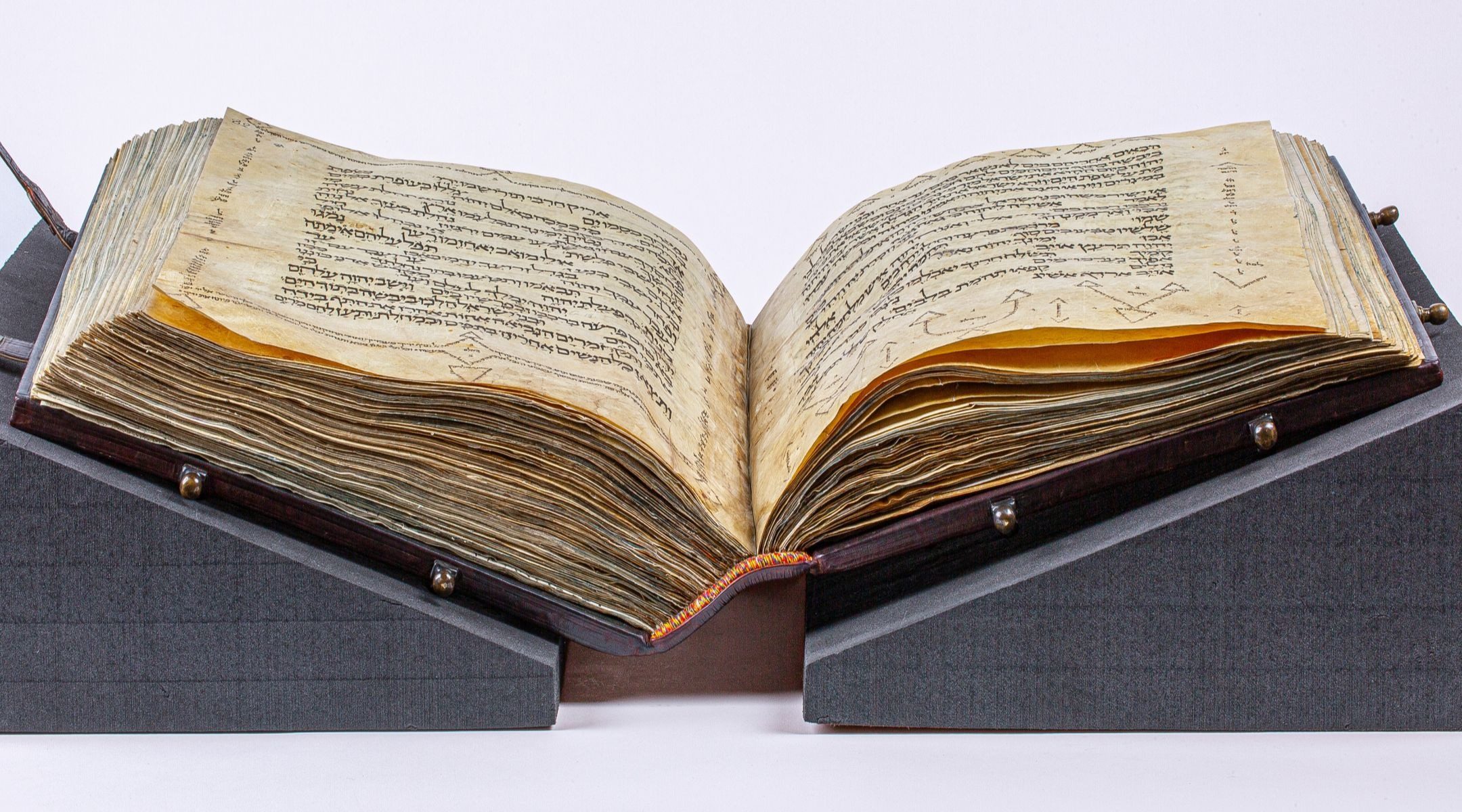
1,000-year-old Hebrew Bible on display in Washington

The 1,000-year-old Washington Bible is on display at the Museum of the Bible in Washington DC. (Alejandro Matos/Museum of the Bible)

As reported by Marcy Oster of Jewish Telegraphic Agency, November 11, 2019 (links in original):

A 1,000-year-old Hebrew Bible has gone on public display at a museum in Washington, D.C.

The bible, called the Washington Pentateuch, was unveiled Thursday at the Museum of the Bible.

It is one of the oldest intact Hebrew Bible manuscripts in the United States, according to a statement from the museum. It contains all of the the five books of Moses.

The bible was first owned by a Jewish community in Ukraine, which gave it as a gift to a local archbishop in the 19th century. During the 20th century, the manuscript was owned by collectors in Israel and the United Kingdom before it was purchased by the museum and went on display in D.C., according to Haaretz.

The Museum of the Bible, which opened in November 2017 and cost $500 million to build, was largely funded by the evangelical Green family, which runs the Hobby Lobby chain of crafts stores. Its president, Steven Green, serves as the museum’s chairman.

Tuesday, 4 December 2018

Swiss feminists publish A Women's Bible to advance their antichrist agenda

There's nothing new about feminist rebellion against God, always masquerading as justice. The reader will note that feminist twisting of scripture easily surmounts denominational divisions. As reported by Agence France-Presse, November 27, 2018:

Tired of seeing their holy texts used to justify the subjugation of women, a group of feminist theologians from across the Protestant-Catholic divide have joined forces to draft "A Women's Bible".

As the #MeToo movement continues to expose sexual abuse across cultures and industries, some scholars of Christianity are clamouring for a reckoning with biblical interpretations they say have entrenched negative images of women.

The women we know from translations and interpretations of Bible texts are servants, prostitutes or saints, seen dancing for a king or kneeling to kiss Jesus' feet.

But while many feminists have called for The Bible, Christianity and religion altogether to be cast aside, an eclectic group of theologians instead insists that if interpreted properly, the Good Book can be a tool for promoting women's emancipation.

'Feminist values'

"Feminist values and reading the Bible are not incompatible," insisted Lauriane Savoy, one of two Geneva theology professors behind the push to draft "Une Bible des Femmes" ("A Women's Bible"), which was published in October.

The professor at the Theology Faculty in Geneva, which was established by the father of Calvinism himself in 1559, said the idea for the work came after she and her colleague Elisabeth Parmentier noticed how little most people knew or understood of the biblical texts.

"A lot of people thought they were completely outdated with no relevance to today's values of equality," the 33-year-old told AFP, standing under the towering sculptures of Jean Calvin and other Protestant founders on the University of Geneva campus.

In a bid to counter such notions, Savoy and Parmentier, 57, joined forces with 18 other woman theologians from a range of countries and Christian denominations.

The scholars have created a collection of texts challenging traditional interpretations of Bible scriptures that cast women characters as weak and subordinate to the men around them.

Parmentier points to a passage in the Gospel of Luke, in which Jesus visits two sisters, Martha and Mary.

"It says that Martha ensures the "service", which has been interpreted to mean that she served the food, but the Greek word diakonia can also have other meanings, for instance it could mean she was a deacon," she pointed out.

Overturning religious orthodoxy

They are not the first to provide a more women-friendly reading of the scriptures.

Already back in 1898, American suffragette Elizabeth Cady Stanton and a committee of 26 other women drafted "The Woman's Bible", aimed at overturning religious orthodoxy that women should be subservient to men.

The two Geneva theology professors say they were inspired by that work, and had initially planned to simply translate it to French.

But after determining that the 120-year-old text was too outdated, they decided to create a new work that could resonate in the 21st century.

"We wanted to work in an ecumenical way," Parmentier said, stressing that around half the women involved in the project are Catholic and the other half from a number of branches of Protestantism.

In the introduction to the "Women's Bible", the authors said that the chapters were meant to "scrutinise shifts in the Christian tradition, things that have remained concealed, tendentious translations, partial interpretations."

'Lingering patriarchal readings'

They take to task "the lingering patriarchal readings that have justified numerous restrictions and bans on women," the authors wrote.

Savoy said that Mary Magdalene, "the female character who appears the most in the Gospels", had been given a raw deal in many common interpretations of the texts.

"She stood by Jesus, including as he was dying on the cross, when all of the male disciples were afraid. She was the first one to go to his tomb and to discover his resurrection," she pointed out.

"This is a fundamental character, but she is described as a prostitute, ...and even as Jesus's lover in recent fiction."

The scholars also go to great lengths to place the texts in their historical context.

"We are fighting against a literal reading of the texts," Parmentier said, pointing for instance to letters sent by Saint Paul to nascent Christian communities.

Reading passages from those letters, which could easily be construed as radically anti-feminist, as instructions for how women should be treated today is insane, she said.

"It's like taking a letter someone sends to give advice as being valid for all eternity."

The theologians' texts also approach the Bible through different themes, like the body, seduction, motherhood and subordination.

The authors say they consider their work a useful tool in the age of #MeToo.

"Each chapter addresses existential questions for women, questions they are still asking themselves today," Parmentier said.

"While some say that you have to throw out the Bible to be a feminist, we believe the opposite."
At least Ms. Parmentier is honest enough to say that she and her feminist colleagues are "fighting against a literal reading of the texts." That's true, because there's no way that you can make the Bible support feminism unless you reject a literal reading and put a feminist twist on scripture. When it comes to deacons, one of the qualifications for a deacon is to be "the husband of one wife" (I Timothy 3:12), the same as for a bishop/overseer. That disqualifies Martha. As for Mary Magdalene, the feminists are employing a straw man argument; although it's commonly believed that Mary Magdalene was a prostitute, nowhere does the New Testament say that. She's merely described as someone out of whom seven demons had been cast (Luke 8:2).

Friday, 29 December 2017

The Bible League Canada promotes contemplative spirituality

Dear friends, do not believe every spirit, but test the spirits to see whether they are from God, because many false prophets have gone out into the world. I John 4:1 (NIV)

Contemplative spirituality may be quickly defined as Eastern spirituality masquerading as Christian spirituality. Practitioners are encouraged to have mystical experiences, i.e., turning off the conscious mind and having experiences that go directly to the senses, bypassing reasoning and intellectual mental processes. I don't know how anyone can test the spirits without using the conscious mind, which is one reason why Christians should avoid contemplative spirituality.

I strongly recommend Lighthouse Trails Research Project, which has been warning the body of Christ about contemplative spirituality for years, and whose knowledge of the subject is vastly superior to mine.

The Bible League Canada is dedicated to distributing Bibles throughout the world, especially where there is a scarcity of Bibles and a strong demand for them. They also operate Crossroads Prison Ministries, instructing prisoners in the basics of the Christian faith.

I was grieved to receive a recent catalogue from The Bible League Canada and to notice that they're selling materials promoting contemplative spirituality, and even offering the false "Bible" titled The Message:

The Presence DVD Experience
$24.99

The wonder of closeness with God is available to you here and now. The Presence, a six-session DVD study based on the book by Alec Rowlands, reveals the ways God makes His presence known, how you can prepare for it, and how experiencing it will transform everything. As you draw near to God—as you are consumed by His love and your life is rearranged by His grace—you’ll find fulfillment, purpose, and an unmatched sense of adventure. If you’re feeling a hunger for more of God, you are already on your way to discovering: He is good. He is powerful. He is here. (The Presence book and curriculum workbook are available separately.)
---------------------------------
The Presence: Experiencing More of God (Participants Guide)
$13.99
1-D6005

Description
For your small group this fall or winter. The wonder of closeness with God is available to you here and now. This workbook, a companion to The Presence DVD curriculum (and book) by Alec Rowlands, walks you through six sessions of seeking God. Rowlands reveals the ways God makes His presence known, how you can prepare for it, and how experiencing it will transform everything. As you draw near to God—as you are consumed by His love and your life is rearranged by His grace—you’ll find fulfillment, purpose, and an unmatched sense of adventure. If you’re feeling a hunger for more of God, you are already on your way to discovering: He is good. He is powerful. He is here.

Order 10 and receive 15% off! Call or email only using product code 1-D6018.

Paperback; 92 pages; includes note-taking space for each session.
---------------------------------------
The Presence: Experiencing More of God
$19.99

Have you settled for far less of God than He wants to reveal? Do you feel close to God in your everyday life . . . or does He too often seem distant and silent? Maybe, like many Christians, you live somewhere between those two extremes. You occasionally sense God’s presence, but at other times feel as if He’s a million miles away.
The wonder of closeness with God is available to you here and now.

In The Presence, Alec Rowlands reveals the ways God makes His presence known, how you can prepare for it, and how experiencing it will transform everything. As you draw near to God—as you are consumed by His love and your life is rearranged by His grace—you’ll find fulfillment, purpose, and an unmatched sense of adventure. If you’re feeling a hunger for more of God, you are already on your way to discovering: He is good. He is powerful. He is here.
--------------------------------
The Way of the Heart, by Henri J.M. Nouwen
$14.99

Description
This book has helped millions of people cast off the anger and greed that trouble the world-and find love, compassion, and peace in the heart of God. Within this one small book lies the most relevant and inspiring challenge that we shall ever face: to surrender the compulsive noise of the world for the way of the heart that leads us to God.
--------------------------------
‘The Message’ by Eugene Peterson
$8.99

Some like the Bible in Elizabethan English; others want close to word-for-word between original languages and English. Eugene Peterson authored The Message to engage people and help them understand what they read. This is not a study Bible, but 'a reading Bible.' No verse numbers and modern language make for easy, enjoyable reading. Great devotional or companion to the Bible.
----------------------------
Coloring Kit – ‘Be Still’ with Coloring Pencils
$19.99

Makes the perfect gift! A one-stop shop for the “Be Still” colouring book and 12-pack of Veritas, high-quality colouring pencils. Both great products in one purchase!
---------------------------------
Be Still Adult Coloring Book
$13.99

Scripture from the Book of Psalms, with its beautiful poetry and rich imagery, is featured in 27 of the beautiful designs and ink drawings. Share the joy of coloring again and invite others to join you! Meditate on the Word of God while exploring your creative side!
----------------------------------
‘The Psalms in Color’ Adult Coloring Book
$13.99

The Book of Psalms is featured in this beautifully crafted Christian Adult Coloring Book. The pages include a variety of delightful patterns, designs, motifs and ink drawings that incorporate Scripture from Psalms. Rejoice in the songs of praise while you put color to the pages to create your unique work-of-art. Because the one-sided pages are perforated, you can share the joyful pastime of coloring and display or share your artwork as a source of inspiration. The book is bound in heavy-duty stock with embossed text and design and lavish applications of spot-varnish and silver foil.

Perforated One-Side Printed Sturdy Pages
Designed for Fun – Serenity – Calmness & Quiet Inspiration
56 Full Page Ink Drawings With Scripture From Psalms
Includes 7 Pages With Gift Tags – Bookmarks – Cards to Color
Presentation Page for Gift-Giving
8 1/2 x 11 Inch

Saturday, 9 December 2017

Pope Francis wants the English translation of the Lord's Prayer changed

After this manner therefore pray ye: Our Father which art in heaven, Hallowed be thy name.
Thy kingdom come, Thy will be done in earth, as it is in heaven.
Give us this day our daily bread.
And forgive us our debts, as we forgive our debtors. And lead us not into temptation, but deliver us from evil: For thine is the kingdom, and the power, and the glory, for ever. Amen.
Matthew 6:9-13

As reported by Maham Abedi of Global News, December 8, 2017 (link in original):

Pope Francis says the words in the ‘Lord’s Prayer’ — one of the most well-known prayers in Christianity — need to be tweaked.

In an interview on an Italian TV show Wednesday, he explained that he thinks the current English translation isn’t completely accurate. The pontiff explained that the translation, which asks God “lead us not into temptation,” doesn’t work because Satan — not God — leads to sin.

“A father does not do that, a father helps you to get up immediately. It’s Satan who leads us into temptation, that’s his department,” he said during the interview.

That’s why he wants the Roman Catholic Church to consider changing the words to “do not let us fall into temptation.”

The prayer’s translations are from the Latin vulgate, which was translated from ancient Greek, which was, in turn, translated from Aramaic, the language spoken by Jesus.

Liturgical translations are usually done by local Churches in co-ordination with the Vatican.
As reported by Harriet Sherwood and agency in the English newspaper The Guardian, December 8, 2017 (link in original):

...The 80-year-old also highlighted that the Catholic church in France had adapted the prayer, and uses the phrase “do not let us fall into temptation” instead.

The two versions of the Lord’s Prayer most commonly used in England both say “lead us not into temptation”.

“I’m not aware of any plans to change the translation in the English-speaking world but you can certainly see the logic of doing so,” said Austen Ivereigh, the pope’s biographer.

“It is not God who tempts us into sin but the enemy of human nature. But tradition and familiarity are also important factors in weighing up any decision to modify a translation.”

The Rev Ian Paul, an Anglican theologian, said the pope’s comments would make traditionalists nervous.

“The word in question is peirasmos [from New Testament Greek] which means both to tempt and to be tested. So on one level the pope has a point. But he’s also stepping into a theological debate about the nature of evil.

“In terms of church culture, people learn this prayer by heart as children. If you tweak the translation, you risk disrupting the pattern of communal prayer. You fiddle with it at your peril.”

The Lord’s Prayer, which is memorised by millions of Christians across the world, appears in the Bible.
It speaks volumes about the state of Biblical illiteracy in England these days that a newspaper has to state that the Lord's Prayer is found in the Bible.

Friday, 12 February 2016

UNESCO recognizes the Aleppo Codex as a world treasure

Fragment of the Aleppo Codex containing verses from Exodus 8 recently was brought to Israel. (Photo credit: Yad Ben-Zvi Institute)

As reported by Jewish Telegraphic Agency, February 9, 2016 (link in original):

The Aleppo Codex — believed to be the world’s oldest surviving copy of the Hebrew Bible — has been officially recognized as a treasured item by the United Nations Educational Scientific and Cultural Organization.

The codex, which is on permanent display at the Israel Museum in Jerusalem, will be listed in UNESCO’s International Memory of the World Register, Haaretz reported Tuesday.

UNESCO officially recognized the codex on Monday, according to Haaretz, deciding it belongs in its registry of 300 items and collections from all over the world. The registry already includes two other items from Israel: the Israel Museum’s Rothschild Miscellany, a collection of illustrated 15th-century manuscripts, and the Pages of Testimony at the Yad Vashem Holocaust Museum, which documents the names and stories of Holocaust victims.

Written in northern Israel around 930 CE, the codex has a storied and transient history. It was smuggled into Israel from Syria 60 years ago, and since then 200 of the original 500 pages have mysteriously disappeared.

An award-winning 2013 book — “The Aleppo Codex: In Pursuit of One of the World’s Most Coveted, Sacred and Mysterious Books” — chronicles its history.

According to Haaretz, 7,200 pages of Isaac Newton’s papers, which are stored in Israel’s National Library in Jerusalem, was also added to the UNESCO registry this week.
And this item, reported by Jewish Telegraphic Agency, July 12, 1976:

JERUSALEM (Jul. 11)

A facsimile edition of the oldest known manuscript of the Hebrew Bible — the Aleppo Codex — was published by the Hebrew University last week. It is the fruit of 20 years’ work by a team of Hebrew University scholars, headed by Prof. Moshe Goshen Gottstein. The 500-page red and blue leather-bound facsimiles will sell for $400 apiece.

The Aleppo Codex was first published in about 900 AD in Tiberias by Aharon Ben Asher, a master of the textual tradition. By the end of the 11th century, the manuscript had been carried off from Jerusalem to Cairo. But it was subsequently transferred to Aleppo, Syria where it remained in the possession of the Jewish community. During Israel’s War for Independence in 1948, the Syrians tried to burn the Biblical treasure, but 600 of the 800 pages were saved.

The manuscript was smuggled out of Syria in 1956 and delivered to President Yitzhak Ben Zvi of Israel for safe-keeping. It is now at the Ben Zvi Institute in Jerusalem. Most of the Pentateuch is among the lost portion. The manuscript begins with Deuteronomy, Chapt. 28, Verse 17. It includes the books of Joshua, Judges and Samuel but Kings I is missing and only parts of Kings 2 have been preserved. The books of Isaiah and Ezekial are complete, but only parts of Jeremiah are preserved. Most of the minor prophets, the Book of Psalms and Chronicles are also preserved.
See also my post Israeli scholar completes 30-year mission to "fix" textual errors in Old Testament (January 18, 2013).

Thursday, 11 February 2016

70 years ago: The Revised Standard Version of the New Testament is published

On February 11, 1946, the Revised Standard Version of the New Testament--the first serious challenge to the popularity of the King James Version--was published. The copyright was held by the International Council of Religious Education, which merged with the Federal Council of Churches of Christ in America in 1950 to form the National Council of the Churches of Christ in the USA.

The complete Revised Standard Version of the Bible was published on September 30, 1952, and was officially the best-selling non-fiction book in the United States from 1952-1954. Real Christians eventually rejected the RSV because of its liberalism (e.g., substituting "young woman" for "virgin" in Isaiah 7:14), and it's largely forgotten today. The King James Version is still with us.

Thursday, 15 October 2015

Scholar claims to have found the earliest known draft of the King James Bible

As reported by Jennifer Schuessler of The New York Times, October 14, 2015:

The King James Bible is the most widely read work in English literature, a masterpiece of translation whose stately cadences and transcendent phrases have long been seen, even by secular readers, as having emerged from a kind of collective divine inspiration.

But now, in an unassuming notebook held in an archive at the University of Cambridge, an American scholar has found what he says is an important new clue to the earthly processes behind that masterpiece: the earliest known draft, and the only one definitively written in the hand of one of the roughly four dozen translators who worked on it.

The notebook, which dates from 1604 to 1608, was discovered by Jeffrey Alan Miller, an assistant professor of English at Montclair State University in New Jersey, who announced his research on Wednesday in an article in The Times Literary Supplement.

While the notebook has yet to be examined by other scholars, experts who have reviewed Professor Miller’s research called it perhaps the most significant archival find relating to the King James Bible in decades.

David Norton, an emeritus professor at the Victoria University of Wellington in New Zealand and the author of several books about the King James Bible, called it “a major discovery” — if not quite equal to finding a draft of one of Shakespeare’s plays, “getting on up there.”

Gordon Campbell, a fellow in Renaissance studies at the University of Leicester and a consultant for the planned Museum of the Bible in Washington, said the new manuscript shed fresh light on how the King James translators actually did their work, as opposed to how they had been told to do it.

Studying the creation of the King James Bible “is like working with a jigsaw puzzle where 90 percent of the pieces are missing,” Mr. Campbell said. “You can arrange the surviving pieces as you wish, but then you find something new and you realize you put it together the wrong way.”

The King James Bible, published in 1611, was produced by six teams of translators, known as “companies,” in London, Oxford and Cambridge, who were charged with creating an authorized version that would support the Church of England against the Puritan influence seen in some earlier translations. Along with Shakespeare’s First Folio of 1623, it is one of the most influential books in the history of English and the wellspring of common phrases like “salt of the earth,” “drop in the bucket” and “fight the good fight,” to name only a few.

While some records of the committee that supervised the overall translation survive, only three manuscripts of the text itself have been known to exist until now. The Bodleian Library at Oxford owns nearly complete drafts of the Old Testament and the Gospels, in the form of corrected pages of the Bishops’ Bible, a 16th-century translation that the King James teams used as a base text. Lambeth Palace Library in London has a partial draft of the New Testament epistles.

Professor Miller discovered the manuscript last fall, when he was in the archives at Sidney Sussex College in Cambridge, researching an essay about Samuel Ward, one of the King James translators and, later, the college’s master. He was hoping to find an unknown letter, which he did.

Advertisement
Continue reading the main story

Advertisement
Continue reading the main story

“I thought that would be my great discovery,” he recalled.

But he also came across an unassuming notebook about the size of a modern paperback, wrapped in a stained piece of waste vellum and filled with some 70 pages of Ward’s nearly indecipherable handwriting.

The notebook had been cataloged in the 1980s as a “verse-by-verse biblical commentary” with “Greek word studies, and some Hebrew notes.” But as Professor Miller tried to puzzle out which passages of the Bible it concerned, he realized what it was: a draft of parts of the King James Version of the Apocrypha, a disputed section of the Bible that is left out of many editions, particularly in the United States.

“There was a kind of thunderstruck, leap-out-of-bathtub moment,” Professor Miller said. “But then comes the more laborious process of making sure you are 100 percent correct.”

The draft, Professor Miller argues, dates from between 1604, when the King James Bible was commissioned, and 1608, when the six teams were asked to send their work to the general committee for review. Unlike the other surviving drafts, which scholars date to later parts of the process, it shows an individual translator’s initial puzzling over aspects of the Greek text of the Apocrypha, indicating the reasoning behind his translation choices, with reference to Hebrew and Latin as well.

“You can actually see the way Greek, Latin and Hebrew are all feeding into what will become the most widely read work of English literature of all time,” Professor Miller said. “It gets you so close to the thought process, it’s incredible.”

The draft, he argues, also complicates one long-cherished aspect of the “mythos,” as he put it, surrounding the King James: that it was a collaborative project through and through.

The companies were charged with doing their work as a group, rather than subdividing it by assigning individual books to individual translators, as was the case with the Bishops’ Bible. But the Ward notebook, Professor Miller said, suggests “beyond a reasonable doubt” that at least some of the companies ignored the instructions and divided up the work among individuals, at least initially.

Further, he said, the notebook contains a complete draft for the book of the Apocrypha known as 1 Esdras, but then, after a run of blank pages, only a partial manuscript for the book known as the Wisdom of Solomon, suggesting that Ward picked up the slack for another translator.

“Some of them, being typical academics, either fell down on the job or just decided not to do it,” Professor Miller said, with a laugh. “It really testifies to the human element of this kind of great undertaking.”

In recent years, scholars have chipped away at the idea of Shakespeare’s plays as the product of an isolated genius, emphasizing instead the intensely collaborative nature of Elizabethan theater. Professor Miller said that the origins of the other great monument of 17th-century English literature is due for a similar reconsideration.

“There’s a strong desire to see the King James Bible as a uniform object, and a belief that it’s great because of its collaborative nature,” Professor Miller said.

“It was incredibly collaborative,” he continued. “But it was done in a much more complicated, nuanced, and at times individualistic way than we’ve ever really had good evidence to believe.”
Click on the link to see Professor Miller's article, Fruit of Good Labours.

Tuesday, 7 January 2014

Inuktitut Bible app available for free download

Another backlog item, as reported by the Iqaluit newspaper Nunatsiaq News, March 28, 2013 (links in original):

The Inuit language bible, produced in Inuktitut syllabics last June after 34 years of work, is now available for download online.

The Inuktitut Bible application can be downloaded for free on a number of devices, including computers, iPads, iPhones, iPods and android phones.

However, the app won’t work on older Blackberry smartphones, but it will work on computers and laptops.

The online version of the Inuktitut Bible took about a year to develop, because of the “unusual font” of Inuktitut, according to a spokesperson from the company that helped develop the app in Kitchener, Ontario.

Last June, the Inuktitut Bible was dedicated at the new St. Jude’s Cathedral in Iqaluit.

The cathedral’s dedication services featured the consecration of the Anglican Church’s new Inuktitut Bible, produced by a team lead by Bishop Benjamin Arreak.

Andrew Atagotaaluk, the former Bishop of the Arctic, had earlier praised the project, saying that for the first time, readers of syllabics could read all books of the Old and New Testament in the Inuit language.

The Inuktitut Bible also marked the first time in Canada that a translation was done by first-language speakers of Inuktitut rather than by missionaries.

The first draft of that Bible was completed after 23 years of collaboration between the Canadian Bible Society and the Diocese of the Arctic of the Anglican Church of Canada.

The online Inuktitut Bible can be downloaded here, by selecting Inuktitut from a pull-down menu.
I'm suspicious of anything coming from the Anglican Church of Canada, but if that's all that's available, so be it. If it took 34 years for this version of the Bible to be published, it's unlikely that another Inuktitut version will be coming out soon.

Wednesday, 27 February 2013

Hebrew Old Testament goes online

As reported by Aryeh Savir of Tazpit, February 18, 2013:

The Bible, the best-selling book in history, is making its transition into the 21st century. An online project which intends to produce the first grassroots Internet Bible, "Tanach b'Mirshetet" (The Bible Online), has uploaded the entire Tanach online, with each of its 23,127 verses awaiting an "owner."

Each person that participates chooses a verse on the site and may dedicate it, or indicate why they chose it. The final objective is to get 23,127 people to select one verse each, thus having a complete Tanach "transcribed" on the internet by the Israeli public.

Thousands of verses have already been chosen, and thousands more which can be selected and personalized. Upon completing registration, each participant receives a certificate attesting to his participation.

Project coordinator Raphael Harkham told Tazpit News Agency that the aim of the project was to highlight the Bible's unique value, not only to the Jewish people, but as a platform for dialogue.

"It's a project to unite Israelis from all different sectors, while strengthening the connection between the nation and the Book. It is a great platform for Tanach conversation and a great tool for Tanach study.

"We are also working to get Israeli youths involved. I feel this project is especially important for them because they represent Israel's future."
The site currently exists in Hebrew, and four other versions are slated to be launched – English, French, Spanish, and Russian.

The launch of the Hebrew website in April 2011 is part of a global project run by the Bible Valley, a non-profit organization, in cooperation with the Foreign Ministry and the Public Diplomacy and Diaspora Affairs Ministry, in which hundreds of thousands of people from around the world, of all faiths, are copying the Bible in their own handwriting, in 100 languages.

This project was preceded by the Bible Valley's inaugural project, "Children of the World Illustrated the Bible," in which hundreds of thousands of paintings were sent from 91 countries.

After all the verses of the Tanach have been selected, the book will be printed, and – along with the 100 Bibles in 100 languages – will be placed in the planned Heichal Hatanach (The Hall of the Bible) to be built at the City of David in Jerusalem.

At the launch of the website, Prime Minister Benjamin Netanyahu and his cabinet were the first to choose their verses. Netanyahu chose the first verse: "Nation shall not lift up sword against nation; neither shall they learn war anymore." (Isaiah 2:4).

Communications Minister Moshe Kahlon chose "A Song of Ascents. I will lift up mine eyes unto the mountains: from whence shall my help come?" (Psalms 121:1).

Prime Minister Netanyahu said that he chose his verse because this was the vision of the prophets of Israel for the entire world: "While the Tanach has a universal aspect, it is, first of all, the Jewish People's book of books. The Tanach conquers with its ideals, faith and unique character. No other book can compare to it.

"We hope that one day peace will prevail among all nations, and nation will not lift up sword against nation."

To select a verse, visit: www.mybible.org.il

Thursday, 24 March 2011

My Word Like Fire points out another distortion in The Message

About 1995 I first became aware of the unsoundness of The Message when Dave Hunt quoted I Corinthians 6:9-10, and Eugene Peterson had removed homosexuals from the list of those who won’t inherit the kingdom of God and added "those who use and abuse the earth." John Lanagan at My Word Like Fire has a good post on this as well as Mr. Peterson’s removal of the word "sodomites" from I Kings 22:46. It isn’t just The Message that has removed "sodomites" from the Old Testament. The New International Version has substituted "male shrine prostitutes" for "sodomites in I Kings 22:46 and similar passages. I suspect the NIV’s removal of "sodomites" is related to the fact that the head of the NIV’s Old Testament translation committee was a man named Marten Woudstra. Do a Google search using the terms "Marten Woudstra" and "NIV," and you’ll find plenty of items mentioning his homosexuality.

The perceptive reader will also notice that Mr. Peterson has also removed idolaters and drunkards from the I Corinthians 6 hall of shame (The NASB hasn’t removed drunkards from the list--Mr. Lanagan mistakenly omitted the word).

In regard to Mr. Lanagan’s post on The Message’s rendering of I Timothy 1:9-10, here’s what I Timothy 6:9-11 looks like in The Message and the King James Version. As with I Corinthians 6:9-10, The Message’s version is so far removed from a true biblical translation as to be unrecognizable. If I hadn’t entered the relevant references while searching Bible Gateway, I wouldn’t know from Mr. Peterson’s versions that these are from I Corinthians 6 or I Timothy 1.

It's obvious, isn't it, that the law code isn't primarily for people who live responsibly, but for the irresponsible, who defy all authority, riding roughshod over God, life, sex, truth, whatever! They are contemptuous of this great Message I've been put in charge of by this great God. 1 Timothy 1:9-11 (The Message)

Knowing this, that the law is not made for a righteous man, but for the lawless and disobedient, for the ungodly and for sinners, for unholy and profane, for murderers of fathers and murderers of mothers, for manslayers,
For whoremongers, for them that defile themselves with mankind, for menstealers, for liars, for perjured persons, and if there be any other thing that is contrary to sound doctrine;
According to the glorious gospel of the blessed God, which was committed to my trust.
1 Timothy 1:9-11 (KJV)

It came as no suprise to this blogger to see Eugene Peterson’s endorsement on the cover of William P. Young’s novel The Shack (or, as I prefer to call it, "The Outhouse")--a writer of one notorious work of blasphemous fiction endorses another. Antichrists of a feather flock together.

HT: Marsha West

Monday, 21 March 2011

Freemasonry, ancient paganism, and the Manitoba Legislative Building

I recently came across a fascinating book published in 2007 by the Winnipeg Free Press titled The Hermetic Code: Unlocking One of Manitoba’s Greatest Secrets. It was written by Carolin Vesely and Buzz Currie and was originally published in the Free Press as a series of articles in November and December of 2006. The book is based on interviews with and research conducted by Frank Albo of the University of Winnipeg, who should really be given credit as a co-author. Mr. Albo is a specialist in ancient religions and western esotericism who discovered that the Manitoba Legislative Building in Winnipeg has been heavily influenced by Freemasonry and ancient Egyptian and Greek paganism in its design on both the outside and inside of the building. Mr. Albo says, "There is a famous Masonic maxim: Hidden in plain view." Indeed, the symbolism is plain to see for those who are familiar with Greek paganism or Freemasonry, but will likely pass unnoticed by most others. The Premier of Manitoba (Sir Rodmond Roblin); the architect (Frank Worthington Simon); and the contractor (Thomas Kelly) were all known to be Freemasons or were familiar with Masonic symbolism. Mr. Albo joined the Freemasons several years ago, so he doesn’t approach the subject from an anti-Masonic viewpoint.

Mr. Albo mentions that Mr. Simon, the building’s architect, would likely have known about, and perhaps sought out membership in, the Hermetic Order of the Golden Dawn, which was founded in London by three Freemasons in 1888, and which opened a temple in Mr. Simon’s home town of Edinburgh in 1893. According to Mr. Albo, the Hermetic Order of the Golden Dawn believed their rituals to be handed down from Hermes Trismegistus:

"He’s a fusion of the Greek god--your [FTD] florist trademark--and the Egyptian god Thoth.
"Some believe Hermes Trismegistus was not a mythical deity, but a real human...He was a master architect of temple building, and in Masonic lore, he is revered for the discovery of all human knowledge. His philosophy became known as Hermeticism and he became the patron of occultism throughout the history of the western world...He’s the father of alchemy, but not the mere changing of base metal into gold...His famous dictum is ‘As above, so below.’ To some Hermeticists, true alchemy meant elevating the base human soul to godlike wisdom."
(p. 95)

According to Mr. Albo, the famous statue known as the Golden Boy that stands on top of the building is actually a statue of Hermes Trismegistus:

"What’s the Hermetic principle again?" I [Carolin Vesely] asked. "As above, so below?"
"That’s right, Frank said. "What appears on the earthly plane mirrors the greater truth in the spiritual plane. Transmuting the base elements into gold is the lower manifestation. Hermes Trismegistus aims to teach the greater alchemy--the means by which men transform themselves to the perfection of gods, as he did.
"As I said, Gardet, the sculptor, and Simon never called him the Golden Boy. They gave a broad hint of his true identity though, when they named him ‘Eternal Youth’--immortality, in other words."
(p. 117)

"As above, so below." Where have we seen that before? In that perverted paraphrase, The Message, of course (bold added):

Set the world right; Do what's best— as above, so below. Matthew 6:10

For everything, absolutely everything, above and below, visible and invisible, rank after rank after rank of angels—everything got started in him and finds its purpose in him. Colossians 1:16

In addition to the highlighted phrases, the perceptive reader will notice that "Thy kingdom come" has been changed to "set the world right," demoting God from Lord to social reformer. The passages cited above appear in the King James Version as:

Thy kingdom come, Thy will be done in earth, as it is in heaven. Matthew 6:10

For by him were all things created, that are in heaven, and that are in earth, visible and invisible, whether they be thrones, or dominions, or principalities, or powers: all things were created by him, and for him: Colossians 1:16

Here's a segment on Mr. Albo's research that appeared as a news item on the Canadian Broadcasting Corporation under the title Winnipeg's Secret Code:


For a more detailed examination of Mr. Albo's research, a seven-part series is available on YouTube. For reasons of space, I prefer to post the links to the video clips rather than the embed codes: Manitoba Legislative--Esoteric Symbolism Part 1; Part 2; Part 3; Part 4; Part 5; Part 6; Part 7.

Moon Song - Pool of the Blackstar is the title of a YouTube clip of a pagan celebration that took place inside the Manitoba Legislative Building. According to the clip's explanatory note:

On the night of August 17th, 2007, a meeting of freemasons and elders met at the Manitoba Legislature for a ceremony of peace on the night of the Venus inferior conjunction of the sun. Lyna Hart, a Cree elder sang the Moon Song to honour the return of the sacred feminine in all of our lives.

Saturday, 8 January 2011

Matthew 24, the New Age "Master Jesus," and The Message

And Jesus answered and said unto them, Take heed that no man deceive you.
For many shall come in my name, saying, I am Christ; and shall deceive many.
Matthew 24:4-5 (KJV)

Lighthouse Trails Research Blog, one of the best resources available, has just published a fascinating post by Ray Yungen (taken from the 2007 edition of his book For Many Shall Come in My Name (Lighthouse Trails Publishing), pp. 151-156) on Matthew 24. This paragraph in particular (from page 152) got my attention:

A basic tenet of New Age thinking is that of the Master Jesus. Adherents to this idea believe during the unrecorded period of His life, Jesus traveled to various occult centers and mystery schools in such places as Tibet, India, Persia, and Egypt; at these places this same Jesus learned the metaphysical secrets of the ages. Therefore, they claim this Jesus spent seventeen years of travel on a pilgrimage of higher consciousness. According to this viewpoint, Jesus of Nazareth became the Master Jesus, one who allegedly gained mastery over the physical world by becoming one with his higher self.

I knew I’d seen the phrase "Master Jesus" before, and I remembered where I'd seen it: The Message. As I’ve previously posted, the phrases "Lord Jesus" and "Lord Jesus Christ" aren’t found in The Message even once, but a quick search at Bible Gateway finds that the phrase "Master Jesus" is used in The Message 73 times (!)--in each instance, a change from the word "Lord."

One such passage that struck me was Philippians 3:20. For purposes of comparison, here’s how that verse reads in the King James Version, New American Standard Bible, and New International Version (2010), followed by The Message’s rendition:

For our conversation is in heaven; from whence also we look for the Saviour, the Lord Jesus Christ: KJV

For our citizenship is in heaven, from which also we eagerly wait for a Savior, the Lord Jesus Christ; NASB

But our citizenship is in heaven. And we eagerly await a Savior from there, the Lord Jesus Christ, NIV (2010)

But there's far more to life for us. We're citizens of high heaven! We're waiting the arrival of the Savior, the Master, Jesus Christ, The Message

The perceptive reader will notice that in The Message’s rendition of Philippians 3:20, there's no statement that we’re waiting for the "Master, Jesus Christ" to come from heaven. To read this version, the "Master" could well be someone who’s already on Earth when he’s revealed as the Saviour--a change in the text that I regard as very suspicious!

Sunday, 9 May 2010

The Message distorts John 3:16-17

For God so loved the world, that he gave his only begotten Son, that whosoever believeth in him should not perish, but have everlasting life.
For God sent not his Son into the world to condemn the world; but that the world through him might be saved.
John 3:16-17, KJV

This is how much God loved the world: He gave his Son, his one and only Son. And this is why: so that no one need be destroyed; by believing in him, anyone can have a whole and lasting life. God didn't go to all the trouble of sending his Son merely to point an accusing finger, telling the world how bad it was. He came to help, to put the world right again. John 3:16-17, The Message

Some Bereans, such as Dave Hunt and T.A. McMahon at The Berean Call, have commented about how Eugene Peterson in The Message alters the meaning of John 3:17. "That the world through him might be saved" is changed to "put the world right again," which makes Jesus Christ sound more a social reformer than a saviour.

However, it’s also worth taking a look at what Mr. Peterson does to John 3:16. This is perhaps the most beloved verse in the Bible, and one that directly led me to put my faith in the Lord Jesus Christ as my saviour. The word rendered as "everlasting" in the King James Version and "eternal" in most modern versions is the Greek word aionios. According to An Expository Dictionary of New Testament Words by W.E. Vine (1940), "...it is used of persons and things which are in their nature endless..." Which is to say, "everlasting" or "eternal" are correct renderings of the word. However, The Message changes "everlasting life" to "a whole and lasting life." "Whole and lasting" sounds a lot less impressive to me than "everlasting" or "eternal." It sounds as though Mr. Peterson is more interested in promoting a better life on Earth than in preparing people for eternity.

The reader will also note the absence of the word "begotten" from verse 16. I haven’t time to reprint it here, but Mr. Vine’s dictionary has a lengthy explanation of the phrase "only begotten," which is the Greek word monogenes. The phrase is unique to the writings of John, and is found five times (John 1:14; 1:18; 3:16; 3:18; and I John 4:9), always in reference to Christ as the Son of God. I’ve already posted on The Message’s refusal to use the phrases "Lord Jesus" and "Lord Jesus Christ," and I don’t understand how such a perverse paraphrase can be seriously regarded as a "Bible."

Thursday, 8 January 2009

The Lord Jesus Christ is nowhere to be found in The Message

A search for the phrases "Lord Jesus" and "Lord Jesus Christ" at Bible Gateway turned up the following results (try it yourself). The number denotes the number of times that the phrase is found in the particular version. The reader may draw his own conclusions.

The author of The Message, is of course, Eugene Peterson, whose glowing endorsement of The Shack appears on the front cover of that book (see post below).

"Lord Jesus"
King James Version: 115
New American Standard Bible: 101
New International Version: 101
NIV-UK: 101
Today’s NIV: 102
New KJV: 115
21st Century KJV: 115
New Living Translation: 102
American Standard Version: 103
English Standard Version: 100
Contemporary English Version: 109
New Century Version: 104
Amplified: 109
The Message: 0

"Lord Jesus Christ"
KJV: 81
NASB: 63
NIV: 60
NIV-UK: 60
TNIV: 60
NKJV: 81
21st C. KJV: 81
NLT: 60
ASV: 65
ESV: 61
CEV: 59
NCV: 64
Amplified: 75
The Message: 0