Showing posts with label Occult. Show all posts

Monday, 21 October 2024

Quebec religion wants Canadian government to approve the use of magic mushrooms in its ceremonies

Neither repented they of their murders, nor of their sorceries, nor of their fornication, nor of their thefts. Revelation 9:21

According to Vine's Expository Dictionary of New Testament Words, the Greek word for sorcery in Rev. 9:21 is pharmakia (or pharmakeia), from which we get the English word pharmacy...

...primarily signified the use of medicine, drugs, spells; then, poisoning; then, sorcery...mentioned as one of the "works of the flesh..."

...In sorcery, the use of drugs, whether simple or potent, was generally accompanied by incantations and appeals to occult powers, with the provision of various charms, amulets, etc., professedly designed to keep the applicant or patient from the attention and power of demons, but actually to impress the applicant with the mysterious resources and powers of the sorcerer.
We live in an increasingly drugged society--yet another end-time prophecy that's being fulfilled before our eyes. As reported by Darryl Greer of Canadian Press, October 21, 2024:

A Quebec-based religion is taking the minister of mental health and addictions to court, claiming Health Canada is dragging its feet on a decision whether to allow its members to use magic mushrooms in their ceremonies.

Gratitude Sanctuary, known as Sanctuaire de la Gratitude in French, and its “Reverend Superior” Alain Menier, filed an application in Federal Court claiming its members need to consume magic mushrooms to practice their religion.

The application was filed by the religious non-profit in early October in Ottawa, and says the group believes people receive “their own teachings when entering the sacred space opened by the consumption of psilocybin mushrooms.”

The application says ceremonies must be done safely and legally, but Health Canada hasn’t decided on the group’s request for an exemption from the Controlled Drugs and Substances Act, which was first submitted in March 2022.

“An important tenant of the religion is that the mushrooms should be consumed in the safest way possible, which requires that they be consumed under strict health and safety protocols, in a controlled environment, and under trained supervision,” it says.

In response to the request, the application says Health Canada sent two questionnaires to Menier with 41 questions in total, but months went by without a response.

The religious non-profit’s lawyer sent a “demand letter” in September to Health Canada seeking a response to the exemption request within 30 days, and “Health Canada confirmed receipt but did not provide any of the responses requested nor demonstrate that it was taking steps to further the processing of the exemption request.”

It wants to compel the agency to decide on the exemption, saying it “cannot conduct their religious ceremonies without” it.

Menier and Gratitude Sanctuary claim in court that their “religious freedom rights are being infringed by the lack of an exemption,” and they want a judge to compel the minister of mental health and addictions to either decide to grant or refuse the request.

“No harm will result from the minister continuing to process the exemption request,” the court application says.

“Rather, it will result in either the minister granting the request and allowing the applicants to practice their religion or the minister notifying the applicants about what more information that is needed or of the minister’s intent to refuse the request.”

Health Canada said it was looking into a question about religious exemptions from the act.

Health Canada’s website outlines how exemption requests are decided on a “case by case basis,” and processing times vary depending on the purpose of the exemption.

The agency’s website says it strives to “assess requests in a timely fashion,” aiming for 45 days for clinical studies, 70 days for scientific research, but for “non-routine exemptions, there is no set time period for receiving decisions.”

“The review time varies depending on the complexity and completeness of the request,” Health Canada’s website says.

A lawyer for Gratitude Sanctuary did not immediately respond to an email and voice mail seeking comment.

Wednesday, 16 October 2024

Youth "ministry" in at least two churches in Winnipeg (and one in Providence) now includes Dungeons & Dragons

There is a way which seemeth right unto a man, but the end thereof are the ways of death. Proverbs 14: 12 (also Proverbs 16:25)

I've never played or had any desire to play Dungeons & Dragons or any other fantasy role-playing game, but I remember when the game was at the peak of its popularity in the 1980s. One of the few times I ever watched Sally Jessy Raphael's tabloid television show was when she had an episode on D&D in 1989. One of her guests was Paul Valentine, founder of the World Church of Satanic Liberation, and even he said that Dungeons & Dragons could be dangerous for players if they had an evil Dungeon Master. Christians warned against the game in those days, but now there are at least two churches in Winnipeg that use D&D as part of youth "ministry."

There's an old saying, attributed to various people, "What you win them with is what you win them to," or "What wins them is what keeps them." If you use Dungeons & Dragons to attract young people to church, that's what you're winning them to, and what will keep them in church. When I read of the nonsense described in the following article, it makes me more grateful that the Lord saved me when He did. As reported by John Longhurst in the Winnipeg Free Press, October 16, 2024 (photos by Mr. Longhurst):

Fifty years ago, a new game appeared on the scene: Dungeons & Dragons.

Soon after being introduced, the fantasy role-playing game, with its magic, wizards, sorcerers and warlocks, was criticized by many Christian leaders who saw it as a portal to the demonic — a way for Satan to steal the souls of unsuspecting youth.

That was during the time of the so-called “satanic panic,” when some Christians saw the devil everywhere they looked, from heavy metal music to graffiti.

One religious tract that circulated at the time said the game — in which players embark on adventures in a fantasy setting, directed by a dungeon master — was a form of “intense occult training” that caused young people to become witches and even to kill themselves.

In at least two churches in Winnipeg, D&D is seen in a very different light.

At River East Church, which is affiliated with Mennonite Church Manitoba, the game is seen as a great way to engage youth.

That’s the view of associate pastor Aaron Thiessen, 35, who runs a twice-monthly D&D game night at the church for as many as 25 youth from grades 7 to 11.

Thiessen hadn’t played the game himself growing up.

“It’s not that my parents were against it; I just thought it wasn’t for me,” he says.

When he discovered many young people in the church were into D&D, Thiessen decided to start some informal game nights in 2017. It went so well, he made it an official youth activity in 2019.

“The first time we tried it, 10 young people showed up. Now we have trouble keeping up with all who want to play,” he says.

The pandemic put a dent in the game — though they kept playing it online — but it came back stronger than ever when COVID abated.

Many of the youth who come to game nights aren’t from the congregation.

“For some, it’s the one connection they have to a church,” Thiessen says, adding it enables him to engage youth he had not met before, in a different way.

For him, the game nights build community and provide him with opportunities to have natural conversations with youth. He especially likes to see introverts open up as they play.

As for who comes, it’s a good mix of male and female players.

“It’s not just for guys anymore,” he says.

Thiessen begins each session with a story from the Bible or a story of a saint. On an evening in October, it’s the story of Moses going up a mountain, where he saw a burning bush and heard the voice of God.

“Mountains were special places where people could run into a deity,” Thiessen tells the youth about that Bible story. “I’m curious about what stories you will tell tonight.”

For Thiessen, incorporating stories such as this is a way to include a bit of spiritual teaching.

“The Bible is a book of stories, stories that continue to impact us today, stories that shape us as people, just as D&D is about stories,” he says.

The game also gives him and the adults who volunteer as dungeon masters to run the games a way to explore issues outside the games themselves.

“It gives us chances to explore why things happen the way they do in a game, the moral choices characters make,” Thiessen says.

After the games, there can be a time to debrief and talk about what happened.

Nathan Christmas, 18, is a volunteer dungeon master at River East. For him, D&D is a core way to bring youth together in a fun activity.

“It’s a space where youth can get together and tell stories. It builds conversation, improv and critical thinking skills,” he says.

For Kiana, one of the youth playing the game, it’s an opportunity to be with friends and “be in a different world.” For Jaden, it’s about “creating new worlds and stories with friends.”

Another congregation using D&D is FaithWorks, an independent church that meets on the campus of Canadian Mennonite University.

It’s organized by Christopher Neufeld, 42, who wasn’t allowed to play the game as a child, owing to some sort of “ambiguous evil” that was said to surround it.

In high school, he started to play with friends. Today he uses it as a way to engage young adults in the congregation; he hopes to start another game for youth in the church, too.

“It’s a connecting point with the church for some of them. Something in common we can do together,” he says.
Kiana (left) and Nori play Dungeons & Dragons at River East Church.

Anton Klein serves as a dungeon master during game night at River East Church.

I remember the "satanic panic" in the '80s, which included accusations of "backmasking" in rock music recordings in the early years of the decade, and accusations of satanic ritual abuse and murder toward the end of the decade. The latter peaked from about 1988-1992, and faded away when evidence mounted that many of the accounts were the result of false memories. I believe the concerns about Dungeons & Dragons, however, are legitimate. A good book on the subject from a Christian perspective is Playing with Fire by John Weldon and James Bjornstad (1984).

December 30, 2024 update: This isn't happening only in the capital of Manitoba, but also in the capital of Rhode Island; as reported by Jonny Williams of the Providence Journal, December 28, 2024 (bold, links, photos in original):

PROVIDENCE – On a recent overcast afternoon on the second floor of a brick building on Bassett Street, a fierce battle raged. Fireballs soared across the room, magic zipped through the air and sharp claws ripped at people’s clothes and flesh.

This was, of course, no ordinary battle. Fire was not actually involved – no sprinklers went off, thankfully – and though spells were chanted, no supernatural forces invaded the space.

This was Dungeons & Dragons (D&D), a tabletop role-playing game where players suspend reality and for a few hours take on a fantastical identity as a barbarian, a bard, a ranger, a rogue, a warlock or a wizard – to name a few of the classes players can choose – and go on intrepid adventures.

A few minutes into the battle, however, the group paused the game and did something unusual: They bowed their heads and prayed. One of the party’s members had to step out of the skirmish to help care for a family member who was sick. Before he left, the group wanted to pray for him and his family.

Origins of Dungeons & Dragons 50 years ago

If the battle was unusual, the setting was odder still. The venue was not a crowded kitchen table but the administrative offices of an evangelical church in Providence. D&D, created 50 years ago in the basement of a game designer in Lake Geneva, Wisconsin, has not always enjoyed a cordial relationship with Christianity.

The game began as a niche pastime among war gamers – people who played battle simulations with figurines – but it exploded in popularity during the Satanic Panic, a period of time in the 1980s filled with paranoia over rumored satanic rituals. D&D got swept up in the panic, gaining notoriety among conservative Christians who associated the game with the occult. What was often left out of the discussion was the fact that D&D’s creators, Gary Gygax and Dave Arneson, were both Christians themselves.

These days, however, D&D has shed much of the stigma associated with it, and some churches are turning to the game as an outreach tool to bring in nonbelievers.

Sanctuary, a church that meets at 15 Hayes St., is one of them. Mike Valdes, a lay leader at the church, says he and others were – in this case truly – supernaturally compelled to experiment with D&D as a form of ministry.

“We felt like God was actually kind of leading it. It wasn’t merely an idea, but something he wanted us to pursue,” Valdes said.
From left, Hannah Enos, Dungeon Master Mike Valdes, David DiPilato and Autumn Beaudoin play a game of Dungeons & Dragons at the Sanctuary church office in Providence. (Photo credit: Kris Craig, The Providence Journal)

An entry point for those uncomfortable with religion

For some people, church may not be a place where they feel comfortable or welcome, but a D&D game can break some of those barriers.

“Seeing that there are many people who would not want to step into the walls of a church but would totally be down to play D&D, we just saw a couple pieces coming together,” Valdes said. “This could be a way to create a community space for people to be in the room with people of faith but in a way that felt safer or more accessible.”

The ministry is still in a beta-testing phase, though about 50 people have expressed interest in participating. Valdes and other dungeon masters – who organize the game sessions, play side characters and guide the story – hosted two separate campaigns with a few players this year. The storylines eventually merged in a Marvel Cinematic Universe-style grand battle in the feywild, a parallel plane infused with magic and inhabited by sylvan creatures.
Dungeons & Dragons game pieces in play on the board. (Photo credit: Kris Craig, The Providence Journal)
An ogre game piece in Dungeons & Dragons. Providence's Sanctuary church is beta-testing the game as a way to welcome people who might not be comfortable in a traditional church setting. (Photo credit: Kris Craig, The Providence Journal)

Not just fun and games

People who play the game often see potential for more than just a fun time.

Jocelyn Bell is one of the players who has been beta-testing the idea. She plays as a level-four water genasi, a type of elemental genie. Like many Christians, she grew up in a religious community where D&D was taboo.

“I was in a church environment as a kid that equated Dungeons and Dragons with [the] demonic,” Bell said.

Bell is now a fan of fantasy, and she even found a way to incorporate D&D in her work. A sociology professor, she uses D&D and fantasy as tools to teach her students about social justice.

Gabrielle Neel is another player who has helped Valdes with the beta-testing. A librarian, Neel has used D&D as a therapeutic tool to help children with autism and special needs express themselves. Research has shown that playing D&D can have salubrious effects on a person’s mental health.

Some Christians may still not feel entirely comfortable playing D&D. The game has fiendish monsters and dark magic, elements that have been frowned upon in more conservative religious circles.

But Valdes said the group has taken its time to explore these aspects of the game in a safe way, and the leaders are always praying for wisdom on how to best use D&D as an opportunity for ministry.

This much was evident in the upper room on Bassett Street. As the game started, Valdes prayed, “[God], be another player at the table, and we dedicate this time to you and invite you to be present and active among us.”
The Dungeons & Dragons player handbook. Once condemned by conservative Christians for its association with the occult, the game has since shed much of its former stigma. (Photo credit: Kris Craig, The Providence Journal)
I don't know if Dungeons & Dragons has changed over the last 40 years--I suspect not--but what has changed is that Evangelicalism has noticeably become more worldly and less discerning.

Thursday, 19 May 2022

Extrabiblical Jewish holiday of Lag Ba'Omer involves mysticism

Wherefore the Lord said, Forasmuch as this people draw near me with their mouth, and with their lips do honour me, but have removed their heart far from me, and their fear toward me is taught by the precept of men: Isaiah 29:13

I must admit I'd never heard of this holiday until yesterday; it's not one of the Jewish holidays commanded by God in Leviticus 23, and isn't mentioned in the New Testament, mainly because it has later origins. Its practices resemble those of Roman Catholic saints' days more than the observances commanded by God. As reported by Mendel Super of Chabad.org, May 17, 2022:

Jewish communities around the world will gather in backyards, streets, parks, and even cemeteries to celebrate Jewish pride, unity, and even mysticism, beginning on the evening of May 18 and lasting until sundown on May 19.

The festive day, known as Lag BaOmer—the 33rd day of the Omer count, which concludes with the holiday of Shavuot—marks the passing of the great sage and mystic Rabbi Shimon bar Yochai, author of the Zohar, and also commemorates the end of a plague that affected the students of Rabbi Akiva. The reason for the plague was a lack of respect for one another among the students, and so the day is marked by celebrating Jewish unity.

While in the northern hemisphere, it’s a spring holiday, in New Zealand—the first Jewish community to usher in the festivities—the trees are shedding their leaves. Chabad-Lubavitch of Auckland, New Zealand, will gather in the evening for a traditional bonfire and barbecue, complete with inflatable entertainment and face-painting for the children.

“It’s the perfect time to come together and celebrate our proud Jewish community,” says Rabbi Mendel Hecht, co-director of Chabad of New Zealand with his wife, Esther. “As the first community to begin all Jewish holidays, we’ll show everyone how it’s done!”

Even in California, it’s not quite warm yet. In Mammoth Lakes, an alpine town in California’s Sierra Nevada mountains, it was still snowing last week. But Chabad of Mammoth Lakes has plowed ahead with two Lag BaOmer events—one on the nearby Convict Lake, the other 40 miles away in Bishop, Calif., where Rabbi Yisrael and Mushky Gordon, co-directors of Chabad of Mammoth Lakes, commute regularly, offering Torah classes and holiday programming to the dozens of Jews in the nearby town. Community members will bring their boats and kayaks for a family fun day on the lake, with the kosher barbecue and s’mores provided.

In Israel, many thousands of pilgrims gather at the tomb of Rabbi Shimon bar Yochai. In New York, many visit the resting place of the Rebbe, Rabbi Menachem M. Schneerson, and his predecessor, the Sixth Rebbe, Rabbi Yosef Yitzchak Schneersohn, at the Old Montefiore Cemetery in Queens, N.Y., known as the Ohel. The Rebbe taught that the graves of all sages are connected, and those unable to make it to Israel can still use the auspicious day to pray at the graves of a local sage.

In Krakow, Poland, the Jewish community has the custom of visiting the grave of Rabbi Moshe Isserles (1529-1572), the great Ashkenazic codifier of Jewish tradition, who passed away on Lag Ba’Omer and is buried in Krakow. For centuries, Jews have visited his gravesite on this day and the custom lives on, says Rabbi Eliezer Gurary, director of Chabad of Krakow, who will be visiting the tomb with his community—and refugees from Ukraine currently living in Krakow “Tradition says that visiting the grave of Rabbi Isserles is like going to Rabbi Shimon’s tomb on Mount Meron,” explains Gurary.

For some communities, the celebration of Jewish unity takes on special meaning with war raging in Ukraine. Berlin is one of the many Jewish communities around Europe that has taken in refugees, including an entire orphanage from Odessa, Ukraine. Longtime residents and new refugees will mingle at Chabad of Berlin’s Lag Ba’Omer parade, which is expected to see more than 600 people participate.

The Odessa contingent is led by Chaya Wolff, co-director of Chabad of Odessa since its inception in 1992, while her husband, Rabbi Avraham Wolff, has stayed back in Ukraine. His community will gather on Lag Ba’Omer for a bonfire, barbecue and a Chassidic farbrengen, not allowing the threat of war to stop them.

Wolff says the merit of the great sage will protect his community: “The Talmud says that one can rely on Rabbi Shimon bar Yochai in pressing times. There is no time more pressing than this. May his merit protect us and all the people of Ukraine on this holy day.”

In occupied Kherson, his brother, Rabbi Yosef Yitzchak Wolff, director of Chabad of Kherson, is similarly determined to celebrate the day with joy, extreme hardship and sorrow notwithstanding, saying “with God’s help, we will celebrate like we do every year.”
As reported by The Israel Bible, May 18, 2022 (links in original):

Lag Ba’Omer is the 33rd day of the 49-day count between Passover, when a barley wave offering was presented in the Temple, and the holiday of Shavuot (Feast of Weeks), when an offering of two loaves of wheat bread was brought in the Temple. It is celebrated with bonfires and joyous celebrations which take place across Israel.

Classified as a minor holiday, acts normally forbidden on the Sabbath and holidays are permitted on Lag Ba’Omer. The name of the holiday is derived from its position in the counting of the Omer since ‘Lag’ is spelled with the two Hebrew letters lamed (ל) and gimel (ג), which in gematria (Hebrew numerology) equal 33.

Jews are commanded to count the days in this period orally:

And from the day on which you bring the sheaf of elevation offering—the day after the Shabbat—you shall count off seven weeks. They must be complete. You must count until the day after the seventh week—fifty days; then you shall bring an offering of new grain to Hashem. Leviticus 23:14-15

Lag BaOmer is a bright spark of joy in the period of the Omer, which is generally a period of lessened joy when weddings and other celebrations are forbidden. The period of austerity commemorates the deaths of 24,000 students of the 2nd-century Mishnaic sage Rabbi Akiva, who, some believe, died fighting the Romans during the Bar Kochba rebellion (132-136 C.E.). After the tragic death of his students, only five remained—one of whom was Rabbi Shimon bar Yochai.

According to the Talmud (Yevamot 62b), the students died from a plague because they disrespected one another, in violation of Rabbi Akiva’s principle teaching that “loving each other like oneself is a great principle in the Torah.” The death of the students is believed to have ceased on Lag B’Omer.

Ironically, Lag Ba’Omer is a celebration commemorating the death of Rabbi Shimon Bar Yochai, a Jewish sage from the second century known by the acronym Rashbi who, according to tradition, wrote the Zohar, the basis of Kabbalah (Jewish mysticism). Normally, the passing of tzaddikim (holy men) is a source of sadness but, before passing away, Rashbi instructed his students to remember his passing as a day of joy. According to the Zohar, Rabbi Shimon bar Yochai revealed the deepest secrets of Kabbalah on the day of his death, turning Lag Ba’Omer into a celebration of light coming into the world. His grave is located near the city of Safed, which is historically a capital for Kabbalistic studies.

Many Jews celebrate the day with bonfires and barbecues. Most Israeli schools are closed on Lag Ba’Omer. Historically, Mount Meron, the burial place of the Rashbi located near Tzfat (Safed), has been the focus of a mass pilgrimage with up to 250,000 people who would spend the night singing, praying and celebrating at the gravesite of the Rabbi Shimon bar Yochai. Tragically, in 2021, 100,000 people were in attendance when a stampede took place. Forty-five men and boys at the event were killed, and about 150 were injured, dozens of them critically, making it the deadliest civil disaster in the history of the State of Israel.
I somehow missed this news story, as reported by Adam Eliyahu Berkowitz of Israel365 News, April 30, 2021 (links in original):

At least 44 people were killed and over 150 injured on the holiday of Lag Ba’Omer on Thursday night at a mass gathering turned tragedy as people stampeded The tragedy took place shortly after midnight an estimated 100,000 people were at the event. An additional 100,000 were expected to arrive Friday morning but the site was closed by police. It is still unclear what led to the panic with some reports of a bleachers collapse initiating the rush. Police reported large numbers of people at a concert slipping and falling onto people below them (see video).

The Magen David Adom rescue service said 38 people were killed at the scene while they treated18 people in serious condition, 2 who were moderately hurt, and 80 who were lightly injured. Ziv hospital in Tzfat later reported that six of the wounded died from their injuries and the Health Ministry confirmed that the total death toll stood at 44. The IDF, which sent its elite 669 rescue team to the site, said a roof had collapsed. MDA spokesman Zaki Heller told the Ynet news site that the deaths were caused by severe overcrowding.

There is a Hasidic tradition (called Halaka) to give three-year-old boys their first haircut at Meron on Lag Ba’Omer so many small children were at the gathering. Many were separated from the parents in the panic.

“Unfortunately we found small children being trampled there, and we performed resuscitations on children. We managed to save some of them,” United Hatzalah founder Eli Beer said to IDF Army Radio.


ZAKA, an organization of voluntary community emergency response teams, has taken upon itself one of the holiest Jewish tasks; caring for a dead body, referred to as chesed shel meet (true loving kindness). David Rose, the director of ZAKA, reported that ZAKA teams worked through the night to ensure their holy work was carried out to the best of their abilities but their job became even more difficult. Jewish tradition requires burial as soon as possible after death so many, if not all, of those killed will be buried before the Sabbath begins at sundown on Friday.

Mobile telephone systems became overloaded and were not working. Zaka search and rescue set up an online Google doc form to check on missing persons. They will try to locate any missing person reported via the system.

Aviva Spiegel, a resident of Tsfat who was at the event, released an audio in which she described her experience:

“Whatever they say in the media that the Haredim (ultra-Orthodox) were pushing and trampling, that they were like animals, hopefully, the media won’t, I want to tell you that when the sirens started blaring, I saw Hatzala workers running, and I saw men pumping chests, giving CPR,” Spiegel said. “What I saw was a nation that was so united. There is the story of death but the real story is the … thousands of people who were davening (praying) for them…Everyone was saying Tehillim (psalms). The heart of the nation is pure. Even though were dealt a huge blow. We were crying out for our brothers and sisters. And this is what brings geula (redemption). We pray for each other, and give tzedaka (charity).”

Last night’s event was one of the worst peacetime tragedies in Israel’s history, alongside the Carmel forest fire in 2010 in which 44 people lost their lives. The event has always been one of the most challenging for police and emergency and an estimated 5,000 policemen were deployed.


The public is requested to pray for the wounded as well as the many people who were traumatized by the event.

Lag Ba’Omer is celebrated on the 33rd day of the 49-day counting (seven complete weeks) of the Omer between Passover and Shavuot which culminates in the holiday of Shavuot when an offering of two loaves of wheat bread was brought in the Temple. The name of the holiday is derived from its position in the counting of the Omer since ‘Lag’ is spelled by the two Hebrew letters lamed and gimel, which in gematria (Hebrew numerology) equal 33. Before the pandemic, the minor holiday became a major pilgrimage with an estimated 250,000 Israelis—men, women and children—gathering at the gravesite of Rabbi Shimon bar Yochai on Mount Meron in the Upper Galilee near Tzfat (Safed). The day is associated with the anniversary of the passing (yahrtzeit) of the Mishnaic sage and Kabbalist Rabbi Shimon bar Yochai, also known by the acronym “Rashbi.” It is believed that on the day of his passing, he revealed for the first time teachings that constitute a significant portion of the Zohar, the foundational book of Jewish mysticism. Despite being the anniversary of his leaving the world, the Rashbi himself called for this day to be a joyous one and it has become a joyous highlight in the middle of the somber days of the Omer. Most celebrate the day with bonfires and barbecues, making it an attractive celebration to observant and non-observant Jews alike.

The day is also associated with the end of a mourning period, in which 24,000 students of the Mishnaic sage Rabbi Akiva are believed to have died fighting the Romans during the Bar Kochba rebellion (132-136 C.E.). After the tragic death of his students, only five remained—one of whom was bar Yochai. There is another view that the students died from a plague brought about by disrespecting one another, in violation of Rabbi Akiva’s principle teaching of “loving each other like oneself.” The death of the students is believed to have ceased on Lag B’Omer.

As reported by Mr. Berkowitz, May 2, 2021 (bold, links in original):

While the nation of Israel is struggling to cope with its worst peacetime disaster, the death of 45 people killed in a stampede at the Lag Ba’Omer holiday celebrations at Rabbi Shimon Bar Yochai’s gravesite on Mount Meron, it was revealed that the tragic event was predicted in the writings of Rabbi Shimon himself more than 2,000 years ago.

CLUE IN THE ZOHAR: 45 PEOPLE CRUSHED TO DEATH

The reference was made in the section dealing with the section of the Torah Naso on page 144 in the Edra Raba (the great gathering) called HaPartzuf HaElyon (the upper face) from the Zohar, the seminal work of Jewish mysticism authored by Rabbi Shimon bar Yohai who was buried on Mount Meron in 160 CE.

The Edra Raba relates a conversation between Elijah the Prophet and Rabbi Shimon Bar Yochai. There was to be a gathering where Hashem would reveal secrets to the Tzaddikim. Elijah was there but had to leave as Hashem gave him a task. Elijah was sent to rescue Rabbi Hamnunah and his friends who were taken captive in a Roman prison. Elijah pushed down the walls and 45 of the Roman guards were killed. He then saved Rabbi Hamnunah.

Rabbi Yosef Berger, the rabbi of King David’s Tomb on Mount Zion, responded to this remarkable reference.

“It is impossible to fully understand entirely the secrets of the Zohar and now is not the time to place blame,” Rabbi Berger said. “We need to comfort each other and strengthen the nation in this. But even this horrible event is bringing us closer to the redemption.”

“The tragedy happened at the concert when they were singing ‘Ani Maamin’, a song about having complete faith in the coming of the Messiah,” Rabbi Berger said. “The exile began and the Temple was destroyed because of the prevalence of causeless hatred among the Jews. The people who were at the event were all entirely blameless but the tragedy of people trampling each other, people who were forced against their will to harm others, is a clear lesson that we need to increase the love for our fellow man to the point where that is all that remains, love for our fellow man.”

“The crushing avalanche that killed 45 Jews described in the Edra Raba delayed the revelation of deep secrets of the Torah. These secrets will finally be revealed by the Messiah. And the only way to usher in the Messiah is to increase our love for our fellow Jew. Jewish history has shown time after time that hatred among the nation means death for all.”

33: BEYOND HUMAN UNDERSTANDING

Rabbi Eyal Riess, Director of the Tzfat Kabbalah Center, had words of comfort that he posted on the organization’s Facebook page.

“Rabbi Elazar son of Rabbi Shimon Bar Yochai said in the book of Zohar: ‘A cry is stuck in my heart on one side, and joy is stuck in my heart on the other side’. Unfortunately, on the illuminating and happy day of Lag Baomer, this terrible disaster happened, specifically at the grave of Rabbi Shimon which has always been known as a place for celebration. Why? What is the explanation? Why is the pain so great?”

Rabbi Riess cited Psalms:

No signs appear for us; there is no longer any Navi; no one among us knows for how long. Psalms 74:9

“We cannot understand why 45 precious souls were taken from us in the middle of the holy day.”

“According to Kabbalah, the counting on the 33rd day of Omer is expressed in Kabbalah as’Hod in Hod’. ‘Hod’ in the doctrine of Kabbalah symbolizes admission and recognition of the hidden and unattainable aspects of God which cannot be perceived by limited human thought.

Rabbi Riess emphasized that such tragic events come from the unattainable aspect of God’s presence in this world and are, therefore, beyond explanation and understanding. For this reason, they are even more holy.

“We will pray for the safety of the wounded and for the uplifting of the souls of the deceased in the disaster, add light in good deeds, and do everything we can to make sure that such disasters do not happen in the future, anywhere and at any May we bring only good news. Amen.”
Traditional bonfire lit for the Jewish holiday of Lag Ba’omer on Mount Zion, Jerusalem 25.5.16 (Photo: Elron Zabatani/TPS)

Ultra orthodox Jews dance near a bonfire (Photo by Yossi Zeliger/Flash90)

A Jewish man blows the shofar during the celebrations of Lag Baomer in Meron, May 22, 2019. (Photo by David Cohen/Flash90)

Boyan Grand Rabbi Nachum Dov Brayer speaks during the celebrations of Lag Baomer in Meron,May 22, 2019. (Photo by David Cohen/Flash90)

Jewish men seen during a morning prayer, during the celebrations of Lag Baomer in Meron, May 23, 2019. Lag Baomer (Photo by David Cohen/Flash90)

Although those who celebrate Lag Ba'Omer may cite the Old Testament, its mystical practices and connection to Kabbalah make it clear that Lag Ba'Omer has nothing to do with the God of the Bible, but is the sort of celebration that He condemns.

Sunday, 24 January 2021

60 years ago: Sorcery on prime-time television

Neither repented they of their murders, nor of their sorceries, nor of their fornication, nor of their thefts. Revelation 9:21

The word rendered "sorceries" in the end-time prophecy cited above is the Greek word "pharmakeia," which according to Vine's Expository Dictionary of New Testament Words:

...primarily signified the use of medicine, drugs, spells...In sorcery, the use of drugs, whether simple or potent, was generally accompanied by incantations and appeals to occult powers, with provision of various charms, amulets, etc., purportedly designed to keep the applicant or patient from the attention and power of demons, but actually to impress the applicant with the mysterious resources and powers of the sorcerer.

Alcoa Presents: One Step Beyond was an anthology series televised by the American Broadcasting Company from 1959-1961, directed and hosted by John Newland, presenting stories related to the supernatural. The episode broadcast on January 24, 1961, The Sacred Mushroom, instead of being a dramatic story, was instead a documentary on the use of a particular mushroom found in Mexico and whether or not users were able to achieve powers of extrasensory perception.

The consultant for the episode, who was also featured in the program, was Dr. Andrija Puharich (1918-1995), a medical and parapsychological researcher who supported the claims of alleged psychics Peter Hurkos and Uri Geller. Dave Hunt, in his book Peace, Prosperity and the Coming Holocaust (1983), devoted some space to the work of Dr. Puharich. Nowhere in the program was it suggested or suspected that the use of a psychedelic drug such as the sacred mushroom was opening the users to contact with and deception by demons.


Thursday, 24 December 2020

Vatican's 2020 nativity scene displays occult symbols

To quote renowned cultural observer James Stolee out of context: "What utter blasphemy!" As reported by Vigilant Citizen, December 15, 2020 (bold, links in original):

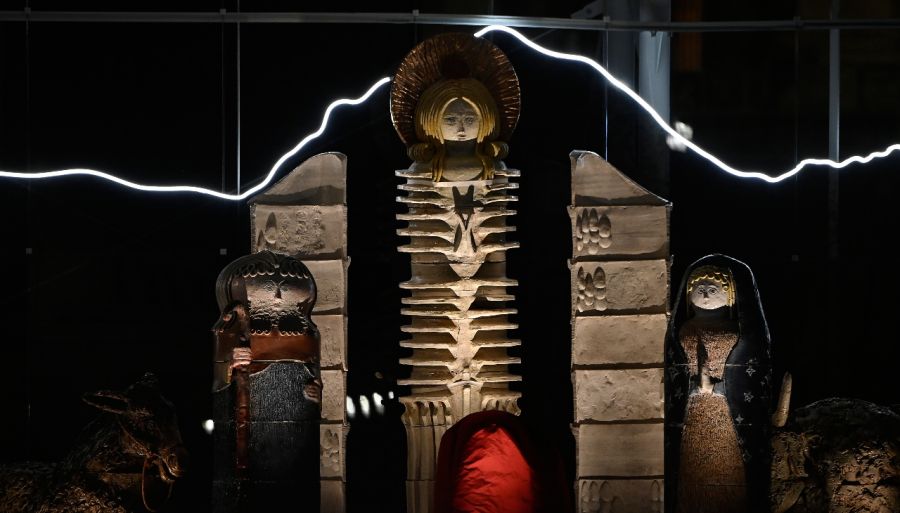
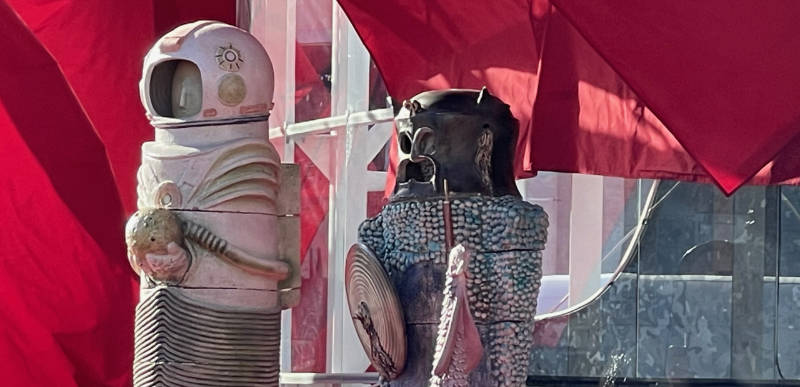
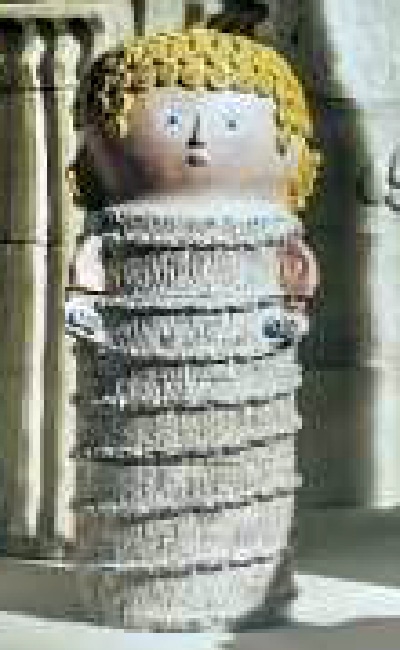
On December 11th, the Vatican unveiled its 2020 Nativity scene in St-Peter’s Square. And, once the red drape covering the scene was removed, the crowd discovered a towering, brutalist, and totem-like Angel Gabriel staring back at them, along with an astronaut and a masked executioner (yes, those guys who kill people who are sentenced to death).

Let’s say that the applause following the unveiling was “polite”. Here are some pictures of the Nativity scene.
An ominous-looking angel looks down at the crowd while Jesus remains covered in red cloth for a while (not sure why). Behind the figures is a neon light that is probably meant to look like mountains on the horizon. However, at first glance, it looks like lightning striking the Nativity scene.
An astronaut and a masked executioner are also included in the Nativity scene.

In a press release, a Vatican City Governorate announced that the manger “aims to be a sign of hope and faith for the whole world especially in this difficult time due to the COVID-19 health emergency.”

But this thing did not bring “hope and faith” at all. In fact, nearly all observers absolutely hated it.
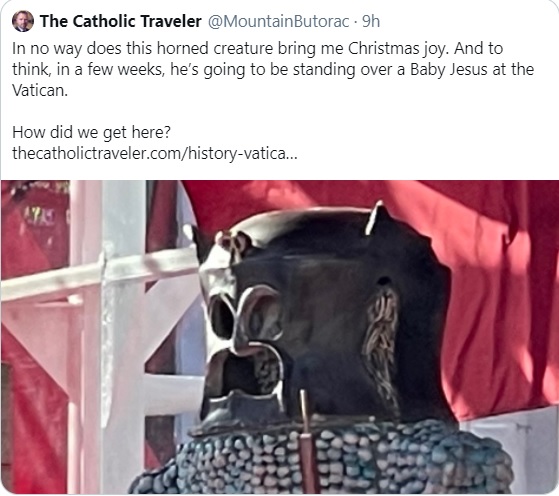
In no way does this horned creature bring me Christmas joy. And to think, in a few weeks, he's going to be standing over a Baby Jesus at the Vatican.

How did we get here?

--The Catholic Traveler

It is almost as if the Vatican created – on purpose – something that is so ugly that it causes devout Christians to hate piece depicting the birth of Jesus. Satanists wouldn’t have done better.

Weaponized Ugliness

Titled “Monumental Nativity”, this Nativity scene was originally created between 1965 and 1975 by students and teachers from the FA Grue Art School in Castelli, Italy. The original work contained over 50 pieces, but only a few were selected for the Vatican’s Nativity scene and they chose an executioner wearing a horned mask.

“Monumental Nativity” is said to be a tribute to the world-renowned ceramic works of the Abruzzo region while giving a post-modern twist to the classic Nativity scene.

Speaking with a local newspaper, Italian art historian Andrea Cionci asked if it was a “nightmare or a masterpiece”.

“Forget the sweet face of the Madonna, the tender, luminous incarnation of the Child Jesus, the paternal sweetness of St. Joseph and the devout wonder of the shepherds. For the first time in the middle of Bernini’s colonnade, the Vatican has erected a brutally postmodern work dating back to the sixties. In the choice of this crib, all the themes of Francis’ pontificate are recognized: Above all, heavy modernism and a drastic break with Tradition.

The figures resemble the masks of the ancient and ferocious Samnites, ancestors of the Abruzzese, who had a pantheistic, animist, fetishist, magical religion, a bit like the Andean fertility goddess Pachamama.

Castelli’s “Nativity scene” is an outdated work and the product of a strongly ideological art school. The work offers an image of Castelli’s ceramics that most certainly does not correspond to reality, given that this admirable art is famous for its formal elegance and exquisite, delicate decorative inspiration that are completely absent here.

The references to the Greek, Egyptian and Sumerian sculptures of the characters suggest the liberal historical-critical method of interpreting Scripture. Liberal biblical scholars have hypothesized various aspects of the Bible as adaptations of pagan cultures rather than the result of divine revelation.”

Although “ugliness” is subjective, this Nativity scene nearly goes out of its way to be as unpleasant to the eye as possible which, in turn, is unpleasant to the soul. The least one can say is that this scene is anti-devotional. I mean, who would actually pray to this thing? You just can’t. And that’s kind of the goal of the twisted minds behind this thing.

Furthermore, beyond its overall ugliness, the Nativity scene also contains many symbols and historical references that convey a rather blatant message: This is actually an anti-Nativity scene.

Anti-Nativity

Usually, the center focus of Nativity scenes is baby Jesus. However, in this thing, Baby Jesus is basically a random toddler, just standing there, looking like a giant cork.
WORSHIP ME

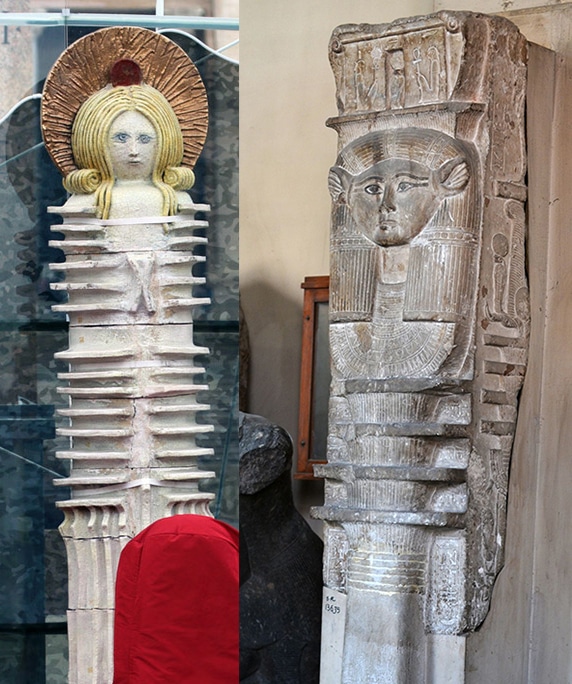
The center focus of this piece is not Jesus but rather the angel Gabriel. He is surrounded by a massive aureola while Jesus is still standing there looking like a giant cork. Furthermore, the angel towers over everything atop a rib ribbed pillar. The overall shape of this pillar is highly reminiscent of an important symbol in Ancient Egypt: The Djed pillar.
On the right: A djed pillar dedicated to the goddess Hathor.

The djed is a common symbol in Ancient Egypt and is believed to represent the god Osiris, more specifically his spine. While this symbol probably bears an esoteric meaning relating to the chakras (which are said to be based on the spine), the djed is also phallic in nature and associated with fertility rites. In fact, the “raising of the djed” was an important ceremony in Ancient Egypt.

Did the Vatican deceptively make its believers witness a “raising of the djed” ceremony? One thing is for sure, the Egyptian influence of this Nativity scene blends well with what’s immediately behind it.
Right behind the Nativity scene is St. Peter’s obelisk (which is originally from Egypt).

The general layout of the Vatican is Egyptian magic in plain sight. The phallic obelisk (representing Osiris and the male principle) faces the womb-like dome of the St. Peter’s Basilica (representing Isis and the female principle). The same exact layout can be found in various power centers of the world, including Washington DC.
In Washington DC, an obelisk (the Washington monument) faces the dome of the U.S. Capitol.

In Egyptian magic, the union of male and female principles (Osiris and Isis) produces a “star child” (Horus). In esoteric terms, that star child is potent magical energy...

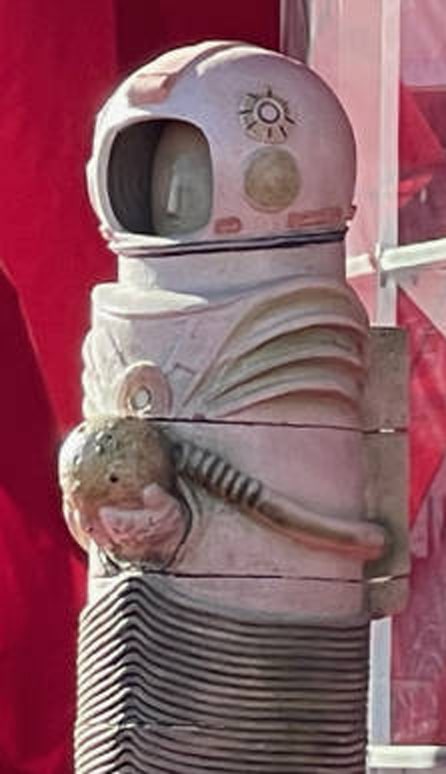
...the Vatican’s Nativity scene also features an astronaut. Why? God knows.
The astronaut appears to be holding/giving birth to something. Also, there’s an eight-pointed star on the helmet.

Considering the fact that this figure was created between 1965 and 1975, it might be a reference to the moon landing of 1969. But why, in 2020, did the Vatican select this thing to stand next to Jesus?

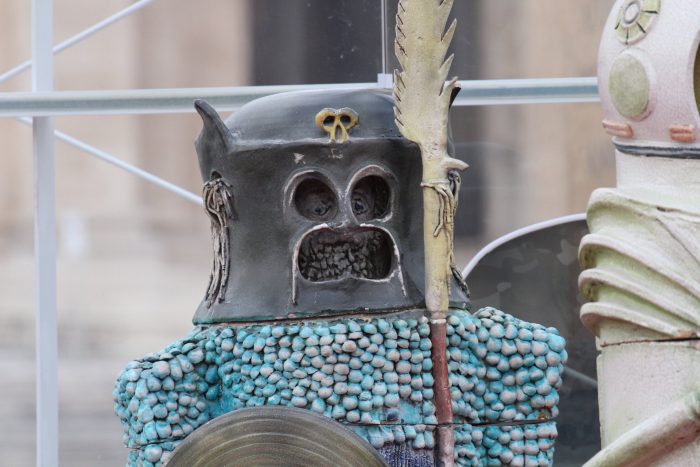
Even more baffling, why is there an executioner wearing a horned mask standing next to Jesus?
Even he’s thinking to himself: “What am I doing here?”.

In ancient times, executioners carried out the death sentences of legally condemned persons by chopping their heads off. In some cases, they wore grotesque masks with macabre and menacing traits to further terrify the prisoners while depersonalizing them as an individual. In short, that’s a bizarre figure to place next to a newborn baby Jesus, especially considering the fact that Jesus himself was ultimately sentenced to death.

According to Religion News Service, the executioner is there to represent the Vatican’s opposition to the death penalty. That’s a pretty weak argument that barely makes any sense. I mean, I’m pretty sure that the Vatican is also against crystal meth. Should they also add a meth dealer to the Nativity scene as well?

In a scene that is literally called “Nativity”, this horned figure represents death. It is the antithesis of a “Nativity”. I don’t think that Satanists would have done a better job desecrating a scene representing the birth of Jesus.

In Conclusion

In a way, this year’s Nativity scene is a sad reflection of the year 2020. It is a collection of expressionless and socially-distanced figures who do not interact with each other while standing under the neon glow of phone and computer screens.

It also reflects how the occult elite reared its ugly head this year, poisoning every aspect of our lives with its toxic agenda. Through a display that is thoroughly anti-Christian, the elite sought to prove that its toxic ideology is also embedded in the Vatican.

While “Monumental Nativity” was created decades ago, it was selected for this year’s 2020 Nativity scene for a specific reason: It contains specific symbols while conveying a specific energy. Like everything else that happened this year, this scene is about showcasing the control of the elite and the demoralization of the masses.

Friday, 15 November 2019

Reports of witchcraft child abuse in England have risen by one-third in the last two years

As you read the following article, you must, of course keep repeating the mantra, "Diversity is strength." As reported by Gabriella Swerling of the London Daily Telegraph, November 14, 2019:

Witchcraft child abuse cases have risen by a third in two years, as experts blame “cultural sensitivity” and “political correctness” as barriers to protecting children.

Abuse of children based on faith or belief – which includes witchcraft, spirit possession and black magic – increased from 1,460 to 1,950 cases between 2016/17 and 2018/19.

This marks an increase of 34 per cent, with councils dealing with the equivalent of 38 such cases a week.

The figures, published today by the Local Government Association (LGA) also show that the number of children identified by councils through a social work assessment as either having or being at risk of Female Genital Mutilation (FGM) has reached a record high – with 1,000 such cases in 2018/19, up 6 per cent on the 940 cases in the previous year.

This comes after a trial at the Old Bailey earlier this year which saw a woman who mutilated her three-year-old daughter become the first person in the UK to be found guilty of FGM.

Responding to the figures, Nimco Ali OBE, co-founder and CEO of The Five Foundation, the global partnership to end FGM said: “this is so depressing”.

She added that while there is increasing awareness in reporting the issue, there is also a cultural sensitivity, political correctness and fear of being accused of racism when it comes to authorities confronting the issues of witchcraft and FGM which occur predominantly among West African communites which have increasingly high birth rates.

“I’m so angered by these figures,” she said. “For so long the political power that black people have has been dismissed… People are scared to tackle FGM and witchcraft as they’re scared of being accused of racism - but it’s racist to ignore it.

“It’s more racist to look away… It really hurts that we still have to tell people that black kids need protecting.”

The National FGM Centre, a joint initiative between the LGA and Barnardo’s, says both sets of figures are hugely worrying, of significant national concern and probably don’t reflect the true prevalence of this “hidden” crime.

The LGA said that council social workers have become better at identifying cases, and that the work of the National FGM Centre – which provides services for children and their families affected by FGM and abuse linked to faith or belief - is vital.

Lisa Oakley, Chair of the National Working Group for child abuse linked to faith or belief/ Associate Professor University of Chester, said that the LGA figures were “concerning” and added that they may be “under-estimations”.

“The figures do demonstrate the need for more effective education, awareness, prevention, intervention and response,” she said.

“To develop these in the area of child abuse linked to faith and belief requires significant financial investment , which is not currently in place.”

The mother of a three-year-old girl has become the first person to be convicted of FGM in the UK, following a failed bid to "shut up" her accusers with witchcraft.

The Ugandan woman, 37, and her Ghanaian partner, 43, both from Walthamstow, east London, were accused of cutting their daughter over the 2017 summer bank holiday.

Forty limes and other fruit were found with pieces of paper with names written on them stuffed inside, including those of police officers and a social worker involved in the investigation.

The spells and curses intended to deter police and social workers from investigating were found at the Ugandan woman's home, the trial heard. Police also found two cow tongues bound in wire with nails and a small blunt knife embedded in them when searching the Ugandan woman’s home.

There was also a jar with a picture of a social worker in pepper found hidden behind the toilet in the bathroom.

Leethen Bartholomew, Head of the National FGM Centre, said: “There are many reasons why a child might be accused of witchcraft or that they are possessed by an evil spirit. When people are experiencing "misfortunes" such as poverty, ill physical health or have mental health needs a child could be blamed for this.

“There are a number of factors as to why local authorities are discovering more cases. The National FGM Centre is providing more training for Local Authorities and communities in England which has lead to an increased awareness around the issue, enabling professionals and communities to better identify cases.”

The LGA said the next government needs to ensure councils have the funding needed to continue to take effective action to keep children safe from harm and abuse.

Wednesday, 18 September 2019

Rabbi in Toledo presents lecture on "Jewish Mindfulness"

Mindfulness is a practice rooted in Buddhism that's being increasingly promoted in Western society. As Ray Yungen stated,

mindfulness involves focusing on the breath to stop the normal flow of thought. In effect, it acts the same way as a mantra; and as with Yoga, it is presented as something to cure society’s ills.

As reported by the Toledo Blade, September 13, 2019 (link in original):

Rabbi Laibl Wolf presents “Jewish Mindfulness and Meditation: Techniques to De-Stress a Stressful Life” via live webcast at Chabad House of Greater Toledo on Wednesday. Rabbi Wolf “has spent more than 30 years studying and serving as a spiritual mentor of the mystical side of Judaism,” and is expected to explore mindfulness in a Jewish context. He draws his teachings from the Kabbalah, which is described as “the source for much of the ‘new age’ wisdom that we are familiar with today.”

Rabbi Wolf speaks at Chabad House, 2728 King Rd., at 7 p.m. Wednesday. There is no cost to attend. To register, $12, go to chabadtoledo.com or call 419-843-9393.


Go to Lighthouse Trails Research Project and search under "mindfulness" for more information.

See also my post United Church of Canada-affiliated St. Stephen's College offers courses in Wicca, mindfulness, and Jungian psychology (April 3, 2017)


Sunday, 23 June 2019

Presbyterian community service centre church in Philadelphia offers eight-week sermon series on Harry Potter

As the old saying goes, what you win people with is what you win them to; put another way, what wins them is what keeps them. If a church attracts people with worldly entertainment, that's what they're being won to, and what will keep them coming back. It's apparent that the lead goatherd of the community service centre church mentioned in the following article doesn't trust in the power of the gospel and the sufficiency of the Bible to bring people to church.

The church mentioned in the following article claims to be in the Reformed tradition, but their commitment to Biblical truth doesn't seem to be to the extent of offending non-Christians. A glance at their events page reveals a schedule that looks more like that of a community service centre than a Christian church (and yes, it includes yoga). As reported by Stephanie Farr of the Philadelphia Inquirer, June 17, 2019 (links in original):

The large banner on the lawn of Leverington Church in Roxborough has been raising eyebrows as if it were a Wingardium Leviosa spell.

"If I read 'Harry Potter meets Jesus,' I'd probably think it was cheesy, too," Pastor Langdon Palmer said. "But I didn't know how else to put it."

Palmer's unconventional eight-week sermon series at the Presbyterian church, which started May 12, has raised something else, as well: attendance. He said weekly attendance has risen 10% to 20%.

"People are literally saying, 'I came because of Harry Potter,' " he said. "It's a little bit of pressure because hard-core Harry Potter fans know everything."

Palmer, who has been pastor at Leverington Church for five years, almost didn't do the series. He was afraid religious people who are skeptical of Harry Potter would think he was trivializing the Gospel. And he was worried that Harry Potter fans who are skeptical of the Bible would believe he was distorting the books to fit his own ends.

But as a man who loves both and as a pastor who sees a generation of people more familiar with the stories of Harry Potter than those in the Bible, he decided to go for it.

"I think if we're going to be good teachers, we start with what people are familiar with to teach them about what they're not familiar with," said Palmer, 60.

In his sermons, which are available as podcasts on the church's website, Palmer uses audio and visual clips from the "Harry Potter" films to illustrate his points. He equates the unexpected and mysterious letters Harry receives to join Hogwarts School of Witchcraft and Wizardry to unexpected and mysterious messages people might be receiving from God.

And he likens the relationship between Harry and Professor Albus Dumbledore, the wise but often inscrutable head wizard at Hogwarts, to his own relationship with God.

"It's so parallel," he said. "God is so good and so kind, but there are times he seems arbitrary, where he leaves, where he doesn't explain himself – just like Dumbledore."

Palmer said he's encountered "both Christians and Harry Potter fans who are definitely not happy that I'm doing this," but on the whole, the reaction has been positive.

Despite his passion today, Palmer hasn't always been a fan – of Harry Potter or of God. For much of his adult life, Palmer was an electrical engineer and a self-proclaimed atheist, though looking back now he thinks he was probably "more of a hard-core agnostic, calling myself an atheist to be cool."

"I'm a born skeptic, and I've had many conversations with God about this: 'Why would you have me be a pastor? I question everything all the time,' " Palmer said. "I came to the conclusion that if this is the way that God wired me, maybe I could relate to other people who struggle with doubt."

As for Harry Potter, Palmer had heard the stories of religious leaders who denounced – and in some cases, even burned – the books because they believe the series promotes the occult and satanism.

"When it first came out, I was not impressed. I was not a fan," he said. "I assumed it was kid stories or promoting dark magic and stuff."

But when Palmer read the books with his children at their urging, he found they offered opportunities to talk with his kids about right and wrong and good and evil.

"I went from someone who was very skeptical to thinking it's really a significant piece of literature," he said.

Harry Potter isn't the only pop-culture touchstone that Palmer has invoked in his sermons. He once did a series on the science-fiction movie "The Fifth Element," and you'll hear him referencing Comic Book Guy from "The Simpsons," "Star Trek," "The Lord of the Rings," and "The Matrix" in his sermons.

He even dreams of doing a sermon series on "Nacho Libre," the Jack Black movie about a monk who follows his dream to become a Mexican wrestler.

For those who question why he mixes pop culture and religion, Palmer pointed out that even Jesus used cultural artifacts and current events to explain ideas.

"I think it can really help the church, but if you try to be hip, if you're trying to be relevant to the kids, it's all over. People can smell fake right away," Palmer said. "But if there's something that moves a pastor deeply in culture, he or she should be free to use that."

Saturday, 18 May 2019

100 years ago: The death of Austrian occultist Guido von List

On May 17, 1919, Austrian journalist and occultist Guido von List died at the age of 70. Mr. List was born into a Roman Catholic family in Vienna, but early in life he developed an interest in pre-Christian paganism. He began his journalistic career in 1877, and used his writings to promote Wotanism, a pan-Germanic völkisch movement worshipping pre-Christian pagan deities. He was influenced by the Theosophical Society and became increasingly interested in occultism, including the study of Runic alphabets.

Mr. List eventually promoted a belief that the modern world was degenerate, and claimed to have received a vision in 1917 that victory of the Central Powers over the Allies in World War I would be the apocalyptic cleansing event that would usher in a new Pan-German Empire based on Wotanism. Mr. List's alleged vision was proved erroneous by the November 1918 armistice and subsequent events. His health declined, exacerbated by food shortages resulting from the non-fulfillment of his vision. Mr. List died while on a visit to Berlin.

Guido von List achieved enough popularity in his own time to inspire the creation of societies promoting his ideas, the first of which was founded in 1908. His ideas influenced the creation of the Thule Society, occultist predecessor to the Nazi Party. While Mr. List's name is largely unknown today, his influence remains, and writers such as historian Joscelyn Godwin have noticed the similarities between the ideas promoted by Guido von List and the beliefs of New Agers and Green Party supporters today. For an example of a pro-Nazi organization that promotes ancient European paganism and is critical of Christianity, see the website of National Vanguard.


Friday, 28 December 2018

Supernatural oddities reportedly accompany interrogation of celebrity medium accused of sexually abusing 300 women

Whatever supernatural powers this man possesses don't come from God; as reported by Janet Tappin Coelho of the London Daily Mail, December 19, 2018:

Detectives questioning a celebrity medium in Brazil, accused of sexually abusing more than 300 women, have reported spooky goings-on during their two hour interrogation.

Unexplained incidents ranging from a 'bizarre' computer crash to wiring on electrical appliances suddenly 'short circuiting' appears to suggest supernatural forces were at play during the interview.

The mysterious problems unnerved cops but didn't deter them from collecting the testimony from faith healer, João Teixeira de Faria, who is known as João de Deus – John of God on Sunday night in Goiânia.

Joao Teixeira de Faria, better known as John of God, arrives at the Dom Inacio Loyola House in Abadiania, Brazil on Wednesday last week

Detective Karla Fernandes, responsible for coordinating the task force investigating the allegations, claimed that as the spiritual guru began to speak, strange things started to happen.

She said to Folha de Sao Paulo: 'Suddenly the computer that was being used to transcribe the suspect's answers to the allegations seemed to have a life of its own and the commands on the keyboard wouldn't work.

'When the clerk tried to enter the medium's statement, the keys locked on a specific letter and 'OOOOOOO' was recorded continuously on the screen for a few seconds.'

Although this has never happened before, bemused agents put the incident down to a faulty computer.

But when the printer in the room began to print without receiving a command and a fridge blew up, their thoughts turned to paranormal interference.

Det Fernandes said: 'It was hot in the interrogation room and I decided to turn on the air conditioning.

'I plugged the lead into an extension shared with a mini-fridge and the electrical wiring suddenly exploded, burning out the fridge. Everyone in the room screamed with fright.'

According to the officer, the 76-year-old spiritual healer, who is accused of sexually molesting women during private consultations at his clinic, stayed silent.

She said: 'Although these things happened and surprised us, they failed to interfere with our work. He (John of God) didn't say a word.'

Twelve women have accused Brazilian spiritual healer Joao Teixeira de Faria, 76, of sexually abusing them while he treated them at his clinic Casa de Dom Inacio de Loyola in Abadiania

Court documents show that Teixeira tried to withdraw nearly $9 million before surrendering to police on Sunday. The documents seen by The Associated Press are part of a judge's ruling rejecting bail.

Fagner Pinho of the prosecutor's office also said Wednesday that investigators found firearms and large quantities of cash in a house used by Teixeira as a spiritual retreat.

Investigators also believe that two unexplained incidents which occurred prior to Teixeira giving himself up, could be linked to the occult.

A police clerk, who was meant to transcribe the faith healer's testimony at the police station in the rural town of Annapolis, was run over in a car accident and broke his arm.

Investigators originally intended to question the suspect at this small outpost. But the unexpected incident meant the interview had to be transferred to Goiânia, the capital of the state of Goiás.

And last Friday as the press staked out John of God's house in the city of Abadiânia, rumours began to circulate that 'spirits' had cursed the reporters, photographers and TV camera crew who had camped for nearly 24 hours waiting for the psychic healer to surrender after a warrant was issued for his arrest.

Thousands gather at his clinic daily for the chance to be healed by Faria, who is said to have supernatural powers

Hardened professionals admitted they started praying when a news agency photographer in the press pack suddenly fell ill and lost consciousness for a few minutes.

Many who were reluctant to admit the 'episode' was associated with John of God's 'mystic powers', did concede that a paranormal association wasn't so 'far-fetched'.

Det Fernandes agreed the unexplained happenings cannot be 'flippantly' dismissed.

'I accept that we are dealing with a situation that involves beliefs and mystic energies,' she said adding she believes John of God has supernatural powers.

'I'm spiritualist and a believer in the spirit world and the paranormal. Although I'm not afraid, I do have a healthy respect for the unknown.'

Faria's followers wait for their turn to be attended, at his 'healing center' Casa de Dom Inacio de Loyola, in Abadiania, 120 km southwest of Brasilia

Teixeira has denied allegations that he sexually violated hundreds of women, including his own daughter, under the pretence of administering mystical treatments.

His lawyer claimed his client is being 'persecuted' and the complaints made by hundreds of women, with the number now topping some 500, are coming from 'people who want to destroy him.'

Many people also say they were underage at the time of the abuse.

The mystic has been detained in custody and on Monday as agents started the search of the faith healer's premises, a court denied an appeal for bail.

The bombshell allegations have sent shock waves across the world.

John of God became famous for performing 'miracle surgeries' on hundreds of thousands of people from all over the globe. He has been practising since 1976 and is revered as a 'powerful' spiritual force. He has been interviewed by Oprah and has treated Bill Clinton.

Many followers have allegedly been cured of cancers, disabilities, psychological illnesses and numerous other ailments while attending his alternative treatment clinic in central west Brazil.

Wednesday, 21 November 2018

Ontario psychic charged with pretending to practice witchcraft

Thou shalt not suffer a witch to live. Exodus 22:18

365 Every one who fraudulently

(a) pretends to exercise or to use any kind of witchcraft, sorcery, enchantment or conjuration,

(b) undertakes, for a consideration, to tell fortunes, or

(c) pretends from his skill in or knowledge of an occult or crafty science to discover where or in what manner anything that is supposed to have been stolen or lost may be found,

is guilty of an offence punishable on summary conviction.

R.S., c. C-34, s. 323.
Criminal Code of Canada (bold in original)

The law is about to be changed, but while it's still in force, it strikes this blogger as amusing that pretending to practice the things mentioned above is a crime, but actually practicing them isn't. As reported by Nick Faris of the National Post, October 22, 2018 (link in original):

An Ontario psychic has been charged with pretending to practice witchcraft for allegedly bilking upwards of 20 clients out of more than $100,000 in cash and jewellery, a score police say she achieved by telling highly vulnerable customers she needed to “cleanse” their property of “evil spirits” in order to cure their ailments.

Police in Milton, Ont., arrested 32-year-old Dorie Stevenson last week on charges of extortion, fraud exceeding $5,000 and pretending to tell fortunes for a fraudulent purpose, an antiquated crime that could soon be removed from Canada’s Criminal Code by legislation Justin Trudeau’s Liberal government introduced last year.

The Halton Regional Police Service launched an investigation into Stevenson, the proprietor of Milton Psychic, in May on the word of one victim who alleged she’d swindled them out of more than $60,000. The number of professed victims is now greater than 20, Det. Const. Sarah McCullagh said Monday, adding that Stevenson, who uses the pseudonym Madeena, is believed to have taken these patrons for sums as large as $85,000.

“She’d be preying on their embarrassment to not come forward to the police, because people were too embarrassed that they’d given that amount of money to someone,” McCullagh said.

Police believe Stevenson tended to target desperate clients who approached her in a state of severe vulnerability. Some were ill or in debt, McCullagh said; others were lamenting the end of a romantic relationship. McCullagh alleged that Stevenson extorted these people by warning “bad things will happen to them or their family members” if they didn’t lend her money or jewellery she claimed she could bless for them.

McCullagh said Stevenson’s alleged victims agreed to these transactions on the understanding she’d return their property once the bill or ornament they’d handed over had been purified. Customers allege Stevenson fostered their trust by giving back small portions of their money, only to stop answering phone calls as soon as they began to ask for the full amount.

Stevenson didn’t respond to phone and email messages on Monday. Police released her from custody shortly after she was arrested last Thursday and she’s expected to make her first court appearance in November.

Milton Psychic is registered as a business in Ontario in Stevenson’s name, according to McCullagh, and police believe she has worked there since 2013. Milton Psychic’s website describes Madeena as a “superior reader, healer and advisor of all psychics” and advertises a range of services that include palm, crystal ball, tarot card and rune stone reading, in addition to intangible exercises such as evaluations of a client’s aura, energy or past life. Customers can pay $75 for one reading or $130 for two.

“I am aware that you could have had false hopes and promises made to you that has (sic) led you into a deeper path of confusion,” an introductory note on the website reads. “Once you have experienced a reading with me, you will know that you have found and experienced the truest gift and guidance you have been searching for.”

Stevenson’s arrest could mark one of the very last times a Canadian is arrested for the deceitful practice of witchcraft. Bill C-51 — legislation that would, among other amendments to outdated sections of the Criminal Code, repeal a ban on fraudulently pretending to practice different forms of witchcraft — is currently in its third reading before the Senate, signifying that it is on the verge of becoming law.

McCullagh said Halton police considered not pressing the witchcraft charge on this basis, but opted to proceed because Bill C-51 has yet to be enacted. She said that the force doesn’t want Stevenson’s arrest to be viewed as a condemnation of the pagan or Wiccan religions, but merely of the fraud they say Stevenson executed.

“It’s not illegal to tell someone’s fortune. It’s not illegal to go to a psychic,” McCullagh said. “But when somebody is using this in order to commit a fraud, that is the criminal offence.”

McCullagh said the majority of alleged victims police have heard from came forward in the days after Stevenson’s arrest, and they’re hoping more will get in touch with their stories. In the meantime, the force is urging people seeking to get their fortune told to only visit psychics who are “reputable,” and to stay away entirely if they might be emotionally or financially susceptible to a possible scam.

“Also, if you are told there is a curse on you, don’t believe them,” McCullagh said. “Go there for entertainment purposes only. Do not take everything they say to heart.”
December 28, 2018 update: Another woman in Ontario has been charged with the same offense, as reported by Kathleen Harris of CBC News, December 19, 2018 (links in original):

A northern Ontario woman was charged with fake witchcraft just two days before the archaic offence was removed from the Criminal Code.

Timmins police charged 33-year-old Tiffany Butch on Dec. 11, accusing her of demanding money in return for lifting a curse. Two days later, Section 365 of the Criminal Code — which prohibits "pretending to practise witchcraft" — was formally repealed.

It's likely that Butch, who goes by the nickname "White Witch of the North," will be the last person in Canada to be charged, and potentially tried, for the offence.

Marc Depatie, a spokesperson for the Timmins force, said police and prosecutors work with the laws that are on the books at the time of the alleged offence, pointing to historical sexual offences as an example.

"That's why police and the Crown attorneys keep ancient, or aged, versions of the Criminal Code on hand, to see what laws apply," he said.

Depatie said the fact that the offence was about to be scrubbed from the Criminal Code was not a factor in the decision to lay the charge. Elements of the case were "best captured" by that section of the Criminal Code in consultation with the local Crown attorney's office, he said.

"(In) this particular set of circumstances, the person gave them a sense of foreboding that a dreadful thing was about to happen to their family at some point ... (that) they should provide them with financial compensation so they could perform some sort of mystical service that would prevent that from happening," Depatie said.

Section 365 was removed under Bill C-51, which received Royal Assent on Dec. 13. It wiped out so-called "zombie" offences that are considered obsolete or redundant, or have been found to be unconstitutional — things like challenging someone to a duel, distributing crime comics, issuing trade stamps and publishing 'blasphemous' libel.

Butch denies the allegations and said she believes she was framed by other psychics.

"People proclaimed me a witch here and gave me a nickname, but I'm not a witch. I'm a psychic," she said in a telephone interview.

Butch said she adopted the "White Witch of the North" nickname because she thought it was "cute," but insists she has never pretended to be a witch or illicitly demanded money.

"Absolutely not. I don't know who this person even is, and none of my customers from October to now have put in any complaints with me or asked me for refunds back," she said.

Butch plans to get a lawyer to fight the charge and is scheduled to appear in court on Jan. 22.

Timmins police issued a release Monday stating that the accused maintains an alias and "holds herself to be a self-proclaimed spiritualist, medium and clairvoyant." The department also reminded people to be wary of "extravagant claims of impending danger" made by anyone who claims to have "clairvoyant or mystical powers."

In October, police charged a Milton, Ont. woman with fraud, extortion and pretending to practice witchcraft, alleging the fortune-teller had scammed vulnerable people out of tens of thousands of dollars.

Stephen Coughlan, a professor at the Schulich School of Law at Dalhousie University, said Bill C-51 was a useful but modest step in cleaning the Criminal Code of outdated offences such as the one related to witchcraft. In addition to removing some obsolete offences, it also takes out a number of "reverse onus" provisions that required an accused to prove their innocence on particular points.

But Coughlan said several provisions which have been declared unconstitutional by the Supreme Court — in some cases twenty-five or thirty years ago — remain on the books.

A bill is now before the Senate to remove more zombie laws, but Coughlan called its targets "low hanging fruit" that make up a small portion of what needs to be fixed.

"Even when they are done, the code will remain riddled with inconsistencies and overlap, and will still fail to provide guidance on such crucial things as the mental states required before behaviour can be called a crime," he said in an email. "No amount of tinkering can accomplish the fundamental changes that are needed."

The Criminal Code was created in 1892 to outline offences, penalties and procedures. It has had only one major overhaul in the 1950s and another review in the 1970s...

Sunday, 14 October 2018

Witches in Brooklyn plan to hex U.S. Supreme Court Justice Brett Kavanaugh

Thou shalt not suffer a witch to live. Exodus 22:18

Having had such notable success in hexing U.S. President Donald Trump, witches are now fixing their evil eyes upon his latest Supreme Court appointee. I'm glad they're identifying as Social Justice Warriors, and increasingly making it clear which side they're on. Look at the causes these witches are supporting, and it leaves no doubt in the mind of this blogger that their movement and the causes they support come from the pit of Hell. As reported by Adam Eliyahu Berkowitz of Breaking Israel News, October 14, 2018 (links in original):

In what is becoming a regular political expression of the left-wing, an occult bookstore in Brooklyn is organizing a gathering to hex newly appointed Supreme Court Justice Brett Kavanaugh.

The Facebook announcement read:

“Please join us for a public hex on Brett Kavanaugh, upon all rapists and the patriarchy at large which emboldens, rewards and protects them. We are embracing witchcraft’s true roots as the magik (sic) of the poor, the downtrodden and disenfranchised and its history as often the only weapon, the only means of exacting justice available to those of us who have been wronged by men just like him.

He will be the focal point, but by no means, the only target, so bring your rage and all of the axes you’ve got to grind. There will also be a second ritual afterward – ‘The Rites of the Scorned One’ which seeks to validate, affirm, uphold and support those of us who have been wronged and who refuse to be silent any longer.”

The event was organized by Dakota Bracciale, who sees witchcraft as a social justice movement for the “oppressed, downtrodden and marginalized,” a means of “exacting justice that would otherwise be denied to you.”

“Witchcraft has been used throughout history as a tool and ally for people on the fringes of society who will not ever really get justice through the powers that be,” Bracciale told Huffington Post. “So they have to exact their own justice.”

The event will have photographs of the people being targeted, an effigy of Kavanaugh, graveyard dirt and coffin nails. The venue, with a maximum capacity of 60, is already sold out but the Huffington Post reported that more than one thousand people are planning on attending. Catland is planning on live streaming the event along with instructions for those who wish to hex at home.

This is not the first political hexing for Bracciale. Last year, she organized three similar events to hex President Donald Trump. Such gatherings began to crop up shortly after President Trump’s inauguration. The first was held directly outside Trump Tower in Manhattan one month after the inauguration and was followed by several others. This strange phenomenon was predicted by famed Israeli mystic, Rabbi Nir Ben Artzi, who, shortly before Trump took office, predicted a rise in black magic.

“[God] rules the world, and not the powers of impurity. Idol worshippers look to the stars and tell fortunes in tea cups, using tarot cards, and other methods. They believe these things rule the future,” the rabbi said in a sermon in October 2017.

Tickets for the event at Catland are $10 and half of the proceeds from the event will be donated to Planned Parenthood and the Ali Forney Center, a New York City shelter for homeless LGBTQ youth.

Catland, located in the Bushwick section of Brooklyn, touts itself as more than a simple occult bookstore, hosting lectures on Feminist Goddesses and Rebel Saints, Demonology 101, Basic Witchcraft, Potions and TInctures and Yoga for Witches. They offer a lending library under the heading of “Join our Coven.”

Tuesday, 7 August 2018

60 years ago: Witchcraft ritual murders continue in Africa

There shall not be found among you any one that maketh his son or his daughter to pass through the fire, or that useth divination, or an observer of times, or an enchanter, or a witch.
Or a charmer, or a consulter with familiar spirits, or a wizard, or a necromancer.
For all that do these things are an abomination unto the Lord: and because of these abominations the Lord thy God doth drive them out from before thee.
Deuteronomy 18:10-12

Witch doctors wouldn't proliferate unless people believed that they were deriving physical and/or spiritual benefits from them. The negative consequences, however, outweigh whatever benefits may result. As C.S. Lewis said, "The Devil will be happy to cure your chilblains if in return he can be permitted to give you cancer."

The article below was published on page 20 of The Edmonton Journal on August 7, 1958. Directly adjoining it was an article by John Barbour of Associated Press about U.S. plans to shoot a rocket to the Moon (in 1958, such an event was still in the future). It's unacceptable, according to modern standards of political correctness and multiculturalism, to say that a culture that produced Moon rockets was superior to a culture that produced witch doctors. Instead, the former must now import large numbers of the latter, because "diversity is our strength," with the various cultures regarded as being of equal merit. Basutoland is now known as Lesotho.

As reported by J.K. Chilwell of North American Newspaper Alliance (bold in original):

Johannesburg--A member of the Nigerian parliament, Vincent Awgu Nwankwo, has been charged with 111 ritual and other murders.

In Basutoland, at the other end of Africa, 22 natives recently were hanged for medicine murders.

In South Africa, portly, middle-aged Khotso Sethuntsa went to town with a suitcase of money and paid £2,400 in £10 and £100 notes for a 1958 car. Mr. Sethuntsa is a leading medicine man of the Transkei tribe--who may or may not use bits of human beings in his "cures."

Witchcraft--which has its devotees among plenty of white men in the black continent--has defied the "civilizers." Much of it is harmless.

The ritual murder side is not.

WITCH DOCTOR UNIVERSITY

In Johannesburg, the witch doctors have formed their own "university" to prevent charlatans, as they term them, from entering the honorable profession of the dingakas.

It is even possible for modern medicine to learn some lessons from this "University." The dingakas know the ages-old herbal remedies for various African complaints. There are scientific reasons why some of them work.

The theory has even been put forward that the presence of a witch doctor can aid his 20th-century brother, the medical practitioner. For a witch doctor can put an ignorant patient in a receptive psychological mood to make the best of a modern cure.

LEADS TO MURDER

Witch-doctorism, however, leads to murder.

Natives hold a strong belief in the medicine of witch doctors. Medicine from a lion's flesh is regarded as strong. The most powerful of all, however, is made from human flesh.

To obtain this flesh, a murder must be committed. The victim of an accident or of a disease is not suitable, say the medicine men.

Ritual murder is always planned, and the murder always is committed by more than one person.

The witch doctors arrange for the remains to be found and for it to appear as if death was accidental.

How to stamp out ritual murder is a matter engaging the attention of all governments from Ghana to South Africa, from Liberia to Abyssinia. The terrible practice brings death to hundreds of Africans every year.

It will be a long battle, as it is mainly one of education.

It took Europe and America long years to eradicate beliefs in black magic, and in vampires, wolfmen and other bogeymen. Such beliefs--and worse--still seize the minds of millions of Africans.