Showing posts with label Blasphemy. Show all posts

Thursday, 24 December 2020

Vatican's 2020 nativity scene displays occult symbols

To quote renowned cultural observer James Stolee out of context: "What utter blasphemy!" As reported by Vigilant Citizen, December 15, 2020 (bold, links in original):

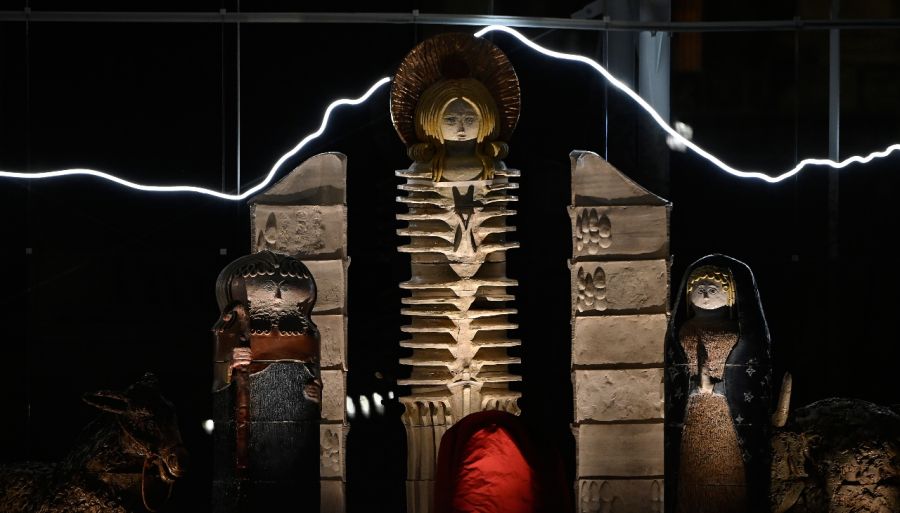
On December 11th, the Vatican unveiled its 2020 Nativity scene in St-Peter’s Square. And, once the red drape covering the scene was removed, the crowd discovered a towering, brutalist, and totem-like Angel Gabriel staring back at them, along with an astronaut and a masked executioner (yes, those guys who kill people who are sentenced to death).

Let’s say that the applause following the unveiling was “polite”. Here are some pictures of the Nativity scene.
An ominous-looking angel looks down at the crowd while Jesus remains covered in red cloth for a while (not sure why). Behind the figures is a neon light that is probably meant to look like mountains on the horizon. However, at first glance, it looks like lightning striking the Nativity scene.
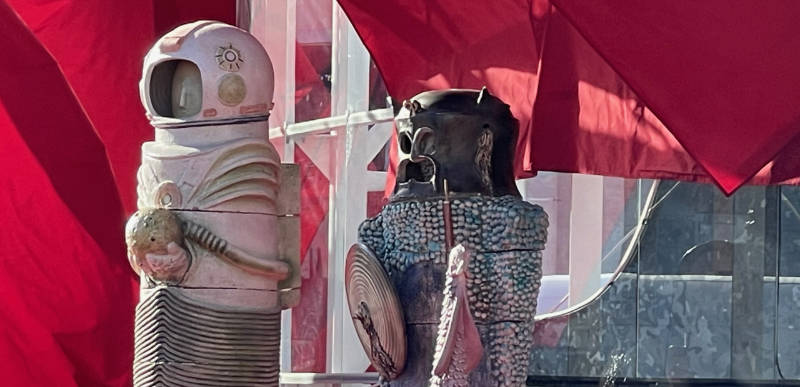
An astronaut and a masked executioner are also included in the Nativity scene.

In a press release, a Vatican City Governorate announced that the manger “aims to be a sign of hope and faith for the whole world especially in this difficult time due to the COVID-19 health emergency.”

But this thing did not bring “hope and faith” at all. In fact, nearly all observers absolutely hated it.
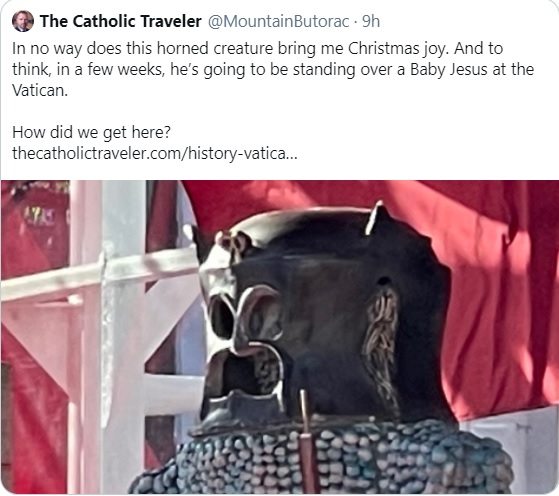
In no way does this horned creature bring me Christmas joy. And to think, in a few weeks, he's going to be standing over a Baby Jesus at the Vatican.

How did we get here?

--The Catholic Traveler

It is almost as if the Vatican created – on purpose – something that is so ugly that it causes devout Christians to hate piece depicting the birth of Jesus. Satanists wouldn’t have done better.

Weaponized Ugliness

Titled “Monumental Nativity”, this Nativity scene was originally created between 1965 and 1975 by students and teachers from the FA Grue Art School in Castelli, Italy. The original work contained over 50 pieces, but only a few were selected for the Vatican’s Nativity scene and they chose an executioner wearing a horned mask.

“Monumental Nativity” is said to be a tribute to the world-renowned ceramic works of the Abruzzo region while giving a post-modern twist to the classic Nativity scene.

Speaking with a local newspaper, Italian art historian Andrea Cionci asked if it was a “nightmare or a masterpiece”.

“Forget the sweet face of the Madonna, the tender, luminous incarnation of the Child Jesus, the paternal sweetness of St. Joseph and the devout wonder of the shepherds. For the first time in the middle of Bernini’s colonnade, the Vatican has erected a brutally postmodern work dating back to the sixties. In the choice of this crib, all the themes of Francis’ pontificate are recognized: Above all, heavy modernism and a drastic break with Tradition.

The figures resemble the masks of the ancient and ferocious Samnites, ancestors of the Abruzzese, who had a pantheistic, animist, fetishist, magical religion, a bit like the Andean fertility goddess Pachamama.

Castelli’s “Nativity scene” is an outdated work and the product of a strongly ideological art school. The work offers an image of Castelli’s ceramics that most certainly does not correspond to reality, given that this admirable art is famous for its formal elegance and exquisite, delicate decorative inspiration that are completely absent here.

The references to the Greek, Egyptian and Sumerian sculptures of the characters suggest the liberal historical-critical method of interpreting Scripture. Liberal biblical scholars have hypothesized various aspects of the Bible as adaptations of pagan cultures rather than the result of divine revelation.”

Although “ugliness” is subjective, this Nativity scene nearly goes out of its way to be as unpleasant to the eye as possible which, in turn, is unpleasant to the soul. The least one can say is that this scene is anti-devotional. I mean, who would actually pray to this thing? You just can’t. And that’s kind of the goal of the twisted minds behind this thing.

Furthermore, beyond its overall ugliness, the Nativity scene also contains many symbols and historical references that convey a rather blatant message: This is actually an anti-Nativity scene.

Anti-Nativity

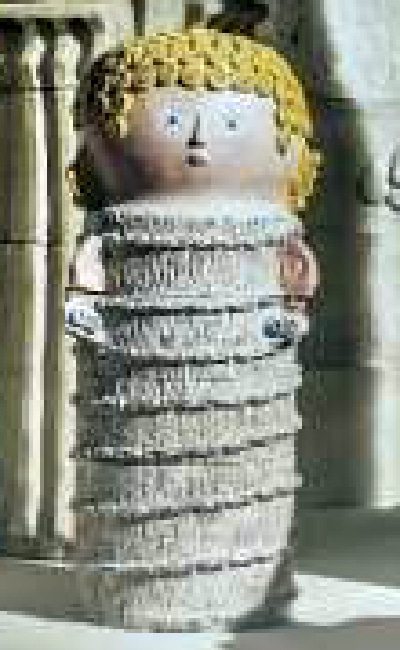
Usually, the center focus of Nativity scenes is baby Jesus. However, in this thing, Baby Jesus is basically a random toddler, just standing there, looking like a giant cork.
WORSHIP ME

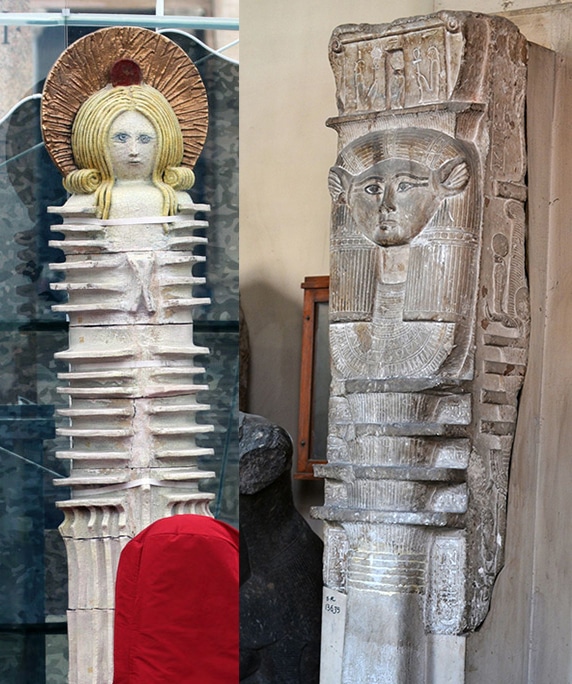
The center focus of this piece is not Jesus but rather the angel Gabriel. He is surrounded by a massive aureola while Jesus is still standing there looking like a giant cork. Furthermore, the angel towers over everything atop a rib ribbed pillar. The overall shape of this pillar is highly reminiscent of an important symbol in Ancient Egypt: The Djed pillar.
On the right: A djed pillar dedicated to the goddess Hathor.

The djed is a common symbol in Ancient Egypt and is believed to represent the god Osiris, more specifically his spine. While this symbol probably bears an esoteric meaning relating to the chakras (which are said to be based on the spine), the djed is also phallic in nature and associated with fertility rites. In fact, the “raising of the djed” was an important ceremony in Ancient Egypt.

Did the Vatican deceptively make its believers witness a “raising of the djed” ceremony? One thing is for sure, the Egyptian influence of this Nativity scene blends well with what’s immediately behind it.
Right behind the Nativity scene is St. Peter’s obelisk (which is originally from Egypt).

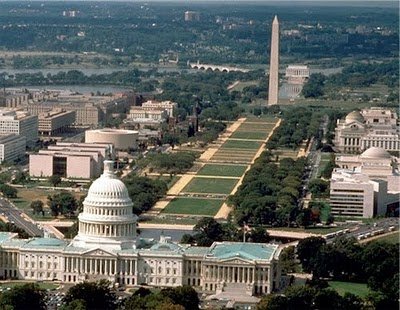
The general layout of the Vatican is Egyptian magic in plain sight. The phallic obelisk (representing Osiris and the male principle) faces the womb-like dome of the St. Peter’s Basilica (representing Isis and the female principle). The same exact layout can be found in various power centers of the world, including Washington DC.
In Washington DC, an obelisk (the Washington monument) faces the dome of the U.S. Capitol.

In Egyptian magic, the union of male and female principles (Osiris and Isis) produces a “star child” (Horus). In esoteric terms, that star child is potent magical energy...

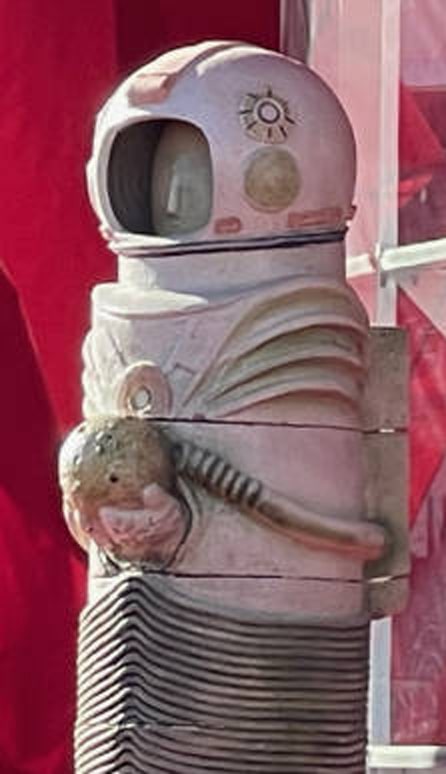
...the Vatican’s Nativity scene also features an astronaut. Why? God knows.
The astronaut appears to be holding/giving birth to something. Also, there’s an eight-pointed star on the helmet.

Considering the fact that this figure was created between 1965 and 1975, it might be a reference to the moon landing of 1969. But why, in 2020, did the Vatican select this thing to stand next to Jesus?

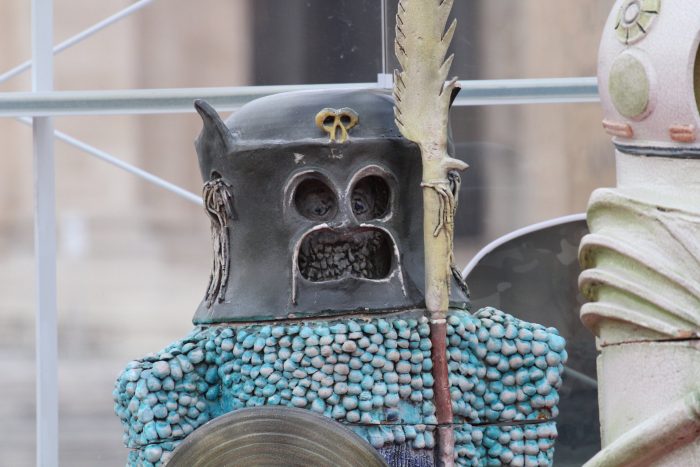
Even more baffling, why is there an executioner wearing a horned mask standing next to Jesus?
Even he’s thinking to himself: “What am I doing here?”.

In ancient times, executioners carried out the death sentences of legally condemned persons by chopping their heads off. In some cases, they wore grotesque masks with macabre and menacing traits to further terrify the prisoners while depersonalizing them as an individual. In short, that’s a bizarre figure to place next to a newborn baby Jesus, especially considering the fact that Jesus himself was ultimately sentenced to death.

According to Religion News Service, the executioner is there to represent the Vatican’s opposition to the death penalty. That’s a pretty weak argument that barely makes any sense. I mean, I’m pretty sure that the Vatican is also against crystal meth. Should they also add a meth dealer to the Nativity scene as well?

In a scene that is literally called “Nativity”, this horned figure represents death. It is the antithesis of a “Nativity”. I don’t think that Satanists would have done a better job desecrating a scene representing the birth of Jesus.

In Conclusion

In a way, this year’s Nativity scene is a sad reflection of the year 2020. It is a collection of expressionless and socially-distanced figures who do not interact with each other while standing under the neon glow of phone and computer screens.

It also reflects how the occult elite reared its ugly head this year, poisoning every aspect of our lives with its toxic agenda. Through a display that is thoroughly anti-Christian, the elite sought to prove that its toxic ideology is also embedded in the Vatican.

While “Monumental Nativity” was created decades ago, it was selected for this year’s 2020 Nativity scene for a specific reason: It contains specific symbols while conveying a specific energy. Like everything else that happened this year, this scene is about showcasing the control of the elite and the demoralization of the masses.

Saturday, 18 July 2020

150 years ago: First Vatican Council issues decree proclaiming papal infallibility

On July 18, 1870, the First Vatican Council, which had been convened by Pope Pius IX on June 29, 1868, issued Pastor aeternus (First Dogmatic Constitution on the Church of Christ). Pastor aeternus defined four Roman Catholic doctrines regarding the papacy: I. Of the Institution of the Apostolic Primacy in blessed Peter; II. On the Perpetuity of the Primacy of blessed Peter in the Roman Pontiffs; III. On the Power and Nature of the Primacy of the Roman Pontiff; IV. Concerning the Infallible Teaching of the Roman Pontiff. The doctrine that attracted the most controversy was Chapter IV, the text of which reads:

First Dogmatic Constitution on the Church of Christ.

Published in the Fourth Session of the holy Œcumenical Council of the Vatican.

PIUS BISHOP, SERVANT OF THE SERVANTS OF GOD, WITH THE APPROVAL OF THE SACRED COUNCIL, FOR AN EVERLASTING REMEMBRANCE...

...Chapter IV.
Concerning the Infallible Teaching of the Roman Pontiff.

Moreover, that the supreme power of teaching is also included in the Apostolic primacy, which the Roman Pontiff, as the successor of Peter, Prince of the Apostles, possesses over the whole Church, this Holy See has always held, the perpetual practice of the Church confirms, and œcumenical Councils also have declared, especially those in which the East with the West met in the union of faith and charity. For the Fathers of the Fourth Council of Constantinople, following in the footsteps of their predecessors, gave forth this solemn profession: The first condition of salvation is to keep the rule of the true faith. And because the sentence of our Lord Jesus Christ can not be passed by, who said: 'Thou art Peter, and upon this rock I will build my Church,'301 these things which have been said are approved by events, because in the Apostolic See the Catholic religion and her holy and well-known doctrine has always been kept undefiled. Desiring therefore, not to be in the least degree separated from the faith and doctrine of that See, we hope that we may deserve to be in the one communion, which the Apostolic See preaches, in which is the entire and true solidity of the Christian religion.302

And, with the approval of the Second Council of Lyons, the Greeks professed that the holy Roman Church enjoys supreme and full primacy and preeminence over the whole Catholic Church, which it truly and humbly acknowledges that it has received with the plenitude of power from our Lord himself in the person of blessed Peter, Prince or Head of the Apostles, whose successor the Roman Pontiff is; and as the Apostolic See is bound before all others to defend the truth of faith, so also, if any questions regarding faith shall arise, they must be defined by its judgment.303

Finally, the Council of Florence defined:304 That the Roman Pontiff is the true vicar of Christ, and the head of the whole Church, and the father and teacher of all Christians; and that to him in blessed Peter was delivered by our Lord Jesus Christ the full power of feeding, ruling, and governing the whole Church.305

To satisfy this pastoral duty, our predecessors ever made unwearied efforts that the salutary doctrine of Christ might be propagated among all the nations of the earth, and with equal care watched that it might be preserved genuine and pure where it had been received. Therefore the Bishops of the whole world, now singly, now assembled in Synod, following the long-established custom of churches,306 and the form of the ancient rule,307 sent word to this Apostolic See of those dangers especially which sprang up in matters of faith, that there the losses of faith might be most effectually repaired where the faith can not fail.308 And the Roman Pontiffs, according to the exigencies of times and circumstances, sometimes assembling œcumenical Councils, or asking for the mind of the Church scattered throughout the world, sometimes by particular Synods, sometimes using other helps which Divine Providence supplied, defined as to be held those things which with the help of God they had recognized as conformable with the sacred Scriptures and Apostolic traditions. For the Holy Spirit was not promised to the successors of Peter, that by his revelation they might make known new doctrine; but that by his assistance they might inviolably keep and faithfully expound the revelation or deposit of faith delivered through the Apostles. And, indeed, all the venerable Fathers have embraced, and the holy orthodox doctors have venerated and followed, their Apostolic doctrine; knowing most fully that this See of holy Peter remains ever free from all blemish of error according to the divine promise of the Lord our Saviour made to the Prince of his disciples: 'I have prayed for thee that thy faith fail not, and, when thou art converted, confirm thy brethren.'309

This gift, then, of truth and never-failing faith was conferred by heaven upon Peter and his successors in this chair, that they might perform their high office for the salvation of all; that the whole flock of Christ, kept away by them from the poisonous food of error, might be nourished with the pasture of heavenly doctrine; that the occasion of schism being removed, the whole Church might be kept one, and, resting on its foundation, might stand firm against the gates of hell.
But since in this very age, in which the salutary efficacy of the Apostolic office is most of all required, not a few are found who take away from its authority, we judge it altogether necessary solemnly to assert the prerogative which the only-begotten Son of God vouchsafed to join with the supreme pastoral office.

Therefore faithfully adhering to the tradition received from the beginning of the Christian faith, for the glory of God our Saviour, the exaltation of the Catholic religion, and the salvation of Christian people, the sacred Council approving, we teach and define that it is a dogma divinely revealed: that the Roman Pontiff, when he speaks ex cathedra, that is, when in discharge of the office of pastor and doctor of all Christians, by virtue of his supreme Apostolic authority, he defines a doctrine regarding faith or morals to be held by the universal Church, by the divine assistance promised to him in blessed Peter, is possessed of that infallibility with which the divine Redeemer willed that his Church should be endowed for defining doctrine regarding faith or morals; and that therefore such definitions of the Roman Pontiff are irreformable310 of themselves, and not from the consent of the Church.
But if any one—which may God avert—presume to contradict this our definition: let him be anathema.

Given at Rome in public Session solemnly held in the Vatican Basilica in the year of our Lord one thousand eight hundred and seventy, on the eighteenth day of July, in the twenty-fifth year of our Pontificate.

301 Matt. xvi. 18.

302 From the Formula of St. Hormisdas, subscribed by the Fathers of the Eighth General Council (Fourth of Constantinople), A.D. 869 (Labbe's Councils, Vol. V. pp. 583, 622).

303 From the Acts of the Fourteenth General Council (Second of Lyons), A.D. 1274 (Labbe, Vol. XIV. p. 512).

304 From the Acts of the Seventeenth General Council of Florence, A.D. 1438 (Labbe, Vol. XVIII. p. 526).

305 John xxi. 15-17.

306 From a letter of St. Cyril of Alexandria to Pope St. Celestine I., A.D. 422 (Vol. VI. Part II. p. 36, Paris edition of 1638).

307 From a Rescript of St. Innocent I. to the Council of Milevis, A.D. 402 (Labbe, Vol. III. p. 47).

308 From a letter of St. Bernard to Pope Innocent II. A.D. 1130 (Epist. 191, Vol. IV. p. 433, Paris edition of 1742).

309 Luke xxii. 32. See also the Acts of the Sixth General Council, A.D. 680 (Labbe, Vol. VII. p. 659).

310 That is, in the words used by Pope Nicholas I., note 13, and in the Synod of Quedlinburg, A.D. 1085, 'It is allowed to none to revise its judgment, and to sit in judgment upon what it has judged' (Labbe, Vol. XII. p. 679).
The way the doctrine is defined by the Roman Catholic Church, papal infallibility only once (so far): On November 1, 1950, Pope Pius XII exercised his official infallibility in the apostolic constitution Munificentissimus Deus, which includes:

...3. Actually God, who from all eternity regards Mary with a most favorable and unique affection, has "when the fullness of time came"(2) put the plan of his providence into effect in such a way that all the privileges and prerogatives he had granted to her in his sovereign generosity were to shine forth in her in a kind of perfect harmony. And, although the Church has always recognized this supreme generosity and the perfect harmony of graces and has daily studied them more and more throughout the course of the centuries, still it is in our own age that the privilege of the bodily Assumption into heaven of Mary, the Virgin Mother of God, has certainly shone forth more clearly.

4. That privilege has shone forth in new radiance since our predecessor of immortal memory, Pius IX, solemnly proclaimed the dogma of the loving Mother of God's Immaculate Conception. These two privileges are most closely bound to one another. Christ overcame sin and death by his own death, and one who through Baptism has been born again in a supernatural way has conquered sin and death through the same Christ. Yet, according to the general rule, God does not will to grant to the just the full effect of the victory over death until the end of time has come. And so it is that the bodies of even the just are corrupted after death, and only on the last day will they be joined, each to its own glorious soul.

5. Now God has willed that the Blessed Virgin Mary should be exempted from this general rule. She, by an entirely unique privilege, completely overcame sin by her Immaculate Conception, and as a result she was not subject to the law of remaining in the corruption of the grave, and she did not have to wait until the end of time for the redemption of her body.

6. Thus, when it was solemnly proclaimed that Mary, the Virgin Mother of God, was from the very beginning free from the taint of original sin, the minds of the faithful were filled with a stronger hope that the day might soon come when the dogma of the Virgin Mary's bodily Assumption into heaven would also be defined by the Church's supreme teaching authority...
-------------------------------------------------------------------------
2. Gal 4:4.
This reiteration of the Roman Catholic doctrine that Mary was "from the very beginning free from the taint of original sin" is anything but infallible, as it contradicts the plain words of the Bible:

And Mary said, My soul doth magnify the Lord,
And my spirit hath rejoiced in God my Saviour.
Luke 1:46-47

Mary wouldn't have rejoiced in God as her Saviour if she had been "free from the taint of original sin," because she wouldn't have needed a saviour. So much for papal infallibility.

Sunday, 26 April 2020

Apostate Congregational church in Nebraska offers drive-by Easter egg hunt

I'm a few weeks late in posting this, but here it is for the record, as reported in the Lincoln Journal-Star, April 3, 2020 (link in original):

First-Plymouth Congregational Church will offer a drive-by Easter Egg Hunt Sunday, April 12, from noon to 7 p.m. around the block outside the church at 20th and D streets.

On Easter Sunday, First-Plymouth encourages families to pile in the car to take an afternoon drive to see over 300 large and colorful Easter egg signs around the church block. Everyone is asked to respect social distancing and remain in your vehicles as you drive by. Planners hope the event will brighten things up a bit during this difficult time.

For more information on First-Plymouth, go to firstplymouth.org or call 402-476-7565.
A quick glance at the church's Who We Are page shows it to be a member of the United Church of Christ, claiming to be Christian while denying every fundamental Christian doctrine, and sounding more like Unitarians than Christians (bold inserted by blogger):

First-Plymouth strives to blend tradition and innovation, the historical and the contemporary. Our worship services have a quality that echoes through the ages and yet, speaks to the present and points to the future. Our religious life is shaped by five guiding principles: We are Christian, Open-minded, Spiritual, Evolving and Diverse. First-Plymouth Congregational Church is part of the United Church of Christ.

WE ARE CHRISTIAN

"Christian" means we perceive in Jesus the divine qualities of love, peace, joy, and justice. It does not mean we think Jesus is the only path to God.

"Christian" means we eagerly explore the Bible for its spiritual wisdom contained in symbol, metaphor, and history. It does not mean a literal or heavy-handed approach that uses the Bible to prove we are right or righteous.

WE ARE OPEN-MINDED

"Open-minded" means we understand faith as a quest, not a clutched certainty. "Open-minded" flies above the tired distinction between conservative and liberal, and does not refer to one’s specific beliefs, but how one relates to those beliefs. It means we do not assume a defensive posture, but rather enter appreciatively into different points of view with the expectation of learning and growing.

WE ARE SPIRITUAL

"Spiritual" means we believe God is a spirit of love that can be felt and known by each one of us. It means Christianity is as much about the heart as the head, as much about the body as the mind.

"Spiritual" means not merely hoping for a better world or pining after justice, but rolling up one’s sleeves and starting to feed the hungry, care for the sick and anguished, house the homeless and advocate for a more just society.

WE ARE EVOLVING

"Evolving" means rather than resisting change or innovation, we eagerly experiment with new ways of being faithful and new understandings. We strive to be rooted but not stuck.

WE ARE DIVERSE

"Diverse" means we celebrate the differences among us such as sexual orientation, ethnicity, class, mental abilities, physical capabilities, personalities, and backgrounds.

"Diverse" means we trust that these differences inform and strengthen community. A diverse spiritual community welcomes conventional believers, curious agnostics, and questioning skeptics.

And, finally, "diverse" means you are free to seek your own guiding principles in our midst. These principles are not a creed to which one must ascribe. Rather, they are one attempt to describe the spirit and nature of our congregation.

– Jim Keck, Senior Minister, First-Plymouth Church
The current sermon series promotes mysticism:

THE MYSTICAL HEART OF RELIGION

This week Dr. Keck continues his sermon series on mysticism. Using three mystical exemplars from history - Girodano Bruno, Joan of Arc and Howard Thurman - he will propose that the mystical heart of Christianity can be reclaimed through the theological imagination(Bruno), an embrace of high tradition (Joan of Arc) and an appreciation of nature mixed with a thirst for justice (Thurman). Join the journey this Sunday!

Tuesday, 14 April 2020

Muslims declare Islamic supremacy in prayer at Roman Catholic mass in Ireland

(video)

With friends like the priest mentioned in the following article, who needs enemies? As reported by Jules Gomes of the Roman Catholic site Church Militant, April 3, 2020 (links in original):

COUNTY MAYO, Ireland -- Muslims, invited by a Catholic priest in Ireland to pray alongside him during the celebration of the Holy Eucharist, prayed the Adhan — the Islamic call to prayer that categorically proclaims Islam's supremacy over its forebears — Judaism and Christianity.

Father Stephen Farragher, parish priest of St. Patrick's Church in Ballyhaunis, County Mayo, invited two Muslims to "pray in solidarity" with him "the final blessing and prayer" at the 10 a.m. Friday Mass to be broadcast on radio, Midwest Radio Ireland reported.

Mohammed Cherbatji and Mohammed Rahmani joined Fr. Farragher to seek a blessing on all frontline health care workers and frontline workers during the pandemic and pray for the eradication of the Wuhan virus. The church was reportedly empty because of the Wuhan virus restrictions.

However, a video of the Islamic prayer released on Twitter showed one of the Muslims in the pulpit cantillating the Adhan in Arabic.

Church Militant contacted an Arabic expert and scholar in Islamic jurisprudence who confirmed that the prayer was not a blessing for health care workers but the "Islamic call to prayer, which conclusively and unambiguously asserts that God's revelation to Muhammad has supplanted and superseded God's prior revelations to Moses in the Old Testament and to Jesus in the New Testament."

The Adhan asserts: "Allah is the greatest. I bear witness that there is no god except Allah. I bear witness that Muhammad is the Messenger of Allah. Come to prayer. Come to salvation." These affirmations are repeated twice.

Theologian Dr. Gavin Ashenden, who resigned his position as Chaplain to the Queen in protest against a reading from the Koran at St. Mary's Cathedral in Glasgow, Scotland, confirmed to Church Militant that "the Muslim call to prayer is a dramatic piece of Islamic triumphalism."

"It proclaims Islam's superiority over all other religions, and in so doing casts Jesus in the role of a charlatan and a liar. The Muslim god, Allah, is unknowable and has no son. Jesus was, therefore, a fraud in claiming He and the Father are one," Ashenden, who recently converted to Catholicism, said.

"In a religious narrative where one religion denigrates another, compromise is not logically or theologically available," he stressed.

Ashenden explained how Fr. Farragher, having invited a Muslim to end his broadcast-Mass with the Adhan prayed from the Catholic pulpit, "so far from creating a congenial interfaith event for the online world, he had given a platform to an alien prayer that invalidated the Mass, his Saviour, the authenticity of the Gospels and the legitimacy of the whole Catholic Church."

Ashenden added:

No doubt he sought to be imaginatively generous. But his profound ignorance will have caused the deepest offense to all literate and faithful Christians as well as the profoundest grief to those growing scores of thousands of Christians who suffer around the world at the hands of a brutalising Islam that makes them pay the price of loving and believing in Jesus, Son of God and Saviour, with their lives.

Former Swedish Imam Tomas Samuel explains how the Adhan is a statement of Islamic supremacy. In Islamic sources, "we discover that the prayer call states that everyone should submit to Islam and proclaims power over the area of the ​​prayer."

The Adhan is prayed for two reasons: "It will remind people of when it is time to pray, and the prayer call will proclaim Islam over a city," he explains.

Samuel quotes Omdat Al-Ahkam, a fundamental text for Islamic law: "One can liken the Adhan to the Muslim flag. Its proclamation shows that the people of the city are Muslims."

In Arabic, "adhan" means "information" or "enlightenment" — signifying that people previously in darkness and ignorance are now "informed" and "enlightened" about the "true religion" of Islam, to which they must submit. Islam means submission (from the Arabic root "al-Silm" — submission or surrender).

Commentators have explained how reciting the Adhan in churches is a "power play" intended to conquer and sacralize Christian territory. Islamic scholars are engaged in an in-house discussion on whether it is haram (forbidden) or makrooh (offensive) for Muslims to enter churches.

"If your going to the church is just to show tolerance and lenience, then it is not permissible, but if it is done to call them to Islam and create opportunities for you to do so, and you will not be taking part in their worship and you are not afraid that you may be influenced by their beliefs or customs, then it is permissible," declares the Fatwa al-Lajnah al-Daa'imah.

Friday prayers at Ballyhaunis mosque (pictured in this article) have been canceled as a result of the virus. Over 500 Muslims attend Friday prayers regularly at the mosque — the oldest purpose-built mosque in Ireland.

Islam is poised to become Ireland's second-largest religion in the next 10 years. Ballyhaunis is Ireland's most diverse town, according to the 2011 national census, and only 40% are of Irish origin while 60% are immigrants — a significant portion of whom are Muslim.

Church Militant contacted Fr. Farragher and asked him if he was aware of the implications of the Islamic prayer. We also inquired if Pope Francis' Abu Dhabi declaration had inspired him to indulge in this act of combined Muslim-Catholic worship — but received no response as of press time.

Friday, 20 December 2019

Liberal churches' nativity scenes depict Christ child as a caged refugee

Having a form of godliness, but denying the power thereof: from such turn away. II Timothy 3:5

"What utter blasphemy!"
--James Stolee

The apostasy and blasphemy of apostate denominations such as the United Church of Canada and their various components continues. Submitted for your approval, a couple of examples reported by David Menzies of Rebel News, December 16, 2019:

It’s beginning to look a lot like Christmas... Well, not really. Case in point: the nativity scene at Toronto’s Eastminster United Church.

Now called “The Detained Christ”, the church's Christmas display depicts the baby Jesus inside a cage and wrapped in a solar blanket.

Apparently, this art installation is meant to raise awareness of illegal migrants and refugee claimants. Gee, where are the Three Wise Men when you really need them?


It hardly needs to be pointed out--but I will, anyway--that Joseph, Mary, and Jesus were not refugees at the time of Jesus' birth, but were temporarily in Bethlehem to register for a census (Luke 2:1-7). They were refugees in Egypt for a time when Herod was seeking to kill Jesus, but returned to Nazareth after Joseph was informed by an angel that those who were seeking to kill Jesus were dead (Matthew 2:13-23). This was a family of three people who were temporarily in exile, and returned home when it was safe. They weren't part of a movement of mass migration such as is being promoted by the liberal churches today. If those who claim that their views are based on Christian charity and compassion find themselves on the same side of an issue as anti-Christian figures such as George Soros and Justin Trudeau, I suggest they reexamine their positions.

Saturday, 30 November 2019

Barcelona's nativity scene attracts criticism

As reported by The Local (Spain), November 29, 2019:
(photo)

You know the Christmas season is here when social media becomes awash with criticism for Barcelona’s Belen – the Nativity scene installed by City Hall in the Plaça Sant Jaume.

Continuing a tradition that began when Ada Colau became mayor five years ago, the Nativity scene unveiled on Friday immediately divided opinions and left many scratching their heads as to the meaning it was supposed to convey.

This year’s offering may at first glance appear not to have been unpacked properly as the figures one expects to find in a traditional depiction of the Christmas story all appear in old wooden storage boxes.

Baby Jesus in his crib takes pride of place in the centre ( in a wooden crate) and piled in boxes around him it is possible to spot Mary, Joseph, the odd farm animal, visiting shepherds, a wise man astride a camel and even an angle.

So the elements are there.

But the characters are joined by other boxes containing the detritus of Christmas; a poinsettia, boxed up baubles, a turkey roasting in a tin, tangles of tinsel and a Christmas hamper.

“When I think of the nativity scene, what comes to mind is Christmases spent living at my parents' house. For me, the most notable thing was not setting up the scene, arranging the elements of the stable on a table and placing the figurines around the manger, but rather all the previous preparation that led up to it,” said artist Paula Bosch explaining her inspiration for the installation.

“It started with a visit to the attic and rummaging through all the storage boxes.”

But although her reference is clear, her artistry hasn’t been appreciated by everyone.

“Instead of a nativity scene, it looks like a storage room,” said one detractor on Twitter.

Another joked that Ada Colau had set up a new ‘Punto Limpia’ in Plaça Sant Jaume. “You can take your old tat to throw away and recycle”.

Someone else said it looked “like a rummage sale”, while another said it was like a “kitsch stall at a flea market”.

Another cleverly announced that it was Black Friday in Plaça Sant Jaume - meaning everything was going cheap.

Josep Bou Vila, a city councillor for the conservative PP branded it "a disgrace" and pointed out that the installation that cost €97,000 looked like a recycling dump.

In 2016, the elements of the traditional stable scene were placed individually in their own snow globe, including a cow on skis emblazed with the Catalan flag.

The following year, in 2017, the scene was represented by white cardboard cutouts on stilts.


Even more bizarre was the effort in 2018 when giant chairs set around a Christmas table represented the holy figures.

Tuesday, 12 November 2019

Conservative Catholics accuse Pope Francis of "idolatrous worship" during Amazon synod

The lesson, as always, is: Never trust a Jesuit. As reported by Nick Squires of the London Daily Telegraph, November 12, 2019 (links in original):

One of the statuettes of an Amazon fertility symbol that went on display at the Vatican during the Amazon synod (AFP)

Pope Francis has been accused of being “sacrilegious” and idolatrous for embracing indigenous symbols in the Vatican’s recent summit on the Amazon by a group of 100 Catholic traditionalists.

In one of the strongest attacks yet on the Pope, conservative Catholic clergy, historians and intellectuals from around the world lambasted Francis for supposedly allowing the “idolatrous worship” of statuettes of an Amazon fertility symbol.

Several statues of the goddess Pachamama featured in ceremonies during last month’s synod, or bishops’ meeting, on the future of Catholicism in the Amazon.

A pair of ultra-conservatives was so incensed that they stole the statuettes from a church near the Vatican and tossed them into the Tiber River.

In a strongly-worded open letter, the traditionalists accused the Pope of indulging in “sacrilegious and superstitious acts” during the synod, in which bishops from the Amazon gathered in Rome.

The most contentious issue the bishops discussed was whether to allow already married men to become priests, in an attempt to address the chronic lack of Catholic clergy in the vast region.

Conservatives see that as the beginning of the end for the centuries-old tradition of celibacy.

During the synod, Pope Francis adopted an inclusive attitude towards indigenous people, welcoming them to the Vatican and embracing the traditional objects they use in their worship of God.

But the conservatives, from Britain, the US, France, the Netherlands, Australia, Germany and several other countries, branded the statuettes of Pachamama as “pagan idols” which represented “a false goddess of mother earth.”

They were further angered when the Pope asked forgiveness from Amazonian bishops and tribal leaders after the statues were stolen and dumped in the Tiber.

He insisted that the statuettes of naked pregnant women were brought to the Vatican “without any intention of idolatry.”

But in their letter, the Pope’s critics said: “Absolutely all participation in any form of the veneration of idols is … an objectively grave sin that only God can judge.”

Francis should “repent publicly and unambiguously … of all the public offences that he has committed against God and the true religion.”

Their letter is the latest salvo in the battle being waged against Francis’s papacy by conservative Catholics who are appalled at his inclusive stance on homosexuality and the prospect of giving communion to divorced Catholics who have remarried in civil ceremonies.

Leading figures in the resistance movement against the Argentinian pope include Cardinal Gerhard Müller of Germany and Cardinal Raymond Burke of the US.

“These traditionalists take every opportunity to criticise Francis,” Austen Ivereigh, a Vatican expert, told The Telegraph.

“They have a deliberate strategy to weaken Francis’s position in advance of the next conclave (the election of a new pope).”

The conservatives remain vehemently opposed to the reforms of the Second Vatican Council in the 1960s, said Mr Ivereigh, the author of The Great Reformer: Francis and the Making of a Radical Pope.

“For them it’s all about the war against modernity - the Church should be a fortress that protects traditions from contamination. But they are not representative of the majority of the world’s one billion Catholics. They speak for the rump of the Church, which is very small but very vociferous.”

Wednesday, 9 October 2019

"Jesus Shoes" cashes in on greed and superstition

More evidence that you can't be a satirist anymore, as reported by Alexandra Deabler of Fox News, October 9, 2019 (link in original):

That’s a holy lot of money.

A limited-edition sneaker, which is filled with holy water in the soles and blessed by a priest, sold out within minutes of its debut, despite each pair costing a whopping $3,000.

Brooklyn-based creative label MSCHF is responsible for releasing the shoe, which is a pair of all-white Nike Air Max 97s -- though the design is in no way affiliated with Nike -- that have been injected with holy water sourced from the Jordan River. The water, which is visible in the see-through sole, has some coloring added to enhance visibility, the shoe’s creator told Fox News.

The kicks, succinctly called “Jesus Shoes,” also feature the Bible verse Matthew 14:25 — the passage describing Jesus walking on water — and a single blood drop to represent the blood of Christ.

Among the other religious details are the frankincense-scented insoles, a crucifix threaded through the laces, and a red sole, which references the red shoes traditionally worn by past Popes.

The shoebox itself also displays an angel and a seal that resembles the official papal seal.

The shoes, which were bought at Nike retail value by MSCHF designers before being re-designed, were part of a desire for the MSCHF brand to poke fun at collaboration culture.

“We thought of that Arizona Iced Tea and Adidas collab, where they were selling shoes that [advertised] a beverage company that sells iced tea at bodegas,” head of commerce Daniel Greenberg tells the New York Post. “So we wanted to make a statement about how absurd collab culture has gotten.”

“We were wondering, what would a collab with Jesus Christ look like?” he added.

Less than two dozen of the Jesus Shoes were made with no plans to create more, according to MSCHF. Although, Gabriel Whaley, founder of the brand, hinted there may be a “second coming” in the future.

The MSCHF label releases new items every 2nd and 4th Tuesday of the month.
As reported by Lauren Steussy and Hannah Frishberg in the New York Post, October 8, 2019:

What would Jesus wear? The sickest sneakers ever dropped, most likely.

Nike shoes with actual holy water in the soles are going for as much as $3,000 a pop, and sold out in mere minutes when they dropped Tuesday morning. “Jesus Shoes” are made with 100% frankincense wool (get it?), while the laces are strewn with a crucifix.

The godly shoes were made by Brooklyn-based product design company MSCHF, which created about two dozen of the kicks as a way of trolling “collab culture,” its head of commerce Daniel Greenberg tells The Post.

“We thought of that Arizona Iced Tea and Adidas collab, where they were selling shoes that [advertised] a beverage company that sells iced tea at bodegas,” Greenberg says. “So we wanted to make a statement about how absurd collab culture has gotten.”

To do that, it started with “one of the most influential figures in history,” Jesus Christ.

“We were wondering, what would a collab with Jesus Christ look like?” Greenberg says. “As a Jew myself, the only thing I knew was that he walked on water.”

The holy water MSCHF injected into Air Max 97 bubble soles came from the Jordan River — “I have a friend in Israel,” Greenberg says — and was blessed by a priest.

Shoe drops like these, followed obsessively by rabid fans called “hypebeasts,” have become an economy unto themselves. Cash-strapped fashion fans are even turning to the underground streetwear market to make ends meet, reselling duds from the likes of Supreme and Kith.

To promote its shoes, MSCHF sent about six pairs to YouTubers and other big shots, such as rapper A$AP Rocky, prior to the drop. Then, by 11 a.m. Tuesday, it posted them on the retail site StockX.

The shoes were in no part affiliated with Nike — MSCHF bought the sneakers at retail value and hand-created the design. MSCHF anticipates making “biweekly drops at 11 a.m. on every second and fourth Tuesday of each month,” Greenberg says.

“But this one was the holiest of all the collabs,” he says.

Wednesday, 31 July 2019

Italian town introduces fines for blasphemy

Thou shalt not take the name of the Lord thy God in vain; for the Lord will not hold him guiltless that taketh his name in vain. Exodus 20:7 (also Deuteronomy 5:11)

As reported by Josephine McKenna of the London Daily Telegraph, July 26, 2019:

A northern Italian town has had enough of people taking the Lord’s name in vain and those who do will be fined up to €400 (£360) for blasphemy.

The city council of Saonara, a town with 10,000 inhabitants just outside Padua, has introduced a new law making it illegal “to blaspheme against any faith or religion” and utter foul language in public.

The mayor, Walter Stefan, said the move was designed to get rid of uncivilised behaviour and promote public decency.

“Blasphemy is offensive, it offends me,” Mr Stefan told The Telegraph on Friday.

“With this law you will not be able to cause offence to any religion, we have to respect the faithful.”

The mayor, a practicing Catholic, said it was not designed to protect only Christianity, but all faiths. “It is valid for Allah, Buddha or Mohammad,” he said.

The blasphemy ban is part of a far-reaching local law aimed at tackling uncivil behaviour. It includes 75 articles with hefty sanctions for those who mow the lawn outside designated hours, walk their dog without a leash or dump their rubbish in public places.

“We have taken a series of measures to contain all those uncivilised activities that make coexistence difficult,” Mr Stefan said.

“It will no longer be possible to cut the lawn at certain times, dogs must be kept on a leash and those who are blasphemous will pay the consequences.

“We want to send a message that incorrect behaviour will no longer be tolerated.”

Mr Stefan, a father of three, is not aligned with any major political party and has been mayor of the town since 2012. He was re-elected in 2017 with 52.2 percent of the vote.

He said flyers in four languages, including Chinese and Romanian, would be sent to residents in September to inform them about the new fines.

“There may be bigger problems around but we can’t consider civility banal," he said. "If we let this go, young people will become louts.

“We want to create a courteous community and behaviour that prevents conflict.”

Omero Badon, a local councillor from the Five Star Movement, said he supported the law but did not know if the fines would be enough to improve behaviour, especially that of young people, in the community.

Blasphemy was decriminalised in Italy in 1999 but certain sanctions remain for offences against the “deity”. In December last year a man was fined €100 for blasphemy in front of a school in Albisola Superiore near Savona.

Thursday, 28 February 2019

Swiss government refuses to support efforts to abolish the country's blasphemy law

The arguments used by those supporting the legalization of blasphemy provide evidence for blogger Vox Day's contention that "freedom of speech" has its origins in an Enlightenment reaction against the blasphemy laws that were in place in almost all Western countries. As reported by George Mills of The Local (Switzerland), February 22, 2019 (links in original):

The Swiss government said this week it would not lend its support to plans to strike a 'blasphemy' clause from the country’s penal code despite similar moves in other countries in recent times.
The government’s statement came after Green Liberal MP Beat Flach said a clause in the penal code which makes blasphemy punished by a fine had no place in a ‘secular and liberal’ state and limited free speech.

Under the article in question, any person "who publicly and maliciously insults or mocks the religious convictions of others, and in particularly their belief in God" can be fined.

In addition, fines can also be imposed on any person "who maliciously prevents, disrupts or publicly mocks an act of worship" or "who maliciously desecrates a place or object that is intended for a religious ceremony or an act of worship".

But in a motion (here in German) put before the Swiss parliament, Flach said the article meant that religious belief could not be criticised to the same degree as other world views.

He also argued that people’s right to freely practice their religion was guaranteed by other Swiss legislation including provisions outlawing incitement to racial hatred or discrimination.

He went on to point out that countries including Ireland, Malta and France had already struck blasphemy clauses from their books.

But the Swiss government came out in defence of the fines for attacks on religion.

It noted that while the Swiss constitution guarantees freedom of expression, and this was of “central importance” in a free state, there were also limits to such expression and that it had to be exercised with responsibility.

The executive also argued that the clause in the penal code outlawed only the most serious attacks on religious freedom – which is also guaranteed by the Swiss constitution – and that this prohibition was necessary to guarantee the successful coexistence of people with different religious beliefs.

In fact, there were less than 30 criminal convictions under the blasphemy clause from 2011 to 2017, according to Swiss media, while the last high profile case was in 1960 when Swiss painter Kurt Fahrner was fined 100 Swiss francs and handed a suspended three-day jail term for his painting of a crucified naked woman.

Lastly, the Swiss executive also noted it was impossible to compare the situation in different countries as the blasphemy laws involved were different. In Ireland for example, a controversial section of the constitutional clause on freedom of speech made “blasphemous, seditious or indecent matter” a punishable offence.

The Irish overwhelmingly voted to scrap this ban on blasphemy in a referendum last year.
See also my post:

Ireland votes to remove blasphemy from the Constitution (October 28, 2018)

Saturday, 22 December 2018

30 years ago: A New Age Christmas service in Edmonton

On December 22, 1988, this blogger and fellow cultwatcher attended the annual Christmas service at Edmonton's Centre for Self-Awareness, led by Rev. Sue Rubin. The musical part of the service included the singing of such inspirational favourites as Frosty the Snowman and I'll Be Home for Christmas.

What passed for a sermon consisted of Rev. Sue reciting the wonderful characteristics we all supposedly possess, while lighting a candle to represent each characteristic as she went through the list. This was the sort of nonsense that New Agers--especially women--fall for, but which strike others, such as the two cultwatchers in the audience, as blasphemy.

Apparently we two weren't the only ones who took a skeptical view of Rev. Sue's message, because when she got to the point where she stated "I am infinity" and "I am enlightenment," the candles started falling over, to the surprise of the infinite and enlightened Rev. Sue Rubin (and to the amusement of the two skeptics).

Fortunately, the building didn't catch fire; however, those who believe in the nonsensical New Age teaching that each of us is God within ourselves will be in danger of eternal fire. The truth is that there is one God, and one mediator between God and men, the man Christ Jesus (I Timothy 2:5).

Sunday, 28 October 2018

Ireland votes to remove blasphemy from the Constitution

There is a way which seemeth right unto a man, but the end thereof are the ways of death...
...Righteousness exalteth a nation: but sin is a reproach to any people.
Proverbs 14:12, 34

Professing themselves to be wise, they became fools, Romans 1:22

This know also, that in the last days perilous times shall come.
For men shall be lovers of their own selves, covetous, boasters, proud, blasphemers,...
II Timothy 3:1-2a

If the people haven't suffered enough, it's their God-given right to suffer more. William Aberhart

As reported by Patsy McGarry of the Irish Times, October 28, 2018 (bold in original):

Every single one of the 40 constituencies in Ireland voted to remove the word “blasphemous” from article 40.6.1 of the Constitution in a unanimity unique in recent Irish referendums.

Last Friday’s vote was closest in constituencies along the Wild Atlantic Way. In Donegal 51.5 per cent voted Yes to 48.4 per cent No, while those in Sligo-Leitrim voted 56.1 per cent to 43.9 per cent to change the Constitution.

Meanwhile, voters in Mayo voted by 56.9 per cent to 43.07 per cent; though the heavily urbanised Galway West constituency was an outlier where 65.8 per cent voted Yes and 34.1 per cent voted No.

Last May Donegal was the only constituency to reject removal of the Eighth Amendment from the Constitution in the abortion referendum, and in May 2015 Roscommon-South Leitrim was alone in voting No to same-sex marriage.

In Clare 61.8 per cent voted Yes and 38.1 per cent vote No, while in Kerry 57.6 voted Yes and 42.3 per cent vote No.

On the east coast, Yes tended to do better overall, with 72.7 per cent in Kildare North, for instance, the highest Yes vote outside Dublin.

In all the Dublin constituencies the Yes vote was over 70 per cent, with the highest in Dublin Bay South, where 76.4 per cent voted Yes. Next there was Dun Laoghaire, where 75.3 per cent voted Yes.

Altogether across the 40 constituencies, 64.85 per cent voted Yes, while 35.15 per cent voted No.

No room

Welcoming the result, Minister for Justice Charlie Flanagan said it had always been his view “that there is no room for a provision such as this in our Constitution”.

He said: “Ireland is rightly proud of our reputation as a modern, liberal society. The world has watched in recent years as we have taken landmark decisions as a people to change our Constitution with regard to some of the deepest personal matters when we voted Yes to marriage equality and to repealing the Eighth Amendment.”

He added: “We have again sent a message to the world, a strong message that laws against blasphemy do not reflect Irish values and that we do not believe such laws should exist.”

In a brief statement the Catholic bishops stressed, now that the offence of blasphemy had been removed from the Constitution, that “it is vital to ensure that the rights of individuals and communities to practise and live out their faith openly are protected by our law”.

The promotion of “freedom of religion, and the freedom of conscience – for all in society – greatly enriches the social fabric of a country, and is one aspect of respect for the dignity of human persons,” they said.

Bishop Kenneth Kearon, chairman of the Church of Ireland’s Church and Society Commission, welcomed the result but regretted “that we didn’t take the opportunity to take a lead within the international community by replacing it with a provision protecting freedom of thought, conscience and expression, including protection from hate speech; rights that are under threat or not available in many parts of the world”.

In a November 2013 joint statement, all the main churches in Ireland had described the blasphemy provision in the Constitution as “largely obsolete”.

Medieval crime

Atheist Ireland also welcomed what it described as removal of the “medieval crime of blasphemy” from the Constitution. Chairman Michael Nugent said it followed “a decade of campaigning by Atheist Ireland to have this referendum held”.

The two-to-one margin was “a great result for freedom of religion, belief, and speech, and for Irish politics based on integrity instead of nods and winks,” he said.

Welcoming the result, Amnesty International Ireland said it was “another important step towards a human-rights-compliant Constitution”.

“Now, States like Pakistan can no longer justify their own severe anti-blasphemy laws by pointing to Ireland’s Constitution,” said executive director Colm O’Gorman.

But he also called on the Government to “ensure that everyone can manifest and practise their religion without discrimination or threat. We also need to have robust prohibition of inciting hatred on religious and other grounds, in law and practice.”

The result was “another significant milestone for Ireland in becoming a modern, secular and more compassionate society,” said Noeleen Hartigan, chief executive of the Humanist Association of Ireland. “Our past should not prescribe our future, and the laws and practices which give one faith system dominance over people’s lives must be dismantled,” she said.
The errors and lies of those supporting the legalization of blasphemy are too numerous to list, but here are a few: Blasphemy is not an indication of social progress. A "modern liberal society" is not one to be proud of, and a "modern, secular" society is not "more compassionate" (the practices of abortion and euthanasia in such societies comes to mind). Blasphemy in Ireland is not the same as blasphemy in a Muslim country such as Pakistan.

The arguments used by those supporting the legalization of blasphemy provide evidence for blogger Vox Day's contention that "freedom of speech" has its origins in an Enlightenment reaction against the blasphemy laws that were in place in almost all Western countries. As someone whose ancestry, although not Roman Catholic, is largely Irish, it doesn't make this blogger glad to see this development. This is not going to end well.

Saturday, 30 June 2018

Philippine President Rodrigo Duterte, after calling God "stupid," seeks to repair relations with the country's Roman Catholic bishops

As Maxwell Smart used to say, "Look, I hope I wasn't out of line with that crack about..." The God of Philippine President Rodrigo Duterte may not be that of Roman Catholicism, but certainly isn't the God of the Bible, either. As reported by Christine Rousselle of Catholic News Agency, June 27, 2018 (link in original):

Manila, Philippines - After calling God “stupid,” Philippine President Rodrigo Duterte said on Tuesday that he will seek to have a dialogue with the country’s bishops’ conference in an effort to repair relationships.

The president’s spokesperson announced that a committee would be created to better collaborate and communicate with the country’s bishops.

On Friday, Duterte caused controversy when, in a speech, he said God was “stupid,” and a “son of a b-tch” for including the tree of knowledge of good and evil in the Garden of Eden. In the Book of Genesis, Adam and Eve were thrown out of the Garden after consuming the forbidden fruit.

“How can you rationalize a God? Do you believe?” added Duterte. He also spoke negatively about the concept of original sin, calling it a “stupid proposition.”

Despite the outcry from his initial remarks, Duterte did not back down. He said that he was criticizing only the God that his critics believe in, not his personal God. Duterte was raised Catholic.

"What I said was your God is not my God, because your God is stupid. Mine has a lot of common sense,” said Duterte on Monday. He also said that the creation of Eve was God’s “greatest mistake.”

A presidential spokesperson said that the comments represented Duterte’s personal beliefs, and referenced the president’s previous statement that he had been abused by a priest while a student at Catholic school, the BBC reported.

The Catholic Bishops’ Conference of the Philippines (CBCP) said they were willing to meet with Duterte to discuss various issues and to rebuild the relationship between the Church and the government. Duterte is seeking to form a committee on this issue.

Archbishop Romulo Valles, president of the CBCP, said on a Catholic radio station in the Philippines that the invitation was a “most welcome development,” and that “to dialogue is to listen to one another, and is always good.”

Valles and Duterte have been friendly in the past, according to Filipino media.

Other bishops in the country aren’t so sure that Duterte is genuine in his desire for a dialogue. Bishop Broderick Pabillo, the auxiliary bishop of Manila, told ABS-CBN News that the call for a dialogue was “just his way of diffusing the criticisms against him.”

The Philippines is about 80 percent Catholic, and an additional 10 percent of the population is Protestant.

Duterte has been openly hostile to the Catholic Church since he came to power in July of 2016. Shortly before taking office, he referred to the country’s bishops as “sons of wh-res.”

He has been accused of “social cleansing” for his bloody war on drugs in the country. The country’s bishops offered to provide sanctuary for any whistleblowers in the Philippine police department who spoke out against various human rights abuses. In response, Duterte said the Church was “full of sh-t.”

Tuesday, 5 June 2018

50 years ago: Roman Catholic priest says "Sock it to 'em, God!" in high school benediction

Buffoonery on the part of clergy in an attempt to be culturally relevant is nothing new. Chris Rosebrough has said that relevance is a cruel mistress, and this item is evidence of that, as some of the phrases used and things referred to, that seemed relevant in 1968, seem a wee bit dated in 2018. The reader will notice that, as is so often the case, the lay person has a better grasp of things than the clergyman. Submitted for your approval, the following item, as reported by Reuters, that somehow found its way onto the front page of the London Free Press, June 5, 1968:

Glendale, Ariz. - A Roman Catholic priest apologized Tuesday for saying "Sock it to 'em God" in a high school benediction.

St. Jerome's Church assistant pastor Rev. William Healy said he used the phrase--which provoked a storm of protest here--while trying to relate God with the teen-age world.

In his benediction to Cortez High School seniors Sunday, he said: "We ask your blessing on things and people You created...Bless hair spray, mini-skirts, turtleneck shirts,...For God's sake bless our parties, religious exercises,...We ask because You are an understanding God, a swinging God. Sock it to 'em God."

Mrs. John McClellan, representing the parents of some children at the school, claimed Tuesday the "sock it" remark bordered on blasphemy. She deplored what she called "an attempt to bring God down" to the level of the graduating class.

Father Healy, who re-read the benediction in the Glendale Union High School Board on Monday night, declared: "I was praying from the heart and not just from words..."

Superintendent Howard Roberts said the words were misunderstood by the students and advised Father Healy to apologize.

Father Healy replied:

"I apologize if I offended anyone in doing what I thought was right. I was speaking to the graduates in terms they know.

"What does a swinging God mean to the mentality of a teen-ager?

"A swinging God is a God they know as a good God."

Thursday, 31 May 2018

U.S. cross-country exhibition of Padre Pio's relics shows that Roman Catholicism is still a religion of idolatry and superstition

For there is one God, and one mediator between God and men, the man Christ Jesus; I Timothy 2:5

As reported by Katherine Burgess of the Wichita Eagle, April 9, 2018:

A fingerless glove. Cotton gauze stained with blood. A lock of hair.

An estimated 500,000 Catholics will flock to see these items as they travel across the country.

Last year, the relics of Saint Pio of Pietrelcina, known as Padre Pio, toured 18 dioceses throughout the United States.

This year, the six relics will visit 40 dioceses, including one in Canada and one in Mexico. One stop will be at the Cathedral of the Immaculate Conception in the Diocese of Wichita this Friday.

Relics are physical objects associated with a saint. They can include part of the saint’s body (a first-class relic), a piece of the saint’s clothing or something used by the saint (second-class) or an object touched by a first-class relic (third-class). The relics visiting Wichita include first- and second-class relics.

“We do hope indeed that when the people come to venerate the relics, they might take Padre Pio’s life as an example, the way he endured suffering and cared for the sick and the poor,” said Luciano Lamonarca, president of the Saint Pio Foundation. “My hope is that through this tour, people will find an inspiration in living their lives with humbleness and really with the faith. If Padre Pio himself was able to bear all this suffering for 50 years, surely we can do so as well.”

Born in Italy in 1887, Padre Pio was baptized Francesco Forgione, but took the name Pio when he entered the Capuchin order at 15. He was ordained a priest at 23.

Pio is widely known as the first stigmatized priest in the history of the Catholic Church. Catholics believe the stigmata — wounds that correspond with those Christ received at the crucifixion — appeared on Pio’s hands, feet and side in 1918.

Because Pio identified with Christ’s suffering in such a physical way, people see in him someone who understands their own suffering, said the Rev. Adam Keiter, rector of the Cathedral of the Immaculate Conception.

“Our Lord himself said if you wish to be my disciple you must deny yourself, pick up your cross and follow me,” Keiter said. “Padre Pio demonstrated that in a tremendous way, the value of redemptive suffering.”

Pio is known for spending long hours praying and taking confessions as well as starting a Home for the Relief of Suffering, which still exists.

Pio did many good things in his lifetime, but also said he would do even more good after his death, Keiter said.

“People really do feel that Padre Pio intercedes for them, that if they have a prayer, a request, Padre Pio goes to our Lord and presents that request on behalf of the people who’ve been asking,” Keiter said.

Lamonarca said Catholics will often travel from out of state to see the relics. Last year, the first time the relics toured the United States, at least 60 percent of those who came to venerate them said they were unable to go to Italy, where Pio’s body is on view.

The Diocese of Wichita has received inquiries from Nebraska and Oklahoma as well as across Kansas, Keiter said. They expect thousands to show up Friday.

Veneration of a saint’s relic is similar to carrying a photo of a loved one who has died, Lamonarca said.

“We want to have a reminder to us that the person is watching us, that we’d like to have the picture to remind us of the love we had and respect of the person when they were alive,” he said.

The relics will be available for public veneration at the Cathedral of the Immaculate Conception, 430 N. Broadway, from 7 a.m. to 11 p.m. Friday, April 13.
Mr. Lamonarca's comment that veneration of a saint's relics is similar to carrying a photo of a loved one who has died is nonsense. I don't know anyone who believes that photos of dead loved ones possess spiritual power, or that one can ask the dead loved one to intercede to God on our behalf. Padre Pio's followers believe that he intercedes with God for them, which is contrary to the clear Biblical statement that Jesus Christ is the only mediator between God and men. In fact, the whole cult around Padre Pio is blasphemous; it's part of a variety of Catholicism that believes that the Lord Jesus Christ didn't accomplish everything necessary for our salvation on the cross--contrary to His statement, "It is finished" (John 19:30)--but that additional physical suffering is required on the part of those such as Padre Pio.

July 29, 2018 update: In a related item, a relic of St. Francis Xavier has been on a tour of Canada, as reported by BBC News, February 1, 2018
(Photograph)

Thousands across Canada have attended public veneration for the right forearm of St Francis Xavier. The relic has made a rare trip outside of Rome to visit more than a dozen cities.

Wednesday, 9 May 2018

Backlog: Dissatisfied with the Jesus of the Bible, female Roman Catholic fiction writer creates her own Jesus

If Jesus had been a woman, he wouldn't have fulfilled the Messianic prophecies--a fact which escapes feminists. As reported by Elaine Lies of Reuters, August 18, 2011:

TOKYO - As a child, Kristen Wolf set up a makeshift altar in the driveway of her home, decorating a desk with a white cloth and a crucifix before proceeding to conduct a Mass and causing a stir that resulted in a reprimand.

The move came, she now says, from a sense that she was left outside the center of Catholic tradition and spirituality by her gender, a feeling that led her decades later to write “The Way,” a re-imagining of the story of Jesus with a woman in the central role.

“I had a very definite sense, even as a young child, of being somehow excluded from my spiritual experience,” Wolf said in a recent telephone interview.

“As I looked on it, the church leaders could only be male and our God was male, the main player was the Father’s only son. The women were mostly in ancillary roles ... I never felt there was a heroic female.”

Decades later, after attending Georgetown University in Washington, D.C. and studying the Bible and mythology, as well as reading retellings of once-male stories from a female point of view, Wolf thought there was a need for a new take on the Biblical tale of the Messiah.

The result was the story of Anna, a tomboy in ancient Palestine whose androgynous appearance leads to her being disguised as a boy and sold to shepherds. Captured and taught by a group of women who live according to an ancient philosophy, she tries to spread their teachings to ordinary people.

Wolf said that she didn’t want to be critical of any religion, but instead sought to tap into one of the major stories still told in modern society — just from a slightly different angle.

“The stories need to be dusted off and re-invigorated. My intention was to create a new story that we tell differently, that brings out the timelessness of this story, this person Jesus,” she said.

“It captures that timelessness but reshapes it so it becomes relevant in our lives again.”

The book took some time to be sold to a publisher, but Wolf said she felt that was due at least as much to difficult times in the industry and her own status as a debut novelist. She noted that much of the response since it was launched has been positive.

While there were pleasures and perils involved in retelling such a famous story, she found the overall experience was “thrilling.”

“You already have, intrinsically, a powerful, moving, evocative story and character that has already stood the test of time. It’s as if you’re working with a great masterpiece of human emotion,” she said.

“Which probably also ties into why you’re at peril, because you’re taking something that is powerful and you are willing to alter it. Your intention is to refresh it but I suppose there’s always the risk that you don’t.”

Wednesday, 2 May 2018

"Beyoncé Mass" at Grace Cathedral in San Francisco provides more evidence of Episcopalian apostasy

Now the Spirit speaketh expressly, that in the latter times some shall depart from the faith, giving heed to seducing spirits, and doctrines of devils;
Speaking lies in hypocrisy; having their conscience seared with a hot iron;
I Timothy 4:1-2

This know also, that in the last days perilous times shall come...
...Having a form of godliness, but denying the power thereof: from such turn away.
For of this sort are they which creep into houses, and lead captive silly women laden with sins, led away with divers lusts,
Ever learning, and never able to come to the knowledge of the truth.
II Timothy 3:1, 5-7

As reported by Thomas D. Williams of Breitbart News, April 30, 2018 (links in original):

The pastor of Grace Cathedral, a San Francisco progressive Episcopal church, has held the first-ever “Beyoncé Mass,” featuring songs by the pop artist and a sermon on “Beyoncé and the Hebrew Bible.”
More than 900 people showed up for the April 25 worship service using the music and message of the pop star on an evening billed as “empowering black women.” The mass included a selection of Beyoncé’s major hits, Bible readings, preaching, prayer, and communion.

The founding pastor of the Vine, a Wednesday night ministry of Grace Cathedral Church, has defended the service against criticism from “fundamentalist” Christians who say the liturgical stunt bordered on idolatry.

“I know there are people who will say using Beyoncé is just a cheap way of trying to get people in the church,” said Pastor Jude Harmon. “But Jesus used very provocative images in the stories he would tell to incite people to ask hard questions about their own religious assumptions. He regularly provoked. We’re following in the way of Jesus.”

Along with the music of Beyoncé, the event featured a sermon by the Rev. Yolanda Norton of the San Francisco Theological Seminary, inspired by her seminary course on “Beyoncé and the Hebrew Bible.”

“Empire never falls lightly,” Norton said in her sermon. “Sometimes we call it racism; we call it empire. You call it homophobia; we call it heterosexual aggression; and tonight, we call it empire.”

According to Norton, the “Mass” sought to remind people that “God is in all the world and that Beyoncé is made in God’s image. The church has not treated women of color fairly and it is time to face this truth.”

“I’ve been asked time and time again, ‘Why Beyoncé?’” Norton told the congregation, “I believe in Beyoncé because she reminds us you have to do things your way.”

“When we talk about womanist biblical interpretation, Beyoncé felt like a natural fit,” she said. If we look at the trajectory of her person and her relationships, we can see so many issues black women face and how it can affect how we interpret the text.”

The Beyoncé Mass was the third in a series called “Speaking Truth: The Power of Story in Community,” which recounts stories of marginalized Christians, such as women and people of color.

The lead-off event in the series focused on Mary Magdalene as “The Original Nasty Woman” and compared Mary Magdalene to Hillary Clinton, noting that “strong, smart women being insulted and marginalized by agents of patriarchy is as old as time.”

“If Mary Magdalene were alive today, she’d surely be wearing a pink hat and marching with all who wear that epithet, ‘nasty woman,’ as a badge of honor,” the church declared.

Tuesday, 31 October 2017

20 years ago: Good riddance to Anton LaVey

On October 29, 1997, Anton Szandor LaVey, who founded the Church of Satan in 1966 and published The Satanic Bible in 1969, died at the age of 67. Mr. LaVey, born Howard Stanton Levey, was mainly a con man and a showman, and often seemed to do things in order to generate publicity; many aspects of his biography that he claimed for himself have apparently been proven untrue. Anton LaVey was already largely forgotten by the time of his death, and with the further passage of time, I suspect he will increasingly be regarded as a footnote character in the culture of the 1960s.

The book Selling Satan: The Tragic History of Mike Warnke (1993) by Mike Hertenstein and Jon Trott contains an appendix titled Reality is a Sometime Thing: A Strange Evening with Anton LaVey. As part of the research for their book, Messrs. Hertenstein and Trott were dinner guests circa 1991-1992 at the home of Mr. LaVey and his longtime companion Blanche Barton, and provided the following commentary on Mr. LaVey:

If our quest had been to discover the "real" Anton LaVey, here at last he was: a human being on the edge of eternity, grasping after immortality and significance. he seemed very much alone and quite deluded...

...the interplay between Anton LaVey's barricaded Kingdom of Evil and the rest of the world was full of contradictions. The Satanic Bible, which purported to be a celebration of will, was actually a celebration of LaVey's will, full of "oughts" and "shoulds" that any real nonconformist would have thrown out the window. The Black Pope, hater of humanity--who has praised such isolated "joys" as masturbation--worries about being forgotten, his own icon smashed by time. One had to wonder if perhaps LaVey's entire masquerade was just one long whistle past the graveyard, an attempt to tame evil and take the sting out of death by reducing them to mere objects of "kitsch." But the last laugh was coming.

Jon shook the iron gate--Blanche had insisted we make sure it was locked behind us. We waved to her on the porch and she pulled the front door shut, securing the black house from the violent world of homicidal nuts that LaVey, with his bubble gum nihilism, had helped to create. As we headed down California Street toward our car, my partner and I felt a great sadness for Anton LaVey. It was clear that his chain-link fence against the darkness wasn't going to hold out for much longer.

Tuesday, 11 July 2017

40 years ago: British sodomite newspaper is convicted of blasphemous libel

Be not deceived; God is not mocked; Galatians 6:7a

It's hard to believe that this happened in the United Kingdom as recently as 1977, but this can be filed under "Scenes I'd like to see--again." As reported by BBC News, July 11, 1977:

The Gay News and its editor Denis Lemon have been found guilty of blasphemous libel in the first case of its kind for more than 50 years.

The case was brought as a private prosecution by the secretary of the National Viewers and Listeners Association, Mary Whitehouse.

She objected to a poem and illustration published in the fortnightly paper last year about a homosexual centurion's love for Christ at the Crucifixion.

After the jury gave their 10-2 guilty verdict at the Old Bailey Mrs Whitehouse said: "I'm rejoicing because I saw the possibility of Our Lord being vilified. Now it's been shown that it won't be".

The poem, The Love that Dares to Speak its Name, by Professor James Kirkup, 54, was distributed to the jury and reporters. However, the judge, Mr Alan King-Hamilton, ordered that it could not be published.

Prosecuting Counsel John Smyth told the court: "it may be said that this is a love poem - it is not, it is a poem about buggery."

The defence argued that far from being "vile" and "perverted" the poem glorified Christ by illustrating that all of mankind could love him.

During the six-day trial columnist and TV personality Bernard Levin and novelist Margaret Drabble testified that the Gay News was a responsible paper that did not encourage illegal sexual practices.

Blasphemous libel is akin to the ecclesiastical charge of heresy - once punishable by death - and in the UK is an offence under common law and the 1697 Blasphemy Act.

The last time a case was brought in the UK was in 1921 when a Mr Gott was sentenced to nine months in prison for publishing a pamphlet that suggested that Christ looked like a clown as he entered Jerusalem.

Represented by playwright and novelist John Mortimer, QC, Mr Lemon, 32, sat silently in the dock as the verdict was given.
The aftermath, as reported by BBC News:

The next day Denis Lemon was given a nine-month suspended jail sentence and a £500 fine. The Gay News was fined £1,000 but with court costs the paper had to pay £10,000.
The paper and its editor appealed against the decision in spring 1978, but the Law Lords upheld the convictions.

A couple of days after the original trial two socialist newspapers published the offending poem as a protest against censorship.

The Gay News was launched by Denis Lemon and a team of five others in 1972 with very little funding or journalistic experience. By 1977 it had a circulation of 20,000.

Mr Lemon fell ill with an Aids-related illness and sold the paper in 1982 - it closed down in 1983.

He died in July 1994.

Saturday, 20 May 2017

Sologamy--yet another indication that we're in the last days

This know also, that in the last days perilous times shall come.
For men shall be lovers of their own selves, covetous, boasters, proud, blasphemers, disobedient to parents, unthankful, unholy,
Without natural affection, trucebreakers, false accusers, incontinent, fierce, despisers of those that are good,
Traitors, heady, highminded, lovers of pleasures more than lovers of God;
Having a form of godliness, but denying the power thereof: from such turn away.
II Timothy 3:1-5

Several of the characteristics mentioned in the passage above--and the word "men" includes both men and women--can be found in the article below. It comes as no surprise to this blogger that the sisters and stepsisters of the main subject of this article remain unmarried. Nor does it come as any surprise that the ceremony took place at a Unitarian church. The Unitarian Church never seems to pass up an opportunity for buffoonery. The reader will also notice that the vows were "adapted from their Biblical origins"--i.e., wrested out of their proper context (see II Peter 3:15-16).

So far, the practice of sologamy seems to be restricted to women, but it will come as no surprise to this blogger to read of metrosexuals and members of Generation Selfie following suit. Any normal man who reading this article will likely react to a sologamist by quoting Horace Stoneham out of context: "Who wants that?" As reported by Charlotte Lytton of the London Daily Telegraph, May 19, 2017 (links in original):

When 38-year-old Sophie Tanner celebrated her second wedding anniversary on Tuesday, there were none of the usual trappings – no flowers or romantic meal for two, no card sealed with a kiss.

It’s not that her other half is remiss, but that on May 16, 2015, when the PR consultant took her vows on the steps of Brighton’s Unitarian Church, the person she swore to cherish for eternity was, well, herself.

“I literally had the idea when I was lying in bed recovering from flu and a bad relationship,” she remembers. “Everyone celebrates getting together with someone and getting married, but there’s no milestone in society that celebrates escaping something awful or returning to your own happiness and contentment.”

Initially, Tanner's idea was to write a book in which a woman married herself, but after two years researching sologamy – people who commit to themselves – for her novel, Happily, she was sold.

“By the end of that journey I was such an advocate for it as a concept that I thought I’d better do it myself,” she says. “It felt like an obvious step, and all of my friends and family had become really into it, so by the time I said I wanted my own wedding, they were on board.”

The nuptials were both holy and wholly unique; the vows Tanner wrote were all adapted from their Biblical origins, she wore a $105 vintage white dress and her father Malcolm, a 69-year-old painter and decorator, gave her away – to herself. Afterwards, the 50-strong wedding party danced through the streets of Brighton and down to the beach to the sounds of Kendrick Lamar’s I Love Myself playing from a boom box.

It’s tempting to dismiss this as the height of Generation Selfie’s narcissism, particularly as the ceremony is not legally recognized (Tanner’s letter of enquiry on the matter, to Brighton and Hove register office, while researching her book met with the response that marriage was “exclusive” to two people). But for Tanner, the weight of the occasion – a celebration of being single, and thoroughly enjoying it – still holds.

“Initially, I thought of the wedding as a light-hearted thing, and held it during the Brighton Fringe so passers-by could be a part of it,” she explains. “But I got really nervous the day before. It felt like a really important thing to be doing, especially as it was one of the first sologamous marriages many people had seen. A few people told me it was the best wedding they’d ever been to. The atmosphere was amazing and it felt really powerful.”

Though solo ceremonies such as Tanner’s are unlikely to unseat the traditional union for two, they do seem to be on the rise; part of a much bigger social trend for women rejecting the traditional timeline of their mothers and grandmothers, and forging an independent path, worlds away from the 'spinster' stereotype.

“I think it’s hard not to adopt whatever society’s messages are… and I certainly think that one of the messages is, ‘You are not enough if you are not with someone else’,” says Erika Anderson of her decision to self marry. The 37-year-old, who lives in New York, wed her university sweetheart in her twenties, but the pair split aged 30 after growing apart. Committing to herself, she says, was “an act of defiance”.

The notion of marrying oneself entered popular consciousness in a 2003 episode of Sex and the City, the US television series, in which Carrie Bradshaw, its protagonist, announced she was fed up with forking out to celebrate friends’ life choices, but never her own.

In 2010, one of the lead characters on TV musical comedy Glee enjoyed a solitary wedding ceremony. Now, with some 42 per cent of British marriages ending in divorce (unmarried women having outnumbered their married counterparts for the past decade), marrying yourself is, perhaps, the only safe bet.

Its proponents say that it is a modern rite of passage. “A wedding is just a marker in life,” explains Alexandra Gill, a Canadian food critic who married herself in 2006 and renewed her vows on her 10th wedding anniversary last year.

“Our mothers and grandmothers didn’t have the choice to remain single… Self-marriage is an opportunity to celebrate our personal independence, self-reliance and freedom from the chains of convention.”

Unsurprisingly, a number of businesses have spotted opportunities. Gill launched Marry Yourself Vancouver, a wedding planning service, last year. In Japan, where one in seven women are unmarried, Cerca Travel offers a two-day package that provides a dress fitting, make-up and hair styling, and a photo shoot, for upwards of $4,400.

Are these companies helping to de-stigmatize lone declarations of love or, as one website posited in response to Erika’s big day, “just looking to make bucks [off] a few sad feminists”?

“This is not a substitute for a partner, on the contrary it is (about being) a stronger member of society (and) more grounded as a person,” says California-based jeweller Jeffrey Levin, who created the self-marriage kit service, I Married Me, despite being conventionally married to his wife, Bonnie.

The pair have sold “hundreds” of packages, which can include white gold wedding rings, vows and ceremony instructions for around £200 [$352 Canadian], in a bid to “allow individuals to be have a physical, tangible way of self-reinforcement and positivity”.

Of course, not everyone looks at the trend quite so positively.

When news of Tanner's wedding hit the headlines, many on social media were quick to call her a narcissist; acquaintances, too, haven’t held back.

“A couple of guys have become a bit incensed,” she says. She has continued to date since her wedding ceremony, but has no plans to marry anyone (else). “One told me I couldn’t have my cake and eat it by marrying myself and then going on to have other relationships, and a man I was having a holiday fling with flipped out,” she says.

“I was surprised by the anger – it’s not harming anyone. Most of the guys I’ve been out with have been really supportive. It’s been a good filter to see their reactions when I tell them, as if they suddenly become wary, they’re not the one for me anyway.”

Tanner has one sister and four step-sisters, ranging in age from 22 to 38. She is, thus far, the only one out of the six of them to have been a bride.

“We’re all familiar with the fact that 2.4 children don’t always work out,” she says. “I think Mum might quite like me to find a nice man and be happy, but she knows from experience that things don’t always end up like that.”

If marrying oneself doesn’t preclude having a relationships with anyone else, however, and confers no legal benefits, what is the point?

“You can be more lonely in a relationship that’s not functioning than just being on your own, and a lot of people don’t realise that,” Tanner explains. “I hope seeing how empowering committing to yourself is, can liberate people and teach them that seeking solitude is a good thing. You can waste your life waiting for the one, when you are the one yourself.”

Perhaps sologamy is the inevitable next step for millennials, who have already traded the traditional grown-up signifiers of home ownership and settling down for travelling the world, itinerant careers and moving from one rented flat to the next. In these very modern marriages, as with so much else, the only constant seems to be themselves.