Showing posts with label Hinduism. Show all posts

Wednesday, 27 August 2025

"Edmonton's Christian University" schedules a celebration of a Hindu festival

According to the Indian site Book My Pooja (bold in original):

Diwali, also known as Deepavali, is India’s grand festival of lights, symbolizing the victory of light over darkness, knowledge over ignorance, and good over evil. Families come together for prayers, feasting, charity, home decoration, and festive joy. It holds immense spiritual and cultural significance across Hindu, Jain, Sikh, and Buddhist communities.

In 2025, Diwali falls on Monday, 20th October, with Lakshmi Puja as the main highlight of the festival.

Diwali 2025 – Main Date and Tithi Details

Main Diwali Date (Lakshmi Puja): Monday, 20th October 2025
Amavasya Tithi Begins: 20th October at 12:11 AM
Amavasya Tithi Ends: 21st October at 10:43 PM
Lakshmi Puja Muhurat: 6:59 PM to 8:32 PM IST

The 5 Days of Diwali Festival 2025

1. Dhanteras (Dhantrayodashi) – Saturday, 18th October 2025
Worship of Lord Dhanvantari and Goddess Lakshmi
Buying gold, silver, brass, or utensils is considered auspicious
Homes are cleaned and illuminated to welcome prosperity

2. Narak Chaturdashi / Kali Chaudas – Sunday, 19th October 2025

Also known as Choti Diwali
Ritual Abhyang Snan (holy oil bath) is performed before sunrise
In South India, this is the main Deepavali day, marking Lord Krishna’s victory over Narakasura

3. Lakshmi Puja (Main Diwali Night) – Monday, 20th October 2025

Goddess Lakshmi, Lord Ganesha, and Kuber are worshipped
Diyas are lit to drive away darkness and invite divine blessings
Families perform Lakshmi-Ganesha Puja in homes and businesses

4. Govardhan Puja / Annakut – Tuesday, 21st October 2025

Worship of Lord Krishna who lifted Govardhan Hill to protect devotees
Celebrated with grand food offerings (Annakut) and Govardhan rituals in temples

5. Bhai Dooj / Yama Dwitiya – Wednesday, 22nd October 2025

Celebration of the bond between brothers and sisters
Sisters apply tilak on brothers’ foreheads and pray for their longevity
Gifts and sweets are exchanged in a joyful atmosphere

Why Diwali is Celebrated – Cultural Significance

North India: Commemorates Lord Rama’s return to Ayodhya and the lighting of diyas across the kingdom
Gujarat: Marks the end of the financial year, with Chopda Pujan (sanctification of account books)
South India: Celebrates Lord Krishna’s victory over Narakasura
Bengal & Odisha: Diwali coincides with Kali Puja, invoking the fierce form of Goddess Durga
Jainism: Observes Mahavira’s Nirvana (liberation) on this night
Sikhism: Celebrated as Bandi Chhor Divas, marking Guru Hargobind Ji’s release from prison

How Diwali is Celebrated Across India

Lakshmi-Ganesha Puja: Prayers for prosperity, wisdom, and new beginnings
Lighting Diyas: Symbol of light, purity, and spiritual awakening
Decorating Homes: With rangoli, flowers, torans, and lights
Firecrackers: Traditional celebration of joy and the victory of dharma
Feasting and Sweets: Preparation and sharing of homemade mithai like laddus, barfi, kheer
Charity (Daan): Donating food, clothes, or money as part of Diwali dharma
New Clothes: A symbol of renewal and abundance

Modern Tips for a Sustainable Diwali

Use eco-friendly diyas and natural rangoli colors
Prefer green or silent firecrackers to reduce pollution
Gift handmade or local artisan products
Focus on spiritual practices, bonding, and seva (service) rather than materialism

Book Pandit for Lakshmi Puja or 5-Day Diwali Rituals

BookMyPooja offers:

Full 5-day Diwali Puja services, including Lakshmi-Ganesha Archana, Chopda Pujan, Govardhan Puja, and Bhai Dooj rituals
Experienced priests fluent in Hindi, Gujarati, Kannada, Tamil, Telugu, Marathi traditions
Online and in-person pujas with complete puja samagri kits included
Customized pujas for homes, businesses, and gated societies
One need not understand the meaning of all the terms mentioned in the paragraphs above to see that Diwali is a festival of Hinduism and its derivatives, worshipping Hindu deities. One might therefore wonder why The King's University, which bills itself as "Edmonton's Christian University," has the following in its calendar of events for 2025-26 (bold in original):

Diwali Celebration
Current Students
October 21, 2025
All Day
The King's University
This comes as no surprise to this blogger, who has long warned that anyone who thinks that The King's University and similar institutions are actually Christian isn't paying attention to what's going on.

See also my posts:

"Christian" play The Big Picture reduces the Bible to a two-hour production (February 15, 2012)

20 years ago: Activist Supreme Court of Canada invents sodomite rights in provincial legislation (April 2, 2018)

"Edmonton's Christian University" holds a silent online auction (September 23, 2021)

"Edmonton's Christian University" supports United Nations sustainable development goals (January 31, 2023)

"Edmonton's Christian University" celebrates "Pride Week" (March 8, 2023)

Wednesday, 31 July 2024

False gods exact a high price from their devotees

When a mere man is worshipped as God, the results are never good; as reported by Elena Salvoni and Agence France-Presse in the London Daily Mail, July 2, 2024:

Around 100 worshippers have been crushed to death at a Hindu religious gathering in northern India, government medics have said.

The death toll has risen to 107, with scores of others injured, according to a senior government official. There are fears the number of dead could increase further.

A large crowd had gathered near the city of Hathras, Uttar Pradesh state, for a sermon by a popular preacher but a fierce dust storm sparked panic as people were leaving.

Many were crushed or trampled, falling on top of each other, with some collapsing into a roadside drain in the chaos.

'The attendees were exiting the venue when a dust storm blinded their vision, leading to a melee and the subsequent tragic incident,' said Chaitra V., divisional commissioner of Aligarh city.

Unverified videos show people crammed together as panicked shrieks and sirens ring out. Separate footage shows bodies piled up on the ground outside a local hospital in the aftermath.

Indian president Droupadi Murmu said in a statement on X: 'The news of the death of many devotees including women and children in the accident in Hathras district of Uttar Pradesh is heart-rending.

'I express my deepest condolences to those who lost their family members and pray for the speedy recovery of those injured.'

State Chief Minister Yogi Adityanath said his thoughts were with the bereaved families and he ordered an urgent investigation into the incident.

'Instructions have been given to the concerned officials to conduct relief and rescue operations on war footing and to provide proper treatment to the injured,' he wrote on X.

Indian prime minister Narendra Modi said he has spoken to Adityanath regarding the tragic incident.

He said the Uttar Pradesh government 'is engaged in providing all possible help to all the victims.'

'My condolences are with those who have lost their loved ones in this,' he added, 'Along with this, I wish for the speedy recovery of all the injured.'

Crowds had been massing to celebrate the Hindu deity Shiva in the town of Sikandrarao, some 120 miles (200km) southeast of New Delhi.

Hathras District Magistrate Ashish Kumar said that it was 'a private event and permission had been given by the sub-divisional magistrate.

'Security arrangements were made by the administration but the other arrangements were supposed to be made by the organisers.'

Deadly accidents are common at places of worship in India during major religious festivals.

At least 112 people were killed in 2016 after a huge explosion caused by a banned fireworks display at a temple marking the Hindu new year.

The blast ripped through concrete buildings and ignited a fire at a temple complex in Kerala state, where thousands had gathered.

Another 115 devotees died in 2013 after a stampede at a bridge near a temple in Madhya Pradesh.

Up to 400,000 people were gathered in the area, and the stampede occurred after a rumour spread that the bridge was about to collapse.

About 224 pilgrims died and more than 400 others were injured in a 2008 stampede at a hilltop temple in the northern city of Jodhpur.
Perceptive readers will notice that the devotees were gathering to worship Shiva. Shiva is a major deity in Hinduism, and is known as the Destroyer in the Hindu trinity that includes Brahma and Vishnu. The destruction resulting from this incident was reported by Cherylann Mollan of BBC News and Dilnawaz Pasha of BBC Hindi, July 3, 2024 (bold, links in original):

The number of people killed in a crush at a religious gathering in the northern Indian state of Uttar Pradesh has risen to 121, making it one of the deadliest such disasters in more than a decade.

The incident took place during a satsang (a Hindu religious festival) in Hathras district on Tuesday.

Police said the number of people present at the venue was three times the permitted limit and most of those who died or were injured were women.

A case has been registered against the event's organisers.

The tragedy has sparked outrage in India, and has led to questions about lapses in safety measures.

What happened?

The crush took place in Pulrai village, where a self-styled godman called Bhole Baba was holding a religious gathering.

Officials said the event was massively overcrowded.

Authorities had given permission for 80,000 people to gather but around 250,000 people attended the event, according to the first information report (FIR) lodged by the police.

Chaos broke out at the end of the event as the preacher was about to leave in his car.

The police report said thousands of devotees ran towards his vehicle and began collecting dust from the path in an act of devotion.

As crowds swelled, several of those sitting and squatting on the ground got crushed.

The document added that some people tried running to a patch of mud-filled fields across the road, but were forcibly stopped by the organisers and were crushed.

Police have registered a case against a man who they say was the event's main organiser and a few others on several charges, including culpable homicide.

On Tuesday, distressing images from the site were circulated online.

Some videos showed the injured being taken to hospitals in pick-up trucks, tuk tuks and even motorbikes.

Other clips showed distraught family members screaming outside a local hospital as they tried to find their loved ones among rows of bodies left at the entrance.

Bunty, who uses only one name and comes from the state's Aligarh district, said he was devastated at the loss of his mother.

He saw her body lying outside a hospital on a news channel on Tuesday evening.

"But when I went there, I could not find my mother and have since been trying to locate her body," he told BBC Hindi.

Others expressed anger over the incident.

Ritesh Kumar, whose 28-year-old wife was among those killed, said his life had been upended.

“My family has been destroyed. The government should see to it that we get justice,” he said.

Who is Bhole Baba?

The self-styled godman's original name is Suraj Pal but he reportedly re-christened himself Narayan Sakar Vishwa Hari. His devotees call him Bhole Baba.

He hails from Bahadurpur village in Kasganj district, which is about 65km (40 miles) from Hathras.

Sanjay Kumar, a senior police officer in the state, told BBC Hindi that he was a constable in the police but was suspended from service after a criminal case was lodged against him.

He was reinstated in the force after a court cleared him but left his job in 2002, Mr Kumar added.

Details about his life are sketchy, but Mr Kumar says that after leaving the force, he began to call himself Bhole Baba.

He does not have much social media presence, but has hundreds of thousands of followers in Hathras and neighbouring districts.

Huge crowds attend his sermons where he is mostly seen in white clothes.

Since the tragedy, the preacher is believed to be hiding in his ashram in Mainpuri, about 100km (62 miles) from Pulrai village.

Shalabh Mathur, a senior official in Aligarh police, said a search was underway to find him and question him.

Police say he runs an organisation called the Ram Kutir Charitable Trust, which was also the main organiser of Tuesday's event.

Satsangs are events where people gather to pray, sing devotional songs or listen to a preacher and they are often attended by a large number of women.

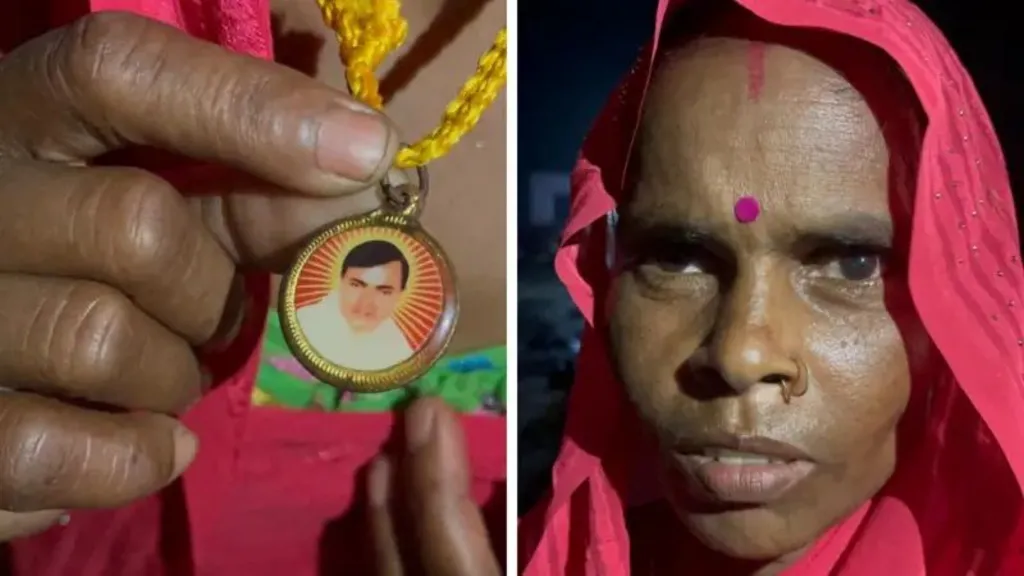
Gomti Devi, who was present at the event, said she had a lot of faith in the Bhole Baba.

She said she wears a locket with his photo because he "cures diseases, ends domestic troubles, and provides employment".
Gomti Devi holds up a locket with the religious leader's image
As reported by Reuters, July 3, 2024 (bold, links in original):

A massive gathering addressed by an Indian policeman-turned-preacher, considered an incarnation of God by his followers, turned horribly wrong on Tuesday, as at least 121 people, mostly women and children, died in a stampede.

"Bhole Baba", or the Innocent Elder, is the sobriquet of a self-styled godman who was a police constable before he turned to spirituality and became a preacher. Originally Suraj Pal Singh, he later changed his name to Narayan Sakar Hari. He is currently untraceable, and police in India's northern state of Uttar Pradesh, where Tuesday's tragedy occurred, said they were still trying to trace him.

Here are some known facts about the preacher:

ORIGINS

Bhole Baba was a police constable in Uttar Pradesh for nearly a decade before he resigned and turned to spirituality, Sudhir Kumar, a senior police official said. The preacher is a native of Kasganj village, close to the Hathras area where the stampede took place.

He used to travel across the states of Uttar Pradesh, Rajasthan and Madhya Pradesh, in India's northern belt, where he has a huge following, and address gatherings, mostly on the first Tuesday of every month, local media said.

A member of India's low-caste Dalit community, Bhole Baba's aim was to create an ideal society, free of superstition and full of compassion, according to a hoarding erected at the site of Tuesday's incident.

ONLINE PERSONA

Posters and videos posted on Bhole Baba's YouTube channel, which boasts of millions of views, show him dressed in either traditional Indian kurta tunics or pristine white suits and ties, often sporting sunglasses, a departure from the spartan image of most godmen.

Holding a microphone in hand, seated on an ornate throne and with his wife by his side, Bhole Baba is seen addressing huge gatherings of mostly women, almost all of whom are sitting on the ground, hands folded in reverence. "Humanity was the true religion, is the true religion and will always be the true religion," he is quoted as saying in a poster.

To protect himself from devotees who would rush to touch his feet and seek his blessings, Bhole Baba had formed a security team known as Narayani Sena, with men and women guards who would escort him to gatherings, an NDTV report said.


Who is Bhole Baba aka Narayan Saakar Hari?

Suraj Pal Singh, known to his followers as Bhole Baba, was born in Bahadur Nagari village in Uttar Pradesh's Etah district to a farmer. He joined UP police and was a head constable working with the Intelligence Unit for over 18 years. However, his followers say he has also claimed that he worked for the Intelligence Bureau.

In 1999, he took voluntary retirement from the service, changed his name to Narayan Saakar Hari and began holding satsangs. He told his devotees he felt an inclination towards spirituality and world peace and he resigned to begin his spiritual journey.

From Suraj Pal to Narayan Saakar Hari

According to a report, he claimed to live in a hut in his village and travelled across Uttar Pradesh to preach. Narayan Hari also enjoys a large following in neighbouring states of Rajasthan and Madhya Pradesh.

Unlike most self-styled godmen, Narayan Hari is seen wearing a white suit and tie or a simple kurta pyjama accompanied by his wife Prem Bati. He also claims he does not keep any money offered to him by followers at his satsangs and distributes it among his followers.

Covid Satsang Had 50,000 Attendees

Even though the self-styled godman is known to keep his distance from the media, he has been embroiled in several controversies. In 2022, he held a similar satsang in UP's Farrukhabad even as cases of Covid were on the rise. While the district administration only permitted 50 people to attend the event over 50,000 people reached the site to attend the programme. The large crowd led to the significant traffic snarls in the area.

Seeing the large crowds that turn up for his satsangs, the godman has a security team named "Narayani Sena" that consists of men and women guards who escort him from his ashram to the satsang locations.
As reported by Reuters, July 5, 2024 (links in original):

The chief organiser of an Indian preacher's event where a stampede killed 121 people this week surrendered to police on Friday, a lawyer for the preacher said, after police had launched a manhunt.

Devprakash Madhukar was named a key suspect in an initial report registered by police under charges including attempted culpable homicide. Police had announced a reward of 100,000 rupees ($1,200) for information leading to his arrest.

A.P. Singh, lawyer for self-styled godman Bhole Baba, said Madhukar was the main organiser of the Hindu religious event on Tuesday attended by about 250,000 people in a village in the northern state of Uttar Pradesh. District authorities had permitted an event of only 80,000 people.

"He has surrendered from Delhi. We are not seeking an anticipatory bail," Singh told reporters. He denied any wrongdoing by the event's organisers and said Devprakash was getting medical treatment in a hospital after the stampede.

The preacher said on Saturday he was saddened by the incident and his aides would help the injured and families of the deceased.

"I have faith that anyone who created the chaos will not be spared," he told Indian news agency ANI, in which Reuters has a minority stake.

($1 = 83.47 Indian rupees)

Sunday, 27 November 2022

Flashback--1975: Guru offers doubletalk on yoga

The definition of yoga from Webster's Seventh New Collegiate Dictionary (1965):
1 cap: a Hindu theistic philosophy teaching the suppression of all activity of body, mind, and will in order that the self may realize its distinction from them and attain liberation 2: a system of exercises for attaining bodily or mental control and well-being
From The Edmonton Journal, November 10, 1975 (bold in original):

He spreads word of yoga

Guru Hariananda wants to spread the true knowledge of yoga.

"Yoga can kill people right away if they don't know what they're doing," he says. "But yoga is a very, very old science, before we had hospitals and doctors, people were still suffering, and how did they get well?"

"They were cured by purifying their bodies with their own bodies. That is the yoga."

The guru (Hari for short) says there are 128 processes in yoga, based on the 8,000-year-old teachings of Yogi Patanjali.

"So many people know of yoga, as standing on their heads, or as a form of exercise, but yoga has a very deep meaning. It's a way of life."

"Yoga makes you fit mentally, physically, spiritually and morally."

The guru came to Edmonton two weeks ago to teach his knowledge of yoga to people in the city. He's been in the city a couple of times before during the past several years, and already has a small number of devotees.

He asks no fees from his devotees, but says he'll take donations to help cover his expenses.

Classes go in in different areas of the city each weekday evening...

...Born in the Himalayas, the 24-year-old Hari has lectured on and taught yoga since he was 13 years old.

In his teaching, he has travelled widely.

Hari stresses that his yoga has nothing to do with Hinduism or any other religion.

"You can stay with your religion. You will reach God. God is within you. You are the God as long as you maintain yourself physically and spiritually.

Those who wish to learn more about the classes or the guru's philosophy should call 484-8025.

Guru Hariananda's assertion that "his yoga has nothing to do with Hinduism or any other religion" is, of course, nonsense. Yoga comes from the Sanskrit word yunakti, meaning “he yokes.” The yoking is with Brahma, the ground of all being in Hinduism. Patanjali was a Hindu author, philosopher, and mystic whose lifespan was apparently between the 2nd and 4th centuries A.D. Until it became “westernized,” Yoga was mainly about teaching old Hindus how to die. It’s no more about relaxation and relieving stress than Transcendental Meditation, which is also Hinduism. Neither one caught on in the west until they decided to change the marketing approach to appeal to westerners’ priorities, such as financial prosperity, physical health and emotional well-being. It's interesting that Guru Hariananda claims that yoga "can kill people right away if they don't know what they're doing" which could apply to many Westerners who don't realize what yoga acutally is.

Guru Hariananda's statement that "God is within you...you are the God..." is certainly in conflict with the Bible's consistent teaching that we are not God, and that God lives only within those who have saving faith in Jesus Christ. For further reading, I recommend the books Death of a Guru by Rabi Maharaj with Dave Hunt (1977, 1984) and Yoga & the Body of Christ by Dave Hunt (2006), and the article The Basic Spirituality of Yoga by Marcia Montenegro of Midwest Christian Outreach (March 8, 2018). See also my post Christian woman in Manitoba who warns of the dangers of Yoga shows more discernment and courage than the local "Christian" clergy (April 26, 2018).

Elvis Presley offered a good practical view of yoga in the movie Easy Come, Easy Go (1967):

Saturday, 1 October 2022

Hindu nationalism raises concerns in New Jersey

While some people in the U.S.A.--especially those who want the country to continue on the secular road to destruction--are raising alarms about Christian nationalism, another form of religious nationalism is attracting concern--such are the "blessings" of multiculturalism. As reported by Hannan Adely of North Jersey Media Group, October 1, 2022 (links in original):

In his native India, Shaheen Khateeb said he was treated like an outsider, harassed at school and called “Turk” because of his Muslim faith. Hearing about cases of mob violence against Muslims, he decided to move to the U.S. in 1979.

Today, Khateeb, who lives in Washington Township, fears the tensions he left behind are bubbling up in Indian immigrant communities, including in New Jersey, where, according to the U.S. Census Bureau, about 420,000 people of Indian ancestry live.

In recent months, controversies have ensued over a divisive display at the India Day Parade in Edison, a scuttled speaking engagement in Ridgewood by a Hindu nationalist leader and a Teaneck committee resolution condemned by Hindu groups.

Khateeb said the tensions have strained friendships.

“We visited each other’s homes. We shared dinners. But not anymore,"he said. "What’s happening in India is happening here nowadays because social media news travels really very fast."

Muslim and human rights groups say tensions in the U.S. mirror what is happening abroad as a Hindu nationalist movement grows in India, spurring allegations of discrimination and hate crimes against minorities. But some Hindu leaders say that concerns about nationalist activity in the U.S. are exaggerated and that they are being unfairly vilified and maligned.

Raju Patel, president of the Jersey City Asian Merchants Association, said Indian immigrants are concerned about educating their children and being good citizens, and not the divisions that they left behind.

“People are making a fuss about all these things,” he said. “They are trying to bring those problems here to the U.S.”

Tensions are not new among religious communities in India, where Hindus make up about 80% of the population. But the movement known as Hindutva — a far-right ideology that promotes Hindu rule — has gained strength since Narendra Modi, India’s prime minister, was elected in 2014. Indian right-wing websites and WhatsApp groups have fueled support for the movement in the U.S., said Audrey Truschke, an associate professor of South Asian history at Rutgers University.

What’s new about it is the ferocity of Hindu nationalism, how aggressive they are being and the negative impacts that is having on the Indian Muslim community and cross-community relations,” Truschke said.

Nationalist fervor couched in patriotism, ethnocentrism and anti-immigrant sentiment has risen around the globe. Often, there is a populist strongman at the helm and, in some cases, nationalist extremists have embraced violence to further their cause. These forces have shaped politics in countries like Brazil, Hungary and the U.S., where groups with an "America First" nationalist agenda stormed the Capitol on Jan. 6 to try to subvert the transfer of power.

In New Jersey, many Indian immigrants closely follow news from their native country, but in the past few months, they themselves have been a focus of news stories.

In August, the inclusion of a bulldozer at the India Day Parade in Edison sparked condemnations. In India, some view the bulldozer as a hate symbol for its use in razing homes and businesses to punish Muslim activists in India.

Earlier this month, activists protested a planned fundraiser with Hindu nationalist leader Sadhvi Rithambara at Old Paramus Reformed Church in Ridgewood, leading to its cancelation.

And last week, the Teaneck Democratic Municipal Committee passed a resolution calling for investigations of organizations in the U.S. with alleged ties to a Hindu nationalist paramilitary group. The resolution also called for politicians to reject campaign funds and support from these groups.

The Teaneck resolution sparked outcry from Hindu organizations, which issued a statement calling it a provocative and false act that demonizes the Hindu community and condemns groups that were not given a chance to respond. The backlash prompted Teaneck Mayor James Dunleavy to issue a statement saying the committee is not associated with the township, which has a nonpartisan form of government.

On Friday, the New Jersey Democratic State Committee took a stand against the resolution.

"A foundational goal of the Democratic Party is to bring people together, not to divide them, and the anti-Hindu Teaneck resolution does not accomplish this important goal," the committee wrote in a statement. "We stand with those who value inclusivity and diversity, and against hate and bigotry in any form."

In Edison and Teaneck, residents had heated exchanges over religion and nationalism at municipal meetings or expressed outrage in calls and emails, while urging local officials to take a stance.

Patel said the spate of incidents was due to misinformation and grudges. Nationalism to him meant pride in one's country, he said.

“Is it a crime to have Hindu nationalism? If I hurt somebody, then it’s a crime. In this country, free speech is for everything but some people won’t tolerate that free speech,” he said.

In Jersey City, he said, South Asian immigrants of different faiths continue to work and socialize with one another without problems.

Still, activists, including Khateeb, say the rise of the nationalist movement should not be ignored. Recent violent confrontations in the city of Leicester in England between groups of Hindu and Muslim men were a warning of how problems can escalate, he said. In Leicester, men with metal poles marched through streets chanting “Jai Shri Ram," a religious chant used as a rallying cry against Muslims. At the same time, a Hindu temple was vandalized.

“What happened in the United Kingdom was an eye opener,” he said. “What is happening is Hindutva forces are gathering. There is a massive amount of work being done behind the scenes.”

Thursday, 18 August 2022

The success of this item from Olivia Newton-John's discography reveals something about modern evangelicalism

British-born Australian singer and actress Olivia Newton-John, one of the most successful performing artists of the last 50 years, died on August 8, 2022 at the age of 73, after several battles with breast cancer. I was sorry to hear of her death, and I hope she came to faith in Jesus Christ before her passing. She supported various causes, including women's health, the environment, and animal welfare.

In 1994, following her first bout with breast cancer, Miss Newton-John released the album Gaia: One Woman's Journey. Gaia, in Greek mythology, is the personification of the Earth, and is regarded as the ancestral mother of all life. According to the Infogalactic entry on Miss Newton-John:

The following year, Newton-John released a healing CD, Grace and Gratitude. The album was sold exclusively by Walgreens also benefitting various charities including Y-ME National Breast Cancer Organization. The CD was the "heart" of their Body – Heart – Spirit Wellness Collection which also featured a re-branded Liv-Kit and breast-health dietary supplements. Newton-John re-recorded some tracks from Grace and Gratitude in 2010 and re-released the album as Grace and Gratitude Renewed on the Green Hill music label. The Renewed CD includes a new track, "Help Me to Heal," not featured on the original album. The Renewed CD yielded Newton-John's first appearances on the Billboard Christian Albums (No. 36), Christian & Gospel Albums (No. 54) and New Age Albums (No. 2) charts.
The songs on Grace and Gratitude Renewed include Learn to Love Yourself; Grace and Gratitude; Let Go Let God; Help Me to Heal; and The Power of Now. I've listened to these five songs, and I've noticed a few things. Learn to Love Yourself contains the words "Trust the light that shines within," which is far more in keeping with New Age belief than Christian doctrine. Grace and Gratitude contains the words "A thousand names a thousand roads all lead to one simple truth," although the simple truth isn't clearly stated. The thanks expressed are apparently directed toward God, but it's not clear. Let Go Let God is a phrase common among Christians, but the instrumental arrangement sounds increasingly Indian as the song goes on. At about the 2:27 mark of the video for Help Me to Heal, Miss Newton-John is happily pointing to a chart of "The Chakra System," depicting the Hindu teaching that the human body contains nodes of psychic energy known as chakras. The Power of Now is also the title of the first book of New Age author Eckhardt Tolle. The full title of the book is The Power of Now: A Guide to Spiritual Enlightenment (1997); he also wrote the sequel, Practicing the Power of Now: Essential Teachings, Meditations, and Exercises from The Power of Now (2001).

The fact that Grace and Gratitude Renewed appeared on both Christian and New Age charts is an indication of the lack of discernment in modern evangelicalism. See and hear for yourself.


Thursday, 26 March 2020

Hindu idolaters in India drink cow urine in an attempt to fight coronavirus

I think I'd rather take my chances with the virus. As reported by David Sidman of Breaking Israel News, March 25, 2020:

Hundreds of Hindus across India are holding cow urine ceremonies in New Delhi to protect and cure themselves from the coronavirus.

Most forms of Hinduism are henotheistic. This means that they worship a single deity called “Brahman,” but still believe in other gods and goddesses. Or, as Hindu writer Shuba Swaminathan puts it: “Hindus do not worship idols” but rather “the power vested in the idols.”

Many in India, a nation of 1.3 billion whose majority is Hindu, consider cows to be sacred. Some of them have recently claimed that cow urine is an elixir.

In their ceremonies, the Hindus can be seen making an “offering” to the coronavirus and while praying that “mother cow” helps them.

Hindu activist Om Prakash claims that the coronavirus is a bacteria (even though it has the word ‘virus’ in its name). He adds that “cow urine is effective against all forms of bacteria” and that he and his fellow Hindus use it “to cleanse their souls and bodies.” Prakash adds that he is “sure cow urine will destroy the bacteria.”

Please don’t try this at home kids.


Sunday, 19 January 2020

30 years ago: The death of Bhagwan Shree Rajneesh

For false Christs and false prophets shall rise, and shall shew signs and wonders, to seduce, if it were possible, even the elect. Mark 13:22 (also Matthew 24:24)

On January 19, 1990, Indian "holy man" Bhagwan Shree Rajneesh died of heart failure at the age of 58. Bhagwan Shree Rajneesh, born Chandhra Mohan Jain, was a Hindu guru who became a philosophy professor and a popular lecturer in the 1950s and '60s. Bhagwan Shree Rajneesh became known as the "sex guru" because of his liberal teachings on sex. He began initiating disciples in 1970, and created an ashram. The ashram began attracting Western followers, especially after 1975, when therapists promoting human potential, aka New Age teachings arrived. Violence and abundant sexual activity between members attracted critical attention from Indian authorities, and Bhagwan Shree Rajneesh and he relocated to Oregon in 1981, where American followers Sheela Silverman and her husband John Shelfer had purchased property.

The Rajneesh organization created the city of Rajneeshpuram, accumulating 93 Rolls Royces and encountering stiff opposition from local residents. Bhagwan Shree Rajneesh had taken a vow of silence in April 1981, but ended the public silence in October 1984, and almost a year later publicly denounced Ms. Silverman and her associates, accusing them of serious crimes, including a 1984 salmonella attack on local residents. Rajneeshpuram collapsed, and Bhagwan Shree Rajneesh was indicted in October 1985 for conspiracy to evade U.S. immigration laws; he ended up making a deal including a fine and an agreement not to return to the United States for five years. After various stops around the world, he landed in Mumbai in July 1986, returning to his ashram in Pune six months later. He suffered from declining health, which he blamed on poisoning in U.S. jails, and in 1989 took the name Osho Rajneesh.

It's interesting to note that a disproportionate number of Bhagwan Shree Rajneesh's followers had backgrounds in psychology. I was a student at Grant MacEwan Community College in Edmonton in the early 1980s, and the college had a psychology instructor under the surname of Narayan, who was a Rajneesh devotee. Mr. Narayan was a Jew whose original name I've forgotten, but he changed his name after falling under the spell of the Bhagwan.

Bhagwan Shree Rajneesh's organization continues to proclaim his false teachings, using the name OSHO. As for the current whereabouts of Rajneeshpuram's 93 Rolls Royces--we're not sure. False Christs such as Bhagwan Shree Rajneesh come and go, but the Lord Jesus Christ lives, and will return to Earth (Acts 1:11).


Wednesday, 25 December 2019

Good riddance to Richard Alpert, aka Baba Ram Dass

And as it is appointed unto men once to die, but after this the judgment: Hebrews 9:27

Neither repented they of their murders, nor of their sorceries, Revelation 9:21a

On December 22, 2019, New Age guru Baba Ram Dass, born Richard Alpert, died at the age of 88 after years of declining health. Dr. Alpert was born into a Jewish family and was bar mitzvahed, but considered himself an atheist in his younger years.

He earned a doctorate in psychology and became an assistant professor of clinical psychology at Harvard University in 1958. Dr. Alpert soon became associated with fellow Harvard psychology professor Dr. Timothy Leary, and the two began experimenting with hallucinogenic drugs, which Dr. Alpert regarded as his first "whiff of God." Drs. Leary and Alpert were both dismissed from Harvard University in 1963, and set up a commune with other advocates of mind-altering drugs. The word rendered "sorceries" in Revelation 9:21 is from the Greek pharmakeia--from which we get the English word "pharmacy"--referring to the use of drugs, "generally accompanied by incantations and appeals to occult powers...".

Dr. Alpert went to India in 1967, and was indoctrinated into Hinduism, becoming a devotee of Neem Karoli Baba, aka Maharaj-ji, who gave him the name "Ram Dass." Dr. Alpert's conversion to Hinduism was a predictable development; the supernatural experiences people reported while using hallucinogenic drugs were similar, if not identical, to those reported by Hindu gurus, thus indicating a common source for the experiences.

Baba Ram Dass went on to found educational and service foundations, such as the Hanuman Foundation and the Seva Foundation. He denounced Dr. Leary in 1974, but the two reconciled in 1983. Ram Dass co-founded the Living/Dying Project in 1986, based in Marin County, California (surprise!), in which people were instructed in "conscious dying." Dr. Elisabeth Kübler-Ross, the pioneering scholar of near-death studies and authoress of On Death and Dying (1969), was one of Ram Dass' students. It's worth noting here that Hinduism teaches reincarnation rather than resurrection, and believes the lie "Ye shall not surely die" (Genesis 3:4), while denying the biblical truth that death is an enemy (I Corinthians 15:26).

At the age of 60, Baba Ram Dass began exploring Judaism, and established a long-standing friendship with Rabbi Zalman Schachter-Shalomi of the Jewish Renewal movement, who tried, without apparent success, to draw him back into the Jewish fold. In the 1990s, Baba Ram Dass began publicly discussing his bisexuality, thereby providing more evidence that deviant spirituality is often manifested in deviant sexuality.

Saturday, 16 November 2019

And now for something completely different: Church of England vicar bars yoga from his church

At least one clergyman in the Church of England is able to recognize that yoga is a Hindu practice, and has no place in an ostensibly Christian church. As reported by the London Daily Telegraph, November 6, 2019:

A yoga teacher has been barred from using a church hall for her classes after a clergyman claimed the practice was not "compatible" with Christianity.

Atsuko Kato, 54, has run sessions at a range of venues for 25 years, building up a client base across Devon.

But when she looked for new venues to host classes in Barnstaple she was rejected from hiring a church hall in the village of Pilton due to religious reasons.

Reverend Nigel Dilkes said St Mary's Church could not accommodate Ms Kato because the activity was not "compatible with the Christian faith".

Yoga originated in northern India and has connections to both Hinduism and Buddhism. Ms Kato said the reverend's stance was "outdated", and pointed out that a female vicar was among her students.

She said: "They asked me what I wanted to hire it for and I said to teach a yoga class.

"They said they can not tolerate it if it was for yoga and claimed yoga was not suitable for a church.

"They said they weren't allowed to host yoga classes because they were a church and it was not compatible with Christian beliefs. No other explanation, that was it.

"In one of my classes I have a female vicar and they don't seem to have concerns, so I struggle to understand what the problem is.

"I was very surprised by this attitude, yoga is so mainstream now."

Reverend Dilkes said the church hall was solely to be used for activities deemed compatible with the Christian faith, and encouraged pilates to be practiced as an alternative.

He said: "The test of this is whether a belief or world view underpinning the activity acknowledges that there is only one God and that the New Testament person of Jesus Christ is God himself.

"Yoga is one of several activities that claims to confer physical benefits for flexibility and balance but also claims a spiritual connection which doesn't stand this test.

"So we say why not enjoy, for example, pilates instead. We would welcome pilates classes to our church hall."
It's not surprising that a female "vicar" would have no concerns about a Hindu practice. I don't know about pilates, but I've noticed a difference of opinion as to whether it includes New Age teaching. For more information, search Lighthouse Trails Research Project and Kjos Ministries, as well as the book Yoga & the Body of Christ by Dave Hunt (2006).

Friday, 30 August 2019

Practicing "extreme yoga" may produce extreme results

You tell me just how I can take this Yoga serious
When all it ever gives to me is a pain in my posterious.


--Yoga is as Yoga Does, as performed by Elvis Presley (with Elsa Lanchester) in the movie Easy Come, Easy Go (1967).

Yoga is a Hindu practice that is not only dangerous spiritually, but can be dangerous physically if taken to an extreme. The young lady mentioned in the following article is very pretty, if the photographs are accurate, but not very bright.

As reported by Meaghan Wray of Global News, August 27, 2019 (links in original):

Alexa Terrazas, 23, was pictured hanging upside down on a balcony in Mexico Monday. Moments later, she survived a 25-metre fall that resulted in 110 broken bones.

The college student, originally from Chihuahua, was supposedly practising “extreme yoga,” a tweet by social media user Javier Rayado reads.

Speaking to Global News, Rayado says he received the photo from a friend he has in common with Terrazas, but would not provide a name.

The fall occurred in the area of Las Privanzas in San Pedro Garza García, Nuevo León.

According to the New York Post, the woman was treated by paramedics with the Red Cross and Nuevo León Civil Protection before being brought to the hospital.

She reportedly needs full reconstruction of her ankles, knees and face, and likely won’t walk for another three years after the fall.

Local publication El Universal says she underwent an 11-hour surgery at Hospital Zambrano Hellion, and that the fall is being investigated by the Nuevo Leon Attorney General’s Office.

According to numerous Mexican publications, the woman’s family is requesting blood and platelet donations through blooders.org, though her profile is no longer visible on the donation website.

A student of nutrition at Tecnológico de Monterrey, Terrazas is known to be a thrill-seeker, per her Instagram account featuring many images of skydiving, bungee jumping and other adrenaline-fuelled activities.

She has more than 4,000 followers.

According to Extreme Yoga: Challenging Poses for a Cutting-Edge Practice by Jessie Chapman, the practice asks participants to perform over-the-top postures that “add challenge and excitement to the yoga practice of anyone who can handle them.”

The cover shows a woman doing an extreme backbend with her feet over her head in a traditional pose taken to the next level.

A Pinterest board for similar poses shows many options for one or two people on the ground.
Miss Terrazas succeeded in taking the practice of yoga to the "next level," but that level turned out to be in the wrong direction, giving her more "thrills" and "challenge and excitement" than she was expecting. Her more than 4,000 followers should refrain from following her to that extent. Now that the Lord has graciously spared Miss Terrazas' life, let's pray that she will come to know Him during her long convalescence.

Elvis Presley took a safer position on yoga than the promoters of the extreme variety:

Wednesday, 22 May 2019

40 years ago: Indian guru receives prison sentence in Switzerland for ordering followers to commit crimes against opponents

As reported by United Press International, May 23, 1979:

Lausanne, Switzerland--Self-styled Indian guru Swami Okmarananda [reported in some newspapers as Ommarananda--blogger] was sentenced to 14 years imprisonment Tuesday for ordering members of his bizarre Divine Light Centre to kill and intimidate opponents of his sect.

Okmarananda, 49, whose sect practised sexual and black-magic rites, promptly appealed the verdict by the Swiss Federal Criminal Court.

He was arrested in 1976 after Divine Light members blew up the house of Zurich state police chief Jakob Stucki.

Stucki and his family escaped unhurt.

Sentenced along with Okmarananda was his right-hand man Joseph Meichtry, a Swiss, who was sentenced to seven years.

A German woman, Verena Plein, received a four-year sentence and was ordered to undergo psychiatric treatment.

A 24-year-old Australian nurse, Katherine Bingham, was sentenced to 27 months.

Verena Plein told the court during the two-week trial that she had been forced to serve as a human altar. She was raped and a chicken was slaughtered over her body.

Katherine Bingham told the court that Okmarananda had sect members inject poison into chocolates and tomatoes and try to give them to the families of authorities opposing the Divine Light Centre, which had its headquarters in Wintethur, north of Zurich.

Two youths, Johannes Schaeben and Theo Diem, received suspended terms of one year and six months respectively.

Miss Bingham's sentence was also suspended. She will be expelled immediately from Switzerland because the court also handed down a sentence of three years expulsion from the country.


According to the Wikibin entry on Swami Okmarananda:

The evidence against the Swami himself is disputed, however, and in a later series of articles published in the Swiss newspaper Tages Anzeiger an investigative journalist presented certain materials which supposedly had been suppressed at the time of the trial, such as involvement of Belgian and Zurich police. One of the Zurich police officers - who led the investigation and the one who is accused of signing a letter ordering the suppression of material - was later accused of corruption.

Swami Okmarananda died on January 4, 2000, six days after his 70th birthday.


Saturday, 1 December 2018

30 years ago: Yogi Satchakrananda underwhelms Edmonton

On December 1, 1988, five days after witnessing a performance by disgraced televangelist Peter Popoff (these were interesting times), this blogger and fellow cultwatcher Chris Milner were among several dozen people who attended a lecture by one Yogi Satchakrananda at a New Age centre whose name I've forgotten--its initials were ARC--on Whyte Avenue in Edmonton. Yogi Satchakrananda was a white American who ran a New Age community called Raj-Yoga Math and Retreat. According to a page archived from the now-defunct site Novelguide:

The Raj-Yoga Math and Retreat is a small monastic community formed in 1974 by Fr. Satchakrananda Bodhisattvaguru. Satchakrananda began the practice when he experienced the raising of the kundalini, an internal energy pictured in Hindu thought as a snake coiled and resting at the base of the spine that, upon awakening, rises to the crown chakra (psychic center at the top of the head). That event produced an awareness of Satchakrananda's divine heritage. Following that event, he spent a short time in a Trappist monastery, attended Western Washington University, then became coordinator for the Northwest Free University, where he taught yoga. in the early 1970s.

In 1973 Satchakrananda was "mystically" initiated as a yogi by the late Swami Sivananda Saraswati (1887-1963), the founder of the Divine Life Society, through a trilogy of "female Matas" at a retreat he attended on the Olympic (Washington) Peninsula. The following year, with a small group of men and women, he founded the math (monastery). In 1977, he was ordained a priest by Archbishop Herman Adrian Spruit of the Church of Antioch (see separate entry) and has attempted to use both Hindu and Christian traditions at the math. Spiritual disciplines include the regular celebrations of the mass, though the major practice offered is the Jaya Yoga Sadhana, consisting of the successive practice of japa (mantra) yoga, meditation, kriyas (cleansings), mudras, asanas (hatha yoga postures), and pranayam (disciplined breathing). Jaya yoga allows practitioners to become aware of their divine nature.

The math is located in the foothills of Mt. Baker overlooking the Nooksuck River near Deming, Washington. It accepts resident students for individual instruction, but offers a variety of retreats/ workshops for nonresidents. For those unable to travel to the math for instruction, Satchakrananda has put together a jaya yoga workshop packet.

Membership: The resident community at the math fluctuates between two and twelve. Several hundred individuals are associated with the math through an oblate order of men and women.
The yogi wore a robe and turban, but the sneakers that were clearly visible underneath gave him a greater resemblance to George Costanza than to a supposed holy man. I don't remember much of what Yogi Satchakrananda said, but it included the usual New Age mumbo-jumbo about how we create our own reality through means such as visualization. At one point a young man in the front row mentioned that a train crossing in front of his car had delayed his arrival, forcing him to adjust his thinking accordingly (or something like that), prompting Mr. Milner to wonder why the man didn't just create a better reality for himself by visualizing the train disappearing.

Yogi Satchakrananda said that he had had an experience years earlier (I think it was in 1967, but I could be wrong) which had caused his head to explode (which I thought might explain the turban). This was undoubtedly the rising of the kundalini referred to in the article above.

At one point he asked "You guys don't think I'm a cult, do you?," and oddly, he was looking right at the two of us.

To this blogger, the most interesting thing about the article above, which wasn't part of Yogi Satchakrananda's talk in Edmonton, is the yogi's advocacy of a mixture of Hinduism and ostensible Christianity. The bridge between these incompatible faiths is contemplative spirituality, in which mysticism--direct unmediated experience of the supernatural--takes precedence over the truth of the Bible and the instructions and warnings found therein. This is exactly what we're increasingly seeing in supposedly "evangelical" churches today. It seems as though Yogi Satchakrananda was considerably ahead of the curve on that. The reader will notice that while the Raj-Yoga Math and Retreat attempted to combine Hindu and Christian methods, the goal was strictly Hindu: realization of one's divine nature.

Yogi Satchakrananda's books include the following:

Coming and Going, The Mother's Drama. Deming, WA: Raj-Yoga Math & Retreat, 1975.

Letters to Satchakrananda. Deming, WA: Raj-Yoga Math & Retreat, 1977.

To Create No Freedom. Deming, WA: Raj-Yoga Math & Retreat, 1983.

Thomas Merton's Dharma. Deming, WA: Raj-Yoga Math & Retreat, 1986.


The perceptive reader will note the book about Thomas Merton--a Roman Catholic Trappist monk who's so beloved by practitioners of contemplative spirituality. The 50th anniversary of Rev. Merton's death--of accidental electrocution at a Buddhist retreat in Thailand--will be coming up on December 10, 2018.

As Dave Hunt and others have observed, I can't have much of a divine nature if I don't automatically realize it, and have to take a course from someone in order to discover it. The Bible refutes our divine nature in passages such as Romans 3:10-23. Salvation is achieved not by getting in touch with our allegedly divine nature, but by putting our trust in the one true God and the work done on the cross by the one mediator He has provided:

For there is one God and one mediator between God and men, the man Christ Jesus. I Timothy 2:5

For an excellent book on the subject, I recommend Rabindranath R. Maharaj's autobiography Death of a Guru (1977), which was republished under the title Escape Into the Light in 1984. He was born in Trinidad, came from a long line of Brahmin priests and trained as a yogi, but as a young man in the early 1960s, came to know Jesus Christ as his saviour, and has been a great contender for the Christian faith ever since.

This blogger has been unable to find anything recent on Raj-Yoga Math and Retreat or Yogi Satchakrananda; as to his current whereabouts or even whether he's still alive--we're not sure.

For good information on contemplative spirituality, I especially recommend Lighthouse Trails Research Project and Herescope.

Saturday, 17 November 2018

"Secular" Oasis community incorporates practices from various religions

The fool hath said in his heart, There is no God...Psalms 14:1a (also Psalms 53:1a)

Having a form of godliness, but denying the power thereof: from such turn away. II Timothy 3:5

The Oasis community in Toronto, whose board of directors includes the notorious atheist United Church of Canada minister Gretta Vosper (see post below), claims to be "secular" and "not atheist," which leads this blogger to suspect that they just prefer the word "secular" because "atheist" carries more negative connotations. As reported by Megan Dolski of the Toronto Star, December 28, 2016 (links in original):

A new Toronto group is expected to launch on Feb. 12, joining a growing network of communities popping up across the central and southern United States, with meetings based on shared common values instead of a religion.

It’s not a church, but in many ways is sort of like one.

Oasis groups meet weekly in whatever space they find suitable — from dance studios to conference centres — for talks, discussions and music. This movement is founded on five shared values including: people are more important than beliefs, reality has its roots in reason, and humans can fix human problems.

In Toronto, the group is being started by a core team of about 10 people, including West Hill United Church’s atheist minister Gretta Vosper, Humanist Canada’s Martin Frith, Bangladeshi author Raihan Abir and advocate and artist Agah Bahari. It will be the first chapter of the network in Canada.

Vosper, who joined the network’s board of directors this year, made headlines when the United Church ruled that she was “unsuitable” to do her job because she doesn’t believe in God. The church is expected to decide whether it will defrock sometime next year. Although she’s still at West Hill United, Vosper is expanding her work with Oasis, which she says is similar to what she’s doing already — but this time, with absolutely no church affiliation.

“I think there are a number of things that religion does within community and for individuals that are important,” Vosper said. “Church didn’t come up with the idea of gathering, and church didn’t come up with the idea of transmitting values from one person to the next or transmitting things from one generation to the next.”

She thinks Oasis can meet those needs in a non-religious way. Vosper said no membership is needed to attend an Oasis gathering and drop-ins are welcome.

Helen Stringer, who started an Oasis chapter in Kansas City and is the co-founder of the network, said the movement is growing faster than she expected.

“The real thing that we’re offering is really that type of community support that is missing, I think, in a lot of people’s lives,” she said. “We are more individualized and isolated probably than ever, our society has just kind of started to flow that way. So a lot of us are looking for alternative ways to still connect with human beings.”

Stringer said even though the group has made no attempt at promoting itself, the Oasis network has received media attention. She said people have expressed interest in starting their own Oasis communities as far as Africa, South America and Europe. Although the non-profit network hasn’t got around to translating its start-up materials to meet overseas demand, she thinks the concept can work anywhere.

Bahari, one of the Toronto group’s founding members, thinks the network will fit well here, even if it might initially “freak some people out.”

He notes that Oasis is a secular community, not an atheist one, and that it will be open to listening and morphing into what the local public wants it to be.

“I think the fact that there are many different people from many different backgrounds has a lot of significance,” Bahari said. “I think that’s the most Toronto thing about it.”

Closer to its launch date, founding members of the Toronto Oasis will announce details about upcoming, public weekly gatherings, which will be hosted at the University of Toronto’s multi-faith centre.
From a quick glance at the Toronto Oasis website, the movement strikes this blogger not so much as "secular," but rather just anti-Christian. I always find it amusing that secularists atheists can't invent anything of their own, but always seem to counterfeit Christianity; in the case of Oasis, they have their gatherings on Sunday. The blog posts announcing the topics of their gatherings promote several practices that have religious origins and associations. Just two recent examples:

Sun Oct 14th: Mindful Living: The True Path to Wisdom

Sun Nov 18 – Plant-based Eating: Discussion and Questions

Mindfulness comes from Buddhism, while vegetarianism is traditionally associated with pagan nature worship and Eastern religious beliefs, including reincarnation. The one consistent thing about Oasis is its anti-Christian worldview.

Thursday, 15 November 2018

Feminists attempt to invade Hindu temple in India

Feminists are not only attempting to take over nominal and actual Christian churches (see post below), but are attempting the same in non-Christian religions. Submitted for your approval, the following, as reported by Kai Schultz of The New York Times, October 23, 2018 (links in original):

NEW DELHI — Before Hindus can climb the 18 golden steps leading to the Sabarimala Temple, a centuries-old hillside shrine in southern India, there are customs to observe.

Devotees fast for 41 days, avoiding alcohol and tobacco. They prepare bundles of goods to be tied to their heads, filling pouches with jaggery, flattened rice and turmeric powder. And they observe a ban on women of childbearing age from visiting, because the shrine’s deity, Lord Ayyappa, is celibate.

Last month, after India’s Supreme Court struck down that ban, furious protests burst the calm surroundings at the Sabarimala Temple, located in a forested patch of the state of Kerala.

When the temple reopened for six days on Wednesday, for the first time since the court’s decision, the pilgrimage path became a kind of conflict zone, pitting traditionalists against police officers who vowed to enforce the law and protect any woman who wished to visit.

At least 12 women attempted the journey. Each was met with a mob that variously shouted in her face, pummeled the police, set vehicles on fire, hurled rocks and blocked the steep, three-mile trail leading to the temple by lying on its slippery stones. All of the women were forced to turn back. One was so overwhelmed that she fainted.

Now, with the temple closed again for about two weeks before its peak season starts, officials are scrambling to figure out what to do. On Tuesday, India’s Supreme Court announced that it would hear petitions next month challenging its ruling. The court did not elaborate; some lawyers said it was too early to say whether the justices had been swayed by the protests, but that a reversal of the ruling seemed unlikely.

For now, Krishna Kumar, a commanding officer posted near the temple, said the focus was on law and order. He gave a dry laugh when asked if the police were ready for November’s reopening. The annual event is often compared to the rush at Mecca, and a crush of millions of pilgrims can clog the trail for hours.

“This is a huge problem,” Mr. Kumar said, “a very huge challenge for the police.”

It is not unusual for Indian court rulings to go unenforced, particularly in remote rural areas. The Supreme Court put that to the test with its September ruling, which overturned a 1991 decision by the High Court of the state of Kerala that banned menstruating women — defined as girls or women between the ages of 10 and 50 — from visiting the temple.

Advocates of the ban argued that it should be respected because it had been in effect for so long, and that the temple’s celibate deity had constitutional rights. But in a 4 to 1 decision, the court disagreed. “Religion cannot become a cover to exclude and to deny the right of every woman to find fulfillment in worship,” Judge Dhananjaya Y. Chandrachud wrote in his opinion.

Almost immediately, thousands of protesters who disagreed marched in Kerala, threatening violent repercussions for women who tried to visit the temple.

Bhakti Pasrija Sethi, a lawyer who was involved in challenging the ban, said she was baffled by the backlash, saying the dismantling of exclusionary rules in other places of worship, like the Haji Ali, a mosque and tomb in Mumbai, or temples in west central India, were not met with the same level of vitriol.

In any case, she said, there was evidence that women had peacefully visited the Sabarimala Temple decades ago for rice-feeding ceremonies, which mark a baby’s first intake of solid foods. Other temples dedicated to Lord Ayyappa also allow women to enter, she said.

“They are giving superstition the cover of religion,” Ms. Sethi said of the protesters. “What they are doing is not religion. The Hindu religion is not teaching you violence.”

Kerala’s chief minister, Pinarayi Vijayan, attributed much of the chaos to members of fringe Hindu groups disguising themselves as pilgrims and then “spreading terror.” Kerala is run by a coalition of communist parties; opposition politicians in the state have warned the police not to use force against protesters and argued that India’s central government, which is led by a party with Hindu nationalist roots, should take over security at the temple.

Initially, the police encouraged women to visit. When a female journalist for The New York Times tried to climb up the path on Thursday, several officers went before her, insisting that it was safe to continue even as the mob began throwing stones. She was struck on the shoulder but was not injured.

As the security situation grew more intense, the government seemed to waver on enforcing the court’s ruling. On Friday, two women, Rehana Fathima, a social activist, and Kavitha Jakkal, a journalist, began climbing the trail in helmets and shoulder pads, escorted by about 100 police officers in riot gear.

As they crested the hill, becoming the only women yet to make it that far, a police officer said there was news: The Kerala government had called to say it was not particularly pleased with the situation.

Kadakampally Surendran, an official with the state Devaswom, a religious trust that helps manage temples, told reporters in Kerala’s capital, Thiruvananthapuram, that the authorities could not allow the shrine to become a place where “activists can come and showcase their power.”

Ms. Fathima said she was not there for activism, but Sunil Arumanoor, a public relations officer with the temple, called her “publicity hungry.” He said those who visited the temple specifically to make a point would be turned away. “This temple belongs to true devotees,” he said in an interview.

After Ms. Fathima and Ms. Jakkal reached the temple’s entrance, a crowd of protesters blocked their way. The temple’s priest warned that he would lock the doors if the women proceeded. They turned back.

Since then, several more women have tried their luck, but the obstacles seemed to pile up. On Saturday, when an advocate for the rights of Dalit people told the police she wanted to go, they discouraged her from doing so because of the heavy rains, and they subjected her to a background check. Others were so badly harassed by protesters that they did not even make it to the trail.

By Monday evening, when the temple complex shut, the message, at least for the moment, seemed clear: The Supreme Court’s ruling had no bearing there.

“History not made,” read a headline on NDTV, an Indian news channel.
The temple was scheduled to reopen on November 16, 2018; go here for the latest news.

Several things about the article above struck this blogger as interesting. The reader will notice that false gods and religions make extraordinary demands on their followers; such is the way with man-made religion, which always involves salvation or self-improvement by works. The God of the Bible, on the other hand, is a God of love and grace, who has not only done everything necessary and sufficient for salvation Himself, but has given us everything we need for "life and godliness" (II Peter 1:3).

India's Supreme Court is just as activist as the Supreme Courts of Canada and the United States, making a ruling to push their agenda and then inventing the most absurd legal justification for it. The "right of every woman to find fulfillment in worship" is given precedence over the right of the religion itself to determine its own doctrines and practices. This isn't a matter with wider social significance (such as whether Jehovah's Witnesses can deny blood transfusions to children who aren't yet of age), but a matter just within the religion itself as to what constitutes permissible worship. The Indian Supreme Court's invention of this "right" is one to keep in mind, to see if and when North American courts invoke it in future rulings restricting religious freedom.

The male Hindu traditionalists mentioned in the article above may be aware of Vox Day's second law of Social Justice Warriors: SJWs always double down. In striking contrast to the wimpiness so often seen among professing Christians in the West, they aren't meekly submitting to an activist court ruling, but are vigorously asserting their right to preserve and practice their religion, even if it means opposing the courts and police. You seldom see that among professing Christians in Western nations.

Monday, 15 October 2018

100 years ago: The death of Shirdi Sai Baba

Jesus saith unto him, I am the way, the truth, and the life: no man cometh unto the Father, but by me. John 14:6

For there is one God, and one mediator between God and men, the man Christ Jesus; I Timothy 2:5

On October 15, 1918, Indian mystic and guru Shirdi Sai Baba died at a reported age of 83. He was something of a syncretist, as he preached the importance of self-realization and promoted the reading of both Hindu and Muslim scriptures, while opposing religious orthodoxy, whether it be Christian, Muslim, or Hindu.

Shirdi Sai Baba founded a movement that still has Hindu and Muslim devotees throughout the world who regard him as an avatar, an incarnation of the Hindu deities Shiva and Dattatreya. The later guru Saithya Sai Baba (1926-2011), who also founded a worldwide movement devoted to himself, claimed to be the reincarnation of Shirdi Sai Baba. Both Sai Babas were mistaken.


Tuesday, 11 September 2018

125 years ago: The World's Parliament of Religions opens in Chicago

There is a way which seemeth right unto a man, but the end thereof are the ways of death. Proverbs 14:12 (also Proverbs 16:25)

On September 11, 1893, the World's Parliament of Religions opened at the World's Congress Auxiliary Building (now the Art Institute of Chicago), in conjunction with the World's Columbian Exposition. The Parliament was the brainchild of Swedenborgian layman Charles C. Bonney, who appointed Rev. John Henry Barrows, pastor of First Presbyterian Church in Chicago, as chairman of the General Committee. Religions represented at the Parliament, which ran until September 27, included not only ostensible Christianity, but Hinduism, Buddhism, Jainism, Spiritualism, and Christian Science.

The most prominent speaker was Swami Vivekananda from India, who introduced Hinduism and spoke against fanaticism and in favour of tolerance and truth inherent in all religions. He opened his first speech on the afternoon of September 11 with the words, "Sisters and brothers of America!," prompting an immediate standing ovation from the crowd of 7,000, lasting for two minutes. While Swami Vivekananda, who had been on a speaking tour of the United States and Canada for several months before the Parliament, expressed criticism of the idea that any one religion possessed all truth, he used the Parliament as an occasion to promote Hinduism. Swami Vivekananda played a major role in promoting Vedanta--the school of Hinduism based on knowledge of the Upanishads, Brahma Sūtras, and Bhagavad Gītā--and Yoga in the West until his death in 1902 at the age of 39.

The World's Parliament of Religions was an event of major signifigance in introducing Eastern religion to the West, and thus an event helping to fulfil biblical prophecies of end-time deception. There have been several Parliaments of the World's Religions in recent years, beginning with one in 1993 in Chicago on the occasion of the centenary of the original Parliament, and most recently in 2015 in Salt Lake City. The number of religions represented has continued to expand, and the emphasis has increasingly been toward solving worldly problems, of the sort that Rick Warren, Bill Hybels, and other so-called Evangelical leaders have also been addressing. Birds of a feather--including "unclean and hateful birds" (Revelation 18:2)--flock together.


Monday, 10 September 2018

Contemplative spirituality links various religions at syncretistic event in Little Rock

Can two walk together, except they be agreed? Amos 3:3

Associated Press expresses a dim view of unauthorized republication of its articles, and this blogger can't be bothered to obtain permission, so I'll merely reproduce the link to the article We gather 'together as one'; ‘Love Thy Neighbor’ interfaith event for belonging, oneness by Francisca Jones in the Arkansas Democrat-Gazette, September 1, 2018. The article is well worth reading as an indication of the way in which things are headed.

Monday, 30 July 2018

Seven members of Japanese cult Aum Shinrikyo are hanged for 1995 Tokyo subway murders

For there shall arise false Christs, and false prophets, and shall shew great signs and wonders; insomuch that, if it were possible, they shall deceive the very elect. Matthew 24:24

I missed this item when it was reported a few weeks ago. The reader will notice the influence of the Hindu god Shiva--known as "The Destroyer"--as well as yoga and Eastern meditation. As reported by Daniel Oberhaus in Motherboard, July 6, 2018 (bold, links in original):

On March 20, 1995, two physicists, an artificial intelligence researcher, an engineer, and a heart doctor entered the Tokyo subway system at the peak of morning rush hour. Each of the men carried two small plastic bags wrapped in newspaper and an umbrella with a sharpened tip. After boarding five different trains, the scientists dropped the plastic bags at preordained stations and punctured them with the tips of their umbrellas before exiting the subway to rendezvous with their getaway drivers. As these scientists were whisked away to a hideout, the deadly sarin gas contained in their packages began to permeate the air in the subway tunnels.

By the time the air had cleared, 12 subway commuters were dead and over 1,000 others were injured through exposure to the potent nerve gas. It remains the deadliest act of domestic terrorism in Japanese history.

On Friday, seven leaders of Aum Shinrikyo, the doomsday cult formed in the late 80s that was responsible for the 1995 Tokyo sarin gas attack were executed by hanging. Among the seven were Shoko Asahara, the leader of the Aum cult, Yoshihiro Inoue, the mastermind of the subway attack, Seiichi Endo, the cult’s lead scientist, and Masami Tsuchiya, the group’s chief chemist. The actual perpetrators of the chemical attack are still on death row in Japan.

Although human rights groups like Amnesty International condemned the executions, which are carried out without advance warning in Japan, some attack victims only wish they had been notified about the executions ahead of time.

“When I think of those who died because of them, it was a pity (my husband’s) parents and my parents could not hear the news of this execution,” Shizue Takahashi, the widow of a Tokyo Metro employee who died in the 1995 attacks told CNN. “I wanted (cult members) to confess more about the incident, so it’s a pity that we cannot hear their account anymore.”

Aum Shinrikyo was a religious cult for the internet age. Its members blended yoga, terrorism, murder, chemical weapon production, arms manufacturing, and software development to create a multinational LSD-fueled monster. This is the story of Aum’s creation, the role of science in its terrorist activities, and why the cult’s vision never really died.

Bioterrorists and Software Developers

Formed in 1984 by the pharmacist Chizuo Matumoto, who would later assume the name Shoko Asahara, Aum Shinrikyo was originally dedicated to yoga and meditation. Shortly after its founding, however, Asahara believed he had been selected by the Hindu god Shiva to create a utopian society and set about trying to elect members of his ascetic cult to the Japanese government. When Aum members only managed to secure a few hundred votes in the 1990 elections, Ashara told his reclusive followers that the group should instead focus on the violent overthrow of the Japanese government.

Ashara’s plan began with an attempt to create large reserves of botulinum, a neurotoxic chemical produced by bacteria. To produce the neurotoxin, Seiichi Endo collected soil from the Ishikari River and allowed the bacteria to ferment in large containers at a compound run by the group. Endo managed to produce nearly 50,000 liters of fermented sludge, but since the sludge hadn’t been purified, initial tests showed it induced no toxic effects. Nevertheless, in April 1990 members of Aum loaded the sludge into three spray trucks. They drove by two US naval bases, Narita airport, a Japanese government building and the Imperial Palace while spraying the sludge from the trucks, but the ‘attack’ didn’t induce any negative effects in the people near those areas.

The early years of Aum Shinrikyo were defined by failed chemical attacks. In 1992, Ashara, who now believed he was Jesus, and some of his followers traveled to Zaire in an attempt to acquire Ebola samples, but returned empty handed. The following year, the group again tried to launch an botulinum attack at Prince Naruhito’s wedding using a spray truck, but like the first attack attempt the neurotoxin hadn’t been activated. Shortly thereafter, Aum members tried to launch an anthrax attack by spraying the bacteria from the roof of its headquarters using a fan and in drive-by attacks with spray vehicles. In both instances, the attacks failed due to using unusable strains of the anthrax bacteria.

At the same time, however, Aum carried out a string of murders against those it considered to be enemies or members of the cult that tried to defect. Although the mysterious circumstances of these murders brought increasing public scrutiny to the group, police couldn’t tie the murders to Aum and the negative attention didn’t dampen its popularity. By 1992, Aum Shinrikyo had a net worth of more than $1 billion raised from charging exorbitant fees from its roughly 20,000 members in several countries, including the US, Australia and Russia.

Many of these members were highly educated students and wealthy businessmen. According to a 1996 Wired feature on Aum, many of the cult's recruits were “the otaku—Japan's version of computer nerds—technofreaks who spent their free time logged on to electronic networks and amassing data of every type.” As such, Aum relied heavily on science fiction imagery and grandeur to pedal its vision of nuclear armageddon and techno-redemption to attract new members.Indeed, Isaac Asimov’s Foundation trilogy served as a sort of “bible” for the sect, which also aspired to build a utopian community of scientists.

In 1994, Aum orchestrated its first successful bioterrorism attack by releasing clouds of sarin gas near the homes of judges who were presiding over a real estate lawsuit brought against the cult in Matsumoto. These attacks resulted in eight deaths and injured several hundred others. After years of failures, the chemists working at the cult’s Ministry of Science and Technology demonstrated they could produce large quantities of active nerve agents. As it would turn out, however, this was just the beginning.

Shortly after the Matsumoto attack, Aum’s chief chemist Masami Tsuchiya produced around 200 grams of VX gas, a militarized nerve agent that is more potent than sarin—exposure to only a few dozen milligrams is enough to kill a human adult. In September of 1994, the initial batch of VX created by Tsuchiya was used to kill 20 Aum members that had left the cult as an experiment to demonstrate that the VX gas had been successfully synthesized. In the months leading up to the Tokyo subway attack, Aum stepped up its VX attacks, spreading it on car door handles, injecting it into keyholes and spraying it from syringes onto lawyers, members of Aum victims groups, rival religious leaders and other dissident cult members.

As the members of Aum Shinrikyo made preparations for a large-scale subway attack using sarin gas it had manufactured at a massive facility at the base of Mt. Fuji, Japanese police were building a case against the religious group and preparing for a raid. When word of the impending raid reached Asahara, he ordered the Tokyo attack to be carried out ahead of schedule on March 20. Two days after the attack, Japanese police arrested Ashara and hundreds of Aum cult members and raided the cult’s headquarters at the base of Mt. Fuji. There police found the entrance to a massive sarin production facility hidden behind an alter, a stockpile of sarin precursors that could produce enough of the neurotoxin to kill 4 million people, a Russian military helicopter, explosives, labs equipped to manufacture LSD and meth, millions of dollars in US cash and gold, and several prisoners being held in cells.

The Future of Aum

By 2004, 13 members of Aum Shinrikyo had been sentenced to death and five members given life sentences for their roles in the sarin attack on the Tokyo subway and various individual murders perpetrated by the group. 80 other members of the cult were given prison sentences of varying lengths. Asahara’s execution was postponed in 2012 after two wanted members of Aum were apprehended in Japan. After years of delays due to repeated appeals for re-trials, on Friday morning, seven of the senior members of Aum were executed by hanging with no advance notice given to the public.

Despite the sordid legacy of the Aum Shinrikyo, the group continues to exist, albeit in a nominally different form. Since 2000, the organization has gone by the name Aleph and renounced the violent program of Aum. Still, in 1999, the Japanese government authorized the Public Security Investigation Agency to carry out investigations of the group’s activities across the country as it saw fit. Despite the scrutiny and public protest, however, Aleph members still follow Asahara’s teachings and appear to have deep ties in the Japanese science and technology sectors.

In 2000, it was revealed that Aum-affiliated computer companies had developed software for at least 10 Japanese government agencies and over 80 major Japanese corporations. According to the New York Times, this raised concerns that Aleph may have had access to sensitive government information and computer systems. Following the report, many Japanese companies immediately suspended use of software developed by Aum-affiliated companies out of fear that it would be used for cyberterrorism. In 2002, The Guardian reported that Aum also “enjoys a huge following within Japan's nuclear establishment, which is riddled with believers from millennialist sects.”

Today, Aleph is seen as less of a threat than Aum once was, but it is still an active religious organization that has seen a resurgence of interest in Japan and Russia. In 2016, authorities in Montenegro broke up a conference organized by Aleph in the country after the hotel that was hosting them reported that some of the attendees, most of whom were Russian, showed “signs of ritualistic injury.” In Japan, the organization continues to recruit young people through yoga sessions. Last year, Aleph was raided by Japanese police over illegal recruiting practices, including taking thousands of dollars in membership fees without requiring members to fill out requisite paperwork and failing to disclose the organization’s links to Aum.

In the lead up to Friday’s execution of top Aum members, Japanese police searched 16 facilities related to Aum, including some run by Aleph. Following the execution, a “senior official” at Tokyo’s Metropolitan Police Department said the agency was stepping up security at some locations out of fear that some of Asahara’s followers may try to retaliate for his death.

The story of Aum is as strange as it is tragic, but it serves as an important reminder about the ambiguity of scientific advancement and the democratization of high technology. Although scientists pride themselves on their objectivity and ability to stick to evidence, Asahara demonstrated that they are just as susceptible to being lead astray as anyone else. Moreover, as the cost of sophisticated technologies continues to decrease, it becomes easier for bad actors to get their hands on these same technologies and use them for destructive ends. In the age of deep fakes, gun-toting drones, and freely available militarized malware, the next incarnation of Aum might not be so easy to stop.