Friday, 26 February 2016

400 years ago: The Roman Catholic Church tells Galileo to shut up

On February 26, 1616, the Roman Catholic Church, led by Cardinal Robert Bellarmine, ordered Italian astronomer Galileo Galilei:

to abstain completely from teaching or defending this doctrine and opinion or from discussing it... to abandon completely... the opinion that the sun stands still at the center of the world and the earth moves, and henceforth not to hold, teach, or defend it in any way whatever, either orally or in writing.

Click on the link to see copies of the original documents from Mr. Galilei's trials in 1616 and 1633.

350 years after Galileo Galilei's death, Pope John Paul II decided it was a good time to make amends, as reported by Alan Cowell of The New York Times, October 31, 1992:

ROME, Oct. 30— More than 350 years after the Roman Catholic Church condemned Galileo, Pope John Paul II is poised to rectify one of the Church's most infamous wrongs -- the persecution of the Italian astronomer and physicist for proving the Earth moves around the Sun.

With a formal statement at the Pontifical Academy of Sciences on Saturday, Vatican officials said the Pope will formally close a 13-year investigation into the Church's condemnation of Galileo in 1633. The condemnation, which forced the astronomer and physicist to recant his discoveries, led to Galileo's house arrest for eight years before his death in 1642 at the age of 77.

The dispute between the Church and Galileo has long stood as one of history's great emblems of conflict between reason and dogma, science and faith. The Vatican's formal acknowledgement of an error, moreover, is a rarity in an institution built over centuries on the belief that the Church is the final arbiter in matters of faith.

At the time of his condemnation, Galileo had won fame and the patronage of leading Italian powers like the Medicis and Barberinis for discoveries he had made with the astronomical telescope he had built. But when his observations led him to proof of the Copernican theory of the solar system, in which the sun and not the earth is the center, and which the Church regarded as heresy, Galileo was summoned to Rome by the Inquisition. Forced to Recant

By the end of his trial, Galileo was forced to recant his own scientific findings as "abjured, cursed and detested," a renunciation that caused him great personal anguish but which saved him from being burned at the stake.

Since then, the Church has taken various steps to reverse its opposition to Galileo's conclusions. In 1757, Galileo's "Dialogue Concerning the Two Chief World Systems" was removed from the Index, a former list of publications banned by the Church. When the latest investigation, conducted by a panel of scientists, theologians and historians, made a preliminary report in 1984, it said that Galileo had been wrongfully condemned. More recently, Pope John Paul II himself has said that the scientist was "imprudently opposed."

"We today know that Galileo was right in adopting the Copernican astronomical theory," Paul Cardinal Poupard, the head of the current investigation, said in an interview published this week.

This theory had been presented in a book published in 1543 by the Polish scientist Nicolaus Copernicus in opposition to the prevailing theory, advanced by the second-century astronomer Ptolemy, that the Sun and the rest of the cosmos orbited the Earth. But the contest between the two models was purely on theoretic and theological grounds until Galileo made the first observations of the four largest moons of Jupiter, exploding the Ptolemaic notion that all heavenly bodies must orbit the Earth.

In 1616, the Copernican view was declared heretical because it refuted a strict biblical interpreation of the Creation that "God fixed the Earth upon its foundation, not to be moved forever." But Galileo obtained the permission of Pope Urban VIII, a Barberini and a friend, to continue research into both the Ptolemaic and the Copernican views of the world, provided that his findings drew no definitive conclusions and acknowledged divine omnipotence.

But when, in 1632, Galileo published his findings in "Dialogue Concerning the Two Chief World Systems," the work was a compelling endorsement of the Copernican system.

Summoned to Rome for trial by the Inquisition one year later, Galileo defended himself by saying that scientific research and the Christian faith were not mutually exclusive and that study of the natural world would promote understanding and interpretation of the scriptures. But his views were judged "false and erroneous." Aging, ailing and threatened with torture by the Inquisition, Galileo recanted on April 30, 1633.

Because of his advanced years, he was permitted house arrest in Siena. Legend has it that as Galileo rose from kneeling before his inquisitors, he murmured, "e pur, si muove" -- "even so, it does move."
The Roman Catholic Church's opposition to heliocentrism is an example of the danger of taking an idea with pagan origins and making it church dogma.

Wednesday, 24 February 2016

70 years ago: Provisional Committee of the World Council of Churches concludes its conference in Geneva

On February 24, 1946, the Provisional Committee of the World Council of Churches concluded its four-day conference in Geneva by establishing the Commission of the Churches on International Affairs (CCIA) to stimulate a "vigorous expression" of Christian demands for justice and world order. The conference was attended by representatives of nearly 100 Protestant and Orthodox church organizations from 32 countries.

According to the WCC's website, the CCIA was one of two pioneering projects launched in 1946 in cooperation with the International Missionary Council (IMC) in 1946; the Ecumenical Institute in Bossey, Switzerland was the other.

The Geneva conference was another event in the timeline of end times apostasy. The World Council of Churches, falsely claiming to represent the Lord Jesus Christ and the faith once delivered unto the saints, officially came into being with its first assembly in Amsterdam in 1948.

Saturday, 20 February 2016

Israeli government wants a share of gratuities for private religious services

As reported by Ari Rabinovitch of Reuters, February 5, 2016:

Israel's Tax Authority says it wants a cut of gratuities traditionally offered to Jewish ritual circumcisors and a slice of the payments that private kosher inspectors usually pocket.

A recent state comptroller's report said unreported payments for such religious services could account for tens of millions of dollars of income kept off the books while the Israeli state struggles with a large budget deficit and high debt.

In a message warning rabbis and others in the so-called religious services industry, the Authority said it would seek out this hidden revenue in assessing their tax bills.

"You can't come later and say you didn't know about it," an Authority spokeswoman said. There is no compulsory fee for circumcision in Israel when performed by a state-certified "mohel" or circumcisor. But it is customary for parents of newborn Jewish boys to offer a gratuity up to 1,000 shekels ($255), an amount recommended by the chief rabbinic council.

Tipping is also the norm for rabbis who officiate at weddings as part of a free service underwritten by the state. The Authority spokeswoman said they too will be targeted as part of the new enforcement campaign.

Israel has a national authority to certify that food products are kosher, but some communities - mostly among the ultra-Orthodox - ask their own rabbis to confirm privately that food meets their stricter religious standards. A gratuity would also be in order there.

There are also Kabbalah mystics around the country whom devotees seek out for blessings, personal guidance and even financial advice. A session with them usually ends with a private donation as well.

Israeli rabbinical court excommunicates and names man who refuses to grant his wife a divorce

Wherefore the Lord said, Forasmuch as this people draw near me with their mouth, and with their lips do honour me, but have removed their heart far from me, and their fear toward me is taught by the precept of men: Isaiah 29:13

For I hate divorce,” says the Lord, the God of Israel, Malachi 2:16a (NASB)

Another episode in the life of rabbinic Judaism, as reported by Jewish Telegraphic Agency, February 19, 2016 (link in original):

(JTA) — In an unusual move, an Israeli rabbinical court excommunicated a scientist who refused to divorce his wife and ordered the publication of his name, photo and personal details.

The Jerusalem-based rabbinical appeals court issued this week a herem – a writ of banishment — against Oded Guez, a physicist at Tel Aviv University, because he had refused to give his wife a divorce for the past four years, the Israeli news site Ynet reported Friday.

The herem said Guez is not to be honored, hosted, allowed to attend synagogue or even be asked as to his health or visited at home if he is ill, among other prohibitions, “until he relents from his stubbornness and listens to his betters and he unchains his wife and gives her a get,” the sentence reads. “Get” is the Hebrew word for a religious divorce.

The unusual sentence was issued after Guez failed to show up for a hearing. He had appealed the rabbinical court’s ruling last year to publish his name but lost at Israel’s High Court of Justice.

In Israel, rabbinical tribunals function as family courts for Jewish citizens and are part of the general judiciary — which also has Islamic Sharia courts. These religious tribunals have the authority to grant child custody and impose heavy fines and even jail sentences.

In Judaism, women who are not given a get by their husbands are called chained women because they cannot remarry according to Orthodox Jewish law. Any children they have out of wedlock may not marry under religious Orthodox law. Religious judges, or dayanim, do not have the authority to nullify marriages of reluctant husbands.

40 years ago: The death of Kathryn Kuhlman

And he said unto them, Ye will surely say unto me this proverb, Physician, heal thyself: Luke 4:23a

On February 20, 1976, Miss Kuhlman, was one of the most famous "faith healers" of the 20th century, died at the age of 68. As is so often the case, Miss Kuhlman, who conducted crusades in a career that ran from the 1930s until her death, led an immoral life. She met a married revivalist named Burroughs Waltrip, who divorced his wife and married Miss Kuhlman in 1938. The marriage was reportedly a disaster from the start, and the two divorced in 1948 after several years of separation. Miss Kuhlman travelled through the United States before settling in Los Angeles in 1970, where she continued her healing crusades and was often regarded as a successor to Aimee Semple McPherson. Miss Kuhlman's television program I Believe in Miracles was widely syndicated throughut North America.

Miss Kuhlman was accused of financial impropriety in 1975 in a case that was settled out of court, and the healings claimed from her crusades were disputed by physicians such as William Nolen, and other critics. Miss Kuhlman suffered a minor heart problem in the summer of 1975, suffered a relapse in November, and died after open-heart surgery, apparently unable to heal herself.

Kathryn Kuhlman has left a dubious legacy, being a significant influence on later generations of faith healers, such as the notorious liar and false teacher Benny Hill Hinn. Those who are interested in further reading on Miss Kuhlman are invited to search various blogs and sites listed on this blog, such as Way of Life Literature.

Thursday, 18 February 2016

Islam has its own exorcists

It isn't just the Roman Catholic Church or "evangelical" charismaniacs who go around casting out demons. As reported by Halisatu Aziz of the Accra Graphic, February 12, 2016:

“She had clocked 34 years but was still rejecting suitors. At one time, Mariam (not her real name) would accept a marriage proposal and the next moment, reject it,” Mariam’s brother narrates.

“Our mother thought her attitude was strange and conferred with a Sheik who after examining the situation, told us Mariam might never get married as she had a spiritual husband, a jinn. The only solution was to exorcise her,” he explained.

Quran chapter 72 describes jinns as being made from smokeless and scorching fire who are able to take possession of human beings. Jinns can either be good or evil and capable of harming the people they possess.

Thus, with the foundation of jinns firmly rooted in the Quran and as an Islamic community, residents of Nima in Accra believe in jinn possession and practise exorcism as a way of dealing with it.

Mustapha Hamid, an Islamic scholar at the University of Cape Coast, explained that the term

“jinn” was etymologically derived from the Arabic word “majnun” which means a madman. Thus, the term “jinn” was coined to admit that jinns were the cause of mental illness.

“People who are possessed by jinns typically behave like madmen,” Hamid said.

“They may not be dressed like madmen but their utterances and behaviour can be associated with madness.”

Mallam Luthfi Jamal-Baba, an Imam and exorcist at Nima said that exorcism is done differently by different exorcists though the underlying remedy is the recital of some verses from the Quran, to get the jinns out.

While some exorcists use only the recitation of the Quran, others use physical abuse with the view of inflicting pain on the jinns so that they exit.

“Some of the jinns are stubborn and when the victim is in a trance, they become violent and try to attack the exorcist during the exercise,” Jamal-Baba said. “When it happens that way, the victims are tied with a rope and sometimes chained to chairs to keep them calm.”

Jamal-Baba professed he does not believe in subjecting victims to physical beating as the victims are the ones who suffer the pain. Rather, he recites verses from the Quran.

He usually works with some assistants who pin the victims down when they get violent.

However, Mallam Mohammad, another exorcist at Nima, believes that caning victims during exorcism gets the jinns out more quickly.

“The victims, at that moment, do not feel the pain. The jinns are the ones who feel the pain and it is at this moment, together with the Quranic recitation, that they flee,” Mohammad said.

Though men can be possessed by jinns, women are considered the ones more prone to possession.

Jamal-Baba said the jinns prefer beautiful and attractive people and thus, tend to possess women.

According to him, the only way to prevent demon possession is to be steadfast in prayers, avoid wearing revealing clothes and bathing at midnight.

Women deemed possessed by jinns tend to talk to themselves, harm themselves and in extreme cases, kill themselves or other people around them.

A victim’s brother, who gave his name only as Aminu, said his younger sister behaved like a normal person until she turned 20 years when she was frequently found talking to herself or cutting herself with a razor blade. Before she turned 22, she wouldn’t come out of her room.

“She locked herself up in her room most of the time and we could hear her talk to herself as if she were with someone,” Aminu said.

Aminu’s sister was later taken to a Sheik at Nima who told them she had a jinn husband and needed to be exorcised.

In the field of orthodox medicine, all the symptoms associated with jinn possession may pass for treatable medical conditions.

Mr Nuworza Kugbey, a clinical psychologist at the Guidance and Counselling Placement Centre at the University of Ghana, said such symptoms could pass for psychotic disorders. Such disorders can cause one to behave abnormally.

“These are disorders that can be treated with both medication and psychotherapy,” Mr Kugbey said.

Bipolar disorder, sometimes called manic-depression, is one of the psychotic disorders where patients experience unusual and swift mood swings; at one time, very happy and the next moment, extremely sad.

People who have bipolar disorder can be indecisive and tend to have relationship issues. In extreme cases, they commit suicide.

Schizophrenia, another psychotic disorder, is a brain illness where people who have it usually hear voices. Also, they tend to speak to themselves as though someone was present.

To the majority of Muslims at Nima, however, what may be considered a medical condition by orthodox medicine, is considered jinn possession where exorcism is the only treatment.
If jinns prefer "beautiful and attractive people," the majority of the female population of Edmonton should be immune to possession. To see the references to jinns in the Qur'an, search here.

Wednesday, 17 February 2016

Remains of a 12,000-year-old village have been discovered in the Jordan Valley

As reported by Raoul Wootliff of The Times of Israel, February 17, 2016:

Archaeologists have discovered the remains of a prehistoric village in the Jordan Valley dating from around 12,000 years ago, The Hebrew University revealed on Wednesday.

The site, named NEG II, is located in Wadi Ein-Gev, west of the Sea of Galilee and south of the Golan Heights town of Katzrin, and is estimated to cover an area of roughly 1,200 square meters (three acres).

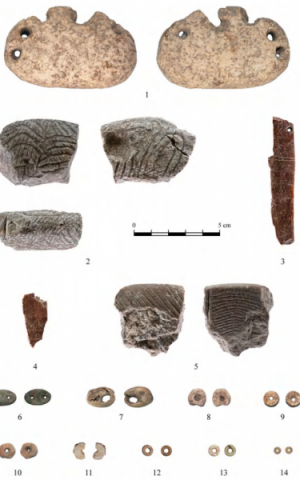
In a series of excavations, archaeologists found numerous artifacts pointing to a vast human settlement including burial remains, flint tools, art manifestations, faunal assemblage and stone and bone tools.

While other sites from the same period have been unearthed in the area, the Institute of Archaeology at The Hebrew University of Jerusalem said that NEG II was unique in that it contains cultural characteristics typical of both the Old Stone Age — known as the Paleolithic period — and the New Stone Age, known as the Neolithic period.

“Although attributes of the stone tool kit found at NEG II place the site chronologically in the Paleolithic period, other characteristics – such as its artistic tradition, size, thickness of archaeological deposits and investment in architecture – are more typical of early agricultural communities in the Neolithic period,” said chief excavator Dr. Leore Grosman.

“Characterizing this important period of potential overlap in the Jordan Valley is crucial for the understanding of the socioeconomic processes that marked the shift from Paleolithic mobile societies of hunter-gatherers to Neolithic agricultural communities,” she added.

The Paleolithic period is considered the earliest period in the history of mankind. The end of that era is marked by the transition to agricultural societies with the emergence of settled villages and domestication of plants and animals.

According to Grosman, NEG II was likely occupied in the midst of the cold and dry global climatic event known as the Younger Dryas, when temperatures declined sharply over most of the northern hemisphere around 12,900–11,600 years ago. Affected by climatic changes, groups in the area became increasingly mobile and potentially smaller in size, she said.

NEG II, however, shows that some groups in the Jordan Valley may have become larger in size and preferred town-like settlements to a nomadic existence.

Researchers said this shift in settlement pattern could be related to climate conditions that provided the ingredients necessary for prehistoric man to take the final steps toward agriculture in the southern Levant.

“It is not surprising that at a number of sites in the Jordan Valley we find a cultural entity that bridges the crossroads between Late Paleolithic foragers and Neolithic farmers,” Grosman said.
The NEG II site in the Jordan Valley where archaeologists from The Hebrew university have discovered the remains of a 12,000 year old settlement. (Photo credit: Austin (Chad) Hill/Leore Grosman)
Items uncovered at the NEG II dig site in the Jordan Valley where archaeologists from The Hebrew university have discovered the remains of a 12,00 year old settlement. (Photo credit: Austin (Chad) Hill/Leore Grosman)

Archaeologists discover evidence of settlement in Jerusalem 7,000 years ago

As reported by Raoul Wootliff of The Times of Israel, February 17, 2016:

Archaeologists have unearthed the oldest known remains of an ancient settlement on the site of modern-day Jerusalem, dating back some 7,000 years, the Israel Antiquities Authority announced Wednesday.

The finds were uncovered by the IAA during excavations carried out prior to the laying of a new road in the Shuafat neighborhood in northeastern Jerusalem.

The excavation exposed two houses with well-preserved remains and floors containing various installations as well as pottery vessels, flint tools, and a basalt bowl, the IAA said.

Experts have dated the finds to 5,000 BCE, the beginning of the Chalcolithic era, also known as the Copper Age. During the period, which stretches back to 3,000 BCE, man started using copper tools for the first time, a revolutionary advancement from the stone tools previously used.

According to Dr. Omri Barzilai, head of the IAA’s Prehistory Branch, the findings are the oldest proof of human settlement in the Jerusalem area.

“The Chalcolithic period is known in the Negev, the coastal plain, the Galilee and the Golan, but is almost completely absent in the Judean Hills and Jerusalem,” Barzilai said in a statement. “Although in recent years we have discovered a few traces of Chalcolithic settlements, such as those at Abu Gosh, Motza Junction, and the Holyland compound in Jerusalem, they have been extremely sparse. Now, for the first time, we have discovered significant remains from 7,000 years ago.”

The remains predate previously found evidence of human settlement in the area by up to 2,000 years. Before the latest discovery, it was thought that the area was first settled in the early Bronze Age, from around 3,000–2,800 BCE.

Ronit Lupo, director of excavations for the IAA, said the discovery, which includes complicated architectural structures and a range of different tools, points to a thriving population in the area.

“This discovery represents a highly significant addition to our research of the city and the vicinity,” she said.

“Apart from the pottery, the fascinating flint finds attest to the livelihood of the local population in prehistoric times: Small sickle blades for harvesting cereal crops, chisels and polished axes for building, borers and awls, and even a bead made of carnelian (a gemstone), indicating that jewelry was either made or imported,” Lupo added. “The grinding tools, mortars and pestles, like the basalt bowl, attest to technological skills as well as to the kinds of crafts practiced in the local community.”

Lupo said that the site also yielded a number of animal bones, which will be analyzed to help understand the dietary and economic habits of the people who lived there.
Excavation director Ronit Lupo of the Israel Antiquities Authority next to the remains of an ancient house dating back 7,000 years, in the Shuafat neighborhood, northern Jerusalem. (Photo credit: Assaf Peretz/Israel Antiquities Authority)
Polished flint ax and blades, and a gemstone bead dating back 7,000 years, found during archaeological excavations in the Shuafat neighborhood, northern Jerusalem. (Photo credit: Assaf Peretz/Israel Antiquities Authority)
A 7,000-year-old bead found during archaeological excavations in the Shuafat neighborhood, northern Jerusalem. (Photo credit: Ronit Lupo/Israel Antiquities Authority)
A basalt bowl dating back 7,000 years, found during archaeological excavations in the Shuafat neighborhood, northern Jerusalem. (Photo credit: Israel Antiquities Authority)

Friday, 12 February 2016

UNESCO recognizes the Aleppo Codex as a world treasure

Fragment of the Aleppo Codex containing verses from Exodus 8 recently was brought to Israel. (Photo credit: Yad Ben-Zvi Institute)

As reported by Jewish Telegraphic Agency, February 9, 2016 (link in original):

The Aleppo Codex — believed to be the world’s oldest surviving copy of the Hebrew Bible — has been officially recognized as a treasured item by the United Nations Educational Scientific and Cultural Organization.

The codex, which is on permanent display at the Israel Museum in Jerusalem, will be listed in UNESCO’s International Memory of the World Register, Haaretz reported Tuesday.

UNESCO officially recognized the codex on Monday, according to Haaretz, deciding it belongs in its registry of 300 items and collections from all over the world. The registry already includes two other items from Israel: the Israel Museum’s Rothschild Miscellany, a collection of illustrated 15th-century manuscripts, and the Pages of Testimony at the Yad Vashem Holocaust Museum, which documents the names and stories of Holocaust victims.

Written in northern Israel around 930 CE, the codex has a storied and transient history. It was smuggled into Israel from Syria 60 years ago, and since then 200 of the original 500 pages have mysteriously disappeared.

An award-winning 2013 book — “The Aleppo Codex: In Pursuit of One of the World’s Most Coveted, Sacred and Mysterious Books” — chronicles its history.

According to Haaretz, 7,200 pages of Isaac Newton’s papers, which are stored in Israel’s National Library in Jerusalem, was also added to the UNESCO registry this week.
And this item, reported by Jewish Telegraphic Agency, July 12, 1976:

JERUSALEM (Jul. 11)

A facsimile edition of the oldest known manuscript of the Hebrew Bible — the Aleppo Codex — was published by the Hebrew University last week. It is the fruit of 20 years’ work by a team of Hebrew University scholars, headed by Prof. Moshe Goshen Gottstein. The 500-page red and blue leather-bound facsimiles will sell for $400 apiece.

The Aleppo Codex was first published in about 900 AD in Tiberias by Aharon Ben Asher, a master of the textual tradition. By the end of the 11th century, the manuscript had been carried off from Jerusalem to Cairo. But it was subsequently transferred to Aleppo, Syria where it remained in the possession of the Jewish community. During Israel’s War for Independence in 1948, the Syrians tried to burn the Biblical treasure, but 600 of the 800 pages were saved.

The manuscript was smuggled out of Syria in 1956 and delivered to President Yitzhak Ben Zvi of Israel for safe-keeping. It is now at the Ben Zvi Institute in Jerusalem. Most of the Pentateuch is among the lost portion. The manuscript begins with Deuteronomy, Chapt. 28, Verse 17. It includes the books of Joshua, Judges and Samuel but Kings I is missing and only parts of Kings 2 have been preserved. The books of Isaiah and Ezekial are complete, but only parts of Jeremiah are preserved. Most of the minor prophets, the Book of Psalms and Chronicles are also preserved.
See also my post Israeli scholar completes 30-year mission to "fix" textual errors in Old Testament (January 18, 2013).

Thursday, 11 February 2016

The first Palestinian embassy in the Western Hemisphere is inaugurated in Brazil

As reported by Jewish Telegraphic Agency, February 4, 2016:

RIO DE JANEIRO (JTA) — A new building housing the first Palestinian Authority embassy in the Western Hemisphere was inaugurated in Brasilia.

The PA’s envoy to Brazil, Ibrahim Alzeben, led Wednesday’s event, which was attended by left-wing Brazilian government officials, representatives of Arab countries and members of the local Arab community.

A week earlier, Alzeben attended the International Holocaust Remembrance Day ceremony held by the Jewish community in the Brazilian capital, saying “I could not be absent. It is very important to remember this date.”

The inauguration of the embassy comes as Brazil and Israel tussle over Israeli Prime Minister Benjamin Netanyahu’s nominee to fill the vacant Israeli envoy position.

The closeness of the new embassy to major Brazilian governmental buildings, including the Planalto Palace, Congress, Supreme Court and ministries, has been widely criticized due to security concerns.

“Diplomats and their vehicles cannot be checked. The embassy is a sovereign Hamas area now,” an unnamed military source told Brazil’s Veja magazine in an article published last year. “The site is strategic. Terrorists could access the whole governmental structure in a half an hour.”

Built on a piece of land that is more than 17,000 square feet and donated by the Brazilian government when it was led by former President Luiz Inacio Lula da Silva, the space is considered large in comparison to other diplomatic missions. Topped with a golden dome, the building resembles the famous mosque on the Temple Mount in Jerusalem. Palestinian Authority President Mahmoud Abbas laid the cornerstone for the building in 2011.

Bilateral relations between Brazil and the Palestinians date back to 1975, when the Palestine Liberation Organization was authorized to appoint representatives in Brasilia. In 1993, Brazil authorized the opening of the Palestinian Special Delegation in Brasília, whose status was equated to embassy in 1998. In 2004, a representative office of Brazil in Ramallah was opened. After Brazil recognized a state of Palestine in December 2010, the Special Delegation became the Embassy of Palestine.

Israel has not had an ambassador in Brasilia since December. Prime Minister Benjamin Netanyahu’s nomination of Dani Dayan, a former settler leader in the West Bank, remains unapproved by Rousseff since August and has set off a diplomatic row.
See my previous post, Israeli Prime Minister Benjamin Netanyahu stands by his choice as Ambassador to Brazil despite Brazilian objections (January 16, 2016).

Scientists announce the discovery of gravitational waves--100 years after Albert Einstein theorized their existence

The heavens declare the glory of God; and the firmament sheweth his handywork. Psalms 19:1

As reported by Mariëtte Le Roux of The Times of Israel, February 11, 2016 (bold in original):

Great excitement rippled through the physics world Thursday at the announcement that gravitational waves have been detected after a 100-year search.

Here’s what it means.

Q: What are gravitational waves?

A: Albert Einstein predicted gravitational waves in his general theory of relativity a century ago. Under this theory, space and time are interwoven into something called “spacetime” — adding a fourth dimension to our concept of the Universe, in addition to our 3D perception of it.

Einstein predicted that mass warps space-time through its gravitational force. A common analogy is to view space-time as a trampoline, and mass as a bowling ball placed on it. Objects on the trampoline’s surface will “fall” towards the centre — representing gravity.

When objects with mass accelerate, such as when two black holes spiral towards each other, they send waves along the curved space-time around them at the speed of light, like ripples on a pond.

The more massive the object, the larger the wave and the easier for scientists to detect.

Gravitational waves do not interact with matter and travel through the Universe completely unimpeded.

The strongest waves are caused by the most cataclysmic processes in the Universe — black holes coalescing, massive stars exploding, or the very birth of the Universe some 13.8 billion years ago.

Q: Why is the detection of gravitational waves important?

A: It ended the search for proof of a key prediction in Einstein’s theory, which changed the way that humanity perceived key concepts like space and time.

Detectable gravitational waves open exciting new avenues in astronomy — allowing measurements of faraway stars, galaxies and black holes based on the waves they make.

Indirectly, it also adds to the evidence that black holes — never directly observed — do actually exist.

So-called primordial gravitational waves, the hardest kind to detect and not implicated in Thursday’s announcement, would boost another leading theory of cosmology, that of “inflation” or exponential expansion of the infant Universe.

Primordial waves are theorised to still be resonating throughout the Universe today, though feebly.

If they are found, they would tell us about the energy scale at which inflation ocurred, shedding light on the Big Bang itself.

Q: Why are gravitational waves they so elusive?

A: Einstein himself doubted gravitational waves would ever be detected given how small they are.

Ripples emitted by a pair of merging black holes, for example, would stretch a one-million-kilometre (621,000-mile) ruler on Earth by less than the size of an atom.

Waves coming from tens of millions of lightyears away would deform a four-kilometre light beam such as those used at the Advanced Laser Interferometer Gravitational Wave Observatory (LIGO) by about the width of a proton.

Q: How have we looked for them?

A: Before now, gravitational waves had only been detected indirectly.

In 1974, scientists found that the orbits of a pair of neutron stars in our galaxy, circling a common centre of mass, were getting smaller at a rate consistent with a loss of energy through gravitational waves.

That discovery earned the Nobel Physics Prize in 1993. Experts say the first direct detection of gravitational waves is likely to be bestowed the same honour.

After American physicist Joseph Weber built the first aluminium cylinder-based detectors in the 1960s, decades of effort followed using telescopes, satellites and laser beams.

Earth- and space-based telescopes have been trained on cosmic microwave background, a faint glow of light left over from the Big Bang, for evidence of it being curved and stretched by gravitational waves.

Using this method, American astrophysicists announced two years ago they had identified gravitational waves using a telescope called BICEP2, stationed at the South Pole. But they later had to admit they made an error.

Another technique involves detecting small changes in distances between objects.

Gravitational waves passing through an object distort its shape, stretching and squeezing it in the direction the wave is travelling, leaving a telltale, though miniscule, effect.

Detectors such as LIGO at the centre of Thursday’s news, and its sister detector Virgo in Italy, are designed to pick up such distortions in laser light beams.

At LIGO, scientists split the light into two perpendicular beams that travel over several kilometres to be reflected by mirrors back to the point where they started.

Any difference in length upon their return would point to the influence of gravitational waves.

Sources: European Space Agency, Institute of Physics, LIGO, Nature.
As reported by Kerry Sheridan of The Times of Israel, February 11, 2016 (bold in original):

The wave that made history snuck up on them.

David Shoemaker will never forget the date — September 14, 2015 — when he woke up to a message alerting him that an underground detector had spotted a 1.3-billion-year-old ripple in the fabric of space-time.

A gravitational wave — predicted to exist a century ago by Albert Einstein — had been glimpsed directly for the first time by a pair of US-based detectors.

“It is seared in my brain,” said Shoemaker, a top scientist at the Massachusetts Institute of Technology (MIT) and head of the Advanced LIGO Project, an international effort to uncover evidence of gravitational waves.

Such waves are a measure of strain in space, an effect of the motion of large masses that stretches the fabric of space-time — a way of viewing space and time as a single, interweaved continuum.

The “chirp,” as Shoemaker described the long-awaited wave, had arrived while he was asleep.

But since the data analysis works in quasi-real-time, scientists watching the data stream early in the work day in Europe saw it immediately.

Two black holes spiraling into each other became a single black hole, and the joining of these two giants curved the fabric of space-time around them, ever so briefly.

“When the signal finally got to the Earth on September 14 we knew within three minutes that our instruments had seen something really different,” said Shoemaker.

“I was sitting at home, with a cup of coffee in my hand and opening up my email at around 7 am,” he told AFP.

An instant message had arrived from a close colleague in Germany.

The message said: “I think we are in trouble now,” he recalled.

But Shoemaker, a leading scientist in the search for gravitational waves since the early 1980s, did not leap out his chair or shout expletives.

He just took a deep breath.

“My immediate reaction was, ‘That’s fascinating. Let’s see what the instruments did wrong.'”

Taken by surprise

In fact, the team had only just turned on the pair of underground detectors — one in Louisiana and one in Washington state — for a series of final checks before formally starting the observation experiment, which would run from mid September until January.


“It was just at the beginning of this run, when we were all ready to go — to press the button to start the observing run — that the gravitational wave was observed,” he said.

“So it was a very exciting moment for us and it took us perfectly by surprise.”\

Immediately, Shoemaker and colleagues began running through a checklist of possible failures.

One by one, they ruled out electromagnetic storms, lighting strikes, earthquakes, or interference by people near sensitive parts of the instruments.

Furthermore, the timing matched up.

The detector in Hanford, Washington picked up the signal 7.1 milliseconds after the Livingston, Louisiana instrument, some 1,800 miles (3,000 kilometers) away.

“The travel time of light between the two instruments is 10 milliseconds,” said Shoemaker.

“And if the two signals had arrived 11 milliseconds apart, we would have simply said, ‘Nope. It’s two instrumental defects that happened at the same time.’

“But it happened within 7.1 milliseconds, which is a perfectly plausible delay between the two.”

Weeks of tests

After many tests, the LIGO team’s discovery was confirmed.

“It took weeks before we were really gaining confidence that it was a true gravitational wave event, before I could admit to myself that something had been seen,” Shoemaker said.

“But, you know, eventually, joy sets in.”

The LIGO work is vastly different from that done by US astrophysicists who announced in 2014 they had detected the first ripples from the Big Bang, then months later admitted their indirect, telescope-based findings were premature and could not be confirmed.

Shoemaker and colleagues are using different equipment to hunt for much smaller, shorter waves, on the order of milliseconds or seconds. In other words, the kinds of gravitational waves that happen all the time, but had never before been observed.

“This is the first time there has ever been a direct detection of the gravitational waveform,” Shoemaker said.

“And that makes it a magical thing.”
As reported by Joe Dyke of Agence France-Presse, February 11, 2016 (bold in original):

It took a century, but the theory from Albert Einstein handwritten neatly on paper that is now yellowing has finally been vindicated.

Israeli officials on Thursday offered a rare look at the documents where Einstein presented his ideas on gravitational waves, a display that coincided with the historic announcement that scientists had glimpsed the first direct evidence of his theory.

“Einstein devised this with pen and paper, but it took humanity 100 years to develop the tools to catch a glimpse of it,” said Roni Grosz, curator of the Albert Einstein Archives at Jerusalem’s Hebrew University, pointing to two pages.

One was the first document in which Einstein fully presented his theory of gravitational waves, while the other was a page from his 46-page theory of relativity, written in 1916 and 1915 respectively.

They were written neatly in German, with corrections made within the text.

The theory of gravitational waves was developed by the German physicist 100 years ago.

In a landmark discovery for physics and astronomy, international scientists announced in Washington on Thursday that they had glimpsed the first direct evidence of gravitational waves, or ripples in space-time.

Einstein’s theory states that mass warps space and time, much like placing a bowling ball on a trampoline.

Other objects on the surface will “fall” towards the centre — a metaphor for gravity in which the trampoline is space-time.

Gravitational waves do not interact with matter and travel through the universe completely unimpeded.

It was a central pillar of Einstein’s theory of gravity, but had never been proven.

“(The discovery) is a very moving moment,” Grosz said, wearing a tie with a picture of Einstein and his familiar bushy hair. “A smile from heaven after exactly 100 years.”

‘A new window’

Einstein himself doubted gravitational waves would ever be detected given how tiny they are.

Barak Kol, head of physics at the Hebrew University, explained the size of their impact can be as small as “one thousandths of the nucleus of an atom”.

Kol, who had worked on trying to prove the theory, said the discovery was a historic day for scientists and those concerned with Einstein’s legacy.

“It is the end of a part of the journey that took 100 years since it started with the idea of one person,” he said.

“(But) it will open a new window to the universe. It will enable us to see processes in the universe.”

He added that, as with other major scientific discoveries, it was likely to lead to many developments that “we cannot predict...”

70 years ago: The Revised Standard Version of the New Testament is published

On February 11, 1946, the Revised Standard Version of the New Testament--the first serious challenge to the popularity of the King James Version--was published. The copyright was held by the International Council of Religious Education, which merged with the Federal Council of Churches of Christ in America in 1950 to form the National Council of the Churches of Christ in the USA.

The complete Revised Standard Version of the Bible was published on September 30, 1952, and was officially the best-selling non-fiction book in the United States from 1952-1954. Real Christians eventually rejected the RSV because of its liberalism (e.g., substituting "young woman" for "virgin" in Isaiah 7:14), and it's largely forgotten today. The King James Version is still with us.

Thursday, 4 February 2016

Australian-made globe pulled from stores after omitting Israel, but including Palestine

I don't know if this resulted from evil intentions or incompetence (or both), but Typo seems an appropriate name for the chain of stores. As reported by Michael Safi of the British newspaper The Guardian, February 1, 2016:

The Australian stationery chain Typo has inadvertently waded into one of the world’s thorniest political conflicts, pulling a line of globes that named Palestine but omitted to label Israel.

The design choice, which saw Israel and 12 other countries represented by a number on the map, corresponding to a legend at the base of the globe, prompted threats of boycott and charges of anti-Semitism by supporters of the Jewish state.

The decision to halt production of the globes led to similar threats by Palestine advocates.

Issues with the original design were first pointed out on 21 January by a flurry of customers on the store’s Facebook page, including one who asked why Typo was selling a globe “that has wiped Israel from the face of the earth”.

Typo said in response the design – a Mercator projection from around 1860 – was “an official map from an international body that has been approved for export” and Israel’s label had been omitted “purely because there wasn’t enough space to include the name”.

Two hours later the chain said it had “decided to remove the globes from sale in-store and online and will halt all future production”.

This decision in turn drew complaints from supporters of Palestine, who have peppered the store’s social media accounts with complaints and threats of boycott.

The ensuing anger bled over into otherwise uncontroversial posts on the company’s Facebook page, including one advertising a travel bag with the tagline, “I just took the road less travelled ... And now I’m lost!”

Among the replies were: “Could you be lost because you don’t know how to use a map. Use the correct one with Palestine and it will help!”

“The road less travelled is one that DOESN’T bow down to Zionist sentiment,” another user said.

(The map also omitted the former Yugoslavian republic of Macedonia, prompting one user to ask: “What is your political agenda Typo?”)

The company, part of the Cotton On Group, tried to stem the damage on Monday, writing on its Facebook page that new globes would be manufactured labelling every country.

“Typo is not removing any country from the globe. We made the decision to recall the current globes from sale as we are sourcing new artwork from our supplier that has every country marked on it but with no need for a key. All countries will remain on the map, the key will not,” it said.

“We never intended to offend anyone with this product.”

Among other errors the map labelled the Caspian Sea twice and misspelled the name of the former Soviet republic of Azerbaijan.

10 years ago: The death of Betty Friedan, and a suspicious coincidence

On February 4, 2006, Betty Friedan died in New York City on her 85th birthday. Mrs. Friedan, born Betty Goldstein, was the author of The Feminine Mystique (1963); co-founded in 1966 and served as the first president of the National Orgnization for Women (NOW); and was responsible more than anyone else for creating the modern feminist movement and its associated evils. She provided ample evidence for Rush Limbaugh's statement that the feminist movement was created to give unattractive women easier access to the mainstream of society.

Mrs. Friedan's death came the day after news of the death in New York City of actor Al Lewis at the reported age of 82. Mr. Lewis, born Albert or Alexander Meister, was best known for playing Grandpa Munster in the television comedy series The Munsters (1964-1966). Mr. Lewis was also known for his support of liberal causes.

Is it just a coincidence that Betty Friedan and Grandpa Munster died in the same city on the same weekend? I find it very suspicious. ;)

Thursday, 28 January 2016

El Salvador denies that it's moving its embassy in Israel from Tel Aviv to Ramallah

As reported by the Times of Israel, January 18, 2016:

El Salvador’s ambassador to Israel emphatically denied media reports on Sunday that his country was planning on moving its embassy to the West Bank in response to Foreign Ministry intentions to close the Israeli embassy in the Central American nation.

The country’s newly appointed ambassador, Werner Matias Romero, told The Times of Israel that El Salvador was “not even thinking” of moving its embassy from Tel Aviv.

However, Romero expressed his grave disappointment with the Israeli move to shut down its embassy in San Salvador, the capital, and said El Salvadoran authorities had taken up the matter with Prime Minister Benjamin Netanyahu, who also serves as Israel’s foreign minister.

“We were very surprised and concerned with that decision,” he said. “My minister has sent a letter to Netanyahu expressing that concern and surprise. We are hoping the government of Israel reconsiders its unfortunate decision due to the longstanding deep relationship between El Salvador and Israel.”

In addition to the embassy in El Salvador, Israel’s Foreign Ministry intends to close its consulates in Philadelphia, Marseilles, the Caribbean as well as its embassy in Belarus.

The decision to close the diplomatic outposts was reportedly made in order to free up funds needed to strengthen existing diplomatic offices.

“I just arrived in October and we were planning on deepening ties and holding a lot of joint events, programs and activities, so the decision took us by surprise,” Romero lamented.

He noted that funding for embassies is a problem for El Salvador, too, but Israel is worth the effort.

“We also struggle with trying to find enough resources so we can maintain all our embassies. El Salvador has been opening instead of closing embassies. The Israeli embassy is considered by us one of the most important. We struggle but are committed to maintaining our diplomatic network, and maintaining Israel is a priority.

“We were told by the Foreign Ministry that Israel was reaching out to Latin American countries,” he continued. “Central America, despite being small, is 55 million people, and is very economically important. El Salvador has been extremely supportive of allowing Israel to join the Central American Integration System (CETA) as an extraterritorial member. Israel has wanted to become an extraterritorial member, and the HQ is in San Salvador.

“We in El Salvador are also going through hard times in terms of security and see Israel as a key partner in this endeavor.”

“I want to reiterate that we are disappointed but we are hopeful. Even though Israel said they will shut the embassy down at the end of 2016, we will try to get the government to reconsider.”

Earlier Sunday, the Ynet news site quoted diplomatic sources saying that El Salvador had threatened to close its embassy in Israel and move it to the West Bank or Egypt because Salvadorian officials were upset to learn that Israel had decided to close its mission in San Salvador.

In the summer of 2014, El Salvador recalled its ambassador from Tel Aviv in protest over Israel’s military operation in the Gaza Strip. Israeli Foreign Ministry officials slammed the move, saying recalling ambassadors only encouraged Gaza’s radical Hamas leaders.
Click on the link for the article El Salvador threatens to move its embassy to Ramallah from Ynet News, January 17, 2016.

Wednesday, 27 January 2016

75 years ago: a scientist offers his opinion on the physical characteristics of the "best minds"

On January 27, 1941, it was reported that Dr. Alex Hardlisha of the Smithsonian Institution claimed that larger and broader skulls, lower cheekbones, and dark hair were the physical characteristics that distinguished the nation's "best minds."

I've been unable to find out anything about Dr. Hardlisha, but I suspect that the physical characteristics that distinguished America's "best minds" were characteristics possessed by Dr. Hardlisha himself--a coincidence, no doubt.

Saturday, 16 January 2016

Israel bars visits from Swedish officials following criticism from Swedish Foreign Minister Margot Wallstrom

It's easy for Sweden and other countries to criticize Israel for its handling of the Palestinian issue, when they haven't had to deal with similar situations. As reported by Jewish Telegraphic Agency, January 13, 2016:

Israel will not welcome visits by Swedish officials, the deputy foreign minister of Israel said a day after Sweden’s foreign minister called for an investigation into Israel’s killing of Palestinian attackers.

“Israel is closing its gates to official visits from Sweden,” Tzipi Hotovely said at a meeting with members of the Foreign Ministry’s cadet course. The remarks were widely published in the Israeli media.

Foreign Ministry spokesman Emmanuel Nahshon told The Associated Press that “given the incendiary and aggressive nature” of Swedish Foreign Minister Margot Wallstrom’s comments, “we have made it clear that she is not welcome in Israel.”

But an official in the Prime Minister’s Office told Haaretz that Netanyahu had not made a decision to halt official visits from Swedish officials.

Also, Sweden’s ambassador to Israel, Carl Magnus, was summoned for a reprimand in response to the Wallstrom remarks about possible “extrajudicial killings” by Israel. The summons came from Prime Minister Benjamin Netanyahu.

During a parliamentary debate on Tuesday, Wallstrom also said it is “vital that there is a thorough, credible investigation into these deaths in order to clarify and bring about possible accountability.”

Israeli officials have said security forces are justified in killing suspected attackers because trying to neutralize them without killing them would pose unnecessary risk. However, some human rights organizations and pro-Palestinian groups have said Israeli police and soldiers are too quick to kill alleged perpetrators and should instead make more efforts to subdue and arrest them.

Over 130 Palestinians have been killed during the recent wave of violence that began in October, most while perpetrating or attempting attacks, and others in violent clashes with security forces. Twenty-one Israelis and an American studying in Israel at a yeshiva have been killed in the attacks.

“The Swedish foreign minister’s statement backs terrorism,” Israeli opposition leader Isaac Herzog said Tuesday night in a post on Facebook. “Every declaration like this takes the whole region back a step from reaching a two-state solution and helps the murderous terrorists who do everything possible to stop us from getting there.

“It’s interesting that Sweden did not have a similar response when police in Paris killed the terrorists, as they had to do, and it will be interesting to see how Sweden will react when terrorists carry out attacks within its territory. Will it also want to pat them on the head because they had rough childhoods?”

In November, Wallstrom linked the Paris terrorist attacks that killed 130, which were blamed on the Islamic State, to perceived hopelessness among the Palestinians.
As reported by Ian Deitch of Associated Press, January 13, 2016:
Israel said Wednesday that Sweden's foreign minister is "not welcome" in Israel after she called for an investigation into the deaths of Palestinians involved in a four-months' spate of deadly attacks on Israeli civilians and soldiers.

Foreign Ministry spokesman Emmanuel Nahshon said that "given the incendiary and aggressive nature" of Margot Wallstrom's comments, "we have made it clear that she is not welcome in Israel." He did not elaborate.

Sweden's ambassador was summoned Wednesday and reprimanded in protest over Wallstrom's remarks, Nahshon added. The summons, he said, showed "the anger of the government and the people in Israel" over Wallstrom's "twisted" view of reality in Israel that is "biased and even hostile" against Israel.

"Wallstrom's remarks show that she doesn't understand what is taking place in our region and is apparently unaware of the harsh situation where Israelis are exposed to the perpetual dangers of murderous terror attacks," Nahshon said.

Near-daily Palestinian attacks on Israeli civilians and soldiers have killed 24 people and wounded dozens in stabbings, shootings and other assaults since mid-September. At least 141 Palestinians have died by Israeli fire. About two-thirds of them are said by Israel to be attackers. The rest were killed in clashes with security personnel...

...Sweden's relations with Israel have been strained since the Social Democratic-led government in 2014 recognized Palestinian statehood, and Wallstrom's comments on the Israeli-Palestinian conflict have elicited angry responses from Israeli officials.

Swedish opposition lawmaker Jan Bjorklund of the Liberal Party accused the government of shifting the country's Middle East policy so that it's perceived to be "siding much more unilaterally with the Palestinian party."

As foreign minister, Wallstrom has been outspoken on women's rights and the Israeli-Palestinian conflict. Her statements have riled not just Israel but also Saudi Arabia, which temporarily recalled its ambassador from Sweden last year after Wallstrom criticized the kingdom's human rights record.

Affable in person, Wallstrom has been accused of being too blunt and undiplomatic in her public comments...

Israeli Prime Minister Benjamin Netanyahu stands by his choice as Ambassador to Brazil despite Brazilian objections

As reported by Jewish Telegraphic Agency, January 13, 2016 (link in original):

Israeli Prime Minister Benjamin Netanyahu said if Brazil won’t approve former settler leader Dani Dayan as its ambassador, Israel won’t offer another diplomat.

Israel’s Channel 2 News reported Netanyahu’s comments Wednesday.

According to i24news, Israel not having an ambassador in Brazil would represent a “de facto downgrade in relations” between the two countries.

Netanyahu’s apparent decision to stand by Dayan comes a week after various reports that Israel would withdraw Dayan’s name and instead give him the Israeli consulate general position in Los Angeles or New York.

Earlier this week, a group of 40 retired Brazilian diplomats signed a statement against the appointment of Dayan, complaining that Israel had bypassed protocol because there was no prior communication with the Brazilian Foreign Ministry or any presentation of his credentials for an agreement.

Netanyahu tapped the former head of the settlers’ Yesha Council four months ago to serve as envoy to Latin America’s largest nation, but the Brazilian government remained silent on the choice to signal an official rejection of Dayan’s credentials because of his settler past.

A native of Argentina, Dayan, 59, currently lives in the West Bank settlement of Maale Shomron.
February 11, 2016 update: As reported by The Times of Israel, February 7, 2016:

Rebuffed for months by Brasilia, former settler leader Dani Dayan will not become Israel’s ambassador to Brazil, Foreign Affairs and Defense Committee chairman Tzachi Hanegbi (Likud) finally acknowledged on Sunday, during a committee discussion on Brazil’s refusal to accept Dayan’s credentials.

“We needn’t delude ourselves, Dani Dayan will not be the ambassador to Brazil. We condemn Brazil’s behavior,” said Hanegbi, a close aide to Prime Minister Benjamin Netanyahu, adding that Dayan would instead doubtless be made ambassador in a country “just as important.”

During the committee session, Likud MK Anat Berko said that Israel must be careful that the Dayan affair does not set a precedent for other countries wishing to dictate to Israel which diplomats represent it.

The Latin America director at the Foreign Ministry, Moti Efraim, was present at the committee session and said that the Foreign Ministry has been waiting for a response from Brasilia for six months, “an answer we have yet to receive, even though this is an unprecedented situation,” Maariv reported

Netanyahu, who also serves as foreign minister, has been trying for months to get Brazil to agree to accept Dayan’s credentials, to no avail, but has chosen not to cancel the appointment.

As first reported by The Times of Israel in early December, Brasilia indicated that it would not accept Dayan’s appointment because he previously headed the Yesha Council, a committee representing Israeli settlements in the West Bank, and because of the unorthodox way in which his appointment was announced.

Dayan was named as envoy in August, 2015 and endorsed by the Israeli cabinet in September, but Brazil has maintained a frosty silence on the appointment rather than issuing the customary confirmation.

Netanyahu named Dayan only one year after the current envoy, Reda Mansour, took up his post in Brasilia. According to diplomatic sources in Jerusalem, Mansour’s wife did not want to move to Brasilia, and he therefore informed Jerusalem that he wanted to quit. As soon as Netanyahu heard that Mansour was planning to vacate the post in December, he publicly nominated Dayan without first informing the Brazilian Foreign Ministry.

British authorities shut down ultra-Orthodox Jewish school in London

It's taken only 40 years, but British authorities have decided that multiculturalism--at least in the case of ultra-Orthodox Judaism--has its limits. Let's see if they do more than just "consider" prosecuting unregistered Islamic schools--40 years is too long to wait.

As reported by David Connett of the London newspaper The Independent, January 15, 2016:

An orthodox Jewish school which operated illegally for 40 years and does not teach children English has been ordered to shut down.

The Charedi Talmud Torah Tashbar school in Stamford Hill, north London has been ordered to close by the Deparment for Education next month after Ofsted inspectors warned that it was failing to meet the “minimum” standards required.

Inspectors who investigated the school, which has more than 200 pupils, said that its curriculum, taught in Hebrew, encouraged “cultural and ethnic insularity because it is so narrow and almost exclusively rooted in the study of the Torah”.

The school was found to “severely restrict the spiritual, moral, social and cultural development of pupils” and prevent them from “developing a wider, deeper understanding of different faiths, communities, cultures and lifestyles, including those of England”.

The school’s failings are spelt out in a series of Ofsted reports into the school after it applied to be a private school. The reports between 2012-14 were disclosed under Freedom of Information requests.

According to the reports, the school states that “as a matter of religious principle” it does not allow pupils to learn English, nor provide for any secular education.

Despite the school failing to meet the minimum standards three times, no action has been taken to shut it down and it continues to operate.

Sir Michael Wilshaw, the Chief Inspector of Schools, disclosed in December that Ofsted was considering prosecuting those involved in the running of unregistered Islamic religious schools.

A Government consultation on combating schools which “promote intolerance” will end later this month.

The British Humanist Association, which campaigns for a crackdown on all illegal “faith” schools, welcomed the decision but called on the Education Secretary to move against scores of other schools like it.

“We’re glad that the Government has now moved to shut this particular school down... However, there are clearly many more out there just like it. The situation revealed by these reports is simply outrageous and those in government who have failed to act in the past ought to be ashamed of themselves for standing idly by while thousands of children have their childhoods stolen.

“Every year, every month, every week that these places are allowed to stay open, a huge number of children remain isolated, indoctrinated, and very likely abused, so we will certainly be writing to the Government to ask that action is taken far more swiftly in the case of other schools than it has been here.”

A Department for Education spokesman said: “It is a criminal offence to operate an unregistered independent school. This school’s application for registration has been rejected and on 30 December it was informed of this decision. It has been told to close by 12 February.”

The school was unavailable for comment.
In a related matter, there has been a complaint about similar schools in New York; as reported by Jewish Telegraphic Agency, July 27, 2015:

Fifty-two people — former yeshiva students, parents of current yeshiva students and former teachers from schools — reportedly signed a letter sent to New York City education officials expressing “deep concern” about “the poor quality and scant amount of secular education” at the 39 schools with which they say they are affiliated.

The letter, sent to seven district superintendents in Queens and Brooklyn and New York City Schools Chancellor Carmen Farina, allege that the yeshivas are failing to meet New York state law requiring all nonpublic schools to provide an education that is “substantially equivalent” to what is offered in public schools. The letter urges the superintendents to “investigate the quality of secular education and, in particular English instruction, at the listed Yeshivas and to take steps to ensure that pupils at these Yeshivas receive the essential and substantially equivalent education to which they are entitled.”

The letter-writing campaign was organized by Yaffed, a 3-year-old advocacy group that seeks to improve the quality of secular education in haredi Orthodox schools in New York state. Haredi Orthodox schools devote far greater time and resources to religious instruction than to secular instruction, particularly in boys’ schools. As a result, some graduates complain that they are unprepared for careers and unable to support themselves financially.

Yaffed shared a copy of the letter in a news release, but is withholding the names of the signatories and is asking the letter’s recipients not to release them in order to protect the letter-writers’ “safety.” The group also did not release the names of the 39 schools it said were identified in the letter.

Tuesday, 12 January 2016

Debate among Marseille's Jews over whether they should stop wearing yarmulkes in the interest of their own safety

As reported by Itamar Eichner and Rachel Cadars of Ynet News, January 12, 2016:

Jews across Europe are taking off their yarmulkes and prayer shawls and hiding their Star of David necklaces as the fear of anti-Semitic violence continues to grow across the continent, Israel's Ministry of Foreign Affairs has said.

At the same time, Zvi Ammar, the head of Marseille's Jewish community, has called on the city's Jewish residents to stop wearing yarmulkes in the wake of an attack on a Jewish teacher on Monday morning.

Benjamin Amsalem, an ultra-Orthodox resident of the southern French city, was attacked with a machete by a 15-year-old Turkish citizen of Kurdish origin, who was caught after a brief chase.

In his interrogation the stabber said that he had attacked Amsalem in the name of Islamic State and that he was also planning to attack police.

"The stream of events means that we need to take exceptional decision," Ammar said. "Life is more sacred than anything else. We need to hide a little."

The head of the Department for Combating Anti-Semism in the Ministry of Foreign Affairs, Gideon Bachar, said: "There is a sense of growing fear and worry among Europe's Jews.

"Many Jews feel that their Jewish identity is a threat to them. We know that many have stopped going to synagogue on holy days for fear of terror attacks. To our regret, Jewish life is taking place more and more behind walls, armed guards, police and security cameras."

The Ministry of Foreign Affairs called on European governments to increase the level of security for Jewish communities and institutions throughout the continent, including synagogues, community centers, schools and kindergartens.

The rise in aliyah from Europe to Israel is also testament to the growing impact of anti-Semitism on European Jews. Aliyah has also grown from countries such as Canada, the US and Australia. "We are seeing a lot of Jews leaving France making aliyah, or leaving France and Europe. The numbers are not huge but there is a clear phenomenon," Bachar said.

Meanwhile, police in France are investigating the murder of Jewish politician Alain Ghozlan, who was found dead in his home on the outskirts of Paris on Tuesday morning, was motivated by anti-Semitism.

Ghozlan, a prominent figure in the French Jewish community and a resident of Créteil – a predominantly Jewish suburb of the French capital – failed to show up to his synagogue on Monday evening or Tuesday morning, arousing his brother's suspicions.

Arriving at Ghozlan's apartment, his brother found the body, which showed signs of violence. The initial indication is that Ghozlan was beaten to death.

Ghozlan's credit cards and car had disappeared, but according to local media the French police have not rejected any line of enquiry and are investigating possibilities from robbery to anti-Semitism.

Ghozlan was a member of the Créteil local council as well as of the local Jewish community.

The police are also investigating the possibility of anti-Semitism due to the current rise in such incidents in France.
As reported by Jewish Telegraphic Agency, January 12, 2016:

Representatives of the Jewish community of Marseille issued conflicting statements on whether Jews should hide their kippah in the southern French city following a spate of anti-Semitic stabbings there.

Tzvi Amar, president of the local office of the Consistoire, the French Jewish community’s organization responsible for religious services, was quoted Tuesday by Le Figaro as saying Jews should “remove the kippah during these troubled times” because “the preservation of life is sacrosanct.”

But Michele Teboul, president of the local branch of CRIF – an umbrella group that represents French Jewish communities politically as a lobby – told JTA that she “could not support a measure which dials back hundreds of years during which Jews were able to practice their faiths and live freely as citizens of the French Republic.”

Jewish individuals “should decide whether to wear a hat on top of their kippah, depending on the situation, but removing one’s kippah seems unwarranted,” Teboul said.

France’s chief rabbi, Haim Korsia, also rejected Amar’s call, saying, “We should not give an inch, we should continue wearing the kippah.”

Amar’s statement, which he said “turns his stomach” and is born of “grave circumstances that require extraordinary measures,” came after the stabbing of a Jewish man in Marseille on Tuesday, allegedly by a 15-year-old Muslim radical. He sustained minor injuries.

In November, a Jewish teacher was stabbed and seriously injured in Marseille by a man who hurled insults at him along with two other men, one of whom was wearing a T-shirt with the logo of the Islamic State terrorist group. The previous month, also in the city, a Frenchman of Algerian descent stabbed a Jewish man who was returning from synagogue and assaulted two others, including a rabbi.

Marseille has 80,000 Jews in a total population of approximately 850,000. About a third of its residents are Muslim, according to estimates.
Click the link to see the original article in Le Figaro, January 12, 2016.

January 30, 2016 update: A survey conducted in France shows that most French oppose the idea of Jews removing their yarmulkes. As reported by Jewish Telegraphic Agency, January 18, 2016:

PARIS (JTA) — Seventy percent of French citizens said it would be giving in to terrorists if Jews were forced to remove their yarmulkes for security reasons, according to a survey.

The survey commissioned by the Paris Match weekly news magazine and published Friday was conducted Jan. 14-15 following one community leader’s call to Jews in Marseille not to wear their kippahs. The statement came in the aftermath of the stabbing of a Jewish man there earlier in the week — the third stabbing of a kippah-clad Jew in the southern port city since October.

In the survey of 1,011 adults conducted by the Odoxa polling company, 36 percent of respondents said they “absolutely agreed” with the assertion by French Chief Rabbi Haim Korsia, who called on French Jews to keep wearing yarmulkes “to not give in to the terrorists.” Another 34 percent indicated they “pretty much agree.”
Ten percent of respondents, who were pre-selected to represent French society’s voting pattern distribution, said they “totally disagree” and another 19 percent said they “rather disagree.”

Left-wing and right-wing respondents answered similarly in the poll, with 71 percent supporting the assertion on the right — including 66 percent within the far-right National Front party — and 76 percent approving on the left.

Tzvi Amar, the president of the Marseille office of the Consistoire — the communal organization responsible for providing religious services — had called on his city’s Jews to hide traditional head coverings following the Jan. 11 stabbing.

Other community representatives joined Korsia in rejecting the suggestion.
Click on the link to see the original Paris Match article Port de la kippa: 70% des Français approuvent in French.

Friday, 8 January 2016

First kosher medical marijuana to go on sale in New York

Wherefore the Lord said, Forasmuch as this people draw near me with their mouth, and with their lips do honour me, but have removed their heart far from me, and their fear toward me is taught by the precept of men: Isaiah 29:13

As reported by Ynet News, December 31, 2015 (bold in original):

A US pharmaceutical company announced Wednesday that its medical marijuana has been certified kosher by the Orthodox Union (OU).

Vireo Health, one of the five companies permitted to market their medical marijuana in the State of New York stated that this is the first time medical cannabis has been certified kosher and as such it is in fact the first producer of kosher marijuana.

US media reported that the rabbinical association gave its certification after inspecting facilities manufacturing company's facilities and found that the marijuana is grown and produced according to the laws of kashrut. For example it is entirely free of insects.

"Being certified kosher by the OU will not only help us serve the dietary needs of the largest Jewish community in the United States, but also combat unfortunate stigmas associated with medical cannabis," said Vireo CEO Ari Hoffnung in a statement delivered to the press.

He added that kosher marijuana will deliver an "important message" to those who mistakenly believe that use of the product for patients suffering from pain promotes recreational use of drugs.

Rabbi Menachem Genack, chief executive officer of the Orthodox Union, said that "using medical cannabis products recommended by a physician should not be regarded as a chet, a sinful act, but rather as a mitzvah, an imperative, a commandment.”

Vireo expressed hope that the approval will help the company serve its Jewish patients in New York, where the largest Jewish community in the US lives. The product will be on the shelves in about a month, available with a doctor's prescription.

No kosher certification in Israel yet

The United States has seen a veritable revolution in recent years regarding the use of soft drugs. About half of US states allow the use of medical marijuana, and in 2012, two states, Washington and Colorado, legalized the sale of marijuana to those 21 and older without a doctor's prescription.

From a religious standpoint there should not be a problem certifying marijuana as kosher as it's a plant, and like all plants grown overseas, the laws of shmita (every seven years the land in Israel must lie fallow – ed.) and tithes do not apply. When they reach their natural form they are kosher for eating or smoking.

In Israel there are several manufacturers who market medical cannabis, but so far the Chief Rabbinate has not certified the product.
Jews in Trudeaupia need not worry about certification, as reported by Laura Kane of Canadian Press, January 8, 2016:

VANCOUVER—Is marijuana kosher? If it’s medicine, it doesn’t matter.

That’s the message from Canada’s largest kosher certification agency after its board of rabbis held a debate on whether to certify cannabis oils as kosher.

The Kashruth Council of Canada met Thursday to discuss an application from MedReleaf, a licensed producer of medical pot. The meeting followed news in the U.S. that a New York company would soon offer certified kosher medical cannabis products.

But after “a lot of interplay and exchange,” the Kashruth council decided the Jewish faith doesn’t require sick people to consume kosher medicine, said managing director Richard Rabkin.

“Something that is medicine, that’s prescribed from your doctor, that you need to take for your health, that doesn’t need kosher certification,” he said by phone after the meeting.

“We don’t really want to get into the business of providing kosher certification for something that is doctor-prescribed. We’re not going to go down that path.”

Kosher foods are those that conform to Jewish law, with strict guidelines on the types of foods that can be consumed and how they are prepared.

Rabkin said there’s a principle in Judaism that the preservation of human life overrides other religious concerns. If one must consume something non-kosher to survive — or, in the case of medical marijuana, to relieve pain or seizures — one can and should do so.

He acknowledged that some medical cannabis users might prefer to consume kosher pot, but he said a conversation with a rabbi should alleviate their concerns.

Neil Closner, chief executive officer of MedReleaf, said he was proud his company pushed Kashruth to consider the issue.

“It was because of us that they even had this meeting,” he said. “We’re pleased with the outcome that from their perspective, (medical) cannabis is considered kosher for all consumers.”

Closner is Jewish and observes a kosher lifestyle. He said to his knowledge, no other companies in Canada currently offer kosher medical marijuana products and he had hoped MedReleaf would become the first. It has a licence to produce oils and expects to begin selling them in six to eight weeks.

He said he might consider seeking certification from another agency in the future, particularly if he expands into the recreational pot market.

In fact, not all kosher certification agencies agree with Kashruth on medical marijuana.

Kosher Check, a global kosher certification agency headquartered in British Columbia, debated the issue two years ago and decided in favour of certifying edible medical pot products.

Rabbi Mendy Feigelstock said while preservation of life does come before all else in Judaism, his organization decided it would be helpful to offer a kosher choice for those who want it.

He said dried marijuana that is smoked is automatically considered kosher since it is a plant. However, edible products including oils, capsules, brownies and cookies would need to be certified.

“There are people who are suffering and unfortunately sometimes the only medication left for them is marijuana, which could ease their symptoms, and to force a person to smoke it seems silly,” he said.

“If it’s easier to ingest it either in an oil or some other edible, then there’s no reason why that person should not be able to ingest it kosher, if that’s something that they’re careful about.”

Kosher Check’s business director Richard Wood said the organization had a few inquiries about kosher cannabis over the years but nothing had progressed to the certification stage.

He said when certifying an edible pot product, inspectors would look for issues including insect infestation in plants, equipment that is used for multiple purposes or capsules that use gelatin, which is produced from a non-kosher animal slaughter.

The issue of kosher pot is only coming to the forefront now in Canada because cannabis producers were banned from selling oils until last July, following a Supreme Court of Canada decision that ruled medical cannabis patients have the right to consume edible pot.

Another licensed medical marijuana producer, Aurora, is also considering kosher certification. Chief brand officer Neil Belot said in an email that the company had been in touch with a prominent certification agency to discuss the possibility.
What if it's a sabbath year in Israel and the land is supposed to lie fallow? The rabbis have that covered, as reported by Akiva Novick of Ynet News, May 24, 2014:

An unusual halachic issue was place of the table of Israel's Chief Rabbinate recently: Is it permitted to consume marijuana on a shmita year – the seventh year in a seven-year cycle during which land in Israel must lie fallow.

The issue does not just apply to drug smokers, but mainly to patients in need of medical cannabis.

"I receive grass as a medication," explained M., a religious man who suffers from shell shock, in a letter to the Rabbinate. "The shmita year will begin in four months, and observant IDF disabled veterans have been asking themselves whether the grass should be grown differently like fruits and vegetables."

There are several methods to maintain the kashrut of fruits and vegetables which are halachically forbidden during the shmita year, but what about marijuana?

The question was referred to rabbis in the Religious Zionism movement, and most of them replied that because it is used as a medication and not as food, patients can continue consuming the plant.

And what about the consumption of cannabis for non-medical purposes? The rabbis agreed unanimously that it is forbidden due to the halachic on smoking drugs.

"It’s like asking if one can drive 300 kilometers per hour on Shabbat," said Efraim Zalmanovich, the rabbi of the central Israeli town of Mazkeret Batya.

60 years ago: Five American missionaries are martyred by natives in Ecuador

Precious in the sight of the Lord is the death of his saints. Psalms 116:15

For to me to live is Christ, and to die is gain. Philippians 1:21

And we know that all things work together for good to them that love God, to them who are the called according to his purpose. Romans 8:28

On January 8, 1956, what was popularly labelled Operation Auca--an evangelistic effort among the with the isolated and hostile Huaorani people--also known as Auca--in Ecuador ended when missionaries Nate Saint, 32; Roger Youdarian, 31; Ed McCully, 28; Jim Elliot, 28; and Pete Fleming, 27 were speared to death by Huarani tribesmen. It seems hard to believe now, but the martyrdom of the missionaries was a major news item in the secular press at the time.

From a worldy perspective, the missionary effort was a failure--but not from God's perspective. The deaths of the martyrs in Operation Auca served to galvanize missionary efforts elsewhere. Jim Elliot's wife Elisabeth and Mr. Saint's sister Rachel later returned to the area, and many of the Huaorani people came to saving faith in the Lord Jesus Christ. The story was told in Mrs. Elliot's book Through Gates of Splendor, which was originally published in 1957, and was published in several revised editions through 2005. Mrs. Elliot went to be with the Lord on June 15, 2015 at the age of 88.

Friday, 1 January 2016

70 years ago: Arab League economic boycott of Jewish goods in Palestine goes into effect

Jerusalem shall be inhabited as towns without walls for the multitude of men and cattle therein:
For I, saith the Lord, will be unto her a wall of fire round about, and will be the glory in the midst of her.
Ho, ho, come forth, and flee from the land of the north, saith the Lord: for I have spread you abroad as the four winds of the heaven, saith the Lord.
Deliver thyself, O Zion, that dwellest with the daughter of Babylon.
For thus saith the Lord of hosts; After the glory hath he sent me unto the nations which spoiled you: for he that toucheth you toucheth the apple of his eye.
For, behold, I will shake mine hand upon them, and they shall be a spoil to their servants: and ye shall know that the Lord of hosts hath sent me.
Sing and rejoice, O daughter of Zion: for, lo, I come, and I will dwell in the midst of thee, saith the Lord.
And many nations shall be joined to the Lord in that day, and shall be my people: and I will dwell in the midst of thee, and thou shalt know that the Lord of hosts hath sent me unto thee.
And the Lord shall inherit Judah his portion in the holy land, and shall choose Jerusalem again.
Zechariah 2:4b-12

From the "the more things change, the more they stay the same" department:

For those who think that the Boycott, Divestment and Sanctions Movement (BDS Movement)--the worldwide anti-Israel campaign on behalf of the Palestinian cause--is a recent phenomenon, it's worth noting that the idea goes back to 1945, before the state of Israel existed, when the Jewish community in Palestine was known as the Yishuv.

On December 2, 1945, the Arab League announced that, effective January 1, 1946, its seven member states--Egypt, Iraq, Transjordan, Lebanon, Saudi Arabia, Syria, and Yemen--would boycott all Jewish-produced goods from Palestine in an effort to weaken Jewish industry in the region and to deter Jewish immigration to Palestine. The declaration urged both Arab states that were members of the then-new United Nations and Arab states which had not yet obtained UN membership to prohibit the products and usage of the products of Jewish industry in Palestine. The declaration, contained in Arab League Resolution 16, stated:

Products of Palestinian Jews are to be considered undesirable in Arab countries. They should be prohibited and refused as long as their production in Palestine might lead to the realization of Zionist political aims.

On December 30, 1945, the Egyptian cabinet of Prime Minister Mahmoud an-Nukrashi Pasha approved the boycott. The Arab League boycott of Israel largely failed; Jewish immigration to Palestine continued, and Israel became a state, with a prosperous economy. Egypt and Jordan ended their participation in the boycott when they signed peace treaties with Israel in 1979 and 1994, respectively. Most Arab nations don't enforce the economic boycott against Israel today; neither, apparently, does ISIS, as reported by the Israeli business news service Globes, November 30, 2015:

Kurdish and Turkish smugglers are transporting oil from ISIS controlled territory in Syria and Iraq and selling it to Israel, according to several reports in the Arab and Russian media. An estimated 20,000-40,000 barrels of oil are produced daily in ISIS controlled territory generating $1-1.5 million daily profit for the terrorist organization.

The oil is extracted from Dir A-Zur in Syria and two fields in Iraq and transported to the Kurdish city of Zakhu in a triangle of land near the borders of Syria, Iraq and Turkey. Israeli and Turkish mediators come to the city and when prices are agreed, the oil is smuggled to the Turkish city of Silop marked as originating from Kurdish regions of Iraq and sold for $15-18 per barrel (WTI and Brent Crude currently sell for $41 and $45 per barrel) to the Israeli mediator, a man in his 50s with dual Greek-Israeli citizenship known as Dr. Farid. He transports the oil via several Turkish ports and then onto other ports, with Israel among the main destinations.

In August, the "Financial Times" reported that Israel obtained 75% of its oil supplies from Iraqi Kurdistan. More than a third of such exports go through the port of Ceyhan, which the FT describe as a “potential gateway for ISIS-smuggled crude."

“Israel has in one way or another become the main marketer of ISIS oil. Without them, most ISIS-produced oil would have remained going between Iraq, Syria and Turkey. Even the three companies would not receive the oil if they did not have a buyer in Israel,” an industry official told the newspaper "al-Araby al-Jadeed."

"Israel has in one way or another become the main marketer of IS oil. Without them, most ISIS-produced oil would have remained going between Iraq, Syria and Turkey," the industry official added.