Showing posts with label Mark of the Beast. Show all posts

Wednesday, 27 January 2021

Trudeaupia's Canada's public health officer wants "faith leaders" to promote Covid-19 vaccine acceptance

"Dr." Theresa Tam, who has consistently represented the interests of the Chinese Communist regime during the Covid-19 "pandemic" rather than the interests of the Canadian people whom she's supposed to be serving, isn't content with offering Canadians ridiculous advice on their sex lives (see here and here); now she wants "faith leaders" to promote acceptance of the Covid-19 vaccine among their congregations. As reported by John Longhurst of the Winnipeg Free Press, January 22, 2021:

Canadian faith leaders have an important role to play in promoting COVID-19 vaccines, including helping their members overcome vaccine hesitancy.

That was the message Dr. Theresa Tam, Canada’s chief public health officer, delivered to more than 1,300 participants of an online information event Wednesday.

The event was arranged by the Canadian Council of Churches, Canadian Interfaith Conversation and Canadian Multifaith Federation, at the request of the Privy Council and Public Health Agency of Canada.

In her remarks, Tam said combatting the novel coronavirus is a "whole of government, whole of society effort."

As "trusted voices" in their communities, faith leaders are "instrumental" in that effort, since they "know the hearts and minds of their members" and are often "called on for guidance."

Faith groups can help battle the virus by sharing credible information about vaccines with their members, she said, including dispelling fears about their safety.

They can also help by staying "vigilant" and encouraging congregations to maintain safe practices (social distancing, hand hygiene and mask wearing).

By doing this, it will not only help prevent the spread of virus, it will also give vaccines a "bit of a runway" to get going, she added.

Tam said faith groups also have an important role to play by supporting members who are struggling due to the pandemic, especially those who are elderly, vulnerable or dealing with mental health issues.

"Maintaining social, and emotional and spiritual closeness is more important than ever," she said. "Your leadership is vital for supporting and building resilience in your communities as we move through this pandemic and beyond."

Noting some communication materials about vaccines might need to be translated or adapted for different faith and cultural groups, Tam said the federal government is open to providing financial support in such efforts.

She also said Ottawa is open to working with faith groups to use their facilities as vaccination sites.

However, she added, it’s not practical now, since the "first two vaccines are tricky to handle... maybe in the future as more vaccines become available."

As to whether clergy might be put on a priority list for getting the vaccine, Tam said it might be possible, if they are involved in supporting people in long-term care homes, homeless shelters or other services to marginal and vulnerable people.

She also assured faith leaders no animal products or fetal cells were used in the production of the two current vaccines.

When asked when religious groups might see a return to in-person worship services, Tam noted the decision is up to provincial public health authorities.

Her own view is "right now is definitely not the time," with the pandemic surging in some parts of the country.

"It’s really important to follow local public health advice," Tam said, adding: "The best thing to do is to reduce the number of contacts."

All pandemics come to an end, she said, "and this one will as well."

In remarks at the conclusion of the event, Ian Shugart, Clerk of the Privy Council, noted faith groups can contribute to dealing with the pandemic by "inspiring people to action on behalf of others" while showing "none of us is self-sufficient."
The reader will note the liberalism of the "faith groups" named above. Those in "faith groups" that are ostensibly more conservative would still do well to notice if their own "faith leaders" promote acceptance of the vaccine, providing evidence of whether they're shepherds or hirelings.

This blogger would like to see the vaccine administered to politicians, police, and other beings in positions of authority who have shown so little human feeling and done so much to make people's lives miserable over the last year. With reports of people dying from the vaccine (RIP, Hank Aaron), the disappearance from the scene of these authority figures would be what baseball legend Branch Rickey referred to as "addition by subtraction."

May 17, 2022 update: This is also happening in the United States; as reported by Beth Brelje in The Epoch Times, April 6, 2022:

Many who have chosen not to get the COVID-19 shots have cited religious objections. Now Pennsylvania Governor Tom Wolf’s administration wants church leaders to bring vaccination events into churches.

Pennsylvania’s public health leaders want to “harness the power of community trust in statewide faith-based organizations” to convince folks to get a COVID-19 shot. That is according to the mission statement of the Faith-based Organization Coalition, which is being formed under the state’s Department of Health and is expected to launch April 11.

The state aims to reduce vaccine hesitancy through the “Local Innovations in Vaccine Equity in Pennsylvania” project (LIVE PA), which is a grant program that pays churches and nonprofits to speak with their people and persuade them to get vaccinated.

That is, $10 for each person-to-person outreach including direct phone calls, direct text messages, direct social media messages, door-knocking campaigns, and anything that involves one on one dialogue promoting the COVID-19 shot. The church or other nonprofit gets another $10 for each person who gets the shot.

“LIVE PA is a collaboration between the Wolf Administration’s Office of Advocacy and Reform and the departments of Health and Human Services, working closely with United Way of Pennsylvania to fund hyper-local, grassroots nonprofit and faith-based organizations to partner with certified vaccine providers to help the populations they serve overcome barriers to vaccination,” Amanda McNaughton, member services manager and Resilient PA Staff Liaison for United Way of Pennsylvania, told The Epoch Times.

The funding comes federally from the Center for Disease Control with $4 million dollars allocated to nonprofit organizations and $630,000 for faith-based organizations, McNaughton said. Grant applications were open in July 2021 and will continue through the end of 2023. So far, 104 applications have been approved, combining faith-based and nonprofit organizations, and 93 clinics have been hosted.

The LIVE PA program was promoted in a March 24, 2022 training meeting for chaplain assistants at UPMC Health Care System. Usually connected to churches, chaplains visit the sick and offer spiritual services. The Epoch Times obtained a video of the meeting, during which Aubrey Juris, partnership opportunity initiative coordinator for the Pennsylvania Department of Health Office of Health Equity explained its faith-based initiatives and encouraged chaplains to bring LIVE PA to their churches.

She suggested churches and nonprofits get creative in hosting vaccination events. Churches could set aside two hours after the worship service and the state vaccination partner could give entire families shots. A program like Meals on Wheels could have a vaccination nurse ride along on deliveries and offer the shot immediately, right in people’s homes. Or a community block party with food and prizes could be held where vaccines are being offered.

In another program, the state is seeking partners, including churches, to help distribute COVID tests in high-need communities. Participating sites must manage test kit distribution and publicize availability.

Ultimately, Juris said, the state wants to “establish COVID-19 Resource Centers in nonprofit outreach centers and houses of worship that will serve as long term, trusted resources to local communities, paving the way for COVID-19 mitigation as a social norm.”

Of the $630,000 available for faith-based organizations to participate in LIVE PA, only about $16,000 has been spent, Juris said.

McNaughton says working with faith-based organizations has been helpful.

“We have been thrilled to partner with local faith-based organizations because they are often trusted representatives with long, established histories in their communities,” McNaughton said. “The remaining population of people who are not fully vaccinated are experiencing barriers such as lack of trust or lack of access. Faith-based organizations are uniquely placed to have long histories with the populations they serve and have earned mutual trust with them. Their efforts to promote the vaccine to their congregations and the communities they serve through their charity work have been successful at reaching vaccine-hesitant populations.”
As reported by Leo Hohmann, April 7, 2022 (bold, links in original):

...Is your church or favorite ministry one of these organizations sucking up tax dollars to poison and sterilize their congregants and followers? It’s not just local churches, but big ministries that are involved in this evil.

I reported previously that the Vatican was encouraging Catholic churches to partner with governments worldwide to promote the vaccine, and some of the big-name evangelical ministries such as Samaritan’s Purse are doing the same.


I received hateful emails for weeks because folks didn’t want to believe that such a trusted name in evangelical circles as Samaritan’s Purse could be involved in this plan to vaccinate every man, woman and child with an unproven, untested, and now proven deadly serum. If you still don’t believe it, don’t trust me: Read here, here and here.

Many other churches and ministries are involved in this deadly propaganda campaign. My advice would be to check with your pastor and/or the financial records keeping department of your favorite ministries and ask if they have or ever will accept any of these funds.

I did a quick online search and found several examples of churches participating in this.

An ad from Montgomery County, Pennsylvania, states: “Bethel AME Church of Ardmore, Love Your Neighbor, Alpha Kappa Alpha Inc. Phi Beta Omega Chapter, VNA, Walmart Pharmacy and ACME Pharmacy will partner with the Montgomery County Immunization Coalition to hold a community vaccination clinic.”

St. Paul’s Catholic Church partnered with Penn Medicine Princeton Health in Princeton, New Jersey, to convert its church into a vaccine clinic last May.

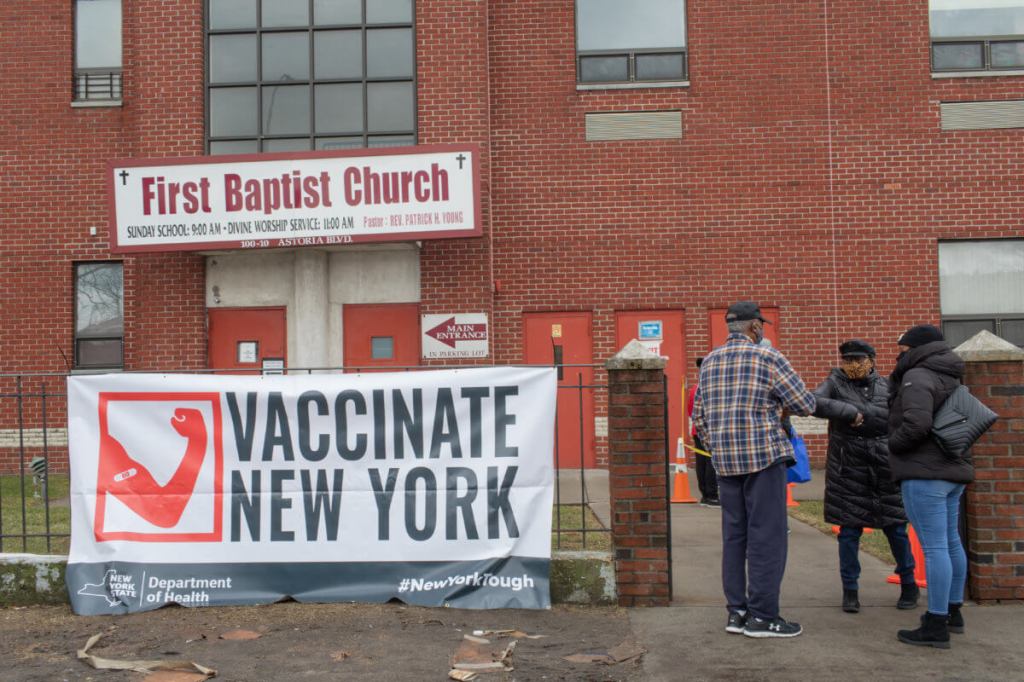
Democrat Congresswoman Alexandria Ocasio-Cortez helped convert First Baptist Church of Corona in New York City into a temporary vaccination center.
You can find hundreds of such examples online of collusion between corrupt churches and the corrupt medical/pharma complex, all feeding off of taxpayer dollars.

I am sure not every one of these churches is being paid to promote this death shot. Some are no doubt doing it for free, thinking they are doing the Lord’s work. There are no more excuses for that kind of stupidity. At this point the data is clear. You just have to look for it, because you won’t find any reporting from the mainstream media on the issue of vaccine safety. They are all bought off.

When the lid finally blows on this story, and the perpetrators of the greatest crime in human history are exposed, every one of these church leaders will be held accountable for their roles in what is quickly becoming a genocide...

...Number one, those churches didn’t become trusted by working with corrupt governments that force experimental medical treatments on their citizens.

Number two, how can this promotional work be considered “charity” if the churches are being paid to do it?

This is not earning trust. This is abusing trust, which is exactly what the globalist elites said they would do when they sat down at the Event 201 conference in October 2019 to run a simulation of the coming global coronavirus pandemic. If you listened to those seminars, they made it very clear that they would tap into “trusted sources” in the community to promote their narrative and destroy competing narratives about the pandemic.

Watch the video below from Event 201 and fast forward to the 19:25 mark. That’s CIA operative Avril Haines speaking in October 2019 about “flooding the zone” with “trusted sources” during an upcoming pandemic. Haines would later become Biden’s director of national intelligence. Another speaker, LaToya Abbott, starts talking at the 23:56 mark about the importance of combatting “anti-vaccine sentiment,” which tells you they already knew (in October 2019 two months before the pandemic was discovered in China) they were going to roll out a first-ever coronavirus vaccine that would be controversial.


Recruiting pastors to entice their flocks to accept a medical treatment they know nothing about is fraud and abuse against the people of God. Only an extremely naive and stupid pastor, or one who is an evil globalist, would agree to work with the government on such an devious plan.

With more data coming out every day on not only the failed efficacy of these injections but the dangers to health and safety, there are simply no more excuses left for pastors to be naive.

God have mercy on any pastor or ministry leader who is participating in this program.
Monday, 1 June 2020

Israeli Prime Minister Benjamin Netanyahu suggests microchipping children

And he causeth all, both small and great, rich and poor, free and bond, to receive a mark in their right hand, or in their foreheads:
And that no man might buy or sell, save he that had the mark, or the name of the beast, or the number of his name.
Revelation 13:16-17

Reading Biblical prophecies about the end times helped bring me to Christ in 1975; the prophecies seemed to be describing many things that were true at the time, and there was a lot of preaching and writing about the end times. In those days and the years immediately following, I tried to imagine how the prophecies would be fulfilled. It's one thing to imagine how prophecies will be fulfilled in the future, and it's another to live long enough to see them being fulfilled in the present. End times prophecies are more true now than they were in 1975, yet there's a lot less preaching on these scriptures than there was then, despite the fact that the prophecies are increasingly being fulfilled before our eyes--no doubt because it doesn't fit the Church Growth Movement paradigm of Peter Drucker, Rick Warren and company.

It would be ironic if the mark of the Beast were to originate in Israel. With everything else going on these days, you might have missed this item from a few weeks ago, as reported by Leon Sverdlov in The Jerusalem Post, May 8, 2020 (link in original):

Cyber experts slammed Prime Minister Benjamin Netanyahu for his proposal to "microchip" children who return to schools and kindergartens as the coronavirus lockdown is lifted, Ynet reported on Friday.

While speaking at a press conference on Monday, Netanyahu suggested the Health Ministry use new technology to help Israel adjust to its new routine as the state is lifting the coronavirus lockdown. "That is, technology that has not been used before and is allowed under the legislation we shall enact," he clarified.

"I spoke with our heads of technology in order to find measures Israel is good at, such as sensors. For instance, every person, every kid – I want it on kids first – would have a sensor that would sound an alarm when you get too close, like the ones on cars," the prime minister said.

"It will be hard to do it to more than a million schoolchildren who return to their educational institutions in order to ensure one student sits at the distance of two meters from another. It is fictional and dangerous," cyber resilience expert Einat Meron told Ynet.

"Theoretically, I get the idea behind it," she said. "But although such distance-sensitive microchips exist in vehicles, it is different in humans." According to Meron, "a beeping sound telling me I got close to someone is not enough. Who says it will change anything? I would have gotten closer either way."

The expert added that "the actual issue is the enforcement, and here everything changes." Meron told Ynet that "microchipping children will not pass any test – both practically and legally." Similar to Meron's notion that notifying citizens on their distance will not affect their actions, many fear the state would make use of the information available from the sensors.

"If the information with the kids' location is uploaded to the internet, a pedophile with some cyber knowledge may invade the system and stalk them outside their schools, follow them and distribute the information on other platforms," Meron said. "Can the state take responsibility for that?"

The Prime Minister's Office responded to the report, telling Ynet Netanyahu's suggestion "is not to be implemented through databases, but through simple technology notifying [the citizens] about their distance. It is a voluntary option that is designed to help children keep their distance, like Mobileye with vehicles."

The office added that the prime minister's suggestion is "an idea that may help maintain social distancing, and there will not be any violation of privacy."

On Wednesday, Walla reported the movements of all vehicles in Israel were tracked by police and stored in an unregulated database named Eagle Eye. A source cited by the media site said the information "may be kept for years on end."

The Association for Civil Rights in Israel (ACRI) reportedly submitted a request under the Freedom of Information Act that police disclose the extent of the operations of Eagle Eye, as well as the time the information on citizens' movements is stored in the system.

Israel Police responded to ACRI, saying the system's activity was not standardized internally despite several years of operations. "Either way, once finalized, the procedure will not be disclosed to the public," police added.

In late March, Yediot Aharonot reported a classified Shin Bet (Israel Security Agency) database stored information on all Israeli citizens and most Palestinians from the West Bank. The data tracked by the security agency included movements, phone calls and text messages.

Sunday, 1 December 2019

Backlog: Schoolchildren are increasingly being prepared to receive the mark of the beast

And he causeth all, both small and great, rich and poor, free and bond, to receive a mark in their right hand, or in their foreheads:

And that no man might buy or sell, save he that had the mark, or the name of the beast, or the number of his name.
Revelation 13:16-17

When I was in kindergarten in Edmonton in 1966-67, I didn't go to a bus stop. A station wagon with a "School Bus" sign on top, driven by a nice, attractive brunette (who must be in her late 70s now, if she's still alive), stopped at the house of each child, and took us all downtown, where we had kindergarten in the basement of the Seven Seas restaurant, and then took us home afterward. I'll take that over the surveillance technology of the 21st century.

The following article, six years old but still relevant (maybe now just for historical purposes), illustrates that surveillance technology can have positive aspects. No parents want their children to be on the wrong bus or in the wrong school, or who-knows-where. However, it's only a matter of time before an electronically-scanned card today becomes a mark in the right hand or forehead tomorrow. As reported by Andrea Sands in the Edmonton Journal, September 20, 2013:

When five-year-old Jack Rattray gets on his school bus to leave Wes Hosford Elementary School in Sherwood Park, a swipe of his electronic bus pass tells school district authorities he's aboard.

Jack swipes the card again when he gets off the bus at a busy transfer centre at Salisbury Composite High School, where he boards a second bus to his day home with another swipe. On days his mom isn't working, Jack takes a different bus from school straight home.

Jack's mom, Sydney Rattray, can log in at work using an application called My Stop and see on a map where Jack's bus is located and its estimated arrival time.

"If he got confused one day and thought he was supposed to go to the day home, I could find him," said Rattray, a pharmacy technician who does shift work at the University of Alberta.

"It feels safe. You can monitor without being there, without hovering...It does give me peace of mind."

Elk Island Public Schools was the first school district in Canada to use student-scanning bus passes and GPS on all its buses, said transportation director Lisa Weder.

Now, Edmonton Public Schools and Edmonton Catholic Schools are testing similar on-board GPS systems that will let parents locate their child's bus pass on a map.

Elk Island Public Schools started rolling out the technology last year, Weder said.

More than 8,000 of Elk Island Public Schools' 16,500 students travel on about 165 buses running 591 routes across Sherwood Park, Fort Saskatchewan, Vegreville and Strathcona County, she said.

The student-scan and GPS technology, plus an automated system called Checkmate that ensures no child is accidentally left on the bus, are now fully installed at a cost of $275,000, Weder said.

"Because we run so many transfers and we transport kindergarten to Grade 12 students on all the same buses, it really helps us if a student boards an incorrect bus," Weder said.

Last week, a four-year-old boy in Winnipeg was dropped off at the wrong school, where he spent his entire first day of kindergarten before someone noticed the error. Also last week, an Edmonton boy got off his bus at the wrong school when he took the bus for the first time to kindergarten, Global News reported.

A school bus driver with the Northern Lights School District was suspended in January 2012 after a young boy was left alone on a bus for an entire school day.

Mix-ups are most common with new students, and more frequent at the beginning of the school year, said Weder.

"There's a significant number of students boarding incorrect buses. In the first two weeks of school, we probably had, I would say, at least four to five cases a day where students were boarding incorrect buses."

The scanned bus passes allow school authorities to monitor which bus each student boards and leaves and at what time. The data also shows transportation planners exactly how many students are taking the bus each day so they can plan most efficiently, Weder added.

"You could have 70 students registered to a 72-passenger bus, but who's actually riding that bus?"

On-board GPS systems also send data about what the bus is doing to school district staff, Weder said. That means employees can see if a bus is speeding, if it stops completely at railway crossings, if it follows the designated route, if it stops on time and in the proper spots to pick up or drop off children, she said.

Edmonton Public Schools started testing on-board GPS at six schools this fall, said district spokeswoman Jane Sterling.

Saturday, 24 August 2019

Chinese government issues 17,000 smart watches to track movements of schoolchildren

With each passing day, conditions are increasingly resembling those prophesied in Revelation 13:11-18. What's "voluntary" today will be compulsory tomorrow. As reported by Sophia Yan of the London Daily Telegraph, July 17, 2019 (links in original):

Beijing -- A local government in southern China has handed out smart watches to nearly 17,000 primary school pupils, capable of pinging their real-time locations and emergency alerts to their parents.

The watches, distributed to students in 60 schools, are equipped with chips powered by BeiDou, China’s own version of GPS, according to the Guangzhou Daily, a Chinese state media outlet. GPS is a system developed and owned by the US government.

“With this watch, Mom and Dad can know where I am, and I can call and voice message them immediately after class,” one enthusiastic fourth-grader told state media.

The smart watch-tracking government program is entirely voluntary and about half of the devices distributed have already come online. Plans are in place to issue another 13,000 smart watches to students, and the authorities will soon begin handing them out to elderly people.

User information will be uploaded to a database maintained by China’s ministry of public security and the ministry of industry and information technology, according to state media.

Cities in China have been getting creative in finding new ways to monitor students and curb truancy with the latest technologies.

In December, more than ten schools in Guizhou and Guangxi provinces began requiring students to wear “intelligent uniforms” embedded with computer chips to track their movements and trigger an alarm if they skip class, according to state media.

Two chips, sown into the shoulders of school jackets, can sustain around 500 wash cycles and temperatures of 150 degrees Celsius.

Facial recognition scanners at school gates match the chips with the correct students, meaning anyone who tries to swap jackets in order to play truant will be caught. Alarms will also sound if a pupil falls asleep in class.

Last May, a high school in Hangzhou installed facial recognition technology to check how attentive pupils were in class.

Movements of students are watched by three cameras positioned above the blackboard, and can pick up seven different emotions, including neutral, happy, sad, disappointed, angry, scared and surprised. If the technology concludes a student is distracted in class, it will send a notification to the teacher to take action.

BeiDou was originally developed by the Chinese military to reduce reliance on the US-owned GPS system, but its positioning accuracy is to within 10 metres while GPS can track down to 30 centimetres.

In efforts to speed up adoption of the system, Chinese authorities have ordered taxis, buses and other vehicles to install BeiDou, and many domestic phone brands including Huawei and Xiaomi are now also compatible with the system.

There are only a handful of other global satellite navigation systems, including Russia’s Glonass and Europe’s Galileo, which has suffered an outage over the last two weeks.

The UK has been involved in developing Galileo, sinking £1.2 billion in the project, but now intends to build its own as part of Brexit fallout.

Sunday, 17 June 2018

Radio frequency may replace X-rays in security devices

As reported by Joshua Philipp of The Epoch Times, June 7, 2018 (link in original):

A new device that fits on a cellphone could soon replace X-ray machines in airports and security checkpoints, while being affordable enough for schools and nightclubs.

Rather than using X-rays, which often require heavy equipment, the new device, SWORD, uses radio frequency. The technology can achieve effects similar to X-rays, but in a noninvasive way, and with no more radiation than what a cellphone already emits.

The SWORD platform would help move options for preventing terrorist attacks and mass shootings from being reactive to proactive, according to Barry Oberholzer, CEO of Royal Holdings, which created the system.

“If you look at all the mass shooter and terror attacks that have been happening, we believe this product we develop is proactive and can save lives,” he said. “It’s not reactive like many people are currently pushing.”

Oberholzer said the system was an answer to threats he has witnessed in his work as an intelligence contractor. He has worked with the FBI Joint Terrorism Task Force, Belgium Customs Intelligence Agency, and others to counter criminal operations, including narco-terrorism and smuggling networks.

SWORD works through a specialized smartphone case with an internal processor and antennae that emit radio frequency waves. These waves can scan people and bags, and transmit data back to the phone. It then runs the data through an app on the phone itself, which connects to an AI-driven threat database. It can then give alerts on whether people are carrying guns or explosives, and can do facial recognition to detect if an individual is banned from a location or wanted by authorities.

Oberholzer said the new system would give even security guards at locations such as airports and metro stations the ability to scan individuals and unattended bags for threats, rather than having to call in police, K-9 units, or bomb squads, which can often take hours.

Saturday, 26 May 2018

Israeli Knesset Finance Committee approves a bill calling for microchipping of camels

Even camels aren't safe from intrusive technology; as usual, the measure is justified on the basis of safety. As reported by Jewish News Syndicate, May 22, 2018:

The legislation dictates that camel owners bear criminal responsibility for accidents and damages caused by their animals. Camels will also be required to have a subcutaneous digital microchip with owners’ details.

The Knesset Finance Committee approved the Camel Law on Tuesday, initiated by Regavim and Knesset member Bezalel Smotrich, for its second and third readings in the Knesset plenum. Regulations requiring identification and registration of camels by subcutaneous microchip were approved, as well as criminal responsibility for camel owners.

The law, which is scheduled for its final Knesset plenum hearing (“second and third reading”) next week, was drafted jointly by Regavim, Smotrich (a resident of the Negev community Retamim) and other Knesset members.

Under the new legislation, camel owners will bear criminal responsibility for accidents and damages caused by their animals. Camels will be required to have a subcutaneous digital microchip recording the owner’s details—similar to the microchips with which dogs and other pets are currently registered. Additionally, the new Camel Law will require owners to officially register the sale or transfer of ownership of all camels in a Ministry of Agriculture database.

Meir Deutsch, director of policy and parliamentary affairs at Regavim, explains that the law began to take shape almost three years ago, after the death of David Cohen of Retamim in a collision with a camel near the entrance to his home town.

“Since the legislative process began, three more people lost their lives in tragic, but avoidable, camel accidents,” said Deutsch. “After the most recent accident, in which 13-year old Liel Almakias was killed, Knesset Finance Committee Chairman MK Eitan Cabel took up the cause and expedited the legislation’s progress. We hope these new regulations will reduce the problem of wandering camels and help save lives.”

Said Smotrich: “We approved an important piece of legislation today, after intensive efforts. Residents of the Negev deserve to be protected by the state, and those who should be held responsible will be forced to take responsibility. With God’s help, the danger to life and limb and the fatal collisions caused by wandering camels will soon be a thing of the past. Today, we took an important step towards this goal—better late than never.”

Tuesday, 20 March 2018

Backlog: Big law firm uses fingerprint-scanning to track employees

As reported by Niamh Scallan of The Toronto Star, November 1, 2012:

The days of sneaking out for three-hour lunch breaks will soon be over at a Bay Street law firm after it decided to install fingerprint-scanning technology to monitor its employees’ whereabouts.

Last month, McCague Borlack LLP announced plans for a revamped security system that will require staff (except lawyers who spend much of their time with clients) to clock in and out of the office with a finger swipe, keeping track of morning late-comers or those who try to jump-start their weekends by slipping out early on a Friday.

“Some people were abusing the system,” said founding partner Howard Borlack, 58. “We had people taking two to three hours for lunch and we had no way of knowing. . . . Some people were complaining.”

Other Toronto firms use security passes and honour systems to keep track of time worked. McCague Borlack, which focuses mostly on insurance law and employs about 200 people, has gone a step further with a system that not only provides office access via fingerprint, but also records employees as they enter and leave.

Come mid-November, when the system is expected to go live, the office will be equipped with finger-scanning machines supplied by Utah-based Qqest, Inc. that will keep a rolling record of the time spent in the office.

It’s mostly about improved building security, said Borlack, a way to keep track of people coming in and out of the office and streamlining administrative tasks. But with concern within the firm that some people are working less than 40 hours a week, the monitoring feature is “a huge bonus.”

“I know we have people who probably work less than 35 hours a week and if I listen to all the griping about certain people, I’m sure it’s well less than that,” Borlack said.

A boon for productivity-conscious managers, the plan has drawn outrage among a group of bloggers who identify themselves as McCague Borlack secretaries.

On their “Finger Campaign” website, the group has accused the firm of singling out secretaries and copy-room staff (by exempting some lawyers from the program), and called the system an “insult to our human dignity” that has had a “very chilling effect on the secretaries’ psyche.”

“The indignant fingerprinting program does not seek to address any security concerns at all,” one post read. “It’s for the ‘mark ’em and track ’em’ purpose exclusively.”

Borlack admitted he “knew it would be uncomfortable” for some employees, but said he was careful to ensure the fingerprint technology would not violate privacy issues. He denounced the “Finger Campaign” as false, noting the new measure was intended mostly for security purposes and most staff seemed to be on board.

Rosa DeFrenza, a receptionist at the firm for five years, said she had not yet seen the “Finger Campaign” website, but said she thought the program could help to standardize work hours among her colleagues.

She added that diligent workers, herself included, had no reason to be concerned about the program. “No one should be working more than anyone else, no one should be working less than anyone else,” DeFrenza said.

But where to draw the line?

Carleton University law professor Michael MacNeil, who specializes in legal issues surrounding privacy and surveillance, said the fingerprinting system is just one example of the way workplaces are using technology to monitor and maximize productivity.

But legislation has lagged behind the trend, he said, leaving more questions than answers over what constitutes an invasion of privacy in the workplace.

“There’s a lot of it going on,” he said. “It’s an area where the law is underdeveloped.”
If a religious group used methods such as those described above, it would be considered evidence of the group's cultic character. Indeed, that comparison has already been made. Mary Otvos, a young woman who was quitting the practice of law after 10 years wrote an article titled Why I'm Leaving Law, which appeared on pages 12-17 of the February 1992 issue of Canadian Lawyer. Unfortunately, the magazine's online archives don't go back that far, and that article doesn't seem to be available online. One of the observations that Ms. Otvos made was that big law firms are like religious cults in their efforts to control their people. That article appeared 20 years before McCague Borlack began using fingerprint technology to monitor their employees' whereabouts; the use of surveillance technology has enabled the cult leaders to be even more controlling.

Friday, 29 December 2017

If your favourite performing artist is dead, you can still catch him "live" on tour by hologram

And I beheld another beast coming up out of the earth; and he had two horns like a lamb, and he spake as a dragon.
And he exerciseth all the power of the first beast before him, and causeth the earth and them which dwell therein to worship the first beast, whose deadly wound was healed.
And he doeth great wonders, so that he maketh fire come down from heaven on the earth in the sight of men,
And deceiveth them that dwell on the earth by the means of those miracles which he had power to do in the sight of the beast; saying to them that dwell on the earth, that they should make an image to the beast, which had the wound by a sword, and did live.
And he had power to give life unto the image of the beast, that the image of the beast should both speak, and cause that as many as would not worship the image of the beast should be killed.
Revelation 13:11-15

Roy Orbison has long been one of this blogger's favourite singers; I was fortunate to see him in concert in 1981, and was Crying when I heard of his death in December 1988. I thought the only way to see him perform live again would be In Dreams, but if I want to Ride Away or be Borne on the Wind, I can join The Crowd and catch the Big O on tour in the United Kingdom,
continental Europe, and Australia in April-May 2018.

The fact that an artist who's been dead for almost 30 years can perform concerts by means of a hologram (the accompanying orchestra is presumably real) shows how far the technology has advanced that can create (or recreate) the impression of a live performance, and gives further indication of how the image of the beast will come about, and how people will be deceived into worshipping the image. It's Too Soon to Know how successful the hologram technology will work on Roy Orbison's 2018 tour (there's always the chance of a Communication Breakdown before It's Over), but readers who are Running Scared and asking Where is Tomorrow should waste no time in believing in the Lord Jesus Christ as their Saviour, and receiving the salvation He has provided, lest they find themselves Falling or Drifting Away. The prophecies concerning the Beast, his mark, and image, were given 2,000 years ago, and are in the process of being fulfilled, right on schedule. The return of the Lord Jesus Christ is one of the most important and frequent subjects of New Testament prophecy; that too, will occur right on schedule, and the stage is being set.

HT: M.P.

Tuesday, 31 October 2017

The latest in idolatry: the worship of artificial intelligence

The idols of the heathen are silver and gold, the work of men's hands.
They have mouths, but they speak not; eyes have they, but they see not;
They have ears, but they hear not; neither is there any breath in their mouths.
They that make them are like unto them: so is every one that trusteth in them.
Psalms 135:15-18 (also Psalms 115:4-8)

And I beheld another beast coming up out of the earth; and he had two horns like a lamb, and he spake as a dragon.
And he exerciseth all the power of the first beast before him, and causeth the earth and them which dwell therein to worship the first beast, whose deadly wound was healed.
And he doeth great wonders, so that he maketh fire come down from heaven on the earth in the sight of men,
And deceiveth them that dwell on the earth by the means of those miracles which he had power to do in the sight of the beast; saying to them that dwell on the earth, that they should make an image to the beast, which had the wound by a sword, and did live.
And he had power to give life unto the image of the beast, that the image of the beast should both speak, and cause that as many as would not worship the image of the beast should be killed.
Revelation 13:11-15

As reported by Glenn McDonald of Seeker, October 3, 2017 (links in original):

You might soon be able — if you’re so inclined — to join a bonefide church worshiping an artificially intelligent god.

Former Google and Uber engineer Anthony Levandowski, according to a recent Backchannel profile, filed paperwork with the state of California in 2015 to establish Way of the Future, a nonprofit religious corporation dedicated to worshiping AI. The church's mission, according to paperwork obtained by Backchannel, is “to develop and promote the realization of a Godhead based on artificial intelligence and through understanding and worship of the Godhead contribute to the betterment of society.”

The documents show Levandowski is CEO and President of Way of the Future. Presumably there was no option for High Priest.

Author and religious studies scholar Candi Cann, who teaches comparative religion at Baylor University, said Levandowski's spiritual initiative isn't necessarily that odd from a historical perspective.

“It strikes me that Levandowski's idea reads like a quintessential American religion,” Cann told Seeker. “LDS [The Church of Jesus Christ of Latter-day Saints] and Scientology are both distinctly American traditions that focus on very forward thinking religious viewpoints. LDS discusses other planets and extra-terrestrial life. Scientology has an emphasis on therapy and a psychological worldview, which is quite modern and forward thinking.”

The concept of worshiping artificial intelligence even has a certain resonance with a major world religion, Cann said.

“From a comparative religion perspective, I think it feels the most like Hinduism, in which there are avatars of deities found on Earth,” she said. “In this way, I think AI can reflect the best of humans back to us, which are, in turn, worshiped.”

Levandowski is accused of stealing proprietary documents when he was an engineer at Google and taking them to his own self-driving vehicle start-up, which was later acquired by Uber for $680 million. Uber denies knowledge of Levandowski’s alleged theft or that Google technology made it into its vehicle technology. Waymo, Google’s self-driving vehicle spin-off, filed suit against Levandowski in February. Uber fired him in May, claiming he was not cooperating with the company’s legal work.

Levendowski’s pitch for an AI church comes amid apocalyptic warnings from tech and science luminaries like Elon Musk and Stephen Hawking to the dangers of artificial intelligence. Musk suggested a few years back that he's investing heavily in artificial intelligence largely to keep an eye on AI, which he views as an existential threat to humanity.

“With artificial intelligence we are summoning the demon,” the founder of Tesla and SpaceX said. “In all those stories where there’s the guy with the pentagram and the holy water.... It’s like — yeah, he’s sure he can control the demon. It didn't work out.”

A former friend and colleague of Levandowski quoted by Backchannel provides some insights to the would-be church leader's views on robots and artificial intelligence.

“He had this very weird motivation about robots taking over the world — like actually taking over, in a military sense,” an unidentified engineer and former friend told the publication. “It was like [he wanted] to be able to control the world, and robots were the way to do that.”

Baylor’s Cann noted that it's important to keep in mind that any speculation about Levandowski’s motivation for Way of the Future is based on a mission statement from only one document.

“For me, this is more like a new paradigm out of which new religious practices could emerge,” Cann told Seeker. “It doesn't seem like a religion as much as a religious worldview. Along those lines, secularism is a religious worldview.”

Saturday, 30 September 2017

U.K. supermarket allows payment by scanning the fingertip veins of customers

And he causeth all, both small and great, rich and poor, free and bond, to receive a mark in their right hand, or in their foreheads:
And that no man might buy or sell, save he that had the mark, or the name of the beast, or the number of his name.
Revelation 13:16-17

The world is increasingly being softened up to take the mark of the Beast. While the Bible never refers to that mark as good, the world is increasingly promoting the technology that's leading to the adoption of the mark of the Beast in terms of convenience and security for prospective users. As reported by Karen Morley in the London Daily Telegraph, September 20, 2017 (links in original):

A UK supermarket has become the first in the world to let shoppers pay for groceries using just the veins in their fingertips.

Customers at the Costcutter store, at Brunel University in London, can now pay using their unique vein pattern to identify themselves.

The firm behind the technology, Sthaler, has said it is in "serious talks" with other major UK supermarkets to adopt hi-tech finger vein scanners at pay points across thousands of stores.

It works by using infrared to scan people's finger veins and then links this unique biometric map to their bank cards. Customers’ bank details are then stored with payment provider Worldpay, in the same way you can store your card details when shopping online. Shoppers can then turn up to the supermarket with nothing on them but their own hands and use it to make payments in just three seconds.

Finger vein-scanning is a proven technology in Japan #biometric #payments
https://t.co/S4WOvAxdTh pic.twitter.com/eKfsThfPPO
— Sthaler (@SthalerLtd) July 12, 2017

It comes as previous studies have found fingerprint recognition, used widely on mobile phones, is vulnerable to being hacked and can be copied even from finger smears left on phone screens.

But Sthaler, the firm behind the technology, claims vein technology is the most secure biometric identification method as it cannot be copied or stolen.

Shaler said dozens of students were already using the system and it expected 3,000 students out of 13,000 to have signed up by November.

Finger print payments are already used widely at cash points in Poland, Turkey and Japan.

Vein scanners are also used as a way of accessing high-security UK police buildings and authorising internal trading at least one major British investment bank.

The firm is also in discussions with nightclubs, gyms about using the technology to verify membership and even Premier League football clubs to check people have the right access to VIP hospitality areas.

The technology uses an infrared light to create a detailed map of the vein pattern in your finger. It requires the person to be alive, meaning in the unlikely event a criminal hacks off someone’s finger, it would not work. Sthaler said it take just one minute to sign up to the system initially and, after that, it takes just seconds to place your finger in a scanner each time you reach the supermarket checkout.

Simon Binns, commercial director of Sthaler, told the Daily Telegraph: ‘This makes payments so much easier for customers.

"They don’t need to carry cash or cards. They don’t need to remember a pin number. You just bring yourself. This is the safest form of biometrics. There are no known incidences where this security has been breached.

"When you put your finger in the scanner it checks you are alive, it checks for a pulse, it checks for haemoglobin. ‘Your vein pattern is secure because it is kept on a database in an encrypted form, as binary numbers. No card details are stored with the retailer or ourselves, it is held with Worldpay, in the same way it is when you buy online."

Nick Telford-Reed, director of technology innovation at Worldpay UK, said: "In our view, finger vein technology has a number of advantages over fingerprint. This deployment of Fingopay in Costcutter branches demonstrates how consumers increasingly want to see their payment methods secure and simple."

Wednesday, 2 August 2017

Employees of Wisconsin company are embedded with microchips

And he causeth all, both small and great, rich and poor, free and bond, to receive a mark in their right hand, or in their foreheads:
And that no man might buy or sell, save he that had the mark, or the name of the beast, or the number of his name...
...And the third angel followed them, saying with a loud voice, If any man worship the beast and his image, and receive his mark in his forehead, or in his hand,
The same shall drink of the wine of the wrath of God, which is poured out without mixture into the cup of his indignation; and he shall be tormented with fire and brimstone in the presence of the holy angels, and in the presence of the Lamb:
And the smoke of their torment ascendeth up for ever and ever: and they have no rest day nor night, who worship the beast and his image, and whosoever receiveth the mark of his name.
Revelation 13:16-17, 14:9-11

As reported by Jefferson Graham and Laura Schulte in USA Today, August 1, 2017:

RIVER FALLS, Wis. — A local firm here made good today on its vow to embed employees with microchips.

Sporting "I Got Chipped" T-shirts, some 40 workers at Three Square Market, a firm that makes cafeteria kiosks aimed at replacing vending machines, got tiny rice-sized microchips embedded in their hands.

Company officials said it was for convenience, a way for them to bypass using company badges and corporate log-ons to computers. Now, they can just have their hands read by a reader, similar to using a smartphone to pay for goods.

The company would like to see payments go cashless, as iPhone users do with Apple Pay. Except in this case, consumers use their hand instead of a smartphone to pay.

The chip is not a tracker nor does it have GPS in it, so the boss can't track your movements, company officials say. Still, to those who worry about Big Brother having more control over our lives, Three Square Market President Patrick McMullan says you should, "take your cell phone and throw it away."

The chips come from Biohax Sweden, a company that says it has nearly 3,000 people using it in Europe. The founder of that company, Jowan Osterlund, has struck alliances with companies to pay to have the chips installed in employees or pass them out at tech fairs.

Three Square Market employees say they were having the chip installed to be part of the larger team, and help develop the technology.

The chip ceremony was held in the company's cafeteria, where a local tattoo artist, was on hand to perform the installation.

The entire process took about a minute. It started with Osterlund cleaning the skin, finding a spot in the hand to pinch, then asking the employee to inhale and exhale as he inserted a syringe, install the chip, and place a band-aid over the spot.

"The pinch hurt more than the injection," says McMullen. "It stung for about an hour and half afterwards, but now it's getting back to normal."

But what seemed normal in Wisconsin played out differently across the Internet.

During our Facebook Live interview with McMullen, Chris Malak from Winneconne, Wis., said, "I have a co-worker who can never keep track of their keys thus always asking for mine and no idea what her pass word are. This would be good for her. But as for me, hell no."
Go here to see an interview with Three Market Square Chief Executive Officer Todd Westby on the company's plan to insert microchips into their employees.

Prophecy is one of the most useful tools Christians have in defending the truth of the Bible. Most Biblical prophecies have already been fulfilled, some have yet to be fulfilled, and some are in the process of being fulfilled. The prophecies in Revelation cited above weren't capable of fulfillment until recently, because the technology didn't exist. The technology does exist now, and the prophecy of the mark of the Beast is in the process of being fulfilled. Skeptics may claim that Biblical prophecies of a "mark" in the right hand or forehead without which no one may buy or sell, and the existence and gradually increasing acceptance of microchip implants, is just a coincidence, but the skeptics can't deny that the prophecies are in the Bible--and they've been there for over 1,900 years.

In the case of Three Square Market, the fulfillment of the prophecy in the passages from Revelation isn't exact--
this photo shows an employee receiving the implant in his left hand, not his right--but the stage is clearly being set.

It's one thing to imagine how Biblical prophecy will be fulfilled, and it's another thing to hang around long enough to see it being fulfilled--and not necessarily as I imagined. When I read these prophecies in my early years as a Christian in the 1970s, and 1980s, I imagined that there would be a lot of force involved in getting people to receive the mark of the Beast. However, over the last 15 or 20 years, I've come to believe that my earlier view was wrong--rather than being forced to take the mark of the Beast, people will want it. Submitted for your approval, the following article by Jefferson Graham in USA Today, July 29, 2017 (updated August 1, 2017) (link in original):

LOS ANGELES — Charlene Li wants to be chipped.

“I am so ready,” says the long-time author and principal analyst for the Altimeter Group.

She’s referring to having a microchip embedded in her body, one that would do many of the things her smartphone could do now.

This week science fiction came to the heartland when a small Wisconsin company announced it would begin implanting microchips into employees hands. The pitch: This will be a convenience for them to ditch the company badge and corporate log-on for computers. Instead, the chip identifies them.

For Li, “as a woman, we don’t generally have outside pockets in our clothes so we have to carry a purse for my keys and phone and other things," she says. "If I had a chip, I wouldn’t have to lose things, and I could pay for things, open my car doors, so many options.”

Tuesday, the Wisconsin firm, Three Square Market, will stage a “chips and salsa,” party at its company headquarters near the Minnesota border, where it expects to chip up 50 of its 85 employees.

The announcement set up off alarm bells with some readers, who asked about the health risks (experts say they’re minimal, for now) and worried about them being evasive).

First, a reality check. The tiny, rice-shaped microchips do not have GPS. They are similar to the chip inside smartphones that let us pay for goods at the store by holding it under a reader. They can identify us, but they can’t track us — yet.

Still, it got us wondering. Beyond company ID and logging onto the computer, how else could an implanted chip improve (or worsen) our lives?
We went to a farmer’s market this week to ask folks. Their take:

— Replace passwords forever. Haley Cameron, 20, a hostess for a Hermosa Beach, Calif., restaurant says she has so many passwords and always forgets them. If they were already in you, “you wouldn’t have to memorize things or write them down,” she says.

— Goodbye passports. “It would be more efficient," says Mari Calisto, 17, a Hermosa Beach student. "At the airport it would be really quick to scan your ID” ... “and you wouldn’t have to worry about carrying a lot of paperwork.”

— Ditch the phone. Implant a chip that would allow you to receive phone calls through an accessory earpiece — as they communicated in the 2012 remake of Total Recall, when actual phones were implanted in bodies, and the characters held their hands to their ears to make calls. “I wouldn’t want to use the phone anymore. It’s all about the chips,” says Stephen Blackshear, 17, a Hermosa Beach student.

— Medical Safety. You could put vital information into the chip, says Bob Hoffman, 71, a retiree in Hermosa Beach. “If someone passed out, they might be able to read from the chip what allergies or medical problems they had.”

— Keeping track of criminals. Instead of ankle bracelets that monitor the movement of those under custody, “maybe they could trade it for chipping,” says Joe Terry, a farmer from Lawndale, Calif.

— Buy goods at stores quicker. Amazon is testing a new supermarket concept in Seattle that eliminates cash registers and lets customers pay with an app. For Li, an embedded chip would do even better.(Three Square Market sells kiosks that replace vending machines for employees, and is encouraging paying for food with the chip.)

— Business cards are so yesteryear. “When I meet people and they would say, can I connect with you, I say, read my chip,” says Li. “There’s no exchange of business cards, I'd just show up in their contacts.”

Click here to listen to our complete interview with Li about being chipped on the #TalkingTech podcast.
While the Scripture dwells on the negative aspects of receiving the mark of the Beast, the article above mentions a number of positive aspects, which I suggest are helping to soften people up for accepting the microchip. Another motivation, as stated in the earlier article, is to be "part of the larger team"--which sounds somewhat coercive and suspiciously cultic to me, especially with so many workers wearing t-shirts reading "I Got Chipped." It's also worth noting that while the microchipping technology comes from and is accepted in Sweden--which long ago abandoned its Christian heritage--it's now gaining increasing acceptance in the United States, which still retains a vestige of its Christian heritage.

I suggest that a pre-Tribulation, pre-millennial Rapture would hasten acceptance of the mark of the Beast. Imagine, if you will, the sudden disappearance of untold numbers of Christians. Those who are left behind won't likely recognize that those who have disappeared are Christians who've gone up in the Rapture--when the Antichrist is revealed, God shall send them strong delusion that they should believe a lie (II Thessalonians 2:11).

More likely, the reaction of those left behind will be panic because of the disappearance of large numbers of people, with no way of tracing where they went. (New Agers--and "Christian" dominionists--will likely say that the "good guys" have been left behind, while the "bad guys" who have been holding back the introduction or progress of the New Age have been removed either for re-education or destruction.) The reaction will likely be "Where did they go? Who's next? If this happens again and I disappear, I want those left behind to be able to find out where I went. Give me that microchip before this happens again."

God doesn't condemn people merely for having a piece of technology put in their bodies--there are no biblical condemnations, for instance, of pacemakers, or pieces of steel in the case of fractured bones--but there is a condemnation for receiving the mark of the Beast. Since the passages in Revelation talk about the mark as "of the beast," and say that those who receive it "drink of the wine of the wrath of God," there has to be a major religious component to accepting the mark, involving allegiance to the Antichrist and rejection of Jesus Christ.

All of these developments indicate that the return of the Lord Jesus Christ is imminent and draws ever nearer. Maranatha!

Friday, 28 July 2017

Comerica Park in Detroit introduces biometric readers to identify regular attenders

And he causeth all, both small and great, rich and poor, free and bond, to receive a mark in their right hand, or in their foreheads:
And that no man might buy or sell, save he that had the mark, or the name of the beast, or the number of his name.
Revelation 13:16-17

This blogger finds it hard to believe that lineups for tickets at Comerica Park are very long, given the way the Detroit Tigers are playing this year. However, the world doesn't seem to want to pass up an opportunity to soften up people for accepting the mark of the beast. As reported by Frank Witsil of the Detroit Free Press, July 25, 2017:

If you’ve ever had to stand in one of those looong lines to get into Comerica Park, you might have wanted to give the gate attendant the finger.

Well, now you can. Sort of.

The Detroit Tigers are trying out a new system that identifies you by your fingerprints, similar to the newest smartphones, to lessen the time it takes to get through security.

The Detroit stadium is among the first nationwide to get biometric readers. The Tigers debuted the system Monday at Gate A — the main gate across from the Fox Theatre.

"Once you are in the system, so to speak, you have the ability to enter different venues and perform different transactions," said Ed O'Brien, the head of sports business development at New York-based Clear, which installed the system. "The way we view our long-term sports fan experience is, you'd never have to carry a wallet again."

To use the biometric system, you must register your fingerprints, which is free. Registration at Comerica was offered Monday and will be available at a kiosk on game days. To sign up, which takes about five minutes, you'll need your ID and to correctly answer a series of questions, the company said. You then scan all 10 fingers.

Once your information is in the system, you are good to go, and you never have to register again.

In addition, the ballpark will allow registered users to bring one adult with a ticket and an unlimited number of unregistered children with tickets through the line with them.

The purpose of the exceptions, O'Brien said, is to benefit season-ticket holders and families. As more ticket holders register, the company plans to add more special entrance lanes. Financial details of the deal were not disclosed.

Beyond stadium entry, Clear envisions a world in which people use their fingertips — and eyes — to buy concessions, enter offices and perhaps even start their cars.

In addition to baseball, O'Brien said the company is in conversations with other professional sports arenas in Detroit — Ford Field and Little Caesars Arena — to add the technology.

The biometric reader at Comerica is similar to what Clear uses with the Transportation Security Administration and has installed at airports, including Detroit Metro, to get flyers through security faster.

Clear has biometric scanners at 30 major airports, including those in Atlanta, Dallas, Denver, Las Vegas, Los Angeles, Miami, New York, Orlando, San Francisco, Seattle and Washington.

A privately held company that started in 2010, Clear also has technology that scans eyes.

Tuesday, 30 August 2016

Facebook founder Mark Zuckerberg visits Pope Francis and gives him a drone

The world moves further toward the mark of the Beast. This blogger isn't on Facebook and never will be, God willing (I've heard that it's very difficult to get off Facebook once you're on it). As reported by Sarah Perez of Tech Crunch, August 29, 2016 (links in original):

On Monday, Facebook CEO Mark Zuckerberg and his wife Priscilla Chan met with Pope Francis, as part of Zuckerberg’s trip of Italy, announced following the devastating earthquake that hit the country last week, killing hundreds. After discussing the importance of connecting people in the world without internet access, Zuckerberg presented the Pope with a drone – but, alas, not a working one. Instead, it was a model of Facebook’s solar-powered Aquila aircraft, designed to beam internet access to those areas of the world that are lacking connectivity.

The Aquila drone, which has a wingspan of over 113 feet – bigger than a Boeing 737 – just completed its first official test flight this summer. The drone will fly for 90 days at a time, and can blanket a 60-mile wide area with internet access.

According to a post on Zuckerberg’s Facebook page, the CEO told the Pope how much he admired his message of mercy and tenderness, as well as how he’s found new ways to communicate with people of every faith around the world. (The current Pope uses social media, having followed in Benedict’s footsteps by joining Twitter, and he signed up for an Instagram account just this March.)

In a statement released by the Vatican’s press office, the Pope and Zuckerberg discussed how technology can aid in continuing to spread the Pope’s message.

“Together they spoke about how to use communications technology to alleviate poverty, encourage a culture of encounter, and to communicate a message of hope, especially to the most disadvantaged,” said Vatican press office director Greg Burke in a statement.

As part of the trip, Zuckerberg also met with Italian Prime Minister Matteo Renzi to discuss the earthquake, the economy, and technology’s impact on job creation, among other things. The CEO hosted a Townhall Q&A in Rome, which was live-streamed on Facebook, as well.

“I told the Prime Minister I’m especially excited with the work being done across Europe on artificial intelligence,” wrote Zuckerberg on Facebook.

“As part of the Facebook AI Research Partnership Program, we’re providing 26 state-of-the-art GPU servers to research institutions across Europe — including one to the University of Modena and Reggio Emilia here in Italy. They’ve got a great artificial intelligence and computer vision program, and this new technology will hopefully help students and the faculty do even more,” he said.

Fifteen research groups across 9 countries in Europe will receive these computers, which are similar to those at FAIR (Facebook AI Research) with 8 high-end GPU cards each. The computers are meant to help recipients in research areas like computer vision, learning systems, deep neural networks, and more.

Beyond getting face time with the Pope, it’s also interesting to see Zuckerberg taking on the role that’s usually reserved for politicians – that is, touring a country after a natural disaster. While that wasn’t the primary purpose of the visit, it’s clear that Facebook has a larger role to play in the world economy these days, and is working to get key players to buy into its plans to bring the internet to the unconnected masses.

Earlier this year, Zuckerberg went to China, where he held a rare meeting with China’s propaganda chief, Liu Yunshan, to discuss internet development in China, and how Facebook could be included. The site has been blocked in the country, which hosts 720+ million internet users, since 2009.
As reported by Fortune, August 29, 2016:

During his trip to Italy, Mark Zuckerberg made sure to pencil the Pope into his schedule.

On Monday, the Facebook (fb) CEO and his wife, Priscilla Chan, met with Pope Francis to discuss “how to use communications technology to alleviate poverty, encourage a culture of encounter, and to communicate a message of hope, especially to the most disadvantaged,” according to a statement from the Vatican press office obtained by CNN.

Zuckerberg has made it his mission to bring the Internet to those around the world who don’t have access. Last year, he announced a plan to provide refugee camps with Internet access, which is a small part of a larger global connectivity plan he’s working on with rock star Bono. In an op-ed for the New York Times, Zuckerberg and the U2 frontman detailed their plan to get everyone online by 2020, a step they believe is “necessary for development.”

On his Facebook page, Zuckerberg posted a picture of him giving Pope Francis an Aquila—Facebook’s solar-powered drone designed to help the Internet expand to and improve in developing countries. The aircraft successfully completed its first test flight just two months ago.

Italy was hit by an earthquake last week that killed nearly 300 people and injured hundreds of others. Soon afterward, Zuckerberg announced that he would be taking a trip to the country. It’s uncertain whether he’ll visit the cities affected by the natural disaster, though he did host a live question and answer session in Rome on Monday.

During the Q&A, Zuckerberg answered questions about people increasingly looking to social media outlets, such as Facebook and Twitter (twtr) , to get their news. While he said there are “advantages to obtaining information from different parts of the world,” he shot down rumors that Facebook was becoming a news outlet.

“We are a tech company, not a media company,” Zuckerberg said.

Facebook could not immediately be reached for comment.
Click on the link to see To Unite the Earth, Connect It by Bono and Mark Zuckerberg in The New York Times, September 26, 2015. It's worth noting that Bono, who wants to unite the world technologically, is also involved in the Coexist movement, which seeks to unite the world's religions. See my post A false Jesus on Youtube (December 16, 2009).

Monday, 18 March 2013

Dutch appeals court upholds fine for Orthodox Jewish rabbi who refused to carry a national identity card

The Netherlands, Belgium (see post below)--weren't these countries opposed to the Nazis? Here they are 70 years later, increasingly adopting the Nazis' policies. The times they are a'changin', as reported by Associated Press and Kobi Nahshoni of Ynet News, February 28, 2013:

A Dutch appeals court has upheld a €60 ($90) fine against an Orthodox Jew who refused to show police an identity card, citing religious reasons.

The Hague Appeals Court ruled that a law which makes it mandatory for all people older than 14 to carry ID cards and show them to police upon request does not have a religious exemption.

The man, whose name was not released due to privacy laws, had argued it was against his religious beliefs to carry anything but his clothing on the Jewish Sabbath.

The ruling didn't say why police approached the man.

The law was introduced in 2005 amid a wave of anti-immigrant and anti-Muslim sentiment. Carrying ID cards hadn't previously been mandatory in the Netherlands since the Nazi occupation in World War II.

Rabbi Pinchas Goldschmidt, president of the Conference of European Rabbis, said in response that "the problem of carrying an ID card on Shabbat is not new, and even in Nazi Germany religious authorities discussed whether and how should one go out to the public domain with certificates.

"I hope the Jewish community in Holland reaches an agreement with the authorities on this issue," he concluded.

Saturday, 23 February 2013

British government tells pet owners to have microchips implanted in their dogs--or else

As reported by Alex Johnston of The Epoch Times, February 7, 2013 (updated February 11, 2013):

All dogs in the United Kingdom must be implanted with microchips within the next few years, authorities said this week, adding that pet owners who refuse to comply will be served up a heavy fine.

Environment Secretary Owen Paterson said that the microchips, which will have to be implanted in the dogs by April 2016, will allow the animals to be more easily traced back to their owners if they get lost, or could allow owners to be held accountable if the dog misbehaves. Paterson said that the chips would also take the pressure off animal shelters.

“It’s a shame that in a nation of dog lovers, thousands of dogs are roaming the streets or stuck in kennels because the owner cannot be tracked down. I am determined to put an end to this and ease the pressure on charities and councils to find new homes for these dogs,” Paterson said in a statement on Wednesday.

“Microchipping is a simple solution that gives peace of mind to owners. It makes it easier to get their pet back if it strays and easier to trace if it’s stolen. The generous support of Dogs Trust will mean that this valuable service can be offered for free to pet owners across the country,” Paterson continued.

There are some 8 million pet dogs in the U.K., with around 60 percent of them already implanted with microchips. The chips go underneath the skin between the shoulder blades.

By 2016, police will be granted the ability to check dogs to see if they have the chips. Owners who do not get their dogs chipped will be hit with fines for as much as $800.

Paterson said that more than 100,000 dogs are dumped or lost each year in the U.K., costing taxpayers some $89 million to deal with them. The chips will help these dogs be found and reunited with their owners more quickly, he stressed...
When the practice of implanting microchips in dogs started to catch on in the early 1990s, it was promoted as a technology that would be useful in finding dogs that were lost, although not many dogs wander 200 miles away from home (the range of the devices in those days). In 20 years the technology has gone from convenient to compulsory. I don't object to microchips being implanted in dogs--it's the compulsory aspect of it that bothers me. And it's only a matter of time before microchips will be implanted in people, with the authorities claiming that it's for their own good and the good of society.

One of the reasons I believe in a pre-millennial, pre-Tribulation rapture is that it would best explain the behaviour of the Christ-rejecting world of the end times. Imagine if you will, that you're a non-Christian, and a pre-millennial, pre-Tribulation rapture of untold numbers of Christians has just occurred. You won't believe that what has happened is the rapture, because God will send those remaining on Earth a strong delusion, that they should believe a lie (II Thessalonians 2:11). The sudden disappearance, without a trace, of a large number of people at the same time, will possibly be attributed to extraterrestrials, enlightened spirit beings, or perhaps to a "harmonic convergence" of people thinking the right thoughts. Those left behind will likely believe that they are the "good guys," and that those who disappeared were the "bad guys"--narrow-minded fundamentalist Christians whose opposition to the new cosmic consciousness was creating negative vibrations and was preventing the introduction of the New Age. They were taken away either for re-education, or maybe just taken away, period, and now the New Age of peace and harmony can begin.

Whatever the explanation, you'll probably still feel anxiety over the mass disappearance, especially over the fact that there are no clues as to where these people have gone. If only there were some way of tracing their whereabouts...

Of course, there is this microchip technology that has been around for a few decades, and it has been used on dogs, but only a relative handful of people have used it. However, the recent vanishing of a significant percentage of the population makes you think that if it happened once it could happen again, and if it does, you want those left behind to be able to detect where you've gone. You therefore abandon whatever resistance you had to the idea of having a tracking device placed into your body, and decide to accept a mark in your right hand or forehead, unaware that you're helping to fulfil the prophecy of Revelation 13:16.

Wednesday, 16 May 2012

New Jersey man implants four magnets in his wrist in order to wear an iPod Nano without straps

Ye shall not make any cuttings in your flesh for the dead, nor print any marks upon you: I am the LORD. Leviticus 19:28

As reported by Jeff Saginor of Digital Trends, May 10, 2012:

The pantheon of bodily devotion to tech just got a new hero: Meet Dave Hurban. He’s the guy that embedded 4 magnets in his left wrist in order to attach an iPod Nano to his body. The project is called iDermal, and Hurban can now simply rest an iPod on his arm and be on his merry way — that is, until Apple inevitably redesigns the diminutive music player, which is now on its sixth iteration. We got in touch with Dave and asked him a few questions about the whole procedure, including why he did it — it may not surprise you to find that as an experienced body piercer, Hurban is more interested in living in the moment and doing cool things than whether Apple will change its iconic design anytime soon.

Hurban explained that the technique he used to get the four magnets under his skin to hold the iPod in place is actually a fairly typical one in the world of body piercing. “Those magnets are actually called micro-dermal anchors,” Dave explained, “and in body piercing they are very common. The tops are actually just 5 millimeter magnetic tops.” If you check out the admittedly cringe-worthy video of the process that the design firm Kaleidoscope Kreative shot, you can witness Hurban planting those very anchors, with a look of placid concentration on his face. “I took the ends of magnets and actually adhered them to the back of the iPod, and that’s how they click into my skin.”

When asked about how much the whole thing hurt, Dave explained, “It actually wasn’t as bad as I thought. It definitely is not the worst piercing I’ve ever done to myself. I was actually just very determined to do the piercing correctly.” We did not dare ask about his most painful piercing.

The true test of success in this case, however, is if the iPod actually stays put and does what it’s supposed to — there’s not much point of a Borg-like human/iPod arm if the thing keeps falling off. Thankfully, Hurban claims that he can swing his arm back and forth and the music player won’t budge. “I can go for a run and it won’t come off. I’ve already taken it to the gym and jogged with it on.” And when he wears the iPod in public, he gets his fair share of stunned responses. “When people see this, it’s like they’ve seen something that no one else has done, ever, it’s just such a crazy concept. And it almost takes them a little bit of time to grasp. I actually am the inventor of the strapless watch.”

When asked about the capricious nature of Apple product cycles — hey isn’t the Nano due for an upgrade just about…now? — Hurban is characteristically Zen: “I did it because I’m living in the now. I did it because it’s cool now. Even if they do come out with a new iPod, the fact that I did this when this iPod was out, that’s what matters.” Hurban disregards any negative reaction to the piercing, such as some of the comments on his YouTube video documenting the procedure, explaining that the idea was for a strapless watch, the iPod is an infinitely cool gadget, and nothing is going to change that. “To be honest, if they come up with a new one, and it’s bigger or smaller, I probably won’t change it.” Hurban wasn’t making a grand statement about the human reliance on technology in modern society, about how we are all on our phones and Mp3 players so often that they might as well be embedded in us. He also wasn’t trying to sell us something using the jaded cynicism of a viral publicity stunt. According to Hurban, “the ultimate reasoning was that I just thought it would be cool.”

Canada to phase out SIN cards to prevent identity theft

And he causeth all, both small and great, rich and poor, free and bond, to receive a mark in their right hand, or in their foreheads...
...And the third angel followed them, saying with a loud voice, If any man worship the beast and his image, and receive his mark in his forehead, or in his hand,
The same shall drink of the wine of the wrath of God, which is poured out without mixture into the cup of his indignation; and he shall be tormented with fire and brimstone in the presence of the holy angels, and in the presence of the Lamb...
...And I saw thrones, and they sat upon them, and judgment was given unto them: and I saw the souls of them that were beheaded for the witness of Jesus, and for the word of God, and which had not worshipped the beast, neither his image, neither had received his mark upon their foreheads, or in their hands; and they lived and reigned with Christ a thousand years.
Revelation 13:16; 14:9-10; 20:4

For non-Canadian readers, SIN is an acronym for Social Insurance Number. As reported by Meagan Fitzpatrick of CBC News, May 15, 2012:

Social Insurance Number cards are going to be a thing of the past starting in 2014 in an effort to cut costs and to reduce the risk of identity theft.

The measures to phase out the plastic cards are contained in the federal government's massive budget implementation bill and were discussed as part of a Senate committee's study of the bill on Tuesday morning.

An official from Service Canada said cancelling the cards will save the government about $1.5 million annually. Peter Boyd said Canadians will be advised of their SIN via letter, adding that because the plastic cards have no security features, it is "not prudent" to use them for identification.

Social insurance numbers are required by Canadians to work and to access government programs and services. There is no fee to get a SIN card but it costs $10 to replace one.

"It costs an awful lot to produce. People still will be getting a social insurance number, they just won't be getting the card," Human Resources Minister Diane Finley said Tuesday in an interview with Evan Solomon on CBC's Power & Politics. "One of the things we found was it's a piece that's used frequently for identity theft."

"You won't have to worry about losing your card anymore," said Finley.

The government currently advises people not to carry their SIN card because of the risk of it getting stolen or lost.

Finley's office said Canadians should always keep their SIN private "as it can be a source of identity theft or fraud if not kept safe."

"Along with better protecting Canadians' personal information, this responsible approach will also save taxpayers' hard-earned money by not producing physical cards and replacements," Finley's spokeswoman Alyson Queen said in an email.
Yes, a mark in the right hand or forehead is much more difficult to lose, steal, or counterfeit. It's only a matter of time...

Wednesday, 14 March 2012

French Assemblée Nationale legislates the creation of a new biometric ID card

And he causeth all, both small and great, rich and poor, free and bond, to receive a mark in their right hand, or in their foreheads:
And that no man might buy or sell, save he that had the mark, or the name of the beast, or the number of his name.
Revelation 13:16-17

As reported by Angela Daly of Electronic Frontier Foundation, March 8, 2012:

On Tuesday March 6, the French National Assembly (Assemblée Nationale) passed a law proposing the creation of a new biometric ID card for French citizens with the justification of combating “identity fraud”. More than 45 million individuals in France will have their fingerprints and digitized faces stored in what would be the largest biometric database in the country. The bill was immediately met with negative reactions. Yesterday more than 200 members of the French Parliament referred it to the Conseil constitutional, challenging its compatibility with Europeans' fundamental rights framework, including the right to privacy and the presumption of innocence. The Conseil will consider whether the law is contrary to the French Constitution.1

The new law compels the creation of a biometric ID card that includes a compulsory chip containing various pieces of personal information, including fingerprints, a photograph, home address, height, and eye color. Newly issued passports will also contain the biometric chip. The information on the biometric chip will be stored in a central database. A second, optional chip will be implemented for online authentication and electronic signatures, which will be used for e-government services and e-commerce.

François Pillet, a French senator, called the initiative a time bomb for civil liberties, warning that those interested in protecting civil liberties must stop the creation of a database that could be transformed into a dangerous, draconian tool.2 EFF couldn’t agree more. Last year, Privacy International, EFF, and 80 other civil liberties organizations asked the Council of Europe to study whether biometrics policies respect the fundamental rights of every European. Governments are increasingly demanding storage of their citizens’ biometric data on chips embedded into identity cards or passports, and centrally kept on government databases, all with little regard to citizens’ civil liberties.3 France’s National Commission on IT and Freedoms (CNIL) also published a report criticizing the creation of the centralized biometric database.

France does not have a good track record of initiatives involving biometric identification. In 2009, it introduced biometric passports—which proved to be a disaster. Last year, the French Minister of the Interior admitted that 10 percent of biometric passports in circulation were fraudulently obtained. It is therefore ironic that the justification for the biometrics bill was that it is needed to combat identity fraud.

Biometric databases posed a mission-creep threat since the data can be used for reasons beyond identity fraud. The French legislation lists certain crimes in which authorities could use the biometric databases to identify suspects. History has shown that databases in France created for one purpose have been used for others: In 1998 for example, France created a national DNA database of sex offenders, but its scope was expanded to include data from those convicted of other serious violent criminal offences and terrorism. 4 The database was later expanded to include the data of those who committed a wide range of offenses. 5 Anyone suspected of any crime is now compelled to submit a DNA sample as well.

Moreover, the measure is non-proportionate, given that there are less than 10,000 annual instances of fraudulent identity documents reported in France. It is difficult to argue that this justifies fingerprinting and face digitization of an estimated 45 million individuals and storing this information in a central biometric database.

Disturbingly, it seems that there may be other motives behind this bill, besides the prevention of identity fraud. Several documents suggest that French smart cards and biometrics companies, such as Morpho, Oberthur, Thalès, and Gemalto, have been lobbying heavily for the creation of a national biometric identity card as a means of creating domestic market opportunities for French smart card and biometrics companies. Senator Jean-René Lecerf, who introduced the bill, bluntly noted that while French companies are leaders in biometrics technologies, they do not sell anything domestically. He claims that this creates an export disadvantage compared to competitors based in the United States.

EFF urges the Conseil constitutionnel to consider the negative implications of the new law on the rights and freedoms of French citizens, and especially noting the vast disproportionality to its aims. Furthermore, France’s poor track record on biometric passports and databases expanded far beyond their original purpose does not bode well for the success of this new law. This invasive law brings undue interference into citizens’ private lives. The Conseil constitutionnel should reject it as unconstitutional.


1. The Conseil is the main authority to rule on whether or not laws that are challenged are in fact unconstitutional.

2. Direct quote (in French): "Monsieur le ministre, nous ne pouvons pas, élus et Gouvernement, en démocrates soucieux des droits protégeant les libertés publiques, laisser derrière nous – bien sûr, en cet instant, je n’ai aucune crainte, en particulier parce que c’est vous qui êtes en fonction – un fichier que d’autres, dans l’avenir, au fil d’une histoire dont nous ne serons plus les écrivains, pourraient transformer en un outil dangereux, liberticide."

3. Other countries with compulsory biometric ID cards or cards that contain a chip with identifying information about the holder in Europe include Albania, Portugal and Spain, with various other countries considering their implementation.

4. As a result of the enactment of Article 56 of the LOI no 2001-1062 du 15 novembre 2001 relative à la sécurité quotidienne.5. As a result of the enactment of Article 29 of the Loi n° 2003-239 du 18 mars 2003 pour la sécurité intérieure.

Friday, 16 December 2011

40 years ago: Canada's Parliament debates a national identity card

And he causeth all, both small and great, rich and poor, free and bond, to receive a mark in their right hand, or in their foreheads:
And that no man might buy or sell, save he that had the mark, or the name of the beast, or the number of his name.
Revelation 13:16-17

I didn't know that the subject of a national identity card in Canada went back 40 years, until I discovered the following op-ed piece by Arthur Blakely in the Montreal Gazette, October 15, 1971, p. 7. For those who don't know, or are too young to remember, the Quebec crisis referred to in the column involved terrorists who were members of the Front de Liberation du Quebec (FLQ), who favoured independence from Canada for the province of Quebec. On October 5, 1970, James Cross, British Trade Commissioner to Canada, was kidnapped from his Montreal home by FLQ terrorists. Five days later, the FLQ struck again, kidnapping Quebec Labour Minister Pierre Laporte. Mr. Laporte's dead body was found stuffed into the trunk of a car a week later. The Canadian government of Prime Minister Pierre Trudeau invoked the War Measures Act, which resulted in troops in the streets of Montreal and the arrests of hundreds of people known to favour Quebec independence. Mr. Cross was freed unharmed on December 3, 1970.

Question of ID cards stalls on trial run in Commons

Ottawa--A proposal that all Canadians be required to carry identification cards has had a trial run in the House of Commons.

It didn't encourage optimism that the project once favored by Quebec's Justice Minister Jerome Choquette would have the slightest chance of securing parliamentary approval, even in a free vote.

For the record, the sponsor of the motion is Fernand-E. Leblanc, Liberal member for Laurier.

Choquette behind it
Some have suspected Choquette of being the real sponsor.

But Leblanc points out that he placed the motion on the Commons order paper in October of last year, before the Quebec minister of justice had expressed himself as being in favor of the idea.

He introduced it, of course, as a personal reaction to the tragic events then unfolding in the Front de Liberation du Quebec crisis.

Under parliamentary rules, so little time is set aside for the debating of the legislative projects of the individual members of Parliament, that it was not until last week that the Leblanc motion was debated for the first time, and then only for an hour.

In his introductory speech, Leblanc drew attention to the fact that the strong public interest in, and support for, the identity card idea didn't begin with the Quebec crisis.

In 1962, the Montreal municipal election featured a referendum on the mandatory ID card, and some 75 per cent of the Montreal voters endorsed the idea. So too, Leblanc noted, had several Quebec governments, Mayor Drapeau, and a 1967 conference of Quebec judges.

The motion calling on the federal government to "consider the advisability of requiring Canadian citizens and immigrants to carry an identification card" didn't come to a vote.

It is now unlikely, in fact, that it will reach a vote during what remains of this session of Parliament.

But even during the single hour of discussion, it was evident that the proposal has few supporters in the Commons.

Problems arose
Leblanc, naturally enough, supported his own motion.

Some measure of his difficulties became apparent when his fellow-liberal, E.B. Osler (Winnipeg South Centre) rose to second his motion.

"I am glad to second this motion," he said.

"I think it is a motion that should be brought forward, discussed, examined from every angle with very long tongs, then dropped into a furnace and burned."

Seconders of this kind are a luxury which few sponsors of a motion feel that they can afford.

Gordon Aiken (PC--Parry Sound-Muskoka) and Stanley Knowles (NDP--Winnipeg North Centre), speaking for their respective parties, were more thoughtful in their opposition to the Leblanc motion, but opposed nonetheless.

There was only one other participant in the brief debate, Albert Bechard (L--Bonaventure-Iles de la Madeleine), who took a friendlier view of the proposition.

A little better
If Bechard wasn't, perhaps, quite as enthusiastic an advocate of the compulsory ID card as its sponsor, he was certainly much more receptive to the idea than its hostile seconder.

Bechard summed up his views this way:

"...I find certain advantages in the use of an identification card issued by a governmental agency. I do not think it should be mandatory and I would object to a measure making it mandatory for Canadian citizens to carry one or to produce it on request.

"I recognize that such a system raises problems and can lead to abuses, but I think the problems can be solved and the abuses eliminated."

Bechard's willingness to accept a non-mandatory system of ID cards attracted attention because he had been, for a long period, parliamentary secretary to Justice Minister John Turner.

But as far as can be ascertained, he was speaking on this occasion as an ordinary member of Parliament.

He didn't specify that he had been given the authority to speak for the government. And without that authority, his statements carry no more weight than those of any other Liberal MP.

In any event, he took a more uncritical view of the ID card than have such federal Liberal spokesmen as Prime Minister Pierre Trudeau and Justice Minister Turner in the past.

While the federal government has never rejected the idea out of hand, it has questioned the desirability of the compulsory ID card, noting the political perils of any such big-brother-is-watching innovation.

Trudeau has also questioned the capacity of any government except the federal government to introduce such a system. Compulsory ID cards would be national, or nothing.

Bad timing
In all probability, a government-sponsored bill creating compulsory ID cards would have passed easily enough, had it been introduced and pushed through while the Quebec crisis was at its height.

But even the one-hour debate last week suggested that this motion sponsored by a Liberal backbencher and coming up for debate a year after the crisis, faces certain defeat even in the unlikely possibility that it reaches a vote this fall.

The text of the full debate on Mr. Leblanc's motion can be found in House of Commons Debates, October 8, 1971, pp. 8672-8678. His motion was placed on the order paper on October 27, 1970, just over a week after Pierre Laporte had been murdered.

40 years later, there is no federal law in Canada requiring a national identity card, but the social insurance number, introduced in 1964 only for the ostensible purpose of facilitating payment of unemployment insurance and pension benefits, is required on an amazingly large number of forms that Canadians fill out. Because of concerns about identity theft--a term that wasn't part of the popular vocabulary until the last 10-15 years--photo identification is required for many credit card transactions, although that usually takes the form of a driver's license issued by a provincial government. Until at least 2000, if my name was on the voter's list, I could vote in federal or provincial elections just by showing up at the poll and giving my name. Now I have to provide proof of my identity: one piece of photo ID, or two pieces of ID without a photo, both of which have my name, and at least one of which contains my address.

I agree with Mr. Blakely when he says that Mr. Leblanc's bill would probably have passed if it had been introduced a year earlier, in the midst of the FLQ crisis--just as, in 2001, the PATRIOT Act was passed by the United States Congress and signed into law in the wake of the terrorist attacks of 9/11. Perhaps it was in the providence of God that a bill calling for a national identity card didn't come up for debate in Canada until the immediate crisis had passed, and the need for such a measure seemed a lot less urgent. If Mr. Leblanc's bill were to be introduced in 2011 or 2012, it would probably pass both houses of Parliament--and I suspect that it would be introduced and be most enthusiastically supported by the "Conservative" government of Prime Minister Stephen Harper. Time will tell if we ever see such a law in Canada.