Showing posts with label China. Show all posts

Tuesday, 30 December 2025

100 years ago--Harry F. Ward condemns Western attitude toward China

The following article was published more than eight months after the death of Sun Yat-sen, founder of the Republic of China and Premier of its governing party, the Kuomintang (KMT). China was ruled by the collective leadership of the Central Executive Committee of the Kuomintang from March 1925-May 1926, before Chiang Kai-shek won a power struggle for party and national leadership in 1927. As published in the Montreal Gazette, November 30, 1925 (bold in original):

TRY DOING RIGHT INSTEAD OF GOOD

-------

Pharisaical Attitude of Western World to China Condemned by Prof. H.F. Ward

------

MILITARISTIC SPIRIT

-------

Chinese Students Coming Over to Study Arts of War, Is Warning Given

-------- "If people of today do not understand what is now going on in and concerning China, there is likely to be a much heavier price paid for that ignorance in the future than was paid for the ignorance of this generation concerning affairs in Europe."

This was the message brought to the members of the People's Forum and the public last night by Professor Harry F. Ward, of New York. Professor Ward is a student of international politics, who has devoted a great deal of time to study of the problems of the East, from where he has recently returned...

...The address...[was] broadcast by the Northern Electric Company.

Professor Ward's contention was that China, always a pacifist sort of nation, was being driven to the use of force through not being given fair play by the Western powers.

"What is passing in China at the present moment," he said, "is that the young China is trained in the knowledge of the West as well as in the ancient law of the East and is writing her declaration of independence. That is likely to be an even more significant event for history than the writing of a similar declaration upon this continent during last century.

"Consider what it means that the oldest and largest unit of the world's population, people with the largest potentialities because of the vigor of their racial stock and long experience of life, should form for the first time a nation in the Western sense of the word."

Always a national unit because of her culture, customs, philosophy and practice of life, China now becomes organized and throws into the conflicting issues of the competing nationalities of the world, the weight of her demand and the strength of her power.

Professor Ward said the great question is whether she can attain her demand by her ancient method of reason or whether she will have to resort to force.

They have always been pacifists, he said: their pacifism being the result of their practical experience of life. China has lived by an appeal to reason, not that there have not been wars, but war has never been the recognized way to do things. A proof of it he cited was the soldier, in past days, having been the lowest member of the social scale.

STUDYING WAR.

Now all that is changing. The Chinese people think they will not get what they want unless they have behind them the military and naval forces that Western countries have. Chinese students are not now coming over to the United States to study in the colleges, but are coming to get to know something of military matters.

"The West may move forces she cannot overcome," he remarked. "Yet the question is very much deeper than that. If the West cannot gi

ve China justice it means that the West is destroying a spiritual contribution which China has made to the world, a contribution which, joined with similar elements in the West, might prove to be the salvation of mankind." Outlining the forces and causes at work which are bringing about this change, Professor Ward stated that firstly there have been treaties which have been secured by force which have deprived China of very vital parts of her territory.

Another grudge the Chinese have is that at a tariff convention at Peking the Western powers did things they had no right to do. The duty on cigarettes, oil and steel going into China was fixed at 5 per cent. Chinese silk coming into the United States is charged 54 per cent.

Professor Ward condemned the settlement system which is in vogue in China. By this system, foreign residents are able to live there without being under the control of Chinese law, a situation which exists nowhere else in the world.

Certainly the Chinese residents in these cities have benefitted by the sanitary methods and municipal administration introduced, but these things count as nothing beside the basic fact of foreign control and he contended no further good of any sort to China or the West can be attained by perpetuating this foreign control.

The speake gave several instances of the misuse of this system, one of which is in Shanghai where, in the foreign settlement, 80 per cent of the taxes are paid by Chinese residents and they are not pemitted a vote or a voice in the administration. Moreover, there is more money spent on the upkeep of two parks, to which the Chinese with few exceptions, are admitted than there is spent on the education of the Chinese children.

Professor Ward designated the Western attitude to China as an unjustifiable assumption of superiority.

"If the West would stop trying to do good and try to do right for a few years, it would be more advantageous," he said. "We have almost come to the attitude of the Pharisee."
When I saw the name Harry F. Ward, I immediately recognized him as the man who devised the Methodist Social Creed, which served as the basis for the Social Creed of the National Council of Churches, and a man who was identified under oath by several witnesses before the U.S. House of Representatives Committee on Un-American Activities in the 1950s as a member of the Communist Party. For more on Harry F. Ward, see the books Collectivism in the Churches (1958) by Edgar C. Bundy and Outside the Gate (1967) by Carl McIntire.

100 years ago--an anti-Christian spirit in China

The following article was published three months after the death of Sun Yat-sen, founder of the Republic of China and Premier of its governing party, the Kuomintang (KMT). China was ruled by the collective leadership of the Central Executive Committee of the Kuomintang from March 1925-May 1926, before Chiang Kai-shek won a power struggle for party and national leadership in 1927. The arguments used against Christianity in China in the 1920s sound like those used by the Communists in later years. As reported in an anonymous article pubished in the Border Cities Star, June 26, 1925 (bold in original):

Strong Anti-Christian Spirit is Big Factor in Chinese Situation

------------------------------

China's dislikes of foreigners is a stream gathered from many sources, but perhaps the most important of them is the strong anti-Christian spirit in China today. Naturally the Chinese have identified the foreign religion with the foreigners who first brought it to them and continued to preach it, and they believe it has been used as a cloak to conceal imperialist designs. But the sentiment is even wider than that. It is more than anti-Christian. it is anti-religious in the same sense as is the spirit among the leading Bolshevists. Probably the challenge of Christianity was responsible for the growth of anti-religious feeling. The Chinese were forced to think seriously upon religious matters because the question was pressed upon them by missionaries, and as a result, many of them came to the conclusion that all religious ideas were mistaken and immoral. The anit-religious movement is being carried on by the anti-Christian Federation among other similar agencies. They spring up like mushrooms and are manned largely by young and educated Chinese, many of them having been first trained in Christian missions.

AROUSED THE STUDENTS

Writing in The Nation, Stanley High, who is connected with the American Methodist Board of Foreign Missions, says that it is doubtful if even in Soviet Russia the literature of anti-religion has grown more rapidly in the past two years than it has in China. It was given impetus in 1922 by the eleventh conference of the World's Student Christian Federation in Pekin. Many distinguished representatives of organized Christianity addressed the student delegates from some 40 nations on the significance of the Christian world program. The publicity given the proceedings and some of the remarks of the speakers aroused hostility of the anti-religionists in Pekin, and shortly after the conference concluded there came into being the Student Anti-Religious movement, sponsored by several professors of national reputation. The anti-imperialist movement which began among students last year aided the drive against Christianity, and was followed by the Anti-Christian Federation organized by a prominent student leader who had been discharged from Shanghai College. He founded the paper, The Awakened, which is having a tremendous sale.

RELIGION IS OPPOSED

At the inauguration of the Federation a manifesto was issued declaring the purpose of the movement to "actively oppose Christianity and its various expressions with a nationalistic consciousness and a scientific spirit." In regard to religion in general opposition is declared because:

It is conservative and traditional and it does not make for intellectual progress.

It encourages denominational prejudice and hatred. It does not make for the unity and harmony of the human race.

It develops superstition (sic) in superhuman beings.

It does not make for scientific enlightenment.

It cultivates the attitude of dependence as over against the development of self-realization.

It suppresses individuality. It does not develop the human instincts.

CHRISTIANITY AND THE CHURCH

In regard to Christianity in particular, this opposition is especially pronounced because:

It is one form of religion.

It contains dogmatisms and monopolizes good teachings of the past.

It is the forerunner of imperialism and foreign exploitation.

Further, in regard to the Christian Church, hostility is expressed because:

It always allies itself with the influential class.

It draws people into its membership by material temptations.

It is alrady composed of eaters on religion (sic) as well as hypocrites.

It interferes with the civil and military affairs of China and other nations.

It sometimes meddles with personal affairs.

It substitutes God for gods and develops a servile attitude toward foreigners.

NOT OPPOSED TO CHRIST

Mr. High says that the movement is not fundamentally a result of Bolshevist propaganda though that has not been lacking. While foreign prestige in China has declined as a result of the war, the spirit of nationalism has constantly grown. It is believed that Western influence is the chief obstacle to a rediscovery of the basis of China's ancient civilization which is the aim of the young nationalists. It is particularly felt, says Mr. High, that Christian missionaries are too conservative to aid in China's progress. The books which are most reverenced in missionary circles are said to be of no interest whatever to many of the outstanding students. Ibsen, Kropotkin and Marx are mores esteemed even than Confucius, and they are at the centre of the intellectual ferment among the leading young Chinese. At the annual meeting of the National Federation of Provincial Educational Associations further anti-foreign sentiment was shown because education is being maintained in China by foreigners. This is held to kill the nationalistic spirit, and is an interference with the educational rights of a free people. Mr. High concludes by observing that though there is widespread hostility toward many Christian organizations there is very little hostility toward the person or teachings of Jesus Christ. He thinks it is possible that when the history of this period of western ascendancy is written, it may be recorded that its greatest achievement was not the advance of the organizations of Christianity, but the restoration of the person of Christ to the Orient.

Saturday, 11 April 2020

Mainland China's first Mormon temple to open

As reported by Keith Zhai and Tony Munroe of Reuters, April 6, 2020:

The Utah-based Church of Jesus Christ of Latter-day Saints, also known as the Mormon church, plans to open its first temple in mainland China at a time when Beijing has been clamping down steadily on religious freedoms.

The temple in the eastern Chinese city of Shanghai will help fill a gap left by renovation work since last July at the church’s temple in Hong Kong, Russell M. Nelson, president of the church, announced on Sunday.

He also said seven other temples would open, including one in Dubai, its first in the Middle East.

“In Shanghai, a modest, multipurpose meeting place will provide a way for Chinese members to continue to participate in ordinances of the temple,” Nelson said.

“Because we respect the laws and regulations of the People’s Republic of China, the Church does not send proselytizing missionaries there; nor will we do so now,” he said.

A former cardiac surgeon, Nelson has spent time in China, studied Mandarin and was granted an honorary professorship by China’s Shandong University School of Medicine.

In January, the church sent two planeloads of protective medical equipment to the Children’s Medical Center in Shanghai to help manage the coronavirus outbreak.

No official figure is available for the number of Mormons in China.

China’s constitution guarantees religious freedom but under President Xi, Jinping Beijing has tightened restrictions on religions seen as a challenge to the authority of the ruling Communist Party.

The government has cracked down on underground churches, both Protestant and Catholic, and has rolled out legislation to increase oversight of religious education and practices.

Chinese law requires that places of worship register and submit to government oversight, but some have declined to register and are known as “house” or “underground” churches.

The Chinese government formally recognizes five religions: Buddhism, Taoism, Islam, Catholicism and Protestantism.

“Expatriate and Chinese congregations will continue to meet separately. The Church’s legal status there remains unchanged,” Nelson said.

“In an initial phase of facility use, entry will be by appointment only. The Shanghai Temple will not be a temple for tourists from other countries,” he said.

In 2018, the Vatican and China signed an agreement on the appointment of Roman Catholic bishops, a breakthrough on an issue that for decades fuelled tensions between the Holy See and Beijing and thwarted efforts toward diplomatic relations.

Saturday, 24 August 2019

Chinese government issues 17,000 smart watches to track movements of schoolchildren

With each passing day, conditions are increasingly resembling those prophesied in Revelation 13:11-18. What's "voluntary" today will be compulsory tomorrow. As reported by Sophia Yan of the London Daily Telegraph, July 17, 2019 (links in original):

Beijing -- A local government in southern China has handed out smart watches to nearly 17,000 primary school pupils, capable of pinging their real-time locations and emergency alerts to their parents.

The watches, distributed to students in 60 schools, are equipped with chips powered by BeiDou, China’s own version of GPS, according to the Guangzhou Daily, a Chinese state media outlet. GPS is a system developed and owned by the US government.

“With this watch, Mom and Dad can know where I am, and I can call and voice message them immediately after class,” one enthusiastic fourth-grader told state media.

The smart watch-tracking government program is entirely voluntary and about half of the devices distributed have already come online. Plans are in place to issue another 13,000 smart watches to students, and the authorities will soon begin handing them out to elderly people.

User information will be uploaded to a database maintained by China’s ministry of public security and the ministry of industry and information technology, according to state media.

Cities in China have been getting creative in finding new ways to monitor students and curb truancy with the latest technologies.

In December, more than ten schools in Guizhou and Guangxi provinces began requiring students to wear “intelligent uniforms” embedded with computer chips to track their movements and trigger an alarm if they skip class, according to state media.

Two chips, sown into the shoulders of school jackets, can sustain around 500 wash cycles and temperatures of 150 degrees Celsius.

Facial recognition scanners at school gates match the chips with the correct students, meaning anyone who tries to swap jackets in order to play truant will be caught. Alarms will also sound if a pupil falls asleep in class.

Last May, a high school in Hangzhou installed facial recognition technology to check how attentive pupils were in class.

Movements of students are watched by three cameras positioned above the blackboard, and can pick up seven different emotions, including neutral, happy, sad, disappointed, angry, scared and surprised. If the technology concludes a student is distracted in class, it will send a notification to the teacher to take action.

BeiDou was originally developed by the Chinese military to reduce reliance on the US-owned GPS system, but its positioning accuracy is to within 10 metres while GPS can track down to 30 centimetres.

In efforts to speed up adoption of the system, Chinese authorities have ordered taxis, buses and other vehicles to install BeiDou, and many domestic phone brands including Huawei and Xiaomi are now also compatible with the system.

There are only a handful of other global satellite navigation systems, including Russia’s Glonass and Europe’s Galileo, which has suffered an outage over the last two weeks.

The UK has been involved in developing Galileo, sinking £1.2 billion in the project, but now intends to build its own as part of Brexit fallout.

Saturday, 22 June 2019

U.S. Secretary of State Michael Pompeo rebukes China for persecution of religious minorities

As reported by Eva Fu of The Epoch Times, June 21, 2019 (updated June 22, 2019) (bold in original):

U.S. State Secretary Michael Pompeo sternly reprimanded China for “staggering religious abuses” committed in the country during his unveiling of the State Department’s annual report on global religious freedom on June 21.

He warned that governments that persecute religious believers should not be able to get away with such actions without consequences.

Pompeo especially pointed to atrocities being committed in China against religious groups of all sorts.

“The Chinese Communist Party has exhibited extreme hostility to all religious faiths since its founding,” Pompeo said during a June 21 press conference.

“In China, the intense persecution of many faiths—Falun Gong practitioners, Christians, and Tibetan Buddhism among them—is the norm,” Pompeo said, adding that the department decided to add a special subsection in the China section to document human rights abuses on Islam-practicing minority groups in the northwestern region of Xinjiang. The United Nations estimates that over one million Uyghurs and other minorities are currently being detained inside concentration camps where they are forced to renounce their faith.

Individuals there won’t be able to tell their stories otherwise.

“History will not be silent about these abuses—but only if voices of liberty like ours record it,” Pompeo said.

His comments were also a rare instance of a top U.S. official publicly calling out China for its ongoing persecution of Falun Gong, a spiritual discipline for mind and body improvement based on moral teachings of truthfulness, compassion, and tolerance. It has been severely persecuted since 1999, with hundreds of thousands of adherents being thrown into prison, brainwashing centers, labor camps, and other detention facilities where they are often tortured.

Sam Brownback, the U.S. Ambassador-at-Large for International Religious Freedom, also specifically condemned the atrocity of forced organ harvesting, a state-sanctioned practice whereby hospitals amass profits by killing prisoners of conscience and selling fresh organs for transplant surgery.

A recent ruling by an independent people’s tribunal in London found substantial evidence that forced organ harvesting has taken place in China for years “on a significant scale,” and that Falun Gong practitioners were likely the principal source of organs.

The new report pointed out that although freedom of belief is enshrined in China’s constitution, the scope for the protection of such rights is not defined, giving way for the Chinese communist regime to outlaw religious activities and restrict believers’ rights when they are perceived as a threat to the Party’s control.

“The Party demands that it alone be called god,” Pompeo said.

Religious Abuses

In China, only five religious organizations have state approval to officially hold worship services under strict Party control, forcing many who refuse to conform with the Party ideology to go underground.

U.S. officials, as well as international NGOs, have repeatedly expressed their concerns over China’s crackdown on over 200 million religious believers in the country.

In Xinjiang, for example, residents are confined in concentration camps “designed to strip away the culture, identity, and faith,” said Brownback at the press conference. The Chinese regime has sought to break their faith by forcing detainees to eat pork and forbid their fasting during Ramadan.

The Chinese regime has employed a massive network of advanced surveillance cameras that tracks residents’ every movement in real time.

In Tibet, communist red flags, as well as portraits of communist leaders, are hung up prominently in Buddhist monasteries. Over the past decade, more than 150 Tibetans have set themselves on fire as a public protest against authorities’ trampling on their religious practices and culture, according to the report.

Meanwhile, members of underground Christian churches face the threat of constant arrests and forced demolition. Authorities also require Christian churches to install surveillance cameras and have forced house church members to sign papers to give up their faith.

“China has declared war on faith,” Brownback said.

Falun Gong, first introduced in China in 1992, grew to a following of 70 million to 100 million in China by 1999, according to official estimates at the time. Beijing saw its popularity as a threat and began a decades-long persecution that has seen at least thousands of adherents killed for their faith.

With regards to organ harvesting, a 2016 report by three investigators, Nobel Peace Prize nominee Ethan Gutmann, former Canada Secretary of State David Kilgour, and human rights lawyer David Matas, gave a conservative estimate based on hospital data that 60,000 to 90,000 transplant operations take place in the country each year, far exceeding the Chinese regime’s stated numbers based on its voluntary donation system.

“This [organ harvesting] should shock everyone’s conscience,” Brownback said.

Brownback and Pompeo both said that it is more pertinent right now than ever to promote and protect religious freedom.

“We will not stop until the iron curtain of religious freedom come down, until governments no longer detain and torture people for simply being of a particular faith or associated with it,” Brownback said.

Pompeo added that the U.S. administration will make promoting religious freedom a “top foreign policy agenda” and continue to be the vanguard for international religious rights.

“For all those that run roughshod over religious freedoms, I’ll say this: the United States is watching and you will be held to account,” he said.

“It’s a distinctly American responsibility to stand up for faith in every nation’s public square,” Pompeo added.

Chinese authorities tear down a church--and order the congregation to pay for the demolition

As reported by Olivia Li of The Epoch Times, June 10, 2019 (bold, link in original):

Local Chinese authorities tore down another Christian church in May, after church members refused to donate the building to the county government.

Moreover, church members were ordered to pay the demolition cost and were fined 50,000 yuan ($7,236) for “illegally using farmland to build a church.”

Local government officials in Tanghe County, Henan Province, had initially demanded that the church building be donated to the county, a church member surnamed Zhou told Radio Free Asia on June 7. When the demand was rejected, the local court issued a mandatory demolition notice, and the roughly 2,700-square-foot church was torn down overnight on May 16.

Forced demolitions of Christian churches is widespread in China. In addition, since 2018, crosses on thousands of churches have been dismantled by local authorities in Henan, Anhui, and Shandong provinces, and Christian believers have been forbidden from attending meetings.

Zhou also revealed that the priest, Zhang Yongcheng, had to leave the county so that local authorities couldn’t target him to pay the fine. Meanwhile, Zhang’s son, a student, was intimidated at school.

Other Churches Confiscated

After that incident, several other churches were “donated” to the Tanghe county government, and the donations were notarized, according to Zhou.

“If they refuse to donate, officials will come and tear down their church just like what they did to our church,” Zhou said.

Another church member who spoke on condition of anonymity said that the county government accused the church of using overseas funds for construction; in fact, all the money came from member donations and the church members still owe more than 400,000 yuan ($57,889) in loans.

According to a religious affairs ordinance, effective Feb. 1, 2018, religious groups aren’t allowed to accept conditional donations from overseas organizations or individuals. Furthermore, any donation from overseas that exceeds 100,000 yuan ($14,472) must be reported to a department of religious affairs at the county level or above for approval.

Liu Yi, the founder of Chinese Christian Fellowship of Righteousness in the United States, told Taiwanese journalist Yang Hsien-hung in September 2018 that in Henan Province alone, crosses in nearly 7,000 churches were forcibly removed in 2018.

A priest surnamed Feng from Guangdong Province told Radio Free Asia that he was outraged when he heard about the recent incident in Tanghe County.

“Christian believers were even forced to pay the demolition cost. It tells us the suppression of Christians is getting worse. We’ve heard of similar incidents in Beijing, in Anhui Province and Jiangxi Province, as well as in northeastern China,” he said. “We are facing a harsh environment. We pray to the Lord to protect us and give us courage.”

The Chinese regime has recently intensified its suppression of house Christians, with reports since February that local authorities were dismantling underground churches, taking down crosses, and ramping up efforts to “sinicize” religious faith—in other words, forcing worshippers to recognize the Chinese Communist Party’s control over religion.

Thursday, 18 October 2018

Bronze Age Israeli artifacts to be exhibited in China for the first time

Bowl decorated with recumbent lions and calves before the symbol of the god An. (Photo credit: David Harris/BLMJ)

As reported by David Brummer of Breaking Israeli News, October 18, 2018:

A new international exhibition entitled “Bronze Age Mesopotamia and the Chengdu Plain,” will open October 21 in China – representing the first time that Israeli historical artifacts will be displayed in the Asian superpower. Hosted at the Sichuan University Museum the exhibition focuses on the two ancient civilizations that developed at the opposite extremities of Asia: Mesopotamia in the Middle East and the East Asian Chengdu Valley.

Scholars define the Bronze Age as taking place between 3,300 BCE to 1,200 BCE.

The Bible Lands Museum in Jerusalem – the only one of its kind dedicated to the history of the Ancient Near East from a biblical perspective – will loan 15 artifacts to the exhibit. Through these objects – cuneiform tablets, cylinder seals, and a statuette made of precious blue lapis lazuli – visitors will discover the way of life, the royal institutions and the rituals that characterized the ancient Mesopotamian civilization. In addition, the exhibition will include dozens of artifacts on loan from various museums in China and from the Yale Peabody Museum in the United States.

The exhibit has been constructed in such a way to offer visitors a comparative view of two Bronze Age civilizations – separated by 5,500 kilometers (3,400 miles) – and in regions that witnessed the development of rich cultures.

“The goal of the Museum is to connect each individual with their own educational heritage through the treasures on display. Welcoming visitors of all faiths and nationalities, it brings the universal narrative of the development of civilization to audiences through exhibitions, and cultural programs ,” said Director of Bible Lands Museum Amanda Weiss.

“This exhibition provides a wonderful opportunity to extend the limits of our knowledge, to create a dialog between different cultures, to observe the traits they had in common in the past, and to forge fruitful in the present.,” she added.

The exhibition marks the first collaboration of its kind between Israel and China – and is symptomatic of a deepening of ties between the two countries – culturally and economically. Despite a slight decline in Chinese tourism to Israel in 2018 – following a government directive that it was not safe to travel there – numbers are beginning to pick up again. In the first eight months of the year, Israel welcomed a total of 65,500 tourists from China, which was still more than in all of 2015, but down 8 percent from the same period in 2017.

Thursday, 13 September 2018

Chinese government drafts new regulations to restrict religious content online

As reported by Agence France-Presse, September 11, 2018 (links inserted by London Daily Telegraph):

Chinese authorities have drafted sweeping new regulations that would severely restrict religious content online, including images or even descriptions of religious activities from praying and chanting to burning incense.

The move comes as Beijing tightens the screws on religion, especially for followers of Islam and Christianity.

The new rules would only allow members of officially licensed organisations to post certain kinds of religious content, according to a draft document published online Monday by the bureau of religious affairs.

Individuals would be forbidden from posting photos, videos and even text related to religious activities, or sharing links related to preaching.

Organisations that break the rules could be shut down, the document said, but it did not detail penalties for individuals, beyond saying any violations would be handled "according to law".

China's officially atheist government is wary of any organised movements outside its own control, including religious ones, and analysts say oversight of such groups has tightened under President Xi Jinping.

While Beijing officially recognises five religions, it imposes strict controls on how they may be practised - regulating everything from who can attend services to what can be said by religious leaders.

The regulations are intended to promote "social stability" and stop religious fraud, cults and appeals to "extremism", the document said.

The propagation of religious information within China by any "overseas individuals and organisations" would also be banned.

As written, the regulations could make it illegal to publish information about virtually any kind of religious activity - even pictures from a wedding ceremony - according to Jeremy Daum, an expert on Chinese law.

"As they currently read, the measures cast the net far too wide," he said, adding that "even parts of traditional Chinese culture over which the Party is rightly proud will be excluded".

The country's top leaders recently called for religious practices to be brought in line with "traditional" Chinese values and culture, sparking concern among rights groups.

State supervision of religion has increased in a bid to "block extremism", and in areas with significant Muslim populations authorities have removed Islamic symbols, such as crescents, from public spaces.

In the far-western region of Xinjiang, Uighurs and other Turkic Muslim minorities are harshly punished for violating regulations banning beards and burqas, and even for the possession of unauthorised Korans.

Up to a million minorities are believed to be held in extrajudicial re-education camps in Xinjiang, rights groups say.

Many of them were detained for posting "extremist" religious content - everything from Islamic State group videos to holiday greetings - on social media.
As reported by Frank Fang of The Epoch Times, September 12, 2018 (links in original):

Beijing has intensified its suppression of religious groups, especially in central China’s Henan Province, where authorities have continued to tear down Christian crosses.

The Chinese regime has removed about 7,000 crosses from churches across Henan recently, according to Jonathan Liu, a priest and founder of the San Francisco-based Chinese Christian Fellowship of Righteousness, in a Sept. 10 interview with Taiwan’s international radio station Radio Taiwan International (RTI). Liu said a pastor for a Three-Self Church located in Henan told him the number of crosses while the two communicated through China’s popular social messaging app WeChat.

The Three-Self Church, a Protestant church, is one of several congregations that have received official approval from Chinese authorities, as Chinese law stipulates that religious believers can only worship at government-sanctioned churches. However, millions of Chinese have defied such restrictions to attend congregations at so-called underground or house churches.

Liu added that the cross removal in Henan targeted both government-sanctioned and house churches.

As for why Henan is being targeted by the Chinese regime, Liu explained that Henan is a place of significance for Chinese Christianity since it is nicknamed China’s Galilee—a reference to the site where Jesus is said to have walked on water. In some villages of Henan, more than 95 percent of the local population are Christians, Liu said.

“Even though [Chinese authorities] have never publicly acknowledged this, the reason behind [the Henan suppression] is that the Chinese Communist Party (CCP) wants to secure its rule in the area,” said Liu.

The mass removal of church crosses in Henan is similar to what happened in eastern China’s Zhejiang Province in 2016, according to Liu. Then, crosses from more than 1,700 churches were taken down by Chinese authorities.

They also targeted Wenzhou, a city in Zhejiang that’s known for a large number of churches and practicing Christians, Liu said. That was one of the first areas of China visited by foreign missionaries during the 1800s.

On Sept. 10, the Chinese regime toughened its controls on religious groups in China with new draft guidelines. According to China’s state-run newspaper Global Times, the guidelines require that all organizations engaged in the dissemination of religious information online will need to apply for licenses from provincial religious affairs departments.

The new guidelines also specifically prohibit online religious services from inciting subversion—a catch-all charge for virtually anything the CCP disapproves of, such as opposing the leadership of the Party.

The recent suppression of Christians isn’t limited to Henan. In Beijing, the Zion church, the largest house church in the capital, was shut down by local authorities on Sept. 9, after declaring gatherings at the church illegal.

According to a Sept. 8 report by Association for the Defense of Human Rights and Religious Freedom, an independent nonprofit, restrictions on churches also are occurring in southern China’s Guangdong Province and in Heilongjiang Province in the north.

Liu told RTI that Christianity has become very different under the CCP, because the core of the religion has become toeing the Party line. Christians must be obedient under the regime’s leadership, he said.

For example, during church services, churchgoers are required to sing China’s national anthem or other songs that praise the Party, and pastors are required to read out a set of Party regulations on “religious affairs” before giving sermons.

Ultimately, the Chinese regime turns local Christians into “Pink Christians,” said Liu. Pink in China has the underlying meaning of being very patriotic to the CCP, a play on the significance of the color red in symbolizing communism. The term “Little Pink,” or “Xiaofenhong” in Chinese, for example, means Chinese youth who are nationalistic trolls on the internet who defend the Party against any criticism.

Tuesday, 24 April 2018

New test that determines a baby's sex after just eight weeks sparks fears of sex-selection abortions in countries such as China and India

As reported by Stephen Matthews and George Martin in the London Daily Mail, April 24, 2018 (link in original):

Scientists have sparked controversy after creating a pin-prick test that can determine the gender of a baby after just eight weeks.

Concerns have been raised the test could trigger a rise in sex-selective abortions, especially in countries such as India and China where families desire boys over girls for cultural reasons.

A recently published government report in India found that the country has 63 million fewer woman then it should because families are choosing to abort their female babies.

The situation is much the same in China, where men outnumber women by 34 million - significantly more than the entire population of Australia.

Experts claim the controversial one-child policy, which lasted from the 1970s until 2015, helped to create the imbalance as families sought to have a son.

It is feared the new pin-prick test could fuel a 'genocide' of female babies in India and China as parents are given more time than previously to make a decision on whether to abort their babies.

Experts also fear the test - which is similar to a version set to be rolled out on the NHS this year - could also fuel terminations in the UK, where the abortion time limit is 24 weeks.

Parents-to-be are currently offered the chance to find out the sex of their child at their 20-week scan in the UK. But it is not 100 per cent accurate.

Some critics have also expressed concerns such tests could lead to a rise in sex-selection tourism. However, the British Pregnancy Advisory Service today condemned such fears as 'unfounded'.

The pin-prick test has been created by Brazilian researchers who set out to improve the existing non-invasive prenatal test (NIPT), which already spots Down's syndrome and two other genetic conditions.

The updated test, created by a team at Sabin Laboratory in Brasilia - the capital of Brazil - have updated the NIPT to make it able to spot the sex of a foetus with just a drop of blood.

In experiments on 101 pregnant women, the team led by Dr Gustavo Barra found the test was completely accurate from eight weeks gestation.

Some private firms in the UK already charge women keen to discover the gender of their baby hundreds of pounds to take the test during the first trimester.

Hugh Whittall, director of the Nuffield Council on Bioethics, today told MailOnline: 'Many pregnant women and couples find out the sex of their foetus simply so they can prepare for a baby of one sex or the other, or because they are curious.

'However, revealing the sex of the foetus at such an early stage of pregnancy increases the risk of terminations on the basis of sex taking place.

'There is limited evidence about the extent to which sex selective terminations are taking place in the UK, but there is a real possibility that permitting very early tests for sex may encourage sex selection, both among UK residents and through "sex selection tourism".

'Given that there are few benefits to most pregnant women of finding out the sex of the fetus in the first few weeks of pregnancy, we believe that test providers should not be allowed to give out this kind of information.'

Dr Andrew McLennan, a gynaecologist at Royal North Shore Hospital in Sydney, told NewScientist that it could lead to more sex-selective abortions.

Thursday, 15 March 2018

Backlog: Plastinated fetuses for sale in China

This item is very bizarre, and I can't verify its truth, but as reported by Lu Chen and Matthew Robertson of The Epoch Times, October 16, 2013 (bold, links in original):
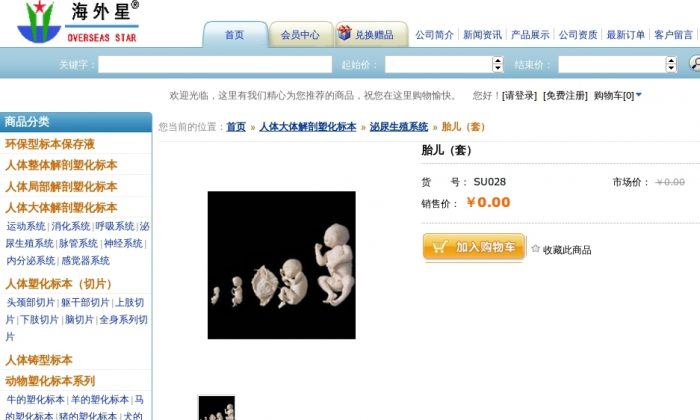
A screenshot from the website of the Beijing Overseas Star Science & Technology Development Co. shows a variety of plastinated fetus specimens for order.

In the annals of all strange things to emerge from China, the wares for sale — but not really for sale — on the website of the Beijing Overseas Star Science & Technology Development Co. must rank among the strangest.

That is, plastinated fetuses. Or more simply: dead unborn babies that have been pumped full of plastic, which preserves them for medical research.

They’re available for sale from between $10,000 and $12,000, according to an English-language advertisement on Alibaba.com, the equivalent of Ebay in China. The company can supply 5,000 of them per year, the ad says.

According to Chen Guoxin, the director of the company reached by telephone, the plastic babies are not actually for sale. On his own website, the price next to them is 0 yuan. This is because, he said, “it’s illegal to traffic human bodies in China.”

‘Donations’
Instead, Chen said, “We donate the fetus to medical institutes for research, and they can donate money to us in return. We can negotiate a price for compensation or support to us to avoid legal risk.”

When asked by a reporter how much would be expected as donation, he said “around $10,000.”

Multiple strands of very China-specific developments were required to make way for this possibility. These include an abundance of aborted, dead fetuses as a result of the one-child policy, and secondly, the technical ability to plastinate human specimens, brought to China in the 1990s by the German impresario Gunther von Hagens, who built a multimillion dollar empire by charging people to view his works.

Fetuses are available in sets of 5, from 12 to 20 weeks old; those who need to can also purchase an embryo set (running from 4 to 8 weeks of gestation) complete with placenta and umbilical cord.

Fetus Source
Mr. Chen was coy on the conditions of how the fetuses are obtained. He said they came from hospitals, but could not explain why so many were available, and repeatedly cautioned that no money changed hands. Buying and selling fetuses would be illegal in China, he said several times.

He said that his company works with a third party — whose name he would not disclose — that performs the plastination and works with the hospital to obtain fetuses.

Aside from Mr. Chen’s cautions, the rate of abortions and forced abortions in China is known to be extremely high, due to the Chinese Communist Party’s birth control policies, which typically restrict families to one child. The result is a documented, enormous number of abortions, forced and otherwise: an average of 7 million a year, according to official data.

Hospitals have been known to drown or strangle babies in front of their parents, and in one case that stirred public outrage in 2012, a killed fetus at seven months of development was simply placed on a hospital bed next to its distraught mother. It is likely that fetuses of this sort make their way into the ranks of the plastinated.

A Legal Question
Mr. Chen was adamant in his discussion with a reporter that the company followed all applicable laws in its processing of plastinated fetuses and other human specimens. He did not explain why they were advertised for sale on Alibaba, where that was supposed to be illegal, however.

The company lists an impressive number of registration certificates and licenses on its website, but phone calls to several of the groups referred to did not clarify matters.

The General Administration of Quality Supervision, Inspection and Quarantine (GAQSIQ), and the China Quality Certification Centre, both of whom are listed on Beijing Overseas Star Science & Technology’s website, said that human specimens are not in their bailiwick.

GAQSIQ recommended a reporter call the Ministry of Health’s consultation hotline. A staff member there, after being apprised of the situation, was surprised and said: “A medical device company like that shouldn’t have the qualification to do research on human specimens. Of course it’s illegal.”

She added: “Doing research on human specimens needs to go through organ donation institutes via legal procedures. A medical device company has nothing to do with human specimens.”

Plastination and its Abuses
The technique of plastination has a checkered history in China. It was pioneered by Gunther von Hagens, who found that China — the city of Dalian, in particular, when it was the stomping ground of disgraced Chinese official Bo Xilai in the 1990s — was particularly accommodating to his line of work.

Von Hagens and, later, a former employee who took von Hagen’s techniques to establish his own plastination empire, were able to obtain bodies with relative ease. Von Hagen’s former partner, Sui Hongjin, is suspected of having used executed prisoners, including the bodies of killed Falun Gong practitioners, among his plastinations, given that the area in which he operated was a key center for the persecution of the practice and the suspected organ harvesting of adherents.

Chen Guoxin’s company sells adult specimens, too — not just babies. One can purchase plastinated thymuses, bisected brains, urinary tracts, and even sliced-open faces.

A whole specimen of the human body is around $30,000 to $40,000 — donated, not purchased, of course, Chen said. He assured the reporter proudly: “The quality won’t change in 1,000 years.”

Friday, 9 February 2018

Pontifical Academy of Social Sciences Chancellor praises the social doctrine of China's Communist regime

It comes as no surprise to this blogger to find that Pope Francis isn't the only scoundrel in the Vatican who subscribes to Liberation Theology (i.e., Marxism in Christian dress). As reported by the British publication Catholic Herald, February 6, 2018:

“Right now, those who are best implementing the social doctrine of the Church are the Chinese,” a senior Vatican official has said.

Bishop Marcelo Sánchez Sorondo, chancellor of the Pontifical Academy of Social Sciences, praised the Communist state as “extraordinary”, saying: “You do not have shantytowns, you do not have drugs, young people do not take drugs”. Instead, there is a “positive national conscience”.

The bishop told the Spanish-language edition of Vatican Insider that in China “the economy does not dominate politics, as happens in the United States, something Americans themselves would say.”

Bishop Sánchez Sorondo said that China was implementing Pope Francis’s encyclical Laudato Si’ better than many other countries and praised it for defending Paris Climate Accord. “In that, it is assuming a moral leadership that others have abandoned”, he added.

He accused US president Donald Trump of being “manipulated” by global oil firms, and said that, as opposed to those who follow “liberal thought”, the Chinese are working for the greater good of the planet.

The Vatican and China have been holding talks in recent years over the status of the ‘underground’ Church and the appointment of bishops. In November, the Vatican Museums also organised joint exhibitions with China in what was called “diplomacy of art”.

As part of the diplomacy efforts, Bishop Sánchez Sorondo visited the country. “What I found was an extraordinary China,” he said. “What people don’t realise is that the central value in China is work, work, work. There’s no other way, fundamentally it is like St Paul said: he who doesn’t work, doesn’t eat.”

Bishop Sánchez Sorondo concluded by saying that China is “developing well” and now has “many points of agreement” with the Vatican.

“You cannot think that the China of today is the China of [the time of] John Paul II, or Cold War Russia,” he said.
Bishop Sánchez Sorondo is apparently unaware that China's Communist regime, which is estimated to have killed more Christians over the years than the number of Jews killed by the Nazis, is still arresting and imprisoning Christians, destroying church buildings, and even in the case of the Roman Catholic Church in China, intervening in the appointment of clergy.

The reader, of course, can't help but notice the hypocrisy of a bishop who seems to do no labour himself, and is a high-ranking official in an institution that possesses considerable wealth but produces none, singing the praises of an ethic of "work, work, work"--for wages so low that most Westerners would regard such labour as virtual slavery. And what does the Paris climate accord have to do with the gospel of Jesus Christ?

See my recent posts:

Chinese military police demolish unregistered church's building (February 4, 2018)

Chinese government officials accused of taking over a Tibetan Buddhist monastery (February 4, 2018)

Pope Francis betrays legitimate Chinese Roman Catholic bishops in favour of those appointed by China's Communist government (February 4, 2018)

HT: Dracul Van Helsing

Sunday, 4 February 2018

Pope Francis betrays legitimate Chinese Roman Catholic bishops in favour of those appointed by China's Communist government

The lesson, as always, is: Never trust a Jesuit. As reported by Paul Huang of The Epoch Times, January 26, 2018 (updated February 3, 2018) (links, bold in original):

In a move that breaks with centuries of Catholic tradition, the Vatican under Pope Francis has reportedly forced two duly appointed Chinese bishops to make way for those unilaterally imposed by the Chinese regime. The move is the latest in a series of concessions Pope Francis has made in recent years to seek resumption of diplomatic relations between the Vatican and the Chinese regime, which has always rejected the Pope’s authority to appoint Catholic bishops in mainland China.

According to Asia News, a Vatican delegation to China was sent in December of last year to force Bishop Peter Zhuang Jianjian of Shantou to “retire” or be demoted so that the Chinese regime could install its own bishops who come from regime-sanctioned churches.

The Vatican and the People’s Republic of China have had no diplomatic relations since 1951, as the Chinese Communist Party has insisted from the very beginning of its rule that all bishops of the Roman Catholic Church in mainland China should be appointed by itself so that the regime may maintain control of the church. A regime-controlled Chinese Patriotic Catholic Association (CPCA) was created to supposedly represent Catholics in China.

The Vatican under all previous popes has rejected such an arrangement and refused to recognize bishops unilaterally “appointed” by the CPCA. The power to appoint bishops, known as “Investiture”, has been considered to be at the core of the Catholic Church’s teachings.

Outside of CPCA control, a defiant network of underground Catholic “house churches” still exist in China, whose followers were represented by Chinese bishops legitimately ordained by the Vatican, such as Zhuang and Guo.

The 88-year-old Bishop Zhuang reportedly burst into tears on hearing the order from Vatican, he also rejected the “offer” to accept a demotion into a priest to serve under his replacement, CPCA Bishop Huang Bingzhang, since Huang could simply remove him at any later time.

In addition to being a CPCA Bishop, Huang is also a member of the National People’s Congress, the Chinese regime’s rubber stamp parliament.

Pope Francis’ Vatican previously demanded Zhuang’s retirement in a letter dated Oct. 26, of which Zhuang replied that he would rather “carry his cross” for disobeying the Vatican’s order, according to Asia News.

The Vatican delegation also traveled to Fujian Province where they asked Bishop Joseph Guo Xijin of Mindong, who belongs to the underground Catholic church, to “accept” a demotion so that CPCA-backed Bishop Vincent Zhan Silu can take his place. Previously, Guo had gone missing for some time last year after the Chinese regime forced him to “visit” a religious affairs bureau in the city of Fuan.

“It’s a shame for the Vatican politicians to put their political interests above the church’s by kowtowing to Communist Beijing,” said Bob Fu, founder of ChinaAid, a Christian NGO based in Midland, Texas. “This action constitutes a true betrayal both of Christian principle and of the ongoing persecuted faithful in China. I hope the Pope Francis can intervene and correct course before the damage is too huge to remedy.”

Appeases Chinese Regime at Any Cost

The Epoch Times’ repeated phone calls to the Vatican’s Press Office to request for comment have not been answered. The news of the forced exile of two bishops by the Vatican however has been confirmed by Cardinal Joseph Zen, the respected former bishop of Hong Kong who retired in 2009 and who in recent years has become a vocal voice in questioning Pope Francis’ various overtures to the Chinese regime.

Just this week, the 86-year-old Joseph Zen reportedly visited the Vatican on Wednesday, Jan. 23 and lined up with other petitioners in the cold in Saint Peter’s Square to personally deliver a letter to Pope Francis. He was not given the privilege of an express access to the Pope that is traditionally offered to retired cardinals at his level. The letter contains an appeal for Pope Francis to pay attention to the desperate plight of the underground Catholic churches in China.

The Vatican under Pope Francis however has clearly set its course for a rapprochement with the Chinese regime at any cost. Numerous overtures to the Chinese regime have been made ever since Pope Francis was elected in 2013, such as a Papal flight over China in 2014, and an announcement in February 2017 that an “agreement” over the issue of bishop appointment had been reached with Beijing, among other events.

The Epoch Times also reported last October that a senior archbishop known for his strong opposition to the Chinese regime has been removed from a key post in the Vatican by Pope Francis.

Pope Francis’s approach to the Chinese regime also marks a sharp contrast with many of his predecessors. For instance, John Paul II is known as the pope who inspired the fall of communism in his native Poland. While various Popes before Francis have attempted to restart the Vatican’s relations with China, none has crossed the line of accepting the Chinese regime depriving the Vatican of its power of Investiture.

The issue of the appointment of bishops is not the only thing that stands between the Vatican and the People’s Republic of China. The fate of the network of underground Catholic churches in China, which have an estimated 5-10 million members, has yet to be resolved, even though their bishops have now been abandoned by the Vatican. Underground Catholics complain of the Chinese regime having arrested hundreds of priests and bishops and having destroyed their churches.

A Vatican deal with China also has to settle the issue of Taiwan, which it still has formal diplomatic relations with. Partially due to the Chinese regime’s non-recognition of the Vatican’s authority in China, Taiwan was able to maintain the sovereign state of the Holy See as one of its few remaining diplomatic allies that formally recognize the island nation—at least until now.

Observers often speculated that the Vatican would abandon its relations with Taiwan to secure a deal with the Chinese regime on the other side of the strait, an act that would be seen not just as a betrayal of Taiwan but also the 240,000-strong Taiwanese Catholics, who unlike their Chinese counterparts have been allowed to practice their religion freely there and follow the Vatican’s authority.
January 22, 2019 update: The top Roman Catholic bishop in China makes the church's capitulation to the Communists clear, as reported by Catholic News Service, January 22, 2019 (link in original):

BEIJING – The president of China's state-sanctioned bishops' conference has pledged to work with the Chinese Catholic Patriotic Association to develop the Sinicization of religion in the communist nation.

Ucanews.com reported that Bishop Joseph Ma Yinglin of Kunming spoke after Wang Zuoan, deputy minister of the United Front Work Department, visited the patriotic association and the Bishops' Conference of the Catholic Church in China in Beijing.

Bishop Ma said the association and the conference would live up to the trust of the Communist Party and the government.

"In the new year, they will work hard, unite as one heart, think seriously, strive to practice, work according to the situation, and continue to make greater and better progress on the path of the development of Sinicization for gaining a satisfactory result for the 70th anniversary of the founding of the People's Republic of China," he said.

On his visit to Beijing, Wang said work on the election and consecration of bishops and the transformation of underground bishops must be done well.

Ucanews.com reported Wang called on the patriotic association and the bishops' conference to "maintain a high sense of responsibility and mission and lead the mass believers of the Catholic Church to continue to study through Xi Jinping's new era of socialism with Chinese characteristics."

They also should "make progress on the road of independence, autonomy and self-administration of the church and operating the church democratically."

Wang said it is necessary to constantly explore and practice the direction of Sinicization – modifying by Chinese influence – to strengthen the revision and improvement of systems, while it is important to "let the five-star red flag fly high in church courtyards."

He said it is also important to formulate a plan for managing dioceses appropriately.

Bishop Ma was ordained as a bishop in 2006 without a papal mandate. In 2010, he was elected president of the bishops' conference and vice chairman of the patriotic association. Neither organization is recognized by the Vatican.

On Sept. 22, 2018, Pope Francis lifted the excommunication of Bishop Ma and six other bishops appointed by the Chinese government without a pontifical mandate. That came a few hours after the Vatican and the Chinese government had signed a provisional agreement on the appointment of bishops.

The pope's forgiveness was seen as part of the process toward healing the Chinese Church.

"Pope Francis hopes that, with these decisions, a new process may begin that will allow the wounds of the past to be overcome, leading to the full communion of all Chinese Catholics," the Vatican said in a statement.
February 21, 2020 update: As reported by Adam Eliyahu Berkowitz in Breaking Israel News, February 21, 2020 (links in original):

A meeting between the Chinese Foreign Minister and his Vatican counterpart last week resulted in a “secret agreement” that will bring the Chinese government into the process of appointing Catholic Bishops.

Chinese Foreign Minister Wang Yi met in Munich on Friday with the Vatican Foreign Minister Archbishop Paul Gallagher to finalize the agreement that was initiated and approved by Pope Francis. The agreement was to formalize a provisional agreement that was made in 2018 which will be expiring in August. The agreement allows for the Chinese government to pre-approve the Vatican’s appointment of Chinese Bishops.

The actual terms and details of the agreement remain undisclosed but it is being hailed as an unprecedented level of cooperation between the Catholic Church and Communist China, which officially cut off relations with the Vatican in 1951.

“Pope Francis hopes that, with these decisions, a new process may begin that will allow the wounds of the past to be overcome, leading to the full communion of all Chinese Catholics,” the Vatican said in a statement. “With a view to sustaining the proclamation of the Gospel in China, the Holy Father Pope Francis has decided to readmit to full ecclesial communion the remaining ‘official’ Bishops, ordained without Pontifical Mandate,”

It was reported that in return, Beijing would recognize some, though not all, of the bishops previously appointed by the Vatican. China has an estimated 12 million Catholics and 101 Bishops.

Retired Hong Kong cardinal Joseph Zen Ze-kiun has long been a critic of Pope Francis’ relations with the Chinese government.

“Francis may have natural sympathy for Communists because for him, they are the persecuted,” Zen wrote in a 2018 op-ed. “He doesn’t know them as the persecutors they become once in power, like the Communists in China.”

Zen issued a statement criticizing the deal, accusing the Vatican of “selling out”mainland Chinese Catholics in order to normalize ties with Communist China. In an interview with Life Site News, Zen criticized Vatican Secretary of State Cardinal Pietro Parolin, “is not acting for the faith,” said Zen. “I’m sorry to say, he is not a man of faith because he despises the heroes of faith.”

“[Communists] never accept compromise,” Zen said. “They want full surrender. And so now we are at the bottom. They finished the operation selling the Church.”

“With a totalitarian regime, there’s no possibility of any talk or bargaining. No, no,” warned Zen. “They just want you on your knees.”
July 24, 2023 update: As reported by Courtney Mares and Matthew Santucci of Catholic News Agency, July 15, 2023 (bold in original):

Pope Francis has decided to approve the appointment of the bishop of Shanghai who was previously installed by Chinese authorities without the Vatican’s approval.

Vatican Secretary of State Cardinal Pietro Parolin announced on Saturday that Pope Francis wanted to “remedy the canonical irregularity created in Shanghai, in view of the greater good of the diocese and the fruitful exercise of the bishop’s pastoral ministry.”

Parolin said that the pope’s “intention is fundamentally pastoral” and will allow the bishop to “work with greater serenity to promote evangelization and foster ecclesial communion.”

Bishop Joseph Shen Bin was installed in Shanghai in April in violation of the Holy See’s provisional agreement with Beijing on the appointment of bishops. It was the second unauthorized appointment by Chinese authorities in the past year.

Pope Francis formally confirmed Shen Bin for the Shanghai post on July 15. Parolin said that the Vatican intentionally made “the decision to take time before publicly commenting on the case” to evaluate the pastoral situation in Shanghai, which has been without a bishop for over a decade.

In an interview with Vatican News published with the announcement of the Chinese bishop’s appointment, Parolin underlined that it is “indispensable, that all episcopal appointments in China, including transfers, be made by consensus, as agreed, and keeping alive the spirit of dialogue” between the Holy See and China.

The Holy See first entered into a provisional two-year agreement with Beijing on the appointment of bishops in 2018, which was renewed in 2020 and again in 2022.

One month after the Holy See agreed to renew the deal last October, the Vatican said that Chinese authorities violated the terms stipulated in the agreement by installing Bishop John Peng Weizhao as an “auxiliary bishop of Jiangxi,” a diocese that is not recognized by the Vatican.

Parolin explained that the text of the provisional agreement has been kept confidential “because it has not yet been definitively approved.”

“It revolves around the fundamental principle of consensual decisions affecting bishops,” he said.

“We are, therefore, trying to clarify this point, in an open dialogue and in a respectful confrontation with the Chinese side.”

When asked what other topics need to be discussed in the Vatican’s dialogue with China, Parolin listed evangelization, the bishops’ conference, and the communication between Chinese bishops and the pope.

The cardinal called for a Chinese bishops’ conference with “statutes appropriate to its ecclesial nature and pastoral mission” and the establishment of regular communication between Chinese bishops and the pope.

“In fact, it must be said that too many suspicions slow down and hinder the work of evangelization: Chinese Catholics, even those defined as ‘underground,’ deserve trust, because they sincerely want to be loyal citizens and to be respected in their conscience and in their faith,” Parolin said.

Despite the repeated violations, Parolin added that the Holy See is “determined” to continue dialogue with China.

“Indeed, the dialogue between the Vatican side and the Chinese side remains open and I believe that it is a path that is in some way obligatory,” he said.

“In order to make it smoother and more fruitful, it seems to me that the opening of a stable liaison office of the Holy See in China would be extremely useful. I take the liberty of adding that, in my opinion, such a presence would not only favor dialogue with the civil authorities but would also contribute to full reconciliation within the Chinese Church and its journey towards desirable normality.”

Bishop Joseph Shen Bin

Shen Bin, 53, was consecrated as a Catholic bishop in 2010 with the consent of both the pope and Chinese authorities, according to the Vatican. He served as bishop of the Diocese of Haimen until April, when he was transferred to Shanghai “without the involvement of the Holy See.”

Since 2022, Shen Bin has been the president of a group called the Council of Chinese Bishops, a state-sanctioned bishops’ conference not recognized by the Vatican. He previously was the vice president of the Chinese Catholic Patriotic Association established by the Chinese Communist Party and under the control of the United Front Work Department.

One month after Shen Bin’s installation, officials from the Chinese People’s Political Consultative Conference (CPPCC) visited Shanghai to evaluate the progress of “Sinicization” in the diocese.

In his installation ceremony, the bishop said that he would, “continue to carry forward the fine tradition of patriotism and love of the Catholic Church in Shanghai, adhere to the principle of independence and self-government, adhere to the direction of my country’s Catholicism in China, and better promote the healthy inheritance of Shanghai Catholic evangelization.”

The Diocese of Shanghai

The Diocese of Shanghai is the largest Catholic diocese in the country and home to the Basilica of Our Lady Help of Christians, also known as the National Shrine of Our Lady of Sheshan. The shrine, consecrated in 1873, is considered the first basilica of East Asia and is one of the main pilgrim sites on the mainland for Catholics.

The diocese was the hub of Catholic counterrevolutionary activity in the 1950s (and the city where the CCP was founded in 1921). Following Mao’s victory in 1949, Bishop Ignatius Kung Pin-Mei helped establish the apparatus of Catholic resistance that would become the underground Catholic church. On the night of Sept. 8, 1955, Bishop Kung, along with several hundred other clergy and lay Catholics, were arrested for their defiance of the regime and their refusal to renounce union with the pope. By the end of the month, some 1,200 Shanghai Catholics were arrested. Kung was imprisoned for a total of 30 years before coming to the United States in 1988.

The Diocese of Shanghai has been functionally vacant since the death of Bishop Aloysius Jin Luxian in 2013. Jin had been imprisoned and sent to reeducation camps, only to be fully freed in 1982. He was made bishop of Shanghai in 1985, during Deng Xiaoping’s period of opening up, but it wasn’t until 2005 that he was recognized by the Holy See. He played a critical role in reestablishing the Sheshan Seminary and in rebuilding the local Church in Shanghai.

Bishop Joseph Xing Wenzhi, who was ordained with papal approval and government approval, was made auxiliary bishop of Shanghai in 2005 and disappeared from the public in 2011.

Auxiliary Bishop Thaddeus Ma Daqin, Xing’s successor, denounced the CCPA during his ordination mass on July 7, 2012; later that night he was put under house arrest in the Sheshan Seminary, where he remains to this day.

Chinese government officials are accused of taking over a Tibetan Buddhist monastery

Christian churches aren't the only religious institutions facing persecution from China's Communist government, but they will do well to keep an eye on similar activity elsewhere. As reported by Christian Shepherd of Reuters, January 25, 2018:

BEIJING—Chinese officials are engaging in a “takeover” of one of the world’s largest Tibetan Buddhist monasteries, with a plan to put Chinese Communist Party officials in charge of its administration, the NGO Human Rights Watch (HRW) said on Jan. 24.

Larung Gar, a sprawling Buddhist center of learning and prayer in the mountains of southwestern Sichuan Province, has already been reduced in size through an eight-month program of demolition and expulsion that ended in April 2017, HRW said.

Chinese authorities are now splitting the center into two sections, an academy and a monastery, divided by a wall, according to an English-language translation of a document shared by HRW, which they said was received in August 2017.

The takeover measures include quotas for recruitment, a management system of “real-name registration” and tags for monks and nuns, as well as placing 97 Party cadres, who are required to be atheist, in top finance, security, and admission roles.
Monastic sources told HRW that a similar system would be set up in the monastery and that a large building had been constructed to house the cadres.

Reuters could not independently verify the authenticity of the document or the claims from HRW sources.

“The administrative takeover of Larung Gar by party officials shows that the government’s aim was not merely to reduce numbers at the settlement,” said Sophie Richardson, the U.S.-based China director for HRW.

“Chinese authorities are also imposing pervasive control and surveillance over every level of activity within religious communities,” she said.

China’s religious affairs bureau did not respond immediately to a request for comment.

China has denied carrying out demolitions at Larung Gar, saying the work is to tackle fire and safety hazards, as well as to “reconstruct” old buildings.

Tibetan-populated areas of western China, including in Sichuan, had been at the epicenter of protests against Chinese rule, which included acts of self-immolation, although reported cases have declined in the past two years.

HRW’s Richardson said the micromanagement of Larung Gar encroaches on religious freedom and is likely to fuel resentment against Beijing.

Chinese law promises freedom of religion but in reality, authorities keep a close eye on religious believers and institutions. New regulations due to take effect at the end of this month are set to expand state oversight of religious institutions.

Chinese military police demolish unregistered church's building

...I will build my church; and the gates of hell shall not prevail against it. Matthew 16:18b

As reported by Paul Huang of The Epoch Times, January 11, 2018 (updated January 20, 2018) (links in original):

The Chinese regime’s persecution of Christianity reached new heights as military police demolished a church in northern China’s Shanxi Province. Explosives were used to bring down the $3 million church, as Chinese Christians who had built and attended it wept.

The Golden Lampstand Church in Linfen, a city of 4.3 million, was one of China’s many unregistered “house churches,” meaning they are not sanctioned by the Chinese regime and are therefore constantly persecuted.

Dramatic video uploaded online shows the church was totally demolished on Jan. 9, as explosives were detonated. The People’s Armed Police, the Chinese regime’s paramilitary force, reportedly conducted the demolition.

The church, originally costing 17 million yuan to build in 2009, was fully paid for by its congregation of tens of thousands of Christians. Prior to its destruction, many of the church’s leaders had been heavily persecuted and some were imprisoned, according to reports by ChinaAid, a Christian NGO based in Midland, Texas.

In 2009, squads of the Chinese regime’s security goons descended on the church, smashed the building, and seized bibles from its members, according to ChinaAid.

“[The authorities] have been plotting to bomb the church ever since 2009,” a church member told Radio Free Asia. “They were hesitant at the time after hearing rumors that officials from the U.N. visited the church and took photos. But now they’ve actually done it.”

The church was surrounded by the authorities beginning Sunday, Jan. 7, with its congregation blocked from entering the building and warned by local police to “stay away.” Many members of the church, though, witnessed the demolition from a distance and wept for their church’s destruction.

“The repeated persecution of the Golden Lampstand Church demonstrates that the Chinese government has no respect for religious freedom or human rights,” said Bob Fu, the founder and president of ChinaAid, who called for the international community to openly condemn the bombing of the church.

While the church belongs to China’s large number of “house churches” that are not registered with the Chinese regime and are therefore completely exposed to any sort of crackdown on religion, even the state-sanctioned Three-Self Churches are not exempt from the regime’s persecution.

ChinaAid has recently reported that the regime’s security apparatus was mobilized to suppress Christmas celebrations by Chinese Christians in 2017—including those at the Three-Self Churches. Church services were strictly curtailed, and the Christians who attended them were heavily monitored by surveillance cameras installed by the authorities.

The Chinese Communist Party officially espouses an atheist ideology based on Marxism–Leninism and Mao Zedong thought and prohibits Party members from belonging to a religion. Despite official opposition to religion and relentless persecution, China’s Christian population has soared in recent years and is now numbered in the tens of millions by various estimates.


It should be kept in mind that the church in the Biblical sense is not a building, but the born-again people who make up the body of Christ, which continues to grow in China. The Communist government authorities are fighting a war they cannot and will not win.

Tuesday, 13 June 2017

Astronomers create the largest map yet of the Universe

When I consider thy heavens, the work of thy fingers, the moon and the stars, which thou hast ordained;
What is man, that thou art mindful of him? and the son of man, that thou visitest him?
Psalms 8:3-4

The heavens declare the glory of God; and the firmament showeth his handiwork. Psalms 19:1

Thou art worthy, O Lord, to receive glory and honour and power: for thou hast created all things, and for thy pleasure they are and were created. Revelation 4:11

As reported by the Chinese news agency Xinhua, May 29, 2017:
A slice through largest-ever three-dimensional map of the Universe. Earth is at the left, and distances to galaxies and quasars are labelled by the lookback time to the objects (lookback time means how long the light from an object has been traveling to reach us here on Earth). The locations of quasars (galaxies with supermassive black holes) are shown by the red dots, and nearer galaxies mapped by SDSS are also shown (yellow).

LOS ANGELES, May 28 -- Based entirely on the positions of quasars, an international collaboration of astronomers with the Sloan Digital Sky Survey (SDSS) have created the first map of the large-scale structure of the Universe. It could also help improve our understanding of dark energy.

"To unveil the mystery of the cosmic acceleration, the astronomers have been trying to map the Universe from now to the remote past. The Chinese astronomers, especially those from National Astronomical Observatories of Chinese Academy of Sciences (NAOC) working on observational and theoretical cosmology, have been playing key roles in the large international collaborations of the eBOSS galaxy survey," Xue Suijian, professor and deputy director of the National Astronomical Observatories of China (NAOC) under Chinese Academy of Sciences, told Xinhua on Sunday.

Quasars are the incredibly bright and distant points of light powered by supermassive black holes. As matter and energy fall into a quasar's black hole, they heat up to incredible temperatures and begin to glow.

It is this bright glow that is detected by a dedicated 2.5-meter telescope here on Earth. The telescope's observations gave the scientists the quasars'distances, which they used to create a three-dimensional map of where the quasars are.

"These quasars are so far away that their light left them when the Universe was between three and seven billion years old, long before the Earth even existed," said Gongbo Zhao from the National Astronomical Observatories of Chinese Academy of Sciences, the study's other co-leader.

To make their map, the international research team used the Sloan Foundation Telescope to observe an unprecedented number of quasars. During the first two years of the SDSS's Extended Baryon Oscillation Spectroscopic Survey (eBOSS), astronomers measured accurate three-dimensional positions for more than 147,000 quasars, according to SDSS.

And to use the map to understand the expansion history of the Universe, the astronomers had to go a step further, using measurements of a phenomena known as baryon acoustic oscillations (BAOs), which are the present-day imprint of sound waves which travelled through the early Universe, when it was much hotter and denser than the Universe we see today.

But when the Universe was 380,000 years old, conditions changed suddenly and the sound waves became "frozen" in place. These frozen waves are left imprinted in the three-dimensional structure of the Universe we see today.

The results of the new study also confirm the standard model of cosmology that researchers have built over the last twenty years. In this standard model, the Universe follows the predictions of Einstein's General Theory of Relativity - but includes components whose effects we can measure, but whose causes we do not understand, according to the study.

There is still work to be done however, and the eBOSS experiment continues using the Sloan Telescope at Apache Point Observatory in New Mexico, USA, in order to observe even more quasars and increase the size of any future maps.

"Besides eBOSS, the Dark Energy Spectroscopic Instrument (DESI), which is a larger galaxy survey mapping the Universe using remote astronomical objects up to 10 billion light years from us, will start observations in 2018, and Chinese astronomers will continue contributing great efforts," Xue said.

Tuesday, 9 June 2015

Chinese bureraucrats falsify data on forced abortions

The only thing that saves us from the bureaucracy is [its] inefficiency. An efficient bureaucracy is the greatest threat to liberty. U.S. Senator Eugene McCarthy, Time, February 12, 1979

An odd aspect of China's abominable policy of restricting families to one child, as reported by Frank Fang and Matthew Robertson of The Epoch Times, June 2, 2015:

It’s a story as old as central planning itself: political leaders hand down quotas for underlings to meet, and those on the front lines inevitably end up faking data, committing fraud, and coming up with inventive ways of appearing to meet the demands.

Most recently in the Chinese county of Lanling, Shandong Province, this came in the form of abortion quotas: Officials involved in population control were told they needed to carry out a certain number of forced abortions—deeply tied up with China’s one-child policy—or else be fined. (Meeting the quota led to a reward of 1,500 yuan (nearly $250) and failure to meet it incurred a fine of 2,000 yuan.)

But what if there aren’t even enough women in the village with “illegal” pregnancies, required to carry out a coercive abortion?

This is where inventiveness comes in. The officials from Lanling County, and the villages in the county, figured out that they could simply outsource the work to brokers.

These middlemen would then purchase and bundle abortion certificates from other counties, and sell them to cadres in Lanling, who would hand them in to their superiors and be congratulated for an abortion well done.

The story was carried by Peng Pai, an online news website. Four village Party secretaries told the publication that they were each given an abortion quota of 0.4 percent—meaning that of 1,000 women in the area, 4 abortions needed to have been reported.

One party official had 1,500 in his village, making his quota 6. But there was only one woman in his village with an out-of-regulation pregnancy—her fetus was aborted, but he had to buy the other five abortion certificates from abortions that had already taken place at a community hospital elsewhere in the county.

“Originally, the abortion information from a single woman was about 2,000 yuan, but later it increased to 5,000 yuan, and finally over 10,000 yuan,” the Party official, given the pseudonym Mr. Xu, said. He decided the enterprise was absurd and attempted to resign, but was told he couldn’t do that until he met his quota.

The middleman obtained abortion certificates from women who actually got abortions willingly, and then prepared them by finding an unmarried man to sign a document certifying that he lived with the woman unmarried—prepared the papers, and gave it to the Party secretaries.

They were, of course, paid a commission from the bonus given the cadres.

Thursday, 26 February 2015

Monkey King is worshipped as a god in eastern China

All who make idols are nothing,
and the things they treasure are worthless.
Those who would speak up for them are blind;
they are ignorant, to their own shame.
Who shapes a god and casts an idol,
which can profit nothing?
People who do that will be put to shame;
such craftsmen are only human beings.
Let them all come together and take their stand;
they will be brought down to terror and shame.

The blacksmith takes a tool
and works with it in the coals;
he shapes an idol with hammers,
he forges it with the might of his arm.
He gets hungry and loses his strength;
he drinks no water and grows faint.
The carpenter measures with a line
and makes an outline with a marker;
he roughs it out with chisels
and marks it with compasses.
He shapes it in human form,
human form in all its glory,
that it may dwell in a shrine.
He cut down cedars,
or perhaps took a cypress or oak.
He let it grow among the trees of the forest,
or planted a pine, and the rain made it grow.
It is used as fuel for burning;
some of it he takes and warms himself,
he kindles a fire and bakes bread.
But he also fashions a god and worships it;
he makes an idol and bows down to it.
Half of the wood he burns in the fire;
over it he prepares his meal,
he roasts his meat and eats his fill.
He also warms himself and says,
“Ah! I am warm; I see the fire.”
From the rest he makes a god, his idol;
he bows down to it and worships.
He prays to it and says,
“Save me! You are my god!”
They know nothing, they understand nothing;
their eyes are plastered over so they cannot see,
and their minds closed so they cannot understand.
Isaiah 44:9-18 (NIV)

As reported by Yao Yuan and Zhang Yizhi of Xinhua, February 20, 2015 (bold in original):

FUZHOU, Feb. 20 (Xinhua) - On a downtown street in Fuzhou of east China's Fujian Province, a niche hosts a deity that will both excite and baffle fans of the classical novel Journey to the West.

Clad in golden armor and with a cudgel in hand, the Monkey King, or Qi Tian Da Sheng, quietly stares at the fruit offered by his human followers. A banyan tree at its side is surrounded by burning incense. A banner declares "every prayer will be answered".

Most Chinese associate the Monkey King with the monkey-turned-demon-slayer in the Ming Dynasty (1368-1644) novel. But here in Fuzhou, it is also a tutelary spirit worshiped at hundreds of temples and outdoor locations.

As most Chinese New Year revellers are busy venerating a ruminant at the start of the Year of the Sheep, the Monkey King is chief among a number of alternative deities popular in Fuzhou.

"[The deities are] like a guardian angel for families. Many Fuzhou families have one -- the God of Illuminating Sky, the Riverside Goddess or the Monkey King," Fuzhou resident Lin Yuemei says.

In Ruyi Hexin Temple on Fuxin Road, another Monkey King statue the size of a child is ready for a grand parade scheduled after the Chinese New Year.

"Fuzhou people call it 'the Parade of Gods', during which the King will patrol the neighborhoods under his administration and bless his people," explains You Xiang, deputy director of the temple's management committee.

Simulating a Chinese emperor's inspection tour, temple workers will carry the statue through several streets banging gongs and lighting firecrackers. Local believers will lay out tables laden with tributes to welcome the King and later join the parade, which will increase to 200 or 300 people at its culmination.

"All tributes to our King must be vegetarian, like fruit, mushrooms and tofu, as he is not only a Taoist god but also a Buddha," You adds.

MYSTERIOUS PAST

Fuzhou, capital of Fujian Province, is known for its many local beliefs -- some neighborhoods even worship a deity of their own. Many of the city's thearchy were local celebrities deified for their charitable or heroic deeds.

One prominent Fuzhou god, "Zhao Tian Jun", or God of Illuminating Sky, was said to be a Taoist monk who used red lanterns to lead residents to escape the city on the eve of a deadly riot. After his death, grateful Fuzhou people built a temple to honor him as a god of peace and safety.

But the origin of the Monkey King belief has many versions: ape worship, a monkey Buddha, a monkey demon converted by a goddess into the heavenly cause -- there are a thousand Monkey Kings in a thousand priests' eyes due to a lack of historical records.

"Unlike those orthodox deities recognized by ancient Chinese governments, our belief relies mostly on story-telling in every temple to pass it on and there are few written descriptions," You says.

One thing is certain: people in Fuzhou were worshipping the Monkey King long before the novel made the character a household name. Historical records suggest the city had a temple for the monkey in the Song Dynasty (960-1279). Some academics say the belief can be traced to the ancient worship of apes.

"Prehistoric Chinese in the mountains worshiped monkeys. The powerful Monkey King figure in the novel met the believers' expectation for an almighty god and made the belief more popular," according to Gan Mantang, a sociology professor at Fuzhou University.

Vague as his identity might be, the monkey god never lacks followers. Belief in the Monkey King has become prominent in Fujian Province, and in Fuzhou, he is worshiped in about 700 to 800 temples, says Zheng Konglin, vice head of Fuzhou's Taoist Association.

In the 1990s, the temple regarded as the Monkey King's "ancestral temple" on Fuzhou's Pingshan Mountain registered 243 offshoot temples, including in Taiwan, Hong Kong and Singapore.

SURVIVING TIMES

It was not always so. The worship was condemned as "superstitious activity" during China's Cultural Revolution (1966-1976). The ancestral temple of the Monkey King was torched while worshippers from You's temple retreated underground.

"We managed to rescue the monkey head," You says, pointing to a peach-sized head now installed on an ornately dressed statue. "Its body was gone, so we placed it on a tea cup to continue our worship."

The belief began to regain strength in the 1980s: the ancestral temple was rebuilt; Ruyi Hexin Temple resumed the Parade of Gods tradition and has seen increasing participation in recent years.

"Now, more people see it as a part of the culture, rather than superstition," says Zheng Kui, a member of the temple's committee.

The biggest threat now comes from Fuzhou's rapid urbanization and the demolition of old neighborhoods.

Many local beliefs are community-based. When the old neighborhoods were demolished and their residents relocated, the temples lost attendance.

The original Ruyi Hexin Temple and its neighborhood were demolished by the city government in 2007. The new venue built to house the celestial monkey is small and cramped, but You still felt lucky as they were resettled close to the parish.

"After all, the King still lives with his people. Many temples have been relocated far from the original sites."