Showing posts with label Astronomy. Show all posts

Monday, 31 August 2026

130 years ago--astrologers actually make a correct prediction

The heavens declare the glory of God; and the firmament sheweth his handywork. Psalms 19:1

On August 9, 1896, a solar eclipse occurred; it was the first to attract an expedition from the British Astronomical Association. According to the editorial Darkening of the Sun., published in the Toronto Globe, August 3, 1896:

...This eclipse is important in that it is a total one, not an annular, and it is expected that much will be added to our knowledge of the sun....

Although this eclipse will not at all be visible in Canada, in fact not at all in America except in Alaska, there are many Canadians and Americans who will witness the phenomenon, because the line of totality passes across a region easily accessible to summer tourists. The path of total eclipse begins at sunrise in the North Atlantic Ocean, passes across the northern part of Norway and over the island of Nova Zembia, thence diagonally across Siberia and the Japanese island of Yezo, ending at sunset in the Pacific Ocean.

Most popular of the places of observation are points on the northeast coast of Norway...More favorable stations for observation are in the interior of Siberia, but these are practically inaccessible to observers. Excellent results are expected from the parties stationed in Japan, for the conditions there are good.

During the two minutes of totality the principal stars will become visible to the unassisted vision. The sun will be in the constellation Leo (the Lion), and the planets Jupiter, Venus and Mercury are close together in the same region of the sky...

Should the photographs of the corona turn out as successfully as everyone hopes and desires light will be thrown on various points of solar physics. Especially may the larger pictures give a further knowledge of the solar currents, "lines of force" or whatever they are that determine the peculiar structure of solar appendages. How the distribution of coronal material differs in various latitudes on the sun should also be revealed, and an investigation of the connection between the coronal prominences and sun-spots may be possible. Another point on which the photographs will shed light is the law of decrease in the intensity of the corona is passing outward. If success crowns the efforts being made all along the line then there will be a possibility of determining if the corona changes form in the interval of about 90 minutes which occurs between those observations taken in Norway and those secured in Japan. Previous experience does not favor the idea of such rapid changes.
Weather conditions prevented good results from the BAA expedition, but a smaller expedition to Novaya Zemlya was more successful.

Partial eclipse photographed by Celia Hammer in Kabelvåg, Norway

Photography of the corona during the total eclipse on Novaya Zemlya on 9. August 1896 by Sergei Kostinsky

According to an anonymous article published in the Winnipeg Daily Tribune, August 8, 1896:

...According to astrologers, the eclipse is likely to be followed by disasters in the orient, owing to the fact that it occurs in the conjunction of the evil planet Mars, Herschel and Saturn, and of Jupiter, Venus and Mercury. The line of totality of the eclipse begins in the North Sea, crosses the northern part of Norway and Lapland, the island of Novaya Zemlya, Siberia, and the Japanese island of Yezo, and ends in the midst of the Pacific ocean. Under the general rulings of astrology, these, taking into consideration the square and opposition of the place of the eclipse, to-morrow's event will primarily affect China, Japan, Eastern Siberia, Corea, Egypt, Armenia, Western Russia, the country tributary to the Danube, Scandinavia in its northeastern section, Venezuela, Guiana and Brazil, Newfoundland, Labrador, New England, Oregon, Washington, Idaho, Nevada, California and Alaska. Only Japan, China and Russia, however, are, according to the astrologers, to experience disaster, and this is not to be immediate, but some time in the next six months...
It did come as a surprise to this blogger that a major disaster did occur not long after the eclipse. On August 31, 1896, the Rikuu earthquake, of magnitude 7.2, struck on the border between the prefectures of Akita and Iwate (39.5 degrees North latitude, 140.7 degrees East longitude), killing 209 people (209 in Akita), injuring 779, and resulting in 5,792 completely destroyed houses, 3,045 partially destroyed houses, and 9,899 landslides.

Of course, even if astrologers make a prediction that turns out to be accurate, astrology is a pagan practice that should be avoided and rejected:

If there arise among you a prophet, or a dreamer of dreams, and giveth thee a sign or a wonder,
And the sign or the wonder come to pass, whereof he spake unto thee, saying, Let us go after other gods, which thou hast not known, and let us serve them;
Thou shalt not hearken unto the words of that prophet, or that dreamer of dreams:
Deuteronomy 13:1-3a

Thus saith the Lord, Learn not the way of the heathen, and be not dismayed at the signs of heaven; for the heathen are dismayed at them. Jeremiah 10:2

Thursday, 30 November 2023

"Perfect solar system" discovered 100 light years away

When I consider thy heavens, the work of thy fingers, the moon and the stars, which thou hast ordained; What is man, that thou art mindful of him? and the son of man, that thou visitest him? Psalms 8:3-4

The heavens declare the glory of God; and the firmament showeth his handiwork. Psalms 19:1

Thou art worthy, O Lord, to receive glory and honour and power: for thou hast created all things, and for thy pleasure they are and were created. Revelation 4:11

As reported by Pallab Ghosh of BBC News, November 29, 2023 (link in original):

Researchers have located "the perfect solar system", forged without the violent collisions that made our own a hotchpotch of different-sized planets.

The system, 100 light years away, has six planets, all about the same size. They've barely changed since its formation up to 12 billion years ago.

These undisturbed conditions make it ideal for learning how these worlds formed and whether they host life.

The research has been published in the scientific journal, Nature.

The creation of our own solar system was a violent process. As planets were forming some crashed into each other, disturbing orbits and leaving us with giants like Jupiter and Saturn alongside relatively small worlds like our own.

In the system HD110067, as astronomers have rather drily named it, things couldn't be more different.

Not only are the planets similarly sized; in a far cry from the unrelated timing of the orbits of the planets in our own solar system, these rotate in synch.

In the time it takes for the innermost planet to go around the star three times, the next planet along gets around twice, and so on out to the fourth planet in the system. From there things change to a 4:3 pattern of relative orbit speeds for the last two planets.

This intricate planetary choreography is so precise that that the researchers have created a cyclical musical piece, akin to a Philip Glass-style composition, with notes and rhythms corresponding to each planet and their orbital periods...

Dr Rafael Luque, of the University of Chicago, who led the research described HD110067 as "the perfect solar system".

"It is ideal for studying how planets are created, because this solar system didn't have the chaotic beginnings ours did and has been undisturbed since its formation."

Dr Marina Lafarga-Magro, of Warwick University, said that the system was "beautiful and unique".

"It is really exciting, just seeing something that no-one has seen before," she told BBC News.

ver the past thirty years, astronomers have discovered thousands of star systems. But none of them are so well suited to study how planets formed. The planets' near identical size and the system's undisturbed nature are gold dust for astronomers because they make it much easier to compare and contrast them. That will help build up a picture of how they first formed and how they evolved.

The system also has a bright star which will make it easier to look for life signs in the planets' atmospheres.

All six of the new planets are what astronomers call "sub-Neptunes", which are larger than the Earth and smaller than the planet Neptune (which is four times wider than the Earth). The six newly discovered planets are between two and three times the size of Earth.

Interest in the new findings has been supercharged since the discovery in September that a sub-Neptune planet, called K2-18b, in another star system, has an atmosphere with hints of a gas that on Earth is produced by living organisms. Astronomers call this a biosignature.

Although our own solar system does not contain any sub-Neptunes, they are thought to be the most common type of planet in the galaxy. Yet astronomers know surprisingly little about these worlds.

They do not know whether they are mostly made of rock, gas or water, or critically, whether they provide conditions for life.

Finding out these details is "one of the hottest topics in the field" according to Dr Luque, adding that the discovery of HD110067 gives his team the perfect opportunity to answer that question relatively quickly.

"It could be a matter of less than ten years," he told BBC News.

"We know the planets, we know where they are, we just need slightly more time, but it will happen."

If the team's next round of observations indicates that sub-Neptunes can also support life, it greatly increases the number of possible habitable planets and therefore increases the chances of detecting signs of life on another world sooner rather than later.

The race is now on to detect biosignatures on one of the six new sub-Neptunes, or dozens of others detected by rival groups. With a battery of new telescopes with enhanced capabilities and others about to come online, many astronomers believe that we may not have too long to wait for that moment.

The planets were detected using NASA's Transiting Exoplanet Survey Satellite (TESS) and ESA's CHaracterising ExOPlanet Satellite (Cheops).

Thursday, 21 July 2022

Mysterious repeating radio signal traced to spiral galaxy 500 million light years from Earth

When I consider thy heavens, the work of thy fingers, the moon and the stars, which thou hast ordained; What is man, that thou art mindful of him? and the son of man, that thou visitest him? Psalms 8:3-4

The heavens declare the glory of God; and the firmament showeth his handiwork. Psalms 19:1

Thou art worthy, O Lord, to receive glory and honour and power: for thou hast created all things, and for thy pleasure they are and were created. Revelation 4:11

As reported by Jennifer Chu of Massachusetts Institute of Technology News Office, July 13, 2022 (bold, link in original):

Astronomers at MIT and universities across Canada and the United States have detected a strange and persistent radio signal from a far-off galaxy that appears to be flashing with surprising regularity.

The signal is classified as a fast radio burst, or FRB — an intensely strong burst of radio waves of unknown astrophysical origin, that typically lasts for a few milliseconds at most. However, this new signal persists for up to three seconds, about 1,000 times longer than the average FRB. Within this window, the team detected bursts of radio waves that repeat every 0.2 seconds in a clear periodic pattern, similar to a beating heart.

The researchers have labeled the signal FRB 20191221A, and it is currently the longest-lasting FRB, with the clearest periodic pattern, detected to date.

The source of the signal lies in a distant galaxy, several billion light-years from Earth. Exactly what that source might be remains a mystery, though astronomers suspect the signal could emanate from either a radio pulsar or a magnetar, both of which are types of neutron stars — extremely dense, rapidly spinning collapsed cores of giant stars.

“There are not many things in the universe that emit strictly periodic signals,” says Daniele Michilli, a postdoc in MIT’s Kavli Institute for Astrophysics and Space Research. “Examples that we know of in our own galaxy are radio pulsars and magnetars, which rotate and produce a beamed emission similar to a lighthouse. And we think this new signal could be a magnetar or pulsar on steroids.”

The team hopes to detect more periodic signals from this source, which could then be used as an astrophysical clock. For instance, the frequency of the bursts, and how they change as the source moves away from Earth, could be used to measure the rate at which the universe is expanding.

The discovery is reported today in the journal Nature, and is authored by members of the CHIME/FRB Collaboration, including MIT co-authors Calvin Leung, Juan Mena-Parra, Kaitlyn Shin, and Kiyoshi Masui at MIT, along with Michilli, who led the discovery first as a researcher at McGill University, and then as a postdoc at MIT.

“Boom, boom, boom”

Since the first FRB was discovered in 2007, hundreds of similar radio flashes have been detected across the universe, most recently by the Canadian Hydrogen Intensity Mapping Experiment, or CHIME, an interferometric radio telescope consisting of four large parabolic reflectors that is located at the Dominion Radio Astrophysical Observatory in British Columbia, Canada.

CHIME continuously observes the sky as the Earth rotates, and is designed to pick up radio waves emitted by hydrogen in the very earliest stages of the universe. The telescope also happens to be sensitive to fast radio bursts, and since it began observing the sky in 2018, CHIME has detected hundreds of FRBs emanating from different parts of the sky.

The vast majority of FRBs observed to date are one-offs — ultrabright bursts of radio waves that last for a few milliseconds before blinking off. Recently, researchers discovered the first periodic FRB that appeared to emit a regular pattern of radio waves. This signal consisted of a four-day window of random bursts that then repeated every 16 days. This 16-day cycle indicated a periodic pattern of activity, though the signal of the actual radio bursts was random rather than periodic.

On Dec. 21, 2019, CHIME picked up a signal of a potential FRB, which immediately drew the attention of Michilli, who was scanning the incoming data.

“It was unusual,” he recalls. “Not only was it very long, lasting about three seconds, but there were periodic peaks that were remarkably precise, emitting every fraction of a second — boom, boom, boom — like a heartbeat. This is the first time the signal itself is periodic.”

Brilliant bursts

In analyzing the pattern of FRB 20191221A’s radio bursts, Michilli and his colleagues found similarities with emissions from radio pulsars and magnetars in our own galaxy. Radio pulsars are neutron stars that emit beams of radio waves, appearing to pulse as the star rotates, while a similar emission is produced by magnetars due to their extreme magnetic fields.

The main difference between the new signal and radio emissions from our own galactic pulsars and magnetars is that FRB 20191221A appears to be more than a million times brighter. Michilli says the luminous flashes may originate from a distant radio pulsar or magnetar that is normally less bright as it rotates and for some unknown reason ejected a train of brilliant bursts, in a rare three-second window that CHIME was luckily positioned to catch.

“CHIME has now detected many FRBs with different properties,” Michilli says. “We’ve seen some that live inside clouds that are very turbulent, while others look like they’re in clean environments. From the properties of this new signal, we can say that around this source, there’s a cloud of plasma that must be extremely turbulent.”

The astronomers hope to catch additional bursts from the periodic FRB 20191221A, which can help to refine their understanding of its source, and of neutron stars in general.

“This detection raises the question of what could cause this extreme signal that we’ve never seen before, and how can we use this signal to study the universe,” Michilli says. “Future telescopes promise to discover thousands of FRBs a month, and at that point we may find many more of these periodic signals.”

This research was supported, in part, by the Canada Foundation for Innovation.
Click on the link to see the abstract of the original article Sub-second periodicity in a fast radio burst in Nature, 607, pages 256–259, July 13, 2022.

Wednesday, 8 January 2020

Mysterious radio signal traced to nearby galaxy

When I consider thy heavens, the work of thy fingers, the moon and the stars, which thou hast ordained;
What is man, that thou art mindful of him? and the son of man, that thou visitest him?
Psalms 8:3-4

The heavens declare the glory of God; and the firmament showeth his handiwork. Psalms 19:1

Thou art worthy, O Lord, to receive glory and honour and power: for thou hast created all things, and for thy pleasure they are and were created. Revelation 4:11

As reported by Josh K. Elliott of Global News, January 7, 2020 (links in original):

If the aliens are trying to tell us something, we finally have a better sense of where to listen for them.

Astronomers say they’ve traced the origin point of a mysterious, repeating radio signal from outer space to a galaxy that’s relatively close to our own, in a discovery that raises more questions about the origins of these strange bursts.

The signal, known as a fast radio burst (FRB), appears to be coming from a spiral galaxy some 500 million light-years from Earth, according to new findings published in the journal Nature. That’s not exactly within walking distance, but it’s still much closer to our planet than any of the other FRB origins identified to date.

And no, the FRB isn’t saying “Hi.” At least, not that scientists can tell.

FRBs are typically one-off blasts of radio waves through space, with each one lasting no more than a millisecond. Scientists have identified hundreds of FRBs over the years, but they’ve only traced five of them back to their points of origin.

This latest find is unusual because it’s just the second repeating signal to be tracked back to its source, which is somewhere in a patch of space some seven light-years wide.

“This object’s location is radically different from that of not only the previously located repeating FRB, but also previously studied FRBs,” astronomer and lead study author Kenzie Nimmo said in a statement released through the National Science Foundation’s National Optical-Infrared Astronomy Research Laboratory.

Canada’s CHIME telescope in Okanagan Falls, B.C., first detected the FRB in 2018, when it heard four extremely brief bursts over the course of about five hours. Researchers later aimed several other telescopes at the sky to determine the repeating signal’s origin point.

Nimmo says the discovery “blurs” the line between repeating and non-repeating FRBs.

“It may be that FRBs are produced in a large zoo of locations across the universe and just require some specific conditions to be visible.”

The first repeating FRB has already been traced back to a dwarf galaxy filled with stars and metal objects. That galaxy was about three billion light-years away.

The new findings are expected to help researchers look for more FRB origin points, in hopes of one day learning what causes them and how they travel through the universe.

Saturday, 10 August 2019

Gamma-ray bursts decoded by Israeli astrophysicists

When I consider thy heavens, the work of thy fingers, the moon and the stars, which thou hast ordained;
What is man, that thou art mindful of him? and the son of man, that thou visitest him?
Psalms 8:3-4

The heavens declare the glory of God; and the firmament showeth his handiwork. Psalms 19:1

Thou art worthy, O Lord, to receive glory and honour and power: for thou hast created all things, and for thy pleasure they are and were created. Revelation 4:11

As reported by Judy Siegel-Itzkovich of Breaking Israel News, August 1, 2019:

The mechanism for gamma-ray bursts – short and intense barrages of energetic radiation coming from outer space – has been decoded by astrophysicists at the Hebrew University of Jerusalem.

The scientific breakthrough was published in the journal Astrophysical Journal Letters by Prof. Tsvi Piran of the Racah Institute of Physics at the university and a member of the institute’s Center for Astrophysics and Planetary Science.

The bursts were deciphered following an eruption observed last January and describes how a stream of particles moving towards us at close to the speed of light emits gamma radiation.

Gamma-ray bursts are the brightest explosions in the universe. As gamma-rays are blocked by the atmosphere the bursts were discovered accidentally in the late 1960s by the Vela satellites, defense satellites sent to monitor man-made nuclear explosions in space.

Since their discovery, the bursts have been at the focus of attention with several dedicated satellites launched to explore their origin. In the late 1990s, it was realized that long bursts (lasting more than a few seconds) arise during the death and collapse of massive stars. In the first decade of the 21st century, it was found that shorter bursts (lasting less than a few seconds) arise in neutron star mergers. This last realization was confirmed dramatically two years ago with simultaneous observations of gravitational waves by the gravitational wave detectors LIGO and Virgo and a short burst by two satellites, NASA’s Fermi and the European Space Agency’s INTEGRAL (INTErnational Gamma-Ray Astrophysics Laboratory).

But many mysteries involving these bursts remained. Especially puzzling was the question of how the high-energy radiation is produced. Last January a gamma-ray detector on board of NASA’s Neil Gehrls Swift satellite detected GRB190114C, a bright burst that took place 4.5 billion years ago in a distant galaxy.

Following a trigger from Swift, the MAGIC telescope – a Cherenkov detector at the Roque de Los Muchachos Observatory in La Palma, Spain – flew towards the burst’s location and detected extremely high-energy photons (at TeV energies) coming from it. The ultra-high energy TeV photons, that were observed about 50 seconds after the prompt emission, in the so-called “afterglow” phase, were at least 10 times more energetic than the highest energy photons detected previously from any burst.

By now, only preliminary data of the MAGIC observations have been posted. Still, Prof. Evgeny Derishev from the Institute for Applied Physics in Nizhny Novogorod and Prof. Piran from Jerusalem combined these data with observations of lower energy (x-ray) photons carried out by the Neil Gehrles Swift and have shown that they reveal the details of the emission mechanism.

In the just-published paper, the authors show that the observed radiation must have originated in a jet moving at 0.9999 of the speed of light towards us. The high energy radiation observed by MAGIC is was emitted by electrons accelerated to TeV energies within the jet. The emission process can also be identified, it is the so-called “inverse Compton mechanism” in which ultra-high-energy electrons collide with low-energy photons and boosts their energy. Remarkably, the same relativistic electrons are also producing the low-energy “seed” photons via synchrotron radiation.

“MAGIC has found the “Rosetta stone of gamma-ray bursts,” Pirat declared. “This unique detection enables us for the first time to discriminate among different emission models and discover what are the exact conditions in the explosion. We can also understand now why such radiation wasn’t observed in the past.”

Future Cherenkov telescopes such as the planned Cherenkov Telescope Array, a multinational project under construction will be much more sensitive than MAGIC. The current detection suggests that many other such events will be detected in the future and will continue to shed light on this cosmic mystery.

Thursday, 10 January 2019

Astronomers detect mysterious distant radio signal

When I consider thy heavens, the work of thy fingers, the moon and the stars, which thou hast ordained;
What is man, that thou art mindful of him? and the son of man, that thou visitest him?
Psalms 8:3-4

The heavens declare the glory of God; and the firmament showeth his handiwork. Psalms 19:1

Thou art worthy, O Lord, to receive glory and honour and power: for thou hast created all things, and for thy pleasure they are and were created. Revelation 4:11

As reported by CTV News, January 10, 2019 (link in original):

A mysterious radio signal emanating from a galaxy far, far away has been detected by a telescope in British Columbia. The discovery is significant because it’s only the second time ever a repeating signal has been observed by scientists.

In a paper published in the journal Nature on Wednesday, researchers from several Canadian universities reported how they detected 13 new fast radio bursts (FRBs) using the new Canadian Hydrogen Intensity Mapping Experiment (CHIME) radio telescope located in British Columbia’s Okanagan Valley.

“They’re a new mysterious thing, just recently discovered,” Mark Halpern, a physics and astronomy professor at the University of British Columbia, told CTV Vancouver.

FRBs are short bursts of radio waves originating from far outside of our galaxy, according to a press release about the discovery by McGill University.

Although there are still many questions about what exactly they are and what causes them, scientists believe they could be emanating from a powerful astrophysical phenomena billions of light years away.

There have been more than 60 FRBs observed by researchers to date; however, scientists have only ever recorded one other repeating burst from a single source. That FRB was discovered by the Arecibo radio telescope in Puerto Rico in 2015.

“Until now, there was only one known repeating FRB. Knowing that there is another suggests that there could be more out there,” Ingrid Stairs, a member of the CHIME team and an astrophysicist at UBC, said.

“With more repeaters and more sources available for study, we may be able to understand these cosmic puzzles – where they’re from and what causes them.”

In addition to the second repeater, the researchers were able to shed new light on FRBs because they detected them at a much lower frequency than previously recorded finds. The radio bursts were observed by CHIME at frequencies between 400 megahertz (MHz) and 800 MHz. The majority of previously detected FRBs were found at frequencies near 1400 MHz.

“We now know] the sources can produce low-frequency radio waves and those low-frequency waves can escape their environment, and are not too scattered to be detected by the time they reach the Earth,” Tom Landecker, a CHIME team member from the National Research Council, said. “That tells us something about the environments and the sources.”

The second repeating FRB was detected during a pre-commissioning run of the CHIME telescope in the summer of 2018, which means it wasn’t even running at its full capacity.

“We’re very excited to see what CHIME can do when it’s running at full capacity,” Deborah Good, a PhD student in physics and astronomy at UBC, said.

The telescope consists of four adjacent cylindrical reflectors and 256 dual-polarization antennas, which receive radiation from a large swatch of sky. To search for FRBs, the telescope will continuously scan the sky for 24 hours a day, seven days a week.

“With CHIME mapping the entire northern hemisphere every day, we’re bound to find more repeaters over time,” Stairs said.

Researchers believe there could be thousands of radio signals travelling to Earth each day. Now that the CHIME telescope has proven it’s capable of detecting these short bursts of energy, astronomers said they’re optimistic they will be able to learn more about these puzzling cosmic radio signals.

“Knowing where they are will enable scientists to point their telescopes at them, creating an opportunity to study these mysterious signals in detail,” Stairs said.

There are a number of theories about what’s causing FRBs, including the possibility that a neutron star is releasing powerful signals after it exploded or even, albeit held by only a small minority, that they’re signals from an alien civilization.

Saturday, 6 October 2018

Whether it's life or planetary bodies, scientists are just guessing about origins

In the beginning God created the heavens and the earth. Genesis 1:1

Scientists profess to be certain about the alleged facts of evolution, but they're really just guessing about things they weren't around to observe, such as the origin of life itself. As reported by Liam Casey of The Canadian Press, October 4, 2018:

A small group of Ontario researchers believe they may have solved the origins of life mystery.

The results come from early experiments run in a planet simulator at McMaster University's new Origins of Life Laboratory, which started running this summer.

The simulator — the centrepiece of the facility — is testing a theory that suggests life on Earth began in warm little ponds after meteorites splashed into them about four billion years ago. The machine recreates those conditions to see whether cellular life can be created and then evolve.

"This is a very big moment," said Maikel Rheinstadter, a biophysics professor and the lead investigator in the new laboratory. "There's nothing else like this machine in the world."

The warm little ponds theory was first put forth by Charles Darwin, expanded on in the 1990s by Carl Sagan, and further developed by David Deamer, a professor in bioengineering at the University of California, Santa Cruz.

Evidence over the last few years points away from another theory that suggests the building blocks of life came about through vents in the Earth's crust at the bottom of the ocean.

Rheinstadter and two colleagues — Ralph Pudritz, a theoretical astrophysicist and Yingfu Li, a biochemist — are now putting that theory into action.

"We are very interested in understanding how the first very basic cell formed on the early Earth four billion years ago," Rheinstadter said. "Nobody knows, but I think that's what we have: a very solid proposal that this is potentially the mechanism."

The lab's work is in its early stages and the planet simulator's recent results must be replicated, Rheinstadter said, but what researchers have seen so far is promising.

The new planet simulator at the heart of their efforts is about the size of a microwave and can control temperature, humidity, pressure, atmosphere and radiation levels to mimic conditions on Earth at any point in its history. It can also create the conditions of any other planet.

It took years to get the machine built — most companies said they simply couldn't make it — but a company in Kitchener, Ont., was able to take on the project, Rheinstadter said.

When the machine was operational, the researchers used it to mimic a summer season on early Earth — a volcanic environment that was very hot during the day and cool at night, with the odd day of rain and periodic flooding.

Inside the simulator's chamber were elements of the "primordial soup" that existed at the time, which includes inorganic salts, clays, lipid molecules and nucleotides at varying concentrations, Rheinstadter said.

The researchers ran the machine for a few weeks through important wet-dry cycles, which drive biochemical reactions, with entire seasons being replicated in days. After a time, they began to see results.

"The molecules started to form cell-like structures and they started to incorporate genetic material just by themselves," Rheinstadter said. "It's amazing."

The researchers say they have shown that they can create what are known as proto-cells, which aren't considered alive because the scientists still have to demonstrate that the genetic material in the cells can replicate itself and create proteins. But the results are still significant, they said.

The developments in the lab come after research from Pudritz and graduate student Ben K.D. Pearce last year calculated that meteorites bombarded the Earth and delivered the building blocks of life that then bonded together to become ribonucleic acid — the basis for the genetic code. It's that very research that the McMaster team is now testing.

"It's very exciting times," Pudritz said.

It's taken years to get the lab and its simulator up and running.

In 2012, Rheinstadter along with Pudritz and Li applied to the Canada Foundation for Innovation, an independent non-profit, for funding for their research.

The team's proposal to search for the origins of life happened to come at the right time as shortly thereafter NASA began reporting a flurry of discoveries of exoplanets where conditions could exist to support life. Public interest on the subject surged and the team's bid for funds to build their simulator was approved.

The $1-million lab also received funding from the provincial government and McMaster, Rheinstadter said.

"We're really fortunate and we're now about five years ahead of everyone else in the business," he said.

Other leaders in the field are now clambering to get involved with the lab, including luminaries from the Max Planck Institute for Astronomy in Germany, Harvard University and the University of California, Santa Cruz, Rheinstadter said.

The lab and its simulator have also been lauded by Deamer, the California professor who has worked on the warm ponds theory.

"It's marvellous," Deamer said. "They'll be able to do experiments no one else can. They just need the governments to open up their coffers to help pay for more collaborations because laboratories around the world want in on this."

Deamer called the planet simulator "game changing" and said the cells it has created so far are significant.

"These cells are not alive, but are evolutionary steps toward a living system of molecules," he said. "It opens up a lot of experimental activities that were literally impossible before."
Scientists are also just guessing when it comes to the origin of planetary bodies, as reported by Bob Weber of The Canadian Press, October 4, 2018:

EDMONTON — New research suggests Mars' moons were once part of the planet, blasted into space by some cataclysmic collision long ago.

Until now, the most common theory was that Deimos and Phobos were once asteroids, captured into orbit by Mars' gravitational field.

"They kind of look like asteroids," said Chris Herd, a planetary geologist at the University of Alberta and a co-author of a new paper published in the Journal of Geophysical Research.

"They're really pockmarked with craters and they have those characteristics that make them look like asteroids we've seen farther out."

Still, doubts remained — especially since the red planet's two moons are so black.

"Those objects are really dark," Herd said.

"They absorb most of the light, with the exception of a few per cent of the sunlight that comes in. That means the information you have for figuring what they're made of is limited."

Herd and his colleagues took a new approach.

They analyzed light recorded from one of the moons by the Mars Global Surveyor mission that orbited the planet in 1997. They then compared that analysis with a similar look at a meteorite known to have come from the asteroid belt — the Tagish Lake meteorite from northwestern British Columbia.

They didn't look like each other at all.

"It was not a match," said Herd. "The best match is ground-up basalt, the kind of common rock that Mars is made of."

The most likely conclusion is that Deimos and Phobos are chunks of rock blown off the surface of the planet, perhaps by a collision with some other heavenly body far back in the history of the solar system.

The theory may help to explain another puzzling feature of a planet that has fascinated skywatchers for centuries.

Mars' northern hemisphere has a far lower elevation than its southern half. The difference is large — several kilometres.

"We don't really know why that is," said Herd. "It's a pretty fundamental problem in Mars science."

Scientists have long wondered if the difference is the result of some long-ago impact.

"There'd be lots of debris that came off of that. If that was the case, then you you'd probably end up producing a whole bunch of objects in orbit around Mars and Phobos and Deimos are the ones that are left."

Wednesday, 3 October 2018

Planet-like object discovered billions of miles beyond Pluto

When I consider thy heavens, the work of thy fingers, the moon and the stars, which thou hast ordained;
What is man, that thou art mindful of him? and the son of man, that thou visitest him?
Psalms 8:3-4

The heavens declare the glory of God; and the firmament showeth his handiwork. Psalms 19:1

Thou art worthy, O Lord, to receive glory and honour and power: for thou hast created all things, and for thy pleasure they are and were created. Revelation 4:11
An artist's conception of distant "Planet X," which could be shaping the orbits of smaller extremely distant objects. (Illustration by Roberto Molar Candanos and Scott Sheppard, courtesy of Carnegie Institution for Science)

As reported by Doyle Rice of USA Today, October 2, 2018 (updated October 3, 2018) (links in original):

Scientists discovered an extremely distant object billions of miles beyond Pluto.

The object has an orbit that hints at an even-farther-out “Super-Earth” or larger “Planet X” that could be lurking out there.

The findings were announced Tuesday by the International Astronomical Union's Minor Planet Center.

The object, which researchers have nicknamed "the Goblin," was discovered as part of astronomy’s hunt for unknown dwarf planets and Planet X, aka "Planet Nine," an as-yet-undiscovered world that could have a mass about 10 times that of Earth.

According to NASA, "the existence of this distant world is only theoretical at this point, and no direct observation of the object nicknamed have been made."

The new research, led by the Carnegie Institution for Science, is the largest and deepest survey conducted for distant solar system objects. "These distant objects are like bread crumbs leading us to Planet X,” astronomer Scott Sheppard of the Carnegie Institution said in a statement.

The object, a 200-mile-wide rock with the rather inelegant name of 2015 TG387, is about 7.9 billion miles from the sun. That's about two and a half times as far away from the sun as Pluto.

"We think there could be thousands of small bodies like 2015 TG387 out on the solar system's fringes, but their distance makes finding them very difficult," said the University of Hawaii's David Tholen, a member of the research team.

Telescopes in Chile, Hawaii and Arizona were used to discover and confirm the existence of the distant object.

This isn't the first discovery this group of researchers has made. This year, again while searching for Planet X, the team found 12 additional moons of Jupiter.

"What makes this result really interesting is that Planet X seems to affect 2015 TG387 the same way as all the other extremely distant solar system objects," said researcher Chad Trujillo of Northern Arizona University. "These simulations do not prove that there's another massive planet in our solar system, but they are further evidence that something big could be out there."

The findings were submitted for publication to the Astronomical Journal.

Friday, 10 August 2018

Edmonton hosts Flat Earth International Conference

In their greed these teachers will exploit you with stories they have made up. II Peter 2:3a (NIV)

The Fantasyland Hotel is an appropriate venue for this conference. The reader will notice the outrageous admission fees, which sound like those a televangelist might charge. As reported by Kevin Maimann of StarMetro Edmonton, August 9, 2018:

EDMONTON—Faith took centre stage at Edmonton’s Fantasyland Hotel Thursday as 250 people packed in for the Flat Earth International Conference.

Flat-Earthers from around North America came to listen to speakers such as Indiana radio host Rick Hummer, who told them to pull their kids out of public schools and ignore the consensus of the scientific community.

“If I were you, I’d get them out of the schools, because they’re not learning the truth,” Hummer told the crowd.

“I believe there’s a movement by the Almighty and his hand is all over this (flat-Earth movement). Because things are being revealed in the last days.”

Presenter Matt Long, a YouTuber from Texas, said he has a “healthy obsession with the Bible and truth” and claimed the Bible is “unequivocally a flat-Earth book.”

Many flat-Earthers believe the Earth is a disc, despite overwhelming scientific and photographic evidence that it is spherical.

Most who subscribe to this idea believe humans have not stumbled over the edge of the Earth because it is encircled in a wall of ice, making ground travel impossible, and pilots are too scared to make the trek.

Many still believe the other planets in our galaxy are round.

YouTuber Mark Sargent, who spoke and took questions from the audience Thursday, thinks the universe is a planetarium with man-made projections of a fake moon and stars.

He spoke derisively of scientists, none of whom were among the presenters at the conference.

“We are the new scientists, and we’re heading straight for you,” Sargent said. “We’ll take the cities, we’ll take the suburbs, we’ll take the countryside.”

Many who attended the conference came to believe in a flat Earth through other conspiracy theories, and were convinced by YouTube videos and articles they read on the internet.

Several said their journey into skepticism started with the debunked theory that humans have never actually walked on the moon.

In most cases, it was an unwavering faith in God that seemed to make the flat-Earth theory fit their world view.

“If the shape of the Earth is flat, then that means that it’s been constructed. And if it’s been constructed, we didn’t just blow up out of nothing,” said attendee John Wahlstrom, who travelled from Chilliwack, B.C. for the conference.

“That means there’s a whole lot more relevance in the fabric of our lives, rather than just coming from mud to fish to monkey to human beings as the evolutionists put forward.”

Lindsey Clark from Saskatchewan said the flat-Earth concept seemed simple for her because she doesn’t believe that we “came from monkeys.”

As far as what scientists could stand to gain by imposing such a massive hoax on humanity, some suggested it goes much deeper, beyond even the government.

“I think it reaches right into secret societies that have been manipulating us for hundreds of years,” Lawrie McLeod, of Edmonton, said.

Attendees shelled out at least $150 for a two-day pass, and some paid $300 for VIP passes that include front-row seating in the ballroom and a special speakers’ dinner.

There was plenty of merchandise for sale in the foyer, including T-shirts, posters with flat-Earth maps, and stickers with slogans such as “Space is Fake.”

But not everyone was buying in.

Matthew Rolheiser, who has a science degree and an education degree, said he came to the conference out of curiosity to understand how flat-Earthers think.

He empathized with the other attendees on some level, and concluded that the scientific community needs to do a better job reaching out and explaining its expertise in ways the average person can understand.

He pointed out that many who attended the conference asked good questions — it was the answers they got that were problematic.

“I would strongly encourage subject-matter experts to talk to people who have some very good, valid scientific questions about gravity, about space travel, about how do we know what we know, about planetary motion, about atmospheric science, about satellites,” he said.

“I think that people here are very intelligent and they are very curious, but they’re reaching a dead end whenever they try to really find out how something works.”

Science Literacy Week founder Jesse Hildebrand also said scientists could be better at communicating their work, and he strives to facilitate that as a science literacy advocate.

He said it’s important to note that, while the flat-Earth community is growing and its conferences have proven to be popular, it still makes up a “very infinitesimal” portion of the population.

While Hildebrand agreed to speak with StarMetro for this article, he was hesitant to facilitate a bigger platform for flat-Earthers.

“The scientific consensus, since basically the dawn of people looking for knowledge, has been that the Earth is round. You have to strain credulity, reason, logic, sense to believe the opposite. So it’s not something that I think should even be given the time of day,” he said.

“It’s like climate change at this point. There’s no tenable position otherwise, and even giving credence to the other side is to legitimize it in a way that it does not deserve.”

The Flat Earth International Conference was founded by Edmontonian Robbie Davidson, who is a Christian and a creationist.

He launched the first conference last year in Raleigh, N.C., and brought it to Edmonton for the first time this year. Another conference is slated for Denver, Colo., in November.

The event runs through Friday at the Fantasyland Hotel.
Those who claim that the Bible supports the flat-Earth view don't speak for this blogger--although, of course, if they got their information from the Internet, it must be true. ; The Bible passage that comes to mind to refute the flat-Earth view is Isaiah 40:22:

It is he that sitteth upon the circle of the earth, and the inhabitants thereof are as grasshoppers; that stretcheth out the heavens as a curtain, and spreadeth them out as a tent to dwell in:

Tuesday, 17 July 2018

12 more moons discovered orbiting Jupiter

When I consider thy heavens, the work of thy fingers, the moon and the stars, which thou hast ordained;
What is man, that thou art mindful of him? and the son of man, that thou visitest him?
Psalms 8:3-4

The heavens declare the glory of God; and the firmament showeth his handiwork. Psalms 19:1

Thou art worthy, O Lord, to receive glory and honour and power: for thou hast created all things, and for thy pleasure they are and were created. Revelation 4:11
Outer Moons of Jupiter

I can't keep up with these discoveries; I remember when the total number of Jupiter's moons was 12. As reported by Andrew Griffin of the London Independent, July 17, 2018:

Scientists have found 12 new moons orbiting around Jupiter, in a breakthrough discovery about our mysterious neighbour.

They include an object that scientists have referred to as an “oddball”. It is just one kilometre in size, and is flying in the opposite direction to many of the planet’s moons – and behaves in an entirely different way to any of the other 78 objects orbiting the planet.

As such, it might be responsible for having smashed up many of the other objects that make up the moons around Jupiter. Scientists think the vast number of objects orbiting the planet are probably the result of collisions earlier in its life, which have been captured by Jupiter and now continue to orbit it.

The tiny moon – which is set to be named Valetudo, after the Roman god Jupiter’s great-granddaughter – is likely to continue having such collisions and could destroy itself, said scientists.

“This is an unstable situation,” said Scott S Sheppard, who helped lead the team who found the moons. “Head-on collisions would quickly break apart and grind the objects down to dust.”

Sheppard told The Independent: “It is as if the moon is travelling the wrong way down a crowded highway,” adding that it is far more likely that it would have a dangerous crash.

The new discoveries take the total number of objects found around the planet up to 79. Scientists expect there are probably around 100 different objects in total.

Saturn, Jupiter’s closest rival, has a mere 62 moons orbiting around it.

All of the new moons around Jupiter are less than two miles wide. That accounts for why they had been left undiscovered until now, when scientists found them using incredibly sensitive telescopes.

The team behind the discovery also found the most distant known object in our solar system – and suggested there might be a mysterious planet, a Planet X or Planet Nine, hiding out in the depths of our solar system. The new discovery was made almost by accident as researchers were hunting for more evidence of that world beyond Pluto.

“Jupiter just happened to be in the sky near the search fields where we were looking for extremely distant solar system objects, so we were serendipitously able to look for new moons around Jupiter while at the same time looking for planets at the fringes of our solar system,” said Sheppard.

Finding how the objects came to be formed and orbit around Jupiter could shed light on the formation of our own solar system. For instance, the new moons are so small that they would be influenced by any gas and dust around the planet – the fact they have managed to survive suggests they formed after the rotating disk of gas and dust that surrounded the sun formed into planets.

Sunday, 15 July 2018

Scientists trace source of neutrinos

When I consider thy heavens, the work of thy fingers, the moon and the stars, which thou hast ordained;
What is man, that thou art mindful of him? and the son of man, that thou visitest him?
Psalms 8:3-4

The heavens declare the glory of God; and the firmament showeth his handiwork. Psalms 19:1

Thou art worthy, O Lord, to receive glory and honour and power: for thou hast created all things, and for thy pleasure they are and were created. Revelation 4:11

As reported by Jennifer-Anne Pascoe in the University of Alberta publication Folio, July 12, 2018:

The first evidence of a source of high-energy cosmic neutrinos—ghostly subatomic particles that can travel unhindered for billions of light years from the most extreme environments in the Universe to Earth—has been revealed by an international team of scientists that includes a contingent from the University of Alberta.

The source has been traced back to a known blazar—a giant elliptical galaxy with a massive, rapidly spinning black hole at its core—situated in the night sky just off the left shoulder of the constellation Orion about 4 billion light years from Earth.

The blazar, designated by astronomers as TXS 0506+056, was first singled out following a neutrino alert sent by the IceCube Neutrino Observatory at the South Pole on Sept. 22, 2017.

“These intriguing results represent the remarkable culmination of thousands of human years of intensive activities by the IceCube Collaboration to bring the dream of neutrino astronomy to reality,” said U of A physics professor Darren Grant, IceCube spokesperson and Canada Research Chair in Astroparticle Physics, speaking of the international team made up of more than 300 scientists from 12 countries.

The observations help resolve a century-old riddle about what sends subatomic particles such as neutrinos and cosmic rays speeding through the universe.

Since they were first detected more than 100 years ago, cosmic rays—highly energetic particles that continuously rain down on Earth from space—have posed an enduring mystery: What creates and launches these particles across such vast distances? Where do they come from?

Because cosmic rays are charged particles, their paths cannot be traced directly back to their sources due to the powerful magnetic fields that fill space and warp their trajectories. But the powerful cosmic accelerators that produce them will also produce neutrinos, uncharged particles that are unaffected by even the most powerful magnetic field.

Because neutrinos rarely interact with matter and have almost no mass—hence their sobriquet “ghost particle”—neutrinos travel nearly undisturbed from their accelerators, giving scientists an almost direct pointer to their source.

The discovery unites two areas of research strength at the U of A, astrophysics and particle physics. Grant’s colleagues and fellow physics professors Claudio Kopper and Gregory Sivakoff, along with their graduate students, played instrumental roles in the discovery.

“This whole project is an interesting mix of scientists whose work together began through things like the IceCube Alerts and Astronomer’s Telegrams, and progressed to an impressive collaboration of facilities working together on one paper,” said Sivakoff. “We're witnessing the benefit of combining the talents of astrophysicists and particle physicists, combining not only photon detection but also new messengers such as astrophysical neutrinos, like the one announced in today’s discovery.”

Alexandra Tetarenko, Sivakoff’s PhD student, converted radio observations into some of the measured data reported in the primary publication in Science.

“It’s truly humbling to be part of such a revolution in the field. There will be some growing pains, but in the end, the best combination of the two will likely emerge to better shape our view of the Universe,” he said.

For Kopper’s part, as lead of the “diffuse neutrino flux” working group for IceCube, which is responsible for the detailed follow-up reconstruction system that provided the initial input used by all of the analyses for the discovery, he emphasized that time is most definitely of the essence when tracking something traveling billions of light years.

"We had to run detailed reconstructions of the neutrino event direction as fast as possible before sending the alert from IceCube to all of its partners,” said Kopper, adding the team was only able to react as quickly as they did because of access to a highly specialized computer cluster funded by the Canada Foundation for Innovation and made at the U of A. “It allowed us to accelerate the necessary computations."

In addition to Kopper and Grant, UAlberta physics professors Roger Moore and Juan Pablo Yáñez are also members of the IceCube collaboration. All told, U of A researchers account for four of the five scientists from Canadian universities.

The announcement for the landmark discovery, marked by two papers published in the prestigious peer-reviewed journal Science, was made by the international IceCube collaboration at the National Science Foundation in Washington. There are several follow-up observations detailed in a half dozen papers in addition to the two Science papers.

Tuesday, 26 June 2018

Israeli rabbi sees messianic prophetic significance in discovery of "cow" nova

When I consider thy heavens, the work of thy fingers, the moon and the stars, which thou hast ordained;
What is man, that thou art mindful of him? and the son of man, that thou visitest him?
Psalms 8:3-4

The heavens declare the glory of God; and the firmament showeth his handiwork. Psalms 19:1

Thou art worthy, O Lord, to receive glory and honour and power: for thou hast created all things, and for thy pleasure they are and were created. Revelation 4:11

As reported by Adam Eliyahu Berkowitz of Breaking Israel News, June 26, 2018 (links in original):

A recent flash in the cosmos, far brighter than any nova, has scientists stumped, but one rabbi who delved into esoteric ancient sources, suggested an answer to this astronomical riddle, while heralding a powerful Messianic message.

On June 17, astronomers at the Keck Observatory’s twin Asteroid Terrestrial-impact Last Alert System (ATLAS) telescopes in Hawaii discovered an enormous, unprecedented bright flash in space that had just appeared in the heavens. Supernovae typically take several weeks to develop but this flash, 10 to 100 times brighter than an average supernova, appeared in a region of space the astronomers had checked only two days before.

“It really just appeared out of nowhere,” said Kate Maguire at Queen’s University Belfast, part of the ATLAS team, to New Scientist.

The discovery was designated AT2018cow in the Astronomer’s Telegram, a website where professionals in the field post new observations of cosmic phenomena. The serendipitous letter ending of the random designation inevitably led astronomers to dub the new discovery, ‘the Cow.’ Due to the extreme brightness, researchers initially believed the flash originated in our galaxy but a group of astronomers in China determined that the Cow was actually quite distant, approximately 200 million light years from earth.

Astronomers are still not sure how to classify this stellar explosion with speculations ranging from a cataclysmic variable star, gamma-ray burst, gravitational wave, supernova or something else entirely.

“There are other objects that have been discovered that are as fast, but the fastness and the brightness, that’s quite unusual,” Maguire said. “We’re not sure yet what it is, but the normal powering mechanism for a supernova is radioactive decay of nickel, and this event is too bright and too fast for that.”

The Cow is indeed fast, and astronomers now believe that it is some sort of explosion carrying high-energy particles. The particles are moving at 12,000 miles per second, close to the speed of light and are burning at an estimated 16,000 degrees Fahrenheit, 1.6 times hotter than the surface of the sun.

Yuval Ovadia, a filmmaker and lecturer on the subject of Nibiru and other astronomical phenomena, was not surprised that researchers could not precisely identify the Cow.

“Science does not have all the answers. Encountering unexpected things that can’t be explained by previous assumptions is part of the scientific process of discovery, especially when studying the cosmos,” Ovadia told Breaking Israel News. “This new discovery is something entirely new and may be a Nibiru-like appearance.”

Nibiru, also known as Planet X, is a planet some believe will collide with the Earth in an end-of-days catastrophe.

“This can’t be Nibiru since it is not heading for the earth but it could be similar,” Ovadia said. “But to truly be scientists, they need to consider every possibility and not just the ideas that conform to their agenda or preconceived ideas.”

Ovadia predicted that as the end of days draws closer, extreme and unprecedented natural phenomena will appear in the heavens and on the earth.

“There were at least 12,000 earthquakes in Hawaii last month,” Ovadia said. “There is a connection between what happens in space and what happens to our planet. It may not be a coincidence that scientists discover this powerful nova at the same time that we are seeing so much seismic activity in the world. We know that what happens in the cosmos can affect our planet. This is part of what we know about Nibiru: that its arrival will be accompanied by earthquakes and volcanoes.”

Ovadia emphasized that implicit in this recent discovery is an admission by NASA that the danger of a a Nibiru-like impact is real enough that it requires attention. The observatory in Hawaii that first reported the Cow is part of ATLAS, which became fully operational just last year and with the express purpose of identifying planet-threatening meteors.

Rabbi Yosef Berger, the Rabbi of King David’s Tomb on Mount Zion, noted that the discovery could not be more timely since this week, Jews around the world will be reading the portion of the Torah describing the blessings Balaam gave to Israel. One of these blessings is enigmatically called the Star of Jacob.

What I see for them is not yet, What I behold will not be soon: A star rises from Yaakov, A scepter comes forth from Yisrael; It smashes the brow of Moab, The foundation of all children of Shet. Numbers 24:17

“It is highly significant that when we read about the Star of Jacob that will come to accompany the Jewish Messiah a powerful light appears in the sky since there is a powerful connection between what is read in the Torah at a given time and what happens in the world,” Rabbi Berger said to Breaking Israel News. “This particular blessing is the source for the future arrival of the Jewish Messiah being accompanied by a powerful new star.”

Rabbi Berger cited Rabbi Moses ben Maimon, known by the acronym Rambam, the foremost Torah authority of the 12th century, whose rulings are still used as the basis for much of Jewish Law.

“The Rambam brings this verse about a star appearing as proof that the Messiah will come one day,” Rabbi Berger said. “But he says it will come from Jacob, and not from Esau. More specifically, from the tribe of Judah.”

Rabbi Berger suggested that the Jewish sources concerning the Star of Jacob may hold clues that could help the scientists understand the new astronomical appearance. He cited the Zohar, the foundational work of Jewish mysticism, which described Star of Jacob as a star with seven “stars” orbiting it.

After forty days, when the pillar rises from earth to heaven in the eyes of the whole world and the Messiah has appeared, a star will rise up on the east, blazing in all colors, and seven other stars will surround that star. And they will wage war on it. (Zohar, Parshat Balak)

“The astronomers are only familiar with novas that come from one star,” Rabbi Berger said. “Since this flash is so much larger, it may have come as the result of several stars, maybe even seven stars, similar to what the Zohar described. If that is the case, this event has greater implications than the scientists realize.”
The reader will note that Rabbi Berger relies on occult sources for his view on the prophetic significance of the nova. This rabbi, and those who agree with his views and cite similar sources of prophetic information are setting themselves up for deception by the Antichrist, whom they will mistake for the true Messiah:

For there shall arise false Christs, and false prophets, and shall shew great signs and wonders; insomuch that, if it were possible, they shall deceive the very elect. Matthew 24:24

See also my post Yet another apocalyptic prediction is about to be proven false (September 22, 2017).

Thursday, 14 June 2018

New Horizons spacecraft discovers evidence of methane ice dunes on Pluto

When I consider thy heavens, the work of thy fingers, the moon and the stars, which thou hast ordained;
What is man, that thou art mindful of him? and the son of man, that thou visitest him?
Psalms 8:3-4

The heavens declare the glory of God; and the firmament showeth his handiwork. Psalms 19:1

Thou art worthy, O Lord, to receive glory and honour and power: for thou hast created all things, and for thy pleasure they are and were created. Revelation 4:11

As reported by David Shukman of BBC News, May 31, 2018 (link in original):

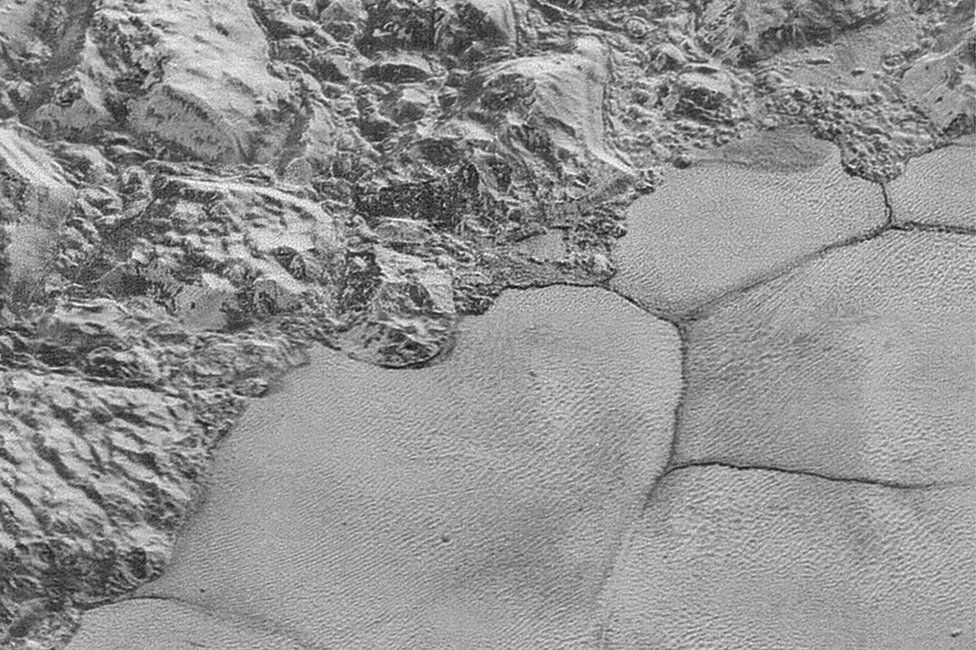
Scientists say they have found evidence of dunes of frozen methane on Pluto.

The research, which is published in the journal Science, suggests that the distant world is more dynamic than previously thought.

Pluto's atmosphere was believed to be too thin to create the features familiar in deserts on Earth.

The findings come from analysis of the startling images sent back by Nasa's New Horizons mission, which flew close to Pluto in July 2015.

After an epic trek through the Solar System that took nearly a decade, New Horizons sped by at a speed of 58,536 km/h (36,373 mph), gathering data as it passed.

In their study, the researchers explain how they studied pictures of a plain known as Sputnik Planitia, parts of which are covered with what look like fields of dunes.

They are lying close to a range of mountains of water ice 5km high.

The scientists conclude that the dunes are 0.4-1km apart and that they are made up of particles of methane ice between 200-300 micrometers in diameter - roughly the size of grains of sand.
Dunes can be seen in the bottom half of this picture of Pluto's Sputnik Planitia region (Image credit: NASA / JHUAPL / SWRI)
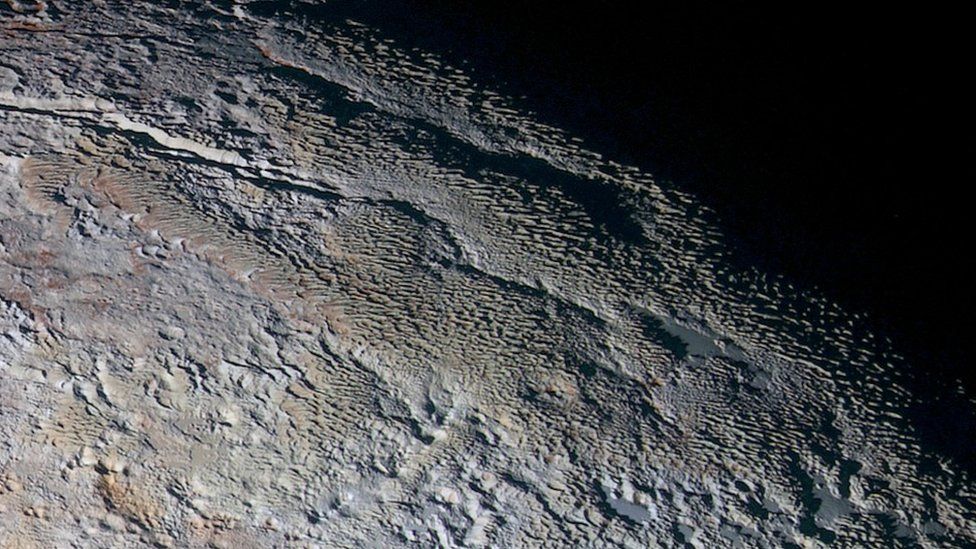
Pluto's strange "snakeskin terrain" may represent not dunes, but blades of ice (Image credit: NASA / JHUAPL / SWRI)

The paper's lead author is Dr Matt Telfer, a physical geographer at the University of Plymouth. He told BBC News: "We can't see individual grains but what we are able to identify dunes, and characterise their basic physical parameters, and the density of the atmosphere that they've been formed under.

"And we can measure some basic things like how far apart they are spaced, and have an estimate at least of the wind speeds that are forming them.

"We can feed all that back into a physical model and from that deduce what the size of the grains must be."

To be able to form, dunes need an atmosphere dense enough to make wind transport possible, a supply of dry particles, and a mechanism that lifts particles off the ground.

At first sight, none of those conditions seem to be met on Pluto.

But Dr Telfer and his colleagues calculate that the dunes may be in one of the windiest areas of the Pluto with wind speeds reaching up to 10m/sec - enough to keep particles moving.

The wind is generated as air flows downhill from the neighbouring mountains and also as frozen material sublimates - or turns directly into gas.

They believe that the dunes are composed of grains of methane, and maybe of nitrogen as well, and that a "reservoir" of methane may exist in the snowpack of the mountains.

As for the process of "lofting" the grains off the ground, the paper suggests that the driver could be a slight warming from the distant Sun, raising the temperature above the frost point of nitrogen: -230C.

With that warming of the ice below the surface, methane crystals should enable nitrogen ice to sublimate - and that would allow the methane crystals to be wafted into the atmosphere.

Dr Telfer says the analysis provides a new insight to Pluto and also changes our view of it.

"It's really exciting just to be able to look at this world and recognise that it's not just a frozen icy blob in the outer reaches of the Solar System but really we're seeing a dynamic world still changing, still forming today," he said.

That sentiment is echoed in an article accompanying the Science paper by Prof Alexander Hayes, an astronomer at Cornell University in Ithaca, US.

He quotes the late Sir Patrick Moore, the famous BBC Sky at Night presenter, describing Pluto in 1955 as "…plunged in everlasting dusk, silent, barren, and touched with the chill of death…" and says that that perspective has to shift.

Prof Hayes says we now know Pluto to be "a geologically diverse and dynamic world driven by internal heat, extreme seasons and sublimating ices".

He adds that it's not the frontier of the Solar System as Patrick Moore suggested, but the "gateway" to the unexplored realm of the Kuiper Belt.

And it may be that dunes themselves are emerging as a fascinating new feature of space exploration.

Pluto now joins Earth, Mars, Venus, Saturn's moon Titan and even the comet 67P - which a European Space Agency (Esa) mission landed on - as homes to dunes.

And Prof Monica Grady of the Open University told me that the discovery raises fascinating questions about whether there are dunes on worlds in other star systems too.

"It makes you realise that you have to open your mind to the idea that familiar objects on different planetary bodies must have formed in their own ways," she said.

"What it does is lead you to thinking about what's there beyond the Solar System, because we can't see their surfaces at the moment but we will do and then we'll probably see familiar things - we'll see dunes and they'll remind us of the dunes of Pluto or the dunes on Earth but they'll have formed in a different way."

New Horizons is now approaching another object in the Kuiper Belt, known as 2014 MU69. The spacecraft will be brought out of hibernation next week and a fly-past is scheduled for Jan 1 2019.

Friday, 27 April 2018

Astronomers discover "cosmic pileup" of 14 galaxies

When I consider thy heavens, the work of thy fingers, the moon and the stars, which thou hast ordained;
What is man, that thou art mindful of him? and the son of man, that thou visitest him?
Psalms 8:3-4

The heavens declare the glory of God; and the firmament showeth his handiwork. Psalms 19:1

Thou art worthy, O Lord, to receive glory and honour and power: for thou hast created all things, and for thy pleasure they are and were created. Revelation 4:11
This is an artist’s impression of the 14 galaxies detected by Atacama Large Millimeter/submillimeter Array.
An artist's impression of SPT2349-56, a group of interacting and merging galaxies in the early Universe.
An Atacama Large Millimeter/submillimeter Array (ALMA) image of 14 galaxies forming a protocluster known as SPT2349-56

As reported by Alison Auld of Canadian Press, April 26, 2018:

Astronomers have discovered the beginnings of a gigantic “cosmic pileup” in the far reaches of the universe, which could form one of the largest structures in the cosmos.

The team of Canadian and international scientists used a powerful telescope in Chile to spot the “impending collision of 14 young, starbursting galaxies” that will become a massive galaxy cluster.

The research, published in the journal Nature, says the so-called protocluster or group of galaxies is 12.4 billion light years away — suggesting its light began travelling to Earth when the universe was 1.4 billion years old.

“Having caught a massive galaxy cluster in throes of formation is spectacular in and of itself,” researcher Scott Chapman, an astrophysicist at Dalhousie University in Halifax, said in a statement.

“But the fact that this is happening so early in the history of the universe poses a formidable challenge to our present-day understanding of the way structures form in the universe.”

Chapman said until now, astronomers had theorized that protoclusters as large as this one would have taken much longer to form. But this formation has upended that thinking because it happened quickly and in a space only about three times the size of the Milky Way, he said.

Galaxy clusters are thought to be the largest objects in the known universe, with masses comparable to a million billion suns, the study says. They are bound together by gravity and can contain a thousand galaxies, dark matter, expansive black holes and extremely hot gas.

The clusters are considered rare and can have typical separations of 600 million light years.

“The distance to the closest big cluster (Coma) is 300 million light years, so we live in a relatively unpopulated region of the universe,” said Chapman.

The paper’s authors say the discovery could shed light on how galaxy clusters form in environments characterized by hot, ionized gas.

“How this assembly of galaxies got so big so fast is a bit of a mystery — it wasn’t built up gradually over billions of years, as astronomers might expect,” said Tim Miller, a doctoral candidate at Yale University and co-author of the paper.

“This discovery provides an incredible opportunity to study how galaxy clusters and their massive galaxies came together in these extreme environments.”

The galactic cluster — dubbed SPT2349-56 — was first seen as a smudge of light in 2010 by the South Pole Telescope in Antarctica. That led scientists to follow up with the ALMA telescope, ultimately determining that the smudge was 14 galaxies located 90 per cent of the way across the observable universe.

“SPT2349 shows us that massive cluster formation can happen much more rapidly and explosively than simulations or theory have suggested,” Chapman said.

“The incredible energetics are like 10,000 supernova going off at a time, quite literally.”

The researchers found its energetic individual galaxies are forming stars up to 1,000 times faster than the Milky Way.

“In the short term, SPT2349 affords us a wonderful shortcut — we can use SPT2349 as the initial conditions for a simulation of cluster formation and see what lessons can be learned,” said Chapman.
Click on the link for the abstract of the original article A massive core for a cluster of galaxies at a redshift of 4.3 by T.B. Miller, S.C. Chapman, et al in Nature, 556:469-472, April 25, 2018.

Saturday, 7 April 2018

Most distant star yet observed, 9.3 billion light years away

When I consider thy heavens, the work of thy fingers, the moon and the stars, which thou hast ordained;
What is man, that thou art mindful of him? and the son of man, that thou visitest him?
Psalms 8:3-4

The heavens declare the glory of God; and the firmament showeth his handiwork. Psalms 19:1

Thou art worthy, O Lord, to receive glory and honour and power: for thou hast created all things, and for thy pleasure they are and were created. Revelation 4:11

As reported by Will Dunham of Reuters, April 2, 2018 (link inserted by blogger):

WASHINGTON - Scientists have detected the most distant star ever viewed, a blue behemoth located more than halfway across the universe and named after the ancient Greek mythological figure Icarus.

Researchers said on Monday they used NASA’s Hubble Space Telescope to spot the star, which is up to a million times more luminous and about twice as hot as our sun, residing 9.3 billion lights years away from Earth. It is a type of star called a blue supergiant.

The star, located in a distant spiral galaxy, is at least 100 times further away than any other star previously observed, with the exception of things like the huge supernova explosions that mark the death of certain stars. Older galaxies have been spotted but their individual stars were indiscernible.

The scientists took advantage of a phenomenon called “gravitational lensing” to spot the star. It involves the bending of light by massive galaxy clusters in the line of sight, which magnifies more distant celestial objects. This makes dim, faraway objects that otherwise would be undetectable, like an individual star, visible.

“The fraction of the universe where we can see stars is very small. But this sort of quirk of nature allows us to see much bigger volumes,” said astronomer Patrick Kelly of the University of Minnesota, lead author of the research published in the journal Nature Astronomy.

“We will now be able to study in detail what the universe was like — and specifically how stars evolved and what their natures are — almost all the way back to the earliest stages of the universe and the first generations of stars,” Kelly added.

Because its light has taken so long to reach Earth, looking at this star is like peering back in time to when the universe was less than a third of its current age. The Big Bang that gave rise to the universe occurred 13.8 billion years ago.

The star spotted in this study is formally named MACS J1149+2223 Lensed Star-1, but its discoverers dubbed it Icarus, who flew so close to the sun that his wings fashioned from wax and feathers melted, sending him plunging fatally into the sea.

Kelly said he preferred the nickname Warhol, after the American artist Andy Warhol, owing to the star’s “15 minutes of fame” following its discovery.

“No one liked that, except for one other person, so it ended up Icarus,” Kelly said.

Wednesday, 28 March 2018

Dark matter continues to baffle astronomers

When I consider thy heavens, the work of thy fingers, the moon and the stars, which thou hast ordained;
What is man, that thou art mindful of him? and the son of man, that thou visitest him?
Psalms 8:3-4

The heavens declare the glory of God; and the firmament showeth his handiwork. Psalms 19:1

Thou art worthy, O Lord, to receive glory and honour and power: for thou hast created all things, and for thy pleasure they are and were created. Revelation 4:11

As reported by Seth Borenstein of Associated Press, March 28, 2018 (links in original):

WASHINGTON (AP) — It’s a double cosmic conundrum: Lots of stuff that was already invisible has gone missing.

Astronomers have found a distant galaxy where there is no dark matter.

Dark matter is called “dark” because it can’t be seen. It is the mysterious and invisible skeleton of the universe that scientists figure makes up about 27 percent of the cosmos. Scientists only know dark matter exists because they can observe how it pushes and pulls things they can see, like stars.

It’s supposed to be everywhere.

But Yale University astronomer Pieter van Dokkum and colleagues spied a vast, old galaxy with relatively few stars where what you see truly is what you get. The galaxy’s stars are speeding around with no apparent influence from dark matter, according to a study published in Wednesday’s journal Nature.

Instead of shaking the very foundations of physics, scientists say this absence of dark matter may help prove the existence of, wait for it, dark matter.

“Not sure what to make of it, but it is definitely intriguing,” wrote Case Western Reserve astronomer Stacy McGaugh, who was not part of the study, in an email. “This is a weird galaxy.”

Van Dokkum studies diffuse galaxies, ones that cover enormous areas but have relatively few stars. To look for them he and colleagues built their own makeshift telescope out of 48 telephoto lenses that he first tested by using a toy flashlight to shine a light on a paper clip. The bug-eyed telescope, called Dragonfly, peers into the sky from New Mexico.

Using Dragonfly, van Dokkum and colleagues found a large, sparse galaxy called NGC1052-DF2 in the northern constellation Cetus, also known as the whale. It’s as big as the Milky Way but with only one percent of its stars. Then they used larger telescopes on Hawaii and eventually the Hubble Space Telescope to study the galaxy.

Even though the galaxy is mostly empty, they found clusters of densely grouped stars. With measurements from the telescopes, van Dokkum and colleagues calculated how fast those clusters moved. If there were a normal amount of dark matter those clusters would be speeding around at about 67,000 mph (108,000 kilometers per hour). Instead, the clusters were moving at about 18,000 mph (28,000 kilometers per hour). That’s about how fast they would move if there were no dark matter at all, van Dokkum said.

The team also calculated the total mass of the galaxy and found the stars account for everything, with little or no room left for dark matter.

“I find this unlikely in all possible contexts,” said McGaugh, who is a proponent of a “modified gravity” theory that excludes the existence of dark matter altogether. “That doesn’t make it wrong, just really weird.”

How could this absence of dark matter help prove that it exists? By potentially disproving modified gravity theories that suggest gravity acts in a way that the cosmos makes sense without dark matter. But those alternative theories require stars in this galaxy to zip at least twice as fast as they were seen moving in this study.

Other outside scientists said the initial look at the calculations appear to be correct, though the results are confounding. A galaxy with so few stars should have more dark matter than others, not none.

“These are very strong scientists and so I take the results very seriously,” said Marc Kamionkowski, a physicist at Johns Hopkins University.

One outsider suggested that perhaps the “galaxy” van Dokkum studied is so diffuse that it may not really be a galaxy. Another suggested that the dark matter might just be outside of the area that van Dokkum measured.

Van Dokkum dismissed both possibilities. “It’s sort of non-negotiable. There’s nothing else, just the stars,” he said. The only way this can be explained is if dark matter exists in the universe, just not in that galaxy, he said.

There’s no good explanation for why and how this galaxy has no dark matter, van Dokkum said. He proposed four different possibilities — all unproven. His favorite: That the galaxy formed in the very early universe in a way astronomers have never seen or understood.

“It’s not so often you get a true surprise,” van Dokkum said.
Click on the link to see the original article Beguiling dark-matter signal persists 20 years on by Davide Castelvecchi in Nature, March 28, 2018.

Saturday, 16 December 2017

Student discovers one exoplanet while researching Earth-like conditions on another

When I consider thy heavens, the work of thy fingers, the moon and the stars, which thou hast ordained;
What is man, that thou art mindful of him? and the son of man, that thou visitest him?
Psalms 8:3-4

The heavens declare the glory of God; and the firmament showeth his handiwork. Psalms 19:1

Thou art worthy, O Lord, to receive glory and honour and power: for thou hast created all things, and for thy pleasure they are and were created. Revelation 4:11
Researchers at the Centre for Planetary Sciences at U of T Scarborough have found that K2-18b could be a scaled-up version of Earth and discovered it has a neighbouring planet (Illustration by Alex Boersma)

As reported by Don Campbell of U of T News, December 5, 2017 (link in original):

A University of Toronto PhD student has found that a little-known exoplanet called K2-18b could be a “super-Earth,” and in the process discovered a new planet in the same solar system.

The researcher, who had set a goal to discover a new exoplanet for his thesis, made the discovery by scouring data collected by the European Southern Observatory (ESO).

“Being able to measure the mass and density of K2-18b was tremendous, but to discover a new exoplanet was lucky and equally exciting,” says Ryan Cloutier, a PhD student in U of T Scarborough’s Centre for Planetary Science, U of T’s department of astronomy and astrophysics in the Faculty of Arts & Science and the Université de Montréal Institute.

Both planets orbit K2-18, a red-dwarf star located about 111 light-years away in the constellation Leo. When the planet K2-18b was first discovered in 2015, it was found to be orbiting within the star’s habitable zone, making it an ideal candidate to have liquid surface water, a key element in harbouring conditions for life as we know it.

“It wasn’t a eureka moment because we still had to go through a checklist of things to do in order to verify the data,” Cloutier said. “Once all the boxes were checked it sunk in that, wow, this actually is a planet.”

The dataset used by Cloutier, the lead author, and other researchers came from the High Accuracy Radial Velocity Planet Searcher (HARPS) using the ESO’s 3.6-metre telescope at La Silla Observatory, in Chile. HARPS allows for measurements of radial velocities of stars, which can be affected by the presence of nearby planets, to be taken with the highest accuracy currently available. The instrument makes it possible to detect very small planets orbiting those stars.

In order to figure out whether K2-18b was a scaled-up version of Earth (mostly rock), or a scaled-down version of Neptune (mostly gas), researchers had to first figure out the planet’s mass, using radial velocity measurements taken with HARPS.

“If you can get the mass and radius, you can measure the bulk density of the planet and that can tell you what the bulk of the planet is made of,” says Cloutier.

After using a machine-learning approach to figure out the mass measurement, Cloutier and his team were able to determine the planet is either a mostly rocky planet with a small gaseous atmosphere – like Earth, but bigger – or a mostly water planet with a thick layer of ice on top of it.

“With the current data, we can’t distinguish between those two possibilities,” he says. “But with the James Webb Space Telescope (JWST), we can probe the atmosphere and see whether it has an extensive atmosphere or it’s a planet covered in water.”

The James Webb Space Telescope, which will be launched in 2019, will be instrumental in collecting a range of data for studying the solar system, early universe and exoplanets.

“There’s a lot of demand to use this telescope, so you have to be meticulous in choosing which exoplanets to look at,” says René Doyon, a co-author on the paper who is with Université de Montréal Institute and a principal investigator for NIRISS, which is the Canadian Space Agency instrument on board the James Webb Space Telescope.

“K2-18b is now one of the best targets for atmospheric study, it’s going to the near top of the list.”

It was while looking through the data of K2-18b that Cloutier noticed something unusual. In addition to a signal occurring every 39 days from the rotation of K2-18, and one taking place every 33 days from the orbit of K2-18b, he noticed a different signal occurring every nine days.

“When we first threw the data on the table we were trying to figure out what it was. You have to ensure the signal isn’t just noise, and you need to do careful analysis to verify it, but seeing that initial signal was a good indication there was another planet,” Cloutier says.

Cloutier collaborated with an international team of researchers, including his supervisor U of T Scarborough Associate Professor Kristen Menou, and from the Observatoire Astronomique de l’Université de Genève, the Institute for research on exoplanets (iREx), Université de Grenoble and Universidade do Porto.

While the newly described planet K2-18c is closer to its star and probably too hot to be in the habitable zone, like K2-18b it also appears to be a Super-Earth meaning it has a mass similar to Earth.

The research, which received support from the Natural Sciences and Research Council of Canada (NSERC) and the Institute for Research on Exoplanets, will be published in the journal Astronomy and Astrophysics.