

On December 5, 2013, Nelson Mandela, who served as President of the Republic of South Africa from 1994-1999, died at the age of 95. Mr. Mandela was Deputy President of the African National Congress from 1952-1958 and 1985-1991, and was President of the ANC from 1991-1997. He was one of the most famous opponents of South Africa`s racial policy of apartheid, and was in prison from 1963-1990 before being released by South Africa`s then-State President, F.W. de Klerk. When the ANC won South Africa`s first multiracial elections in 1994, the new National Assembly elected Mr. Mandela President, becoming the country's first President under the current constitution. Mr. Mandela received honours too numerous to mention here, but they included the 1993 Nobel Peace Prize (shared with Mr. de Klerk), and having his birthday of July 18 named by the United Nations as "Nelson Mandela International Day."
When Mr. Mandela's death was announced, he was lauded as a "man of peace," and professing Christians were among the most outspoken mourners, as the following examples illustrate:
Nelson Mandela's death: Christian reactions=========================
A round-up of the latest reactions from Christian leaders and organisations
Published 06 December 2013
Archbishop Desmond Tutu said: "God was so good to us in South Africa by giving us Nelson Mandela to be our President at a crucial moment in our history. He inspired us to walk the path of forgiveness and reconciliation and so South Africa did not go up in flames. Thank you God, for this wonderful gift who became a moral colossus, a global icon of forgiveness and reconciliation. May he rest in peace and rise in glory."
Reverend Moss Ntlha, General Secretary of the Evangelical Alliance of South Africa said: "Madiba is considered by many as the father of the nation. He modelled firm confrontation with evil and injustice, and magnanimity in his triumph over those who sought his destruction. His passing calls to mind the prophetic tradition of Micah that says: "He has shown you, O mortal, what is good. And what does the LORD require of you? To act justly and to love mercy and to walk humbly with your God. (Micah 6:8)."
Reverend Aiah Foday-Khabenje, the General Secretary of the Association of Evangelicals in Africa, said: "The life of Madiba is yet another proof and reminder about the origin, nature and commonality of the human species; created in the image of God with ability to reflect some of God's attributes though vainly because of finitude, fallenness with feet of clay; regardless of race or geographical location. Heartfelt condolences to immediate family members and the people of South Africa. May his exemplary leadership inspire African leaders"
In a telegram to South African President Jacob Zuma, Pope Francis praised "the steadfast commitment shown by Nelson Mandela in promoting the human dignity of all the nation's citizens and in forging a new South Africa built on the firm foundations of non-violence, reconciliation and truth".
"I pray that the late president's example will inspire generations of South Africans to put justice and the common good at the forefront of their political aspirations," he said.
The Archbishop of Canterbury, the Most Reverend Justin Welby, has offered his prayers for friends and family, as well as the nation of South Africa.
"The death of President Nelson Mandela was announced in memorable words by president Zuma. South Africa has lost its greatest citizen and its father. Nelson Mandela, fighting to the end, is freed to be with his God in joy and reward for his great service and sacrifice. We pray for his family, for his friends and for his country. We are challenged to show the same degree of humanity, of courage and of generosity."
The Right Reverend Lorna Hood, Moderator of the General Assembly of the Church of Scotland said: "Nelson Mandela was a towering figure of the 20th century whose strength, courage and determination are only matched by his grace and ability to forgive.
"He will forever be remembered not only for the end of apartheid in South Africa but the manner in which the change was accomplished.
"Emerging from prison after 27-years in Robben Island, without bitterness or a call for revenge, he led by example believing that the only hope for his country was the reconciliation of all people regardless of their colour or creed.
"Nelson Mandela is the epitome of a man who has never given up hope but believes wholeheartedly that no injustice can last forever and that evil will not have the last word."
The Reverend Ruth Gee, President of the Methodist Conference, said: "Nelson Mandela is regarded as one of the fathers of Africa. His persistent way of standing up for justice has inspired Africans and the world at large. As a leader, one of his most impressive attributes was his emphasis on peace and reconciliation in the post-apartheid regime.
"Nelson Mandela attended Methodist missionary schools during his formative years. His understanding of Christian values was reflected in his passion for social justice. Representatives from the Methodist Church in Britain who were fortunate to meet Mandela have spoken about him with admiration: he was a welcoming, gracious and charismatic leader of exceptional ability who did not hold any bitterness about what had happened to him. During the years of his imprisonment on Robben Island, Mandela was visited by a Methodist chaplain. He will always remain loved and honoured in our hearts."
Roy Crowder was the Africa Secretary for the Methodist Church in Britain from 1999 to 2009. He lived in Cape Town from 1983 to 1999, where he worked as a lecturer at University of the Western Cape, and met Nelson Mandela three times.
He said: "As the crisis in South Africa deepened in the late eighties it became clear that Government was negotiating with the ANC. The newspapers still could not print Nelson Mandela's picture but they discussed his future role intensely. No one could have lived up to the expectations that were built up in that frantic period. But miraculously Mandela did! He grew to be the global political leader without feet of clay, which was exactly what his supporters had projected during the Free Mandela campaign. He even risked alienating those supporters by donning the Springbok rugby jersey and having tea with Betsie Verwoerd, the widow of man who jailed him. Such iconic actions instilled a spirit of unity into the politics of a tragically divided country."
World Vision International President Kevin Jenkins said Nelson Mandela will always be an "inspiration" for those involved in humanitarian work.
"Mandela was probably the greatest leader of our age, a tireless, fearless advocate for the needs of some of the most vulnerable people in our world, particularly children. He believed in justice, and wasn't afraid to do what
he thought it would take to achieve it.
"Mandela's death is, of course, most keenly felt in his home country, and we join with South Africans in sending our condolences to his family, and in mourning his loss.
"Many of the children we work with, and our staff, have life-changing stories to tell of meeting Madiba over the years. All talk of his great compassion, and his tireless commitment to seeking justice and change."
"He knew when to get his hands dirty and when to be diplomatic. He made the world better for countless millions of children. What better legacy is there than that?"
Christian Aid Chief executive Loretta Minghella described the late leader as a "man whose strength of vision founded a nation".
"The sufferings and injustices inflicted by apartheid could so easily have led to a reckoning in blood when majority rule was introduced.
"The fact that South Africa's transition from pariah state to independent nation took place in relative peace was largely down to the magnanimity and moral courage of Mr Mandela.
"His readiness to eschew revenge after 27 years in prison was an example to all. His calm and restraint showed the people, not just of South Africa but the world, that justice and tolerance can prevail over fear and oppression.
"He was that rare creature, a person of immense power who used his energies and influence for the good of all. He will be sorely missed."
Steve Clifford, general director of the Evangelical Alliance: "We are sad to hear of the death of this great man, whose tireless dedication to equality and the dignity of all human persons has been inspirational over the decades.
"As evangelical Christians we believe that all are equal in the sight of God, that Jesus is good news for all members of all societies, everywhere. Our prayer is that Nelson Mandela's legacy will not be forgotten and that we will, together, continue to fight for justice, peace and hope locally, nationally and globally."
Dr Dave Landrum, director of advocacy at the Evangelical Alliance, said: "Nelson Mandela stands out among world politicians because, although he suffered greatly for justice, he never forgot mercy.
"With his political leadership characterised by humility, dignity and integrity, he has left a legacy to the Republic of South Africa of reconciliation and hope for a better future. He reminds us all of our obligation to speak truth to power and to demand government for the good of all."
Dr Geoff Tunnicliffe, Secretary-General of the World Evangelical Alliance said: "The world has lost a great leader. Nelson Mandela was a model of courage, vision and personal sacrifice. Today more than ever we need this kind of leadership. May the memory of Nelson Mandela inspire a new generation of such leaders around the world."
Dr Samuel Rodriguez, President of the National Hispanic Christian Leadership Conference said: "Nelson Mandela's life embodied the idea of prophetic activism with an unquenchable thirst for justice. His struggle for equality brought down one of the final strongholds of segregation and subsequently empowered an entire continent to overcome by doing justice and loving mercy. His life inspired us while his humble demeanor will continue to move us towards a more just and loving world."
Mandela's grace prevailed in 'tireless struggle'================================
Posted on Dec 6, 2013 | by Diana Chandler
PRETORIA, South Africa (BP) -- "Our nation has lost its greatest son," South African President Jacob Zuma said in announcing the loss of Nelson Rolihlahla Mandela, the nation's former president who died at home Thursday (Dec. 5) at age 95 after months of declining health.
"Our people have lost a father. Although we knew that this day would come, nothing can diminish our sense of a profound and enduring loss," Zuma said.
Mandela's "tireless struggle for freedom earned him the respect of the world," Zuma said. "His humility, his compassion and his humanity earned him their love."
Among world leaders, President Barack Obama voiced similar sentiments.
"Nelson Mandela achieved more than could be expected of any man," Obama said. "His own struggle inspired others to believe in the promise of a better world, and the rightness of reconciliation. Through his fierce dignity and unbending will to sacrifice his own freedom for the freedom of others, he transformed South Africa –- and moved the entire world."
In the U.S. and South Africa, respective national flags are being flown at half-staff in honor of Mandela. Obama ordered the recognition to continue through sunset Dec. 9 at the White House and other public and military facilities in the U.S.
Russell D. Moore, president of the Southern Baptist Ethics & Religious Liberty Commission, noted the heroism of the leader who rose from 27 years of incarceration to become the first black South African president as well as a hallmark of freedom and a leader of worldwide acclaim.
"Nelson Mandela's heroism will outlast him throughout untold generations. Mandela will be remembered for standing up to a racist regime, for persevering under persecution, and for leading his country toward democracy," Moore told Baptist Press. Mandela's move from prison cell to president's office was a living parable of the power of freedom over apartheid.
"Even those who don't agree with all of Mandela's political or religious views ought to give thanks for the many good things that came from his life and work," Moore said. "As we remember Nelson Mandela, let's pray for a South Africa that experiences the freedom not only of the voting booth but also of widespread Gospel reconciliation to God and to one another."
Mandela rarely discussed religion outside the arena of religious freedom, but a transcript on NelsonMandela.org quotes his comments on religion in a 2000 Christian Science Monitor interview.
"Religion has had a tremendous influence on my own life. You must remember that during our time -- right from Grade 1 up to university -- our education was provided by religious institutions. I was in [Christian] missionary schools," the transcript records Mandela as saying. "The government [of the day] had no interest whatsoever in our education and, therefore, religion became a force which was responsible for our development.
"I appreciate the importance of religion," Mandela said. "You have to have been in a South African jail under apartheid where you could see the cruelty of human beings to each other in its naked form. Again, religious institutions and their leaders gave us hope that one day we would return."
Nigeria native Adeniya Ojutiku, a Southern Baptist in the U.S. who fights for Christians and their livelihood in his homeland, described Mandela as "an epitome of forgiveness, kindness and love" who had "a dogged resolve for the pursuit of peace and justice."
"His extraordinary life story, witty sense of humor and lack of bitterness toward his former oppressors has ensured global appeal for his type of charismatic leadership," Ojutiku told Baptist Press. "Mandela has no antecedence, parallel or equal in the contemporary history of harmonious race relations.
"He rekindled hope in the humaneness and greatness of the black, colored and white races, as he soared above the petty confines of party politics and prejudice," Ojutiku said.
Former international missionary Gordon Fort, the International Mission Board senior vice president for prayer mobilization and training, said Mandela's leadership allowed churches to flourish in South Africa.
"While tackling the daunting task of dismantling institutionalized racism, poverty and inequality, [Mandela] gave a clarion call to national unity and religious freedom," Fort said in an email to IMB staff. "This atmosphere led to a season of opportunity for the church and its missionary representatives to advance the Gospel, engage new people groups, and play a part in the healing of the deep rifts within the nation.
"President Mandela was among the first to invite and welcome the role of the church in the new nation he was seeking to build," Fort wrote. "After retirement from the presidency, he continued to provide leadership and an example of statesmanship that allowed the church to flourish."
Nelson Mandela and his faith================================
Published 06 December 2013 | Michael Trimmer
One of Nelson Mandela's famous quotes was also an expression of a deeply Christian idea - "until I changed myself, I could not change others". That expression of being born again, the need for internal revival before one can lead others to their own change, was just one of many expressions of faith Nelson Mandela shared throughout his life.
Although it is almost universally agreed that he was a Christian, his exact denominational allegiances remain a source of discussion. While some have suggested that he was a Jehovah's Witness, as his first wife, his sister, and many relatives around him identified as such, most believe he was a Methodist. He attended a Methodist church school growing up, and was baptised in a small Methodist stone church in the Eastern Cape village of Qunu.
In his autobiography, "The Long Walk to Freedom" he talked of his early experiences with Christianity, praising its engagements with the society around him: "The Church was as concerned with this world as the next: I saw that virtually all of the achievements of Africans seemed to have come about through the missionary work of the Church."
Consequently, while attending the University of Fort Hare, an elite black university in Alice, Eastern Cape, Mandela became a member of the Students Christian Association and taught Bible classes on Sundays in nearby villages.
Among other factors, it was Mandela's Christianity that steered him away from Communism and the class struggle that was spreading into South Africa in the 1940s. Despite befriending Gaur Redebe and Nat Bregman, prominent Xhosa and Jewish South African communists, he could not reconcile communism's atheistic attitudes with his Christian faith. Also, he felt that the idea of class struggle was misleading, and that South Africa's problems were primarily racial in origin. Although he was impressed that the local communist party saw Europeans, Africans, Indians, and those of mixed heritage all mixing equally, he clearly believed there was another way to go.
It is likely that Mandela's Christian faith influenced his strategy during the more militant portion of his protest against the government, when he co-founded the armed resistance group Umkhonto we Sizwe, or "Spear of the Nation" in English. The targets Mandela chose, and the way in which the group timed its attacks, was a clear message that he intended to target the government, not the civilians it claimed to serve.
Rather than bombing densely populated areas, Mandela instead chose to organise acts of sabotage, the first target being an electricity substation. Later attacks would focus on things like the burning of crops, destruction of government offices, damaging government owned factory machines, and blowing up telephone lines. All of this was done at night, so as to avoid civilian casualties. Although Mandela considered that terrorism might be necessary, he did not want to resort to it until other routes had failed.
During his imprisonment on Robben Island, he continued to attend Sunday services, but also took classes on Islam, in what he called "the University of Robben Island". Prisoners would lecture on their subjects of expertise, and Mandela frequently listened to what other students had to say about communism, Islam, and many other subjects. This led to many impassioned debates, but ultimately they equipped him with a greater level of understanding. He also learned to speak Afrikaans in the hope that he could reach out to the guards and convert them to his cause.
At the moment of his release, Mandela once again remembered the importance of internal renewal ahead of external change. "As I walked out the door toward the gate that would lead to my freedom, I knew if I didn't leave my bitterness and hatred behind, I'd still be in prison."
Upon his liberation, Mandela took opportunities to speak at substantial Christian events. Two of these were the Zionist Christian Church's Easter Conferences, once in 1992 and again in 1994. In the latter of these conferences he shared the following:
"The Good News borne by our risen Messiah who chose not one race, who chose not one country, who chose not one language, who chose not one tribe, who chose all of humankind!
"Each Easter marks the rebirth of our faith. It marks the victory of our risen Saviour over the torture of the cross and the grave.
"Our Messiah, who came to us in the form of a mortal man, but who by his suffering and crucifixion attained immortality.
"Our Messiah, born like an outcast in a stable, and executed like criminal on the cross.
"Our Messiah, whose life bears testimony to the truth that there is no shame in poverty: Those who should be ashamed are they who impoverish others.
"Whose life testifies to the truth that there is no shame in being persecuted: Those who should be ashamed are they who persecute others.
"Whose life proclaims the truth that there is no shame in being conquered: Those who should be ashamed are they who conquer others.
"Whose life testifies to the truth that there is no shame in being dispossessed: Those who should be ashamed are they who dispossess others.
"Whose life testifies to the truth that there is no shame in being oppressed: Those who should be ashamed are they who oppress others."
As South Africa's president, Mandela addressed the 8th Assembly of the World Council of Churches in Harare, Zimbabwe in 1998. In his address, he praised the effort of churches in South Africa to end apartheid, and paid tribute to missionaries for bringing high standards of education to Africa from which he benefitted as a child.
"You have to have been in an apartheid prison in South Africa to appreciate the further importance of the church," he told the Assembly.
"They tried to isolate us completely from the outside. Our relatives could see us only once every six months. The link was religious organisations, Christians, Muslims, Hindus and members of the Jewish faith. They were the faithful who inspired us."
He added, "The WCC's support exemplified in the most concrete way the contribution that religion made to our liberation."
Although he clearly was a passionate believer, religion was not something he spoke about publically on many occasions. Given the situation, he was aware that speaking too zealously and too regularly about his religious beliefs could cause partisan division at a time when unity in South Africa was so important.
In his 1994 autobiography, "Long Walk to Freedom", he said: "No one is born hating another person because of the colour of his skin, or his background, or his religion. People must learn to hate, and if they can learn to hate, they can be taught to love, for love comes more naturally to the human heart than its opposite."
He may not have put his faith into so many words, but this mattered little as it was his often simple and humble gestures that so powerfully and clearly conveyed what it was he believed. The words of Francis of Assisi come to mind: "Preach the Gospel and if necessary, use words."
An unforgettable witness to his message of reconciliation came in 1995, when Mandela rallied both blacks and whites to support the Springbok rugby team in the Rugby World Cup. The team had been such a strong symbol of white authority during the apartheid years and it was loathed by black South Africans, who would lend their support to the opposing team.
When the Springboks reached the finals against New Zealand, it was a heart stopping moment when Mandela walked onto the pitch wearing the green Springbok rugby shirt and cap, and shook the hands of the mostly white team.
In the end, it was a stunning victory for South Africa in more ways than winning the Cup. Barriers spanning decades were melted in an instant when black South Africans watching the game on TV heard the largely white crowd in the stadium shout "Nelson", "Nelson".
Not surprisingly, one of the most iconic images in South African and sporting history is that of Mandela presenting Springbok captain Francois Pienaar with the Cup.
Pienaar later recalled their exchange of words in that moment as follows: "He said to me 'Thank you for what you have done for South Africa. I said to him, 'No, Madiba, you've got it wrong. Thank you for what you've done for South Africa.' And I felt like hugging him."
It's clear from these very "human" moments he shared with others, that for Mandela, faith was very much a "doing word", with respect and a desire to always bridge the gap to the other at its heart.
On 10 May 1994, Mandela ended his inaugural presidential speech in Pretoria with "God bless Africa!".
While the words "God bless" are so often carelessly thrown around, it's different when they come from a man as deliberate with his words as Mandela, who had a genuine faith and was so careful to live out everything that he spoke.
As the people of South Africa learn to live without their beloved Madiba in their midst, may God indeed answer that call.
Baptists admire, mourn Mandela================================
Pastors say Nelson Mandela modeled a form of radical forgiveness that can help individuals conquer anger and resentment just like Mandela conquered apartheid.
By Jeff Brumley
Huge voices, including past and present world leaders, are flooding the web with praise for Nelson Mandela, saying he showed the world how love can overcome hate. Other voices are speaking up, too, turning to social media to express grief and admiration for Mandela, who died Thursday night in South Africa at age 95.
“Praise God for the life and legacy of Mr. Nelson Mandela,” Ronald Bobo Sr., senior pastor at West Side Missionary Baptist Church in St. Louis, posted on Facebook late Thursday. “The world is richer because of his grace and humility in the face of tyranny, hatred and oppression.”
Bobo and other Baptist preachers told ABPnews today that Mandela’s influence went far beyond African and international politics. That by “living peace,” he reminded every-day Christians that forgiveness is the door to harmony in interpersonal relationships, too.
Bobo said he got that message from Mandela directly in the early 1990s, when he encountered the African leader on a plane from Malawi to Zimbabwe. A photo of the meeting accompanies Bobo’s Facebook comment.
“He was very kind, very non-impressed with himself,” said Bobo, who was traveling on Baptist World Alliance business at the time. “I was impressed with how he talked to us and handled us with grace and dignity.”
Bobo said he’s met well-known evangelists who don’t do that. The encounter was so striking, Bobo said, that it has influenced his own ministry ever since.
“I use him as a great example of humility and grace," Bobo said. "With all of this power he still had great humility. I thank God for that example and have used it.”
Baptists with global influence were also speaking out today. BWA General Secretary Neville Callam said the world cannot afford to forget the example set by Mandela, whom he called “a remarkable emancipator.”
“Mandela blazed a trail of respect for human dignity and human rights,” Callam said in a statement released by BWA Friday. “Let us be prepared, whatever the cost, to devote our lives to loving our neighbors, forgiving our enemies, and pursuing all that makes for justice and peace in our communities.”
Baptist and former U.S. President Jimmy Carter also issued a statement about Mandela on Friday.
“His passion for freedom and justice created new hope for generations of oppressed people worldwide, and because of him, South Africa is today one of the world's leading democracies,” Carter said.
American Baptist minister Alan Rudnick said such high-octane praise for Mandela must be translated into terms the average Christian can understand and apply to his or her life.
“It’s figures like Mandela and Mother Teresa that seem inaccessible because of the magnitude of the work they have done,” said Rudnick, the pastor of First Baptist Church of Ballston Spa, N.Y.
Rudnick wrote a commentary for ABPnews today which seeks to show how Mandela’s idea of “waging peace” can be used by Christians to practice radical forgiveness. Rudnick said he will preach about Mandela on Sunday and the role of forgiveness in a Christ-like life.
“As a pastor, teaching reconciliation is one thing and leading them to it is another,” he said. “Looking to people like Nelson Mandela ... you can say hey, this is doable.”
Nelson Mandela: Peace wager=====================================
Today, let us remember Nelson Mandela and wage peace in his honor.
By Alan Rudnick
As the world reacts to the death of Nelson Mandela, we cannot help but read and understand his amazing history of peace. Fighting against injustice and apartheid in South Africa were his notable achievements, but Mandela did so much more.
Mandela spent 27 years in prison for fighting for his beliefs and for justice. Emerging from oppressive imprisonment, Mandela spoke about peace, reconciliation and forgiveness. How does someone emerge from such hate, injustice and pain to talk about reconciliation? He became a symbol of truth, reconciliation, grace and peace.
Many talk about peace, but few understand what it takes. It's easy to speak about peace, but if one truly wants to achieve peace, one must "wage peace." Nelson Mandela died in the midst of Advent, the precursor to Christmas. The story of Christmas is the story of God waging peace with the world. Making peace is not an easy business. Mandela was a peace-wager.
Peace amid tragedy is challenging. Mandela was one who could find peace in tragedy.
The message of Christmas is this: Christ was born to all the world for the redemption of the world. However, as Christians, we often believe that peace is something to pray for but never accomplished. It is common for Christians to think that peace is to be prayed for and never acted on.
Jesus said, “Blessed on the peace makers, for they will be called the children of God.” Jesus was not being vague, but specific.
As we reflect upon Nelson Mandela's legacy and a world of injustice, we Christians cannot sit around on our hands. We must wage peace. Just as war is waged, peace must be waged. Praying for peace is one thing, but waging peace is another. Peace must be waged on a daily basis...
And this drivel from the appropriately-initialled Brian Stiller, former President of the Evangelical Fellowship of Canada, President Emeritus of Tyndale University College & Seminary, and current Global Ambassador of the World Evangelical Alliance:
An untold story behind Mandela===================================
Posted by brianstiller on May 20, 2014
I stood in the cell where Nelson Mandela spent eighteen of his twenty-seven imprisoned years. While it now appeared unremarkable, it still seemed somewhat hallowed. As we walked about Robben Island, just off the South African coast near Cape Town, I tried to imagine Mandela’s feelings and to hear his many conversations with colleagues of the African National Congress (ANC). There must have been a sense of futility mingled with hope for their cause.
The transition from white minority power over both the black and colored majority is a story like none other. A political system called apartheid had evolved through the early years of the twentieth century and came to full bloom in the 1960s. As its laws became more repressive and absurd, Mandela led the underground resistance and was eventually convicted by the white courts, as were many of his ANC associates. As the resistance grew to rebellion, the government finally realized that the laws needed changing and they eventually consulted Mandela while in prison. They promised his soon release and general elections to be held in 1994.
In 1990 the world watched and wondered as Mandela left prison and boarded a ferry to cross to Cape Town. His peaceful presence, his measured words, his respect for his captors and his carefully considered convictions showed that he was a leader of a different stripe. His mature wisdom and gracious manner suggested how he might someday govern.
This is the story that we all saw. But behind it was another story less reported in the major media. After so many decades of harsh rule under apartheid, the oppressed majority could have easily pursued retribution. And yet, their antagonisms were focused primarily on their own people, for the black community was divided. Mandela led the ANC while Buthelezi, chief of the large Zulu tribe in South Africa, led the Independence Freedom Party (IFP). The two sides were at each other’s throats, with killings on a regular basis.
South Africa was ruled by people who were steeped in the doctrines of the Dutch Reformed Church mixed with their need to survive as a majority. This had certain similarities to the position of early settlers in the United States who perpetuated the practice of slavery while trying to defending it biblically. But there were other spiritual influences in South Africa, one of the most dominant being the legacy of Andrew Murray, a minister who had died in 1917 but had left a rich heritage of Christian thinking in his more than 240 books. He is still read and appreciated around the world for his writings on prayer.
As the Christian leaders in South Africa saw the conflict that was likely to happen, they mobilized in an effort of prayer for a peaceful resolution in a time of momentous change. At the same time, the leaders of the ANC and the IFP knew that the violence had to stop and they agreed to invite Henry Kissinger from the United States and Lord Carrington from Britain to assist in mediation. Adding to the foment was Buthelezi’s threat to forbid Zulus to vote in the coming election. This meant that when Mandela was elected – a forgone conclusion – Buthelezi could then declare that the election was illegitimate since a major tribe wasn’t part of the vote. This would, in effect, make Mandela a president without a mandate, an accusation which could rally the troops to further conflict, at the very time the white laws of apartheid were crumbling. What was seen as a wonderful transition was turning into a nightmare.
It was Michael Cassidy, a South African leader of African Enterprise, who saw the futility of high level mediation without also relying on God’s intervention. He reached out to Washington Okumu, a Christian professor from Kenya who was often called “the gentle giant” to join in the negotiations.
On April 14, 1994, thirteen days before the election, Kissinger and Carrington boarded planes to head home, with Kissinger offering a prediction that a million people would die in what he saw as a coming civil war.
Michael Cassidy went into action and rented a stadium in Durban and prayer meetings began to happen all over South Africa. While the prayer meetings were going on, Washington Okumu worked all night with the IFP to find a way to avoid the conflict. With an agreement in hand, he sped to the airport in Johannesburg to get Chief Buthelezi’s endorsement, but he arrived too late. The Chief has already left; at least he thought he had. A few minutes into the flight his pilot said they had an instrument problem and had to return to Johannesburg.
Washington Okumu got his meeting with Buthelezi.
On April 17, 25,000 people turned out for prayer at the Durban stadium, matched by smaller prayer groups around the country. And in the VIP lounge Washington Okumu and Buthelezi had final discussions on a settlement with President de Klerk, hammering out a plan while thousands were in prayer for a peaceful settlement.
Ten days later elections were held. The chief allowed his Zulu people to vote. Mandela was elected and not one person died from tribal conflict.
The convergence of leadership, skill and a will to pray brought change to a nation racked by decades of cruelty. Into that world at a time of enormous potential for good came a threat so severe that the country could have been torn apart. Michael Cassidy provided Christian leadership. Washington Okumu, a scholar of Christian faith, lent his considerable skill in negotiating. Thousands upon thousands reached out in prayer for their nation, believing that the Spirit would intervene in ways no one could predict. And God had his Cyrus, Mandela, to lead the people through the coming days.
Despite the admiration for Nelson Mandela, there are some voices--including even those in a few secular media outlets--who have the courage to go against the tide and remind the public of some facts about Mr. Mandela that most of the world would rather ignore. Rachel Johnson of the London Daily Mail offered this commentary on the biographical film The Long Walk to Freedom on December 15, 2013:
I'll get hate mail for this... Mandela was NOT perfect=================================
You'll get hate mail,’ I was warned by William Nicholson, who wrote the new Mandela movie, after I’d told him what I was going to say here.
And yes, I am aware that the late first black leader of South Africa is being buried today, and may his mortal soul rest in peace.
After Nelson Mandela died, aged 95 (I was surprised that some of the hacks who’d prepared his obits hadn’t predeceased him), our national broadcaster cleared the schedules across the channels for syrupy obsequies.
Editors obeyed the convention that you must only speak good of the newly departed so literally – and at such length – that, after several days, one could only pray for one’s own end to come quickly (the BBC has now received 1,000 complaints, not including this one).
And yet, in all this, no one really flagged up something that is foregrounded early on in the epic new biopic The Long Walk To Freedom.
And I found this a strange omission, given the opprobrium heaped on Charles Saatchi for gripping his then wife Nigella Lawson around the neck in a public place. Or indeed on Lord Edward Somerset, who last week brought ‘disgrace’ on to the storied and ducal family name of Beaufort by pleading guilty at Bristol Crown Court to two decades of domestic violence against his wife.
Allow me to explain if you haven’t seen the film – although at this point, I’m so confused that I’m not sure if it’s tasteless to mention it, or derelict to leave it out.
Anyway: in the film, our hero is shown as a sharp-suited Jo’burg lawyer in his 20s – and a faithless and violent husband. At one point, his first wife Evelyn is so enraged by his tomcatting that she brandishes a red-hot poker at her husband, who retaliates by striking his wife to the ground.
This isn’t the first time that Mandela has been painted a womanising wife-beater: in 2010, David James Smith wrote a biography called Young Mandela. He recounts how Evelyn claimed he beat and throttled her, and even threatened to murder her with an axe.
This has been denied by Team Mandela. But the fact the filmmakers included so many of their subject’s youthful warts, while he was still alive, is significant and, I would argue, far more instructive than the post-mortem open-casket airbrushing of the broadcasters.
Their coverage favoured comparisons with Gandhi, and Mother Teresa, even though Mandela himself asked for the line ‘I led a thoroughly immoral life’ to be inserted into his own autobiography. At one point, one of the many hundred BBC journalists on the story even asked a talking head to compare ‘Madiba’ to Jesus.
In bracing contrast, the filmmakers felt it important to show their subject as he was. Drafts of the film were shown to members of Mandela’s circle, and approved, though one, Ahmed Kathrada, who spent 26 years in prison with Mandela, did object to portions of script showing Mandela’s roving eye and flying fists. But Mandela, according to Nicholson, ‘trusted’ the director to get it right.
Nicholson said: ‘It was a tremendous problem, how to portray an icon. He wasn’t born the way he ended up.
‘So we had to show what happened. This is a guy who is not unlike other men. He messed up his marriages and destroyed two families. He made mistakes, but over time, changed. If we show he is human, then we too can say we can do what he did. If we show an angel, however, we can’t.’
I believe the screenwriter is right to insist we need to talk about Nelson as well as mourn ‘Madiba’. The glossing of his biography is a disservice in terms of human – as opposed to political – legacy. Mandela was a man of his time.
But domestic violence is not something that went on only in South Africa under apartheid. Or is merely perpetrated by men against women. In the last crime survey of England and Wales, there were 1.2 million female victims of domestic abuse, and 800,000 men. In fact, it’s such a common problem that cast members of Hollyoaks are to star in a series of TV ads to promote the Government’s ‘This Is Abuse’ campaign – playing out scenes of different types of domestic abuse.
But still. Daring of the film producers to show the ‘arc’ of Mandela’s ‘journey’ from darkness into light. And correct. ‘The more human Mandela becomes, the more extraordinary his achievements,’ argues Nicholson. If we don’t talk about domestic violence, or admit it, this helps neither ‘abusers’ nor their ‘victims’ – the Somersets’ went on for an alleged 22 years, Nigella Lawson in court talked of acts of ‘intimate terrorism’ over her ten-year marriage.
As for my hate mail, Nicholson doesn’t think I’m going to get it for saying Mandela was a wife-beater. After all, that’s in the film. And the biography.
No, I’m going to get it in the neck for saying this: as the life story of Mandela teaches us, it’s not all black and white. Not all men who beat women – or women who beat men – are monsters.
As reported by Hirania Luzardo in The Huffington Post, June 27, 2013:
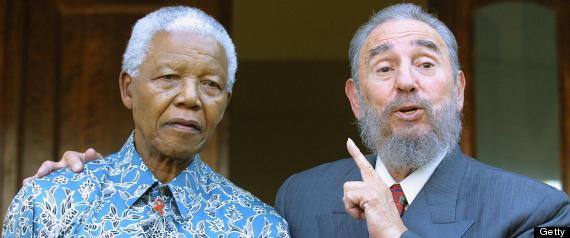
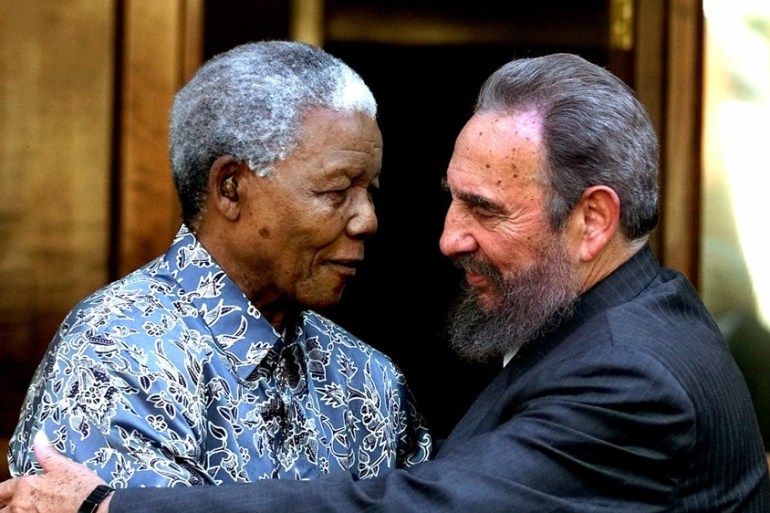
Nelson Mandela, Fidel Castro: A Relationship Built On Mutual AdmirationAnd as reported by Roque Planas in The Huffington Post, December 6, 2013:
After being released from prison in 1990, one of the first things Nelson Mandela did was visit Cuba to express his admiration and respect for Cuban leader Fidel Castro.
“Who trained our people, who gave us resources, who helped so many of our soldiers, our doctors?" Mandela asked Castro during a public appearance in Havana. "You have not come to our country -- when are you coming?"
Fidel Castro responded, "I have not visited my homeland South Africa, but I love it as if it were my homeland."
Fidel Castro and Nelson Mandela developed such a close relationship that it’s impossible to forget when speaking about the African leader in Latin America. The triumph of the Cuban Revolution in 1959 inspired a young Mandela. Later in life, Mandela credited Cuba's military support to Angola in the 1970s and 1980s with playing a role in debilitating South Africa's government enough to result in the legalization of his party, the African National Congress, in 1990.
Nelson Mandela visited Cuba in 1991, months after his release from prison. After his trip to the Communist island he visited Argentina and Brazil -- the beginning of his relationship with Latin American countries that had recently lived under dictatorships, like Chile, Argentina, Brazil, and Peru.
South African business leader and philanthropist Bertie Lubner, in an interview with TeleSUR, explained that it shouldn’t be forgotten that many South African leaders had already visited Latin America in the past while Mandela was in prison.
“Members of the African National Congress party had already visited foreign countries with socialist components like Cuba, East Germany, Russian and in that way embraced socialism, equality,” Lubner explained.
When Mandela arrived to Cuba in 1991, Cubans were summoned onto the streets of Havana to receive the African leader who was awarded the country’s highest honors.
“If you ask any Cuban who Mandela is, they will place him among the greatest men who have ever lived,” Havana journalist Maria Elena Calderín told TeleSur.
In 1994, Nelson Mandela became South Africa’s first black president and Fidel Castro was the guest of honor at the inauguration ceremony.
"What Fidel [Castro] has done for us is difficult to describe with words," Mandela said. "First in the struggle against Apartheid he did not hesitate to give us all his help and now that we are free we have many Cuban doctors working here,"
Formal diplomatic relations between Cuba and South Africa began after May 11, 1994, though a friendship already existed between Castro and Mandela.
Cuba also agreed to celebrate Nelson Mandela International Day on July 18.
For Nelson Mandela’s 90th birthday, Fidel Castro sent a congratulatory message to the leader:
“Glory to you, Nelson, who while in prison for 25 years defended human dignity! Slander and hatred could do nothing against your endurance of steel. You were able to resist and, without knowing or looking for it, you became a symbol of what is most noble in humanity. You will live in the memory of future generations, and in your memory the Cubans who died defending the liberty of their brothers in other lands of the world,” Castro wrote Juventud Rebelde, on the island’s state newspapers.
In 1975 Cuba began sending troops to southern Africa to support independence, over 300,000 soldiers set foot on Angolan soil alone, according to Cuban state newspaper Granma.
Why Nelson Mandela Loved Fidel Castro
Americans generally view Nelson Mandela as a hero and Fidel Castro as a villain. Mandela saw things differently.As reported by Reuters, September 12, 2002, and reposted by Free Republic:
The South African leader’s nationalist and anti-imperialist stances collided head on with the world’s superpower and gave him a lot in common with its Cuban archenemy. Mandela embraced the former Cuban dictator because he opposed apartheid and represented the aspirations of Third World nationalists that the United States undermined across the globe during the Cold War.
As it did for many leftists in the Global South, the Cuban Revolution’s triumph in 1959 inspired Mandela. Charged with the task of starting a guerrilla army in 1961, he looked to the writings of Cuban Communists for guidance.
“Any and every source was of interest to me,” Mandela wrote in his 2008 autobiography. “I read the report of Blas Roca, the general secretary of the Community Party of Cuba, about their years as an illegal organization during the Batista regime. In Commando, by Deneys Reitz, I read of the unconventional guerrilla tactics of the Boer generals during the Anglo-Boer War. I read works by and about Che Guevara, Mao Tse-tung, Fidel Castro.”
Mandela’s admiration for the Cuban Revolution only grew with time. Cuba under Castro opposed apartheid and supported the African National Congress -- Mandela's political organization and the current ruling party. Mandela credited Cuba’s military support to Angola in the 1970s and 1980s with helping to debilitate South Africa’s government enough to result in the legalization of the ANC in 1990.
The U.S. government, on the other hand, reportedly played a role in Mandela’s 1962 arrest and subsequently branded him a terrorist -- a designation they only rescinded in 2008. In 1986, President Ronald Reagan vetoed the Anti-Apartheid Act.
Given this history, it shouldn’t be surprising that Mandela remained sharply critical of the United States into his later life. When the George W. Bush administration announced plans to invade Iraq in 2003, Mandela said: “If there’s a country that has committed unspeakable atrocities in the world, it is the United States of America. They don’t care.”
Shortly following his release after 27 years as a political prisoner in 1990, Mandela visited Cuba to express his gratitude, calling Castro’s Revolution “a source of inspiration to all freedom-loving people.”
"We admire the sacrifices of the Cuban people in maintaining their independence and sovereignty in the face of a vicious, imperialist-orchestrated campaign," Mandela said during the visit, according to the Los Angeles Times. "We, too, want to control our own destiny.”
During a public event in Havana, Mandela asked Castro to visit South Africa.
“Who trained our people, who gave us resources, who helped so many of our soldiers, our doctors?” Mandela said. “You have not come to our country -- when are you coming?”
None of this went down well with the Cuban exile community in the United States, most of whom fled the dictatorship in the early 1960s. Even before Mandela’s visit to Cuba, Castro’s opponents in South Florida fumed over the praise Mandela heaped on the island’s Communist dictator. When Mandela came to speak against apartheid in Miami in 1990, five Cuban-American mayors signed a letter criticizing him for his pro-Castro comments.
The pressure prompted the local government to snub Mandela, canceling an official welcome of the recently released leader.
In response, black leaders boycotted the Miami tourist industry until 1993, according to the Miami Herald.
Despite protest from Cuban Americans and criticism from those who pointed to human rights abuses in Cuba, Castro and Mandela continued their warm relationship, with Mandela saying he wouldn’t turn his back on those who had opposed apartheid. Castro took Mandela up on his offer to visit in 1994, when he traveled to attend Mandela’s inauguration as South Africa’s first black president.
Mandela:'Long live the Cuban Revolution and Comrade Fidel Castro.' - U.S.'Threat to World Peace'From the same Free Republic post:
CAPE TOWN (Reuters) - South African statesman Nelson Mandela urged the United States on Thursday to act only through the United Nations in its campaign against Iraq after a report in which he branded the U.S. a threat to world peace.
"Everybody who wants peace and stability in the world will respect the world body," he told reporters in Cape Town. "All its members (should) respect the United Nations charter. They don't do anything which might be disturb peace and stability."
President Bush issued a ringing challenge to the world body over Iraq on Thursday, saying if it did not force President Saddam Hussein to disarm and stop backing terrorism then "action will be unavoidable."
In an interview with Newsweek magazine on Monday, Mandela criticized the United States for acting unilaterally and undermining the United Nations as a forum for settling international disputes. He said hardline U.S. policies aimed to please American oil and arms companies.
"If you look at those matters, you will come to the conclusion that the attitude of the United States of America is a threat to world peace," the 84-year-old African statesman said in the interview, which appears on Newsweek's Web Site.
Asked on Thursday if he believed a U.S. attack on Iraq could undermine world peace, the Nobel peace prize laureate said: "Oh most certainly, there is no doubt."
The United Nations imposed sanctions on Iraq after its invasion of Kuwait and imposed U.N. weapons inspectors on the country after the Gulf War. The inspectors left in 1998 ahead of a U.S.-British bombing campaign carried out in the name of forcing greater inspections compliance from Iraq.
PLEASING OIL MAGNATES
Bush and his top aides have accused Iraq of seeking weapons of mass destruction, saying it poses a danger to the Middle East region and the West. Iraq denies the charges.
"It is clearly a decision that is motivated by George W. Bush's desire to please the arms and oil industries in the United States of America," Mandela said in the Newsweek article.
Nearly every country in the world, with the exception of Britain and Israel, has expressed grave misgivings about a pre-emptive attack on Iraq and want prior approval by the 15-nations U.N. Security of any military action.
"On what basis must he (Bush) ignore the considered opinion of world leaders who are members of the United Nations and respect their charter," Mandela said in Cape Town after a 25th anniversary memorial event for slain black activist Steve Biko.
The statesman also warned that if the United States ignored the Security Council it would "introduce chaos in international relations and that must be condemned in the strongest terms."
Mandela championed the fight against white minority rule and emerged from 27 years in apartheid jails to become South Africa's first black president from 1994 to 1999.
During his presidency, Mandela's close ties to Cuba's Fidel Castro and Libya's Muammar Gaddafi irked Washington.
Mandela earlier told Newsweek that while it was not his personal view, others believed there was an element of racism behind Washington's unilateral policies.
"Many people say quietly, but they don't have the courage to stand up and say publicly, that when there were white (U.N.) secretaries-general you didn't find this question of the United States and Britain going out of the United Nations," he said.
"But now that you've had black secretaries-general like...Kofi Annan, they do not respect the United Nations. They have contempt for it," Mandela added.
Castro Opens National Moncada Barracks Ceremony Cuba 30 Jul 91 FULL TEXT OF ARTICLE: 1. [Editorial Report] Havana Radio and Television Networks in Spanish at 2255 GMT on 26 July begin live coverage of the central national ceremony commemorating the 38th anniversary of the attack on the Moncada Barracks.==============================
2. The ceremony opens with Fidel Castro and Nelson Mandela standing together on the platform. The Cuban national anthem is played. Manolo Ortega, master of ceremonies, greets the people of Mantanzas and of Cuba. He notes the presence of honored guest, Nelson Mandela. The crowd applauds. He notes the presence of other honored international guests and diplomats accredited to Havana. He notes the arrival of a brigade of polytechnic students by bicycle who have ridden to Mantanzas from Santiago de Cuba. A representative of the youth brigade presents a banner to Fidel Castro. Fidel then presents several provincial enterprises with awards for over-fulfillment of the annual production quota.
3. Ortega introduces Jose Ramon Machado Ventura, vice president of the State Council and member of the Communist Party of Cuba Politboro, to present a State Council resolution. He reads the resolution which cites Nelson Mandela as the foremost freedom fighter against the racist regime of apartheid, and expresses Cuban rejoicing over the visit of Nelson Mandela. He notes Mandela's 27 years in prison, and explains that Mandela, from being the accused, has become the accuser in his fight for justice. He points out that Mandela chose to remain in prison rather than accept compromise with injustice. Today Mandela leads the African National Congress [ANC] with wisdom and patience. Therefore, in this decisive hour in Cuba, Cuba takes as a model the heroic attitude of Nelson Mandela as a representative of the highest attributes and characteristics. He points out that Jose Marti suffered imprisonment at 16 years of age. Therefore, the State Council of Cuba awards the Jose Marti Order to Comrade Nelson Mandela and requests that the insignia be awarded by State Council
President Fidel Castro at the central ceremony commemorating the Moncada Barracks attack.
4. Fidel Castro and Nelson Mandela step to the front of the stage and Fidel pins the insignia of the Jose Marti Order on Nelson Mandela.
5. Ortega announces that the first speaker will be Comrade Nelson Mandela. Mandela begins speaking in English. His speech is translated into Spanish. Eventually, Mandela quits speaking and the translator reads the bulk of his speech in Spanish without Mandela saying it in English. Mandela greets Comrade Fidel Castro, the Cuban people, and especially Cuban internationalists ``who have done so much to free our continent.'' He notes the importance of July 26 and the role of Cuban internationalism, especially in Africa.
6. ``The people of Cuba hold a very special place in the hearts of the African people.'' He notes the ``imperialist campaign to destroy the gains of the Cuban Revolution.'' He expresses admiration for Cuban advances in science, education, literacy, medicine, and culture. He cites the ``systematic eradication of racism'' in Cuba, and predicts that ``the resilient people of Cuba will overcome their difficulties as they have helped other countries overcome theirs.''
7. He expresses great admiration for Jose Marti and Ernesto Che Guevara. ``The life of Che is a great inspiration for every person who loves liberty.'' He says that Africans are used to being victims of foreign countries, but there has never been another case of a foreign country coming to defend Africans. He points out that the Cuban-assisted defeat of the ``racist army'' in Cuito, Cuanavale, made freedom possible in Angola, in Namibia, and destroyed the myth of white racist invincibility. He says that the ANC has acquired the characteristics of a mass organization. Mandela discusses his hopes for a peaceful transfer of power in South Africa. He points out ``the ANC is not a communist party,'' but goes on to note the respect and cooperation between the ANC and the South African Communist Party. He expresses deep appreciation for the Jose Marti Award. ``Long live the Cuban Revolution. Long live Comrade Fidel Castro.''
8. Monolo Ortega introduces the main speaker Commander in Chief Fidel Castro. The crowd chants and applauds. -END-
As reported by wizbang, December 7, 2013:
Communist Mandela Chose to Side With Despots, Murders Like Castro, Arafat, and Ghadafi========================================
Everyone has turned to star-struck mush on the death of former South African President Nelson Mandela, but it should be remembered that he chose to side with murderers, despots, and communists when he emerged from prison in the 1980s. He also headed up a political party guilty of murder and terrorism.
Mandela was the head of the African National Congress Party (ANC) a party guilty of decades of murder, terrorism, and violence. In fact, South African President P.W. Botha gave Mandela the opportunity to walk out of jail for free if he just renounced the ANC’s terrorism. He always refused to renounce terrorism.
But beyond the crimes he was accused of before he became “the” Mandela that everyone so gauzily remembers, he had a long list of crimes accredited to him. At the bottom of the page you can see a list of the charges leveled against him.
The truth is, Nelson Mandela was the head of UmKhonto we Sizwe, (MK), the terrorist wing of the ANC and South African Communist Party. He had pleaded guilty to 156 acts of public violence including mobilizing terrorist bombing campaigns, which planted bombs in public places, including the Johannesburg railway station. Many innocent people, including women and children, were killed by Nelson Mandela’s MK terrorists–murderers he never, ever renounced.
But even after he walked out of prison and became the elected president of South Africa, Mandela chose to side with some of the worst monsters of the 20th century.
Nelson Mandela was an avowed Communist and he sided with Cuban murderer and dictator Fidel Castro, he sided with the USSR, he sided with Mumar Ghadafi and the terrorist and so-called “Palestinian” Yasser Arafat.
And, as Breitbart’s Joel Pollak notes, the Old Media establishment is trying to sue Mandela’s death as yet another excuse to attack conservatives in general and Ronald Reagan in particular.
As Pollak says,
More important, the left is ignoring the context in which conservatives were skeptical of Mandela and the ANC–namely, the fact that they had aligned themselves with the Soviet Union, as well as some of the most villainous figures of the time, including Fidel Castro, Yasser Arafat, and Muammar Ghadafi. For conservatives, the fight against Soviet communism was the overriding strategic concern, and Mandela had chosen the wrong side.
That does not mean Mandela ought to be saddled with all the evils of the Soviet empire. He kept communism at arm’s length and tried to argue that his partnership with the USSR was a means to an end, much like America’s own alliance with Stalin during WWII had been a strategic move, not necessarily a moral endorsement. Yet it is the most challenging part of Mandela’s otherwise inspiring legacy, and one that cannot be erased from history.
Pollak also astutely points out that South Africa only started improving the little bit it did under Mandela only after the Soviet Union collapsed and international communism fell apart as a Cold War threat.
So, let’s have some perspective, shall we?
The Charges Against Nelson Mandela:
One count under the South African Suppression of Communism Act No. 44 of 1950, charging that the accused committed acts calculated to further the achievement of the objective of communism;
Nelson Mandela
One count of contravening the South African Criminal Law Act (1953), which prohibits any person from soliciting or receiving any money or articles for the purpose of achieving organized defiance of laws and country; and
Two counts of sabotage, committing or aiding or procuring the commission of the following acts:
1) The further recruitment of persons for instruction and training, both within and outside the Republic of South Africa, in:
(a) the preparation, manufacture and use of explosives—for the purpose of committing acts of violence and destruction in the aforesaid Republic, (the preparation and manufacture of explosives, according to evidence submitted, included 210,000 hand grenades, 48,000 anti-personnel mines, 1,500 time devices, 144 tons of ammonium nitrate, 21.6 tons of aluminum powder and a ton of black powder);
(b) the art of warfare, including guerrilla warfare, and military training generally for the purpose in the aforesaid Republic;
Nelson Mandela
(ii) Further acts of violence and destruction, (this includes 193 counts of terrorism committed between 1961 and 1963);
(iii) Acts of guerrilla warfare in the aforesaid Republic;
(iv) Acts of assistance to military units of foreign countries when involving the aforesaid Republic;
(v) Acts of participation in a violent revolution in the aforesaid Republic, whereby the accused, injured, damaged, destroyed, rendered useless or unserviceable, put out of action, obstructed, with or endangered.
So? Tell us what you think of Mandela, won’t you?
As reported by Pete Papaherakles of American Free Press, July 24, 2013:
The Mandela Industry
• Truth about South African icon at odds with public portrayal
As South Africa’s 95-year-old Nelson Mandela lies in the hospital, the worldwide media portrays him as a larger-than-life heroic figure and the liberator of his people. But is that truth or fiction? And how will honest historians judge him?=====================================
The official story goes something like this: Nelson Rolihlahla Mandela was born in 1918 into the Thembu tribe’s royal family. He studied law at two prestigious universities and became involved in “anti-colonial politics,” joining the African National Congress (ANC). He was committed to non-violent protest in gaining sovereignty for blacks. In 1962 he was arrested and convicted of sabotage and conspiracy to overthrow the government and was sentenced to life in prison.
An international campaign lobbied for his release, which was granted in 1990, and he was hailed as martyr of white racism by the international media. This popularity propelled him to be elected president of South Africa in 1994, where he continued with his struggle to “end ethnic tensions and bring about racial equality.” Over the years, Mandela has received over 250 awards, including the 1993 Nobel Peace Prize, the U.S. Presidential Medal of Freedom and the Soviet Order of Lenin.
That’s the official story. His critics, however, have a different opinion.
They point to the fact that Mandela was not imprisoned for opposing apartheid, or segregation, in Africa, but for being a communist terrorist murderer-bomber in service to the Soviet Union.
The ANC’s guerrilla force, known as uMkhonto we Sizwe—MK, or “Spear of the Nation”—was founded in 1961 by Mandela and his advisor, the Lithuanian-born communist Jew Joe Slovo, born Yossel Mashel Slovo, who was officially named secretary general of the South African Communist Party in 1986.
Slovo had been the planner of many of the ANC terrorist attacks, as detailed in the book Victory or Violence: The Story of the AWB of South Africa, including the January 8, 1982 attack on the Koeberg nuclear power plant near Cape Town, the Church Street bombing on May 20, 1983, which killed 19 people, and the June 14, 1986 car-bombing of Magoo’s Bar in Durban, in which three people were killed and 73 injured.
In 1962, Mandela was arrested along with 19 others, half of whom were White communist Jews, in a police raid of ANC headquarters at a farm owned by Andrew Goldreich, also a communist Jew, at Rivonia, a Johannesburg suburb.
In the Rivonia Trial, which took place between 1963 and 1964, the defendants were tried for 221 acts of sabotage designed to overthrow the government and conspiring to aid foreign military units, when they invaded SA to further the objects of communism.
The prosecutor, Percy Yutar said at the trial that “production requirements for munitions were sufficient to blow up a city the size of Johannesburg.”
Escaping the death sentence, Mandela was given life in prison.
By 1990, the communists behind Mandela had gained enough power to force his release. Apartheid was abolished in 1992 and the ANC was put into power in 1994 with Mandela as president. Slovo became his secretary of housing.
Shortly thereafter, Mandela and Slovo, along with a group of ANC leaders, were filmed chanting a pledge to kill all whites in South Africa.
Current South African President Jacob Zuma, also of the ANC, was also filmed as late as January 2012 singing a song called “Kill the Boer” in front of a crowd of thousands of blacks while they cheered and danced. The song advocates the murder of the descendents of the original white settlers of South Africa, with lyrics encouraging blacks to gun down the farmers with machine guns.
Mandela’s ex-wife Winnie, also a longtime ANC activist, prefers a method called “necklacing,” where a gasoline-filled tire is placed around the neck of a victim and set ablaze. “With our boxes of matches and our necklaces we shall liberate this country,” she is infamous for saying.
(Mandela was in solitary confinement at the time of the necklacing torture-murders. An estimated 3,000 victims died by necklacing.)
Since 1994, 68,000 whites have been brutally tortured and murdered by blacks in South Africa, in ways too gruesome to describe, including almost 4,000 Boers whose farms were confiscated by savage murderers, a combined area of over 25,000 square miles.
Contrary to popular belief, the vast majority of blacks in South Africa aren’t natives, but came by the millions from neighboring countries only after the white Boers created a country with a thriving economy, education opportunities and medical benefits.
Under white rule, blacks in South Africa enjoyed better living conditions than any other African country, where blacks kill each other in tribal warfare.
In 1994, the same year Mandela took power, the Hutu tribe killed 800,000 Tutsis in Rwanda. Similar tribal genocides have taken place in Congo, Somalia, Ethiopia, Chad, Mali, Zimbabwe, Angola and many more African countries. Tribal savagery and genocide has always been a way of life for Africans.
Since Mandela took over, South Africa has become a Third World country. It went from being the safest country in Africa, to being the rape and murder capital of the world. In Johannesburg, 5,000 people are murdered every year. Unemployment went from 5% in 1994 to 50% today.
South Africa also has the largest number of people infected with HIV/AIDS in the world. In 2007, over 18% of adults, or 5,700,000 people had AIDS. In 2010, an estimated 280,000 died of AIDS.
Looking beyond the media myth of a “demigod Mandela” as he faces his twilight, one can only say, “good riddance.”
The best and most informed commentary on Nelson Mandela comes from Peter Hammond of Frontline Fellowship. Mr. Hammond is a white South African evangelist with a history of opposition to apartheid, and has a multiracial ministry. As reported by Mr. Hammond:
Making Idols of Modern Men and Myths
Idolatry Today
Most people's perceptions of Nelson Mandela have been shaped by Invictus, the stirring film directed by Clint Eastwood on South Africa's 1995 Rugby World Cup victory. Starring Morgan Freeman as President Nelson Mandela, Invictus made a major contribution towards the building up of the mythology of Nelson Mandela as a modern day idol.
Their Finest Hour
Invictus focused on the New South Africa's finest hour, as the Springbok rugby team, led by Francois Pienaar, won the World Cup. It also focused on President Nelson Mandela's finest hour as he donned the Springbok rugby team's green and gold jersey and cap and publicly associated with the Springbok's triumph.
Astute
There is no doubt that this was probably Nelson Mandela's most astute move to appear in public at the World Cup Finals in the Springbok uniform jersey and cap. One billion people were watching. This was, as Morgan Freeman playing Nelson Mandela in the film declared: "An opportunity!" Indeed any wise politician would seize the limelight and exploit such an opportunity to identify with his national team's greatest moment of triumph.
Political Gesture
In the context of the racially polarized New South Africa, this gesture was meaningful and it was appreciated. It particularly won Nelson Mandela much admiration and support from white South Africans to whom rugby was much more than their national sport. However, it was a political token amidst a much broader context of Marxist violence.
Racial Stereotypes
The stirring Invictus film clearly has a political agenda. It includes dangerous distortions of reality and a selective focus which portrays whites in South Africa as narrow minded, disgruntled, racial bigots. In fact, all the white characters in Invictus are one or two dimensional, with no depth of character. Incredibly this even includes Matt Damon's portrayal of Francois Pienaar, the South African rugby team captain. One never got to see quite what made him tick. His leadership seemed completely inadequate to explain this spectacular triumph of the Springboks over the previously unbeatable Australian and New Zealand rugby teams.
A Political Hijack
Incredibly, Invictus boldly gave all the credit for the Springboks' World Cup victory to President Nelson Mandela. This must be the first time in history that any head of state had been given the credit for a sport team's achievements on the field. Does Queen Elizabeth II get the credit if England's rugby team wins? Was US President Bush credited with American Olympic athlete's achievements in Beijing?
An Astute Politician
It was undoubtedly a very wise and astute political move for Nelson Mandela to oppose his own party's plans to abolish the Springbok green and gold uniform and symbols. Doubtless Nelson Mandela genuinely wanted the national team to win, not only for the desirable national unity it could inspire, but for the international prestige it could give to his government.
Ignoring the Context
However, the filmmaker should not have oversimplified the fascinating story by separating it from its real context of crime and violence, after a brutal 30-year terrorist war waged by Nelson Mandela's ANC.
Imaginative Idolatry
Time and again the film focuses on Mandela's imprisonment on Robben Island, often with dream-like imaginative flashbacks of Nelson Mandela breaking rocks on Robben Island. The film even includes a pilgrimage to Mandela's cell in the prison on Robben Island, but there is never any mention of why he was imprisoned. The impression given is that he was imprisoned for opposing apartheid, but many people, including Bishop Desmond Tutu, vigorously opposed apartheid without being imprisoned.
The Unanswered Reason Why
The fact is that even Amnesty International refused to take on Nelson Mandela's case because they asserted that he was not a political prisoner, but had committed numerous violent crimes and had had a fair trial and a reasonable sentence. The most radical newspapers of the day, such as the Star and Rand Daily Mail praised the leniency of the Court in giving away the lightest possible sentence for such violent crimes. In 1964, anyone in America, or Britain, or France, who committed such crimes would have been executed.
Just and Fair
Even the Rand Daily Mail, the most outspoken liberal newspaper at the time in South Africa and, in many ways, a supporter of Mandela and the ANC, wrote about the sentences passed by the judge, "The sentences pronounced by Judge De Wet at the close of the Rivonia trial are both wise and just. The law is best served when there is firmness tinged with mercy, and this was the case yesterday. The sentences could not have been less severe than those imposed. The men found guilty had planned sabotage on a wide scale and had conspired for armed revolution. As the judge pointed out yesterday, the crime of which they were found guilty was really high treason. The death penalty would have been justified."
Mercy
These are the facts of history. Sentencing Mandela to imprisonment instead of letting him be hanged was an act of mercy on the part of his political enemies. Mandela had, therefore, every reason to be grateful and not the least reason to harbour a grudge against them. He owed his life to them.
Terror Bombing Campaign
Nelson Mandela was the head of UmKhonto we Sizwe (MK), the terrorist wing of the ANC and South African Communist Party. He had pleaded guilty to 156 acts of public violence including mobilizing terrorist bombing campaigns, which planted bombs in public places, including the Johannesburg railway station. Many innocent people, including women and children, were killed by Nelson Mandela's MK terrorists. President Obama, when condemning the Boston bombings declared: "Any time bombs are used to target innocent civilians it is an act of terror." Obama denounced the Boston bombings as "cruel", "savage" and "malevolent", yet he still seems to honour a man responsible for many such terror attacks! Obama praises Mandela as his "role model".
Refusal to Renounce Terrorism
South African President P.W. Botha had, on a number of occasions, offered Nelson Mandela freedom from prison, if he would only renounce terrorist violence. This Mandela refused to do.
New Maths
In Invictus Mandela's 26 years in jail, custody and prison becomes 30 years in the cell in Robben Island! Even though prisoners on Robben Island were allowed to walk freely around the Island during the day and were only locked up at night. No mention was made of the very comfortable warden's house at Victor Verster (five-star) prison where Mandela spent his last years of confinement. Actually Mandela was on Robben Island for 18 years.
Inspiring Words
Invictus regularly portrays Nelson Mandela as a most gracious, kind and forgiving man. Many most commendable words are put in his mouth including "the past is past. We need your services. We can only succeed with your help… reconciliation starts here…. forgiveness liberates the soul….forgiveness is a powerful weapon." On occasions Nelson Mandela has articulated inspiring words of reconciliation and national unity. However, he failed to speak out clearly against the explosion of violent attacks on white farmers. Nor did he rebuke his followers who frequently spoke of an Uhuru/Night of the Long Knives massacre of whites "when Mandela dies."
Did Only One Group Have Anything to Forgive?
Under Clint Eastwood's directorship, Invictus dogmatically asserts that Nelson Mandela and the black people needed to forgive the whites. Never does the film portray how much the whites had to forgive people like Nelson Mandela and his ANC terrorists who were responsible for the murder of thousands of South Africans. There is no mention in Invictus of the three decades of vicious terrorist warfare, including the burning down of thousands of schools, hacking to death of thousands of innocent people in homes and in the streets, pouring gasoline over thousands of innocent victims setting them alight, in the brutal necklace murders, the car bombs in public streets, limpet mines in shopping centres, petrol bombs and grenades through windows at night and assassinations.
Sanctions and Boycotts
Nor were economic sanctions referred to - which cost millions of jobs; and the sports boycott which had prevented the Springboks from competing internationally for decades.
A Negotiated Settlement
At one point in the film, Morgan Freeman's Mandela character reminds his secretary: "The whites still control the army, the police and the economy." That was correct, which gives the lie to the picture portrayed in Invictus of grudging, unwilling, narrow-minded white racist bigots. The fact is that white South Africans, who had the political, military and economic power and who had defeated Mandela's ANC terrorists consistently, willingly handed over the reigns of power after a negotiated settlement.
The Communist Connection
Invictus never mentions Nelson Mandela's open support for brutal communist regimes such as Fidel Castro's Cuba, Robert Mugabe's Zimbabwe, Red China, Gadhaffi's Libya, Saddam Hussein, Yasar Arafat and other dictators. During the very time covered by Invictus Mandela received Fidel Castro, the longest reigning dictator in the world, and gave him the highest award that South Africa could give and then had both Houses of Parliament gather to hear an address from the Cuban tyrant.
The Ugly Reality
During the very time covered by the movie many hundreds of white farmers, and their wives and children, were being brutally murdered, actually tortured to death, often by UmKhonto we Sizwe guerrillas, many of whom were now part of the South African National Defence Force.
Double Standards
Although Invictus gives all glory for the Springbok Rugby World Cup win to Nelson Mandela, it does not attach any blame to him for the rising crime and plummeting economy he presided over. During one short visual in the film Mandela looks at a newspaper headline which speaks of the rising crime and plummeting currency. This reality deserved a little bit more attention. During 46 years of National Party apartheid rule over 18,000 people had been killed by rioters, terrorists, by the police and the army, on all sides, including terrorists, civilian victims, military casualties and police. A total of 18,000 dead during 46 years of conflict. However, in peace time, under Nelson Mandela, an average of 25,000 people were murdered every year. In Mandela's first four years as president, the Rand lost 80% of its value, more than 2.8 million man-days were lost to strikes and the national debt doubled.
Fuelling the Crime Wave
Yet to celebrate his birthdays, Mandela would regularly open the prison doors and set many criminals, including armed robbers, murderers and rapists, free, some of whom were murdering and raping within 24-hours of being released. Over 100,000 people were murdered under Mandela's term as president.
Economic Deterioration
In the 1970s, even while facing terrorism, riots and engaged in a border war with the Cubans in Angola, the South African Rand was stronger than the US Dollar. However, after years of US sanctions, the South African Rand had fallen to R2 to the Dollar. Under Nelson Mandela even with no war, no sanctions, no riots, no conscription, and with massive international aid and investment, the Rand plummeted to R8 to the Dollar, and even R10 to the Dollar, then R12 and even to R14 to the Dollar for a time. But according to Invictus, no blame can be attached to Nelson Mandela for the economic deterioration and the sky-rocketing crime rate under his presidency. However, he should be given all the credit for what the Springbok rugby team achieved on the field!
Legalising Abortion and Pornography
Viewers of Invictus also need to be aware that the kind and thoughtful gentleman portrayed in Invictus was the prime mover of the legalisation of abortion, pornography, gambling and homosexuality in South Africa and of the introduction of sex education in public schools. Since Nelson Mandela forced through the legalisation of abortion, not even allowing ANC MPs a conscience vote, and signed it into Law, 1 February 1997, over a million South African babies have been killed through abortion, officially, legally and with tax-payers money.
Censoring Christianity
Another disturbing aspect of Invictus is the editing out of the Christian Faith of key members of the Springbok rugby team. There were many consistent reports of a core of the Springbok rugby team being Bible-believing Christians who regularly met for prayer before the matches. Yet that is never depicted. The film does give a very anaemic presentation of the Springbok team kneeling in prayer after their victory, but it is such a lame and limp "Thanks Lord for letting us win the game" that it just doesn't ring true. As Francois Pienaar declared in his BBC Sport interview in 1995: When the final whistle went "I fell right to my knees. I'm a Christian and wanted to say a quick prayer for being in such a wonderful event, not because of the winning. Then all of a sudden, the whole team was around me, which was a special moment." Pienaar testified: "It wasn't about winning! We would have knelt and prayed and thanked God no matter what the result!"
Slanderous Distortion
Despite Francois Pienaar's testimony, Invictus incredibly portrays him as fornicating before the winning match and swearing during it. Although the Springbok rugby team gave all glory to the Lord Jesus Christ for their triumph, Clint Eastwood's production of Invictus transfers that glory to Nelson Mandela and a humanist poem by English poet William Ernest Henley, which he quotes: "I thank whatever gods may be for my unconquerable soul… I am the master of my fate: I am the captain of my soul."
Invictus Poem
It is the title of that poem, Invictus, after which the film is named. Invictus states: "It matters not how straight the gate, how charged with punishment the scroll, I am the master of my fate; I am the captain of my soul." Clearly Jesus Christ is the Gate that is straight and the Bible is the scroll charged with punishments. The Invictus poem is openly anti-Christ and hostile to the Scriptures. Invictus is blatant secular humanism. Yet many Christians idolise both the Invictus film and that which the film idolises.
Selective Focus
Francois Pienaar also pointed out in his 1995 interview with BBC Sport that the game favourites for the 1995 World Cup Rugby had been Australia, whom the Springboks beat in the opening game. This landmark victory is down played in Invictus, to give the false impression of a hopelessly weak team that came from below to achieve victory only because of Mandela!
Oversimplifying a Complex Country
It is unfortunate that Invictus reinforces stereotypes of narrow minded, white racists and whitewashes Nelson Mandela and the Marxists in the ANC. South Africa is far more complex and interesting than this film suggests. To understand South African history we need to understand the African context and the reality of the Cold War, which was the backdrop to the conflict in which Nelson Mandela played such a key role.
Mandela Day and the Making of a New Religion==============================
United Nations Resolution
In November 2009 the United Nations General Assembly declared 18 July, "Nelson Mandela International Day"! This they said was "in recognition of the former South African president's contribution to the culture of peace and freedom." The General Assembly Resolution: "recognises Nelson Mandela's values and his dedication to the service of humanity, in the fields of conflict resolution, race relations, the promotion and protection of human rights, reconciliation, gender equality, and the rights of children and other vulnerable groups, as well as the upliftment of poor and undeveloped communities. It acknowledges his contribution to the struggle for democracy internationally and the promotion of a culture of peace throughout the world."
Personality Cults
With songs of praise and hymns glorifying Nelson Mandela being sung by choirs and taught to school children, we seem to be seeing the beginning of a new religion. The ancient pharaohs were worshipped as gods. The chairmen of the Communist Party in the Soviet Union, were elevated to cult status, particularly in the case of Vladimir Lenin, whose tomb continues to be a site of pilgrimage. When Joseph Stalin was dictator of the Soviet Union, the cult of the chairman reached new heights, or rather depths.
Emperor Worship
In Romania, Communist Party General Secretary, Nikolai Ceausescu, became the focal point of emperor worship, such as the world had not seen since the days of the caesars. Over 8,000 hymns of praise were composed, honouring the communist dictator, Ceausescu. Literally millions of his pictures adorned homes, offices, schools and government buildings.
Celebrity Cults
Hollywood certainly has produced many celebrity cults. However, the extravagant praise and idolising of Nelson Mandela as a hero/martyr and ideal example, has exceeded all bounds. The mythology and idolatry surrounding the Mandela cult is startling.
Indoctrination
Choirs have sung songs and hymns in praise of Nelson Mandela. Concerts and events have been organised in his honour. Massive posters have been erected on Civic Centres. The Department of Education has apparently replaced education – teaching children how to think, with indoctrination – teaching children what to think. In order to enable Nelson Mandela to be entered into the Guinness Book of Records, various publicity stunts have been promoted, including requiring children of all ages in the classroom to write birthday cards to Nelson Mandela and sing Happy Birthday to him on 18 July, to create new records. Now school children are being required to write Tributes and Dedications, praising Nelson Mandela and no dissent permitted. This was a directive to all schools, even independent schools, from the Ministry of Education!
Mandela's Abortion Legacy
This is deeply disturbing on many levels. For example: Are pro-life Christians expected to put their values to one side and deify the man who rammed through parliament, against all opposition, his bill legalising abortion in South Africa? Over one million babies have been killed, officially, legally, in South Africa, with tax-payers' money, since Nelson Mandela signed the Termination of Pregnancy Bill, 1 February 1997. Life begins at conception. Abortion is murder.
Pornography is Propaganda for a Rape Culture
The UN General Assembly may speak of Nelson Mandela's "promotion of the rights of children, and other vulnerable groups", but under his presidency pornography was legalised. The South African Police Services, Child Protection Unit reported that child rape increased over 400% as a result.
Supporting Dictators
The General Assembly may claim that Nelson Mandela "contributed to the struggle for democracy internationally and the promotion of a culture of peace throughout the world", yet he closed down South Africa's Embassy in the Republic of China on the island of Taiwan, and opened up South Africa's Embassy in Communist China, a one party dictatorship with a brutal human rights record. Nelson Mandela welcomed to South Africa the longest reigning dictator in the world, Fidel Castro, and gave him the highest award this country can offer. Mandela also assembled both Houses of Parliament for Fidel Castro to address. A rare privilege. As president, Nelson Mandela uncritically supported some of the worst dictatorships on the planet such as Castro's Cuba, Mugabe's Zimbabwe, Communist China, Gaddafi's Libya, Saddam Hussein's Iraq, and numerous other states notorious for their human rights abuses.
Pornography is the Theory - Rape is the Practise
The General Assembly Resolution may speak of Nelson Mandela's "dedication to the service of humanity… gender equality…" yet under him, pornography was legalised and prostitution effectively decriminalised, human trafficking exploded in South Africa. Incidents of rape exploded exponentially in the country as sex shops and pornography were, for the first time, allowed in South Africa.
Do Not Let Facts Get in the Way of a Good Story!
The UN Declaration describes Nelson Mandela as "a prisoner of conscience." However the fact is that even Amnesty International refused to take on Nelson Mandela's case, because they asserted that he was not a political prisoner, but had committed numerous violent crimes and had had a fair trial and a reasonable sentence.
The Unanswered Reason Why
The most radical newspapers of the day, such as The Star and Rand Daily Mail praised the leniency of the Court in giving away the lightest possible sentence for such violent crimes. In 1964, anyone in America, or Britain, or France, who committed such crimes would have been executed.
Just and Fair
Even the Rand Daily Mail, the most outspoken, liberal newspaper at the time in South Africa and, in many ways, a supporter of Mandela and the ANC, wrote about the sentences passed by the judge: "The sentences pronounced by Judge De Wet at the close of the Rivonia trial are both wise and just. The law is best served when there is firmness tinged with mercy, and this was the case yesterday. The sentences could not have been less severe than those imposed. The men found guilty had planned sabotage on a wide scale and had conspired for armed revolution. As the judge pointed out yesterday, the crime of which they were found guilty was really high treason. The death penalty would have been justified."
Mercy
These are the facts of history. Sentencing Mandela to imprisonment, instead of letting him be hanged, was an act of mercy on the part of his political enemies. Mandela had, therefore, every reason to be grateful and no reason to harbour a grudge against them. He owed his life to them.
Terror Bombing Campaign
Nelson Mandela was the head of UmKhonto we Sizwe (MK), the terrorist wing of the ANC and South African Communist Party. He had pleaded guilty to 156 acts of public violence including mobilizing terrorist bombing campaigns, which planted bombs in public places. This included the Johannesburg railway station bombing. Many innocent people, including women and children, were killed by Nelson Mandela's MK terrorists. President Obama, when condemning the Boston bombings declared: "Any time bombs are used to target innocent civilians it is an act of terror." Obama denounced the Boston bombings as "cruel", "savage" and "malevolent", yet he still seems to honour a man responsible for many such terror attacks! Obama praises Mandela as his "role model".
Refusal to Renounce Terrorism
South African President P.W. Botha had, on a number of occasions, offered Nelson Mandela freedom from prison, if he would only renounce terrorist violence. This Mandela refused to do.
Controversial
Many people may highly respect and idolise Nelson Mandela because of the Invictus film, and the very positive image portrayed through most of the mass media. However, there are many South Africans who would disagree. Nelson Mandela remains a controversial figure.
Crime Wave
Under Nelson Mandela's presidency an average of 25,000 people were murdered each year. Yet, to celebrate his birthdays, Nelson Mandela would regularly open prison doors and set many convicted criminals, including armed robbers, murderers and rapists, free. Some of these were murdering and raping within 24 hours of being released. Well over 100,000 people were murdered under Mandela's term as president.
Economic Deterioration
In 1970s, even while facing terrorism, riots and engaged in a border war with the Cubans in Angola, the South Africa Rand was stronger than the US Dollar. However, after years of international sanctions, the South African Rand had fallen to R2 to the Dollar. In Mandela's first four years as president, the Rand lost 80% of its value and more than 2.8 million man-days were lost to strikes. The national debt also doubled under Nelson Mandela's presidency. Under Nelson Mandela, even with no war, no sanctions, no riots, no conscription, and with massive international aid and investment, the Rand plummeted to R8 to the Dollar and even to R10 to the Dollar. Even publications such as The Economist described Nelson Mandela's presidency at the time as "a failure". Economic deterioration and skyrocketing crime marred his presidency.
Idolising a Mythical Figure
However, we are meant to forget all these facts, and shelve our pro-life, pro-family, moral convictions and bow before this new idol, sing a politician's praises and effectively burn incense before the image of a new Caesar!
Refusal to Compromise our Faith
Historically, Christians have refused to bow before any idol, nor give the worship due to the Creator alone to anyone else. Daniel ended up in the Lion's Den, Shadrack, Meshach and Abednego were thrown into the fiery furnace, and countless Christians were thrown to the lions in the arena for refusing to engage in the statism of their day.
An Abuse of Education
It would appear to be an abuse of education to require students to write a positive tribute, or dedication, to any political figure, whom they and their family may have serious reservations about. Education is teaching one how to think. Indoctrination is teaching one what to think.
Freedom of Conscience
In any civilised and free society there needs to be room for dissent. Medical personnel who do not want to be part of an abortion should not be forced against their conscience to participate. A teacher who believes in traditional family values should not be required to teach what they see as immorality and perversion. Nor should any student be required to idolise, whether through an assignment, or through singing the praises of a politician.
Margaret Thatcher
Recently, Margaret Thatcher, arguable the most outstanding Prime Minister in recent British history, died. Most of the United Kingdom mourned and honoured her memory and achievements. However, it would not be reasonable to expect every child, in every school, in Great Britain to write a tribute to Margaret Thatcher, because some would belong to families who would have disagreed with her economic policies.
Ronald Reagan
Ronald Reagan is widely recognised as the greatest president in most American's memory. However, again, one could not imagine a requirement that every school child in the United States would have to write a positive tribute to Ronald Reagan, as surely there may be some who would disagree.
Mother Theresa
Even someone as widely respected as Mother Theresa would have her detractors. One could not expect Protestants to idolise someone who prayed to statues of Mary, no matter how much good work she did amongst the poor of India.
Divisive and Offensive
Neither is it reasonable to railroad school children in South Africa into a celebrity cult of any past president of South Africa. Politics is frequently divisive. We would be wiser seeking to focus our children's attention on that which is uplifting and edifying to all.
For many years, Nelson Mandela denied being a Communist, but upon his death, the South African Communist Party let the cat out of the bag with this official statement:
SACP statement on the passing away of Madiba======================================
“…the true revolutionary is guided by great feelings of love”:
Last night the millions of the people of South Africa, majority of whom the working class and poor, and the billions of the rest of the people the world over, lost a true revolutionary, President Nelson Rolihlahla Mandela, Tata Madiba.
The South African Communist Party (SACP) joins the people of South Africa and the world in expressing its most sincere condolences to Ms Graca Machel and the entire Mandela family on the loss of what President Zuma correctly described as South Africa's greatest son, Comrade Mandela. We also wish to use this opportunity to express our solidarity with the African National Congress, an organisation that produced him and that he also served with distinction, as well as all his colleagues and comrades in our broader liberation movement. As Tata Madiba said: “It is not the kings and generals that make history but the masses of the people, the workers, the peasants…”
The passing away of Cde Mandela marks an end to the life of one of the greatest revolutionaries of the 20th century, who fought for freedom and against all forms of oppression in both their countries and globally. As part of the masses that make history, Cde Mandela’s contribution in the struggle for freedom was located and steeled in the collective membership and leadership of our revolutionary national liberation movement as led by the ANC – for he was not an island. In Cde Mandela we had a brave and courageous soldier, patriot and internationalist who, to borrow from Che Guevara, was a true revolutionary guided by great feelings of love for his people, an outstanding feature of all genuine people’s revolutionaries.
At his arrest in August 1962, Nelson Mandela was not only a member of the then underground South African Communist Party, but was also a member of our Party’s Central Committee. To us as South African communists, Cde Mandela shall forever symbolise the monumental contribution of the SACP in our liberation struggle. The contribution of communists in the struggle to achieve the South African freedom has very few parallels in the history of our country. After his release from prison in 1990, Cde Madiba became a great and close friend of the communists till his last days.
The one major lesson we need to learn from Mandela and his generation of leaders was their commitment to principled unity within each of our Alliance formations as well as the unity of our Alliance as a whole and that of the entire mass democratic movement. Their generation struggled to build and cement the unity of our Alliance, and we therefore owe it to the memory of Cde Madiba to preserve the unity of our Alliance. Let those who do not understand the extent to which blood was spilt in pursuance of Alliance unity be reminded not to throw mud at the legacy and memory of the likes of Madiba by being reckless and gambling with the unity of our Alliance.
The SACP supported Madiba's championing of national reconciliation. But national reconciliation for him never meant avoiding tackling the class and other social inequalities in our society, as some would like to make us believe today. For Madiba, national reconciliation was a platform to pursue the objective of building a more egalitarian South African society free of the scourge of racism, patriarchy and gross inequalities. And true national reconciliation shall never be achieved in a society still characterized by the yawning gap of inequalities and capitalist exploitation.
In honour of this gallant fighter the SACP will intensify the struggle against all forms of inequality, including intensifying the struggle for socialism, as the only political and economic solution to the problems facing humanity.
For the SACP the passing away of Madiba must give all those South Africans who had not fully embraced a democratic South Africa, and who still in one way or the other hanker to the era of white domination, a second chance to come to terms with a democratic South Africa founded on the principle of majority rule.
We call upon all South Africans to emulate his example of selflessness, sacrifice, commitment and service to his people.
The SACP says Hamba kahle Mkhonto!
Issued by SACP
Let's look at Nelson Mandela's own words, as detailed in this post at Free Republic, October 24, 2004:
How to be a Good Communist - by Nelson Mandela ("Great Statesman")================================
Rivonia Trial evidence ^ | unknown | Online Books, Richard Allport
Mandela - The "Great Statesman"
"Nelson Mandela is a symbol, an icon, one of the world's most famous statesmen, recognised and revered by all. He dines with royalty, associates with the world's great leaders and his opinion is sought and valued on all weighty matters. He has achieved an almost divine status in the world, equal to that of the Pope or the late Princess Diana."
Most people on the left of the political spectrum would agree wholeheartedly with the above quote. But they run into an unexpected problem when someone asks "why is he considered such a great statesman?"
The problem is that Mandela, apart from having a likeable personality, has achieved next to nothing in his relatively short political career which saw South Africa rapidly decline to the status of the world's most violent and crime-ridden country, and, to add to the confusion, his greatest friends are communists and dictators like Fidel Castro, Moammar Qaddafi, Yasser Arafat and Saddam Hussein. His ex-wife Winnie Mandela, whom he quickly jettisoned when it became clear she was a considerable embarassment to his political career, is a self-confessed advocate of terrorism and violence and has even committed murder.
In his public statements and speeches Mandela is always critical of the democratic countries of the west, but has nothing but praise for the remaining communist dictatorships of the world. He condemns mistakes and controversial policies of the west, but refuses to publicly condemn the genocides and brutal repression of current or former communist countries; he is supposedly a "champion of freedom and democracy", the "hero of oppressed people everywhere" but considers dictatorships like Cuba and Libya shining beacons of freedom and justice...
Perhaps this is what makes Mandela such a revered statesman - chameleon-like he can advocate democracy and freedom as the highest ideals one day and hold up Cuba or Libya as shining examples for the world to follow the next day. And his admirers do not even notice the contradiction, or worse, they agree with him...
Many of his apologists optimistically claim that Mandela may well have had "communist leanings" in his past, but that he has since put all that behind him and become a moderate in his political beliefs. They are perhaps unaware of his fulsome praise of a communist dictatorship as late as 1991 when he and Winnie went to what they called their "second home" - Cuba - to celebrate the communist revolution with Fidel Castro. In his speech Mandela said:
"Long live the Cuban Revolution. Long live comrade Fidel Castro... Cuban internationalists have done so much for African independence, freedom, and justice. We admire the sacrifices of the Cuban people in maintaining their independence and sovereignty in the face of a vicious imperialist campaign designed to destroy the advances of the Cuban revolution. We too want to control our destiny... There can be no surrender. It is a case of freedom or death. The Cuban revolution has been a source of inspiration to all freedom-loving people."
Mandela's adulation of Castro and Cuba almost outshines that of his own admirers. In May of 1990 Mandela, visiting America, went on record, referring to Cuba:
There's one thing where that country stands out head and shoulders above the rest. That is in its love for human rights and liberty.
A week later in Libya, he lauded Qaddafi's:
Committment to the fight for peace and human rights in the world.
While in America Mandela also made public statements that amounted to support for violence and terrorism in the furtherance of political aims. In a speech in Harlem, referring to four Puerto Rican terrorists who shot and wounded five US Congressmen in 1954, he said:
We support the cause of anyone who is fighting for self-determination, and our attitude is the same, no matter who it is. I would be honored to sit on the platform with the four comrades you refer to.
Suitable "comrades" for Mandela indeed. He was himself originally incarcerated, not for his political views, but for involvement in 23 different acts of sabotage and conspiring to overthrow the government. He and his fellow conspirators of the ANC and the South African Communist Party were caught by the police while in the possession of 48,000 Soviet-made anti-personnel mines and 210,000 hand-grenades!*
It is also interesting to note that in later years Mandela was offered his freedom by none other than the South African President Botha if he would simply renounce the use of terrorism, but Mandela refused to do this.
Winnie Mandela has been equally fulsome in her praise of Communism and violence. In 1986 she was reported in Moscow's communist party newspaper Pravda as saying:
The Soviet Union is the torch-bearer for all our hopes and aspirations. We have learned and are continuing to learn resilience and bravery from the Soviet people, who are an example to us in our struggle for freedom, a model of loyalty to internationalist duty. In Soviet Russia, genuine power of the people has been transformed from dreams into reality. The land of the Soviets is the genuine friend and ally of all peoples fighting against the dark forces of world reaction.
and again at Munsieville, on April 13, 1986, she said:
With our boxes of matches and our necklaces we shall liberate this country.
referring here to her own specific brand of democratic political activity whereby anyone who opposed her would be bound hand and foot and then burned to death by means of a tyre filled with gasoline being placed around the neck and set on fire.
Has Mandela since changed his tune in any way?
In September, 2002, Mandela gave an interview to "Newsweek" and the following summary gives his views on the situation with regard to the Iraq crisis:
You will come to the conclusion that the attitude of the United States of America is a threat to world peace…. It (war against Iraq) is clearly a decision that is motivated by George W. Bush’s desire to please the arms and oil industries in the United States of America…When there were white (UN) secretary generals you didn’t find this question of the United States and Britain going out of the United Nations. But now that you’ve had black secretary generals like Boutros Boutros Ghali, like Kofi Annan, they do not respect the United Nations. They have contempt for it… It is the men around him (Cheney and Rumsfeld) who are dinosaurs, who do not want him (President Bush) to belong to the modern age… The only man, the only person who wants to help Bush move to the modern era is Gen. Colin Powell.
No-one will deny Mandela the right to hold views opposed to a war on Iraq, but he is here revealing his own racist attitude to world politics - only white leaders are a threat to peace, and especially so when there are black secretary generals of the U.N. And in case we don't get the message he singles out the black member of the US administration, Colin Powell, as the only exception! (And, one could add, when it suits Mandela's argument, the Egyptian Boutros Ghali, suddenly qualifies as a "black" man...) The race card is one that is always brought out by Africans when they lack valid arguments, and it has always been a standard ploy of Communist rhetoric.
To Mandela's way of thinking, it is capitalist greed that is preventing a one-world U.N. Government - in February 2003 he was reported as saying:
"if there is a country that has committed unspeakable atrocities in the world, it is the United States of America...Iraq produces 64 percent of the oil in the world. What Bush wants is to get hold of that oil."
Apart from displaying his Communist sentiments, Mandela here also reveals his ignorance of world economics - Iraq produces only 5% of world oil exports, not 64%. He also makes no mention of the huge debts of money that Iraq owes France, Germany and Russia, and that it is just possible that they are opposed to the war because they would like those debts paid.
If Mandela's opposition to the United States comes as a surprise to some, or are dismissed as an expression of particularly strong feelings about the Iraq crisis, we should note that Mandela is nothing if not consistent. His views are always anti-American and pro-Communist, and always have been. In his book "The Struggle is My Life", a collection of his writings, we read in a piece dated 1958:
...the people of Asia and Africa have seen through the slanderous campaign conducted by the U.S.A. against the Socialist countries. They know that their independence is threatened not by any of the countries in the Socialist camp but by the U.S.A., who has surrounded their continent with military bases. The Communist bogey is an American stunt to distract the attention of the people of Africa from the real issue facing them, namely, American imperialism. (pp 76)
----------------------------------------------------
* The full list of munitions and charges read as follows:
• One count under the South African Suppression of Communism Act No. 44 of 1950, charging that the accused committed acts calculated to further the achievement of the objective of communism;
• One count of contravening the South African Criminal Law Act (1953), which prohibits any person from soliciting or receiving any money or articles for the purpose of achieving organized defiance of laws and country; and
• Two counts of sabotage, committing or aiding or procuring the commission of the following acts:
1) The further recruitment of persons for instruction and training, both within and outside the Republic of South Africa, in:
(a) the preparation, manufacture and use of explosives—for the purpose of committing acts of violence and destruction in the aforesaid Republic, (the preparation and manufacture of explo- sives, according to evidence submitted, included 210,000 hand grenades, 48,000 anti-personnel mines, 1,500 time devices, 144 tons of ammonium nitrate, 21.6 tons of aluminum powder and a ton of black powder);
(b) the art of warfare, including guerrilla warfare, and military training generally for the purpose in the aforesaid Republic;
(ii) Further acts of violence and destruction, (this includes 193 counts of terrorism committed between 1961 and 1963);
(iii) Acts of guerrilla warfare in the aforesaid Republic;
(iv) Acts of assistance to military units of foreign countries when involving the aforesaid Republic;
(v) Acts of participation in a violent revolution in the aforesaid Republic, whereby the accused, injured, damaged, destroyed, rendered useless or unserviceable, put out of action, obstructed, with or endangered:
(a) the health or safety of the public;
(b) the maintenance of law and order;
(c) the supply and distribution of light, power or fuel;
(d) postal, telephone or telegraph installations;
(e) the free movement of traffic on land; and
(f) the property, movable or immovable, of other persons or of the state.
Source: The State v. Nelson Mandela et al, Supreme Court of South Africa, Transvaal Provincial Division, 1963-1964, Indictment.
----------------------------------------------------
Text of the handwritten Manuscript:
HOW TO BE A GOOD COMMUNIST
by
Nelson Mandela
INTRODUCTION
A Communist is a member of the Communist Party who understands and accepts the theory and practice of Marxism-Leninism as explained by Marx, Engels, Lenin and Stalin , and who subjects himself to the discipline of the Party. (See notes 1, 2, 3 & 4)
The goal of Communism is a classless society based on the principle: from each according to his ability and to each according to his needs. The aim is to change the present world into a Communist world where there will be no exploiters and no exploited, no oppressor and oppressed, no rich and no poor. Communists fight for a world where there will be no unemployment, no poverty and starvation, disease and ignorance. In such a world there will be no capitalists, no imperialists, no fascists. There will be neither colonies nor wars.
In our own country, the struggles of the oppressed people are guided by the South African Communist Party and inspired by its policies. The aim of the S.A.C.P. is to defeat the Nationalist government and to free the people of South Africa from the evils of racial discrimination and exploitation and to build a classless or socialist society in which the land, the mines, the mills, our . . . . . . . (unreadable)
Under a Communist Party Government South Africa will become a land of milk and honey. Political, economic and social rights will cease to be enjoyed by Whites only. They will be shared equally by Whites and Non-Whites. There will be enough land and houses for all. There will be no unemployment, starvation and disease.
Workers will earn decent wages; transport will be cheap and education free. There will be no pass laws, no influx control, no Police raids for passes and poll tax, and Africans, Europeans, Coloureds and Indians will live in racial peace and perfect equality.
The victory of Socialism in the U.S.S.R., in the Peoples Republic of China, in Bulgaria, Czechoslovakia, Hungary, Poland and Rumania, where the living conditions of the people were in many respects similar and even worse than ours, proves that we too can achieve this important goal.
Communists everywhere fight to destroy capitalist society and to replace it with Socialism, where the masses of the common people, irrespective of race or colour, will live in complete equality, freedom and happiness. They seek to revolutionise society and are thus called revolutionaries. Those who support capitalism with its class divisions and other evils and who oppose our just struggles to end oppression are called counter revolutionaries.
Comrade Liu Hao Schi, member of the Central Committee of the Communist Party of China, says:
we Communist Party members are the most advanced revolutionaries in modern history and are the contemporary fighting and driving force in changing society and the world. Revolutionaries exist because counter-revolutionaries still exist. Therefore, to conduct a ceaseless struggle against the counter-revolutionaries constitutes an essential condition for the existence and development of revolutionaries. If they fail to carry on such a struggle, they cannot be called revolutionaries and still less can they advance and develop. It is in the course of this … [that] ... members change society, change the world and at the same time change themselves.
To succeed in conducting a ceaseless struggle against the counter-revolutionaries, and to be able to play the vital role of being the most advanced revolutionary and driving force in changing society and the world, one must put all else aside and seriously and faithfully undertake self-cultivation.
THE PROCESS OF SELF-CULTIVATION
The process of self-cultivation involves two elements:
(a) One’s steeling in the practical struggle of the oppressed people, and
(b) the cultivation of one’s ideas.
(a) ONE’S STEELING IN THE PRACTICAL STRUGGLES OF THE OPPRESSED PEOPLE.
To become the most advanced communist revolutionary, it is not enough to understand and accept the theory of Marxism-Leninism. In addition, one must take part in the practical struggles of the people against oppression and exploitation. A person who is isolated from the people’s struggles, an arm-chair politician however deep his knowledge of Marxist theory might be, is not a communist revolutionary.
It is only in the course of such practical struggles that one’s advancement and development is stimulated, that one acquires the necessary experience to guide the masses of the people in their political battles and the art and skill of being a driving force in changing society and the world. It is precisely for this reason that SACP requires its members to participate fully and without reservations in such issues as the Anti-Pass Campaigns, the struggle against Bantu Authorities, against job reservation, the Group Areas Act and in all other mass campaigns.
By consistently taking part in such struggles, Party members who may ……… whatsoever, gain valuable knowledge and get hardened for the stern mass struggles that are part and parcel of the life of every Communist revolutionary.
(b) THE CULTIVATION OF ONE’S IDEAS
Participation (in) practical mass struggles does (not) in itself enable a Party member to raise his revolutionary qualities, nor does it help him to understand the (aims) of the development of society and the laws of the revolution. Progress in one’s revolutionary qualities and knowledge of the laws of social development and the laws of the revolution will be achieved by a thorough understanding of the meaning of Marxism.
It is thus absolutely imperative for all Party members to have to make a serious study of Marxist philosophy and to master it completely. Only in this way will Party members become the most advanced revolutionaries. Only in this way will they advance and develop.
The aim of studying Marxist philosophy is to enable us to direct more effectively revolutionary mass struggles. To put it in a nutshell, Marxism is a guide to action.
Communist Party members must undertake self-cultivation whether they are new members in the Party or old ones, whether they are workers, peasants, businessmen, professional men or intellectuals, and whether they are conducting difficult or easy revolutionary mass campaigns; in victory or defeat.
Finally, self-cultivation must be imaginative and practical, and must be used to eliminate from one’s outlook and conduct unhealthy tendencies which local conditions may give rise to.
South Africa is a country where the Whites dominate politically, economically and socially and where Africans, Coloureds and Indians are treated as inferiors. It is a country torn asunder by racial strife and where black and white chauvinism finds fertile soil in which it thrives and where efforts and appeals for working-class solidarity very often fall on deaf ears.
The pamphlet compiled by the S.A.C.P. to mark the fortieth anniversary of the Communist Party of South Africa which preceded the S.A.C.P. and which was declared illegal in 1950 correctly points out that, in spite of all the formidable difficulties that face it, the C.P.S.A. had in its existence brought about profound changes in the thinking and political outlook of the oppressed people of South Africa. These achievements are being expanded and further developed by the S.A.C.P.; the worthy successor of the C.P.S.A. In spite of these advances, however, there is still the danger that the historical problems and prejudices produced by capitalist society in our country may infiltrate into our Party and influence the political outlook of our Party members.
In cultivating their outlook, our members must consciously strive to remove these particular weaknesses and shortcomings as well.
This is what we mean when we say Party members must undertake self-cultivation
2. HOW TO BECOME THE BEST PUPILS OF MARX, ENGELS, LENIN AND STALIN.
At the beginning of these lectures, we defined a communist as a member of the Communist Party who understands and accepts the theory and practice of Marxism, Leninism as explained by Marx, Engels, Lenin and Stalin.
Any person may become a member of the Communist Party if he accepts the Programme and Constitution of the Party, pays Party membership fees and undertakes tasks given to him in one of the Party’s organisations. These are called the minimum qualifications that every Party member must possess, but every one of our members should not be content to be a member of minimum qualifications He must strive to become a member of maximum qualifications. Every Party member should raise his revolutionary qualities in every respect to the same level as those of Marx, Engels, Lenin and Stalin.
Some say that it is impossible to acquire the great qualities of revolutionary geniuses like Marx, Engels, Lenin and Stalin and that it is impossible to raise our own qualities to the same level as theirs. But as long as Party members work hard and earnestly, never allow themselves to be isolated for one single moment from the day to day struggle of the people, and make serious efforts to study Marxist literature, learn from the experiences of other comrades and the masses of the people, and constantly strive to steel and cultivate themselves, they will be perfectly able to raise their qualities to the same level as that of Marx, Engels, Lenin and Stalin.
There are two ways of studying Marxism. One is to learn it by heart and be able to repeat mechanically the information learnt without being able to use this information for the purpose of solving problems. The second is to try to master the essence, spirit and methods of Marxism. In this second category belongs those comrades who read over and over again Marxist literature, who pay special attention to the concrete conditions existing in the country where they live and draw their own conclusions, their …… activities, their attitude towards other comrades and the masses of the people, and the whole of their lives are guided by the principles of Marxism-Leninism and aimed at one thing - national liberation, the victory of the working class, the liberation of mankind, the success of Communism and nothing else.
To reach this goal calls for a supreme effort and an iron will. It means complete dedication to the struggle for the removal of oppression and exploitation and for lifelong dedication to the study of Marxism.
3. THE ASPECTS AND METHODS OF CULTIVATION
Cultivation must be carried out in all aspects in the course of the long and strenuous struggle to free the working class and the masses of the people from capitalist exploitation. Cultivation is needed in studying Marxism and in applying it to answer questions and to solve practical problems, in sharpening one’s class outlook and political thinking, in shaping one’s moral character and behaviour; in hard work and ability to withstand hardship, in preserving the unity of the Party and conducting inner party struggle; in loyalty to the Party and complete dedication to the cause of the Communist Revolution.
The life of a Communist revolutionary is no bed of roses. It consists of serious studies in Marxist literature, of hard work and of constant participation in numerous and endless mass struggles. He has no time for worldly pleasures and his whole life is devoted to one thing, and one thing only, the destruction of capitalist society, the removal of all forms of exploitation and the liberation of mankind.
A Communist revolutionary always combines thought with practice. He studies for the sole purpose of putting into practice what he has learnt. He regards Marxism, as ….. action and takes part fully and without reservation in mass struggles directed by the party or by other political organisation outside of the Party.
In South Africa, a Communist Party member must take part in mass struggles initiated by the S.A.C.P., the Congress movement or by other political bodies within the liberation movement.
4. RELATION BETWEEN THE STUDY OF MARXIST-LENINIST THEORY AND THE IDEOLOGICAL CULTIVATION OF PARTY MEMBERS.
It is commonly thought that one’s intelligence, ability and the study of Marxist text-books are in themselves enough to enable one to master the theory and method of Marxism-Leninism. Nothing could be further from the truth. Dealing with this point, Liu Shao Chu says: -
“Marxism-Leninism is the science of the proletarian revolution. It can be thoroughly understood and mastered only by those who fully take the proletarian standpoint and who adopt the ideals of the proletariat as their own. It is impossible for anyone to thoroughly understand and master the Marxist science of the proletariat only by means of his intellect and strenuous study if he lacks the firm standpoint and …. ideals of the proletariat. This is also an obvious truth. Therefore, in studying the theory and method of Marxism-Leninism today, it is necessary that our study proceeds simultaneously with our ideological cultivation and steeling because without the theory and method of Marxism-Leninism, we should have nothing to guide our thoughts and actions and our ideological cultivation would also be impossible. These two are closely related to each other, and are inseparable.”
We do need Communist Party members who are highly intelligent and who have ability and who make it their business to have a thorough understanding of Marxist theory. But a working class revolution will be carried out successfully by those Party members who, in addition to the characteristics mentioned above, adopt without reservation, the standpoint and ideals of the working class.
Although they may be unable to recite quotations from Marxist textbooks, experience shows that Party members of working class origin have a keener interest and deeper understanding of Marxism-Leninism than those Party members of student origin provided it is explained to them in words they understand. In loyalty to the Party, in discipline and in the handling of practical problems, they often prove more correct and more in conformity with the Principles of Marxism-Leninism than others.
This is so because Party members of working class origin have a firm and pure Communist standpoint and ideals, an objective attitude towards things, and in their minds they have no preconceived ideas whatsoever, and no worries about personal problems or about impure matters.
Party members who lack a firm working class outlook, who have the habits and ….. of other classes and who have personal interests and selfish ideas are not true Communists. As a matter of fact they very often find that Marxist-Leninism principles will clash with their interests, and they invariably try to distort these principles to suit their own personal interests and prejudices.
Every Communist revolutionary must therefore, firmly adopt the standpoint and ideology of the working class. Unless he does this, it is not possible for him to understand the universal truth of Marxism-Leninism.
5. THE CAUSE OF COMMUNISM IS THE GREATEST AND MOST ARDUOUS CAUSE IN THE HISTORY OF MANKIND.
On Page One of this section we found out that our aim is to change the present world into a Communist world where there will be no exploiters and exploited, no oppressor and oppressed, no rich and poor. We also make the point that the victory of Socialism in the U.S.S.R., in China and other States in Asia and Eastern Europe proves that a Communist world is capable of attainment. Moreover, since the victory of Socialism in the U.S.S.R. in 1917, the Socialist camp has grown to become a world force with a population of more than 1,000 million and occupying a third of the globe.
But in spite of this victorious advance, the Communist movement still faces powerful enemies which must be crushed and wiped out from the face of the earth before a Communist world can be realised. Without a hard and bitter and long struggle against capitalism and exploitation, there can be no Communist world.
The cause of Communism is the greatest cause in the history of mankind, because it seeks to remove from society all forms of oppression and exploitation to liberate mankind, and to ensure peace and prosperity to all.
A Communist revolution is different from all other revolutions in history. Whereas in other revolutions the seizure of State Power is an end in itself, in a Communist revolution the seizure of State Power by the working class is a means to an end, that end being the total removal of all forms of exploitation, the liberation of mankind by building up a classless society.
Every Communist Party member must possess the greatest courage and revolutionary determination and must be prepared to play his part and carry out all political tasks without fear or hesitation.
In the struggle to transform the present world into a Communist world, we must strive consistently to combine theory with practice.
Finally, WE must live and develop in reality in fighting to change the world, we must start from the very people in close contact with us. We must thoroughly study our own situation and problems, understand them completely and work out appropriate solutions.
6. THE UNCONDITIONAL SUBORDINATION OF THE PERSONAL INTERESTS OF A PARTY MEMBER TO THE INTERESTS OF THE PARTY.
A Communist Party member must subordinate his personal interests to those of the Party. The Communist Party has no interests of its own apart from those of the working class. Therefore, the subordination of a Party member’s personal interests to the Party’s interests means subordination to the interests of the working class.
We test a Communist Party member’s loyalty to the Party, to the revolution and the Communist cause by the manner in which he absolutely and unconditionally subordinates his interests to those of the Party under all circumstances. To sacrifice one’s personal interests and even one’s life without hesitation for the cause of the Party is the highest manifestation of Communist ethics.
In the Party our members should not have personal aims independent of the Party’s interests. The desire for personal power and positions, individual heroism, conflict with the interests of the Party and the working class.
A true communist should possess the following characteristics:
(i) He must posses very good Communist ethics.
He can show love and loyalty to all his Comrades, revolutionaries and working people, help them unconditionally, treat them with equality and never harm any one of them.
He always tries to do more revolutionary work than others and to fight harder. In times of adversity he will stand out courageously and unflinchingly and, in the face of difficulties he will demonstrate the greatest sense of responsibility. He is able to resist corruption by riches or honours, to resist tendencies to vacillate in spite of poverty and lowly states and to refuse to yield in spite of threats of force.
(ii) He possess(es) the greatest courage. He can see his mistakes and shortcomings and has sufficient willpower to correct them. At all times and under all circumstances he speaks the truth and nothing but the truth. He courageously fights for it even when it is temporarily to his disadvantage to do so.
(iii) He has a thorough understanding of the theory and method of Marxism-Leninism. He has an objective attitude.
(iv) He is the most sincere, most candid and happiest of men. Apart from the interests of the Party and of the revolution he has no personal losses or gains or other things to worry about. He takes care not to do wrong things when he works independently and without supervision and when there is ample opportunity for him to do all kinds of wrong things.
He does not fear criticism from others and he can courageously and sincerely criticise others.
(v) He possesses the highest self-respect and self-esteem. For the interest of the party and of the revolution, he can also be the most lenient, most tolerant and most ready to compromise and he will even endure if necessary, various forms of humiliation and injustice without feeling hurt or bearing grudges.
The Communist Party represents not only the interests of individual Party members but also the long-range interests of the entire body of workers and the emancipation of mankind; the Communist Party has no other interests and aims. The Party must not be regarded as a narrow small group like a guild which seeks only the personal interests of its members. Whoever holds such a view is not a Communist.
A member of our Party is no longer just an ordinary person. He is a conscious vanguard fighter of the working class. He should prove himself a conscious living representative of the interests and ideology of the working class. He should thoroughly merge his personal interests and aims in the general interests and aims of the Party and the working class.
A communist revolutionary has his personal interests and the Party should neither eliminate his personality nor prevent personal development, as long as these do not conflict with the interests of the Party.
This is what is meant by the unconditional subordination of the personal interest of a Party member to the interests of the Party.
7. EXAMPLES AND ORIGIN OF THE VARIOUS KINDS OF ERRONEOUS IDEOLOGIES IN THE PARTY.
(i) People who join the Communist Party come from different classes of society and bring with them various habits which often clash with the basic tenets of Marxism-Leninism. Because these people do not have a firm and clear cut Communist outlook they very often waver and even desert the Party when they are faced with danger or difficulties.
The Party must pay particular attention to the education, steeling and self-cultivation of such comrades since without them, they cannot develop to be true Communists. No Communist Party anywhere in the world limits its membership only to those who have a thorough understanding of Communism. The Party will admit any person who accepts the programme of the Party and its Constitution. By serious study and hard work such comrades can develop into excellent Communists ready to give their lives for the Party and the Communist cause …. individualism and self interests in their work. In their attitude and work they place their personal interests above the Party’s interests, they worry about personal gains, they use the Party for their own personal interests.
They always want special treatment, less work and more pay. They avoid hard work and hardship; and will disappear at the first signs of danger, and yet they will want to share the honours won by their comrades for the Party through sacrifice and hard work.
Individualism frequently expresses itself in unprincipled discussions and disputes, factional struggles and in sectarian tendencies and in undermining Party discipline. A closely related mistake is that of departmentalism, in which a comrade sees only partial interests, sees only his part of the work instead of seeing the situation as a whole and of the work of others. It often leads to obstruction and must be avoided.
(iii) Others show conceit, individual heroism and like to show off. Liu Shao Chi says of these people: -
The first consideration of people with such ideas is their position in the Party. They like to show off, and want others to flatter them and admire them. They have a personal ambition to become leaders. They take advantage of their abilities and like to claim credit; to show off themselves; to keep everything in their hands and they are intolerant. They are full of vanity, do not want to keep their heads in hard work and are unwilling to do technical work. They are haughty. When they have made some small achievements they become very arrogant and domineering as if there were no one else like them in the world. They seek to overshadow others and cannot treat others on equal terms, modestly and politely. They are self conceited and like to lecture others, to instruct and boss others. They are always trying to climb above others, and do not accept directions from others, do not learn modestly from others and …….. from the masses, nor do they accept criticism from others. They like to be “promoted” but cannot stand being “demoted”.
“They can only work in fair weather but not in foul. They cannot bear attacks on injustices and are unable to adapt themselves to circumstances. They are no great men capable of asserting themselves when necessary or of keeping in the background when required. They have not yet got rid of their deep-rooted “desire for fame” and they try to build themselves up into “great men” and “heroes” in the Communist cause, and even have no scruples in employing any means for the gratification of such desires. However, when their aims cannot be achieved, when they …….. treatment from comrades in the Party, there is a possible danger of their wavering. In the minds of such persons there exists remnants of the ideology of the exploiting classes. They do not understand the greatness of Communism, nor do they have the broad vision of a Communist.
A Communist should have none of these shortcomings. Whoever possesses such weaknesses does not understand Communism and cannot rise to become as great as Lenin. In the Communist Party leaders achieve success through mass support. Mass support is earned by those Party members who have no personal interests as against those of the working class and the Party who are completely loyal to the Party, who have a high degree of Communist ethics and revolutionary qualities, who strive to master the theory and methods of Marxism-Leninism, who have considerable practical ability, who can actually direct Party work, who are not afraid of serious study and love work, and who become heroes and leaders in the Communist revolution because of the confidence and support they enjoy from the masses of the people.
The struggle to change the …….. world into a Communist world cannot be carried out by one person however able he may be and however hard he works. It can be carried out successfully only by the planned and combined efforts of millions of people.
Some Party members are contemptuous of technical work within the Party. Such an attitude is incorrect because technical work forms an important part of Party work and because a Party member should be ready and willing to do any work which is important to the Party whether or no(t) he likes to do such work.
(iv) Other comrades within the Party reflect the ideology of the exploiting classes. In their Party work and in their relations with other Party members they behave like landlords, capitalists, and fascists.
These persons seek to develop themselves by holding down others. They are jealous of those who are more capable. They are not prepared to work under other comrades or to take instructions. They secretly rejoice when other comrades fail in their political tasks and in their moral standards and conduct. They indulge in gossip and spread false information about their comrades. These are the characteristics of exploiting classes and are …….. the working class and the Party. They should be fought and exposed wherever they are found.
The working class is entirely different from the exploiting class. It does not exploit others nor does its interests conflict with those of the Party and other workers of exploited masses.
The outlook and thinking of the working class are altogether different from those of the exploiting classes. In dealing with the enemies of the people they are merciless and uncompromising, but in dealing with their comrades they are always inspired by love and the desire to assist. They are strict with themselves but lenient towards other comrades. They are strict and firm on matters of principle and always adopt a frank and serious attitude. This is the outlook of the working class and should be learnt and developed by every Party member.
(v) Some comrades still have bureaucratic tendencies. They like to run the Party by issuing edicts and directives without …….. without taking into account the views of other comrades. They resent criticism and are very harsh in dealing with other comrades. Such weaknesses are unmarxist and every communist should strive to overcome them completely.
Furthermore a Party member should be broad minded and concern himself always with the overall situation when dealing with problems. He should avoid pettiness and unprincipled discussion. He should have …….. standpoint and not a fence sitter.
Although the Communist Party is the most progressive of all political parties, and although it fights for a society which guarantees happiness and prosperity to millions of people, not everything in it is perfect. In spite of the fact that its members are the world’s most conscious and progressive revolutionaries with the highest sense of morality and righteousness, there are still defects in the Party and some of its members do not measure up to the qualifications of a Communist revolutionary. The explanation for this state of affairs lies in the fact that every Communist Party member emerges out of the very society whose evils it seeks to remove. Its members come from the various classes of that society and some of them bring into the Party the habits, prejudices and outlook on life of the class from which they came. It is precisely for this reason that Communist Party members must undertake self-cultivation.
In addition to waging struggles against counter-revolutionary forces, the Party must carry on inner-Party struggles against those comrades who are still influenced by the outlook and prejudices of the exploiting classes.
The working class is commonly referred to as the proletariat. The working class can be divided into three groups:
(i) The first group is composed of those who completely severed their ties with the capitalist class years ago. This is the core of the working class and are the most loyal and reliable.
(ii) The second group consists of those who only recently came from the non-working class, who came from the …….. the middle class and the …….. They are usually anarchistic and ultra-left.
(iii) The third group is composed of the working class aristocracy, those working class members who are best provided for, who earn high wages and whose economic position is comparatively high. They compromise easily with the enemies of the people, with the capitalist class.
Every Party member should aim to be the most loyal and reliable to the cause of Communism and to have a firm and clear-cut working class outlook.
8. THE ATTITUDE TOWARDS VARIOUS ERRONEOUS IDEOLOGIES IN THE PARTY AND INNER PARTY STRUGGLE.
Some Party members have a pessimistic view on things and they see errors, defects and a future beset with formidable difficulties and dangers. The growing strength of the socialist camp, the power influence exerted by our Party in our own country and the certainty of the final victory of Communism over Capitalism inspire them with no hope in the future.
Others see only victory and progress, and fail altogether to notice defects and errors in the Party. They become dizzy with success, become blindly optimistic and become less vigilant.
Both views are un-marxist. A Communist Party member knows that the Communist Party is the most progressive and most revolutionary Party in the world. He has complete confidence in the future and he dedicates his entire career to the cause of Communism. In spite of this knowledge he realises most clearly that in our Party there are still various kinds of errors, defects and undesirable things. A Party member clearly understands the origin of these errors and the method to be used in removing them.
The following are the various kinds of attitudes towards undesirable things in the Party:
(i) To enjoy seeing errors and defects in the Party and to magnify them to undermine the Party. This is the attitude of spies and similar elements within the Party.
(ii) Some people consider that the existence of errors and defects in the Party is to their advantage and they deliberately help to spread them and to make use of them. This is the attitude adopted by opportunists and similar elements within the Party.
(iii) To leave these errors and defects undisturbed instead of fighting against them. This is the course followed by those members who have but a weak sense of duty towards the Party and who have bureaucratic tendencies.
(iv) To harbour violent hatred towards errors and defects and towards Party members whose political outlook is incorrect. They believe in bitter struggles among Party members and expel their comrades at the slightest pretext. This is the method used by Party comrades who do not correctly understand the methods of correcting mistakes and weakness amongst comrades.
All these attitudes are incorrect and dangerous and should be scrupulously avoided by Communists. Our own attitude is as follows: -
(i) We first analyse the situation most thoroughly and decide which views are correct and which of them are incorrect and dangerous to the Party. Once we are convinced of the correct opinion we firmly uphold it to the bitter end and no matter how strong the opposition and how influential the individuals who hold the opposite point of view.
(ii) Having carefully analysed the situation and having decided which is the correct opinion, we then devote our attention to the promotion and development of the correct viewpoint. We never allow ourselves to be influenced by an incorrect point of view.
(iii) Communists are men of action. In promoting and developing the correct viewpoint we also fight actively against all the undesirable things in life. A Party member who is afraid of action and hard struggle, however brilliant he might be, can never be a Communist revolutionary. A Communist must always and under all circumstances, be ready and willing to conduct an active struggle against all forms of reaction.
(iv) Although a Communist never compromises on questions of principle, he never adopts an inflexible and mechanical attitude in his methods of struggle. The aim is always to reform and educate those comrades who still possess non-Communist tendencies.
(v) The elimination of undesirable tendencies in the Party and the building up of revolutionary qualities in our members enhances the discipline and prestige of the Party. Those Party members who fail to respond to the most patient persuasion and to efforts to educate and reform them, should be expelled from the Party.
As indicated at the very beginning of this series, a Communist is a member of the Communist Party who understands and accepts the theory and practice of Marxism-Leninism as expounded by Marx, Engels, Lenin and Stalin, and who subjects himself to the discipline of the Party. A good Communist is therefore one who:
(i) Is a member of the Communist Party who is absolutely faithful and loyal to the Party, who obeys without question all Party rules and regulations and who carries out all instructions issued by the Party.
(ii) Has thoroughly studied the works of Marx, Engels, Lenin and Stalin, who understands them clearly and who knows how to carry out their teachings in the struggles of the people to defeat capitalism and all forms of exploitation.
(iii) Devotes all his time to one thing, and one thing only, the struggle against Capitalism and for a Communist world.
(iv) In their relations with Party comrades are always inspired by love and sincere friendship and the desire to be helpful.
(v) Are honest and upright and who are prepared to defend the truth at all times and under all circumstances.
Such is a good Communist.
----------------------------------------
DIALECTICAL MATERIALISM
Dialectical Materialism is the revolutionary philosophy of the Communist Party and the working class.
Dialectical Materialism was founded by Marx and Engels and is discussed and explained in the works of Lenin and other prominent leaders of the Communist Movement.
It is a dialectical philosophy because it studies things concretely and objectively and because its approach on all things in nature is always based on data established through scientific investigation and experience.
It is materialistic because it holds the view that the world is by its very nature material and that the numerous things and processes we see in the world constitute different forms of matter in motion.
In ancient times dialectics was the art of arriving at the truth by disclosing the contradictions in the argument of an opponent and solving these contradictions. This dialectical method of establishing truth was later extended to the study of nature. Using the dialectical method of study and investigation, mankind discovered that all things in nature are always in motion and always changing, and that nature develops as the result of contradictions in nature itself.
DIALECTICAL METHOD
The dialectical method has four main features:
(1) The dialectical method considers that nothing can be understood taken by itself in isolation from other things or from its surrounding circumstances. A thing must always be studied and understood in relation to its environment or circumstances.
(2) The dialectical method considers everything as in a state of continuous movement and change, of renewal and development, where something is always arising and developing and something always falls into pieces or is dying away.
(3) The dialectical method holds that the process of development should be understood as an onward and upward movement, as a transition from an old qualitative state to a new qualitative state, as a development from the simple to the complex, from the lower to the higher.
(4) The dialectical method holds that internal contradictions are inherent in all things in nature. Everything has its positive and negative side, a past and future. In nature there is always something dying away and something developing. The struggle between the opposites, between the positive and the negative, between the past and the future, between the old and the new, between that which is dying away and that which is being born, is the sole reason for development and change.
Historical materialism is the application of the principles of dialectical materialism to the study of society and its history.
A Communist must strive to master completely the principles of the dialectical method discussed above and use them as a guide in his political work.
Dealing with the first proposition mentioned above, the principle of considering things in relation to actual conditions and circumstances and not apart from these actual circumstances, is always of vital importance to a Communist in deciding the simplest policy questions. A Communist is useless to our movement if he deals with policy questions in the abstract without taking into account the actual circumstances in relation to which policy has to be implemented, without understanding that the same policy can be right in one case and wrong in another depending on the concrete circumstances of each case.
In their struggle against race discrimination the oppressed people of South Africa have in the past followed a policy of peace and non-violence. They still seek peaceful solutions and they will do everything in their power to avoid violent strife and bloody revolution. But a blind and mechanical application of this policy, irrespective of actual conditions and circumstances can lead to defeat and disaster for our movement. In the past the people were able to conduct successful non-violent struggles because opportunities were available for peaceful agitation and struggle. But the policy of the Nationalist Government, which forcibly suppresses the peaceful struggles of the people, has created new conditions under which non-violent and peaceful methods of struggle have become inadequate to advance the struggle of the people and to defend their rights. Under these new conditions it is easy to understand why the masses of the people are searching for a new formula of political struggle which will enable them to hit back effectively and end the violent and reactionary policies of the Government. Whilst in the past it was correct to preach non-violence, under present conditions it is not correct to go on stressing it as if nothing has changed. There is nothing sacred or inherently superior about non-violent methods of struggle. So long as they are effective weapons to fight for freedom and democracy, they must be employed fully, but it would be wrong to persist with them mechanically once conditions demand modifications.
The second proposition is equally important. If the world is in a state of constant movement and development, if the dying away of the old and the upgrowth of the new is a law of development, then it follows that no system of society is permanent and everlasting. Just as primitive communal society was replaced by slave society, and just as slave society was replaced by feudalism, and feudalism by capitalism, so will capitalism be replaced by socialism. This is what happened for instance, in Albania, Bulgaria, China, Czechoslovakia, East Germany, Hungary, North Korea, Rumania, Russia and North Vietnam. In all these countries the capitalist system was overthrown and replaced by socialism. In our own country capitalism cannot and will not last indefinitely.
The people of South Africa, led by the S.A.C.P. will destroy capitalist society and build in its place socialism where there will be no exploitation of man by man, and where there will be no rich and poor, no unemployment, starvation, disease and ignorance.
According to the third proposition of dialectical method, the process of development should be understood as an onward and upward movement, as a transition from the lower to the higher and from the simple to the complex. Hence the transition from capitalism to socialism and the liberation of the working class from the yoke cannot be effected by slow changes or by reforms as reactionaries and liberals often advise, but by revolution. One therefore, must be a revolutionary and not a reformist.
Finally, if development and change in things take place by way of collision between opposite forces, then it is clear that the struggle between workers and capitalists is natural and unavoidable. Hence we must not try to preach peace and harmony between workers and capitalists. We must stimulate and encourage class struggle. We must call upon workers to conduct a ceaseless war against the capitalist class and for socialism.
MATERIALISM
The philosophy of materialism as expounded by Marx is a way of explaining all questions, and is irreconcilably opposed to idealism. Two examples are given to illustrate the difference between the two methods of materialism and idealism, namely, what causes thunderstorms and why are some people rich and others poor?
An idealist would answer by saying that thunderstorms are due to the anger of God and that some people are rich and others poor because God made them so. The materialist, on the other hand seeks for an explanation of the natural forces and in the material and economic conditions of normal life. To a materialist, thunderstorms are due solely to natural forces and not to the anger of the Gods. He would explain that some people are poor because they are compelled by material conditions to work for low wages for the rest of their lives for the rich who own the means of production - the land, its mineral resources and its forests, the banks, mills and factories, transport and other systems of communication.
These differences have important practical results. If we accept the idealist’s explanation of thunderstorms, and of why some people are rich whilst others are poor, then there is nothing we can do about the matter except to sit, arms folded and pray to God. If we accept the materialist’s explanation, however, we will take precautions against thunderstorms such as building lightning conductors. Instead of accepting our poverty as the will of God, we will stand up and fight to put an end to a system of society which condemns us to lifelong poverty and misery.
Materialism and idealism are irreconcilably opposed. Materialism teaches: -
(1) That the world is by its very nature material. In other words the things we see in the world are composed of matter.
(2) That matter is something we can see with our naked eyes or by the aid of scientific instruments.
(3) That the world and its laws are capable of being known. That although there are things which are not yet known, such things will yet be known through scientific investigation and experience.
Idealism is essentially a belief in superstition, in the mysterious. It goes hand in hand with religion. It prevents clear thinking and confuses people. For ages it has been used by the exploiting classes to prevent the common people from thinking for themselves. It is a philosophy of the ruling classes and not of the working class. It is not the philosophy of people who fight for freedom. The philosophy of the working class is dialectical materialism, the only philosophy which is based on truth, and which is scientific and practical.
POLITICAL ECONOMY
Political economy explains how men get their living.
It deals with the production and distribution among human beings of food, clothing, shelter, fuel and other things essential to human life.
An important feature about production is that it is always in a state of change and development. Furthermore changes in the mode of production inevitably result in changes in the whole system of society, in the ideas of that society, in its political views and in its political institutions. To put it simply, at different stages of development people lead a different sort of life.
Five main modes of production and five main types of society are known to history. These are primitive communal society, slave society, feudal society, capitalist society and socialist society.
PRIMITIVE COMMUNAL SOCIETY
Under primitive communal society, men of the village went out together to hunt for the animals, to fish and gather the fruit that grew wild. The land and forests in which they hunted and picked up wild fruits, the rivers in which they fished, belonged to the whole community and not to any particular individual property and was shared equally by all. For clothes they used the skins of the animals they killed, and for shelter they used caves and rocks. Their tools consisted mainly of a hunting spear and trap and of a fishing net.
This is how man produced food and shelter under primitive communal society.
There were no classes. There were no rich or poor, no exploitation of man by man, and all were equal before the law. The affairs of the village were discussed publicly in a village council and all members of that community could attend the meetings and take part fully in the discussions. In times of war they killed their prisoners. They could not enslave or exploit them because they had no food to feed them with. In those days man could only produce enough food to feed himself and could not afford slaves.
The only division of labour that existed was between the sexes. The men hunted wild animals and gathered wild fruits whilst the women managed the house, looked after children and cooked the food.
This is the sort of life man led during primitive communal ........ the earliest mode of production known in history.
SLAVE SOCIETY
In course of time some tribes developed new means of producing food and this change in the method of producing food enabled men to lead a different sort of life. They began to sow seed and rear cattle so that they should have food ready at hand whenever they wanted it. Primitive agriculture began to develop and there arose differentiation between the tribes. Some still concentrated on hunting as the principal method of producing food, but others became pastoral farmers. The latter could now produce more than required for their personal needs. They became rich in cattle and began accumulating wealth. Under these new conditions men captured in war were not killed as in former days. Now they were needed to plough the lands of their captors, to look after their wealth and to produce more wealth for the slave owners.
The division of society into classes had begun.
The land and forests in which men used to hunt in former times, and the rivers in which they fished no longer belonged to the whole community but to the slave owners. The common and free labour of all members of the tribe in the production process, which existed under primitive communal society, had now disappeared; in its place there was now the forced labour of the slaves who were exploited by their masters. There was no common ownership of the means of production or of the fruits of production. Common ownership was replaced by private ownership.
Rich and poor, exploiters and exploited, people with full rights and people without rights, and a fierce class struggle - such were the conditions under slave society.
The emergence of private property, of contrasting extremes of enormous wealth on one side and dire poverty on the other, and the class hostility that resulted, made it necessary for the slave owners to build an instrument which they could use to protect their properties and their wealth and to crush slave revolts by force. It was under these circumstances that the exploiting classes created the army, the police force, the courts and the prisons and made laws. These things put together are called the State which is an instrument used by the exploiting classes to compel others to give in to their will.
The State will last as long as class society exists. Only under Communism will the State disappear. In primitive communal society, order and discipline were maintained by tradition and custom and by force of public opinion. It was not necessary to rely on an instrument of force to suppress others. In exactly the same way, under Communism there will be no State because mankind will have reached a high level of political and cultural development and responsibility.
A significant development during slave society was the emergence of commodity production. Articles produced not for the personal use of the producer, but for exchange, are called commodities. This was a development of tremendous importance and we will discuss it very fully when we deal with capitalist society.
This was then the mode of primitive life under slave society. The system of society had changed, the people led a different way of life, new political ideas and new political institutions had arisen.
FEUDAL SOCIETY
Feudal society developed out of slave society and was essentially an agricultural mode of production.
There were two main classes in feudal society. These were the Lords and the Serfs.
As in slave society, the means of production were owned by the lord of the estate. The serf was in a slightly better position than the slave because the lord did not have the power of life and death over him, and also because the serf owned the tools he used to plough the lands of his lord.
He was however, subject to cruel exploitation and restrictions. He ploughed the land of his lord in return for a piece of land which he was allowed to occupy at the pleasure of his lord, and out of which he maintained himself and his family. The piece of ground where he lived was given to him to encourage him to produce more food and more articles for the enrichment of his lord, and he thus produced better results than the slave. He was tied down to the land and could not leave without permission. He was in a similar position to our own squatters commonly found on many white farms in our country.
Under feudal society, food was grown and clothes and other articles were made to cater for the local population but the lords (or nobles as they were commonly referred to) used part of their wealth to buy all sorts of luxuries for themselves. In the course of time trade and transport developed and the desire for more wealth and luxuries increased.
The development of trade and transport led to the growth of towns and their influence. It gave rise to new classes of society and to new ideas. A new class of men who earned their living through trade and commerce arose. These were the merchants.
Feudal society became an obstruction to the expansion and growth of trade and commerce and the new ideas that were arising. The new class that was rising to power came into conflict with that class that held power. Feudal society was being challenged by the new social system of capitalism. Only by revolution could the new forces that were arising be freed. It was by revolution that the new forces challenged feudal society and replaced it with capitalism. It was also by revolution that the working class in many parts of the world replaced capitalism with the higher and democratic system of socialism.
We have now seen that five main types of society are known to history. Primitive Communal Society, Slave Society, Feudalism and Socialism. New forms of society grew out gradually from the other society and in some cases different forms existed side by side. For example, in slave society there were traces of primitive communal society, whilst traces of slave society existed within feudal society. In our own capitalist South Africa there are still Africans, and to a lesser extent Coloureds, who live and work on white farms under conditions remarkably similar to those of feudal society of the Middle Ages. In other parts of the world we see Socialist societies, and societies in transition to Socialism.
We live in a capitalist country and the chief task of our Party is to destroy Capitalism and replace it with Socialism. Capitalism is to us a …….. of …….. great imbalance. It is for this reason that we devote the greater part of this lecture to a study of this system.
CAPITALISM
Capitalism has three essential features.
(1) Wealth is concentrated in the hands of a few people who own the means of production as well as wealth in the form of money. The few people who own the means of production are called capitalists.
(2) The vast masses of the people earn their living by working for capitalists in return for wages. In Marxist language these working people are called the proletariat.
(3)...
End of MS
--------------------------------------------
NOTES
1. Karl Marx (1818-83), German revolutionist, cofounder with Friedrich Engels of modern communism. Suggested that the capitalist society should be overthrown by the working class. His theory of scientific socialism is now called Marxism.
2. Friedrich Engels (1820-95) Co-founder of communism with Karl Marx. Exercised considerable influence in the shaping of communist policy and principles.
3. Vladimir Ilich Lenin, original surname Ulyanov (1870-1924), Russian Marxist revolutionary and theoretician, and founder of the Soviet state (1917).
4. Joseph Stalin, real name Yosif Vissarionovitch Djugashvili (1879-1953), Russian Revolutionist and Soviet dictator. He established a terroristic police state in which millions of his own citizens were murdered.
SPEECH OF THE DEPUTY PRESIDENT OF THE AFRICAN NATIONAL CONGRESS, NELSON MANDELA, AT THE RALLY TO RELAUNCH THE SOUTH AFRICAN COMMUNIST PARTY==================================
Johannesburg, 29 July 1990
Comrade Chairman,
Comrades and friends.
This is an important day in the political history of our country. It is a day which should give comfort and hope to everybody in South Africa who calls himself or herself a Democrat. It is important because it marks the end of a period of exactly 40 years, during which the declared aim and practice of the state was to suppress all political opinion which was not certified by the ruling National Party as legitimate and permissible.
Surely, there are, today, happy smiles on the faces of the political thinkers who said that, though they might disagree with opposing views that some people might express, they would nevertheless defend with their lives the democratic right of such opponents to express their views.
The ANC is not a Communist Party. But as a defender of democracy, it has fought and will continue to fight for the right of the Communist Party to exist. As a movement for national liberation, the ANC has no mandate to espouse a Marxist ideology. But as a democratic movement, as a Parliament of the people of our country, the ANC has defended and will continue to defend the right of any South African to adhere to the Marxist ideology if that is their wish.
To us as a democratic movement, the lesson of our history is very clear. It is what the peoples of Europe learnt during the turbulent decade of the 1930s, when fascism began its assault on democracy by launching a violent offensive against the Communists.
It is the same lesson that the people of the United States learnt during the decade of the nineteen fifties, when the forces of Macarthyism launched an assault aimed at undermining the democratic heritage of the American people, by conducting a virulent offensive against Communist and left opinion.
Theologians of the German Church understood these processes very well when they said the Christian Church did nothing when the Nazis attacked the Communists. And again the Church did nothing when the Nazis turned their brutal attention to the Socialists. And when the Nazis turned against Christian men and women of conscience, the Church found that there was nobody to defend it.
This is a mistake the ANC never made, because we understood that the banning of the Communist Party in 1950, was but a prelude to the suppression of all democratic opinion in our country. This is a lesson that those within the National Party, who consider themselves to be Democrats, need to learn very quickly.
The lesson they need to learn is that it was fundamentally wrong to have enacted the Suppression of Communism Act in 1950. The lesson they need to learn is that it is fundamentally wrong today to seek to build an atmosphere of democratic tolerance of different views by attempting to demonise those who choose to hold Communist opinions. Such a posture leads to one thing and one thing only, namely, the denial and suppression of democracy itself.
We are here today to participate with you in the public launch of the Communist Party, 40 years after it was banned. We do this because during the nearly 70 years of its existence, the Communist Party has distinguished itself as an ally in the common struggle to end the racial oppression and exploitation of the black masses of our country. It has fought side by side with the ANC for the common objective of the National Liberation of people, without seeking to impose its views on our movement.
It has been and is a dependable friend who respected our independence and our policy. Its members have been devoted Congressites who, as members of the ANC, have propagated and defended the policies of our movement, including the Freedom Charter, without hesitation. They have therefore given strength to our own movement, whatever their separate perspectives might be as an independent political formation.
Its leaders have been close friends and colleagues of the leaders of our movement. The general secretary of the Communist Party, comrade Joe Slovo, is an old friend. There is an old established friendship between his family and mine. We went to university together. We were co-accused in the Treason Trial of 1956 to 1961.
Over the years, we have shared the same views on fundamental issues to do with ending the criminal system of apartheid and the democratic transformation of our country. Today we share the same views about the vital importance and urgency of arriving at a political settlement through negotiations, in conditions of peace for all our people.
This personal and political relationship has been able to endure over the decades precisely because Joe Slovo and his colleagues in the Communist Party have understood and respected the fact that the ANC is an independent body. They have never sought to transform the ANC into a tool and a puppet of the Communist Party.
They have fought to uphold the character of the ANC as the Parliament of the oppressed, containing within it people with different ideological views, who are united by the common perspective of national emancipation represented by the Freedom Charter.
Even when we got together with comrade Joe Slovo and others in 1961 to form the People's army, Umkhonto we Sizwe, we understood the specific role that Umkhonto had to play. We understood that despite the fact that state repression had compelled us to take up arms, this did not make the ANC a slave to violence.
We knew that the cadres who made up Umkhonto we Sizwe would have to be men and women who would respect the political authority of the ANC, and always proceed from the position that they took up arms precisely to help establish a democratic order in which the people would have the right to free political opinion and expression, without fear of intimidation from any quarter.
Such are the views of the men and women in who make up our glorious army. To suggest, as some are doing these days, that these outstanding sons and daughters of our people harbour ideas of unilateral military action against the peace process, is an insult manufactured by the enemies of democracy who have built conspiratorial nests within the interstices of the power structures of this country.
Everybody, including the government, also knows that the ANC is the political formation that determines the strategic use of the weapons in the hands of the People's army. Our movement, which has a distinguished and unchallenged history of commitment to peaceful solutions, has itself never abandoned the strategy of non-violent struggle, even when the apartheid regime did everything in its power to make such struggle impossible. It cannot now turn against the peaceful resolution of the conflict in our country, precisely at the moment when such a peaceful resolution seems possible.
Those who today pose as experts on the structure and strategy of our broad movement for national liberation must understand these ABCs of our struggle. What these ABCs point to is the commitment of the alliance led by the ANC to do everything in its power to bring about a peaceful solution of the problems facing our country.
Dear comrades and friends:
The objective we have pursued since our formation 78 years ago remains unchanged. We must move with all possible speed to abolish the apartheid system and to transform South Africa into a united, democratic, non-racial and non-sexist country. We have entered into talks with the government for the realisation of these goals.
Because we have an urgent task to attain our emancipation, we insist that the talks must go on. Our freedom should not be postponed or denied simply because some people have a secret agenda to sustain an anti-democratic crusade against Communist opinion.
But we also insist that the talks must proceed in conditions of peace. Therefore the violence of the police against the people must come to an end. The violence of the black and white vigilantes against the people must come to an end. If it is genuinely interested in peace and negotiations, the government must act to bring about this result.
We wish to repeat here what the entire democratic movement of our country has said in the past - that in the context of an end to state violence against the people and a political process leading to the liquidation of the apartheid system, we ourselves are ready to discuss the suspension of our own armed actions to ensure that peace and stability prevails throughout our country.
We call on the government to respond positively to these positions, to abandon the attempt to create new obstacles by whipping up an anti-communist hysteria, to act in a responsible manner in the interests of all our people, in the interest of the cause of justice and peace.
Dear friends of the Communist Party:
We know we can count on you to stand with us as we pursue these goals. It is our profound desire that you, like all other political formations in our country, should be active participants in the historic process which should lead to the peaceful resolution of the problems confronting our country and people. We extend to you the best wishes of the People's Movement, the ANC, and look forward to continuing co-operation in the common struggle to bring freedom, peace and security to all the people of our country.
The struggle continues!
Victory is certain!
Amandla ngawethu!
We won't turn our back on Gaddafi - Nelson Mandela=================================
SPEECH BY PRESIDENT NELSON MANDELA AT A LUNCHEON IN HONOUR OF MUAMAR QADDAFI, LEADER OF THE REVOLUTION OF THE LIBYAN JAMAHARIYA, Cape Town, 13 June 1999
Your Excellencies
Distinguished Guests
And My Dear Brother Leader
Those who dedicate themselves to causes affecting the lives of millions ought to have a clear understanding of history. They should plan their actions with a sense of their impact on those for whom they believe they act.
I know, My Brother Leader, that you and I, who have both been privileged and obliged by circumstance to be in such positions, have each in our own way tried to be true to that responsibility. Even so, we could not have planned things in such a way that you would be the last head of state I would officially receive on a bilateral basis before retiring from public office.
I am happy that it did, by chance, transpire this way.
The relationship between our two selves and between Libya and democratic South Africa has not been without controversy and therefore some special significance in world affairs.
As a responsible member of the international community of nations, South Africa would never defy predominant international opinion deliberately and merely for effect. This is a particular responsibility in a world that is fraught with possibilities of misunderstanding and consequent conflict and conflagration.
We remain convinced that respect for our multilateral bodies and compliance with their decisions, is crucial to stability, development and progress in a world still marked by tension, inequality and backwardness. This is so even where we may disagree as individual nations with those decisions.
In a world where the strong may seek to impose upon the more vulnerable; and where particular nations or groups of nations may still seek to decide the fate of the planet - in such a world respect for multilateralism, moderation of public discourse and a patient search for compromise become even more imperative to save the world from debilitating conflict and enduring inequality.
When we dismissed criticism of our friendship with yourself, My Brother Leader, and of the relationship between South Africa and Libya, it was precisely in defence of those values.
There must be a kernel of morality also to international behaviour. Of course, nations must place their own interests high on the list of considerations informing their international relations. But the amorality which decrees that might is right can not be the basis on which the world conducts itself in the next century.
It was pure expediency to call on democratic South Africa to turn its back on Libya and Qaddafi, who had assisted us in obtaining democracy at a time when those who now made that call were the friends of the enemies of democracy in South Africa.
Had we heeded those demands, we would have betrayed the very values and attitudes that allowed us as a nation to have adversaries sitting down and negotiating in a spirit of compromise. It would have meant denying that the South African experience could be a model and example for international behaviour.
In many ways, our modest contribution to resolving the Lockerbie issue will remain a highlight of the international aspects of our Presidency. No one can deny that the friendship and trust between South Africa and Libya played a significant part in arriving at this solution. If that be so, it vindicates our view that talking to one another and searching for peaceful solutions remain the surest way to resolve differences and advance peace and progress in the world.
We look forward with joy and anticipation to the full re-entry of Libya into the affairs of our continent and the world.
We have already seen Libya take up its role as an important actor on the African continent to help advance the peace process in the Democratic Republic of the Congo.
South Africa is proud to acknowledge the coincidence between its own position and SADC's, on the one hand, and that of Libya on the other. We share the view that peace in the DRC can only be achieved through the withdrawal of all foreign forces and an inclusive political process of Congolese groups.
We appreciate very much Libya's indication that its own efforts will be co-ordinated with those of our regional organisation, SADC. This approach confounds those who suggest that Libya is less than fully committed to multilateralism. My Brother Leader is involved in the Congolese process as a facilitator of the SADC process, just as we were involved in the Lockerbie issue as facilitators for the United Nations. In such ways we advance the ideals of multilateral co-operation and discipline. And for that we thank our Brother Leader and the Libyan people.
It was with much appreciation that I received reports from my Minister of Trade and Industry about our recent trade delegation to Libya. The friendly political relations between our two countries are now being consolidated and deepened through trade. We look forward to South African companies and Libyan entities bridging our continent from North to South in concrete expressions of African unity.
My Brother Leader, I know that in the abstemious conditions of the North African desert it is not the custom to propose a toast. We are, however, overwhelmed by at last having here on this southern tip of Africa one of the revolutionary icons of our times.
I shall therefore take the liberty to invite our guests to rise and raise their glasses with me in salute to Muamar Qaddafi, our Brother Leader of the Revolution of the Libyan Jamahariya, and to growing friendship between the people of our two countries.
Issued by the Office of the President, June 13 1999
Finally, submitted for your approval are several photographs of Mr. Mandela: