Thursday, 14 June 2018

Yet another "weeping" statue of Mary appears, this time in New Mexico

More evidence that Roman Catholicism is a religion of superstition and idolatry; it will come as a great surprise to this blogger if the latest "weeping" statue of Mary turns out to be more legitimate than any of the others that have been reported over the years. As reported by Carlos Andres López of the Las Cruces Sun-News, June 2, 2018 (link in original):

LAS CRUCES - Is it natural or supernatural? Is it divine or demonic? These are the questions the Las Cruces Catholic Diocese is hoping to answer at the conclusion of its investigation into a statue of the Virgin Mary that appears to shedding tears at a Hobbs church.

Bishop Oscar Cantú addressed the statue in a news conference last week, saying the diocese, which serves as the governing entity for all Catholic churches in southern New Mexico, including Hobbs, is in the middle of its investigation into the occurrence at Our Lady of Guadalupe Catholic Church in Hobbs.

"We've initiated an investigation," Cantú said. "It'll be on a lot of different levels."

As of last Wednesday, Cantú said he had not visited the church since parishioners first reported seeing what appeared to be tears streaming down the face of a statue of the Virgin Mary last month. The church has since become a destination for Catholics, non-Catholics and others who have traveled from near and far in pilgrimages to see what many have called a miracle.

Several images of the statue are on the church's Facebook page, including one that shows a long line of people waiting to see the figure.

In its investigation, the diocese will first try to determine if the tears are a supernatural occurrence, Cantú explained. This part of the probe includes laboratory tests of the liquid believed to be tears, eyewitness interviews and scrutiny of possible natural causes, including human tampering.

"We have to rule out any natural possibilities of that statue emitting liquid, whatever it is," he said. "We will continue to conduct interviews with eyewitnesses, with the pastors, with the priests."

He added: "We are sending the liquid for a chemical analysis, (and) we're going to reach out to the fabricator, the producer of the statue."

However, it is unclear how long the analysis will take to complete. Cantú said it wouldn't be a quick process.

But if the diocese ultimately concludes the tears are in fact a supernatural phenomenon — which has not yet happened — officials will then try to decipher the underlying message, Cantú said.

"If it is supernatural, then is it God? Or it of an evil spirit? We do believe in the fallen angels," he said, "and we renounce the fallen angels because we believe from the scriptures that they're frustrated and they want to make everyone else frustrated — and sometimes they use things, they can be rather cunning.

"So that would be other piece: what are the fruits? If it's from God, it's going to produce positive fruits of joy, of peace, of healing — perhaps physical healing," Cantú said.

Cantú said he personally has not reached any conclusion, and even admitted to being somewhat apprehensive. "As the bishop, I have to kind of have a distance and a kind of a healthy dose of skepticism, as well," he said.

Since the first sighting of the suspected tears, the church has remained open around the clock, only closing for a few hours, as crowds gather in droves to pray before the statue. One person wrote on the church's Facebook page that he drove from Denver to see the statue, and said he hope a permanent church is built in the Virgin Mary's honor.

Cantú views the overwhelming response as a sign that people are looking for "peace or direction in their lives," or "illumination in their lives."
As reported by Evan Folan of the El Paso television station KVIA, June 10, 2018:

LAS CRUCES, N.M. - Twenty thousand people from as far away as Hong Kong have traveled to see the statue of the Virgin Mary reportedly crying at a Hobbs church, parishioners say.

"We've been swamped," said Judy Ronquillo, the church manager.

Not only that, the church told ABC-7 the statue began weeping again on Saturday.

"We need to stay together and unite each other and pray," Ronquillo said. "All I ask is for everybody to forgive and pray."

The Las Cruces Catholic Diocese, the governing body of all Catholic churches in southern New Mexico, will interview witnesses tomorrow, Ronquillo said.

Bishop Oscar Cantú told the Las Cruces Sun-News the diocese will first try to determine if the tears are a supernatural occurrence. This part of the probe includes laboratory tests of the liquid believed to be tears, eyewitness interviews and scrutiny of possible natural causes, including human tampering.

It is unclear how long the investigation will take to complete. The church is open daily, from 7 a.m. to 10 p.m.

New Horizons spacecraft discovers evidence of methane ice dunes on Pluto

When I consider thy heavens, the work of thy fingers, the moon and the stars, which thou hast ordained;
What is man, that thou art mindful of him? and the son of man, that thou visitest him?
Psalms 8:3-4

The heavens declare the glory of God; and the firmament showeth his handiwork. Psalms 19:1

Thou art worthy, O Lord, to receive glory and honour and power: for thou hast created all things, and for thy pleasure they are and were created. Revelation 4:11

As reported by David Shukman of BBC News, May 31, 2018 (link in original):

Scientists say they have found evidence of dunes of frozen methane on Pluto.

The research, which is published in the journal Science, suggests that the distant world is more dynamic than previously thought.

Pluto's atmosphere was believed to be too thin to create the features familiar in deserts on Earth.

The findings come from analysis of the startling images sent back by Nasa's New Horizons mission, which flew close to Pluto in July 2015.

After an epic trek through the Solar System that took nearly a decade, New Horizons sped by at a speed of 58,536 km/h (36,373 mph), gathering data as it passed.

In their study, the researchers explain how they studied pictures of a plain known as Sputnik Planitia, parts of which are covered with what look like fields of dunes.

They are lying close to a range of mountains of water ice 5km high.

The scientists conclude that the dunes are 0.4-1km apart and that they are made up of particles of methane ice between 200-300 micrometers in diameter - roughly the size of grains of sand.
Dunes can be seen in the bottom half of this picture of Pluto's Sputnik Planitia region (Image credit: NASA / JHUAPL / SWRI)
Pluto's strange "snakeskin terrain" may represent not dunes, but blades of ice (Image credit: NASA / JHUAPL / SWRI)

The paper's lead author is Dr Matt Telfer, a physical geographer at the University of Plymouth. He told BBC News: "We can't see individual grains but what we are able to identify dunes, and characterise their basic physical parameters, and the density of the atmosphere that they've been formed under.

"And we can measure some basic things like how far apart they are spaced, and have an estimate at least of the wind speeds that are forming them.

"We can feed all that back into a physical model and from that deduce what the size of the grains must be."

To be able to form, dunes need an atmosphere dense enough to make wind transport possible, a supply of dry particles, and a mechanism that lifts particles off the ground.

At first sight, none of those conditions seem to be met on Pluto.

But Dr Telfer and his colleagues calculate that the dunes may be in one of the windiest areas of the Pluto with wind speeds reaching up to 10m/sec - enough to keep particles moving.

The wind is generated as air flows downhill from the neighbouring mountains and also as frozen material sublimates - or turns directly into gas.

They believe that the dunes are composed of grains of methane, and maybe of nitrogen as well, and that a "reservoir" of methane may exist in the snowpack of the mountains.

As for the process of "lofting" the grains off the ground, the paper suggests that the driver could be a slight warming from the distant Sun, raising the temperature above the frost point of nitrogen: -230C.

With that warming of the ice below the surface, methane crystals should enable nitrogen ice to sublimate - and that would allow the methane crystals to be wafted into the atmosphere.

Dr Telfer says the analysis provides a new insight to Pluto and also changes our view of it.

"It's really exciting just to be able to look at this world and recognise that it's not just a frozen icy blob in the outer reaches of the Solar System but really we're seeing a dynamic world still changing, still forming today," he said.

That sentiment is echoed in an article accompanying the Science paper by Prof Alexander Hayes, an astronomer at Cornell University in Ithaca, US.

He quotes the late Sir Patrick Moore, the famous BBC Sky at Night presenter, describing Pluto in 1955 as "…plunged in everlasting dusk, silent, barren, and touched with the chill of death…" and says that that perspective has to shift.

Prof Hayes says we now know Pluto to be "a geologically diverse and dynamic world driven by internal heat, extreme seasons and sublimating ices".

He adds that it's not the frontier of the Solar System as Patrick Moore suggested, but the "gateway" to the unexplored realm of the Kuiper Belt.

And it may be that dunes themselves are emerging as a fascinating new feature of space exploration.

Pluto now joins Earth, Mars, Venus, Saturn's moon Titan and even the comet 67P - which a European Space Agency (Esa) mission landed on - as homes to dunes.

And Prof Monica Grady of the Open University told me that the discovery raises fascinating questions about whether there are dunes on worlds in other star systems too.

"It makes you realise that you have to open your mind to the idea that familiar objects on different planetary bodies must have formed in their own ways," she said.

"What it does is lead you to thinking about what's there beyond the Solar System, because we can't see their surfaces at the moment but we will do and then we'll probably see familiar things - we'll see dunes and they'll remind us of the dunes of Pluto or the dunes on Earth but they'll have formed in a different way."

New Horizons is now approaching another object in the Kuiper Belt, known as 2014 MU69. The spacecraft will be brought out of hibernation next week and a fly-past is scheduled for Jan 1 2019.

Monday, 11 June 2018

25 years ago: U.S. Supreme Court supports Santeria ritual animal sacrifice

On June 11, 1993, the United States Supreme Court ruled 9-0 in Church of the Lukumi Babalu Aye v. City of Hialeah that the Florida city's statute prohibiting "unnecessar[y]" killing of "an animal in a public or private ritual or ceremony not for the primary purpose of food consumption" violated the religious freedom of Santeria, a mixture of Roman Catholicism and Yoruba religion whose adherents were mainly to be found in the Caribbean area.

I'm not particularly interested in the convoluted reasoning behind the ruling in this case, because it's the observation of this blogger that both the U.S. and Canadian Supreme Courts over the last few decades have made their decisions in accord with the agenda that they've been pursuing, and have invented legal justifications to support the decisions they were going to make, anyway. It's worth noting, however, that the U.S. Supreme Court seemed much more enthusiastic in defending the rights of a pagan religion that was a recent import into the United States than in defending the rights of the Christianity which had so much influence on the founding and history of the country.

U.K. Bible Society fined £100,000 for cyber hack of over 400,000 supporters

It seems as though no one is safe from the perils of modern technology; as reported by Robert Mendick of the London Daily Telegraph, June 8, 2018 (link in original):

The Bible Society has been fined £100,000 over computer security failings that allowed hackers to access the personal details of more than 400,000 mainly Christian backers.

The Information Commissioner’s Office (ICO) said the details of supporters - including home addresses, telephone numbers and bank accounts - were compromised by cyber attackers who guessed the “weak password” of one the charity’s databases.

The password was the same as the username on the account, set up in 2009 but not hacked until November 2016. The account contained details of 417,000 Bible Society supporters.

The ICO complained, in issuing the large fine, that the cyber attack caused “distress” because the “religious belief of the 417,000 supporters could be inferred”.

The fine is particularly embarrassing for the Bible Society which is one most distinguished charities in the UK. It has been operating for more than 200 years, distributing and promoting the bible in the UK and overseas while its patron is Her Majesty the Queen.

But a source close to the charity complained that the ICO had issued an arbitrarily large fine in punishment and had wrongly concluded that the Christian beliefs of its supporters was something they would wish to remain private.

But Steve Eckersley, the ICO’s head of enforcement, said: “The Bible Society failed to protect a significant amount of personal data, and exposed its supporters to possible financial or identity fraud.

“Our investigation determined that it is likely that the religious belief of the 417,000 supporters could be inferred, and the distress this kind of breach can cause cannot be underestimated.

“Cyber-attacks will happen, that’s just a fact, and we fully accept that they are a criminal act. But organisations need to have strong security measures in place to make it as difficult as possible for intruders.”

According to the ICO, “one or more attackers exploited the vulnerability by using brute force” to guess the weak password. Then on December 1 2016, the attackers deployed ransomware that encrypted one million shared files held on the Bible Society’s open network. Ransomware allows hackers to hold organisations to ransom by offering to unlock the encrypted data in exchange for money.

The files included 1,020 payment card details that included card numbers and start and end dates; 27,800 bank details with sort code and account numbers; and contact details of more than 400,000 supporters.

The ransomware also had the capability of stealing files from the Bible Society computer network.

The ICO, the authority which prosecutes data breaches, concluded that the cyber attack was likely to cause “substantial damage or substantial distress” and that the hackers had likely deliberately targeted the charity in an attempt to hold it to ransom.

The Bible Society said in a statement it was the victim of a criminal ransomware attack and that “the incident occurred because of a vulnerability in a single isolated account which had been overlooked”.

It went on: “No other Bible Society account was – or could have been – compromised by the attack as robust cyber security measures were – and remain – in place across the organisation. At no point did this breach involve or affect our website (biblesociety.org.uk) or associated online Bible Society accounts.”

The society said it had “acknowledged, from the outset, the significance of the data security incident and we have taken it very seriously”.

But it also pointed out that it had not received a single report of a breach any supporters’ accounts while “there is no evidence of any material effect on supporters”.

The Bible Society has already paid the fine, receiving a 20 per cent discount for early payment. It insisted that no donations were used to pay the discounted £80,000 fine.

Sunday, 10 June 2018

Archantichrist Archbishop of Canterbury sings the praises of the European Union

This blogger is rapidly coming to the conclusion that nobody whose first name is Justin is to be trusted, as the two most prominent people with that name are mentally and morally retarded. Archantichrist Archbishop of Canterbury Justin Welby has made it clear that he supports the antichrist agenda of the European Union, as reported by Tom Parfitt of the London Daily Express, June 6, 2018:

BREXIT supporters have slammed the Archbishop of Canterbury after he bizarrely praised the EU as one of the biggest achievements in history.

Justin Welby sparked a backlash after calling the union the "greatest dream realised for human beings" since the Roman Empire fell in the fifth century.

He also claimed the Brussels bloc – ruled by unelected bureaucrats – had brought "peace and prosperity" to its member states.

The staunch Remainer was accused of being out-of-touch, with former Ukip leader Nigel Farage branding him "delusional".

Archbishop Welby said: "The EU has been the greatest dream realised for human beings since the fall of the Western Roman Empire.

"It has brought peace, prosperity, compassion for the poor and weak, purpose for the aspirational and hope for all its people.

But the religious leader insisted Brexit would not led to the end of the EU.

Speaking at a Christian conference in Serbia last Sunday, he said: "Europe is not in danger of falling.

"And there is no sense in which I suggest that Brexit or other crises currently around will derail the European Union or bring about the downfall of Europe.

"To suggest that would be akin to the old English saying that when there is fog in the Channel then the continent is cut off.

"But Europe, like other parts of the world, is in a fragile phase.

"Current geo-political uncertainty is unsettling.

"In my part of the continent there is a nation attempting to leave the EU, on the other edges of the EU such as here there are countries and peoples keen to get in."

But David Jones, a former minister in the Department for Exiting the EU, said he was "astounded" by the Archbishop's anti-Brexit comments.

He said: "The European Union is not democratic – it is the world's greatest bureaucracy, it is governed by unelected commissioners.

"If the Archbishop of Canterbury thinks that this is utopia then he has a very different view of most Britons.

"It is an indication of the way the Anglican church is out of touch with the people of this country."

Fellow Tory MP Nigel Evans said the "majority of UK citizens" disagreed with the Archbishop.

He told the Mail: "Most Church of England parishioners tend to be older who were the ones who most voted leave.

"I think the Archbishop has a widely distorted view if he doesn't see this wasteful expensive and dictatorial protectionist racket for what it is."

Ukip leader Gerard Batten added: "They say God moves in mysterious ways, but never as mysteriously as the Archbishop.

"The UK has done more to spread liberty, peace, prosperity and the overthrow of tyranny than the EU, and we are far from perfect."
Leo McKinstry in the Daily Express, June 7, 2018 has it right:

JUSTIN Welby, the Archbishop of Canterbury, is a woeful spiritual leader. Under his failing stewardship the decline of the Anglican Church has continued to accelerate.

As the pews empty and the congregations dwindle, his brand of Christianity is becoming ever more irrelevant in our national life.

Yet, for all his inadequacy, Welby serves one useful purpose. He is an utterly reliable barometer of politically correct thinking.

On almost every issue from welfare to immigration, he can be guaranteed to spout the latest fashionable orthodoxy.

Like so many in the modern priesthood, his creed seems to be based more on progressive ideology than the traditional Christian faith.

That reality was dramatically highlighted in a speech he gave this week in Serbia, where he demonstrated the fervour of his attachment to the EU.

Speaking to an assembly of European churches, he extravagantly declared that the Brussels bureaucracy was not only “the greatest dream realised for humans” since the end of the Roman empire, but also had delivered “hope for all its people”.

In further exultations he claimed that the EU had brought “peace” and “prosperity” to the continent.

In its devotion to the commissars of Brussels, this was an extraordinary address. It might have been thought that an Anglican cleric would regard the Christian gospel as the greatest message of hope.

But no, this prattling prelate wants us to look to the edicts of the EU for inspiration and guidance.

His worship of Brussels is deluded.

He shamefully ignores the central role that Christianity has played in building European civilisation over the past 1,500 years, whether it be in the arts, the law or our moral code.

Just as absurdly, he wilfully neglects all the historic progress made in Europe that had nothing to do with Brussels, such as the spread of the printed word, the industrial Revolution, the advance of medical science and the arrival of liberal democracy.

It insults our intelligence to pretend that the monstrously awed political institution of the EU is more important than the Renaissance in the story of mankind.

Indeed, the catalogue of supposed achievements that he ascribes to the European Union is baseless.

He talks of peace but it was Nato, not the EU, that protected Europe from Soviet tyranny, just as it was Nato that helped to end the conflict in the balkans in the 1990s after Brussels had stood impotently by.

Far from promoting stability, the EU has brought Europe soaring crime and terrorism through its obsession with free movement, precisely the reason why there has recently been such a eurosceptic populist revolt against Brussels across the continent.

Welby blathers about challenging “the divisions of our societies” but it is the EU, with its dogmatic inflexibility and lack of accountability, that helped to create those divisions and distrust.

Sweden used to be one of the most peaceful, egalitarian places on earth, a byword for liberalism. now, thanks to open borders under EU membership, it is a crime-fuelled land of fear.

Just as empty is Welby’s talk about EU prosperity. In truth, the EU is a vast engine of debt, over-regulation and job destruction, as shown by the brutal unemployment rates of young people in southern Europe.

For Greece, the price of EU membership has been savage austerity, for Italy sclerotic growth. If the european Community had remained a common market of free nations, then the outcome might have been different, but the aim of the ideologues was always to use economics as a vehicle to bring about the political goal of the federal superstate.

That is why Welby’s prognostications on Brexit are such nonsense. With the political sanctimony so typical of progressives, he claims the EU withdrawal vote was driven by “fear of the other”, as if the result were a triumph for bigotry.

But what really motivated Brexit was the natural human wish for democratic control over our own laws, trade, justice and borders.

There is nothing ignoble or prejudiced about such an instinct. As Welby should recognise, the desire for freedom from unelected foreign rule has been behind so many of the great, anti-imperial liberation movements in history.

By contrast, there is nothing uplifting about the EU. It is the enemy of European democracy, nationhood and heritage.

Europeans used to be united by shared values based on the ethics of our Judeo-Christian civilisation. The tragic paradox is that the EU, while ruthlessly seeking political unification, has obliterated that real sense of unity through its twin dogmas of mass immigration and cultural diversity.

In fact, the EU is explicitly anti-Christian. During the discussions about the EU constitution in the 2000s, there was a suggestion that the document might make a reference to Europe’s Christian roots.

The very idea was arrogantly rejected by Brussels, not least because it was feared that Turkey, then a candidate for EU membership, might be alienated. The constitution was never implemented but the dismissive attitude remains.

The bitter irony is that the EU, so disdainful of Christianity, has all the trappings of a cult itself, including an exploitative leadership, an army of brainwashed followers and a blind adherence to the founding doctrine despite all the evidence of its failure.

Tellingly, the EU is now desperate to punish Britain for the crime of heresy.

The Archbishop should know better than to act as a cheerleader for this arrogant, destructive oligarchy.

Saturday, 9 June 2018

40 years ago: "Revelation" prompts Mormons to reverse long-standing policy and admit Negroes to the priesthood

On June 9, 1978, the Church of Jesus Christ of Latter-day Saints, popularly known as the Mormon Church, opened its priesthood--normally entered by all white Mormon males at age 12--to "all worthy men," ending a 148-year-old policy of excluding Negro men. Spencer W. Kimball, the church's "Prophet, Seer and Revelator," announced in Salt Lake City that the decision had been based on a revelation that had come to church leaders. He said, "The long-promised day has come when every faithful, worthy man in the Church may receive the holy priesthood." The change was expected to facilitate the church's active missionary program. Women were still not considered worthy for the priesthood.

As was the case with the Latter-day Saints' ban on polygamy in 1890--at a time when Utah was being denied statehood because of the practice of polygamy--the "revelation" concerning the priesthood conveniently came at a time when the church was under social pressure and criticism of its racial attitudes and policies. The occurrence of such "revelations" may seem strange for a church that claims to be restoring the true faith that was supposedly lost centuries earlier, but the "revelations" of the present "Prophet, Seer and Revelator" take precedence over those of any Mormon Presidents.

In contrast to the Mormon priesthood, the priesthood of the true church of the Lord Jesus Christ includes all members of the body of Christ:

Ye also, as lively stones, are built up a spiritual house, an holy priesthood, to offer up spiritual sacrifices, acceptable to God by Jesus Christ...
..But ye are a chosen generation, a royal priesthood, an holy nation, a peculiar people; that ye should shew forth the praises of him who hath called you out of darkness into his marvellous light;
I Peter 2:5,9

For more on the 40th anniversary of the "revelation" concerning the Mormon priesthood, see Priesthood Revelation 40 Year Anniversary by Bill McKeever at the blog Mormon Coffee (June 8, 2018).

Click on the links to see the following articles from the Salt Lake Tribune:

This week in Mormon Land: the lives of black Latter-day Saints past and present — and whose idea was the priesthood and temple ban in the first place? (May 31, 2018, updated June 1, 2018)

Tears, disbelief, shock, joy — How Mormons reacted when they heard the priesthood ban was lifted (June 3, 2018, updated June 4, 2018)

One Sunday, they received the sacrament; the next, they blessed it — how life changed for black Mormons after the priesthood ban (June 3, 2018, updated June 5, 2018)

‘Mormon Land’: Brigham Young, fearing interracial marriage, started the priesthood/temple ban on blacks, but there’s more to the story, says Utah historian (June 6, 2018, updated June 7, 2018)

See also my posts:

40 years ago: Mormons uphold exclusion of Negroes from the priesthood (January 8, 2010)

Mormon Church and NAACP reach historic agreement (May 19, 2018)

Friday, 8 June 2018

Minnesota Army National Guard joins Minnesota Council of Churches "Blessed Ramadan" campaign

Having a form of godliness, but denying the power thereof: from such turn away. II Timothy 3:5

Americans who are inclined to worship their armed forces and regard the military as doing the work of God would do well to rethink such an attitude, especially in light of items such as the following, reported by Jean Hopfensperger of the Minneapolis Star Tribune, April 27, 2018:

Minnesota Army National Guard leaders are packing an unexpected item when they head to their annual training camp next month — a lawn sign displaying the words “To Our Muslim Neighbors: Blessed Ramadan.”

The blue signs, part of a campaign launched by Minnesota Council of Churches three years ago, also will be showing up at several thousand churches, individual homes and educational centers across the nation to mark the expected first day of Ramadan May 15.

The campaign’s popularity, including media coverage from as far away as Indonesia, has caught the council by surprise. So did the request by the Minnesota Army National Guard last year for some signs to display at their headquarters — the first such request from an armed service group.

“It’s an opportunity to demonstrate that we support our soldiers, of all religious traditions,” said National Guard Chaplain Philip (Buddy) Winn, who will post a sign at Camp Atterbury in Indiana for the annual training event next month.

“We’re extending good will — from our tradition to yours,” he said.

National Guard Sgt. Alkali Yaffa, one of about 50 Muslims in the Minnesota Guard, called the signs “wonderful.”

“Those signs mean that people are celebrating with us,” Yaffa said. “They may not be fasting, but they are remembering.”

The Minnesota Council of Churches launched the Blessed Ramadan campaign in 2016 not knowing what to expect. But the presidential campaign had sparked anti-Muslim sentiment, and this was a visible way for the public to show their support, said the Rev. Jerad Morey, a council programs director.

The first year, more than 2,200 signs were distributed, mainly in Minnesota but also from coast to coast, said Morey. That’s in addition to signs that could be downloaded for free off the council’s website, a number not tracked.

The humble yard sign soon was showing up on social media and featured in other media ranging from the Voice of America to the Huffington Post to Minnesota news outlets.

About a dozen state councils of churches — organizations that typically represent mainline Protestant churches in each state — ordered them, Morey said. This year, the Councils of Churches in Wisconsin, New York and Oklahoma are new on board.

Ramadan is the holiest month of the year for Muslims, a time of dawn-to-dusk fasting and frequent prayer. It is based on the lunar calendar, and this year is expected to start May 15 and end June 14.

Most Minnesotans don’t know a lot about Ramadan, and the signs often open the door to questions, said Winn and Yaffa.

“It spurs conversation,” said Winn. “What is Ramadan? Is that when they fast?”

“It’s another way to increase understanding among people,” added Yaffa. “It’s an opportunity for anyone who isn’t Muslim to learn what this means.”

Mayflower United Church of Christ is among the Twin Cities churches that embraced the Blessed Ramadan campaign from the start. It distributed 50 signs the first year and nearly 50 last year, said Belle Scott, who coordinates the campaign.

This month, there’s a table in the church hallway on Sundays offering sign-up sheets for the next batch of signs, said Scott. The Minneapolis church also displays the Blessed Ramadan greetings in front of its building, which often attracts attention from cars whizzing by.

“People drive by the church and honk,” said Scott. “Some have even called the church and thanked us.”

In the weeks ahead, the Blessed Ramadan signs will be showing up across Minnesota and sprinkled across the nation. Although they haven’t been able to end anti-Muslim sentiments, they are a growing public testimony to Muslims’ many supporters.

“There will be bright spots across this country, ” said Morey. “They tell our Muslim neighbors we don’t fear you. We welcome you.”
Of course, there are large numbers of real Minnesotans who don't want to celebrate Islamic holidays, and don't want to welcome large numbers of foreign Muslim invaders into their state--and I don't blame them. As for the Minnesota Council of Churches--which is affiliated with the hopelessly apostate and antichrist World Council of Churches--the list of member denominations should be evidence enough of that organization's liberalism and apostasy:

African Methodist Episcopal Church

American Baptist Churches USA

Christian Church (Disciples of Christ)

Church of God in Christ

Church of the Brethren

The Episcopal Church

Evangelical Lutheran Church in America

Greek Orthodox Archdiocese of America

Mennonite Church USA

Moravian Church in North America

National Association of Congregational Christian Churches

The National Baptist Convention USA

Pentecostal Assemblies of the World

Presbyterian Church (USA)

United Church of Christ

The United Methodist Church

Thursday, 7 June 2018

Mormons and Muslims celebrate the end of Ramadan together

Antichrists of a feather flock together, as reported by Jacob Paulsen of the blog Colorado Mormons, May 29, 2018 (bold in original):

On Tuesday, May 22, 2018, members of the Church of Jesus Christ of Latter-day Saints (Mormons) attended a beautiful Iftar dinner hosted by Multicultural Mosaic Foundation (“Mosaic”), and its President, Ismail Akbulut. The purpose of the event was to deepen friendships while increasing mutual understanding, among local Latter-day Saints and Muslims.

In the tradition of Islam, an Iftar is the evening meal in which Muslims complete their daily fast as part of their holy month of Ramadan. Throughout this special month, Muslims strive to more fully observe the principles of virtuous and generous living that are central to their beliefs. For example, in his highly informative opening presentation (following a welcome given by Brother Akbulut), Mosaic’s Interfaith Director, Dr. Ismail Demirkan, explained that for devout Muslims the Ramadan fast is about abstaining from more than just from food and water, but from other more worldly activities and sin–indicating that one’s words, thoughts, and treatment of others receive greater attention during Ramadan.

In addition to fasting, another of the five pillars of Islam consists of almsgiving, which is the subject of particularly heightened attention during Ramadan, according to Dr. Demirkan. In fact, citing the Prophet Muhammad, he explained: “ you will never be a true believer if your neighbor goes to bed hungry and you go to bed with a full stomach.” In his overview of the Muslim faith, Dr. Demerkin also made reference to the other three pillars of Islam, e.g., declaration of faith, prayer, and pilgrimage (to Mecca).

Following Dr. Dermirkin’s remarks, Elder Thomas T. Priday, one of two Colorado-based Area Seventies for the Church of Jesus Christ of Latter-day Saints, shared some of his own thoughts regarding fasting in the Latter-day Saint tradition and made reference to many other areas of common belief between Muslims and Latter-day Saints. Citing recent remarks by LDS Church President Russell M. Nelson, Elder Priday affirmed “that all people are God’s precious children and therefore our brothers and sisters” and that “all people, organizations and governmental units [must] work with greater civility, eliminating prejudice of all kinds and focusing more on the many areas and interests that we all have in common.” Noting the blessings that enter our lives as we practice fasting and prayer, Elder Priday closed with a story of an extended family member who overcame the great challenge of quitting smoking only after the power of heartfelt fasting and prayer were offered by family members on his behalf.

At about a quarter past 8 p.m., just as the sun was setting, a Muslim brother went to the front of the room and offered a stirring call to prayer, which was effectively the combination of a pleasant song and chant expressing praise for and the greatness of God. Thereafter, all guests were invited to enjoy the evening meal, which began with enjoying fresh dates, followed by the main dinner courses and dessert. All the while, local Latter-day Saints–including many members of local stake presidencies and public affairs leaders across the Denver metropolitan area–enjoyed the sweet conversation and fellowship of their gracious Muslim hosts.

Of the event, President William Thunell, First Counselor in the Arvada Stake Presidency, expressed his appreciation for the opportunity to hear the insightful presentations that were provided and to learn of the many similarities between our two faiths, rather than focusing on differences as can often be the case in the world today. President Thunell added, “the highlight for me was to visit with our hosts at our table and to ask them questions about their faith, and how it operates in their lives, and in particular to hear how they practice repentance and seek forgiveness.”

Denver North Director of Public Affairs for the LDS Church, Jonathan Toronto, added: “We are so grateful for this special invitation extended by our remarkable brothers and sisters of the Muslim faith, for the opportunity to feel of their love and fellowship in such a personal setting, and we look forward to additional opportunities to engage in these sorts of deeply meaningful and enriching interfaith events with our friends of other faiths.”
This isn't the first time such an event has happened. Click on the links to read articles about similar events in 2017 (Montreal); 2017 (Salt Lake City); 2016 (Montreal); and 2010 (southern California). For a remarkable combination of liberalism, Mormonism, and outright lies on this and other subjects, go here.

Wednesday, 6 June 2018

90 years ago: Scottish Episcopal Church eliminates the word "obey" from its marriage service

Wives, submit yourselves unto your own husbands, as unto the Lord.
For the husband is the head of the wife, even as Christ is the head of the church: and he is the saviour of the body.
Therefore as the church is subject unto Christ, so let the wives be to their own husbands in every thing...
...and the wife see that she reverence her husband.
Ephesians 5:22-24, 33b

Liberalism had already begun to set in by June 6, 1928, when it was reported that the Scottish Episcopal Church had eliminated the word "obey" from its marriage service. The Provisional Synod, which had been revising the canons and prayer book in use in Scotland, decided by majority vote of the Upper and Lower Houses to substitute the words: "Wilt thou love him and comfort him?" for "Wilt thou obey him and serve him?" They also decided that instead of the woman promising to "love, cherish and obey" she should undertake "to love and to cherish."

The Scottish Episcopal Church Marriage Liturgy 2007, which is still effective in 2018, has done away with the distinctions between "him" and "her," and the question now for both parties is. "Will you love him/her, respect him/her, and be for ever faithful to him/her?" (p. 12). "To love and to cherish" is still there (pp. 21-22).

The position of the Scottish Episcopal Church on same-sex "marriage" (December 6, 2011) is one of opposition, but it's worded in such a way that one can easily imagine the church going the other way in the near future:

The Canons of the Scottish Episcopal Church (Canon 31) state that the doctrine of the Church is that marriage is ‘a physical, spiritual and mystical union of one man and one woman created by their mutual consent of heart, mind and will thereto, and as a holy and lifelong estate instituted of God’. In the light of that Canon, there is no current basis for agreeing that the law should be changed to view marriage as possible between two people of the same sex.

As mentioned above in the introduction and in response to Question 1, the question of same sex unions in general is the subject of discussion within the Anglican and Porvoo Communions. Within those Communions, and within the Scottish Episcopal Church, the blessing of same sex unions is a matter on which there is a variety of views.
(p. 4)

In other words: Not yet. If the experience of other mainline churches (with "evangelical" churches quickly coming up behind) is any indication, the Social Justice Warriors will keep pushing until they get what they want, and the minute it tips in their favour, "a variety of views" will be reduced to one view.

The Scottish Episcopal Church position on the blessing of "civil unions" seems similarly wimpy, leaving the door open to subversion by SJWs:

The Church does not give official sanction to informal blessings but each Bishop would nevertheless expect to be consulted by clergy prior to the carrying out of any informal blessing of a civil partnership in his diocese. The College is of the view that a decision as to whether or not to attend such an informal blessing should be a personal decision of the individual Bishop in question.


Tuesday, 5 June 2018

50 years ago: Roman Catholic priest says "Sock it to 'em, God!" in high school benediction

Buffoonery on the part of clergy in an attempt to be culturally relevant is nothing new. Chris Rosebrough has said that relevance is a cruel mistress, and this item is evidence of that, as some of the phrases used and things referred to, that seemed relevant in 1968, seem a wee bit dated in 2018. The reader will notice that, as is so often the case, the lay person has a better grasp of things than the clergyman. Submitted for your approval, the following item, as reported by Reuters, that somehow found its way onto the front page of the London Free Press, June 5, 1968:

Glendale, Ariz. - A Roman Catholic priest apologized Tuesday for saying "Sock it to 'em God" in a high school benediction.

St. Jerome's Church assistant pastor Rev. William Healy said he used the phrase--which provoked a storm of protest here--while trying to relate God with the teen-age world.

In his benediction to Cortez High School seniors Sunday, he said: "We ask your blessing on things and people You created...Bless hair spray, mini-skirts, turtleneck shirts,...For God's sake bless our parties, religious exercises,...We ask because You are an understanding God, a swinging God. Sock it to 'em God."

Mrs. John McClellan, representing the parents of some children at the school, claimed Tuesday the "sock it" remark bordered on blasphemy. She deplored what she called "an attempt to bring God down" to the level of the graduating class.

Father Healy, who re-read the benediction in the Glendale Union High School Board on Monday night, declared: "I was praying from the heart and not just from words..."

Superintendent Howard Roberts said the words were misunderstood by the students and advised Father Healy to apologize.

Father Healy replied:

"I apologize if I offended anyone in doing what I thought was right. I was speaking to the graduates in terms they know.

"What does a swinging God mean to the mentality of a teen-ager?

"A swinging God is a God they know as a good God."

Monday, 4 June 2018

Wiccans join Edmonton's perversion pride parade

Wherefore God also gave them up to uncleanness through the lusts of their own hearts, to dishonour their own bodies between themselves:
Who changed the truth of God into a lie, and worshipped and served the creature more than the Creator, who is blessed for ever. Amen.
For this cause God gave them up unto vile affections: for even their women did change the natural use into that which is against nature:
And likewise also the men, leaving the natural use of the woman, burned in their lust one toward another; men with men working that which is unseemly, and receiving in themselves that recompence of their error which was meet.
And even as they did not like to retain God in their knowledge, God gave them over to a reprobate mind, to do those things which are not convenient;
Being filled with all unrighteousness, fornication, wickedness, covetousness, maliciousness; full of envy, murder, debate, deceit, malignity; whisperers,
Backbiters, haters of God, despiteful, proud, boasters, inventors of evil things, disobedient to parents,
Without understanding, covenantbreakers, without natural affection, implacable, unmerciful:
Who knowing the judgment of God, that they which commit such things are worthy of death, not only do the same, but have pleasure in them that do them.
Romans 1:24-32

This blogger is glad that the alphabet perverts are increasingly making it clear that the doctrine of whatever religion they choose to associate with is less important than that religion's willingness to approve of their perversions--which serves as a warning to those who think they can accommodate "gay Christians." The reader will note that immoral sexual practices invariably accompany defective doctrine. As reported by Catherine Griwkowsky of StarMetro Edmonton, June 3, 2018:

EDMONTON—Wiccans have long fought against perceptions that their religion is shadowy, scary and sinister—but this June, they’re wearing their differences loud and proud.

For the first time, Wiccans will be marching in the Edmonton Pride Parade on June 9.

Local Wiccans — a religious group that describes itself as a revival of paganism — say they’ve long been one of the most LGBTQ-friendly religions, but now they’re looking to step up the advocacy.

The Congregationalist Wiccan Assembly of Alberta has participated in interfaith events at Pride for the past four years, but this year members are holding their own celebrations and plan to march in eye-catching Wizard of Oz-themed costumes during the main parade.

The Stony Creek Temple will also host a ritual the day after to show the community what they’re all about.

They say they’ve always been LGBTQ-friendly, but now they want to play a bigger role.

“Our community is so different than the typical church environment,” said Stony Creek Temple high priest Keegan Quinton. “A lot of people have come to our religion because they have felt like they don’t have a safe place because of how they identify.”

Quinton, who said he was more in touch with his feminine side, having grown up as gay man with six sisters, said Wicca helped him discover and embrace a non-toxic masculinity.

“I feel like I was very unbalanced before because I didn’t strongly connect with being a man and what that stereotypically means,” he explained. “Coming to a religion where I was encouraged to be who I am, but also explore that other side of me, has really made me more balanced as a person.”

Quinton said Wicca didn’t feel like something he had to convert to; rather, it was something that fit with his own beliefs and understandings about the world.

“I’m eternally grateful to have become comfortable in my own skin,” he said.

The Stony Creek Temple of Alberta, part of the Congregationalist Wiccan Assembly of Alberta, is currently made up of 25 people from diverse backgrounds, including Norse Pagans, Indigenous spiritual practitioners, traditional Wiccans and feminist Wiccans.

With growing diversity and membership in the temple, Quinton said the timing was right for Wiccans to have their own presence at Pride.

“When we’re involved with the Pride interfaith service, it’s wonderful to be a part of that group, to be a part of this mosaic, to be a part of these different religions, but I also think it’s important for people to come and experience who we are completely as we normally are and express ourselves fully,” he said.

This wouldn’t be the first time Wiccans have tapped into a broader social movement — the religion was founded in the United Kingdom during the 1950s and its members have been social activists right from the beginning.

Since then, practitioners coming from naturalist communities, non-traditional relationships and the LGBTQ community found solace in the “live and let live” Wiccan philosophy.

High Priestess Kayleen McKie, who identifies as a cisgender bisexual woman, explained that while Wicca is a very individual practice, the basic tenets are a match with many members of ostracized groups.

“At the end of the day, if you’re not directly negatively impacting somebody else, you should be able to do what you see fit in your life and what resonates with you,” McKie said.

There is no hierarchy and no equivalent of a Bible, Torah, or Qur’an with written rules of conduct, said McKie, making it appeal to people who want to express themselves freely.

With the only rule being “if you cause no harm, do as you will,” McKie said Pride is a perfect time to promote love over hate.

Sam Wagar, the Wiccan chaplain at the University of Alberta, has activist roots intertwining with his faith. He was the founding high priest of the Pagans for Peace tradition of Wicca in 1982, working toward non-violence.

Wagar said Wicca has long been a haven for those outside of mainstream society — from nudists to people in non-traditional relationships.

The polytheistic nature of Wicca means there is representation in gods, goddesses and deities for non-binary people, he said.

“There are goddesses who are very butch. Warrior goddesses who are dangerous and powerful, goddesses of war,” Wagar said. “There are also soft, nurturing, caring aspects of masculinity expressed in the gods.”

He gave the example of Loki, whom Wagar called “genderqueer,” a Norse trickster god said to have transformed into a female horse and gave birth before reverting to a male form.

From feminists attracted to a role of women in the spiritual practice, as well as the worship of goddesses and female deities, to environmentalists who see the appeal in a nature-based faith, the religion draws those looking for justice and has long been aligned with social activism.

Gender and sexual minority community members are the latest in a lineage of activists and marginalized people seeking acceptance and spirituality.

Pride is the perfect venue to showcase that.

Alyssa Demers, chair of the Pride Society of Edmonton, said her organization is happy that more religious groups are part of the movement, as people should not have to choose between their sexual orientation or gender identity and their faith.

“I think when someone feels they’re torn between the two, that can be really discombobulating because those are two really fundamental parts of yourself,” Demers said.

There are a number of other faith groups participating in Pride, a fact that hasn’t always been the case.

Some religious organizations, such as the United Church, have been very accepting. The Pride Society of Edmonton is working with Catholic and Islamic groups, and while Demers said there is a way to go yet, a number of LGBTQ Muslims, Christians and Jews will be marching.

“Some people see religion as an excuse to be exclusionary, but some people see it as a reason to be inclusive,” she said.

Demers said Wiccans definitely appear to be the latter, so when the group applied to march and to host an event this year, the choice was clear.

“Obviously, if a lot of queer-minded individuals are finding their faith within that group, they are affirming and accepting,” she said. “We love that they’re coming to celebrate with us.”

On top of being a natural partnership, Wagar said it’s critical for the Wiccan and LGBTQ communities to support each other.

As an activist who has fought for religious freedom, Wagar is concerned about authoritarian elements in society.

“We must, indeed, all hang together or, most assuredly, we shall all hang separately,” said Wagar, quoting Benjamin Franklin. “The unfortunate rise of fascism, literal fascism, these days makes that abundantly clear: We really all have to stick together.”

The Edmonton Pride Parade will take place June 9 from 11 a.m. to 1 p.m. The Congregationalist Wiccan Assembly of Alberta will host an “open circle” on June 10 from 6 to 7:30 p.m. at the Richie community league at 7727 98th St.

An open circle is a ritual done at significant times of the year, usually involving a change of season or light. It can involve crafting, singing, dancing, giving back and asking for positive change in the world.
For further reading on the actual origins of Wicca, see Goddess Unmasked: The Rise of Neopagan Feminist Spirituality (1999) by Philip G. Davis.

Sunday, 3 June 2018

Israel proposes to tighten laws on conversion to Judaism

The answer to the question "Who is a Jew?" is a matter for debate in Israel, with conflicts among the various branches of Judaism. As the old saying goes, wherever you have two Jews, you have three opinions. As reported by Jewish Telegraphic Agency, June 3, 2018:\

JERUSALEM (JTA) — A proposal to overhaul the conversion system in Israel, which would remove it from under the control of the haredi-Orthodox dominated rabbinate, has met with opposition from the chief rabbis of Israel and dozens of haredi and religious Zionist rabbis.

The final report and recommendations on conversion in Israel written former government minister Moshe Nissim was delivered on Sunday to Prime Minister Benjamin Netanyahu.

The report recommends removing conversion from under the auspices of the Chief Rabbinate and establishing a new state-run Orthodox authority.

Under the recommendations, conversions that take place in Israel must still be conducted under Orthodox Jewish law. The proposal also calls for recognition in Israel of conversions by the Conservative and Reform movements carried out in the Diaspora.

Nissim said the proposal must be implemented to prevent a “spiritual Holocaust.”

“There are some 400,000 people without a religion in Israel today,” he said, including immigrants from the former Soviet Union who are not recognized by the rabbinate as Jewish. Every year, fewer than 2,000 people convert [to Judaism in Israel], while some 10,000 people without a religion are added. Today, there is 10 percent assimilation in Israel – and if we do not act now, this figure will only increase. There is no other possibility but to describe it as no less than a spiritual holocaust,” he said during a news conference.

“We are continuing our constant efforts to find solutions that strengthen unity among the Jewish People in Israel and the Diaspora,” Netanyahu said upon receiving a copy of the report.

Interior Minister Arye Dery, who is the head of the Sephardi Orthodox Shas party, said he opposes the proposal and will not advance it as legislation in the Knesset. The interior minister is the lawmaker charged with submitting legislation for conversion.

Israel’s chief rabbis, Rabbi David Lau and Rabbi Yitzhak Yosef, convened an emergency meeting of haredi-Orthodox and religious Zionist rabbis, calling on them to reject the proposal and saying the proposal “must be buried.”

The rabbis signed a statement calling the proposed law “a danger to the unity of the Jewish people.”

“We, the rabbis of Israel, regard with concern the danger to the unity of the Jewish people as a result of the proposals for reform in conversion which include the appropriation of conversion from the Chief Rabbinate and the recognition of Reform and Conservative conversion,” the statement said.

Non-Orthodox Jewish movements in Israel also reportedly rejected the proposal because their conversions still would not be recognized.

Under the proposal, a state body would oversee five conversion centers across the country, run by Orthodox officials who would conduct conversions based on Orthodox Jewish law.
As reported by Ben Sales of Jewish Telegraphic Agency, May 31, 2018 (links in original):

Jewish converts in America may have a much harder time being accepted in Israel because of a new set of regulations proposed by Israel’s Chief Rabbinate.

If adopted, some activists in Israel say, the new guidelines for religious courts could drive a deeper wedge between Israel and Diaspora Jewry.

The Chief Rabbinate, which controls Jewish marriage, divorce, conversion and burial in the Jewish state, is largely run by haredi Orthodox leaders. For years it has clashed with rabbis in America — even Orthodox ones — who have more liberal interpretations of Jewish law.

The Chief Rabbinate does not consider non-Orthodox Judaism to be valid, so it does not accept the authority of Conservative and Reform rabbis. And in recent years, it has had a series of public disputes with Orthodox rabbis whose authority it rejects.

This week, hoping to clarify exactly which Orthodox rabbis meet its standards, the Chief Rabbinate published a list of draft criteria for religious courts in the Diaspora. If a religious court meets the criteria, the Jewish conversions it conducts will be recognized by the Chief Rabbinate. If not, the Chief Rabbinate will not consider its converts Jewish.

The same goes for Jewish ritual divorces: The Chief Rabbinate will accept them only if they are performed by a qualified religious court.

This matters for non-Israeli converts and divorcees if they ever want their religious or marital status recognized in Israel. Those who convert in America under an unrecognized religious court, for example, would not be able to marry in Israel because the Chief Rabbinate controls Jewish marriage there. Likewise, divorced individuals would not be able to remarry in Israel if their Jewish divorce is not recognized. If a female divorcee’s Jewish divorce is not recognized, her children from a subsequent marriage would be forbidden by the Chief Rabbinate from marrying most Jews.

The document’s language is in the past tense, which means it could apply retroactively — rejecting the status of Jewish converts who formerly were accepted in Israel. In other words, a convert accepted by the Chief Rabbinate this year could be rejected next year.

The criteria demand that the courts be permanent and operate year-round. Their rabbis must demonstrate fealty to Orthodox Jewish law and be endorsed by a major Orthodox organization.

This means non-Orthodox rabbis and rabbinical courts will be rejected. So will graduates of Yeshivat Chovevei Torah, a liberal Orthodox seminary in New York City, because they are not recognized by the Rabbinical Council of America, the major U.S. Orthodox rabbis’ group. Ad hoc religious courts, often set up in small communities for a specific person’s conversion, also will not be approved.

If two courts are serving the same local population of Jews, only one will receive approval. Courts that want to apply for approval must submit their rabbis to an exam on Jewish law administered by the Chief Rabbinate.

The Chief Rabbinate says the criteria are an attempt to set transparent, objective standards. At a Knesset meeting on the proposed criteria this week, Knesset member Uri Maklev of the haredi United Torah Judaism party said that “clarifying what is Judaism is an obligation in [rabbinical] courts and a fundamental principle upon becoming part of the Jewish people.”

In the past, the religious authority has rejected the qualifications of an Orthodox rabbi because it deemed him insufficiently observant of Jewish law. That’s what happened in 2014 when the Chief Rabbinate rejected a conversion affirmed by Rabbi Avi Weiss, the prominent liberal Orthodox rabbi and founder of Chovevei Torah.

But in other cases, the Chief Rabbinate has rejected rabbis’ authority simply due to bureaucratic confusion. In 2015, one of its district courts rejected the authority of Rabbi Haskel Lookstein, a widely respected Modern Orthodox rabbi in New York, even though Israel’s chief rabbi vouched for him.

As of now, one midlevel bureaucrat, Rabbi Itamar Tubul, decides which rabbis and marriages are accepted by the Chief Rabbinate. Last year, JTA obtained a so-called “blacklist” of Diaspora rabbis whose authority the Chief Rabbinate had rejected.

Critics are calling the criteria demeaning and overly strict. Itim, an Israeli nonprofit that works to navigate and challenge the Chief Rabbinate’s bureaucracy, called the list a “power grab.”

“These ‘criteria’ show the Chief Rabbinate’s disdain for world Jewry, blatant attempt at power consolidation, and profoundly un-Jewish approach,” Rabbi Seth Farber, Itim’s founder and director, said in a statement. “Itim will fight this using every legislative and legal tool available.

The Israel Democracy Institute think tank called the document “very problematic.”

“The proposal creates a reality in which the Israeli rabbinate extends its monopoly over Jews’ personal status in areas of marriage and divorce — beyond Israel,” Shuki Friedman, director of the institute’s Center for Religion, Nation and State, said in a statement. “Thus the rift between Israel and Diaspora Jewry could grow, many Jews around the world may feel alienated, and immigration to Israel could decline.”

Brazil's March for Jesus turns into a march for Israel

I'm not a fan of the various Marches for Jesus, which tend to be dominated by charismatics, uniting on the lowest common denominator. I never participated in the Edmonton version, which seems to have faded away in recent years, but I once found a songbook that someone had dropped during one of these marches, and it wasn't until song number 29 that the cross was mentioned. The early church didn't hold marches to try to make Jesus popular.

I'm a Christian Zionist, i.e., I believe that the land popularly known as Palestine is the land that God gave to the Jewish people and is their proper home. God chose the people of Israel as those through whom the Messiah would come to Israel and then to the world, but the Jewish people still have to come to God the same way the rest of us do: through faith in the work of Jesus Christ on the cross, shedding His blood to pay the penalty for sin. I worship the God of Israel, and I'm concerned that Christian Zionism seems to be turning into a worship of Israel itself. Submitted for your approval, the following example, where Jews who are presumably not Christians are invited to participate in a March for Jesus, begging the question, is this a march for Jesus or a march for Israel?

As reported by Marcus M. Gilban of Jewish Telegraphic Agency, June 3, 2018:
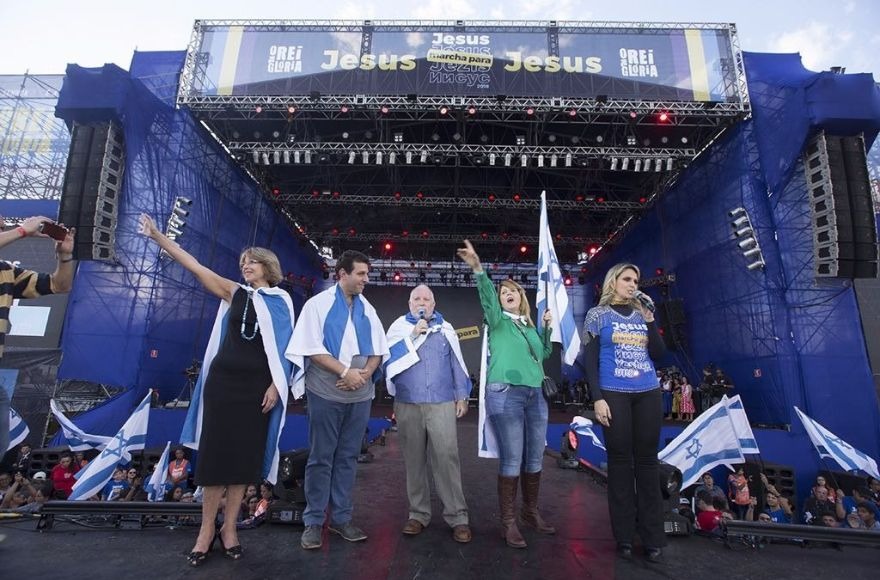
Israel’s counsul Dori Goren, center, joined Evangelical Christians, who waved Israeli flags and prayed for the Jewish state during the March for Jesus on May 31, 2018, in Sao Paulo.

SAO PAULO (JTA) — About 2 million people cheered for Israel during an annual Christian march in Brazil.

Evangelical Christians waved Israeli flags and prayed for the Jewish state during the March for Jesus held Thursday in Sao Paulo.

For the first time in nearly 20 years, Jewish officials were invited to attend the event, including Israel’s consul Dori Goren and the president of the local B’nai B’rith branch, Zelia Sliozbergas.

“Attending the march is our way to express our gratitude for the Evangelical people and the Brazilian people,” said Goren, addressing the gathering from the stage. “The people of Israel bless Brazil and the evangelical people of Brazil.”

The consul received applause for saying that he expected to see the Brazilian embassy transferred from Tel Aviv to Jerusalem soon. He recalled the role of Brazilian diplomat Osvaldo Aranha, who presided over the United Nations vote in 1947 in favor of the resolution that partitioned the British Mandate of Palestine into two states, Jewish and Arab.

“There is a very important alliance between Brazilian Christians and the State of Israel,” Gorel told the Gospel Prime news website. “It was a blessing to be able to see the affection of Brazilians for their country and that it was a great celebration of friendship between the two peoples.”

Pilgrims from Argentina, Mexico, the United States and some African countries joined the event, a 2.5-mile parade surrounded by sound trucks playing gospel music.

Established in 1993, Sao Paulo’s March for Jesus is among the biggest religious events in Brazil, the country with the world’s largest Catholic population and second-largest Christian population after the United States.

Sao Paulo is home to half of Brazil’s 120,000-strong Jewish community.

Saturday, 2 June 2018

Baptist church in South Carolina removes statue of Jesus because of concerns it was "too Catholic"

Thou shalt not make unto thee any graven image, or any likeness of any thing that is in heaven above, or that is in the earth beneath, or that is in the water under the earth. Exodus 20:4

Why a Baptist church would have a statue of Jesus in the first place is beyond me. We don't know what the Lord Jesus Christ looks like; the most recent physical description of Him is in Revelation 1:13-16, which led John to fall at His feet as dead (Rev. 1:17). No man-made image of Him can come close to capturing the reality. Idolatry is not only the worship of false gods, but the use of images as an aid in worshipping the true God, and should have no place in a true Christian church.

The removal of the statue is a move in the right direction, but there's something wrong when people associated with a Baptist church not only tolerate a statue purporting to be of the Lord Jesus Christ, but are so ignorant as to believe that the Roman Catholic Church is actually a Christian denomination. Bert Baker and Rhonda Davis, mentioned in the article below, apparently haven't read enough of the New Testament to know, for instance, that the apostle Paul singled out pseudo-Christian Judaizers in Galatia for criticism, and that he and John both named names of people to beware of. The leaders of Red Bank Baptist Church would do well to "declare unto you all the counsel of God" (Acts 20:27).

As reported by Noah Feit of the Columbia, South Carolina newspaper The State, May 29, 2018 (links in original):
In this 2007 file photo, Bert Baker, an amateur artist, had recently finished a 7-foot-tall sculpture of Christ at Red Bank Baptist Church. The piece, which also depicts multiple scenes from Christ's life, was installed on Easter Sunday.

Jesus Christ is being removed from a South Carolina church.

A statue of Jesus Christ and accompanying artwork that has been displayed at Red Bank Baptist Church for more than a decade will be taken down by Thursday, according to church officials.

The art will be removed because a majority of the congregation voted that the 7-foot-tall statue and sculpted reliefs were "causing some confusion."

According to the church, many people think the sculptures are Catholic and not representative of a Baptist church.

"We have discovered that there are people that view the art as Catholic in nature. We understand that this is not a Catholic icon, however, people perceive it in these terms," said a letter that was signed by Dr. Jeff Wright, Red Bank's senior pastor, and Mike Dennis, the church's Chairman of Deacons.

The letter was sent to Bert Baker Jr., the Midlands artist who hand carved the statue for the church in 2007. Baker is a former member of the Red Bank Baptist Church congregation.

"I'm not interested in stirring the pot, but people not liking it because it looked too Catholic is crazy, man. It's been up there for 11 years," Baker told The State on Tuesday. "I don't agree with the letter, it bothers me."

Both the church's letter and a two-page response from Baker were shared on Facebook by Rhonda Davis. Like Baker, Davis is unhappy with the church's decision to remove the art.

In her Facebook post, Baker called the art "a wordless story of Christ’s life, death and resurrection." She said its removal is sad and regretful because it "insults and prejudices" another denomination, which she described as "totally unbecoming of anyone who calls themselves a representative of Christ."

"It is both disturbing and sad that in a time when we are all needing to come together as brothers and sisters in Christ to project and reflect His love to a lost and dying world, Red Bank has decided to single out another denomination as the reason behind the decision to avoid any real or imagined fear that they would somehow be associated with them," Davis wrote in her Facebook post.

In his letter, Baker echoed those sentiments.

"These sculptures have been gracing the front of RBBC for 11 years and at no time then or now has anyone ever been 'confused' as to who Red Bank Baptist is nor has anyone ever suggested that they are 'Catholic' in nature," Baker wrote. "I am stunned that your letter both insults the intelligence of the Red Bank Community (as not intelligent enough to know that Red Bank Baptist Church is a Baptist church despite having a large sign stating as much); and, more disturbing, singling out the Catholic church in such a manner as to suggest that their denomination is deficient in theology and lacking in Christian core values."

In the church's letter, it offered Baker the opportunity to remove the sculptures if he desired to keep them, adding: "The art needs to be removed by May 31, 2018."

Baker said he hopes the statue and artwork are not destroyed — but instead given to another church or sold, with money raised to support missionary work.

"I was commissioned to make the sculpture, and whatever they choose to do with it is their prerogative," Baker told The State. "I just didn't want it destroyed. I don't want to take it down personally, but I hope they find another place for it."

Baker said he knows there are other churches that have reached out about acquiring the art, but he has not heard from the church beyond the original letter.

Messages left with the church were not answered.
As reported by David Travis Bland in The State, May 31, 2018:

RED BANK, SC--Jesus will have a new home.

Pastor Jeff Wright of Red Bank Baptist Church says the Jesus statue on the front of the church is being donated to another church.

"We are working with a local church that wants to take it," Wright says. "They will remove it when they decide to. But I don’t know when that might be."

The statue has lived on Red Bank Baptist's facade for 11 years, since a women's Sunday school class voted to have the art commissioned. The class was part of the process of that allowed the sculpture to be removed.

Some concerns persist about how the statue is attached to the Red Bank church. If it's attached by an adhesive, the sculpture may crumble when it's removed, according to Wright.

But Wright said the church won't change its mind about having the statue removed. The removal was approved by church leadership, those who originally commissioned the art, and the congregation, which voted 131 to 40 to take it down.

‘This is not a social justice issue," Wright says. "It’s a church governance issue. It has nothing to do with the community. We’re not being unjust to anyone. ... We just want to be able to worship the way our doctrine asks and let others worship the way their doctrine asks.”

The pending removal became public after a letter from Wright to the statue's artist was posted on social media. The letter told the artist, Bert Baker, about the church's intent to take down the statue and informed Baker he could get the statue if he'd like.

The pastor's letter said "the art is causing some confusion in the community," going on to say that people view the Jesus statue as Catholic.

"As a result, it is bringing into question the theology and core values of Red Bank Baptist Church," Wright's letter said.

The artist responded that the Red Bank community was never confused about the denomination of Red Bank Baptist Church and that the pastor's letter also singled out the Catholic church, wrongly presenting the denomination as "deficient in theology and lacking in Christian core values."

Baker said he didn't want the statue destroyed.

"I'm not interested in stirring the pot, but people not liking it because it looked too Catholic is crazy, man," Baker told The State.

Wright says he's comfortable with the removal decision.

"The Jesus I serve is not on the front of the building. He lives in my heart," Wright says.

Friday, 1 June 2018

Roman Catholic Archdiocese of St. Paul and Minneapolis makes $210-million settlement with victims of clergy sexual abuse

As reported by Jean Hopfensperger and Rochelle Olson of the Minneapolis Star Tribune, May 31, 2018 (bold in original):

The wrenching bankruptcy that forced a reckoning on the Archdiocese of St. Paul and Minneapolis for decades of clergy sexual abuse has culminated in a $210 million settlement for roughly 450 victims, the largest of its kind nationwide.

The settlement, announced Thursday, still must be approved in bankruptcy court, but would place the money in a trust fund for the claimants, with payments based on the severity of the abuse they endured. In return, they would be prohibited from pursuing further legal action against the archdiocese or its parishes.

“This has been a long time coming,” said Jim Keenan, chairman of the abuse survivors committee in bankruptcy court. “It’s a triumph. I believe we have made the world a better, safer place.”

Archbishop Bernard Hebda said the settlement brings “definitive resolution … that allows the local church to carry on with its mission.”

“I recognize that the abuse stole so much from you,” Hebda added, addressing victims directly at a news conference at the archdiocese offices. “Lives were forever changed. The church let you down. I am very sorry.”

The archdiocese has also been changed.

It sought bankruptcy protection in January 2015, following an avalanche of clergy abuse lawsuits. The cases were sparked by the passage of the Minnesota Child Victim’s Act, which opened a three-year window for older abuse cases to have their day in court.

Its hand forced, the archdiocese went on to publicly identify 91 clergy members who had been sex abusers, and then-Archbishop John Nienstedt resigned following a string of allegations that he failed to protect children from clergy he should have known posed a threat. Former vicar general the Rev. Kevin McDonough was removed from the chancery for the same reason. The archdiocese also was forced to sell off land and other assets to prepare itself for a settlement. And it instituted new policies meant to better shield children from falling prey to any sexual predators within its ranks.

‘A story of trauma, triumph’

Victims’ attorney Jeff Anderson said at an emotional news conference in his office more than 100,000 documents related to abuse have been released by the archdiocese and many of them made public because of the litigation.

“You have a story of trauma, and triumph, and the pursuit of truth and accountability,” said Anderson, who has for decades represented people alleging sexual abuse by priests.

He paused and teared up, explaining that he had “feelings overwhelming me in this moment.”

The Twin Cities settlement “is the largest diocesan bankruptcy settlement” in the United States, said Marci Hamilton, an expert on child abuse legislation and a professor at the University of Pennsylvania.

“It is very significant,” said Hamilton. “It shows that this [Child Victims Act] legislation created the possibility for an orderly settlement of claims.”

The settlement is the largest bankruptcy settlement ever made by an archdiocese or diocese. The Los Angeles Archdiocese reached a $660 million settlement with victims in 2007 but did not file for bankruptcy. That was the highest payout by any diocese or archdiocese, to date, she said.

Individual settlements

Chuck Turning was among the abuse survivors watching Thursday’s news conference from the back of the room. Tears streamed down his face. He said his mother always believed him when he told her years ago that he’d been sexually abused by a priest. But the archdiocese never did.

It was a great day, he said, because the archdiocese was finally acknowledging its failures. “This is cathartic,’’ Turning said.

The $210 million settlement is $50 million more than the archdiocese had offered in a previous reorganization plan. The bulk of the settlement, $170 million, will be paid by the more than 20 insurance carriers of the archdiocese and local parishes, said Tom Abood, chairman of the archdiocese’s reorganization task force.

The remaining $40 million will be paid by the archdiocese and individual parishes, he said.

Attorneys’ fees, which will come out of the survivors’ trust fund, have yet to be negotiated. The archdiocese still owes $10 million of the roughly $20 million it has accrued in attorney fees, Abood said. Fees for the survivors’ attorneys are estimated at a third of each individual’s settlement.

Anderson said he hoped that the settlement fund, which will be handled by an appointed third-party administrator, could be distributed by the end of the year.

U.S. Bankruptcy Court Judge Robert Kressel still must sign off on the agreement, but given that all parties agree, Anderson said approval is all but assured.

The settlement came after three years of mediation and as the archdiocese was under increasing pressure from supporters, top donors and survivors to reach a deal. Both sides focused last year on preparing competing reorganization plans for Kressel, who vetoed both and sent them back to mediation in December.

The pace of mediation picked up in recent months, attorneys said. It was aided by Kressel’s sense of urgency, said Hebda, and a May federal appeals court decision affirming that parish assets were independent and could not be tapped for the bankruptcy case. Victims’ attorneys had proposed using those assets in the settlement.

‘Healing and restoration’

Archdiocese leaders have been concerned a massive settlement could compromise the church’s ability to carry out the missions of youth education, support for the poor and pastoral care among the Twin Cities’ estimated 800,000 Catholics.

Nationally, 15 dioceses and archdioceses have declared bankruptcy in recent years, according to Bishops Accountability, a database tracking clergy abuse. Only the Milwaukee diocese’s case lasted more than four years. San Diego wrapped things up in seven months. Observers have said most cases settled within a year or two.

Hebda said he is grateful a settlement has been reached.

“While today marks the end of a difficult period for many, today really signals a new beginning,” said Hebda. “The completion of the bankruptcy process allows pursuits of a new day — atonement, healing and restoration of trust.”

For Minnesota’s longtime victim advocates, it was a remarkable day. Bob Schwiderski, who was sexually abused as a boy by a priest, spent decades trying to help others and to force the archdiocese to acknowledge what was happening in its churches.

“This is not about money,” Schwiderski said. “It’s the fact that society has awakened to the fact that you have to protect children. Now parents know that if a child says something, they should listen. Law enforcement knows to listen. Teachers know to listen.

“And children know it’s safe to speak up.”

Bankruptcy numbers

443 Number of abuse victims filing claims.

$20 million Archdiocese’s estimated legal fees so far.

$18 million Archdiocese’s approximate annual operating budget, 2016-17.

24 months Average duration of U.S. archdiocese bankruptcy cases.

41 months Duration for Twin Cities archdiocese bankruptcy case, to date.

This virtue-signalling apostate church would rather be robbed than be racist

Having a form of godliness, but denying the power thereof: from such turn away. II Timothy 3:5

The United Church of Christ is as apostate a pseudo-Christian denomination as there is. The experiment that they're proposing in Oakland should work about as well as declarations of "gun-free zones" do; if they want to "divest" themselves from the police, the police should be only too willing to divest themselves from the church.

As reported by Jaweed Kaleem of the Los Angeles Times, May 30, 2018 (link in original):

OAKLAND, CALIF. - Standing on the front steps of First Congregational Church of Oakland in late April, Nichola Torbett issued a declaration.

"We can no longer tolerate the trauma inflicted on our communities by policing," Torbett, a white church volunteer, said in front of churchgoers who held photos of African-Americans shot dead by law enforcement. The church, she promised, would never call the cops again in nearly every circumstance. Dozens of members had agreed to do the same.

"How do police help? They often don't," Torbett later said in an interview. "So, especially as white people, why call them?"

As videos of the aftermath of white Americans dialing 911 on African-Americans for taking part in innocent activities have repeatedly gone viral – two black friends meeting at a Starbucks, a black grad student napping in a Yale dormitory common room, a black family having a barbecue just blocks from the Oakland congregation – members of this small church are taking extreme measures in response.

They call it "divesting" from police. The church is part of a tiny but growing movement among liberal houses of worship around the nation making similar vows. They include another church in Oakland, one in San Jose and one in Iowa City, Iowa. It's mostly white ministers and majority white congregations leading the efforts, which come as debates over racism, stereotypes and the role of law enforcement hit universities, businesses and neighborhood councils across the U.S.

At Colorado State University, administrators are grappling with an April incident in which a white parent called police on two Native American students touring the campus. The woman told a 911 operator that the teens, who joined the tour late, were acting "really odd" and wore dark clothes with "weird symbolism."

Waffle House has come under fire for recent videos in which police aggressively arrested black customers at restaurants in the South. In one North Carolina incident, a video showed a white officer slamming and choking a 22-year-old man who arrived after taking his sister to her prom. An employee had called police on the customer, alleging that he yelled at workers and tried to start a fight. Waffle House and police said they did no wrong.

The Starbucks incident, in which two men who had made no purchases were denied bathroom access before police were called, led to a new rule that bathrooms are open to noncustomers. Thousands of Starbucks stores shut down Tuesday afternoon while employees were trained in racial bias awareness.

At First Congregational, which is part of the United Church of Christ denomination, the decision to avoid police has generated a variety of responses. A regional body of the United Church of Christ in Northern California endorsed the effort. Elsewhere in the nation, churches have scoffed.

Conservative media have accused the Oakland church of being anti-police, and questioned its commitment to safety. ("All I got to say is 'Oakland, California' and immediately you know we are talking about nutcases," one commentator said during a YouTube broadcast).

Some nearby houses of worship, including a Presbyterian church and a Reconstructionist Jewish synagogue, have asked how they could join. Locals, curious about the church's announcement, have started to stop by on Sundays. On Facebook, dozens of people are signed up to attend a July workshop at the church. It's called "How to NOT call the PoLice (Sheriffs & Kkkorts) Ever."

"We're taught to turn to police for so much, even simple disagreements between people," said church member Sarah Pritchard, who is also white and is setting up trainings such as the July workshop. "Why can't we resolve issues among ourselves?"

"We need to be there as a community for one another so we can provide safety for our congregation without police," she said. Pritchard said the ban wouldn't apply if there was a shooting or other life-threatening violence. But nearly everything else is fair game.

First Congregational began 158 years ago as small house church and has been in its current location since 1923. As the Bay Area became a center of leftist social movements in the 1960s and 1970s, the church became known as one of the most politically active in the region. Today, a Black Lives Matter banner hangs from the church's facade. Inside its sanctuary, black and white banners spell out "truth," "freedom," "justice," and "equality." Its worship space features a memorial to black Americans who have died in police encounters or custody.

At most, a few dozen people usually show up for Sunday service. Members are largely lesbian, gay, bisexual, transgender and queer; about half are white. Its leaders are mostly women, many of whom work in nonprofits, social work and education. Because there's no paid pastor, members take turns preaching and make all decisions collectively. It took around two years of planning before announcing the police ban.

The policy was first put on its website during Holy Week, when Christians recount the last days of Jesus' life before his death and resurrection. "NO MORE STATE-SPONSORED CRUCIFIXIONS IN THE NAME OF 'SAFETY,'" the posting said. The church likened today's police to those who sentenced Christ to death.

In April at Oakland's Lake Merritt, a short distance from the church, a white woman complained to police about a black family using a charcoal barbecue in a no-charcoal area of the park. The event further fueled anger and disappointment among church members who believe some white people are too quick to turn to police when it concerns racial minorities. Police did not arrest anybody or issue citations. Many churchgoers feared it could have been worse.

"We recognize that Jesus was killed, not for anything he did, but for who he was, and we see the same happening to black and brown people today," Torbett said. Still, "we're still debating its limitations," she added about the no-police agreement. Nothing has happened yet that would typically warrant a call to the cops.

Those questions about limitations came up recently after a Sunday church service. Church leaders sat in an office, discussing their nascent effort and hopes for the future.

Marcia Lovelace, a volunteer worship leader, spoke about training church staffers about what to do when people won't leave the building.

The church, which sits on a small hill just north of downtown Oakland, frequently opens its doors to the homeless, mentally ill and those who struggle with drug addictions. It offers a food pantry, transit cards and a place to nap. But it draws the line at hosting people overnight.

"We once had a street person who needed mental health care and wouldn't leave," Lovelace, who is 70 and white, said as she described an incident before new policy. "Police were called and church members who fit the description were hassled by police. For those of us who have the skin color that keeps us from having those experiences, it made things real."

According to current guidelines, church members would not call police if such a situation arose again. In lieu of police services, the church has secured a $10,000 grant to train its members and other community groups on de-escalation tactics and self-defense.

Carol Robison, another volunteer church leader, proposed an idea for dealing with burglaries. The buildings has no security, and thieves have taken purses and backpacks. Doors are unlocked during the day.

The building's property insurance requires police reports for claims. But "we'd rather not attract more police," said Robison, who is 62 and white. She suggested going "to the police station to file a report instead of having the police come into your neighborhood."

The conversation turned to another aspect of policing: deterring and solving crime. Church leaders said they could prevent crime by forming better relationships with neighborhood residents. Their theory, put simply: Friends won't steal from friends. But if crime still happened, church members prayed they could make peace between victims and perpetrators directly without police or courts.

Recently, the church received a phone call from Oakland police with a request to talk about its announcement. The group disagreed on how to respond, if at all.

"We are in conversation about getting into conversation with Oakland police," Torbett said.

Soo Hyun Han, a Korean-American who attends services with her black spouse and biracial son, said she hoped the church wouldn't avoid talking to police completely.

"Hopefully that is a place where a real conversation would happen," Han, 44, said of sitting down with officers.

The Police Department has not responded publicly to the church's stance. A spokeswoman said Chief Anne E. Kirkpatrick was unavailable.

But Barry Donelan, president of the Oakland police union, said he wasn't bothered by the church.

"If this particular group doesn't want to call the police, that's their position, that's their view," Donelan said. "But my members are happy to respond to the tremendous need for police services elsewhere. If they take this view, it makes it so more police can be directed to those who ask for them." He added that he would "never discourage people from calling police" if they changed their minds.

Donelan pointed out that officers in the city field thousands of calls a day. He said the majority don't result in injuries, shootings or deaths. He scoffed at the church's suggestion that police contribute to violence instead of helping resolve it.

"Many in the city would say there's not enough of us," he said. "These guys are here to serve the community as best they can."