Friday, 25 March 2016

British scholar raises the question of whether Jesus was nailed or tied to the cross

Meredith J.C. Warren, Lecturer in Biblical and Religious Studies at the University of Sheffield, wrote the following article, published in the Internet publication The Conversation, March 16, 2016 (bold in original, links inserted by blogger):

Was Jesus really nailed to the cross?

Jesus’s crucifixion is probably one of the most familiar images to emerge from Christianity. Good Friday, one of the holiest days in the Christian calendar, marks the event. But what was crucifixion? And why was Jesus killed that way?

Crucifixion was a Roman method of punishment. Suspended from a large cross, a victim would eventually die from asphyxiation or exhaustion – it was long, drawn-out, and painful. It was used to publicly humiliate slaves and criminals (not always to kill them), and as an execution method was usually reserved for individuals of very low status or those whose crime was against the state. This is the reason given in the Gospels for Jesus’s crucifixion: as King of the Jews, Jesus challenged Roman imperial supremacy (Matt 27:37; Mark 15:26; Luke 23:38; John 19:19–22).

Crucifixion could be carried out in a number of ways. In Christian tradition, nailing the limbs to the wood of the cross is assumed, with debate centring on whether nails would pierce hands or the more structurally sound wrists. But Romans did not always nail crucifixion victims to their crosses, and instead sometimes tied them in place with rope. In fact, the only archaeological evidence for the practice of nailing crucifixion victims is an ankle bone from the tomb of Jehohanan, a man executed in the first century CE.

So was Jesus nailed to the cross?

Gospel accounts

Some early Gospels, such as the Gospel of Thomas, don’t include the narrative of Jesus’s crucifixion, choosing instead to focus on his teaching. But Jesus’s death by crucifixion is one of the things that all four canonical Gospels agree on. Matthew, Mark, Luke, and John, all include the crucifixion event in their own slightly different ways.

None of the Gospels in the New Testament mentions whether Jesus was nailed or tied to the cross. However, the Gospel of John reports wounds in the risen Jesus’s hands. It is this passage, perhaps, that has led to the overwhelming tradition that Jesus’s hands and feet were nailed to the cross, rather than tied to it.

The Gospel of Peter, a non-canonical gospel from the first or second century CE, specifically describes in verse 21 how after Jesus had died, the nails were removed from his hands. The Gospel of Peter also famously includes the cross itself as an active character in the Passion narrative. In verses 41-42 the cross speaks, responding with its own voice to God: “And they were hearing a voice from the heavens saying, ‘Have you made proclamation to the fallen-asleep?’ And an obeisance was heard from the cross, ‘Yes.’” Tradition is clearly of paramount importance to this text.

Over the past few years, several people have claimed to have found the actual nails with which Jesus was crucified. Each time, biblical scholars and archaeologists have rightly pointed out the assumptions and misinterpretations of evidence behind these claims. Curiously, this fixation on the nails persists, despite the fact that the earliest gospels make no mention of Jesus being nailed to the cross.

Depictions of the crucifixion

It isn’t surprising that Christians took a while to embrace the image of Christ on the cross, given that crucifixion was a humiliating way to die. What is surprising is what the earliest image of the crucifixion turns out to be. Rather than the devotional icons with which we are familiar – pictures that glorify Jesus’s death –
this earliest image appears to be some late second-century graffiti mocking Christians.

Called the Alexamenos Graffito, the image shows a figure with the head of a donkey on a cross with the words: “Alexamenos worships his God.” This was apparently a common accusation in antiquity, as Minucius Felix(Octavius 9.3; 28.7) and Tertullian (Apology 16.12) both attest. Since the graffito was clearly not made by a Christian, this image suggests that non-Christians were familiar with some core elements of Christian belief as early as the second century.

Gemstones, some used for magical purposes, also provide some of our earliest depictions of the crucified Jesus. This second or third century
piece of carved jasper depicts a man on a cross surrounded by magic words.
Another very early image of the crucifixion is found carved into the face of a carnelian gemstone made into a ring.

Scholars think that the Constanza gemstone, as it is known, dates from the fourth century CE. In this depiction, Jesus’s hands do not appear to be nailed to the cross, since they fall naturally, as if he is tied at the wrists.

Since the evidence from antiquity doesn’t provide a clear answer as to whether Jesus was nailed or tied to his cross, it’s tradition that dictates this common depiction. Those who have seen the film The Passion of the Christ will recall how much time the director, Mel Gibson, devoted just to the act of nailing Jesus onto the cross —- almost five whole minutes.

Given the relative silence on the act of crucifixion in the Gospels, this stands out as a graphic expansion. One of the only films that does not assume that crucifixion involved nails is Monty Python’s Life of Brian, which shows multiple crucifixion victims, though not Jesus, tied to their crosses.

Eventually, Emperor Constantine put an end to crucifixion as a method of execution, not for ethical reasons, but out of respect for Jesus. But in the end, it is the enduring image of the cross, and not the matter of whether nails or ropes were used, that most firmly evokes the death of Jesus in art and tradition.
The question as to whether or not the Lord Jesus Christ was nailed to the cross is legitimate, but Professor Warren should be more thorough in reading the Bible before saying that "evidence from antiquity doesn’t provide a clear answer as to whether Jesus was nailed or tied to his cross." In fact, scripture does provide evidence that Jesus was nailed to the cross (real scripture, that is; the "Gospels" of Thomas and Peter should be ignored as the postbiblical and unbiblical forgeries they are).

From the Old Testament we have Psalm 22, universally acknowledged as a messianic prophecy:

I am poured out like water, and all my bones are out of joint: my heart is like wax; it is melted in the midst of my bowels...
...For dogs have compassed me: the assembly of the wicked have inclosed me: they pierced my hands and my feet.
Psalms 22:14, 16

Then there's Zechariah 12:10:

And I will pour upon the house of David, and upon the inhabitants of Jerusalem, the spirit of grace and of supplications: and they shall look upon me whom they have pierced, and they shall mourn for him, as one mourneth for his only son, and shall be in bitterness for him, as one that is in bitterness for his firstborn.

While some might say that this is referring to Jesus' side being pierced by a spear after His death (John 19:34), the passage in Zechariah is addressed to "the house of David and the inhabitants of Jerusalem," which would indicate that the piercing being referred to is the crucifixion. The spear that pierced Jesus' side after his death was wielded by a Roman soldier, and is thus not a fulfillment of Zechariah 12:10.

In the New Testament, we have the first post-resurrection encounter between the Lord and Thomas in John 20:24-29:

But Thomas, one of the twelve, called Didymus, was not with them when Jesus came.
The other disciples therefore said unto him, We have seen the Lord. But he said unto them, Except I shall see in his hands the print of the nails, and put my finger into the print of the nails, and thrust my hand into his side, I will not believe.
And after eight days again his disciples were within, and Thomas with them: then came Jesus, the doors being shut, and stood in the midst, and said, Peace be unto you.
Then saith he to Thomas, Reach hither thy finger, and behold my hands; and reach hither thy hand, and thrust it into my side: and be not faithless, but believing.
And Thomas answered and said unto him, My Lord and my God.
Jesus saith unto him, Thomas, because thou hast seen me, thou hast believed: blessed are they that have not seen, and yet have believed.


It's worth noting that when Thomas said that he wouldn't believe until he saw the nail prints in Jesus' hands (and the wrist was regarded as part of the hand), none of the other disciples told him that there were no nail prints to be seen. As for the lack of mention of the nails in the Gospel narratives of the crucifixion, the writers, under the inspiration of the Holy Spirit, wrote with the belief that the reader would understand that crucifixion referred to nailing, and would have otherwise noted the distinction. And of course, Jesus showed Thomas His hands, and the evidence was enough to dispel all of Thomas's doubts.

In Acts 2:23, Peter accuses the Jews of crucifying Jesus; where the King James Version uses the phrase "crucified and slain," the New International Version uses the phrase "put him to death by nailing him to the cross." The New American Standard Bible rendition of this verse also states that He was "nailed to a cross."

In Colossians, Paul is writing about the believer's new identity in Christ:

And you, being dead in your sins and the uncircumcision of your flesh, hath he quickened together with him, having forgiven you all trespasses;
Blotting out the handwriting of ordinances that was against us, which was contrary to us, and took it out of the way, nailing it to his cross;
Colossians 2:13-14

Most important, it must be kept in mind that "without the shedding of blood is no remission" (Hebrews 9:22). In order to pay the penalty for our sins, Jesus had to die in a manner that involved the shedding of His blood; anything less wouldn't have satisfied His Father's requirements of justice. Indeed, Jesus declared that He had accomplished what He set out to do when He said just before He died, "It is finished" (John 19:30), an accounting term meaning "paid in full." As an aside, please note that Jesus was on the cross when He announced that He had paid the debt in full, contrary to heretical "faith" teachers who claim that Jesus had to go to Hell to finish His mission.

The efficacious death of Jesus on the cross is prefigured in the Old Testament by such ordinances as the Passover (Exodus 12:1-27, 43-49)--where God promised to pass over houses where He saw the blood (Exodus 12:13)--and the sin offering (Leviticus 9:1-9), where the blood that wasn't put on the horns of the altar was to be poured out (Leviticus 9:9).

Given the biblical evidence, we can confidently state that the Lord Jesus Christ was indeed nailed to the cross.

Thursday, 24 March 2016

50 years ago: Archbishop of Canterbury Michael Ramsey and Pope Paul VI sign the Common Declaration

On March 24, 1966, Archbishop of Canterbury Michael Ramsey and Pope Paul VI concluded their two-day summit at the Vatican--where the Pope presented the Archbishop with the episcopal (bishop's) ring he had worn as Archbishop of Milan--by signing:

The Common Declaration by Pope Paul VI and the Archbishop of Canterbury Dr Michael Ramsey

Rome, Saint Paul Outside the Walls, 24 March 1966

In this city of Rome, from which Saint Augustine was sent by Saint Gregory to England and there founded the cathedral see of Canterbury, towards which the eyes of all Anglicans now turn as the centre of their Christian Communion, His Holiness Pope Paul VI and His Grace Michael Ramsey, Archbishop of Canterbury, representing the Anglican Communion, have met to exchange fraternal greetings.

At the conclusion of their meeting they give thanks to Almighty God Who by the action of the Holy Spirit has in these latter years created a new atmosphere of Christian fellowship between the Roman Catholic Church and the Churches of the Anglican Communion.

This encounter of the 23 March 1966 marks a new stage in the development of fraternal relations, based upon Christian charity, and of sincere efforts to remove the causes of conflict and to re-establish unity.

In willing obedience to the command of Christ who bade His disciples love one another, they declare that, with His help, they wish to leave in the hands of the God of mercy all that in the past has been opposed to this precept of charity, and that they make their own the mind of the Apostle which he expressed in these words: ‘Forgetting those things which are behind, and reaching forth unto those things which are before, I press towards the mark for the prize of the high calling of God in Christ Jesus’ (Phil 3:13-14).

They affirm their desire that all those Christians who belong to these two Communions may be animated by these same sentiments of respect, esteem and fraternal love, and in order to help these develop to the full, they intend to inaugurate between the Roman Catholic Church and the Anglican Communion a serious dialogue which, founded on the Gospels and on the ancient common traditions, may lead to that unity in truth, for which Christ prayed.

The dialogue should include not only theological matters such as Scripture, Tradition and Liturgy, but also matters of practical difficulty felt on either side. His Holiness the Pope and His Grace the Archbishop of Canterbury are, indeed, aware that serious obstacles stand in the way of a restoration of complete communion of faith and sacramental life; nevertheless, they are of one mind in their determination to promote responsible contacts between their Communions in all those spheres of Church life where collaboration is likely to lead to a greater understanding and a deeper charity, and to strive in common to find solutions for all the great problems that face those who believe in Christ in the world of today.

Through such collaboration, by the Grace of God the Father and in the light of the Holy Spirit, may the prayer of Our Lord Jesus Christ for unity among His disciples be brought nearer to fulfilment, and with progress towards unity may there be a strengthening of peace in the world, the peace that only He can grant Who give ‘the peace that passeth all understanding’, together with the blessing of Almighty God, Father, Son and Holy Spirit, that it may abide with all men for ever.

+Michael Cantuarensis
Paulus PP. VI
The prayer for unity uttered by the Lord Jesus Christ in John 17 is for unity in spirit and truth, not an organizational unity. It should be noted that about 300 Christians were martyred in England during the reign of Queen Mary I from 1553-1558 for holding to the Bible as the only authority of faith and practice, and rejecting Roman Catholic doctrines such as transubstantiation--and the Roman Catholic Church has never repudiated any of those doctrines. The "serious obstacles" referred to in the Declaration include not just teachings and practices of the Roman Catholic Church that are too numerous to mention here, but several of the Articles of Religion of the Church of England, published in 1562, which oppose some of those Roman Catholic doctrines and practices. The articles include:

XI. Of the Justification of Man

We are accounted righteous before God, only for the merit of our Lord and Saviour Jesus Christ by Faith, and not for our own works or deservings: Wherefore, that we are justified by Faith only is a most wholesome Doctrine, and very full of comfort, as more largely is expressed in the Homily of Justification.

XIX. Of the Church

The visible Church of Christ is a congregation of faithful men, in the which the pure Word of God is preached, and the Sacraments be duly ministered according to Christ's ordinance in all those things that of necessity are requisite to the same.

As the Church of Jerusalem, Alexandria, and Antioch, have erred; so also the Church of Rome hath erred, not only in their living and manner of Ceremonies, but also in matters of Faith.

XX. Of the Authority of the Church

The Church hath power to decree Rites or Ceremonies, and authority in Controversies of Faith: And yet it is not lawful for the Church to ordain any thing that is contrary to God's Word written, neither may it so expound one place of Scripture, that it be repugnant to another. Wherefore, although the Church be a witness and a keeper of holy Writ, yet, as it ought not to decree any thing against the same, so besides the same ought it not to enforce any thing to be believed for necessity of Salvation.

XXII. Of Purgatory

The Romish Doctrine concerning Purgatory, Pardons, Worshipping, and Adoration, as well of Images as of Reliques, and also invocation of Saints, is a fond thing vainly invented, and grounded upon no warranty of Scripture, but rather repugnant to the Word of God.

XXVIII. Of the Lord's Supper

The Supper of the Lord is not only a sign of the love that Christians ought to have among themselves one to another; but rather is a Sacrament of our Redemption by Christ's death: insomuch that to such as rightly, worthily, and with faith, receive the same, the Bread which we break is a partaking of the Body of Christ; and likewise the Cup of Blessing is a partaking of the Blood of Christ.

Transubstantiation (or the change of the substance of Bread and Wine) in the Supper of the Lord, cannot be proved by holy Writ; but is repugnant to the plain words of Scripture, overthroweth the nature of a Sacrament, and hath given occasion to many superstitions.

The Body of Christ is given, taken, and eaten, in the Supper, only after an heavenly and spiritual manner. And the mean whereby the Body of Christ is received and eaten in the Supper is Faith.

The Sacrament of the Lord's Supper was not by Christ's ordinance reserved, carried about, lifted up, or worshipped.

XXXI. Of the one Oblation of Christ finished upon the Cross

The Offering of Christ once made is that perfect redemption, propitiation, and satisfaction, for all the sins of the whole world, both original and actual; and there is none other satisfaction for sin, but that alone. Wherefore the sacrifices of Masses, in the which it was commonly said, that the Priest did offer Christ for the quick and the dead, to have remission of pain or guilt, were blasphemous fables, and dangerous deceits.

XXXII. Of the Marriage of Priests

Bishops, Priests, and Deacons, are not commanded by God's Law, either to vow the estate of single life, or to abstain from marriage: therefore it is lawful for them, as for all other Christian men, to marry at their own discretion, as they shall judge the same to serve better to godliness.

XXXVII. Of the Civil Magistrates

...The Bishop of Rome hath no jurisdiction in this Realm of England...
Notwithstanding the "serious obstacles stand[ing] in the way of a restoration of complete communion of faith and sacramental life," the march toward that full organizational unity under the authority of the Roman Catholic Church has continued down that one-way street to apostasy over the last 50 years. Events such as the Church of England's decisions to allow women to become priests and, more recently, bishops, have resulted in many traditionally-minded Anglicans in England and other countries, whose faith would more accurately be termed "churchianity" than "Christianity" defecting to the Roman Catholic Church. Full organizational unity among the Roman Catholic Church, Church of England, and other like-minded churches, is only a matter of time, as the Bible's prophecies of apostasy in the last days prior to the return of the Lord Jesus Christ are increasingly fulfilled.

Saturday, 12 March 2016

Fans of Catholic high school basketball team in suburban Boston shout "You killed Jesus" at Jewish players of opposing team

Another magic moment for multiculturalism, as reported by Valerie Strauss of The Washington Post, March 12, 2016:

BOSTON — An ugly thing happened at a high school basketball game in a suburb of Boston Friday night.

It occurred at a division title game between the all-boys Catholic Memorial School and the public Newton North High School, which has a large Jewish community of students. The game was held at Newton South High School, where an estimated 100 young men sitting in the student section cheering for Catholic Memorial shouted, “You killed Jesus, you killed Jesus,” according to several witnesses who asked not to be identified. Most of those chanting fans wore red shirts as a display of support for their team. Some of the witnesses, who were Jewish, said they found the chant alarming.

Brendan C. Hall, high school sports editor for ESPNBoston, and some other people tweeted about what happened:

Dirty Dan
‎‎@Dtf617

Probably craziest high school chant ever

Newton North fans chant: "sausage fest, sausage fest"

CM fans response: "You killed Jesus"
7:03 PM - 11 Mar 2016

Brendan C. Hall ✔
‎‎@BHallESPN

I am serious. MIAA should consider fining schools whose fans use hate speech. I'm sick of dealing with these stories https://twitter.com/
mlmcclin/status/708486051522846720 …
8:00 PM - 11 Mar 2016

Brendan C. Hall ✔
‎‎@BHallESPN

Credit to the CM administration absolutely scolding its fans. Made every fan apologize to the Newton North principal just now.
6:58 PM - 11 Mar 2016

Matt McClintock
‎‎@mlmcclin

If you chant "You Killed Jesus" to a predominantly Jewish school you're gonna have a bad time. https://twitter.com/bhallespn/stat
us/708472155655290880 …
7:53 PM - 11 Mar 2016


“Sausage fest” — the phrase used in a chant by Newton fans — is a crude reference to the fact that the Catholic school is only for boys. Newton North, a public high school with more than 1,700 students, is in an affluent suburb just west of Boston; Catholic Memorial, the Christian Brothers School of Boston, is a college-preparatory school for boys in grades 7 through 12 about six miles away in West Roxbury, a neighborhood of Boston that borders Newton. The school’s website says that it “transforms boys’ lives and prepares them for college and the world.”

One spectator who was shaken by the events — and who asked not to be identified — is a native of Skokie, Ill., where in the mid-1970s, a controversy erupted when neo-Nazis wanted to march through the heavily Jewish town. Skokie officials tried to stop it but lost the case in court. This spectator, whose parents are survivors of World War II concentration camps, said, “I can’t believe it,” she said. “I just can’t believe it.”

This week Cardinal Seán Patrick O’Malley, the Catholic archbishop of Boston, gave a speech to representatives of the Jewish community to mark the 50th anniversary of Nostra Aetate, the 1965 document that revolutionized Catholic-Jewish relations and made clear for the first time that the Catholic Church rejects any form of anti-Semitism.

The two schools’ basketball teams were evenly matched going into the playoff game; Newton North was 22-3 and Catholic Memorial was 21-2.According to ESPNBoston.com, Catholic Memorial won Friday night’s game, 77-73, to advance to the EMass Final, scheduled for Monday at TD Garden, where the Boston Celtics play.

Thursday, 10 March 2016

Aboriginal bishops in Anglican Church of Canada invoke "colonial occupation" in opposition to same-sex marriage

Aboriginal bishops in the Anglican Church of Canada seem to be as liberal as their brethren when it comes to the acceptance of sodomites and lesbians as "Christians," but even they can't go as far as the white liberals in the church when it comes to "marriage." As reported by Sue Bailey of Canadian Press, March 9, 2016:

ST. JOHN’S, N.L. – Indigenous bishops within the Anglican Church of Canada say they will resist having Western values imposed on them, arguing aboriginal voices are being lost in a “very strained” internal debate over same-sex marriage.

“It is no longer acceptable to impose Western cultural questions and approaches on our societies,” the bishops say in a statement to the church body studying the question. It was delivered Aug. 7, but received little notice until a Newfoundland and Labrador radio station, VOCM, reported on it this week.

“We absolutely reserve the right to make these choices and decisions, now and forever, on our own terms and in our own way.”

The church’s governing body will vote on same-sex marriage in July, but officials say it appears unlikely there will be the support required to change its rules to allow it.

Last month, Bishop Geoff Peddle of eastern Newfoundland suggested on a local radio show that much of the resistance comes from aboriginal bishops.

But Most Rev. Fred Hiltz, primate of the Canadian wing of the church, said many others in the Canadian house of bishops also hold “a conservative view” of marriage.

On Wednesday, Peddle said in an interview he wasn’t singling out one group of bishops. He said he was trying to express that all points of view — from indigenous and other members such as the gay and lesbian community — must be heard.

“I don’t know how we can move forward on this, or make a change, if we can’t all feel that we’re moving together. And if some people say we need a little more time, then I hear them.”

The August statement was signed by three indigenous bishops: Adam Halkett in Saskatchewan, Lydia Mamakwa in northern Ontario and Mark MacDonald, the national indigenous bishop. None was available this week to comment on what the statement describes as “a dangerously complex cross-cultural discussion.”

It stresses the acceptance of gay and lesbian people as “brothers, sisters, children and elders.”

“There is no place for hatred and separation in indigenous communities and, especially, in indigenous Christian communities.”

Still, the bishops emphasize there is disagreement among their own members and elders about same-sex marriage. It’s also difficult to decipher past practice due to “the widespread and deep destruction of our history and traditions by colonial occupation,” says the statement.

“At present, we do not hear our concerns and approach in either side of this very strained discussion,” it says.

“Our understanding of marriage appears to be quite different from the dominating society and both sides of this discussion within it.”

At issue is a resolution toward changing the church’s canon or rules to allow same-sex marriage. Two-thirds support are required from each of the three main groups — bishops, clergy and laity — during two meetings held three years apart.

The resolution will be on the agenda in July when the General Synod, the Anglican Church of Canada’s highest governing party, gathers all three groups in Toronto.

Communications director Meghan Kilty said local bishops can already offer blessings for gay and lesbian unions.

“What is different is this is a canonical change so, theologically, the church’s understanding of what marriage is,” she said from Toronto. “And that’s a huge ethical, theological understanding which some people wrestle with.”

The broader group of Anglican bishops said in a statement last week the required two-thirds support among its 45 members was unlikely. There are four aboriginal bishops.

It did not specify concerns raised by the three indigenous bishops last August. But it referred to “deep differences” that have some members of the group feeling “mortified and devastated.”

A federal bill passed in 2005 legalized same-sex marriage in Canada but also protected religious freedoms.

Two years earlier, the United Church of Canada endorsed same-sex marriage after an emotional debate and urged Ottawa to legally recognize it. Local congregations were free to adopt the national stance or make their own marriage policies, said Right Rev. Jordan Cantwell, the church’s national moderator.

“Those are very difficult conversations,” she said from Toronto. “One of the things we strived to do is create a space that is respectful of one another, where it’s safe to disagree.”

A key difference is that the Anglican Church of Canada is part of a global entity dealing with this question, Cantwell said.

The Anglican communion based in the Church of England, with about 85 million members worldwide, has fractured in recent decades over women’s ordination and same-sex marriage. The Episcopal Church — the U.S.-based Anglican body — voted last year to authorize gay weddings in their churches. Members in other countries such as South Africa and Brazil have also said they’re open to the idea.
See also the articles from VOCM:
Aboriginal Gay Marriage Stigma Came from Church Doctrine, Not Other Way Around: Advocate (March 4, 2016)

For Indigenous Anglicans, Gay Marriage a Colonialism Issue: Bishops (March 7, 2016)

Friday, 4 March 2016

Five young Chinese women arrive in Israel to make aliyah

1And it shall come to pass, when all these things are come upon thee, the blessing and the curse, which I have set before thee, and thou shalt call them to mind among all the nations, whither the LORD thy God hath driven thee,
And shalt return unto the LORD thy God, and shalt obey his voice according to all that I command thee this day, thou and thy children, with all thine heart, and with all thy soul;
That then the LORD thy God will turn thy captivity, and have compassion upon thee, and will return and gather thee from all the nations, whither the LORD thy God hath scattered thee.
If any of thine be driven out unto the outmost parts of heaven, from thence will the LORD thy God gather thee, and from thence will he fetch thee:
And the LORD thy God will bring thee into the land which thy fathers possessed, and thou shalt possess it; and he will do thee good, and multiply thee above thy fathers.
Deuteronomy 30:1-5

As reported by Alexander J. Apfel of Tazpit News Service, February 29, 2016:

Five Chinese women, descended from the medieval Jewish community of Kaifeng, are set to arrive in Israel on Monday. The women, Gao Yichen (“Weiwei”), Yue Ting, Li Jing, Li Yuan, and Li Chengjin (“Lulu”), have studied Hebrew and Judaism to prepare themselves for their journey, as they return to the heritage of their ancestors.

Upon their arrival, the five women will visit the Western Wall before making their way to Midreshet Nishmat – The Jeanie Schottenstein Center for Advanced Torah Study for Women, where they will prepare for their official conversion to Judaism under the auspices of Israel’s Chief Rabbinate.

The women will live in the seminary until the completion of their conversion, after which they will receive Israeli citizenship.

Kaifeng’s Jewish community is believed to have been founded by Iraqi or Persian Jewish merchants in the eighth or ninth century. A synagogue was erected there in 1163 that still stands today. According to estimates, the community consisted of up to 5,000 Jews during the Ming dynasty (1368-1644) but decreased to 500-1000 due to wide-scale assimilation and intermarriage.

According to Michael Freund, chairman of the Shavei Israel organization responsible for bringing the women to Israel, the Kaifeng community was similar to other Jewish communities except that it did not suffer anti-Semitism.

“As a result, beginning perhaps in the 18th century, a process of assimilation and intermarriage began to settle in. Then, the last rabbi of Kaifeng passed away 200 years ago, and the synagogue was rendered unfit for use when a series of floods struck the city in the 19th century,” Freund told Tazpit Press Service (TPS).

However, Freund said that close to 1,000 remain who are identifiable as descendants of the Jewish community and who have shown increasing interest in learning about Judaism and their heritage. Such interest has enabled Freund’s organization to bring many Chinese to Israel, the last group of seven men arriving in October 2009.

Freund further explained that around 25 years ago, Jews were given the option of registering either as regular Han Chinese or, for unknown reasons, as Muslims. “Many opted to register as Muslims since this enabled them to have more than one child, but they are still identifiable as descendants of Jews even if some of them have nothing to do with Judaism,” Freund said.

“Being part of the Jewish people is an honor because of the heritage and wisdom,” said Li Jing, who on a previous visit put a note of prayer in the Kotel asking to return and live in Israel. “Now, my prayer has been answered,” she said.
Funny, they don't look Jewish.

Thursday, 3 March 2016

Roman Catholic priest in Northern Ireland is caught on video, snorting cocaine--in his apartment full of Nazi memorabilia

A night of jocularity in the life of a Roman Catholic priest in Northern Ireland--and wouldn't you know it, by horrible coincidence, the only time in his life he uses drugs, he gets caught on video. At least he wasn't molesting boys. Whatever happened to the kind of priest that Pat O'Brien and Bing Crosby used to play in the movies?

As reported by Ruth Warrander of the Dublin newspaper The Irish Sun, February 28, 2016:

AN IRISH priest has been caught on camera snorting a line of cocaine at a party in his house on church grounds.

Father Stephen Crossan, 37, was seen sniffing a large line of the drug through a note while chatting to a pal in a room full of Nazi memorabilia.

He places a cigarette in an ashtray and seems to say “I shouldn’t” before snorting white powder off a plate in a video obtained by the Irish Sun on Sunday.

The respected Father’s drug use came at the end of a two-day bender that ended with him inviting friends back to his parish home.

Crossan has admitted taking drugs. He confessed: “It was just the one night and that was it. I do not have an issue with drugs.”

A source said revellers went back to Fr Crossan’s home at 11am for seven hours after they had been asked to leave another house party.

They were shocked to see Nazi memorabilia including flags, hats and a Maltese falcon on a plinth on his mantelpiece.

A source said: “Stephen said he was a social worker but told us the truth when we realised he lived on church grounds.

“He had been drinking beers and Jack Daniels as well as taking coke.

“The house was really lovely, with plush carpets and antique furniture everywhere.

“But we were pretty stunned to see all the Nazi stuff everywhere — badges, hats and flags. He showed me all these pins — there must have been about a hundred badges.

“It was all over the house, it reminded me of that Nazi room in Father Ted — I told him that and he laughed it off.

“At one point Stephen put on a cap and did the Nazi salute but he was just messing around.”

The source continued: “There was a big rail of all of his gowns — we tried some of them on and danced about.
As reported by BBC News, March 1, 2016:

Police have begun an investigation after footage emerged of a Catholic priest caught on video snorting what appeared to be cocaine.

Fr Stephen Crossan is reported to have snorted coke through a £10 note during a night of drinking in July 2015 in Banbridge, County Down.

He was in a room containing Nazi memorabilia, and seemed to say "I shouldn't" as he snorted, the Sun on Sunday reported.

He has taken leave from the priesthood.

A spokesperson for the PSNI said: "Police are aware of the article in a Sunday newspaper and are making inquiries."

The bishop of Dromore said in a statement that he had no knowledge of the incident.

It allegedly occurred in the parochial house last July after a party.

The Sun on Sunday said it happened at what was then Fr Crossan's parish home in the grounds of St Patrick's Church, Banbridge, in July 2015.

Father Crossan told the newspaper that he took the drugs but said: "It was just the one night and that was it."

A source said that a group went to Fr Crossan's home after a party and found Nazi memorabilia including flags, hats and an eagle with a swastika on a plinth on his mantelpiece.

In his defence, Fr Crossan told the paper that he was not a Nazi and that he collected historical items from every country.

He said he had been on sick leave with depression at the time of the video and that he had since left the Church but was being backed by the parish.

In his statement, Bishop of Dromore John McAreavey said that Fr Crossan had asked for and been granted leave from his pastoral duties at Seapatrick parish in May 2015. He said he had been receiving counselling and was considering his future.

At the start of February 2016, the statement said that the priest had asked for an extended leave of absence from the priesthood.

Bishop McAreavey said he was concerned for the priest's health.

Fr Crossan is no longer living at the parochial house.

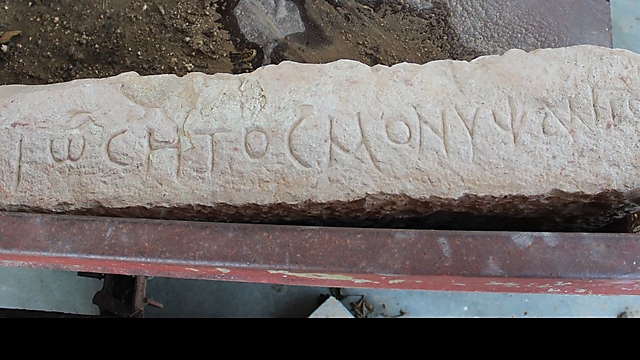
1,700-year-old gravestones of unknown rabbis have been discovered in northern Israel

A nearly 2000-year-old Greek inscription (Photo: Mickey Peleg, courtesy of the Israeli Antiquities Authority)

As reported by Michael Bachner of Tazpit Press Service, February 2, 2016:

Three ancient gravestone epitaphs written in Aramaic and in Greek were recently uncovered in the Galilee region in northern Israel. The people commemorated in two of the inscriptions are described as rabbis, but their exact names and identities have yet to be identified by further research.

The two epitaphs end with the Hebrew greeting word “shalom” (meaning ‘hello’ or ‘peace’). The Greek inscription mentions the name “Jose,” which at the time had been a very common name among Jews in Israel and in the diaspora.

The gravestones were buried in the western part of the cemetery of the Jewish community of Zippori in the Lower Galilee region, which was a major Jewish city in ancient times. The information that ultimately led to the discovery originally came from residents of the community.

The excavation was conducted by researchers from the Kinneret Institute for Galilean Archaeology in Kinneret College, and from the Israel Antiquities Authority (IAA).

“One of the surprises in the newly uncovered inscriptions is that one of the people buried is nicknamed as ‘The Tiberian’,” said Dr. Motti Aviam from the Kinneret College. “This is the second case of a person from Tiberias buried in the Zippori cemetery. Perhaps Jews from all around the Galilee chose to be buried in Zippori due to Judah the Prince’s important activities in the city.”

Judah the Prince, nicknamed simply ‘Rabbi’, was the chief redactor of the Jewish Mishnah (the first major work of Rabbinic literature) and he lived in Zippori during the Roman occupation. Zippori was the first capital of the Galilee region in Hasmonean times, until Tiberias was founded in the first century CE.

The city was a bustling Jewish center as indicated by the many artifacts discovered in the city, including Jewish ritual baths (mikveh) and 17 epitaphs, mostly in Aramaic which had been the spoken language among Jews at the time. Some of them also spoke and wrote in Greek.

“The significance of the gravestones lies in the fact they reflect the daily life of Jews in Zippori and their culture 1,700 years ago,” said Dr. Aviam.

“One of the inscriptions features the Hebrew word ‘leolam’ (meaning ‘forever’), for the first time in Zippori,” he added. “The word is known from epitaphs in other locations, and means in this context that their burial place shall remain his forever, without anyone robbing it from them.”

The inscriptions will be researched further, and the researchers believe that more research will likely produce new discoveries. The IAA and the Kinneret College also stated that the gravestones will be on display for the general public.

Israeli boy on hike finds 3,400-year-old Canaanite figurine

As reported by Michael Bachner of Tazpit News Service, February 28, 2016:

(Photograph)

A seven-year-old child recently discovered an ancient female figurine at the Tel Rehov archeological site in northern Israel. The figurine is estimated to be one of the Teraphim, idolatrous statues used during Biblical times.

Ori Greenhut, from the community of Tel Teomim, went on a hike with friends at the beginning of the week accompanied by the father of one of his friends. While climbing the archeological mound in Tel Rehov, Ori came across a stone that had been moved and suddenly saw a small figure covered in mud. He scraped off the mud and discovered the clay figurine.

“Ori came home with an impressive figurine and it was really exciting,” said Moriya Greenhut, Ori’s mother. “We explained to him that it is an antiquity and that the Antiquities Authority keeps the findings for the benefit of the general public.”

The Greenhut family gave the figurine to the Israel Antiquities Authority (IAA), and IAA representatives came to Ori’s school at Kibbutz Sde Eliyahu to award him a certificate of appreciation for his good citizenship. They also informed the class of details about the figurine, which depicts a naked woman and was made by pressing soft silt into a mold.

“It was incredible,” said Ori’s teacher. “The archeologists came into the class during a Torah lesson in which we had just learned about the Teraphim, statues that were used at the time for pagan idolatry. I suddenly understood that one of these Teraphim was here in the class with us!”

Hebrew University Professor Amihai Mazar, who directs the Tel Rehov excavation expedition, studied the figurine and concluded that it is approximately 3,400 years old and “typical of Canaanite culture between the 15th and 13th centuries BCE.”

“Some researchers believe the figurine depicts a mortal woman while others think it is a depiction of the fertility goddess Ashtoreth, known from the Bible and from Canaanite sources,” added Prof. Mazar. “There is a good chance that the term Teraphim in the Torah indeed refers to this kind of figurine.”

“The figurine seems to have belonged to one of the residents of the ancient city of Rehov, which had then been ruled by the pharaohs of ancient Egypt,” he added.
.

Ultra-Orthodox Jewish men should be prohibited from flying on planes

I'm generally opposed to discrimination against Jews, but the following items illustrate why airplanes (and hot air balloons and airships, for that matter) should be "no-fly" zones for Haredi (ultra-Orthodox) men. These examples also show why the Haredi are unpopular with their fellow Jews.

As reported by Itay Blumenthal of Ynetnews, February 27, 2016:

Police arrested a Beit Shemesh resident earlier this week after he caused a disturbance on an El Al flight from Warsaw to Tel Aviv because a movie being screened on the plane was "immodest" in his opinion.

The 36-year-old ultra-Orthodox man informed flight attendants that he refuses to watch the film, and forcefully pushed the screen away, causing damage. He also attacked passengers who commented on his behavior.

Police officers who arrived at Ben-Gurion International Airport arrested him after he deplaned and took him in for questioning.

"There were some passengers on the plane who decided not to watch TV on the plane," one of the passengers recounted. "There was one who forcefully pushed the screen (coming down from the plane's ceiling - ed.) and really broke it. I think he must've thought all of the other screens will also close, but that didn't happen. At this point, a ruckus broke out and people started yelling at him. He claimed this was 'secular coercion' and would not calm down. He was really upset and later jumped on another passenger who told him off."

This behavior persisted throughout the flight and close to landing time, when the screens came down again, the Beit Shemesh man "yelled on the plane that he could not stand it that movies are being watched. He said these were immodest films."

Another passenger said the Beit Shemesh man boarded the plane late with a group of other passengers, and that is why the airline could not seat them away from the screens.

"Their behavior is just rude. They were late and made exaggerated demands," he said. "The El Al flight attendants behaved in an exemplary manner. They remained level-headed, calmed things down, and called the police, as procedures dictate."

A third passenger said that "A group of ultra-Orthodox passengers came on the plane with a lot of 15 year olds. At first they caused a disturbance over the seating arrangements - they would not sit next to women. They didn't exactly have places to sit that matched their wishes, and they were arguing until the last moment. They would not sit next to a woman under any circumstance."

She went on to say that "the flight attendant told them that the plane won't move until everyone is seated. After a lot of arguments, seats were found for them."

The Beit Shemesh man, she said, "started pushing all of the screens back up, people were shocked. I already saw what movie was being screened and I asked, 'Why are you closing them?' and he said, 'God is the Almighty, and he will preserve us.' Nothing we tried helped and he closed everyone's TVs, using a toothpick to keep the screens locked in. A fight almost broke out there."

This isn't the first time Israeli passengers caused disturbances on flights. An Israeli man was caught smoking in the bathroom stall of an Austrian Airlines flight from Vienna to New York, forcing the pilot to make an emergency landing in Canada. He swore at the flight attendants and demanded to be served alcohol. Two strong passengers had to restrain him and cuff him. The passenger told investigators that he took a sleeping pill and drank several glasses of wine and that he could not remember what had happened.

A year ago, an Israeli woman on an Israir flight to Varna verbally attacked one of the flight attendants during an argument over her desire to purchase duty free chocolate while the flight attendant was busy with another passenger. Two of the passenger's relatives also joined the argument, swearing at the flight attendant, with one of them threatening to hit the flight attendant.

El Al said in response to the Warsaw-Tel Aviv flight incident that "El Al will not accept violent behavior of any kind during its flights, and that is why police was called."
As reported by Isabel Kershner of The New York Times, February 26, 2016:

JERUSALEM — RENEE RABINOWITZ is a sharp-witted retired lawyer with a Ph.D. in educational psychology, who escaped the Nazis in Europe as a child. Now she is about to become a test case in the battle over religion and gender in Israel’s public spaces — and the skies above — as the plaintiff in a lawsuit accusing El Al, the national airline, of discrimination.

Ms. Rabinowitz was comfortably settled into her aisle seat in the business-class section on El Al Flight 028 from Newark to Tel Aviv in December when, as she put it, “this rather distinguished-looking man in Hasidic or Haredi garb, I’d guess around 50 or so, shows up.”

The man was assigned the window seat in her row. But, like many ultra-Orthodox male passengers, he did not want to sit next to a woman, seeing even inadvertent contact with the opposite sex as verboten under the strictest interpretation of Jewish law. Soon, Ms. Rabinowitz said, a flight attendant offered her a “better” seat, up front, closer to first class.

Reluctantly, Ms. Rabinowitz, an impeccably groomed 81-year-old grandmother who walks with a cane because of bad knees, agreed.

“Despite all my accomplishments — and my age is also an accomplishment — I felt minimized,” she recalled in a recent interview in her elegantly appointed apartment in a fashionable neighborhood of Jerusalem.

“For me this is not personal,” Ms. Rabinowitz added. “It is intellectual, ideological and legal. I think to myself, here I am, an older woman, educated, I’ve been around the world, and some guy can decide that I shouldn’t sit next to him. Why?”

That is just what many feminists and advocates of religious pluralism in Israel and abroad have been asking in what by all accounts is a growing phenomenon of religious Jewish men refusing to sit next to women on airplanes. Several flights from New York to Israel, on El Al and other airlines, have been delayed or disrupted as women refused to move, and there have been social media campaigns including a protest petition.

Just this week, in a different but related situation, an ultra-Orthodox man created a disturbance on an El Al flight from Warsaw to Tel Aviv to protest the screening of “Truth,” starring Cate Blanchett and Robert Redford, a movie he deemed immodest, the Israeli newspaper Yediot Aharonot reported.

Now, a liberal advocacy group that had spent two years searching for a test case on switching seats plans to sue the blue-and-white flag carrier on Ms. Rabinowitz’s behalf in a Tel Aviv court next week.

“We needed a case of a flight attendant being actively involved,” explained the group’s director, Anat Hoffman, “to show that El Al has internalized the commandment, ‘I cannot sit next to a woman.’ ”

An El Al spokeswoman said in a statement that “any discrimination between passengers is strictly prohibited.”

“El Al flight attendants are on the front line of providing service for the company’s varied array of passengers,” the statement said. “In the cabin, the attendants receive different and varied requests and they try to assist as much as possible, the goal being to have the plane take off on time and for all the passengers to arrive at their destination as scheduled.”

Ms. Hoffman’s group, the Israel Religious Action Center, the public and legal advocacy arm of the Reform Movement in Israel, previously fought Israeli bus companies and the Ministry of Transportation over gender segregation on so-called kosher lines that serve ultra-Orthodox neighborhoods. The Supreme Court in 2011 made it illegal to require women to sit in the back of the bus and allowed men and women to sit separately only if they did so voluntarily. Two years later, Israel’s attorney general issued guidelines calling on government ministries and public agencies to end all manifestations of gender segregation in the public sphere.

THE group has since turned its focus skyward. Ms. Rabinowitz attended a lecture by Ms. Hoffman a few weeks after her fateful flight. The topic of seat switching came up, and Ms. Rabinowitz told Ms. Hoffman it had happened to her.

“When I told Anat that the flight attendant had asked me to move, she got very excited,” Ms. Rabinowitz recalled.

Ms. Rabinowitz, who moved to Jerusalem from the United States about a decade ago, says that she is not anti-Haredi — the Hebrew term for ultra-Orthodox, meaning one who trembles before God — and she comes with her own God-fearing credentials.

Born in Belgium, she fled with her family during the Nazi occupation in 1941. She had a religious upbringing, attended an Orthodox Jewish school in New York, where a strictly modest dress code applied, and she still observes most of the laws of the Sabbath. Both her second husband, who died three years ago, and her first (they divorced in 1986) were rabbis.

She described one of her grandchildren as being Hasidic or Haredi, and said, “The idea of having a Haredi population is wonderful, as long as they don’t tell me what to do.”

Ms. Rabinowitz had been visiting family in New York before boarding the Dec. 2 El Al flight home. By her account, the flight attendant had a brief conversation in Hebrew with her ultra-Orthodox seatmate-to-be, which she could not understand, then persuaded Ms. Rabinowitz to come and see the “better” seat, at the end of a row of three.

“There were two women seated there,” she said. “I thought, ‘Oy, if they are going to talk all night I am not going to be happy.’” She asked the flight attendant if he was suggesting the switch because the man next to her wanted her to move, she said, “and he said ‘yes’ without any hesitation.”

WHEN Ms. Rabinowitz returned to her original seat to collect her hand luggage, with the attendant’s assistance, she asked the other passenger, “Why does it matter? I’m 81 years old. And he says, ‘It’s in the Torah.’ ” After briefly arguing the point, she moved to the new seat. “I thought, ‘He’s going to be unhappy,’” she recalled. “There was no other seat available for him next to a man so I thought I’d try it.”

The other women in the new row were busy working and did not chatter. Still, Ms. Rabinowitz said she felt further insulted because the attendant had tried to mislead her.

“The flight attendant treated me as if I was stupid,” she said, “but that’s a common problem in Israel if you don’t speak Hebrew. They assume things about you. They assume they can put one over you.”

A lawyer for the religious action group wrote a letter to El Al last month saying that Ms. Rabinowitz had felt pressured by the attendant and accusing El Al of illegal discrimination. It argued that a request not to be seated next to a woman differed from other requests to move, say, to sit near a relative or a friend, because it was by nature degrading. The lawyer demanded 50,000 shekels, about $13,000, in compensation for Ms. Rabinowitz.

The airline offered, instead, a $200 discount on Ms. Rabinowitz’s next El Al flight. It insisted that there was no gender discrimination on El Al flights, that the flight attendant had made it clear to Ms. Rabinowitz that she was in no way obligated to move, and that she had changed seats without argument.

Ms. Rabinowitz has since had time to ponder. She said her son told her that “this whole idea that you cannot sit next to a woman is bogus.” She cited an eminent Orthodox scholar, Rabbi Moshe Feinstein, who counseled that it was acceptable for a Jewish man to sit next to a woman on a subway or a bus so long as there was no intention to seek sexual pleasure from any incidental contact.

“When did modesty become the sum and end all of being a Jewish woman?” Ms. Rabinowitz asked. Citing examples like the biblical warrior Deborah, the matriarch Sarah and Queen Esther, she noted: “Our heroes in history were not modest little women.”

Ultra-Orthodox Jewish politician in Israel compares Reform Judaism to a mentally ill person

Judaism isn't a monolith, especially in Israel. It ranges from Reform, which is very liberal, to ultra-Orthodox, also called Haredi. Reform and Haredi don't get along very well; here's an example, reported by Jewish Telegraphic Agency, February 24, 2016 (links in original):

JERUSALEM (JTA) — A haredi Orthodox lawmaker in Israel reportedly compared the Reform movement to a mentally ill person.

Israel Eichler of the United Torah Judaism party made his remarks Tuesday in the lead-up to a Knesset debate the next day on the Supreme Court’s decision that non-Orthodox converts can immerse in a public mikvah, according to the Israeli daily Haaretz.

“Not every mentally ill person can come to the operating room and decide the rules of medicine and force the hospital to have an operation by whatever way works,” Eichler was quoted as saying. “The High Court can’t force a hospital to allow the court’s surgeons and the court’s medicines into the operating room. And so it is intolerable that the directors of ritual baths will have to allow organizers of Reform religion-changing ceremonies into a Jewish ritual bath.”

Eichler also reportedly said the Supreme Court has “no authority to enforce Jewish law, whose source of authority is the Torah, which the High Court does not recognize as a source of its legal authority.”

He also said: “The High Court decision to force the members of the Jewish religion to carry out ritual bath rules and conversions according to the Reform religion, which does not believe in the purity of the ritual bath … is a serious infraction of freedom of religion for the members of the Jewish religion, which has clear laws. Religious freedom is promised in the Declaration of Independence to the members of all religions in the State of Israel, including the believers in the Jewish religion.”

Earlier this month, the Supreme Court ruled that mikvahs in Israel must open to non-Orthodox conversion rites. Previously, Israeli mikvahs have denied access for conversion immersions to Reform and Conservative converts. Israel’s mikvahs are run by Israel’s Religious Services Ministry, which operates in lock-step with the Orthodox-dominated Chief Rabbinate.

Rabbi Rick Jacobs, president of the Union for Reform Judaism, in a statement Wednesday called Eichler’s remarks “another example of the extreme intolerance of the ultra-Orthodox religious establishment. Clearly they feel a seismic shift in their decades-old monopoly on Judaism in Israel. Their stranglehold on Judaism is being loosened, and their response is desperate and pathetic.

“It is hard to imagine what twisted Torah MK Eichler studies when he characterizes the largest movement in Jewish life as ‘mentally ill.’ Our Torah teaches us the values of pluralism and of tolerance — and it teaches us not to use phrases like ‘mentally ill’ as an epithet.”

Rabbis Denise Eger and Steven Fox, president and chief executive, respectively, of the Central Conference of American Rabbis, the Reform movement’s rabbinical organization, called Eichler’s comments “disturbing and ignorant,” adding that they are “insensitive and backwards.”

“At the very moment that hundreds of Reform rabbis from North America are in Jerusalem celebrating the vibrancy of Reform Judaism in Israel and calling for tolerance, the MK’s comments are an unfortunate reminder of how far we still have to go to achieve equality for all Jews in Israel and around the world,” they said in a statement. “We condemn these comments and the worldview they represent.”

In an Op-Ed posted Wednesday on the website of the Jewish Press, an Orthodox Jewish weekly newspaper, Eichler asserted that “the prime minister, the supreme court and the secular establishment are subservient to the Reform millionaires.”
http://www.jewishpress.com/news/analysis-how-the-reform-control-government-knesset-committees-and-the-courts/2016/02/24/

He added that Reform clergy are “investing millions in bribing Israeli public opinion shapers, something the Christian missionaries and certainly the Muslim preachers would dare to do.”

Indiana state Senate passes anti-BDS bill

As reported by Jewish Telegraphic Agency, March 2, 2016 (links in original):

WASHINGTON (JTA) — The Indiana Senate overwhelmingly approved a bill banning state dealings with entities that boycott Israel or its settlements.

The bill approved 47-3 on Tuesday, with bipartisan backing, defines “the promotion of activities to boycott, divest from, or sanction Israel” as meeting the standard of “extraordinary circumstances” necessary under state law to mandate divestment from a company.

The state House of Representatives passed the measure in January. Gov. Mike Pence, a Republican who was a pro-Israel leader when he was in the U.S. Congress, is expected to sign the bill into law.

“This will place Indiana among the select vanguard of states that have publicly defended the Jewish State of Israel using proactive legislation,” said a statement Wednesday by the Jewish Affairs Committee of Indiana, which led the lobbying effort for the bill.

The bill includes in its definition “territories controlled by the Jewish State of Israel,” effectively including any bid to boycott settlements in its purview.

It is one of over 20 bills that have passed or are under consideration in state legislatures that would counter the BDS movement; not all include language targeting settlements. The Obama administration has said that while it will continue to oppose efforts to boycott Israel, it will not oppose bids that specifically target settlements.

The businesses defined in the bill include commercial enterprises and nonprofit organizations, which would mean that the bill, once enacted, would apply to universities. The Boycott, Divestment and Sanctions, or BDS, movement has focused its efforts on campuses and scholarly associations.

Funds that would be mandated to divest from businesses that boycott Israel include the retirement funds of teachers and public employees.

Canadian House of Commons passes motion condemning BDS

As reported by Ilana Shneider of CIJ News, February 22, 2016:

By a vote of 229 for and 51 against, the Canadian Parliament passed a historic motion this afternoon which formally condemned the boycott, divestment and sanctions (BDS) anti-Israel movement.

The Conservatives (including former Prime Minister Stephen Harper who attended the session to cast his vote against BDS), as well as the Liberals voted for the motion. Tom Muclair, leader of the NDP, opposed it as well as Bloc Québécois and three MPs of the Liberal Party (René Arseneault, Larry Bagnell and Nick Whalen).

The motion, which was brought on November 18 by Conservative MP’s Tony Clement and Michelle Rempel, called on Canada to reject BDS.

“That, given Canada and Israel share a long history of friendship as well as economic and diplomatic relations, the House reject the Boycott, Divestment and Sanctions (BDS) movement, which promotes the demonization and delegitimization of the State of Israel, and call upon the government to condemn any and all attempts by Canadian organizations, groups or individuals to promote the BDS movement, both here at home and abroad.”

After the announcement that the Liberals will join the Conservatives in rejecting BDS, Foreign Affairs Minister Stéphane Dion said that “the world will win nothing for boycotting Israel but depriving itself of the talents of its inventiveness”.

On February 18, during the debate on the motion urging the House to reject BDS, Michael Levitt, Liberal candidate for the riding of York Centre, pointed out that “BDS is about intolerance. It’s a broader movement to demonize and delegitimize Israel, and to collectively punish all Israelis by holding Israel alone responsible for the Arab-Israeli conflict”.

“Whereas anti-Semites have long targeted Jews throughout the world as the root of all society’s ills, this new form of anti-Semitism targets Israel as the Jew among the nations, singling out the Jewish State as the root of all ills in the world”, he continued.

Levitt also called attention to the Ottawa Protocol on Combating Anti-Semitism, passed by the previous Conservative government in 2010, which recognized anti-Semitism as a pernicious evil and a global threat against the Jewish people, the State of Israel and free, democratic countries everywhere. Levitt said the Protocol is instructive in identifying anti-Semitism that is pervasive within the BDS movement. “Denying the Jewish people the right to self-determination, for example, by claiming that the existence of Israel is a racist endeavour – that is anti-Semitism. Applying double standards by requiring of Israel behaviour not expected or demanded of any other democratic nation – that is anti-Semitism. Using the symbols or images of classic anti-Semitism to characterize Israel or Israelis – that is anti-Semitism. Drawing comparison of contemporary Israeli policy to that of the Nazis – that is anti-Semitism. Holding Jews collectively responsible for the actions of the government of Israel – that is anti-Semitism.”

“Anti-Semitism so pervasive within the BDS movement involves the discrimination against and the denial of Jewish national self-determination and the right of the Jewish state to exist as the equal member of the family of nations.” – Michael Levitt, Liberal Candidate for York Centre

During the same debate, Anthony Housefather, Liberal Member of Parliament for Mount Royal, said the following: “The BDS movement as well is wrong because the thrust of what it is asking for is the disappearance of the State of Israel. BDS is saying that all Palestinian refugees must have the right of return to what is today Israel, which would automatically create a situation where we would not have a two-state solution. We would have a one-state solution where Israel was not a majority Jewish state. One of the three things that BDS is asking for is actually to make Israel disappear as a majority Jewish state, the only one in the whole entire world, and that is wrong. BDS, which again singles out Israel, is not looking at all those other countries in the world that engage in egregious human rights violations.”

“Why are they not condemning Saudi Arabia, which does not even let women drive, and does not let women have any kind of rights? Why are they not condemning Syria, where the Assad regime has killed thousands and actually displaced millions of its own people? What about China? What about North Korea? There is not a word from the BDS movement about any of these other countries. Only Israel is condemned, as BDS holds it to a complete double standard. Indeed, I have been to many meeting where there is talk of BDS. I have heard that Israel should be held to a higher standard, that people do not think it is like other Arab countries. That is the new form of anti-Semitism. The whole idea of holding Israel to a higher moral standard than anyone else is clearly anti-Semitic.”

The Conservative Party’s position against BDS is well known. In January 2015, while in Israel on an official visit, then Minister of Foreign Affairs John Baird issued a statement saying “Canada strongly supports Israel’s right to defend itself by itself and its right to live in peace with its neighbours. Canada will fight any efforts internationally to delegitimize the State of Israel, including the disturbing BDS movement.”

Former Public Safety Minister Steven Blaney told the UN General Assembly that “Canada has taken a zero-tolerance approach to anti-Semitism and all forms of discrimination including rhetoric towards Israel, and attempts to delegitimize Israel such as the BDS movement.”

Member of Parliament Jeff Watson called the BDS movement “hateful and deceitful” and denounced “this new anti-Semitism which is poisoning our Canadian campuses.”

During last October’s election campaign, the Liberals also voiced their opposition to BDS. Several days before the elections, a Liberal Party flier titled “Don’t let Harper make Israel a partisan issue” was distributed in predominantly Jewish neighbourhoods in central and north Toronto, which read in part: “We abhor and fight BDS, the targeting of Israel at the UN and all other examples of the new anti-Semitism and efforts to isolate Israel”.

In March, 2015, ahead of a motion put forward by McGill University undergraduates’ association which urged the university to divest from companies “profiting from the illegal occupation of Palestinian territories”, then Liberal leader Trudeau tweeted: “The BDS movement, like Israeli Apartheid Week, has no place on Canadian campuses. As a McGill alum, I’m disappointed [the motion was introduced].”

The Canadian vote comes days after the British government enacted measures to prevent public bodies from engaging in or endorsing boycotts of the State of Israel. The measures, which make such boycotts illegal, represents a serious blow to the BDS movement.

Britain is the second major European country which enacted legislation against boycotting Israel. France passed such laws in 2003, and they have served as the basis for multiple convictions of BDS activists who were sentenced for incitement to discrimination or hate due to their actions on Israel.

In the US, state legislatures in New York, Pennsylvania, Florida, Alabama, Tennessee and Indiana passed anti-BDS resolutions and about a dozen other states are considering following suit.

On February 17, French banking giant BNP Paribas announced that it is shutting down a major financing source for the BDS campaign in Germany. This is the latest in an anti-BDS trend in Germany and, potentially, the first step in cutting of BDS funding in Europe.

On February 20, barely one month after passing a motion supporting a boycott against Israel, the Spanish municipality of Aviles reversed its own decision and denounced it as discriminatory.

Wednesday, 2 March 2016

40 Columbia University professors sign BDS petition, while McGill University students reject BDS in an online petition

Apartheid was abolished in South Africa more than 20 years ago, so those who are always looking for something to protest have made Israel their favourite target in recent years, with such inspirational works as Israel Apartheid Week on university campuses and the Boycott, Divestment and Sanctions (BDS) movement. As reported by Jewish Telegraphic Agency, March 1, 2016 (link in original):

NEW YORK (JTA) — Forty Columbia University faculty members have signed a petition urging the New York school to divest from companies that “supply, perpetuate, and profit from a system that has subjugated the Palestinian people.”

The petition was released Monday morning to mark the first day of Israel Apartheid Week, the Columbia Spectator reported.

According to the petition, the signatories “stand with Columbia University Apartheid Divest, Columbia Students for Justice in Palestine as well as with Jewish Voice for Peace in calling upon the University to take a moral stance against Israel’s violence in all its forms.”

They include Rashid Khalidi, a history and Middle Eastern studies professor who is a longtime critic of Israel and supporter of the Boycott, Divestment and Sanctions movement; Joseph Massad, a professor of modern Arab politics and intellectual history who sees Zionism as a racist and colonialist movement, and Nadia Abu El-Haj, an anthropology professor who received tenure in 2007 following a heated battle over the merits of her work, particularly a book that accuses Israel of manipulating archaeological findings to legitimize its existence.

The most heavily represented departments among the signers are Middle Eastern South Asian and Africa studies, or MESAAS, English and comparative literature, and anthropology.

Partha Chatterjee, an anthropology and MESAAS professor at the Ivy League school who signed, told the Spectator in an email that he wanted to protest Israel’s security regime, which “virtually amounts to apartheid.”

“I fully support every effort to put pressure on the Israeli government to end its illegal occupation of Palestinian lands,” he said.

Dirk Salomons, a signatory who is a senior lecturer at Columbia’s School of International and Public Affairs, told the Spectator, “I’ve always had a feeling as a Jew that a Jewish state should rise slightly above the lack of morality of its neighbors. It pains me to see how a country which I love and which I have visited many times can be so blind to the needs of its neighbors.”
As reported by Jewish Telegraphic Agency, February 28, 2016 (link in original):

MONTREAL (JTA) — Students at Montreal’s McGill University failed to ratify a Boycott, Divestment and Sanctions motion against Israel.

In online voting last week by undergraduates, the motion was rejected 2,819-2,119 (57 percent to 43 percent), with 440 abstentions. It had passed in the university’s student society on Feb. 22 by a vote of 512-357, and was seen as a blow by pro-Israel students.

“The BDS movement, which among other things calls for universities to cut ties with Israeli universities, flies in the face of the tolerance and respect we cherish as values fundamental to a university,” McGill’s principal and vice chancellor, Suzanne Fortier, said in a statement. “It proposed actions that are contrary to the principles of academic freedom, equity, inclusiveness, and the exchange of views and ideas in responsible open discourse.”

Fortier said McGill, which has maintained silence on the issue, could not react to the BDS issue until the online vote deadline passed “out of respect for the student governance process.”

Pro-BDS forces at McGill have tried and failed three times over the past 18 months to pass a BDS motion.

After the student government passed the motion last week, some pro-Israel students said they encountered open hostility and even anti-Semitism on social media, while some previous donors to McGill vowed to stop giving.

On the same day the motion was passed by the student government, the Canadian Parliament passed a measure formally condemning BDS by a vote of 229-51. It calls on the Canadian government to “condemn any and all attempts by Canadian organizations, groups or individuals to promote the BDS movement, both here at home, and abroad.”

Over the past few years, several Canadian universities have passed pro-BDS motions.

Former U.K. Chief Rabbi Jonathan Sacks is named the winner of the Templeton Prize for 2016

As reported by Jewish Telegraphic Agency, March 2, 2016:

(JTA) — Rabbi Lord Jonathan Sacks has been awarded the 2016 Templeton Prize, which honors a living person who has made an exceptional contribution to affirming life’s spiritual dimension.

Sacks, the former chief rabbi of Britain and the author of more than two dozen books, will receive a cash prize worth about $1.5 million.

The announcement was made Wednesday morning at the British Academy in London by the Pennsylvania-based John Templeton Foundation.

The prize will be formally awarded at a ceremony on May 26 in London. It is one of the largest prizes awarded to an individual. Established in 1972 by the late global investor and philanthropist Sir John Templeton, the prize is “a cornerstone of the John Templeton Foundation’s international efforts to serve as a philanthropic catalyst for discoveries relating to the Big Questions of human purpose and ultimate reality,” the prize committee said in a statement.

Sacks, 67, served as Chief Rabbi from 1991 to 2013, and revitalized Britain’s Jewish community during his tenure, according to the prize committee. The committee’s statement also said: “During his tenure he catalyzed a network of organizations that introduced a Jewish focus in areas including business, women’s issues and education, and urged British Jewry to turn outward to share the ethics of their faith with the broader community. Central to his message is appreciation and respect of all faiths, with an emphasis that recognizing the values of each is the only path to effectively combat the global rise of violence and terrorism.”

Sacks was knighted by Queen Elizabeth II in 2005 and awarded a Life Peerage in the British House of Lords in 2009. He currently serves as Professor of Judaic Thought at New York University; Professor of Jewish Thought at Yeshiva University, New York; and Professor of Law, Ethics and the Bible at King’s College, London.

In a statement delivered at the announcement of the prize, Sacks said: I believe that religion, or more precisely, religions, should have a voice in the public conversation within the societies of the West, as to how to live, how to construct a social order, how to enhance human dignity, honour human life, and indeed protect life as a whole from environmental hazard. …Religion must have a voice in the public conversation, but it must be a reasoned and reasonable voice and one that makes space for other voices also.”

Other recipients include Mother Teresa, who received the inaugural Prize award in 1973, Aleksandr Solzhenitsyn (1983), and philosopher Charles Taylor (2007). Last year’s Prize winner was Canadian theologian Jean Vanier, the founder of L’Arche, an international network of communities where people with and without intellectual disabilities live and work together as peers. The 2014 Laureate was Czech priest and philosopher Tomáš Halík, following Desmond Tutu, the former Anglican archbishop of Cape Town, in 2013 and the Dalai Lama in 2012.
Sir John Templeton was no Christian, as the Templeton Prize indicates. From 1973-2001, it was the Templeton Prize for Progress in Religion. Among the recipients during this era were evangelist Billy Graham (1982); Prison Fellowship founder Chuck Colson (1993); and Campus Crusade for Christ founder Bill Bright (1996). Since 2009 the prize has been awarded to a living person, who in the estimation of the judges, "has made an exceptional contribution to affirming life's spiritual dimension, whether through insight, discovery, or practical works". Recent winners include Francisco Ayala (2010), an evolutionary geneticist who opposes the teaching of creation in public schools; the Dalai Lama (2012); and former Anglican Archbishop of Cape Town Desmond Tutu (2013), a universalist. Readers may come to their own conclusions.

Jewish Temple Mount activist Yehuda Glick returns to the site after the ban on him is lifted

As reported by Agence France-Presse, March 1, 2016:

Israeli religious hardliner Yehuda Glick visited the Al-Aqsa mosque compound Tuesday for the first time since a Palestinian tried to kill him over his campaign to boost the Jewish presence at the highly sensitive site.

The site in Israeli-annexed east Jerusalem is the third-holiest in Islam, but is also revered by Jews as the Temple Mount and considered their holiest.

Clashes there last year were a precursor to the current five-month wave of violence in Israel and the Palestinian territories, and there were warnings that the visit by Glick, who has previously been banned from the site, could set off further tensions.

Glick has been an outspoken advocate of Jewish rights to the holy site, which Muslims and Palestinians consider a provocation. He has also guided visits there.

The 50-year-old US-born rabbi carried out "a legal visit to the Temple Mount that took place without incident," a police spokeswoman told AFP.

A spokesman for the Waqf, the Muslim trust which administers the site, said Glick's "actions and statements are provocations against Palestinians. The visit bodes ill."

Glick was on October 29, 2014 shot four times by a masked gunman in Jerusalem. A day later, police shot and killed his suspected attacker, Muataz Hijazi, a Palestinian from east Jerusalem.

The rabbi is also a thorn in the side of the mainstream Israeli Jewish religious establishment, which recognises the Temple Mount as the site of the biblical temples and Judaism's holiest, but says Jews should not pray or even visit there at this time.

Current rules governing the site allow Jews to visit during set hours but not pray there to avoid provoking tensions.

A court recently exonerated Glick of a charge of assaulting a Palestinian woman, and removed the police ban on him visiting the holy site.

Glick, who is a member of the ruling Likud party and next in line to enter parliament, had also been barred from the site between 2011-2013 for praying there.

Speaking to AFP, Glick said that while there were no restrictions on his visits beyond those that apply to other non-Muslims, he had coordinated Tuesday's visit with the police.

He said it felt like "returning home" after the long absence.

Glick said tensions at the site had been dramatically lowered since Israel's September ban on the Murabitat and Murabitun, funded by the Islamic Movement in Israel and acting as self-appointed sentinels who harassed Jewish visitors.

A wave of violence in Israel and the Palestinian territories since October has killed 178 Palestinians as well as 28 Israelis, an American, a Sudanese and an Eritrean.

Most of the Palestinians who died in the violence were killed by Israeli forces while carrying out knife, gun or car-ramming attacks, according to Israeli authorities.

Clashes erupted at the Al-Aqsa compound during a series of Jewish religious holidays in September amid fears among Muslims that Israel was planning to change rules governing the site.

Israeli Prime Minister Benjamin Netanyahu has said repeatedly there are no such plans.
The rebuilding of the Temple is not a matter of if, but when. Preparations are already underway, and have been for years. See, for example, the sites of the Temple Mount Faithful and Temple Institute.

Tuesday, 1 March 2016

Cuckservative Christian university president in the state of Washington supports "immigrant" invasion

And hath made of one blood all nations of men for to dwell on all the face of the earth, and hath determined the times before appointed, and the bounds of their habitation; Acts 17:26

Since early 2015, the term "cuckservative" has become popular. I don't think there's a dictionary definition yet, but I'm inclined to define a cuckservative as someone who claims to be, or is identified as, conservative, but who considers it more important to be seen as not racist, sexist, "homophobic," or [insert politically correct pejorative here] by people who don't like him, rather than to take a principled conservative stand. I put Joseph Castleberry in this category. Mr. Castleberry is described in a Seattle Times headline as a "leading conservative Christian," although I imagine relatively few people have ever heard of him. As reported by Nina Shapiro of the Seattle Times, February 6, 2016 (bold in original):

“I’m going to have Mexican grandchildren and I can’t wait!”

Joseph Castleberry, president of evangelical Northwest University in Kirkland, and a conservative who counts Ronald Reagan as one of his political heroes, has a lot of surprises up his sleeve, including this. One of his three daughters, he told the crowd at an Auburn luncheon, is married to a Mexican American. He beamed.

Castleberry delightedly defies expectations, even while challenging you to think about why you have those expectations in the first place. Yes, he is a 55-year-old white Republican who unabashedly supports immigrants — even, to some extent, immigrants who are here illegally — because of the spiritual, cultural and economic revitalization he says they bring to the United States.

That makes him an anomaly this political season. Republican presidential candidates — prodded by Donald Trump, who early on said he would build a “great wall” to stop Mexico from sending rapists and other criminals here and later proposed a ban on Muslims entering the country — launched into a competition over who could take the hardest line on immigration.

Little has changed in the wake of Iowa’s Republican caucuses, with Texas Sen. Ted Cruz, propounding a “wall that works,” riding the evangelical vote to victory.

Yet Castleberry contends there’s nothing inherently anti-immigrant about conservatism, and certainly not about evangelicalism. He strikes out at “nativist” rhetoric, as he calls it, in his book, “The New Pilgrims: How Immigrants are Renewing America’s Faith and Values,” released last fall in English and Spanish.

He aimed the book at conservative audiences and lucked out in terms of timing.

“I had no idea the issue was going to be as hot as it was,” he said. Some 70 talk-radio programs across the country, along with Fox News and various other TV outlets, have interviewed him. He has also been speaking at churches and Rotary clubs, like the one that co-sponsored the Auburn event.

“Who is doing the greater danger to the rule of law?” he asked at the luncheon. “Immigrants? Or a Congress who knows the system is broken and won’t fix the laws or enforce them?”

Despite the occasional chiding, Castleberry, generally upbeat and inclined toward old-fashioned courtesy learned from his Southern upbringing, mainly expounds upon the positive contributions of immigrants.

Through intermarriage, he said, immigrants infuse the culture with their family values, tempering an individualism that “tends to get out of control in America.”

They are also more likely to start businesses than native-born Americans, he asserts, “whether they be eBay and Google or the local taco truck.” (eBay was started by French-born Pierre Omidyar, and Russian immigrant Sergey Brin co-founded Google.)

Some of his most passionate reasoning concerns the nation’s spiritual life. “A palpable sense of decline hangs over many sectors of American Christianity like winter clouds,” he writes. And he sees immigrants, who are overwhelmingly religious, and often ardently so, as the sunshine breaking through.

He writes admiringly about immigrant churches like the 1,500-strong, Spanish-language Centro de Vida church in Tacoma. Castleberry speaks there regularly, in Spanish.

“He says that Jesus himself was an immigrant,” laughed Peruvian-born senior pastor Roberto Tejada.

“A child racist”

Castleberry honed his Spanish, and deepened his relationship with its speakers, during 20 years in Latin America. He spent them in periodic stints, including one teaching Greek, Hebrew and the New Testament at Christian University of the Assemblies of God in El Salvador.

His international bent is far from unique in the Pentecostal movement, of which the Assemblies of God is a part. James Wellman, chairman of the University of Washington’s comparative religion program, and a onetime fellow divinity student with Castleberry at Princeton University, pointed out that Pentecostalism has seen tremendous growth in Latin America and Africa.

“Many Pentecostals have a broader and deeper commitment to equality than most liberal Protestants,” said Wellman, who authored the 2008 book “Evangelical vs. Liberal: The Clash of Christian Cultures in the Pacific Northwest.” He noted that liberal Protestantism is a mainly “white movement.”

Northwest University is affiliated with the Assemblies of God, and accepts only professed Christians into its undergraduate program. Castleberry came to the school of roughly 2,000 in 2007.

In his office, housed in the Seahawks’ former headquarters and overlooking the athletic fields, the president explained his pro-immigrant feelings are also linked to growing up in what was then “one of the most racist communities in America”: the small Alabama town of Demopolis.

The son of a paper-mill worker, he recalled his “career as a child racist,” going door to door during the civil-rights era to get support for an anti-busing campaign. He radically changed his mindset after being bused to an African-American school and making his first black friend.

“When you grow up in a sewer, you know what it smells like,” he said, citing the “racist tones” he hears in the current talk about immigrants.

He observed that Republicans will have to get past this if they want to recruit immigrant voters. That was a primary goal expressed after the last presidential election, when GOP nominee Mitt Romney’s famous comment about “self-deportation” cost him the Latino vote, and arguably the election.

“It’s not a fixed law of nature that immigrants have to become Democrats,” Castleberry said. He noted, like Republican analysts after the 2012 election, that many immigrants are socially conservative.

Maybe so, but some conservatives remain suspicious. “Do they vote their values?” asked KTTH 770 AM talk-radio host Todd Herman after having Castleberry on his program last fall. “It doesn’t appear they do.”

In the end, said Chris Vance, a Republican challenger this year to Democratic U.S. Sen. Patty Murray, and a supporter of comprehensive immigration reform, “the people in the party who wanted to reach out to Hispanics got shouted down by the people who don’t.”

Losing the culture wars

And there’s never more shouting than when it comes to specific policies, which divide even people who welcome immigrants into their religious fold.

“For me as a Christian American, to be hostile to people from other places is to violate my spiritual mandate,” said Joe Fuiten, pastor emeritus of Cedar Park Church in Bothell, which has had thriving Iranian, Japanese and Spanish wings.

Yet Fuiten supports building a wall on the border “if that’s what it takes” to keep illegal and dangerous immigrants out, and views Muslims with particular wariness.

While recognizing that Islam “has a problem” with terrorism, Castleberry, in contrast, said he and his friends see Muslims primarily as “neighbors that they want to share the gospel with.”

As for illegal immigration, the university president criticized President Obama’s executive order halting deportations for roughly 5 million people living here in the shadows — an order the U.S. Supreme Court announced in January it will review. Yet, Castleberry’s critique lies in his belief that the president exceeded his authority, not in the order’s substance, with which he is sympathetic.

That’s heresy in some conservative circles, where the order is viewed as an outrageous “bureaucratic fiat,” in Herman’s words. Added the talk-show host, “We’re talking about people who broke a law.”

Castleberry concedes the point, which is why he said he’s not in favor of “amnesty.” Yet he said the U.S. is guilty, too — of a “moral dishonesty” that seeks to punish immigrants who are in the country illegally while at the same time taking advantage of their labor.

Consequently, he said, deportation is too harsh a punishment, preferring the idea of a fine.

A number of evangelical leaders across the country are on the same page. Along with Castleberry, many are part of an Evangelical Immigration Table, which lays out a set of principles, including allowing immigrants a path toward legalization.

That would seem to set the stage for evangelicals — known for conservative stances on issues such as abortion, prayer in the schools and same-sex marriage — to exert a different kind of political influence.

Yet, the Cruz win in Iowa suggests that rank-and-file evangelicals may differ with their leaders on immigration. “Sometimes social class values will outweigh religious perspectives,” Castleberry said, adding, “some, not all, working-class white people are taking the bait to blame immigrants for the so-called disappearance of the middle class.”

Whatever their views, evangelicals may do little more than vote. This generation has largely backed away from politics, according to Castleberry. Jerry Falwell’s Moral Majority, he noted, is defunct.

He explained it this way: “The culture wars are already over, and evangelical Christians lost.”

“It’s not what it was,” agreed Vance, speaking of the evangelical force in politics. He said back when Ellen Craswell ran for governor as the Republican nominee in 1996, speaking about “God’s plan” for Washington, “you saw people coming to Republican party meetings with Bibles.” Those people have dropped out, replaced by Tea Partiers bringing copies of the U.S. Constitution.

Castleberry isn’t exactly trying to get evangelicals back into politics. But he is trying to change hearts and minds.

And he had some success at least with Roger Tyson, a retired physician who doesn’t identify with any party but leans conservative. After Castleberry gave his speech in Auburn last month, Tyson walked up to the university president and asked tough questions, including about immigrants taking away American jobs.

Castleberry cited a 2015 study showing that immigrants, by increasing consumer demand, actually create jobs — on average 1.2 per immigrant.

“He had a really good response,” Tyson conceded afterward, noticeably impressed.
I don't disagree with everything Mr. Castleberry says. I agree with him that evangelicals have lost the culture wars; but then, those are wars that God hasn't called us to fight. Christians are called to contend for the faith once delivered unto the saints (Jude 3), not the culture. When Mr. Castleberry asks the rhetorical question about whether immigrants or Congress are more to blame for problems surrounding immmigration, he raises a good point; I suggest both are to blame. I notice, though, in typical cuckservative fashion, he decries as "nativism" what others might call traditional Americans wanting to preserve their country. In the world of multiculturalism, it's okay for other nations to want to preserve their identity, but nations composed of traditionally white peoples aren't entitled to do likewise, and when they do, it's called "racism" or "nativism."

Promoters of "immigrant" invasion within Christian circles are fond of quoting the first part of Acts 17:26, but not the last part. At the time of the tower of Babel, it really was "one world," but it united in rebellion against God:

And the whole earth was of one language, and of one speech.
And it came to pass, as they journeyed from the east, that they found a plain in the land of Shinar; and they dwelt there.
And they said one to another, Go to, let us make brick, and burn them thoroughly. And they had brick for stone, and slime had they for mortar.
And they said, Go to, let us build us a city and a tower, whose top may reach unto heaven; and let us make us a name, lest we be scattered abroad upon the face of the whole earth.
And the Lord came down to see the city and the tower, which the children of men builded.
And the Lord said, Behold, the people is one, and they have all one language; and this they begin to do: and now nothing will be restrained from them, which they have imagined to do.
Go to, let us go down, and there confound their language, that they may not understand one another's speech.
So the Lord scattered them abroad from thence upon the face of all the earth: and they left off to build the city.
Therefore is the name of it called Babel; because the Lord did there confound the language of all the earth: and from thence did the Lord scatter them abroad upon the face of all the earth.
Genesis 11:1-9

This was the first recorded instance where the world came together as one, and God responded by splitting the world up into various nations; and that's the way He wants to keep it, until the Lord Jesus Christ returns to set up his millennial kingdom. As Mark Steyn put it, diversity is great for the world, but not for a country.

There are two other occasions mentioned in Scripture where the world comes together as one: at the end of the Tribulation when the Lord Jesus Christ returns to Earth (Revelation 19:19), and at the end of the Millennium when Satan is loosed and allowed to deceive the nations, and they gather together to battle (Revelation 20:7-9). In every case, the world "coming together as one" is always a movement against God, not a movement by Him.

Vox Day, at his Vox Popoli blog, has a large number of excellent posts on the subject of immigration. For those inclined to be taken in by Mr. Castleberry's arguments, I suggest going to Mr. Day's blog and searching posts under the labels "immigration," "invasion," "Clash of Civilizations," "Vibrancy is our strength," "SJW," and "cuckservative."

To say that Jesus was an immigrant is incorrect. Joseph, Mary, and Jesus fled to Egypt during the time that King Herod of Judea was seeking Jesus in order to kill him, but that was just until Herod died, and then the family returned to Nazareth, where they remained (Matthew 2:13-23).

Mr. Castleberry complains that deportation of illegal immigrants is too harsh a measure, and supports a "path toward legalization." It should be kept in mind that illegal immigrants are just that--people who've broken the law to get into the country. I don't think people who illegally enter a country should be entitled to citizenship. I presume from Mr. Castleberry's attitude that if a stranger invaded his home and set up residence, that Mr. Castleberry would accommodate him and treat him as though he were a member of his own family with all the rights and privileges that go with that.

With his comments that "Sometimes social class values will outweigh religious perspectives" and “some, not all, working-class white people are taking the bait to blame immigrants for the so-called disappearance of the middle class,” Mr. Castleberry shows no empathy for the people who comprise a sizeable portion, and probably the majority, of the people of his own area. "Social class values" sounds like Social Justice Warrior-speak for the natural desire for and concern for people to be able to support themselves and their families. Mr. Castleberry probably has no immediate fear of losing his job to a foreigner (file that under "scenes we'd like to see"). He shows his contempt for working-class white people by referring to the "so-called disappearance of the middle class." The disappearance of the middle class in the United States is real, as reported in the following items from former U.S. deputy Treasury Secretary Dr. Paul Craig Roberts:

A Reader Reports From The Jobs Front (February 8, 2016)

Reader’s Report on Dire Situation in Southern Illinois (February 8, 2016)

Reader reports on job situation in Ohio (February 9, 2016)

I especially refer the reader to this article by Carolyn May of Breitbart, about a white man who was one of hundreds of middle-class workers who lost their jobs to foreigners--and were forced to train their replacements:

Laid Off Disney Worker Breaks Down in Tears Before Senate Panel (February 25, 2016)

Finally, I find it interesting to note that Mr. Castleberry refers to the grandchildren his daughter and her Mexican American husband are expecting as "Mexican grandchildren"--he didn't say "American."

The bottom line: Never trust cuckservatives; in practice, they're indistinguishable from liberals.