

Showing posts with label India. Show all posts

Wednesday, 31 July 2024

False gods exact a high price from their devotees

When a mere man is worshipped as God, the results are never good; as reported by Elena Salvoni and Agence France-Presse in the London Daily Mail, July 2, 2024:

Around 100 worshippers have been crushed to death at a Hindu religious gathering in northern India, government medics have said.

The death toll has risen to 107, with scores of others injured, according to a senior government official. There are fears the number of dead could increase further.

A large crowd had gathered near the city of Hathras, Uttar Pradesh state, for a sermon by a popular preacher but a fierce dust storm sparked panic as people were leaving.

Many were crushed or trampled, falling on top of each other, with some collapsing into a roadside drain in the chaos.

'The attendees were exiting the venue when a dust storm blinded their vision, leading to a melee and the subsequent tragic incident,' said Chaitra V., divisional commissioner of Aligarh city.

Unverified videos show people crammed together as panicked shrieks and sirens ring out. Separate footage shows bodies piled up on the ground outside a local hospital in the aftermath.

Indian president Droupadi Murmu said in a statement on X: 'The news of the death of many devotees including women and children in the accident in Hathras district of Uttar Pradesh is heart-rending.

'I express my deepest condolences to those who lost their family members and pray for the speedy recovery of those injured.'

State Chief Minister Yogi Adityanath said his thoughts were with the bereaved families and he ordered an urgent investigation into the incident.

'Instructions have been given to the concerned officials to conduct relief and rescue operations on war footing and to provide proper treatment to the injured,' he wrote on X.

Indian prime minister Narendra Modi said he has spoken to Adityanath regarding the tragic incident.

He said the Uttar Pradesh government 'is engaged in providing all possible help to all the victims.'

'My condolences are with those who have lost their loved ones in this,' he added, 'Along with this, I wish for the speedy recovery of all the injured.'

Crowds had been massing to celebrate the Hindu deity Shiva in the town of Sikandrarao, some 120 miles (200km) southeast of New Delhi.

Hathras District Magistrate Ashish Kumar said that it was 'a private event and permission had been given by the sub-divisional magistrate.

'Security arrangements were made by the administration but the other arrangements were supposed to be made by the organisers.'

Deadly accidents are common at places of worship in India during major religious festivals.

At least 112 people were killed in 2016 after a huge explosion caused by a banned fireworks display at a temple marking the Hindu new year.

The blast ripped through concrete buildings and ignited a fire at a temple complex in Kerala state, where thousands had gathered.

Another 115 devotees died in 2013 after a stampede at a bridge near a temple in Madhya Pradesh.

Up to 400,000 people were gathered in the area, and the stampede occurred after a rumour spread that the bridge was about to collapse.

About 224 pilgrims died and more than 400 others were injured in a 2008 stampede at a hilltop temple in the northern city of Jodhpur.
Perceptive readers will notice that the devotees were gathering to worship Shiva. Shiva is a major deity in Hinduism, and is known as the Destroyer in the Hindu trinity that includes Brahma and Vishnu. The destruction resulting from this incident was reported by Cherylann Mollan of BBC News and Dilnawaz Pasha of BBC Hindi, July 3, 2024 (bold, links in original):

The number of people killed in a crush at a religious gathering in the northern Indian state of Uttar Pradesh has risen to 121, making it one of the deadliest such disasters in more than a decade.

The incident took place during a satsang (a Hindu religious festival) in Hathras district on Tuesday.

Police said the number of people present at the venue was three times the permitted limit and most of those who died or were injured were women.

A case has been registered against the event's organisers.

The tragedy has sparked outrage in India, and has led to questions about lapses in safety measures.

What happened?

The crush took place in Pulrai village, where a self-styled godman called Bhole Baba was holding a religious gathering.

Officials said the event was massively overcrowded.

Authorities had given permission for 80,000 people to gather but around 250,000 people attended the event, according to the first information report (FIR) lodged by the police.

Chaos broke out at the end of the event as the preacher was about to leave in his car.

The police report said thousands of devotees ran towards his vehicle and began collecting dust from the path in an act of devotion.

As crowds swelled, several of those sitting and squatting on the ground got crushed.

The document added that some people tried running to a patch of mud-filled fields across the road, but were forcibly stopped by the organisers and were crushed.

Police have registered a case against a man who they say was the event's main organiser and a few others on several charges, including culpable homicide.

On Tuesday, distressing images from the site were circulated online.

Some videos showed the injured being taken to hospitals in pick-up trucks, tuk tuks and even motorbikes.

Other clips showed distraught family members screaming outside a local hospital as they tried to find their loved ones among rows of bodies left at the entrance.

Bunty, who uses only one name and comes from the state's Aligarh district, said he was devastated at the loss of his mother.

He saw her body lying outside a hospital on a news channel on Tuesday evening.

"But when I went there, I could not find my mother and have since been trying to locate her body," he told BBC Hindi.

Others expressed anger over the incident.

Ritesh Kumar, whose 28-year-old wife was among those killed, said his life had been upended.

“My family has been destroyed. The government should see to it that we get justice,” he said.

Who is Bhole Baba?

The self-styled godman's original name is Suraj Pal but he reportedly re-christened himself Narayan Sakar Vishwa Hari. His devotees call him Bhole Baba.

He hails from Bahadurpur village in Kasganj district, which is about 65km (40 miles) from Hathras.

Sanjay Kumar, a senior police officer in the state, told BBC Hindi that he was a constable in the police but was suspended from service after a criminal case was lodged against him.

He was reinstated in the force after a court cleared him but left his job in 2002, Mr Kumar added.

Details about his life are sketchy, but Mr Kumar says that after leaving the force, he began to call himself Bhole Baba.

He does not have much social media presence, but has hundreds of thousands of followers in Hathras and neighbouring districts.

Huge crowds attend his sermons where he is mostly seen in white clothes.

Since the tragedy, the preacher is believed to be hiding in his ashram in Mainpuri, about 100km (62 miles) from Pulrai village.

Shalabh Mathur, a senior official in Aligarh police, said a search was underway to find him and question him.

Police say he runs an organisation called the Ram Kutir Charitable Trust, which was also the main organiser of Tuesday's event.

Satsangs are events where people gather to pray, sing devotional songs or listen to a preacher and they are often attended by a large number of women.

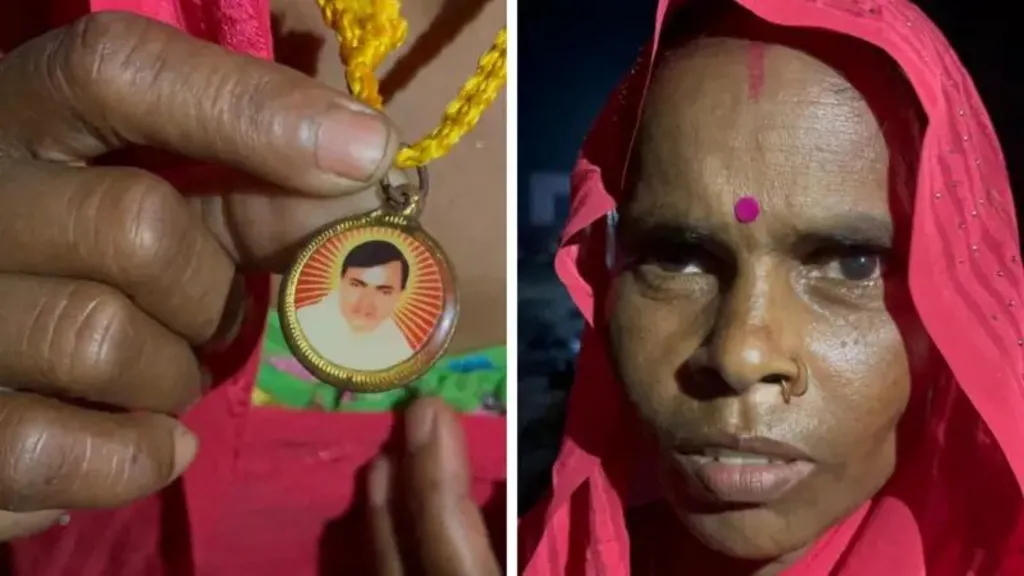
Gomti Devi, who was present at the event, said she had a lot of faith in the Bhole Baba.

She said she wears a locket with his photo because he "cures diseases, ends domestic troubles, and provides employment".
Gomti Devi holds up a locket with the religious leader's image
As reported by Reuters, July 3, 2024 (bold, links in original):

A massive gathering addressed by an Indian policeman-turned-preacher, considered an incarnation of God by his followers, turned horribly wrong on Tuesday, as at least 121 people, mostly women and children, died in a stampede.

"Bhole Baba", or the Innocent Elder, is the sobriquet of a self-styled godman who was a police constable before he turned to spirituality and became a preacher. Originally Suraj Pal Singh, he later changed his name to Narayan Sakar Hari. He is currently untraceable, and police in India's northern state of Uttar Pradesh, where Tuesday's tragedy occurred, said they were still trying to trace him.

Here are some known facts about the preacher:

ORIGINS

Bhole Baba was a police constable in Uttar Pradesh for nearly a decade before he resigned and turned to spirituality, Sudhir Kumar, a senior police official said. The preacher is a native of Kasganj village, close to the Hathras area where the stampede took place.

He used to travel across the states of Uttar Pradesh, Rajasthan and Madhya Pradesh, in India's northern belt, where he has a huge following, and address gatherings, mostly on the first Tuesday of every month, local media said.

A member of India's low-caste Dalit community, Bhole Baba's aim was to create an ideal society, free of superstition and full of compassion, according to a hoarding erected at the site of Tuesday's incident.

ONLINE PERSONA

Posters and videos posted on Bhole Baba's YouTube channel, which boasts of millions of views, show him dressed in either traditional Indian kurta tunics or pristine white suits and ties, often sporting sunglasses, a departure from the spartan image of most godmen.

Holding a microphone in hand, seated on an ornate throne and with his wife by his side, Bhole Baba is seen addressing huge gatherings of mostly women, almost all of whom are sitting on the ground, hands folded in reverence. "Humanity was the true religion, is the true religion and will always be the true religion," he is quoted as saying in a poster.

To protect himself from devotees who would rush to touch his feet and seek his blessings, Bhole Baba had formed a security team known as Narayani Sena, with men and women guards who would escort him to gatherings, an NDTV report said.


Who is Bhole Baba aka Narayan Saakar Hari?

Suraj Pal Singh, known to his followers as Bhole Baba, was born in Bahadur Nagari village in Uttar Pradesh's Etah district to a farmer. He joined UP police and was a head constable working with the Intelligence Unit for over 18 years. However, his followers say he has also claimed that he worked for the Intelligence Bureau.

In 1999, he took voluntary retirement from the service, changed his name to Narayan Saakar Hari and began holding satsangs. He told his devotees he felt an inclination towards spirituality and world peace and he resigned to begin his spiritual journey.

From Suraj Pal to Narayan Saakar Hari

According to a report, he claimed to live in a hut in his village and travelled across Uttar Pradesh to preach. Narayan Hari also enjoys a large following in neighbouring states of Rajasthan and Madhya Pradesh.

Unlike most self-styled godmen, Narayan Hari is seen wearing a white suit and tie or a simple kurta pyjama accompanied by his wife Prem Bati. He also claims he does not keep any money offered to him by followers at his satsangs and distributes it among his followers.

Covid Satsang Had 50,000 Attendees

Even though the self-styled godman is known to keep his distance from the media, he has been embroiled in several controversies. In 2022, he held a similar satsang in UP's Farrukhabad even as cases of Covid were on the rise. While the district administration only permitted 50 people to attend the event over 50,000 people reached the site to attend the programme. The large crowd led to the significant traffic snarls in the area.

Seeing the large crowds that turn up for his satsangs, the godman has a security team named "Narayani Sena" that consists of men and women guards who escort him from his ashram to the satsang locations.
As reported by Reuters, July 5, 2024 (links in original):

The chief organiser of an Indian preacher's event where a stampede killed 121 people this week surrendered to police on Friday, a lawyer for the preacher said, after police had launched a manhunt.

Devprakash Madhukar was named a key suspect in an initial report registered by police under charges including attempted culpable homicide. Police had announced a reward of 100,000 rupees ($1,200) for information leading to his arrest.

A.P. Singh, lawyer for self-styled godman Bhole Baba, said Madhukar was the main organiser of the Hindu religious event on Tuesday attended by about 250,000 people in a village in the northern state of Uttar Pradesh. District authorities had permitted an event of only 80,000 people.

"He has surrendered from Delhi. We are not seeking an anticipatory bail," Singh told reporters. He denied any wrongdoing by the event's organisers and said Devprakash was getting medical treatment in a hospital after the stampede.

The preacher said on Saturday he was saddened by the incident and his aides would help the injured and families of the deceased.

"I have faith that anyone who created the chaos will not be spared," he told Indian news agency ANI, in which Reuters has a minority stake.

($1 = 83.47 Indian rupees)

Saturday, 1 October 2022

Hindu nationalism raises concerns in New Jersey

While some people in the U.S.A.--especially those who want the country to continue on the secular road to destruction--are raising alarms about Christian nationalism, another form of religious nationalism is attracting concern--such are the "blessings" of multiculturalism. As reported by Hannan Adely of North Jersey Media Group, October 1, 2022 (links in original):

In his native India, Shaheen Khateeb said he was treated like an outsider, harassed at school and called “Turk” because of his Muslim faith. Hearing about cases of mob violence against Muslims, he decided to move to the U.S. in 1979.

Today, Khateeb, who lives in Washington Township, fears the tensions he left behind are bubbling up in Indian immigrant communities, including in New Jersey, where, according to the U.S. Census Bureau, about 420,000 people of Indian ancestry live.

In recent months, controversies have ensued over a divisive display at the India Day Parade in Edison, a scuttled speaking engagement in Ridgewood by a Hindu nationalist leader and a Teaneck committee resolution condemned by Hindu groups.

Khateeb said the tensions have strained friendships.

“We visited each other’s homes. We shared dinners. But not anymore,"he said. "What’s happening in India is happening here nowadays because social media news travels really very fast."

Muslim and human rights groups say tensions in the U.S. mirror what is happening abroad as a Hindu nationalist movement grows in India, spurring allegations of discrimination and hate crimes against minorities. But some Hindu leaders say that concerns about nationalist activity in the U.S. are exaggerated and that they are being unfairly vilified and maligned.

Raju Patel, president of the Jersey City Asian Merchants Association, said Indian immigrants are concerned about educating their children and being good citizens, and not the divisions that they left behind.

“People are making a fuss about all these things,” he said. “They are trying to bring those problems here to the U.S.”

Tensions are not new among religious communities in India, where Hindus make up about 80% of the population. But the movement known as Hindutva — a far-right ideology that promotes Hindu rule — has gained strength since Narendra Modi, India’s prime minister, was elected in 2014. Indian right-wing websites and WhatsApp groups have fueled support for the movement in the U.S., said Audrey Truschke, an associate professor of South Asian history at Rutgers University.

What’s new about it is the ferocity of Hindu nationalism, how aggressive they are being and the negative impacts that is having on the Indian Muslim community and cross-community relations,” Truschke said.

Nationalist fervor couched in patriotism, ethnocentrism and anti-immigrant sentiment has risen around the globe. Often, there is a populist strongman at the helm and, in some cases, nationalist extremists have embraced violence to further their cause. These forces have shaped politics in countries like Brazil, Hungary and the U.S., where groups with an "America First" nationalist agenda stormed the Capitol on Jan. 6 to try to subvert the transfer of power.

In New Jersey, many Indian immigrants closely follow news from their native country, but in the past few months, they themselves have been a focus of news stories.

In August, the inclusion of a bulldozer at the India Day Parade in Edison sparked condemnations. In India, some view the bulldozer as a hate symbol for its use in razing homes and businesses to punish Muslim activists in India.

Earlier this month, activists protested a planned fundraiser with Hindu nationalist leader Sadhvi Rithambara at Old Paramus Reformed Church in Ridgewood, leading to its cancelation.

And last week, the Teaneck Democratic Municipal Committee passed a resolution calling for investigations of organizations in the U.S. with alleged ties to a Hindu nationalist paramilitary group. The resolution also called for politicians to reject campaign funds and support from these groups.

The Teaneck resolution sparked outcry from Hindu organizations, which issued a statement calling it a provocative and false act that demonizes the Hindu community and condemns groups that were not given a chance to respond. The backlash prompted Teaneck Mayor James Dunleavy to issue a statement saying the committee is not associated with the township, which has a nonpartisan form of government.

On Friday, the New Jersey Democratic State Committee took a stand against the resolution.

"A foundational goal of the Democratic Party is to bring people together, not to divide them, and the anti-Hindu Teaneck resolution does not accomplish this important goal," the committee wrote in a statement. "We stand with those who value inclusivity and diversity, and against hate and bigotry in any form."

In Edison and Teaneck, residents had heated exchanges over religion and nationalism at municipal meetings or expressed outrage in calls and emails, while urging local officials to take a stance.

Patel said the spate of incidents was due to misinformation and grudges. Nationalism to him meant pride in one's country, he said.

“Is it a crime to have Hindu nationalism? If I hurt somebody, then it’s a crime. In this country, free speech is for everything but some people won’t tolerate that free speech,” he said.

In Jersey City, he said, South Asian immigrants of different faiths continue to work and socialize with one another without problems.

Still, activists, including Khateeb, say the rise of the nationalist movement should not be ignored. Recent violent confrontations in the city of Leicester in England between groups of Hindu and Muslim men were a warning of how problems can escalate, he said. In Leicester, men with metal poles marched through streets chanting “Jai Shri Ram," a religious chant used as a rallying cry against Muslims. At the same time, a Hindu temple was vandalized.

“What happened in the United Kingdom was an eye opener,” he said. “What is happening is Hindutva forces are gathering. There is a massive amount of work being done behind the scenes.”

Tuesday, 15 December 2020

250 members of "lost" "Sons of Manasseh" make aliyah from India to Israel

And it shall come to pass, when all these things are come upon thee, the blessing and the curse, which I have set before thee, and thou shalt call them to mind among all the nations, whither the LORD thy God hath driven thee,
And shalt return unto the LORD thy God, and shalt obey his voice according to all that I command thee this day, thou and thy children, with all thine heart, and with all thy soul;
That then the LORD thy God will turn thy captivity, and have compassion upon thee, and will return and gather thee from all the nations, whither the LORD thy God hath scattered thee.
If any of thine be driven out unto the outmost parts of heaven, from thence will the LORD thy God gather thee, and from thence will he fetch thee:
And the LORD thy God will bring thee into the land which thy fathers possessed, and thou shalt possess it; and he will do thee good, and multiply thee above thy fathers.
Deuteronomy 30:1-5

As reported by Israel365 News, December 14, 2020:

Jerusalem – Tonight, 250 members of the Bnei Menashe Jewish community of northeastern India will make Aliyah via a special flight chartered by both Israel’s Ministry of Aliyah and Integration and the Jerusalem-based nonprofit Shavei Israel.

The Bnei Menashe, or sons of Manasseh, from Mizoram and Manipur claim descent from one of the Ten Lost Tribes of Israel who were sent into exile by the Assyrian Empire more than 27 centuries ago. Their ancestors wandered through Central Asia and the Far East for centuries, before settling along the borders of what are now Burma and Bangladesh. Throughout their sojourn in exile, the Bnei Menashe continued to practice Judaism just as their ancestors did, including observing the Sabbath, keeping kosher, celebrating the festivals, and following the laws of family purity. They continue to nourish the dream of one day returning to the land of their ancestors, the Land of Israel.

The effort was coordinated by Shavei Israel, a nonprofit organization founded by Michael Freund, who immigrated to Israel from the United States with the aim of strengthening the ties between the Jewish people, the State of Israel, and the descendants of Jews around the world. The organization is currently active in more than a dozen countries and provides assistance to a variety of communities such as the Bnei Menashe of India, the Bnei Anousim (referred to by the derogatory term “Marranos” by historians) in Spain, Portugal, and South America, the Subbotnik Jews of Russia, the Jewish community of Kaifeng in China, descendants of Jews living in Poland, and others.
See also my posts: Jews from "lost tribe" move from India to Israel (December 24, 2012)

More descendants of "lost tribe" from India arrive in Israel (April 19, 2017)

Thursday, 26 March 2020

Hindu idolaters in India drink cow urine in an attempt to fight coronavirus

I think I'd rather take my chances with the virus. As reported by David Sidman of Breaking Israel News, March 25, 2020:

Hundreds of Hindus across India are holding cow urine ceremonies in New Delhi to protect and cure themselves from the coronavirus.

Most forms of Hinduism are henotheistic. This means that they worship a single deity called “Brahman,” but still believe in other gods and goddesses. Or, as Hindu writer Shuba Swaminathan puts it: “Hindus do not worship idols” but rather “the power vested in the idols.”

Many in India, a nation of 1.3 billion whose majority is Hindu, consider cows to be sacred. Some of them have recently claimed that cow urine is an elixir.

In their ceremonies, the Hindus can be seen making an “offering” to the coronavirus and while praying that “mother cow” helps them.

Hindu activist Om Prakash claims that the coronavirus is a bacteria (even though it has the word ‘virus’ in its name). He adds that “cow urine is effective against all forms of bacteria” and that he and his fellow Hindus use it “to cleanse their souls and bodies.” Prakash adds that he is “sure cow urine will destroy the bacteria.”

Please don’t try this at home kids.


Sunday, 19 January 2020

30 years ago: The death of Bhagwan Shree Rajneesh

For false Christs and false prophets shall rise, and shall shew signs and wonders, to seduce, if it were possible, even the elect. Mark 13:22 (also Matthew 24:24)

On January 19, 1990, Indian "holy man" Bhagwan Shree Rajneesh died of heart failure at the age of 58. Bhagwan Shree Rajneesh, born Chandhra Mohan Jain, was a Hindu guru who became a philosophy professor and a popular lecturer in the 1950s and '60s. Bhagwan Shree Rajneesh became known as the "sex guru" because of his liberal teachings on sex. He began initiating disciples in 1970, and created an ashram. The ashram began attracting Western followers, especially after 1975, when therapists promoting human potential, aka New Age teachings arrived. Violence and abundant sexual activity between members attracted critical attention from Indian authorities, and Bhagwan Shree Rajneesh and he relocated to Oregon in 1981, where American followers Sheela Silverman and her husband John Shelfer had purchased property.

The Rajneesh organization created the city of Rajneeshpuram, accumulating 93 Rolls Royces and encountering stiff opposition from local residents. Bhagwan Shree Rajneesh had taken a vow of silence in April 1981, but ended the public silence in October 1984, and almost a year later publicly denounced Ms. Silverman and her associates, accusing them of serious crimes, including a 1984 salmonella attack on local residents. Rajneeshpuram collapsed, and Bhagwan Shree Rajneesh was indicted in October 1985 for conspiracy to evade U.S. immigration laws; he ended up making a deal including a fine and an agreement not to return to the United States for five years. After various stops around the world, he landed in Mumbai in July 1986, returning to his ashram in Pune six months later. He suffered from declining health, which he blamed on poisoning in U.S. jails, and in 1989 took the name Osho Rajneesh.

It's interesting to note that a disproportionate number of Bhagwan Shree Rajneesh's followers had backgrounds in psychology. I was a student at Grant MacEwan Community College in Edmonton in the early 1980s, and the college had a psychology instructor under the surname of Narayan, who was a Rajneesh devotee. Mr. Narayan was a Jew whose original name I've forgotten, but he changed his name after falling under the spell of the Bhagwan.

Bhagwan Shree Rajneesh's organization continues to proclaim his false teachings, using the name OSHO. As for the current whereabouts of Rajneeshpuram's 93 Rolls Royces--we're not sure. False Christs such as Bhagwan Shree Rajneesh come and go, but the Lord Jesus Christ lives, and will return to Earth (Acts 1:11).


Thursday, 15 November 2018

Feminists attempt to invade Hindu temple in India

Feminists are not only attempting to take over nominal and actual Christian churches (see post below), but are attempting the same in non-Christian religions. Submitted for your approval, the following, as reported by Kai Schultz of The New York Times, October 23, 2018 (links in original):

NEW DELHI — Before Hindus can climb the 18 golden steps leading to the Sabarimala Temple, a centuries-old hillside shrine in southern India, there are customs to observe.

Devotees fast for 41 days, avoiding alcohol and tobacco. They prepare bundles of goods to be tied to their heads, filling pouches with jaggery, flattened rice and turmeric powder. And they observe a ban on women of childbearing age from visiting, because the shrine’s deity, Lord Ayyappa, is celibate.

Last month, after India’s Supreme Court struck down that ban, furious protests burst the calm surroundings at the Sabarimala Temple, located in a forested patch of the state of Kerala.

When the temple reopened for six days on Wednesday, for the first time since the court’s decision, the pilgrimage path became a kind of conflict zone, pitting traditionalists against police officers who vowed to enforce the law and protect any woman who wished to visit.

At least 12 women attempted the journey. Each was met with a mob that variously shouted in her face, pummeled the police, set vehicles on fire, hurled rocks and blocked the steep, three-mile trail leading to the temple by lying on its slippery stones. All of the women were forced to turn back. One was so overwhelmed that she fainted.

Now, with the temple closed again for about two weeks before its peak season starts, officials are scrambling to figure out what to do. On Tuesday, India’s Supreme Court announced that it would hear petitions next month challenging its ruling. The court did not elaborate; some lawyers said it was too early to say whether the justices had been swayed by the protests, but that a reversal of the ruling seemed unlikely.

For now, Krishna Kumar, a commanding officer posted near the temple, said the focus was on law and order. He gave a dry laugh when asked if the police were ready for November’s reopening. The annual event is often compared to the rush at Mecca, and a crush of millions of pilgrims can clog the trail for hours.

“This is a huge problem,” Mr. Kumar said, “a very huge challenge for the police.”

It is not unusual for Indian court rulings to go unenforced, particularly in remote rural areas. The Supreme Court put that to the test with its September ruling, which overturned a 1991 decision by the High Court of the state of Kerala that banned menstruating women — defined as girls or women between the ages of 10 and 50 — from visiting the temple.

Advocates of the ban argued that it should be respected because it had been in effect for so long, and that the temple’s celibate deity had constitutional rights. But in a 4 to 1 decision, the court disagreed. “Religion cannot become a cover to exclude and to deny the right of every woman to find fulfillment in worship,” Judge Dhananjaya Y. Chandrachud wrote in his opinion.

Almost immediately, thousands of protesters who disagreed marched in Kerala, threatening violent repercussions for women who tried to visit the temple.

Bhakti Pasrija Sethi, a lawyer who was involved in challenging the ban, said she was baffled by the backlash, saying the dismantling of exclusionary rules in other places of worship, like the Haji Ali, a mosque and tomb in Mumbai, or temples in west central India, were not met with the same level of vitriol.

In any case, she said, there was evidence that women had peacefully visited the Sabarimala Temple decades ago for rice-feeding ceremonies, which mark a baby’s first intake of solid foods. Other temples dedicated to Lord Ayyappa also allow women to enter, she said.

“They are giving superstition the cover of religion,” Ms. Sethi said of the protesters. “What they are doing is not religion. The Hindu religion is not teaching you violence.”

Kerala’s chief minister, Pinarayi Vijayan, attributed much of the chaos to members of fringe Hindu groups disguising themselves as pilgrims and then “spreading terror.” Kerala is run by a coalition of communist parties; opposition politicians in the state have warned the police not to use force against protesters and argued that India’s central government, which is led by a party with Hindu nationalist roots, should take over security at the temple.

Initially, the police encouraged women to visit. When a female journalist for The New York Times tried to climb up the path on Thursday, several officers went before her, insisting that it was safe to continue even as the mob began throwing stones. She was struck on the shoulder but was not injured.

As the security situation grew more intense, the government seemed to waver on enforcing the court’s ruling. On Friday, two women, Rehana Fathima, a social activist, and Kavitha Jakkal, a journalist, began climbing the trail in helmets and shoulder pads, escorted by about 100 police officers in riot gear.

As they crested the hill, becoming the only women yet to make it that far, a police officer said there was news: The Kerala government had called to say it was not particularly pleased with the situation.

Kadakampally Surendran, an official with the state Devaswom, a religious trust that helps manage temples, told reporters in Kerala’s capital, Thiruvananthapuram, that the authorities could not allow the shrine to become a place where “activists can come and showcase their power.”

Ms. Fathima said she was not there for activism, but Sunil Arumanoor, a public relations officer with the temple, called her “publicity hungry.” He said those who visited the temple specifically to make a point would be turned away. “This temple belongs to true devotees,” he said in an interview.

After Ms. Fathima and Ms. Jakkal reached the temple’s entrance, a crowd of protesters blocked their way. The temple’s priest warned that he would lock the doors if the women proceeded. They turned back.

Since then, several more women have tried their luck, but the obstacles seemed to pile up. On Saturday, when an advocate for the rights of Dalit people told the police she wanted to go, they discouraged her from doing so because of the heavy rains, and they subjected her to a background check. Others were so badly harassed by protesters that they did not even make it to the trail.

By Monday evening, when the temple complex shut, the message, at least for the moment, seemed clear: The Supreme Court’s ruling had no bearing there.

“History not made,” read a headline on NDTV, an Indian news channel.
The temple was scheduled to reopen on November 16, 2018; go here for the latest news.

Several things about the article above struck this blogger as interesting. The reader will notice that false gods and religions make extraordinary demands on their followers; such is the way with man-made religion, which always involves salvation or self-improvement by works. The God of the Bible, on the other hand, is a God of love and grace, who has not only done everything necessary and sufficient for salvation Himself, but has given us everything we need for "life and godliness" (II Peter 1:3).

India's Supreme Court is just as activist as the Supreme Courts of Canada and the United States, making a ruling to push their agenda and then inventing the most absurd legal justification for it. The "right of every woman to find fulfillment in worship" is given precedence over the right of the religion itself to determine its own doctrines and practices. This isn't a matter with wider social significance (such as whether Jehovah's Witnesses can deny blood transfusions to children who aren't yet of age), but a matter just within the religion itself as to what constitutes permissible worship. The Indian Supreme Court's invention of this "right" is one to keep in mind, to see if and when North American courts invoke it in future rulings restricting religious freedom.

The male Hindu traditionalists mentioned in the article above may be aware of Vox Day's second law of Social Justice Warriors: SJWs always double down. In striking contrast to the wimpiness so often seen among professing Christians in the West, they aren't meekly submitting to an activist court ruling, but are vigorously asserting their right to preserve and practice their religion, even if it means opposing the courts and police. You seldom see that among professing Christians in Western nations.

Monday, 15 October 2018

100 years ago: The death of Shirdi Sai Baba

Jesus saith unto him, I am the way, the truth, and the life: no man cometh unto the Father, but by me. John 14:6

For there is one God, and one mediator between God and men, the man Christ Jesus; I Timothy 2:5

On October 15, 1918, Indian mystic and guru Shirdi Sai Baba died at a reported age of 83. He was something of a syncretist, as he preached the importance of self-realization and promoted the reading of both Hindu and Muslim scriptures, while opposing religious orthodoxy, whether it be Christian, Muslim, or Hindu.

Shirdi Sai Baba founded a movement that still has Hindu and Muslim devotees throughout the world who regard him as an avatar, an incarnation of the Hindu deities Shiva and Dattatreya. The later guru Saithya Sai Baba (1926-2011), who also founded a worldwide movement devoted to himself, claimed to be the reincarnation of Shirdi Sai Baba. Both Sai Babas were mistaken.


Saturday, 21 July 2018

Indian government orders inspection of all child care homes operated by Missionaries of Charity

As reported by Catholic News Service, July 19, 2018 (first link inserted by blogger, second link in original):

BHOPAL, India – A federal ministry in India has ordered inspections of all child care homes run by the Missionaries of Charity, the congregation founded by Mother Teresa, after a lay employee reportedly confessed to selling babies for adoption, reported ucanews.com.

The Ministry of Women and Child Development said in a statement July 16 that its move followed the recent case of alleged illegal adoptions carried out by Nirmal Hriday (Tender Hearts) home for unmarried mothers run by Missionaries of Charity in Ranchi, in Jharkhand state.

Minister Maneka Gandhi asked all states to get homes run by the congregation inspected immediately, ucanews.com reported.

Sister Concelia Balsa and social worker Anima Indwar were arrested July 4 after a childless couple complained to the state's Child Welfare Committee that Indwar took money to provide a baby but failed to keep the promise. They were accused of having already sold three babies from the home.

Indwar reportedly confessed to police that she took money for the baby. Sister Prema said the Missionaries of Charity were not involved.

"We are fully cooperating with the investigations and are open to any free, fair and just inquiry," Sister Mary Prema Pierick, superior general of the Missionaries of Charity, said in a July 17 statement.

She said Indwar, who had worked at the home for six years, enjoyed the trust of Sister Concelia, who oversaw the unmarried mothers section.

The nuns, when busy with other work, allowed Indwar to escort unwed mothers to take their babies to the Child Welfare Committee's office. The nuns had no facility to verify if a baby had been surrendered because "as a matter of practice" the government office would not acknowledge taking custody of a baby from an unwed mother, Sister Prema said.

Media reports said Indwar, the baby's mother and a guard at the home jointly took money to sell the baby in question.

"We have full faith in the courts of law and the investigating authorities and are confident that justice shall prevail," said Sister Prema's statement.

Father Peter Minj, a lawyer who is helping Missionaries of Charity, said the federal move to inspect all the congregation's homes was the "latest in a series of probes we are facing."

D.K. Pandey, Jharkhand state police chief, wrote to the federal home secretary July 11 urging him to freeze the congregation's bank account to facilitate an investigation into whether there were violations of regulations covering acceptance of foreign funding.

Church leaders say the government headed by the pro-Hindu Bharatiya Janata Party is using the case to tarnish the image of Missionaries of Charity and the entire Christian community.

"Many myths are being spread, information distorted and false news being diffused, and baseless innuendos being thrown about regarding the Mother Teresa sisters," Sister Prema said.

The congregation that Mother Teresa founded in 1950 has 244 homes in India.

The congregation "vows to continue its wholehearted and free service to the poorest of the poor" even in the "middle of the unprecedented and unfounded criticism that it faces today," Sister Prema said in her statement.
There are accusations that the investigations may be politically and/or religiously motivated; as reported by Giorgio Bernardelli in La Stampa, July 16, 2018 (link in original):

MILAN--An ugly local affair, which in Hindu nationalistic India risks turning into a general accusation against the nuns of Mother Teresa. For about ten days the Missionaries of Charity have been in the eye of the storm for a judicial affair that in Ranchi saw one of them end up behind bars, together with a lay collaborator, accused of trafficking in illegal adoptions.

The events are said to have taken place in a house for single mothers that the nuns run in the capital of the State of Jharkhand, one of the 243 structures serving the poorest and the poor that the white-and-blue-sari sisters keep open every day throughout India. The judicial authorities have collected a complaint from an Indian couple who allegedly paid 120 thousand rupees (about 1500 euros) for having in adoption one of the single mothers’ children. According to the investigations, this was not an isolated incident in that structure. It should also be added that since 2015 the Missionaries of Charity - as a general policy - had stopped giving children for adoption in India because they do not accept of the New Delhi government’s guidelines that make it possible also for singles and couples of the same sex.

On July 5, when news broke over the center of Ranchi and Sister Concilia, the mother house of the Missionaries of Charity, immediately released a very clear statement: “We are absolutely shocked by what has happened in one of our homes - the Superior Sister Mary Prema wrote - It should never have happened: it goes against our moral convictions. We are carefully looking into this matter. We will take all the necessary precautions to ensure that such an incident never happens again”.

In the meantime, however, the Missionaries of Charity also have to deal with a series of actions implemented by the local government of Jharkhand which - from the specific case - seem to want to broaden the accusations to the work of the entire religious family founded by Mother Teresa. The Chief of Police has in fact asked the Central Government of New Delhi to freeze all the bank accounts of the Missionaries of Charity, in order to check the existence of violations in foreign financing. All this while the old theses of the English journalist Christopher Hitchens, who accused Mother Teresa of exploiting poverty in India, are back in vogue in Indian public opinion. While the RSS - the movement of Hindu nationalists, very close to Prime Minister Narendra Modi - has been asked to withdraw the Bharat Ratna, the most prestigious Indian honor from the founder of the Missionaries of Charity. It was awarded in 1980.

The auxiliary bishop of Ranchi, Telesphore Bilung, pointed his finger at the local government, which, under the guidance of Hindu nationalists, last year also introduced the controversial anti-conversion laws in Jharkhand. “We have news of searches in different districts of the state - told the agency UcaNews - They are trying to prove that Christians are linked to illegal activities. Even the spokesperson of the Missionaries of Charity, Sunita Kumar, speaks of an attempt to “threaten and stifle financially” the religious order founded by Mother Teresa, “whose work in India since 1950 is before everyone’s eyes”.

The approaching general elections in India in May 2019 are also playing a part in this story: the Hindu nationalists of the BJP, which governs with Modi, have been repeatedly accused in recent years of building their consensus through acts of hostility against minorities, which are becoming increasingly serious. And in this context, it is significant that Mamata Banerjee, governor of West Bengal, the State of Calcutta, has taken sides in defense of the Missionaries of Charity in these days: “Malicious attempts to malign their name. The sisters are being targeted. BJP want to spare no one. Highly condemnable. Let MOC continue to do their work for the poorest and the poor”.

Mother Teresa herself set up Missionaries of Charity. And now they are also not being spared. Malicious attempts to malign their name. The Sisters are being targeted. #BJP want to spare no one. Highly condemnable. Let MOC continue to do their work for the poorest of the poor

— Mamata Banerjee (@MamataOfficial) July 12, 2018

Saturday, 28 April 2018

University of Ottawa yoga class falls victim to political correctness as white teacher is replaced by an Indian

This item, which I missed when it was published more than two years ago, provides more evidence that universities should be shut down. At least it's refreshing to see Hinduism instead of Christianity being accused of political incorrectness. As reported by Postmedia News, November 22, 2015:

A mind-bending act of political correctness by student leaders at the University of Ottawa has sparked an international backlash on social media.

Student leaders at the university have halted free yoga classes over concerns that its practice was not sufficiently sensitive to yoga’s cultural roots.

The decision earlier this fall meant that about 60 students in yoga instructor Jennifer Scharf’s weekly class lost out on the program, which had been offered through the university’s Centre for Students with Disabilities since 2008.

Scharf even offered to rebrand the program as a “mindful stretching” class to distance it from any controversy over cultural appropriation, but that idea was rejected because a suitable French translation of the phrase could not be reached.

The story became an international talking point when New York Times technology writer Farhad Manjoo retweeted it to his legion of followers, among them Canadian-born Conservative pundit David Frum.

“Yes, so unacceptable the way Indians appropriated European calisthenics to create modern yoga,” Frum tweeted, citing a story published by the online Yoga Journal that examined western influences on the yoga tradition.

Former New York Daily News columnist Bill Hammond tweeted that applying the same standard for cultural misappropriation would require the cancellation of university algebra courses — the branch of mathematics has its cultural roots in ancient Babylonia — along with jazz and rock ‘n’ roll, which evolved from the musical expression of African-Americans.

From Las Vegas, Doug Ritter tweeted that Ottawa itself is a name appropriated from native culture: It derives from an Algonquin word, adàwe, meaning “to trade.”

Popular U.S. blogger Matthew Yglesias, a Vox.com contributor and liberal writer, also tweeted about the controversy. “Universities shutting down yoga classes over cultural appropriation concerns seems like a great way to get conservatives into yoga,” he wrote.

Yglesias said he couldn’t understand “why cultural appropriation is bad or how stopping it would be feasible or desirable.”

In Britain, London’s Daily Mail newspaper published an online account of the U of O yoga controversy that attracted more than 285 comments, almost all of them expressing outrage. Reader Alesha Brandt was representative of the online reaction: “Someone got their yoga pants in a twist. How utterly full of PC crap.”

Acting student federation president Roméo Ahimakin could not be reached for comment Sunday.

He has said that the yoga program is on hiatus while consultations take place to make the class more accessible and inclusive: “We are trying to have those sessions done in a way in which students are aware of where the spiritual and cultural aspects come from, so that these sessions are done in a respectful manner.”

A video on the Centre for Students with Disabilities’ website continues to highlight the yoga service, which was suspended because of the ongoing debate about the “cultural issues” that surround it.

Also on the centre’s website is a description of its effort to create a safe space at the university. It highlights the complexity of the centre’s commitment to “challenge all forms of oppression.”

“We also acknowledge that ableism is not a siloed issue, but one that affects a variety of communities and individuals. In working to dismantle ableism, we also work to challenge all forms of oppression including, but not limited to, heterosexism, cissexism, homophobia, transphobia, biphobia, queerphobia, HIV-phobia, sex negativity, fatphobia, femme-phobia, misogyny, transmisogyny, racism, classism, ableism, xenophobia, sexism, and linguistic discrimination.”
As reported by Errol McGihon of the Ottawa Sun, January 26, 2016:

Little more than two months ago, many — yogis and non-yogis alike — were outraged to hear that a yoga class at the University of Ottawa was cancelled. The problem wasn’t a lack of interest, the class’s teacher said. It was concerns yoga was taken from India, a culture that “experienced oppression, cultural genocide and diasporas due to colonialism and western supremacy,” according to the group that once sponsored it.

For those enraged about political correctness and trigger warnings — and worried about free speech — on many university campuses, this appeared to be Exhibit A demonstrating that the youth of North America have gone crazy.

“Just take a semester at UOttawa, and you’ll have 100s of useless controversies thrown in your face,” one commenter wrote on the Facebook page of the campus group that canceled the class. “Oh yeah, and your tuition money pays for that.”
Now, it appears the controversial class is back on — with an Indian teacher, who is wondering if she was hired because of her race.

“Nothing was brought to my attention to teach in a different way or do something differently than the other instructor because none of that was really mentioned to me,” Priya Shah, the new teacher, told the CBC. “When I read [about it], I was kind of thinking ‘Did they hire me because I’m Indian?. . . I was born in Calgary, I grew up in Canada but my background is Indian and I’ve been there once before. I was there for about five months.”

She added: “There are many people in my family who practice but I’ve never had the thought that since I’m Indian that I’m a better yoga teacher.” (Shah did not return a request for comment from The Washington Post; the student group that previously cancelled the class was not immediately available for comment.)

In a blog post, ousted Caucasian teacher Jennifer Scharf, who taught the class for up to 60 people at the school, expressed her thoughts.

“I heard today that my old yoga class is back on,” she wrote. “Maybe since I called my foes ‘SJW’s’ [social justice warriors] and then refused to speak the word ‘intersectionality’ with people who don’t even have a cursory understanding of the term, the student centre has decided to hire a teacher of South Indian descent.”

I have heard from a couple students and volunteers that feel uncomfortable with how we are doing yoga while we claim to be inclusive at the same time.

Scharf also said replacement Shah had been caught in the system. She added: “I do not care that someone was a jerk to me, it happens all the time, just please stop using other people in your ideological bullying!”

In November, Scharf told The Post she had taught a yoga class since 2008 through the school’s Centre for Students with Disabilities — part of the university’s Student Federation — until she got an email explaining it had been eighty-sixed.

“I think that our centre agreed … that while yoga is a really great idea, accessible and great for students, that there are cultural issues of implication involved in the practice,” Scharf was told by a student group representative in an email. “I have heard from a couple students and volunteers that feel uncomfortable with how we are doing yoga while we claim to be inclusive at the same time.”

Not long after the story – which was widely shared on social media — exploded, the student group posted a statement saying the class would be back.

“We would like to stress the fact that the classes were not cancelled,” it read. “They were put on hold to allow the CSD to do proper consultation amongst themselves, with Service Centre users, and interested students at large, in order to provide better programming …. We are excited to reintroduce a program that is beneficial for the CSD service-users, in the Winter semester.”

Scharf is not looking back.

“I already have other classes that I teach,” she told the CBC. “I’m writing a book. I’ve got a lot of outreach work I do in the community …. I wouldn’t say I need this class. I would love to teach it again but if they’re happier with someone else, what I care about is the class happening.”

Tuesday, 24 April 2018

New test that determines a baby's sex after just eight weeks sparks fears of sex-selection abortions in countries such as China and India

As reported by Stephen Matthews and George Martin in the London Daily Mail, April 24, 2018 (link in original):

Scientists have sparked controversy after creating a pin-prick test that can determine the gender of a baby after just eight weeks.

Concerns have been raised the test could trigger a rise in sex-selective abortions, especially in countries such as India and China where families desire boys over girls for cultural reasons.

A recently published government report in India found that the country has 63 million fewer woman then it should because families are choosing to abort their female babies.

The situation is much the same in China, where men outnumber women by 34 million - significantly more than the entire population of Australia.

Experts claim the controversial one-child policy, which lasted from the 1970s until 2015, helped to create the imbalance as families sought to have a son.

It is feared the new pin-prick test could fuel a 'genocide' of female babies in India and China as parents are given more time than previously to make a decision on whether to abort their babies.

Experts also fear the test - which is similar to a version set to be rolled out on the NHS this year - could also fuel terminations in the UK, where the abortion time limit is 24 weeks.

Parents-to-be are currently offered the chance to find out the sex of their child at their 20-week scan in the UK. But it is not 100 per cent accurate.

Some critics have also expressed concerns such tests could lead to a rise in sex-selection tourism. However, the British Pregnancy Advisory Service today condemned such fears as 'unfounded'.

The pin-prick test has been created by Brazilian researchers who set out to improve the existing non-invasive prenatal test (NIPT), which already spots Down's syndrome and two other genetic conditions.

The updated test, created by a team at Sabin Laboratory in Brasilia - the capital of Brazil - have updated the NIPT to make it able to spot the sex of a foetus with just a drop of blood.

In experiments on 101 pregnant women, the team led by Dr Gustavo Barra found the test was completely accurate from eight weeks gestation.

Some private firms in the UK already charge women keen to discover the gender of their baby hundreds of pounds to take the test during the first trimester.

Hugh Whittall, director of the Nuffield Council on Bioethics, today told MailOnline: 'Many pregnant women and couples find out the sex of their foetus simply so they can prepare for a baby of one sex or the other, or because they are curious.

'However, revealing the sex of the foetus at such an early stage of pregnancy increases the risk of terminations on the basis of sex taking place.

'There is limited evidence about the extent to which sex selective terminations are taking place in the UK, but there is a real possibility that permitting very early tests for sex may encourage sex selection, both among UK residents and through "sex selection tourism".

'Given that there are few benefits to most pregnant women of finding out the sex of the fetus in the first few weeks of pregnancy, we believe that test providers should not be allowed to give out this kind of information.'

Dr Andrew McLennan, a gynaecologist at Royal North Shore Hospital in Sydney, told NewScientist that it could lead to more sex-selective abortions.

Monday, 5 February 2018

10 years ago: Good riddance to Maharishi Mahesh Yogi

To the law and to the testimony: if they speak not according to this word, it is because there is no light in them. Isaiah 8:20

On February 5, 2008, Maharishi Mahesh Yogi died at the age of 90. Maharishi Mahesh Yogi, born Mahesh Prasad Varma, was a devotee of Swami Brahmananda Saraswati--better known as Guru Dev--before introducing "deep meditation" in 1955. He made his first global tour in 1958, and his first visit to the United States in 1959, when his movement was incorporated in California as the Spiritual Regeneration Movement Foundation. The Maharishi didn't attract too many followers until he began using Western marketing techniques, appealing to the Western desire for self-improvement while deceptively promoting his movement as scientific and non-religious. By 1966, the Maharishi's movement was known as Transcendental Meditation, which has been aptly described by a Christian pastor as a "trade name for Hinduism."

The Maharishi's popularity skyrocketed when he became spiritual adviser to the Beatles, and soon attracted the Beach Boys and other celebrities as followers. TM continued to grow in wealth, membership, and influence, although the movement suffered a setback in 1977 when the Christian anti-cult Spiritual Counterfeits Project initiated a court case in New Jersey over the teaching of TM in public schools, and the court ruled that TM was religious and that teaching it in public schools in New Jersey was a violation of the separation of church and state. The Natural Law Party was founded in 1992 in an effort to achieve political success for TM, but has been overwhelmingly unsuccessful.

The Maharishi spent his last two decades in the Netherlands, and died 26 days after his 90th birthday, and a week after announcing his retirement from leadership of the movement he had founded, with leadership then being assumed by several of his nephews. Transcendental Meditation was estimated to have about five million followers at the time of the Maharishi's death. The wealth of the movement is in the hundreds of millions of dollars, but because Hindus believe that the material world is just illusory, they're able to accumulate such wealth without any qualms, because it doesn't mean anything to them. TM continues to deceive people around the world, but will be among the works that will be destroyed by the Lord Jesus Christ in the brightness of His coming.

For more information, see some of the blogs on my blogroll and sites of interest. See also my posts:

A new documentary film takes a skeptical look at Transcendental Meditation (May 30, 2010)

50 years ago: Then-obscure Maharishi Mahesh Yogi tours Canada (September 30, 2013)

50 years ago: Maharishi Mahesh Yogi underwhelms Edmonton on his first visit to the city (November 10, 2016)

Friday, 5 January 2018

125 years ago: The birth of New Age pioneer Paramahansa Yogananda

And the serpent said unto the woman, Ye shall not surely die:
For God doth know that in the day ye eat thereof, then your eyes shall be opened, and ye shall be as gods, knowing good and evil.
Genesis 3:4-5

On January 5, 1893, Paramahansa Yogananda, one of the major early figures of the New Age Movement, was born Mukunda Lal Ghosh in Uttar Pradesh, India. He began his career in his native India, founding a school in 1917 that became the Yogoda Satsanga Society of India. He moved to the United States in 1920, initially as India's delegate to an International Congress of Religious Liberals in Boston, where his address The Science of Religion was warmly received.

Swami Yogananda founded the Self-Realization Fellowship later in 1920, which is what he's best remembered for. With the exception of a long trip abroad in 1935-1936, Swami Yogananda spent the rest of his life in the United States, advocating the breaking of spiritual barriers between East and West. His Autobiography of a Yogi (1946) became a bestseller and remains an influential work of the New Age Movement. Swami Yogananda died on March 7, 1952 at the age of 57 as he concluded a speech at a dinner for Indian Ambassador to the United States Binay Ranjan Sen, and his wife at the Biltmore Hotel in Los Angeles.

Self-Realization Fellowship's Aims and Ideals "As put forth by Paramahansa Yoganada" will look familiar to anyone with any knowledge of the New Age Movement:

To disseminate among the nations a knowledge of definite scientific techniques for attaining direct personal experience of God.

To teach that the purpose of life is the evolution, through self-effort, of man’s limited mortal consciousness into God Consciousness; and to this end to establish Self-Realization Fellowship temples for God-communion throughout the world, and to encourage the establishment of individual temples of God in the homes and in the hearts of men.

To reveal the complete harmony and basic oneness of original Christianity as taught by Jesus Christ and original Yoga as taught by Bhagavan Krishna; and to show that these principles of truth are the common scientific foundation of all true religions.

To point out the one divine highway to which all paths of true religious beliefs eventually lead: the highway of daily, scientific, devotional meditation on God.

To liberate man from his threefold suffering: physical disease, mental inharmonies, and spiritual ignorance.

To encourage “plain living and high thinking”; and to spread a spirit of brotherhood among all peoples by teaching the eternal basis of their unity: kinship with God.

To demonstrate the superiority of mind over body, of soul over mind.

To overcome evil by good, sorrow by joy, cruelty by kindness, ignorance by wisdom.

To unite science and religion through realization of the unity of their underlying principles.

To advocate cultural and spiritual understanding between East and West, and the exchange of their finest distinctive features.

To serve mankind as one’s larger Self.
When it comes to self-realization, it's hard to top this:

How art thou fallen from heaven, O Lucifer, son of the morning! how art thou cut down to the ground, which didst weaken the nations!
For thou hast said in thine heart, I will ascend into heaven, I will exalt my throne above the stars of God: I will sit also upon the mount of the congregation, in the sides of the north:
I will ascend above the heights of the clouds; I will be like the most High.
Isaiah 14:12-14

As Hindu guru-turned Christian apologist Rabi Maharaj (whose autobiography Death of a Guru (1977)--aka Escape Into the Light--is must and fascinating reading) put it, the Devil was the first one who was into self-realization.

The reader will notice that "original Christianity" is equated with Hinduism. On the contrary, Jesus never encouraged "self-realization" among his followers, but focused their attention on who He was and is:

When Jesus came into the coasts of Caesarea Philippi, he asked his disciples, saying, Whom do men say that I the Son of man am?
And they said, Some say that thou art John the Baptist: some, Elias; and others, Jeremias, or one of the prophets.
He saith unto them, But whom say ye that I am?
And Simon Peter answered and said, Thou art the Christ, the Son of the living God.
Matthew 16:13-16

Thursday, 21 December 2017

Hindu nationalists in India warn Christian missionary schools that they celebrate Christmas "at their own risk"

Let us pray for the safety of Christians in India, and for the success of missionary efforts. As reported from New Delhi by Rahul Bedi of the London Daily Telegraph, December 21, 2017:

A Right-wing Hindu revivalist organisation has warned Christian missionary schools in northern India that they celebrate Christmas at "their own risk" as it claimed Hindu children were being "lured" to Christianity.

In a letter to several Christian-run schools in Aligarh, Uttar Pradesh, 110 miles southeast of the capital New Delhi, the Hindu Jagran Manch stated that Christmas is "essentially a ploy to lure and convert Hindu children”.

Sonu Savita, the local head of the organisation, which is loosely affiliated with prime minister Narendra Modi’s Hindu nationalist government, said that the warning against celebrating Christmas was not directed against Christians, but at a Christian festival being foisted upon Hindu children in their schools.

“No school has a majority of Christian students. So why do these schools where Hindus are in a majority celebrate Christmas?” he asked.

Mr Savita also said that these schools were asking Hindu schoolchildren to bring toys and presents to celebrate Christmas which he declared was the "easy way to lure them to Christianity".

The provincial government has ordered the police to ensure a peaceful Christmas for Aligarh’s small Christian community, many of who fear violence if they celebrate their biggest festival.

Christians constitute around 2.3 per cent of India’s population of 1.30 billion, of which over 80 per cent or around 900 million are Hindus.

Numerous Christian organisations and missionary groups run schools across India that comprise the backbone of the country’s primary and secondary education structure.

The Manch - also known as the Forum for Hindu Awakening - on the other hand, actively campaigns to keep Hinduism pure by reconverting Muslims and Christian to Hinduism and furthering its goal of turning India into a Hindu state.

It is also part of a complex web of religious organisations that have affiliations with Mr Modi’s Hindu nationalist Bharatiya Janata Party (BJP). The BJP is also in power in Uttar Pradesh.

The Manch’s warning against celebrating Christmas follows the recent arrest of around 30 Catholic priests and carol singers in nearby Madhya Pradesh state after a local Hindu accused them of trying to convert him to Christianity.

One of the arrested in Satna, 300 miles north of the state capital Bhopal, included a Catholic theology professor.

A car used by the carol singers was also set on fire, allegedly by right-wing Hindu activists who claimed the Christian priests were trying to convert them by offering them cash incentives.

According to local news reports the attackers belonged to the militant Hindu Bajrang Dal that too is aligned with the Manch.

Friday, 15 December 2017

Man's vegetarianism helps to expose him as a co-murderer

...and be sure your sin will find you out. Numbers 32:23b

This sounds like a plot from the old radio program The Whistler. It seemed like a good idea at the time; what could possibly go wrong?  I have to wonder about the intelligence of the male partner in this scheme; and the woman is a nurse. She'll probably end up rejecting him because he's now so ugly--not that they'll be spending time together anytime soon. As reported in New Delhi by Rahul Bedi in the London Daily Telegraph, December 13, 2017:

Police in southern India have arrested a 34-year old woman for allegedly murdering her husband in collusion with her boyfriend who she then tried to pass off as her husband by disfiguring his face with acid.

Officials said police had charged Swathi Reddy in Nagarkurnool, Telangana state, with murdering her husband Sudhakar Reddy last Friday and will arrest her physiotherapist lover Rajesh Ajjakolu once he is discharged from hospital after undergoing treatment for facial burns.

According to police, Mrs Reddy had confessed to injecting her husband with an anaesthetic on 27 November and, after he lost consciousness, bludgeoning him to death with an iron rod with Mr Ajjakolu.

The pair then disfigured her husbands face and dumped his body in the nearby Nawabpet forest after partially burning it to prevent identification, investigating officer Inspector Srinivas Rao said.

Mrs Reddy, who is a trained nurse, then smeared Mr Ajjakolu's face with a mixture of acid and petrol, partially disfiguring his face.

She then raised the alarm, saying four people had broken into her house and attacked Mr Reddy with acid.

Her lover masquerading as her husband, was then admitted to hospital in Hyderabad to undergo burns treatment and plastic surgery.

However, fearing exposure, Mr Ajjakolu pretended that he could not speak and communicated only through writing.

Police said Mrs Reddy's in-laws were not convinced that Mr Ajjakolu was their son, especially after he declined mutton soup, having registered himself at the hospital as a vegetarian.

Other behavioural differences raised their suspicion and they filed a compliant with the police that the man admitted to hospital was not really their son.

According to Inspector Rao, Mrs Reddy continually changed her statement under sustained interrogation, further fuelling doubt over Mr Ajjakolu's identity.

He said she eventually broke down and admitted that she was having an affair with Mr Ajjakolu, some months after beginning physiotherapy sessions at his clinic two years ago.

Mr Rao said Mrs Reddy and Mr Ajjakolu were spotted together in a car a few days before the alleged murder, and her husband accused her of having an affair.

Fearing they would be exposed, the lovers then hatched their bizarrely elaborate plan, hoping Mr Ajjakolu could undergo plastic surgery and emerge as Mr Reddy.

They also planned that he would take over Mr Reddy's many properties and business interests.

Inspector Rao claimed that Mrs Reddy had confessed the plan and that the person admitted to hospital with facial burns was not her husband.

Thursday, 31 August 2017

Guru of Hindu sect in India is sentenced to 20 years in prison for raping two followers

As I stated in the post below, scandalous and even criminal behaviour in religious circles isn't only to be found among "Christian" televangelists or Roman Catholic clergy. As reported by Hardik Anand and Surender Sharma of the New Delhi Hindustan Times, August 29, 2017 (link in original):

A CBI court on Monday sentenced self-styled godman Gurmeet Ram Rahim Singh to 20 years in jail and fined him Rs 30 lakh for raping two disciples, saying he acted like a “wild beast” and didn’t even spare his “pious” followers.

CBI court judge Jagdeep Singh, who was flown to the district jail in Haryana’s Rohtak where the Dera Sacha Sauda chief is lodged to pronounce the punishment, said the sect leader did not deserve leniency as he had sexually exploited and intimidated his disciples.

“The convict did not even spare his own pious disciples and acted like a wild beast,” the judge said. “Both the victims put the accused on the pedestal of God and revered him like that only. However, the convict committed breach of gravest nature by sexually assaulting such gullible and blind followers.”

The flamboyant dera leader, who prefers bicep-baring T-shirts and takes on gangsters and aliens in his Messenger of God series of films, was in tears and pleaded with folded hands for mercy as the judge read out the verdict.

There were no reports of violence or arson after the sentencing, a contrast to August 25 when dera followers ran riot after he was found guilty in the 15-year-old case, leading to 38 deaths.

HT was the first to report that Ram Rahim faces prospects of harsher punishment. (Read the story here)

“It is 20 years in jail for Singh as two sentences will run consecutively with fine of Rs 30 lakh,” his lawyer SK Garg Narwana told HT.

The court set aside the defence team’s plea that Singh should be shown leniency because he was a social worker and was suffering from hyper-tension, acute diabetes and severe backache.

“… a man who has no concern for humanity, nor has any mercy in his nature, does not deserve leniency from the court,” it said, ordering both the victims be paid Rs 14 lakh each. Failure to pay would lead to two more years in jail. The remaining Rs 2 lakh will towards legal services authority.

During the proceedings that lasted for about four-and-a half hours, Singh said he was unwell and three ambulances were seen moving towards the jail complex. He was examined by a group of doctors, led by the Rohtak chief medical officer, and found to be fine.

After the sentence was announced, the 50-year-old Singh, who enjoys immense political clout on the back of millions of followers, sat down on the floor and wept. The burly leader had to be dragged to his barrack.

Singh would be lodged in a high-security cell and would have to do at least five hours of work in jail though it is not clear where he will serve the sentence.

He was flown to Rohtak as his followers rioted in Panchkula, where the case was heard, and other parts of Haryana and four other states.

The Punjab and Haryana high court had ordered that the judge be flown to the district jail to ensure his safety and that of his staff. The library was turned into a court room with a five-tier security cordon thrown around the jail.

The verdict was followed by hours of confusion with little information trickling out of the jail, where media wasn’t allowed.

Police had kept mediapersons a little more than a kilometer outside the jail. Initial reports said Singh would serve 10 years but later, lawyers clarified he had been handed two consecutive 10-year terms.

Stray incidents of arson were reported minutes before the verdict in Haryana’s Sirsa, where the sect is headquartered, but the presence of thousands of security personnel across the state and neighbouring Punjab staved off the violence that was witnessed on August 25.

“We will appeal the verdict in the high court,” Narwana said.

Singh could be staring at more trouble. Trial in two cases of plotting murder is in final stages and the CBI is probing accusations that he ordered castration of 400 of his followers.
Click on the links to see related Hindustan Times articles on the "godman" who calls himself Dr. Saint Gurmeet Singh Ram Rahim Insan:

Ram Rahim sentencing: Our stand vindicated, says son of murdered journalist

Dark history behind India’s ‘guru in bling’ Gurmeet Ram Rahim

Ram Rahim sentencing | Fall from grace: From revered godman to prisoner

Now focus on other crimes committed by Gurmeet Ram Rahim and Dera associates

Once-influential, later scandal-ridden Indian Hindu guru Chandraswami dies at 66

Another backlog item--more evidence that religious scandals aren't only to be found among "Christian" televangelists or Roman Catholic clergy. Submitted for your approval, the following, as reported by Ellen Barry of The New York Times News Service, June 25, 2017:

Chandraswami, a Hindu holy man who counselled such 1980s glitterati as Elizabeth Taylor, Saudi arms dealer Adnan Khashoggi and the Sultan of Brunei before coming under a barrage of criminal investigations, died in New Delhi on May 23. He was 66.

A spokesman for Apollo Hospital said Chandraswami had a stroke recently and died there.

Born Nemi Chand Jain, the son of a Rajasthani moneylender, Chandraswami left home to study astrology and meditation, only to emerge a few years later as a "guru on the make," said Vinay Sitapati, a political scientist who interviewed him for a book. How Chandraswami spent the intervening time was never clear.

In the decades that followed, he built a vast network of political connections, most of them in the governing Indian National Congress, Mr. Sitapati said. In doing so, he became an influential purveyor of information about India's power centres and of that coveted good: access.

Rustic in appearance, with his wood staff and flowing beard, Chandraswami proved skillful at winning the trust of international leaders, securing their confidence by rattling off the names of his influential confidants and performing such seemingly supernatural feats as mind reading.

Often he would ask a new acquaintance to write questions on scraps of paper, crumple the scraps into balls, and then repeat each question as they unfolded the paper.

"He closed his eyes and went into a trance," wrote K. Natwar Singh, a senior diplomat. "Suddenly he asked my wife to pick up any of the paper balls. She did so. Opened it. Chandraswami then told her what the question was. He was spot on."

In the mid-1970s, Mr. Singh arranged a meeting between Chandraswami and Margaret Thatcher, then the newly elected leader of Britain's Conservative Party. (She was elected prime minister in 1979.) He said he had watched her skepticism melt away as the "godman," as he called him, who spoke only Hindi, guessed her scribbled questions correctly.

"By the fourth question, the future Iron Lady's demeanor changed," Mr. Singh wrote. Mr. Thatcher was so impressed, he said, that she asked for a second appointment, and even agreed to his request that she wear a red dress.

This talent, "for entering the heads of others," as one journalist put it, gave Chandraswami access to all manner of regents and superstars in a period when India's economy was beginning to tap into international networks.

Among Chandraswami's patrons, none mattered more than P.V. Narasimha Rao, India's prime minister from 1991 to 1996.

The two had met in 1971 at the Hindu temple Tirupati Balaji and entered into a kind of symbiosis. Mr. Rao was "a bit of a provincial country bumpkin" eager for the contacts and intelligence the guru could provide. Chandraswami won him over by passing on what other party members were saying about him, said Mr. Sitapati, author of the biography Half-Lion: How P.V. Narasimha Rao Transformed India.

"He needed someone like Chandraswami, who could use the back channels," Mr. Sitapati said.

When Mr. Rao was unexpectedly named prime minister in 1991, after the assassination of Rajiv Gandhi, Chandraswami's ashram became a hub for Delhi's power circles. He vacationed aboard Mr. Khashoggi's 86-metre yacht, Nabila. (It was later used as a set for a James Bond film and owned for a time by Donald Trump.)

Subramanian Swamy, a member of Parliament and a long-time friend of the guru's, said Chandraswami's prominence began to attract ill will.

"He was jetting around the world, living in great comfort," Mr. Swamy said. "A guru is supposed to sit in a hut."

His time in the limelight ended with breathtaking swiftness.

In 1996, Chandraswami was arrested on charges of defrauding Lakhubhai Pathak, a London-based Indian-born businessman, of $100,000 (U.S). Mr. Pathak, nicknamed the "pickle king" by the popular news media for the commodity his family business sold, claimed the money he had given to Chandraswami was meant for Mr. Rao, who left power in 1996. Chandraswami was acquitted in the case, as was Mr. Rao, who faced fraud charges.

An income-tax raid on the guru's ashram reportedly turned up records of $11-million in payments to Mr. Khashoggi, who was later implicated as a middleman in the Iran-Contra scandal, the clandestine effort in which the Reagan administration sold arms to Iran and channelled the proceeds illegally to right-wing counterrevolutionaries in Nicaragua.

In 1997, Congress Party leaders suggested that Chandraswami was party to the conspiracy that led to Gandhi's assassination, though the investigation was curtailed the next year and he was never charged. He was prohibited from travelling abroad, however, and politicians who had sought Chandraswami's blessings for years now avoided him. Even Mr. Rao, his old friend, kept his distance.

"Many of these people, who looked upon him as a spiritual person, seeing that he was not able to protect himself – naturally, there was a devaluation," Mr. Swamy said. "They suddenly felt, if this is what the state is doing to him, you better avoid him."

There was no immediate word on whether he left any family.

Chandraswami was cremated on the banks of the Yamuna River in a ceremony attended by a handful of mourners. The Press Trust of India said there were no VIPs among them.

Wednesday, 19 April 2017

More descendants of "lost tribe" from India arrive in Israel

And it shall come to pass, when all these things are come upon thee, the blessing and the curse, which I have set before thee, and thou shalt call them to mind among all the nations, whither the LORD thy God hath driven thee,
And shalt return unto the LORD thy God, and shalt obey his voice according to all that I command thee this day, thou and thy children, with all thine heart, and with all thy soul;
That then the LORD thy God will turn thy captivity, and have compassion upon thee, and will return and gather thee from all the nations, whither the LORD thy God hath scattered thee.
If any of thine be driven out unto the outmost parts of heaven, from thence will the LORD thy God gather thee, and from thence will he fetch thee:
And the LORD thy God will bring thee into the land which thy fathers possessed, and thou shalt possess it; and he will do thee good, and multiply thee above thy fathers.
Deuteronomy 30:1-5

As reported by Gabi Neuman of Ynet News, February 23, 2017 (links in original):

Over the weekend, two groups of immigrants from Mizoram in northeast India arrived in Israel. They entered Ben Gurion Airport singing and dancing as they were warmly welcomed by family members they had not seen for many years.

With tears in their eyes, about a hundred new immigrants from the tribe of "Bnei Menashe" excitedly clutched their blue Israeli Identification cards to their chests, and spoke of a two-thousand-year-old dream coming to fruition. Shlomit tearfully hugged her sister who she hadn't seen in more than twenty years, and Sarah said, "I tried to get here for so long ... now we're finally here. It's so wonderful."

After a long hiatus, Israel has renewed the "Bnei Menashe" operation—a community belonging to the so-called "lost tribes." As soon as they landed at Ben Gurion Airport, they rushed to say the Shehecheyanu prayer of thanksgiving and received an Israeli identification card issued to them.

"It's a commandment for every Jew to live in Israel, so I'm fulfilling my duty," Leon, one of the immigrants, told Ynet. Vichy Freund, one of the volunteers who took part in the operation, said that "people like to talk about the American Dream, and here we see the culmination of the Israeli dream which is based on tradition; on spiritual things and less on physical things."

In Israel, there are more than three thousand members of the tribe, and they will be joined by another 700 this year. "We are calling it, 'Operation Menashe 2017,'" said Rabbi Michael Freund, CEO of Shavei Israel Organization. "This is the first wave of the 700, who with God's help, we intend to bring in 2017."

According to Freund, "7,000 Bnei Menashe were left behind, in India, and everyone wants to come here and reunite with their families. In the coming years, we will bring all of them because this is their rightful place."

The immigrants made their way out of the airport toward their new (and temporary) homes in the absorption center in Kfar Hasidim, where they are set to complete the conversion process—and then, they will move to upper Nazareth.

"Bnei Menashe" identify themselves as descendants of the Jewish people. They are part of the Kuki-Chin-Mizo tribes from Mizoram, Assam and Manipur in Northeastern India, on the border with Myanmar Burma.

According to tradition transmitted from generation to generation, these are the descendants of the tribe of Manasseh—one of the ten tribes exiled from the Land of Israel at the end of the First Temple period.

Their numbers in these areas is currently estimated at approximately 7,000.
As reported by Ynet News, March 30, 2017:

The Bnei Menashe community throughout the remote northeastern Indian state of Manipur today began preparing for Passover—including by baking matzah, the holiday’s traditional unleavened bread—at the Shavei Israel Hebrew Center in Churachandpur.

“The experience of seeing the entire community kneading, rolling, and then baking the dough—all as the timer calls out the minutes—is amazing,” said Ohaliav Haokip, 31, of Churachandpur. “Everyone present can feel the pressure of baking the matzah in time—it’s reminiscent of Biblical times, and our forefathers’ hurrying to flee Egypt… I hope for a very special Seder this year—and next year in Jerusalem!”

The Bnei Menashe are believed to be descendants of the tribe of Manasseh, one of the Ten Lost Tribes exiled from the Land of Israel more than 2,700 years ago by the Assyrian empire. So far, some 3,000 Bnei Menashe have immigrated to Israel, including more than 1,100 in the past four years and an additional 102 who arrived in Israel from Mizoram, India, in February. Some 7,000 Bnei Menashe remain in India.

“Passover symbolizes the Jewish people’s deliverance and it is a festival that resonates deeply for the Bnei Menashe,” said the founder and chairman of Shavei Israel, Michael Freund. His nonprofit organization explains its “aim of strengthening the ties between the Jewish people, the State of Israel and the descendants of Jews around the world.”

“In the far-flung regions of northeastern India, thousands of Bnei Menashe will sit down on Passover eve to conduct the traditional Seder, which embodies the hope they have been nurturing for generations: to make aliyah and return to the land of their ancestors, the Land of Israel.”

Down through the generations and into the last century, the Bnei Menashe continued to practice Biblical Judaism and marked Passover with a number of rituals, which included the removal of any bread from their homes and refraining from its consumption during the holiday as well as offering the Passover sacrifice.

In addition, each village priest would recite a series of ancient prayers, such as “Miriam’s Song,” which echoed the Biblical account of the Exodus and its aftermath, describing how their ancestors—the Bnei Menashe—were redeemed from slavery in Egypt, crossed the Sea of Reeds and were guided by a pillar of fire and clouds of glory until they reached the Promised Land.

In recent decades, the Bnei Menashe have embraced contemporary Judaism and adopted its practices.
See my post Jews from "lost tribe" move from India to Israel (December 24, 2012).

Thursday, 10 November 2016

50 years ago: Maharishi Mahesh Yogi underwhelms Edmonton on his first visit to the city

To the law and to the testimony: if they speak not according to this word, it is because there is no light in them. Isaiah 8:20

As late as November 1966, Maharishi Mahesh Yogi was still so obscure that he could attract only 125 to his first public appearance in Edmonton, and it was relegated to the bottom of page 43 of The Edmonton Journal. The article below doesn't specify, but I suspect that with a crowd that small, the meeting didn't even take place in the concert hall part of the Northern Alberta Jubilee Auditorium, but in the basement, in what is now the Kaasa Theatre. Earlier that day, the Maharishi addressed a closed meeting in the University of Alberta Faculty Lounge.
The Maharishi's movement had been incorporated in California in 1959 under the name Spiritual Regeneration Movement and had an explicitly religious emphasis, but by November 1966 the Maharishi had figured out how to combine eastern spirituality with western desires for physical health and material success, and the brand name Transcendental Meditation had probably been adopted by this time. For further reading, see my post 50 years ago: Then-obscure Maharishi Mahesh Yogi tours Canada (September 30, 2013).

As reported by Art Sorensen of The Edmonton Journal, November 11, 1966 (bold in original):

Yogi sells bliss at $50 a course

Maharishi Mahesh Yogi Thursday night said he sells the secret to happiness for $50.

For that price a single adult can reach a state of bliss through a process of transcendental meditation, he said.

Preaching the doctrine that no man is born to suffer, Maharishi told a public meeting they would start feeling better as soon as they enrolled in his three-lesson course.

The native of India founded the International Meditation Society at Madras, India in 1957 and says he brought bliss to over 100,000 people since then.

But he wasn't about to drop any hints Thursday night in the Jubilee Auditorium.

Instead Roland Umiker of Calgary will return next Friday to pass on the message to those who can afford it.

Membership 300

Donn McRae of Calgary, provincial president of the society, said the group was organized in Alberta in 1964 and built up a membership of about 300 in the Stampede City.

"But only about 50 of these are considered active in the art now."

Maharishi explained that transcendental meditation takes a person to the source of thought itself--pure intelligence.

This is claimed to bring conscious awareness, more energy, more intelligence, more happiness and better health.

Sitting on crossed legs and playing with a flower, the bearded meditator hinted the process starts with a single thought--"implanted in the mind of the initiate by the teacher who is trained to give the word."

An Hour Daily

After the initiation two thirty-minute periods of meditation a day are required to keep happy.

President McRae said he follows this routine closely.

Although $50 per single adult is charged for the course, a man and wife can get the same instruction for the same price. A student is charged $15.

Many of the 125 plus crowd at the meeting left with the feeling they could perhaps find happiness other ways.

As one University student commented, "I'd have complete happiness if I had $50."