





As reported by Israfan, February 20, 2025:
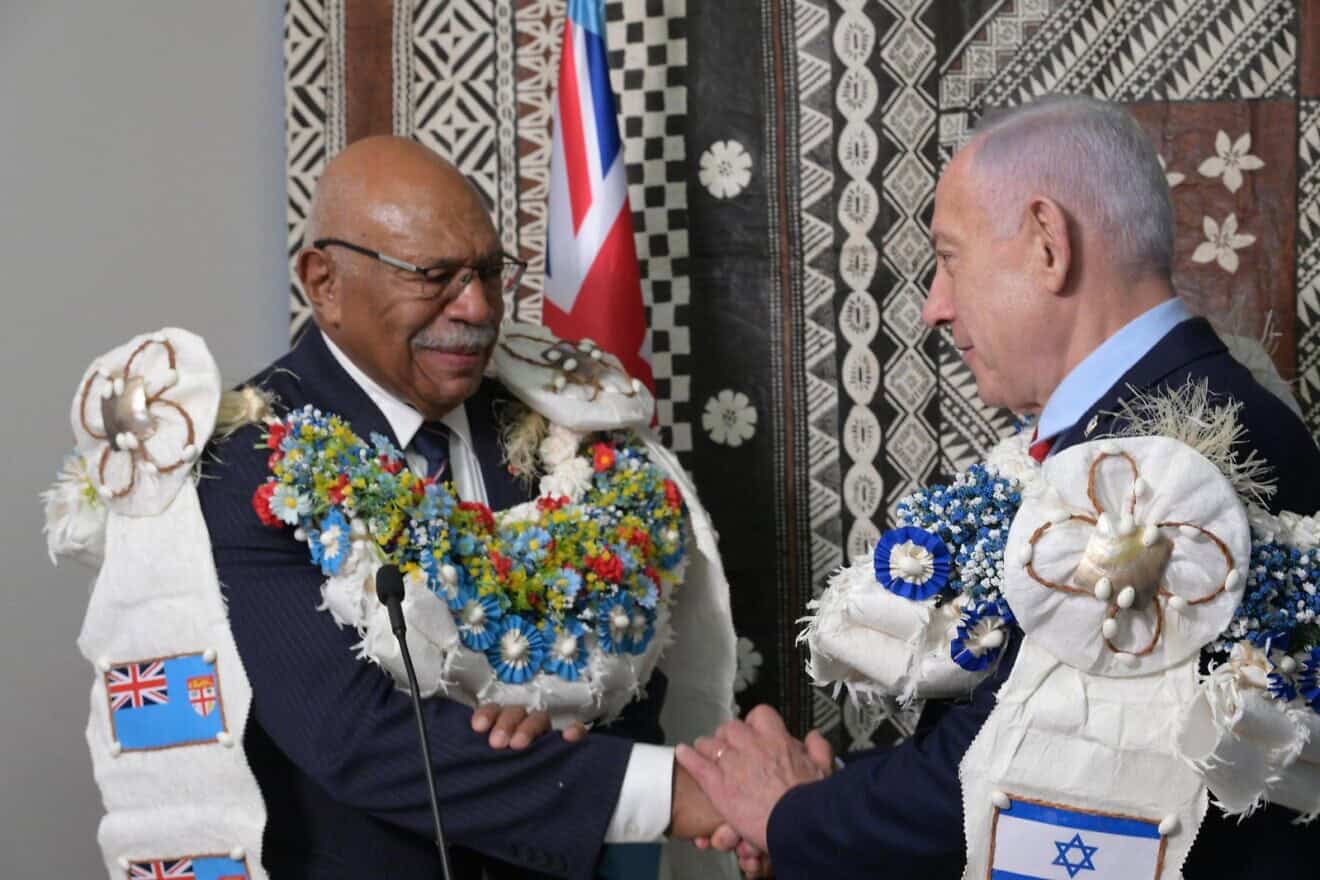
The South Pacific nation of Fiji is set to open an embassy in Jerusalem later this year, Deputy Prime Minister Viliame Gavoka announced on Wednesday. The decision, approved by Fiji’s Cabinet on Tuesday, marks a significant step in strengthening bilateral ties with Israel.As reported by Etgar Lefkovits of Jewish News Syndicate, September 17. 2025:
“We are absolutely excited about coming to Jerusalem, and we most definitely will be there this year,” Gavoka told JNS in a phone interview. The embassy inauguration, originally planned for last year, was delayed due to the war against Hamas in Gaza.
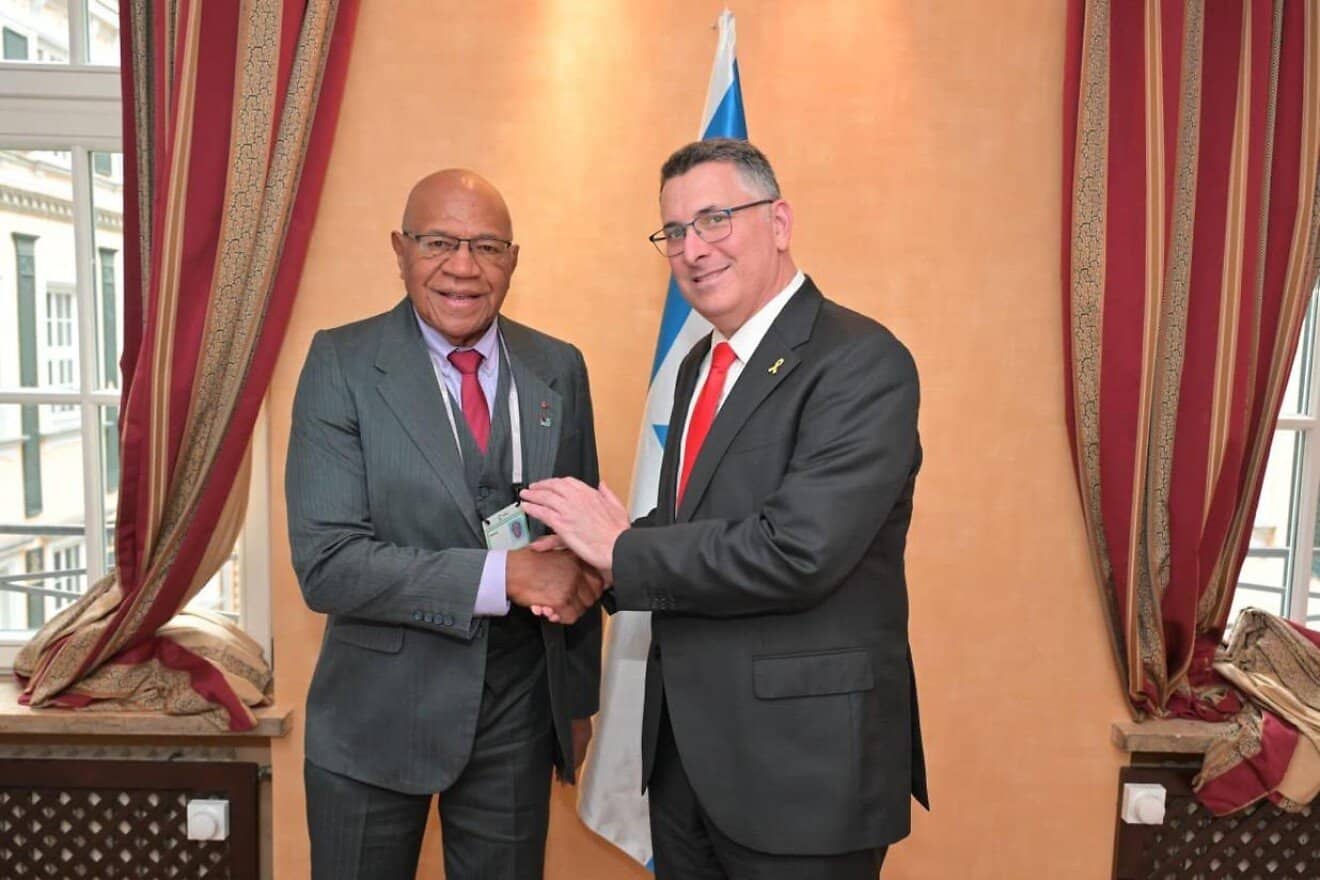
Fiji’s Prime Minister Sitiveni Rabuka reaffirmed the decision during a meeting with Israeli Foreign Minister Gideon Sa’ar on the sidelines of the Munich Security Conference. Sa’ar welcomed the move, tweeting: “I commend the Republic of Fiji’s government for its historic decision to open an embassy in Jerusalem, the eternal capital of the Jewish people.”
With Fiji’s decision, the list of countries with embassies in Jerusalem will grow to seven, joining the United States, Guatemala, Honduras, Kosovo, Paraguay, and Papua New Guinea. Most other countries with diplomatic ties to Israel maintain their embassies in Tel Aviv or its surrounding areas.
The momentum to recognize Jerusalem as Israel’s capital received a major boost in 2018 when then-U.S. President Donald Trump moved the American embassy to the city. Since then, several nations have followed suit, with more expected to announce similar decisions soon.
Fiji’s move not only underscores its support for Israel but also contributes to the growing international acknowledgment of Jerusalem as the heart of the Jewish state.
The South Pacific country of Fiji inaugurated its embassy in Jerusalem on Wednesday, becoming the seventh nation to have its diplomatic mission in the capital of Israel.
”The fact that you have come here and you have put your embassy in Jerusalem, you recognize a truth that everybody should recognize but few governments have done so far: that this has been our capital for 3,000 years since the days of King David,” Israeli Prime Minister Benjamin Netanyahu said at the inauguration ceremony.
“The special bond with your great nation is deeply revered by the people of Fiji,” said its prime minister, Sitiveni Rabuka, who traveled to the Jewish state from halfway around the world with a delegation of his senior government ministers for the inauguration. “The opening of our embassy is a great testament to the enduring connection between our two peoples.”
Rabuka, who took office three years ago, first announced the move in February. He heads a three-party government that includes the right-wing Christian Sodelpa Party, one of whose leaders’ demands was that Fiji open an embassy in Jerusalem.
“You are paving the path of truth,” Israeli Foreign Minister Gideon Sa’ar told the Fijian leader at a reception at the Ministry of Foreign Affairs, expressing disbelief at how other nations around the world still try to deny the Jewish people’s biblical roots to the historic city. “You are a true friend of Israel.”
He added that “Jerusalem is the eternal capital and beating heart of the Jewish people. Today, Fiji lays a stone in its ancient walls.”
Rabuka, who also serves as foreign minister, in turn invited Netanyahu to visit the archipelago in the South Pacific Ocean, northeast of New Zealand and two-thirds of the way from Hawaii to New Zealand.
The move also follows a decades-long campaign by an evangelical organization—the International Christian Embassy in Jerusalem—through its network of churches across the Southern Pacific.
Six countries have their embassies in Israel’s capital: the United States, Guatemala, Honduras, Kosovo, Paraguay and Papua New Guinea.
All other nations that maintain ties with Israel have their embassies in Tel Aviv or its suburbs, due to the political sensitivities of Jerusalem.
U.S. President Donald Trump’s decision to move the American embassy to Jerusalem in May 2018 set the stage for other countries to follow suit. The Hamas-led terrorist attacks in southern Israel on Oct. 7, 2023, and Israel’s ensuing war against the terrorist group based in the Gaza Strip, have temporarily derailed such moves.
As reported by Jewish News Syndicate, December 19, 2025 (links in original):
As reported by Akiva Van Koningsveld of Jewish News Syndicate, August 27, 2025 (links in original):Fiji’s Prime Minister Sitiveni Rabuka (left) and Israeli Foreign Minister Gideon Sa’ar meet in Munich, Germany, on Feb. 15, 2025. Photo by Shlomo Amsalem/GPO.
Israel will open an embassy in the South Pacific island nation of Fiji next year, Foreign Minister Gideon Sa’ar announced on Thursday, saying he informed Fiji’s Prime Minister and Foreign Minister Sitiveni Rabuka of the move during a phone call.
“Fiji is one of Israel’s most consistent supporters, also in the UN arena. In our call today, the PM again said: ‘We will always be with you,’” Sa’ar wrote on X following the call.
Sa’ar said that opening the embassy will deepen relations between the countries, help cultivate their longstanding friendship, and strengthen cooperation in the fields of development, economics, security and more.
“At the same time, Israel’s embassy in Fiji will strengthen Israel’s presence in the entire Pacific region, which is friendly to Israel, and will deepen our ties with other Pacific island nations,” added Sa’ar.
Just spoke with the PM and FM of Fiji @slrabuka, that I met in September during his visit to open Fiji's embassy in Jerusalem.
I informed the PM of my decision to open an Israeli embassy in Fiji in 2026.
Fiji is one of Israel's most consistent supporters, also in the UN arena. In… pic.twitter.com/DJl3LLiRnW
— Gideon Sa'ar | גדעון סער (@gidonsaar) December 18, 2025
Fiji inaugurated its embassy in Jerusalem on Sept. 17, becoming the seventh nation to establish a diplomatic mission in Israel’s capital. Rabuka traveled to the Jewish state with a delegation of senior government ministers for the inauguration ceremony, meeting Sa’ar, Prime Minister Benjamin Netanyahu and other Israeli officials.
In October, Deputy Foreign Minister Sharren Haskel became the first Israeli government official to make a state visit to Fiji and Papua New Guinea.
Israeli Prime Minister Benjamin Netanyahu on Tuesday for the first time publicly recognized the genocide carried out against the Armenians, Assyrians and Greeks by Ottoman Turkey in the early 20th century.As reported by David Isaac of Jewish News Syndicate, November 24, 2025 (bold, links in original):
Asked by conservative podcaster Patrick Bet David why Jerusalem has yet to recognize the Armenian genocide, Netanyahu said, “In fact, I think we have. I think the Knesset passed a resolution to that effect.”
On Aug. 1, 2016, lawmakers of the Knesset Education, Culture and Sports Committee issued a resolution that recognized the Armenian genocide, urging the government to acknowledge it as such formally.
Pressed on why no prime minister has publicly characterized the World War I-era events as genocide, Netanyahu said, “I just did. Here you go.”
A spokesperson for Israel’s Prime Minister’s Office told JNS on Wednesday that it would not be adding to the comments made by Netanyahu.
BREAKING!
Prime Minister @Netanyahu OFFICIALLY recognizes the Armenian, Assyrian & Greek genocide committed by the Ottoman Empire. pic.twitter.com/fLtsr41YRy
— Patrick Bet-David (@patrickbetdavid) August 26, 2025
In 2018, then-Public Security Minister Gilad Erdan urged Netanyahu to recognize the mass murders of 1.5 million Armenians by the Ottoman government as genocide. While Turkey denies the genocide, over 30 countries have officially recognized the 1915-1917 killings as such.
In the past, Jerusalem’s Foreign Ministry assessed that recognition by the Israeli government would likely to lead to the expulsion of embassy staff in Ankara and the recalling of Turkey’s ambassador from Israel.
However, Turkish President Recep Tayyip Erdoğan has become more hostile toward Israel and closer to Hamas since the Palestinian terror organization’s cross-border attack on southern Israel on Oct. 7, 2023.
In March, Erdoğan prayed for the Jewish state’s destruction as he led a prayer service marking the end of Ramadan at a mosque in Istanbul.
“May Allah, for the sake of his name ‘Al-Qahhar,’ destroy and devastate Zionist Israel,” the Islamist Turkish president told attendees. “May we all, witnessing what is happening there [in the Gaza Strip], stay united, strong and resilient as brothers; may Allah keep our unity everlasting.”
Al-Qahhar is one of the names of God in Islam and is often translated from Arabic as “The Conqueror,” “The Vanquisher,” or “The Subduer.”
Last year, the Turkish leader called Netanyahu a “vampire who feeds on blood,” while urging Muslims worldwide to take up arms against Israel.
Erdoğan also told Newsweek that Palestinian terrorists from Gaza were “simply defending their homes, streets and homeland” when they murdered some 1,200 people, primarily civilians, on Oct. 7.
In July 2024, Erdoğan openly threatened to invade the Jewish state. “We must be very strong so that Israel can’t do these things to Palestine. Just as we entered Karabakh, just as we entered Libya, we might do the same to them. There is nothing we cannot do,” he said in a televised address.
Foreign Minister Gideon Sa'ar meets with Paraguay Foreign Minister Rubén Darío Ramírez Lezcano in Asunción, Paraguay, Nov. 24, 2025. Credit: MfA.
Israeli Minister of Foreign Affairs Gideon Sa’ar visited Paraguay on Monday, where he signed a Memorandum of Understanding on security cooperation.
“Paraguay is developing major defense capabilities. Israel’s defense industry has experience and capabilities that we want to share with you,” said Sa’ar during a press conference with Paraguay’s Foreign Minister Rubén Ramírez Lezcano.
In honor of the visit, the South American nation held a special session of both houses of Congress.
Sa’ar also met with Paraguay’s President Santiago Peña, whom he described as “one of the most impressive leaders on the international stage today.”
He thanked Peña for moving his country’s embassy to Jerusalem—a promise made by his predecessor in 2018—and for designating Iran’s Islamic Revolutionary Guards Corps (IRGC) a terrorist organization as well as the so-called “political” wings of Hamas and Hezbollah.
Sa’ar, with an Israeli economic delegation in tow, noted that Paraguay boasts a “strong and growing” economy with projected economic growth for 2025 at 5.3%.
“In 2023, bilateral trade between Israel and Paraguay stood at $133 million. In 2024, it grew to over 212 million. 2025 is not yet over. It has already surpassed last year’s numbers,” he said.
“Israelis love Paraguayan meat,” he said. A huge proportion of Paraguay’s exports to Israel is meat.
“My visit today is an expression of our belief in Paraguay’s bright future,” he said. “We already trade in technological and agricultural equipment. We want to deepen our cooperation in water technologies, advanced agriculture, cyber, renewable energy and more.”
Honored to meet the President of Paraguay @SantiPenap in Asunción.
We discussed ways to strengthen bilateral and economic ties as well as the situation in the Middle East and Latin America.
I detailed our economic delegation that accompanied me and we discussed the MOU on… pic.twitter.com/6i4g86zq7d
— Gideon Sa'ar | גדעון סער (@gidonsaar) November 24, 2025
‘One of Israel’s greatest friends’
Sa’ar spoke of Israel’s targeted killing on Sunday of Hezbollah’s chief of staff, saying: “The world is a better place today without Ali Tabatabai.”
The United States had a $5 million bounty on Tabatabai’s head. The Hamas commander led terror attacks against Israel and had recently directed efforts to rebuild Hezbollah’s terror army, Sa’ar said.
“Over the past year, since the ceasefire, Hezbollah has been working to rearm after the heavy blows it suffered from Israel in 2024,” he said.
Sunday’s IDF operation and its previous ones against Hezbollah didn’t violate Lebanon’s sovereignty because “the very existence of Hezbollah” as the most powerful armed force in Lebanon is a violation of Lebanese sovereignty.
“As long as Hezbollah is not disarmed, Lebanon will remain de facto under Iranian occupation,” the foreign minister added.
Sa’ar called on the Lebanese government to implement its decision to dismantle Hezbollah’s arsenal. So far, it has only made minor inroads, he said. “In fact, Hezbollah is rearming more than it is disarming.”
Sa’ar thanked his hosts for their warm welcome in Paraguay’s capital of Asunción, describing Paraguay as “one of Israel’s greatest friends.”
He stated that the ties between the two countries are based on shared values: “Paraguay’s foreign policy has a clear moral dimension: You voted for the establishment of the State of Israel at the United Nations in 1947. You were among the very first countries to recognize Israel.”
As reported by Pesach Benson of Tazpit Press Service, November 26, 2025:
Argentine President Javier Milei (left) greets Israeli Foreign Minister Gideon Sa'ar in Buenos Aires on Nov. 25, 2025. (Photo by Argentine President's Office/TPS-IL)
Israel and Argentina deepened economic cooperation as Foreign Minister Gideon Sa’ar led a high-level business delegation to Buenos Aires, announcing new trade initiatives and signing agreements aimed at expanding bilateral commerce.
Saar and Argentine Foreign Minister Pablo Quirno opened a business forum on Monday with representatives from Israel’s security, cyber, renewable energy, technology, and science sectors.
The event followed a similar forum held a day earlier in Paraguay as part of Saar’s regional tour.
During the Argentina visit, the Manufacturers Association of Israel signed a memorandum of understanding with the Argentine Industrial Union (UIA), laying what both sides described as the groundwork for expanded industrial collaboration.
The agreement aims to promote joint ventures, facilitate market access, and strengthen diplomatic ties.
Saar highlighted Argentina’s shifting economic direction under President Javier Milei, saying the changes create new space for partnership.
“President Milei is re-paving Argentina’s path to greatness,” he said.
“Over the years, failed leaderships have repeatedly damaged the Argentine economy. But today Argentina is on the right track. I believe that when you combine this with Israeli talent and technology and mutual investment opportunities, something significant can happen.”
The foreign minister also announced that Israel will open new economic attaché offices in Buenos Aires in 2026 to support expanding trade activity.
“We want to dramatically increase our investments in Argentina,” Sa’ar explained.
The Israeli trade delegation includes government officials, business leaders, and representatives from the Export Institute and Chamber of Commerce.
The delegation included individuals from the fields of security, cyber, renewable energy, technology, and science and met with their Argentine counterparts to identify areas of cooperation.
“The signing of the memorandum of understanding today is an important step in establishing a long-term business relationship between Israel and Argentina, which is doubly important for strengthening trade with countries that support Israel and have stood by us for the past two years. The innovation and capabilities of Israeli industry will contribute significantly to the development of Argentine industry, while at the same time opening a gateway to a developing market with enormous potential for Israeli companies,” said President of the Israeli Manufacturers Association Dr. Ron Tomer.
On Tuesday, Milei told Sa’ar he intends to open Argentina’s new embassy in Jerusalem in the spring.
The move would make Argentina the eighth country to move its embassy from Tel Aviv to Jerusalem, joining Fiji, the United States, Guatemala, Honduras, Kosovo, Papua New Guinea, and Paraguay.
Milei has been promoting what he calls the “Isaac Accords,” a partnership between Israel and Latin American democracies—particularly Costa Rica, Panama, and Uruguay.
The initiative is modeled after the 2020 Abraham Accords that normalized relations between Israel, the United Arab Emirates, Bahrain, Morocco, and subsequently Sudan, brokered by Donald Trump’s first presidential administration. As reported by Joshua Marks of Jewish News Syndicate, November 26, 2025 (links in original):
Israel is expecting Argentine President Javier Milei to visit in April or May to open his country’s embassy in Jerusalem, Israeli Foreign Minister Gideon Sa’ar said on Tuesday.
“We hope to have the president in April or May to open Argentina’s embassy in Jerusalem, D.C.—David’s Capital,” said Sa’ar in an address to the Israel-Argentina Business Forum alongside Argentina’s Foreign Minister Pablo Quirno, who he noted will be visiting the Jewish state in February.
Milei announced during his visit to Israel in June that Argentina will open its embassy in Jerusalem in 2026.
Israel’s top diplomat also announced that Israel will be opening an Economic Attaché Office in Buenos Aires next year, stressing that Israel wants to “dramatically increase” investments in Argentina.
Sa’ar brought a business and economic delegation from Israel to accompany him on his diplomatic and trade trip to Paraguay and Argentina, which aimed at expanding economic cooperation between the countries, according to the Israeli Foreign Ministry.
The group included senior government officials, company representatives and key economic leaders.
In the address, Sa’ar also said that Jerusalem is keen to boost imports from Argentina, and updated the announcement on establishing direct flights between the two countries made during Milei’s visit in June.
“A government decision was approved. And we are now moving to the operational stage. I hope and I believe it won’t be long and this will boost our economic relations,” said Sa’ar.
Calling it an honor to meet “one of the world’s boldest and most impressive leaders” in Buenos Aires Tuesday during his diplomatic visit to the ally, Sa’ar said in a post on X that the two had discussed their “extraordinary bilateral relations.”
The President of Argentina @JMilei is one of the world's boldest and most impressive leaders.
It was a true honor to meet him in Buenos Aires and discuss our extraordinary bilateral relations.
The economic delegation accompanying me today is an expression of our belief in the… pic.twitter.com/qHWJsB6Rf0
— Gideon Sa'ar | גדעון סער (@gidonsaar) November 25, 2025
”The economic delegation accompanying me today is an expression of our belief in the president’s bold economic reforms and Argentina’s economy under his leadership,” said the Israeli foreign minister.
He concluded his comments by thanking Milei for “standing consistently by Israel on the international stage. Argentina, under President Milei’s leadership, is one of Israel’s best friends in the world. We’ll continue strengthening these extraordinary relations!”
Sa’ar also met on Tuesday with Quirno, thanking him for his “warm hospitality” in the Argentine capital and saying that they “had great discussions on our extraordinary bilateral relations,” including working on the direct flights between Tel Aviv and Buenos Aires.
I thank Argentina's FM @pabloquirno for his warm hospitality in Buenos Aires.
We had great discussions on our extraordinary bilateral relations.
Our economic delegation here today is an expression of our belief in President Milei's economic reforms. We're working to bring… pic.twitter.com/2KEwTZeaty
— Gideon Sa'ar | גדעון סער (@gidonsaar) November 25, 2025
Sa’ar also met with Martin Menem, president of Argentina’s Chamber of Deputies, and members of the chamber.
“I told them that we want to be partners in Argentina’s success story, under President Milei’s leadership. We discussed parliamentary exchanges and deepening our economic cooperation,” he said.
Sa’ar laid a wreath at a monument honoring Argentine national hero General Jose de San Martin in Buenos Aires on Tuesday.
He was scheduled to attend memorial events for victims of the 1992 Israeli Embassy bombing and 1994 AMIA Jewish center attack, both attributed to Hezbollah and which killed 29 and 85 people, respectively.
Sa’ar will also speak at the 90th anniversary celebration of DAIA, Argentina’s umbrella organization for Jewish institutions.
Israel’s top diplomat visited Paraguay on Monday, where he signed a memorandum of understanding on security cooperation.
“Paraguay is developing major defense capabilities. Israel’s defense industry has experience and capabilities that we want to share with you,” said Sa’ar during a press conference with Paraguay’s Foreign Minister Rubén Ramírez Lezcano.
In honor of the visit, the South American nation held a special session of both houses of Congress in the capital Asunción, playing Israel’s national anthem, “Hatikva,” in Sa’ar’s presence.
Sa’ar also met with Paraguay’s President Santiago Peña, whom he described as “one of the most impressive leaders on the international stage today.”
He thanked Peña for moving his country’s embassy to Jerusalem—a promise first made by his predecessor in 2018—and for designating Iran’s Islamic Revolutionary Guards Corps (IRGC) as a terrorist organization, as well as the so‑called “political” wings of Hamas and Hezbollah.
As reported by Shula Rosen of United With Israel, December 8, 2025:
A Hungarian flag flies next to the country's new embassy branch in Jerusalem on December 1, 2025. (Lazar Berman/The Times of Israel)
A sign denoting Hungary’s new embassy branch in Jerusalem, December 1, 2025.(Lazar Berman/The Times of Israel)
Hungary is expanding its diplomatic footprint in Jerusalem, raising its flag over a new embassy branch that will begin operating early next year, according to information provided to The Times of Israel.
The site, known as the Hungarian Academy, will function as both a cultural center and an official extension of Hungary’s mission in Israel.
The new branch is located in the Talbiyeh neighborhood, next to the YMCA, and will open once its director arrives in January.
It will join two other European representations already clustered in the same area: the Czech Republic’s embassy branch, which faces the new Hungarian site, and Slovakia’s branch a short distance away.
Hungary’s primary embassy will remain in Tel Aviv, though Budapest has maintained a separate trade office in Jerusalem since 2019.
Only seven countries currently host full embassies in Jerusalem — the US, Guatemala, Honduras, Kosovo, Papua New Guinea, Paraguay and Fiji — making Hungary the first European Union member to open a diplomatic branch in the capital following the US decision in 2017 under President Donald Trump.
The step had been on the table for years but was slowed by the Hamas-led terrorist attacks of October 7, 2023. The move comes as ties between Budapest and Jerusalem remain warm. During Prime Minister Benjamin Netanyahu’s wartime trip to Hungary last year — his first visit to Europe since the ICC issued arrest warrants for him and then-defense minister Yoav Gallant — Hungarian Prime Minister Viktor Orbán reiterated that his government would not enforce the order.
Hungary’s Honorary Consul in Israel described the current state of relations as exceptionally close.
“The relations between Hungary and Israel are excellent, and develop every day to an additional level,” David Wiernik told JNS at the time of Netanyahu’s visit, adding that “The recognition of Jerusalem as Israel’s capital, and the move to Jerusalem, is very important to the State of Israel and is much more than a symbolic move.”
Hungary has signaled repeatedly that it views itself as one of Israel’s strongest partners within the EU, a position reflected in its latest diplomatic expansion.
As reported by Jewish News Syndicate, December 9, 2025:
Israeli Economic Minister Nir Barkat and Costa Rica's minister of foreign trade, Manuel Tovar Rivera, at the signing ceremony for a free trade agreement in Jerusalem, Dec. 8, 2025. Credit: Israeli Ministry of Foreign Affairs.
Israel and Costa Rica have taken a “leap forward” in bilateral relations with the signing of a free trade agreement encompassing goods, services and investments, Jerusalem’s Foreign Ministry announced on Monday.
The announcement came just days after Costa Rica’s minister of foreign trade, Manuel Tovar Rivera, announced that San José would be opening an office for innovation in trade and investment in Jerusalem in 2026.
Monday’s ceremony was also attended by Israeli Foreign Minister Gideon Sa’ar and Minister of Economy and Industry Nir Barkat, the MFA stated.
The agreement will immediately eliminate over 90% of tariffs, granting broad access for Israeli industrial and agricultural products to the Costa Rican market. The Jewish state will also reduce import costs on a wide range of goods, from food and medical equipment to industrial tools.
“This agreement opens significant new avenues for both Costa Rica and Israel,” Tovar Rivera said, adding: “It enhances access to high-quality Costa Rican goods and services while creating a mutually beneficial platform for collaboration in high-technology industries, premium agribusiness and specialized services.
Barkat hailed Costa Rica as “a natural trade partner for Israel—an advanced OECD country with a deep commitment to free and open trade.”
He added, “The free trade agreement is expected to strengthen the growth trend in Israeli exports, deepen business cooperation, and help reduce the cost of living in Israel by lowering the costs of imports.”
The announcement that Costa Rica would be opening a trade office was made on Saturday night, in the wake of a meeting in Jerusalem between Sa’ar and Tovar Rivera, and followed similar moves by other countries that do not maintain their embassy in the Jewish state’s capital.
Costa Rica formerly maintained its embassy in Jerusalem but relocated it to Tel Aviv in 2006 due to international pressure and efforts to further its relations with the Arab world.
As reported by Nathan Guttman of All Israel News, December 10, 2025:
FM Sa'ar and Bolivian FM Fernando Armayo at the signing ceremony event in Washington DC, signing a Joint Communiqué to renew diplomatic relations between the two countries. December 10, 2025 Photo: Ministry of Foreign Affairs by Shmulik Almani
Israel and Bolivia have renewed full diplomatic relations. Israeli Foreign Minister Gideon Sa’ar and his Bolivian counterpart, Fernando Aramayo, signed an agreement to re-establish relations at a ceremony in Washington, D.C., on Tuesday.
Bolivian Minister of Finance and Economy José Gabriel Espinoza also attended the event.
“The countries look forward to the renewal of ties between their peoples, including a rediscovery of the spiritual and cultural heritage of the Holy Land by Bolivians, and Israelis returning to explore the breathtaking natural beauty, rich cultural traditions, and warm hospitality of Bolivia,” the agreement stated.
“Aware of the historic opportunity to join in a shared effort to promote a more stable, secure, and prosperous future for the benefit of both peoples, they aspire to renew full diplomatic relations, friendship, and cooperation.”
Sa’ar said in his speech, “Today, we are ending a long and unnecessary chapter of disconnect between our two nations. We agreed to restore full diplomatic relations and to appoint ambassadors in the near future. We exchanged mutual invitations for government and private-sector representatives. We will visit each other’s countries to explore new opportunities for cooperation. The two foreign ministries will maintain an ongoing dialogue on bilateral, regional, and multilateral issues."
"Our goal is to strengthen and deepen relations in many areas. Following the cancellation of the visa requirement for Israeli tourists, I know that thousands of Israelis will once again visit this beautiful country every year. This will help strengthen the human bridge between our peoples.”
“Strengthening relations with Latin American countries is a central objective of my foreign policy for 2026,” Sa’ar declared. “I have just visited Argentina and Paraguay. Renewing and rebuilding relations with Bolivia is a cornerstone of this policy. Today, Israel and Bolivia are opening a new chapter in their relations.”
Earlier this week, Sa’ar announced the renewal of relations, stating that Bolivia has undergone a “political change” in the recent elections that made the move possible.
“I spoke with the new president the day after he was elected. Before him, there was a very left-wing government, connected to Iran and other problematic actors, which, among other things, severed relations with the State of Israel. Tomorrow I will meet their foreign minister and we will sign the renewal of relations,” he said.
In the October elections, Rodrigo Paz Pereira, a center-right candidate, won the election after receiving about 54.5% of the vote in the second round against Jorge Quiroga. For the first time in 20 years, a candidate from the left, part of former president Evo Morales’ Movement for Socialism party, did not make it to the decisive round.
Diplomatic relations between Israel and Bolivia were established in the 1950s, but have been severed several times due to Bolivia’s opposition to Israeli military operations. The most recent break occurred at the start of the Gaza War in October 2023, after relations had previously been restored in 2019.
“I see the beginning of change in Latin America. There is a trend of change, and it is very important for the United States, but also for Israel, because those who are friends of the United States are usually friends of Israel as well,” Sa’ar added.
“We will invest major efforts in establishing and deepening our relations in South America. I will also add that the Minister of Foreign Trade of Costa Rica is currently in Jerusalem to sign a free trade agreement. They will open an innovation office with diplomatic status in Jerusalem. Ecuador has done the same. Argentina will open an embassy in Israel this coming spring. Paraguay did so a year ago. There is much progress in many fields, and we will continue this.”
As reported by Jewish News Syndicate, December 17, 2025:
Hebrew University President Tamir Sheafer (left), Ecuador’s Ambassador to Israel María Cristina Cevallos Calero and Israeli Foreign Minister Gideon Sa’ar. Photo by David Salem/Israel’s Ministry of Foreign Affairs.
Ecuador on Tuesday inaugurated its Center for Innovation and Entrepreneurship in Israel, located within the Hebrew University of Jerusalem Entrepreneurship and Innovation Center in Givat Ram.
The ceremony was attended by Israel’s Foreign Minister Gideon Sa’ar, Ecuadorian Ambassador to Israel María Cristina Cevallos Calero, Hebrew University President Professor Tamir Sheafer and Professor Amnon Dekel, executive director of ASPER-HUJI Innovate.
The new center is slated to spearhead collaborations in entrepreneurship and innovation across government, industry and academia, with student training workshops, the Hebrew University said in a statement.
Ecuador’s President Daniel Noboa visited Israel in May to cement the establishment of the Ecuadorian Center.
Cevallos Calero issued a statement, thanking the university and saying: “Innovation is a catalyst. It opens doors that did not exist before, transforms challenges into opportunities, and empowers societies to reimagine the boundaries of what is possible. When supported by a strong entrepreneurial spirit, innovation becomes a powerful engine of economic growth, social development and long-term resilience.”
Sheafer praised the collaboration, saying, “The establishment of the [Ecuadorian Center] sends a clear message: Innovation is a shared language between our societies. … [This initiative] strengthens our role as a global university and demonstrates how close cooperation between academia, industry and government in Ecuador and Israel can translate into real impact on the ground.”
Dekel was quoted as saying that the Ecuadorian Center “is not envisioned as a one-way relationship. We look forward to deep collaboration between researchers, students and innovators from both Ecuador and Israel.”
On Dec. 1, Sa’ar expressed hope that the new center for Innovation and Entrepreneurship would in time lead to the transfer of the Ecuadoran embassy to Israel’s capital.
Speaking at the opening of the center, Sa’ar noted that Guatemala, Paraguay and Honduras had moved their embassies to Jerusalem, and that Argentinean President Javier Milei had announced he would do so in the spring. The opening of Ecuador’s innovation center was “another milestone” in the right direction, Sa’ar added.
Ecuador opened an embassy in Jerusalem in the 1950s, but moved it to Tel Aviv in 1980. As reported by Etgar Lefkovits of Jewish News Syndicate, December 16, 2025 (links in original):
Czech Foreign Minister Petr Macinka voices support for moving the embassy to Jerusalem at a Sunday night Chanukah candle lighting ceremony in central Prague, Dec. 14, 2025. Credit: Courtesy of Chabad-Lubavitch.
The Czech Republic is expected to move its embassy in Israel to Jerusalem next year, an official said Tuesday, further strengthening close bilateral ties dating back to the founding of the Jewish state.
The show of support from one of Israel’s closest European allies comes as Argentina plans to open its embassy in Jerusalem in the spring, and as Hungary is also weighing a similar move.
The Czech Republic’s new foreign minister publicly voiced support on Sunday for relocating the country’s embassy from Tel Aviv to the Israeli capital.
“I personally am very much looking forward… to be present when one of the symbols of solidarity becomes the fact that the Czech Republic finally moves its embassy to Jerusalem,” Czech Foreign Minister Petr Macinka said at a Chanukah event in central Prague organized by the Chabad movement. “It should have been there a long time ago.”
JNS has learned that Czech Prime Minister Andrej Babiš is expected to visit Israel early next year and could announce the embassy move during the trip.
Three days after the Hamas-led Oct. 7, 2023, massacre, the Czech Parliament unanimously adopted a resolution urging the government to move the country’s embassy to Jerusalem in a bipartisan show of support. The previous government, however, never implemented the move, even as it backed Israel in international legal forums and on the diplomatic stage during the war against Hamas in Gaza.
“We see the Czech Republic as one of our greatest friends in Europe and in the world, and as a natural partner,” Israeli Foreign Minister Gideon Sa’ar wrote on X Tuesday evening after a congratulatory phone call with his Czech counterpart upon assuming office. “We appreciate the Czech Republic’s close friendship and consistent support, especially throughout the war.”
The historic connection between the two small countries dates back to Israel’s 1948 War of Independence, when Czechoslovakia alone supplied vital arms to the fledgling Jewish state.
Seven countries currently maintain embassies in Israel’s capital: the United States, Guatemala, Honduras, Kosovo, Paraguay, Papua New Guinea and Fiji.
U.S. President Donald Trump’s decision to move the American embassy to Jerusalem during his first term set the stage for other countries to follow suit.
As reported by The Algemeiner and World Israel News Staff, December 27, 2025:
Israel on Friday became the first country to officially recognize the Republic of Somaliland as an independent and sovereign state, in a move expected to reshape regional power dynamics as the two governments expand political, security, and economic cooperation.
Israeli Prime Minister Benjamin Netanyahu, alongside Foreign Minister Gideon Saar and Somaliland President Muse Bihi Abdi, signed a joint declaration of mutual recognition, formally establishing full diplomatic relations between the two sides.
Somaliland is an unrecognized state in the Horn of Africa, situated on the southern coast of the Gulf of Aden and bordered by Djibouti to the northwest, Ethiopia to the south and west, and Somalia to the east.
In a statement on the newly signed agreement, Netanyahu praised Abdi for “his leadership and commitment to promoting stability and peace” in the region, while also inviting him to make an official visit to Israel.
“The State of Israel plans to immediately expand its relations with the Republic of Somaliland through extensive cooperation in the fields of agriculture, health, technology, and economy,” the Israeli leader wrote in a post on X.
With the newly signed agreement, Saar said plans would also move forward for the appointment of ambassadors and the opening of embassies.
“We will work together to promote the relations between our countries and nations, regional stability, and economic prosperity,” the top Israeli diplomat said.
Despite Netanyahu’s announcement, Trump made clear that the United States would not immediately follow Israel’s move to recognize the African nation, remarking, “Does anyone know what Somaliland is, really?”
The foreign ministers of Somalia, Egypt, Turkey, and Djibouti also denounced Israel’s decision to recognize Somaliland, Somalia’s breakaway region, Egypt announced on Friday.
According to a statement from Egypt’s Foreign Ministry issued after a phone call among the four foreign ministers, “The ministers affirmed their total rejection and condemnation of Israel’s recognition of the Somaliland region, stressing their full support for the unity, sovereignty and territorial integrity of Somalia.”
The U.N. Security Council will convene an emergency session on Monday afternoon following Israel’s controversial recognition of Somaliland.
For his part, Abdi announced that Somaliland would also join the Abraham Accords, calling it a “step toward regional and global peace” and affirming his government’s commitment to building partnerships, boosting mutual prosperity, and promoting stability across the Middle East and Africa.
Although no other country has formally recognized Somaliland, several — including the United Kingdom, Ethiopia, Turkey, the United Arab Emirates, Denmark, Kenya, and Taiwan — have maintained liaison offices, allowing them to engage diplomatically and conduct trade and consular activities without full formal recognition.
Israel’s move has provoked outrage among several regional powers, with the foreign ministers of Somalia, Egypt, Turkey, and Djibouti condemning its recognition of Somaliland as undermining Somalia’s sovereignty and territorial integrity.
According to experts, the growing Israel-Somaliland partnership could be a “game changer” for Israel, boosting the Jewish state’s ability to counter the Yemen-based Houthi terrorist group while offering strategic and geographic advantages amid shifting regional power dynamics.
Unlike most other states in the region, Somaliland has relative security, regular elections, and a degree of political stability — qualities that make it a valuable partner for international allies and a key player in regional cooperation.
Last month, the Institute for National Security Studies (INSS), a prominent Israeli think tank, released a new report arguing that Somaliland’s strategic position along the Red Sea, its closeness to Houthi-controlled areas in Yemen, and its willingness to work with pro-Western states make it a key ally for Israel, benefiting both sides amid rising regional volatility.
“Somaliland’s significance lies in its geostrategic location and in its willingness — as a stable, moderate, and reliable state in a volatile region — to work closely with Western countries,” the INSS report said.
“Somaliland’s territory could serve as a forward base for multiple missions: intelligence monitoring of the Houthis and their armament efforts; logistical support for Yemen’s legitimate government in its war against them; and a platform for direct operations against the Houthis,” it continued.
This strategic partnership comes at a critical moment, as Israeli and US officials have warned of rising Islamist terrorist threats across Sub-Saharan Africa, placing the region at the forefront of global concern over jihadist activity.
As reported by Matthew Shea and Lahav Harkov of Jewish Insider, December 29, 2025 (links in original):
Israel’s recognition of Somaliland has stirred unease across parts of the Arab and Muslim world, challenging regional power dynamics as Jerusalem moves first in a strategically sensitive corner of the Horn of Africa.
Israel became the first country to recognize Somaliland on Friday, 34 years after the democratic, pro-Western state declared its independence from Somalia. The move puts Israel at odds with a number of Arab and Muslim nations including Qatar, a major power broker in Somalia and a key mediator in regional conflicts, at a time when Washington is seeking to expand the Abraham Accords and manage competing Arab interests in the Horn of Africa.
Israeli Prime Minister Benjamin Netanyahu and Foreign Minister Gideon Sa’ar signed a document establishing full diplomatic relations between the countries which affirms that they have “shared values, strategic interests and the spirit of mutual respect that binds our peoples,” and that “this relationship will contribute to advancing peace, stability, and prosperity in the Horn of Africa, the Middle East and beyond.”
The Prime Minister’s Office described the recognition as being “in the spirit of the Abraham Accords, signed at the initiative of President [Donald] Trump,” and Netanyahu told Somaliland President Abdirahman Mohamed Abdullahi that he would “communicate to President Trump your willingness and desire to join the Abraham Accords.”
However, Trump has largely dismissed the idea that the U.S. would follow suit at this juncture, saying it is “under study.”
“Does anyone know what Somaliland is, really?” Trump told The New York Post.
Somalia is a member of the Arab League, joining in 1974 as the first non-Arab nation due to strong cultural, religious and historical ties. Somalia also holds a crucial geopolitical location for global trade.
Somalia has served as a proxy battleground for broader regional power struggles, with influential Middle Eastern states supporting different factions and projects.
Qatar has sought to establish itself as a dominant influence and key mediator in Somalia, supporting the central government and pouring resources into the country for over a decade.
On Saturday, the Qatari government released a statement rejecting “the announcement of mutual recognition between the Israeli occupation authorities and the Somaliland region,” and “any attempts aimed at establishing or imposing parallel entities that would undermine the unity of Somalia.” Doha also said in the statement that it would be “more appropriate” for the Jewish state to “recognize the State of Palestine.”
Qatar also released a statement with 21 Arab and Muslim countries — including Jordan, Egypt, Iran, Pakistan and “the State of Palestine” — “stressing their unequivocal rejection of Israel’s recognition of the Somaliland region.”
Recognizing Somaliland is also a way of positioning Israel against Qatar, as Foundation for Defense of Democracies CEO Mark Dubowitz pointed out: “Want another reason to back Somaliland? Qatar — the Muslim Brotherhood’s biggest bankroller — backs the other side.”
An official Somaliland X account posted that “Doha has no business meddling in Somaliland’s affairs while bankrolling Muslim Brotherhood proxies to prop up Mogadishu’s failed regime. … Foreign powers parroting Mogadishu’s line can shove their hypocrisy. Our future is ours—not dictated by Qatar’s Islamist agenda.”
Egypt and Turkey, both close allies of Somalia, have also condemned Israel’s recognition of Somaliland. Saudi Arabia, a country that holds a more moderate posture toward the Jewish state but has expressed reticence to establish relations with it, is reportedly less likely to normalize ties with Israel due to the recognition of Somaliland, according to Israel’s Channel 12.
The UAE, in contrast, has nurtured a close relationship with Somaliland, a factor that may have encouraged Jerusalem in its move to recognize the African state, though Abu Dhabi has not yet recognized Somaliland, Asher Lubotzky, a researcher at the Israel-Africa Relations Institute, wrote.
Sa’ar said in a statement that relations between the two countries grew over the course of the last year, and that they will exchange ambassadors and open embassies. Israel and Somaliland also plan to cooperate in the fields of agriculture, health and technology, the Prime Minister’s Office stated.
Israeli and Somaliland officials have reportedly held secret meetings over the course of the past several months. The president of Somaliland has met with Netanyahu and Sa’ar, as well as Israeli Defense Minister Israel Katz, and Netanyahu invited him for another visit.
In a paper published by Tel Aviv University’s Institute for National Security Studies a month before Israel recognized Somaliland, Lubotzky wrote that the African state’s “security importance for Israel has become even more pronounced over the past two years.”
Somaliland is strategically located for Israel, across the Gulf of Aden from parts of Yemen controlled by the Houthis, who have frequently attacked Israel over the past two years.
“Somaliland could serve as a forward base for a range of missions,” Lubotzky wrote, “intelligence collection and monitoring of the Houthis and their military buildup; logistical support for Yemen’s internationally recognized government in its war against the Houthis; and direct operations, from offensive actions to intercepting Houthi attacks at sea or by UAVs.”
The growing number of countries recognizing a Palestinian state also may have curbed Israel’s former reluctance to recognize secessionist states out of a concern that it could set a precedent for supporting Palestinian statehood, Lubotzky noted.
Earlier this year, reports indicated that Somaliland could be open to accepting Palestinian refugees from Gaza, as President Donald Trump expressed support for relocation from the enclave to enable reconstruction efforts. Recent reports suggest this idea has resurfaced and may factor into any emerging arrangement between Israel and Somaliland.
The European Union released a statement that it “reaffirms the importance of respecting the unity, the sovereignty and the territorial integrity of the Federal Republic of Somalia … This is key for the peace and stability of the entire Horn of Africa region.”
The African Union has declined to formally recognize Somaliland in the past, citing concerns that doing so could set a precedent for secession across the continent and trigger wider instability.
As reported by All Israel News, December 31, 2025 (links in original):
Turkish President Recep Tayyip Erdoğan said Israel’s decision to formally recognize the Republic of Somaliland is illegitimate and unacceptable, adding that Israel risks destabilizing the Horn of Africa with the move.
“Preserving the unity and integrity of Somalia in all circumstances holds special importance in our view. Israel’s decision to recognize Somaliland is illegitimate and utterly unacceptable to us,” Erdoğan said on Tuesday during a press conference alongside Somali President Hassan Sheikh Mohamud.
NOW - Turkey's Erdogan condemns Israel's recognition of Somaliland as an illegal act aimed at destabilizing "the entire Horn of Africa." pic.twitter.com/3TCW085JZQ
— Disclose.tv (@disclosetv) December 30, 2025
Mohamud arrived in Istanbul on Tuesday for talks expected to focus on bilateral ties, military cooperation, economic development, and political unity following Israel’s recognition of Somaliland.
Erdoğan also took the opportunity to lash out at Israeli Prime Minister Benjamin Netanyahu, which he has done repeatedly over the past few years, but especially since the start of the Oct. 7 Gaza War.
Turkish President Recep Tayyip Erdoğan accused Israel of seeking to destabilize the Horn of Africa, saying: “The Netanyahu government, which bears the blood of 71,000 of our Palestinian brothers and sisters on its hands, following its relentless and aggressive assaults on Gaza, Lebanon, Yemen, Iran, Qatar, and Syria, is now actively attempting to destabilize the entire Horn of Africa region.”
The Israeli announcement of recognition sparked condemnation, mostly from the Muslim and Arab states in the region, led by the Arab League, along with Turkey, Djibouti and several European countries.
Turkey appears largely concerned that Israel’s move could undermine the regional military superiority it has gradually built under Erdoğan.
At the same time, the Turkish leader announced that his country will send an energy drilling ship to the waters off the coast of Somalia in 2026 as part of the strategic cooperation between the countries, which some analysts have called a form of colonialism.
The new Othman coloniser led by Sultan Erdogan has transformed Somalia into the only modern day colony in Africa. From seizing their resources, airports, ports, and blue economy to enslaving Somalians in their own country, Ankara wanted to swallow Somaliland alongside Somalia.… https://t.co/egKi4PnZ0t pic.twitter.com/6u30whSBUB
— HE. AMB. HAGGOOGANE (@HAGGOOGANE) December 30, 2025
The Israeli think tank, the Institute for National Security Studies (INSS), compared Somalia to a “client state” of Turkey, writing, “For Turkey, Somalia is a central ally in the Red Sea region, approaching the status of a client state.”
Under Erdoğan, Turkey has invested significantly in Somalia, providing military training, infrastructure support – often carried out by Turkish companies – along with economic and humanitarian aid. Ankara has also established its largest embassy in the world in the capital, Mogadishu.
In 2017, Turkey established "Camp TURKSOM," aimed at training the Somali army to be a national defense force. The base operates within a framework of military cooperation established in 2010.
The Turkey-Somali military cooperation expanded significantly in 2024, with the signing of a 10-year defense and economic cooperation agreement that included the construction of a joint naval base, which will include training by Turkish forces.
While the Israeli government said recognition of Somaliland is intended to strengthen regional stability, deepen the fight against terrorism, and expand political, security, and civilian cooperation with like-minded regional partners, analysts say the move is also aimed at countering efforts by Turkey – along with Qatar – to isolate Israel from countries in the region.
Israel's recognition of Somaliland came shortly after Jerusalem hosted Greece and Cyprus for a joint summit last week. Following the summit, Erdoğan warned the three countries against any actions that would violate Turkey’s “rights” in the region.
In recent years, Israel, Greece and Cyprus have gradually increased cooperation and discussed the possibility of forming a joint military force to combat Turkish aggression.
Tuesday, 30 December 2025
100 years ago--Harry F. Ward condemns Western attitude toward China
The following article was published more than eight months after the death of Sun Yat-sen, founder of the Republic of China and Premier of its governing party, the Kuomintang (KMT). China was ruled by the collective leadership of the Central Executive Committee of the Kuomintang from March 1925-May 1926, before Chiang Kai-shek won a power struggle for party and national leadership in 1927. As published in the Montreal Gazette, November 30, 1925 (bold in original):
TRY DOING RIGHT INSTEAD OF GOODWhen I saw the name Harry F. Ward, I immediately recognized him as the man who devised the Methodist Social Creed, which served as the basis for the Social Creed of the National Council of Churches, and a man who was identified under oath by several witnesses before the U.S. House of Representatives Committee on Un-American Activities in the 1950s as a member of the Communist Party. For more on Harry F. Ward, see the books Collectivism in the Churches (1958) by Edgar C. Bundy and Outside the Gate (1967) by Carl McIntire.
-------
Pharisaical Attitude of Western World to China Condemned by Prof. H.F. Ward
------
MILITARISTIC SPIRIT
-------
Chinese Students Coming Over to Study Arts of War, Is Warning Given
-------- "If people of today do not understand what is now going on in and concerning China, there is likely to be a much heavier price paid for that ignorance in the future than was paid for the ignorance of this generation concerning affairs in Europe."
This was the message brought to the members of the People's Forum and the public last night by Professor Harry F. Ward, of New York. Professor Ward is a student of international politics, who has devoted a great deal of time to study of the problems of the East, from where he has recently returned...
...The address...[was] broadcast by the Northern Electric Company.
Professor Ward's contention was that China, always a pacifist sort of nation, was being driven to the use of force through not being given fair play by the Western powers.
"What is passing in China at the present moment," he said, "is that the young China is trained in the knowledge of the West as well as in the ancient law of the East and is writing her declaration of independence. That is likely to be an even more significant event for history than the writing of a similar declaration upon this continent during last century.
"Consider what it means that the oldest and largest unit of the world's population, people with the largest potentialities because of the vigor of their racial stock and long experience of life, should form for the first time a nation in the Western sense of the word."
Always a national unit because of her culture, customs, philosophy and practice of life, China now becomes organized and throws into the conflicting issues of the competing nationalities of the world, the weight of her demand and the strength of her power.
Professor Ward said the great question is whether she can attain her demand by her ancient method of reason or whether she will have to resort to force.
They have always been pacifists, he said: their pacifism being the result of their practical experience of life. China has lived by an appeal to reason, not that there have not been wars, but war has never been the recognized way to do things. A proof of it he cited was the soldier, in past days, having been the lowest member of the social scale.
STUDYING WAR.
Now all that is changing. The Chinese people think they will not get what they want unless they have behind them the military and naval forces that Western countries have. Chinese students are not now coming over to the United States to study in the colleges, but are coming to get to know something of military matters.
"The West may move forces she cannot overcome," he remarked. "Yet the question is very much deeper than that. If the West cannot gi
ve China justice it means that the West is destroying a spiritual contribution which China has made to the world, a contribution which, joined with similar elements in the West, might prove to be the salvation of mankind." Outlining the forces and causes at work which are bringing about this change, Professor Ward stated that firstly there have been treaties which have been secured by force which have deprived China of very vital parts of her territory.
Another grudge the Chinese have is that at a tariff convention at Peking the Western powers did things they had no right to do. The duty on cigarettes, oil and steel going into China was fixed at 5 per cent. Chinese silk coming into the United States is charged 54 per cent.
Professor Ward condemned the settlement system which is in vogue in China. By this system, foreign residents are able to live there without being under the control of Chinese law, a situation which exists nowhere else in the world.
Certainly the Chinese residents in these cities have benefitted by the sanitary methods and municipal administration introduced, but these things count as nothing beside the basic fact of foreign control and he contended no further good of any sort to China or the West can be attained by perpetuating this foreign control.
The speake gave several instances of the misuse of this system, one of which is in Shanghai where, in the foreign settlement, 80 per cent of the taxes are paid by Chinese residents and they are not pemitted a vote or a voice in the administration. Moreover, there is more money spent on the upkeep of two parks, to which the Chinese with few exceptions, are admitted than there is spent on the education of the Chinese children.
Professor Ward designated the Western attitude to China as an unjustifiable assumption of superiority.
"If the West would stop trying to do good and try to do right for a few years, it would be more advantageous," he said. "We have almost come to the attitude of the Pharisee."100 years ago--an anti-Christian spirit in China
The following article was published three months after the death of Sun Yat-sen, founder of the Republic of China and Premier of its governing party, the Kuomintang (KMT). China was ruled by the collective leadership of the Central Executive Committee of the Kuomintang from March 1925-May 1926, before Chiang Kai-shek won a power struggle for party and national leadership in 1927. The arguments used against Christianity in China in the 1920s sound like those used by the Communists in later years. As reported in an anonymous article pubished in the Border Cities Star, June 26, 1925 (bold in original):
Strong Anti-Christian Spirit is Big Factor in Chinese Situation
------------------------------
China's dislikes of foreigners is a stream gathered from many sources, but perhaps the most important of them is the strong anti-Christian spirit in China today. Naturally the Chinese have identified the foreign religion with the foreigners who first brought it to them and continued to preach it, and they believe it has been used as a cloak to conceal imperialist designs. But the sentiment is even wider than that. It is more than anti-Christian. it is anti-religious in the same sense as is the spirit among the leading Bolshevists. Probably the challenge of Christianity was responsible for the growth of anti-religious feeling. The Chinese were forced to think seriously upon religious matters because the question was pressed upon them by missionaries, and as a result, many of them came to the conclusion that all religious ideas were mistaken and immoral. The anit-religious movement is being carried on by the anti-Christian Federation among other similar agencies. They spring up like mushrooms and are manned largely by young and educated Chinese, many of them having been first trained in Christian missions.
AROUSED THE STUDENTS
Writing in The Nation, Stanley High, who is connected with the American Methodist Board of Foreign Missions, says that it is doubtful if even in Soviet Russia the literature of anti-religion has grown more rapidly in the past two years than it has in China. It was given impetus in 1922 by the eleventh conference of the World's Student Christian Federation in Pekin. Many distinguished representatives of organized Christianity addressed the student delegates from some 40 nations on the significance of the Christian world program. The publicity given the proceedings and some of the remarks of the speakers aroused hostility of the anti-religionists in Pekin, and shortly after the conference concluded there came into being the Student Anti-Religious movement, sponsored by several professors of national reputation. The anti-imperialist movement which began among students last year aided the drive against Christianity, and was followed by the Anti-Christian Federation organized by a prominent student leader who had been discharged from Shanghai College. He founded the paper, The Awakened, which is having a tremendous sale.
RELIGION IS OPPOSED
At the inauguration of the Federation a manifesto was issued declaring the purpose of the movement to "actively oppose Christianity and its various expressions with a nationalistic consciousness and a scientific spirit." In regard to religion in general opposition is declared because:
It is conservative and traditional and it does not make for intellectual progress.
It encourages denominational prejudice and hatred. It does not make for the unity and harmony of the human race.
It develops superstition (sic) in superhuman beings.
It does not make for scientific enlightenment.
It cultivates the attitude of dependence as over against the development of self-realization.
It suppresses individuality. It does not develop the human instincts.
CHRISTIANITY AND THE CHURCH
In regard to Christianity in particular, this opposition is especially pronounced because:
It is one form of religion.
It contains dogmatisms and monopolizes good teachings of the past.
It is the forerunner of imperialism and foreign exploitation.
Further, in regard to the Christian Church, hostility is expressed because:
It always allies itself with the influential class.
It draws people into its membership by material temptations.
It is alrady composed of eaters on religion (sic) as well as hypocrites.
It interferes with the civil and military affairs of China and other nations.
It sometimes meddles with personal affairs.
It substitutes God for gods and develops a servile attitude toward foreigners.
NOT OPPOSED TO CHRIST
Mr. High says that the movement is not fundamentally a result of Bolshevist propaganda though that has not been lacking. While foreign prestige in China has declined as a result of the war, the spirit of nationalism has constantly grown. It is believed that Western influence is the chief obstacle to a rediscovery of the basis of China's ancient civilization which is the aim of the young nationalists. It is particularly felt, says Mr. High, that Christian missionaries are too conservative to aid in China's progress. The books which are most reverenced in missionary circles are said to be of no interest whatever to many of the outstanding students. Ibsen, Kropotkin and Marx are mores esteemed even than Confucius, and they are at the centre of the intellectual ferment among the leading young Chinese. At the annual meeting of the National Federation of Provincial Educational Associations further anti-foreign sentiment was shown because education is being maintained in China by foreigners. This is held to kill the nationalistic spirit, and is an interference with the educational rights of a free people. Mr. High concludes by observing that though there is widespread hostility toward many Christian organizations there is very little hostility toward the person or teachings of Jesus Christ. He thinks it is possible that when the history of this period of western ascendancy is written, it may be recorded that its greatest achievement was not the advance of the organizations of Christianity, but the restoration of the person of Christ to the Orient.Saturday, 6 December 2025
100 years ago--Canadian Anglican minister warns against lack of interest in Bible study
It might seem incredible to modern readers, but well into the 20th century, not only did newspapers weekly publish the text of sermons at major churches, but there were Anglican ministers who actually believed the Bible. As reported in the Winnipeg Evening Tribune, December 7, 1925 (bold in original):
Present Generation Too Unconcerned About Bible Study, Pastor DeclaresTo get an idea of how much the Anglican Church of Canada has changed over the last century, see also my posts:
-----------------
Rev. H.D. Martin Deplores Absence of Teaching in Schools
--------------
Following its long established custom of giving its readers each week a sermon from a Winnipeg pulpit, A Tribune reporter, yesterday visited St. George's Church, Crescentwood, and reported the sermon of Rev. H.D. Martin, the pastor.
-----------
Rev. Henry D. Martin, in a sermon [at St. George's] Church, Crescentwood, deplored the fact that the Bible was not taught in the schools. Mr. Martin told his congregation that they had a smaller appreciation of the Bible than its enemies.
Thee was far too little study of the Bible in this generation. If he asked some of them how often they read it he knew what their answer would be. And yet the Bible was the one book they needed at all times, he said.
Outlining briefly the contents of the Bible, he explained that in the Old Testament there was found the literature of an ancient people occupying a distinctive position in their age and in the history of the world. In the New Testament literature they found the story of a movement which centred in a person.
The object of the movement was to promote faith in that person, and through that faith to work a revolution in the world.
Law and Prophecy
In the Old Testament they had the law which comprised religious, moral and social sanctions which had built up the ancient Jewish people. They had also the prophets, which included the history of the captivity and restoration of the Jewish people. The prophetic utterances, said Mr. Martin, were unique, directing the mind of the people and shaping their destiny.
Then there were the writings, in which were included the Psalms, the greatest book of devotion in the world.
In the New Testament, there was a close connection with the Old. There was also a difference. Saint Augustine had expressed it by saying that the New Testament was latent in the Old, and that the Old Testament was patent in the New.
The prophets had forecast the Person of which the New Testament bore witness. He was the Mediator of the new covenant, a unique character, a personality who arrested their attention and won their affection. His words and works, and life was sketched briefly, but His death was described in detail.
Man's Thought Is Changed
His coming brought the possibility of an enlargement of the people of God. It was to be all-inclusive, embracing the whole of mankind. The result of His presence was a decided change in the thought of men. "We realize that faith in this Man, who calls Himself the Son of God and the Son of Man, brings about a regenerative influence in the lives of men who give themeselves to Him, and that this influence spreads to the uttermost parts of the earth," he said.
This faith was a new fact, a new power by which men became sons of God, children of the family of the almighty Father.
The prophetic book with which the Bible closed pictured the time when all the kingdmos of the world would be the kingdoms of God and His Christ, said Mr. Martin.
The study of the Bible would give them the secret of life. It would place in their hands the key of all history. It would provide them with a revelation of God to His children.
Helps Daily Life
"Perhaps the most wonderful thing about the Bible is that it helps us live our common life. Apart from its revelation of God, and its human interest, and practical teaching, it is a curiously 'homey' book. It enters intimately into the ways of life. It always helps us when we go to it for help.
"It has taken the intelligence of the greatest men of the centuries to understand it. Yet the simplest and most unintelligent can take up the Bible and read therein words that bring life to them.
Mr. Martin paid tribute to the character building value of the book, stating that great men testified to the influence on the minds and lives. In the great crises of life there flashed across the memory some words of scripture, he said.
The Bible had been the mother of good literature. It had made English literature. It had provided some nations with the only literature they possessed.
All this was not a mere accident. The Bible was not a collection of myths, stories and legends. It "was the word of God."
"It is a rock that can never be moved. It is a book that enables men to be at one with God; to hold communion and fellowship with God; to enter into the life of God. It teaches them the brotherhood of mankind, and prepares them foer the life that is to come."
Baptists, Anglicans and Pentecostals team up to host Emergent speaker and writer Peter Rollins (February 26, 2009)
Calgary parish votes to leave the Anglican Church of Canada and join the Roman Catholic Church (December 6, 2010)
Anglican Church of Canada mulls open communion (March 9, 2011)
Dissident Anglican congregations lose their properties when the Supreme Court of Canada declines to hear their case (June 18, 2011)
Another dissident congregation leaves the Anglican Church of Canada (July 5, 2011)
Lutheran pastor assumes important Anglican post in Canada (February 5, 2012)
Canadian Anglican priest returns to the pulpit after serving time in prison for indecent assault--and then resigns in the wake of negative publicity (February 3, 2012)
More Canadian Anglicans break away to join the Roman Catholic Church (May 16, 2012)
50 years ago: Anglican Church of Canada adopts new Book of Common Prayer (August 22, 2012)
Aboriginal bishops in Anglican Church of Canada invoke "colonial occupation" in opposition to same-sex marriage (March 10, 2016)
Anglican Church of Canada votes in favour of sodomite and lesbian marriage--after changing the vote count (July 13, 2016)
40 years ago: Anglican Church of Canada ordains its first female priests (November 30, 2016)
90 years ago: Guy Fawkes Day in Toronto (November 5, 2017)
50 years ago: Anglican Church of Canada abandons its opposition to abortion (December 18, 2017)
An Anglican Church of Canada priest who's an example of a pagan disguised as a Christian (February 28, 2018)
50 years ago: Canadian Anglican traditionalists oppose union with United Church of Canada (June 21, 2019)
Statement from Anglican Church of Canada Primate-elect shows the church to be beyond the possibility of satire (July 27, 2019)
Anglican Church of Canada General Synod votes overwhelmingly to remove prayer for the conversion of the Jews from the Book of Common Prayer (August 7, 2019)
Anglican Church of Canada will review its governance structure in order to remove those who stand in the way of the alphabet pervert agenda (August 22, 2019)
Anglican Church of Canada General Synod votes to endorse Chrislamic A Common Word Between Us and You (December 22, 2019)
Anglican Church of Canada will be dead by 2040, according to its own report (December 22, 2019)
100 years ago--Canadian Anglicans envision new social order (September 30, 2023)
An Anglican "church" in Winnipeg hosts an alphabet pervert "reimagination" of Handel's Messiah (December 22, 2023)
50 years ago--the Anglican Church of Canada votes to ordain women to the priesthood (June 18, 2025)
The Anglican Church of Canada is repurposing its buildings because it can no longer fill them (June 22, 2025)Monday, 1 December 2025
100 years ago--Winston Churchill blasts socialism and Communism
Mister, we could use a man like Winston Churchill again. As reported on the front page of the Montreal Gazette, November 30, 1925:
CHURCHILL LASHES BRITISH SOCIALISM
-----------------------------------------------
Summed Up Results of Marx' Teaching in Tunbridge Wells Speech
-------------------------------------------------
(Special Cable to the New York Times and Montreal Gazette.)
London. Nov. 29--Socialists and Communists received a merciless tongue-lashing Saturday from Chancellor of the Exchequer Winston Churchill--who, by the way, is 51 today.
Speaking at Tunbridge Wells, he said:
"The Socialist in his folly and the Communist in his malice would undermine and fatally wreck the pillars of our society. They wish to go as fast as possible along the same road, but the Communist thinks he can smash his way by violence and the Socialist believes he can do it by humbug. The theories of that remarkable German, Karl Marx, if put into practice, would finally and fatally destroy the liberty and prosperity of these islands and, whether our ruin is achieved by a violent blow or by administration in subtle doses of slow poison, is only a secondary matter. Britain would be laid low and the only question at the post-mortem would be: 'Did she fall or was she pushed?'
"The Socialist tries to lead us to disaster by foolish words and the Communist by violent deeds. We must show ourselves equally capable of meeting and beating them, whether it is a matter of words or deeds.
Churchill derided the Socialist claims of seeking to place life on a nobler plane, and commented on the foreign nature of Socialist minds. "Even their dreary gospel," he said, "comes from Germany and Russia. British Socialists are well known to be the dullest in the world. They have merely gulped down what Karl Marx and Lenin handed over to them." Churchill warned against the "dark power of Moscow" and said: "There we have what was never known before--a band of cosmopolitan conspirators gathered from the underworld of the great cities of Europe and America, in despotic possession of what was once the mighty and famous Empire of Russia. These men are ceaseless in their endeavors to spread revolution throughout every land. There is no country more the object of malignity than this island home of ours, which has so long preserved democratic freedom with order and responsibility in all classes."Saturday, 29 November 2025
Reform Judaism, like liberal "Christianity," is a movement in decline
Numerous items on the decline into irrelevancy and eventual extinction of liberal churches can be found on this blog under the tags of "Liberalism" and "Apostasy." The same appears to be true for Reform Judaism, which, like liberal "Christianity," seems to be social and political liberalism covered with a thin veneer of religion. As reported by Ayala Or-El of Ynet News, November 22, 2025:
Reform Judaism in the United States is confronting years of declining membership, shrinking attendance and mounting financial pressures, prompting many synagogues to repurpose space and rethink how they engage congregants.See also my posts:
Across the country, Reform congregations report dwindling dues income as sanctuaries sit half empty. Unused rooms are increasingly being leased for activities ranging from knitting circles and art workshops to lectures, polling centers and musical or theater performances. Leaders say the rentals help keep buildings open but also symbolize a shift in how synagogues function as community centers.
The trend reflects broader changes in American Jewish life. While the Orthodox community continues to grow and attract young families, both Reform and Conservative congregations report steady drops in membership and lower turnout at religious services. Demographic shifts, evolving expectations among younger Jews and new approaches to community life are reshaping institutions that once operated on longstanding models.
Reform synagogues have long grappled with a pattern in which families depart after a child’s bar or bat mitzvah. By contrast, Conservative congregations have largely maintained stable membership numbers, creating a divergence that has led to closures, mergers and significant financial strain for Reform institutions.
One such case occurred two years ago in Woodland Hills, where the long-standing Temple Aliyah merged with nearby Shomrei Torah Synagogue. The combined congregation, now called HaMakom, was created to serve as an inclusive community open to Jews of all backgrounds, levels of observance and gender identities.
Rabbi Jonathan Aaron, who has led Temple Emanuel in Beverly Hills since 1996, said conversations about declining Reform membership are not new. “I grew up in the Reform movement and this is something people talked about 30 years ago and even earlier,” he said. “There is a decline worldwide in the younger generation’s understanding of the importance of belonging to a synagogue and being part of the Jewish community. I think it has less importance today than it once did. At the same time, I also see young people wanting spirituality and seeking depth and meaning.”
Aaron said economic pressures and the COVID-19 pandemic have contributed to the drop in membership. “We didn’t gather for two years and people got used to participating on Zoom,” he said. “There is less focus on Jewish institutions right now. When I was growing up, people belonged to a synagogue to be part of the community. I don’t think people see it the same way today.”
He noted stark differences between Orthodox and Reform synagogue life. “Orthodox Jews depend heavily on their synagogue,” he said. “They pray there three times a day and come every Friday night and Shabbat. In many ways it is the center of their lives, and that is a fundamental difference from how Reform Jews relate to their synagogue.”
Aaron said the perception of obligation is at the heart of the challenge. “Some Reform Jews feel that once their children have had a bar mitzvah, they are done,” he said. “In my view, a 13-year-old is only beginning to understand the beauty of Judaism. That requires ongoing learning and guidance.”
The divide is also visible in attitudes toward worship. Temple of the Arts in Los Angeles holds High Holy Day services in the Saban Theatre, combining traditional prayers with lectures, musical performances and opera. Supporters say the format makes synagogue life more inviting and relevant for young families. Many Orthodox Jews, however, view the approach as a departure from tradition and a dilution of the sanctity of the day. At Temple Emanuel, an early childhood program and a school through 12th grade help sustain long-term involvement. Reform congregations without schools often struggle to retain families and face sharper membership declines.
The long-term drop in participation reflects a broader transformation within American Judaism. As Orthodox communities expand, Reform and Conservative institutions face demographic change, shifting spiritual preferences and younger generations who seek meaning outside traditional frameworks. Many synagogues are adapting through rentals, cultural programming or expanded educational offerings to keep their doors open.
Whether Reform Judaism can stabilize remains uncertain. The movement offers spiritual flexibility and a path for those seeking personal connection to Jewish life outside strict traditional practice. But the lack of long-term commitment and the focus on temporary experiences continue to challenge its institutions. Some Reform Jews may migrate toward Conservative or Orthodox communities if they seek more structure or deeper communal obligations.
For now, Reform Judaism remains a vital force in American Jewish diversity and spiritual innovation. Its future, leaders say, depends on its ability to retain members and offer meaningful experiences that resonate with the next generation.
An example of a dead church morphing into a community centre (January 26, 2014)
An example from Edmonton of a community service centre masquerading as an evangelical church (January 22, 2015)
More examples from Edmonton of community service centres masquerading as churches (December 31, 2015)
Anglican Church of Canada will be dead by 2040, according to its own report (December 22, 2019)
An example from Saskatoon of a community service centre masquerading as a Christian church (March 28, 2016)
100 years ago--Canadian Anglicans envision new social order (September 30, 2023)
The Anglican Church of Canada is repurposing its buildings because it can no longer fill them (June 22, 2025)Subscribe to: Comments (Atom)


